Total Quality Management
(TQM)
Saturday,April1,2017
1
TOTAL QUALITY MANAGEMENT
Total Quality Management
Waqar Jan
CONM 423
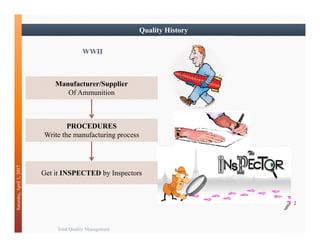
PROCEDURES
Write the manufacturing process
PROCEDURES
Write the manufacturing process
Get it INSPECTED by InspectorsGet it INSPECTED by Inspectors
Manufacturer/Supplier
Of Ammunition
Manufacturer/Supplier
Of Ammunition
Quality History
Saturday,April1,2017
Total Quality Management
2
WWII
Total Quality Management
3
Saturday,April1,2017
Quality is Control & Inspection
“Quality” became associated with “conformance” rather than
“improvement” and “quality assurance” meant that
“conformance is assured” through inspection.
Quality History
Total Quality Management
4
Saturday,April1,2017
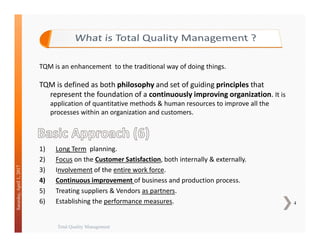
TQM is an enhancement to the traditional way of doing things.
TQM is defined as both philosophy and set of guiding principles that
represent the foundation of a continuously improving organization. It is
application of quantitative methods & human resources to improve all the
processes within an organization and customers.
1) Long Term planning.
2) Focus on the Customer Satisfaction, both internally & externally.
3) Involvement of the entire work force.
4) Continuous improvement of business and production process.
5) Treating suppliers & Vendors as partners.
6) Establishing the performance measures.
Total Quality Management
5
Saturday,April1,2017
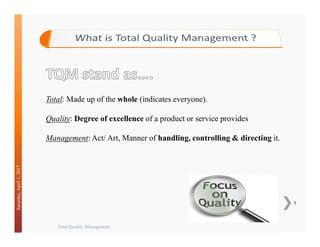
Total: Made up of the whole (indicates everyone).
Quality: Degree of excellence of a product or service provides
Management: Act/ Art, Manner of handling, controlling & directing it.
Total Quality Management
6
Saturday,April1,2017
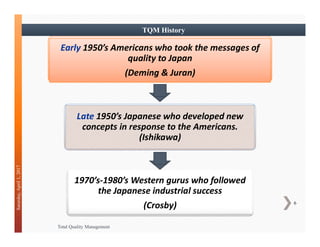
Early 1950’s Americans who took the messages of
quality to Japan
(Deming & Juran)
Late 1950’s Japanese who developed new
concepts in response to the Americans.
(Ishikawa)
1970’s-1980’s Western gurus who followed
the Japanese industrial success
(Crosby)
TQM History
Total Quality Management
7
Saturday,April1,2017
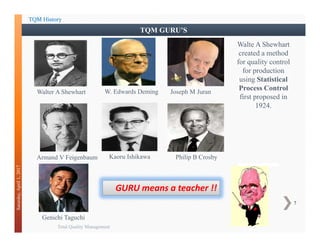
Walter A Shewhart W. Edwards Deming Joseph M Juran
Armand V Feigenbaum Kaoru Ishikawa Philip B Crosby
Genichi Taguchi
TQM History
GURU means a teacher !!
Walte A Shewhart
created a method
for quality control
for production
using Statistical
Process Control
first proposed in
1924.
TQM GURU’S
Total Quality Management
8
Saturday,April1,2017
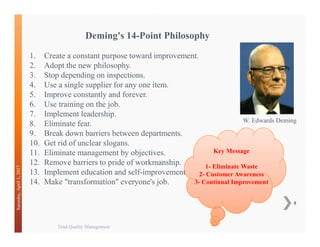
W. Edwards Deming
1. Create a constant purpose toward improvement.
2. Adopt the new philosophy.
3. Stop depending on inspections.
4. Use a single supplier for any one item.
5. Improve constantly and forever.
6. Use training on the job.
7. Implement leadership.
8. Eliminate fear.
9. Break down barriers between departments.
10. Get rid of unclear slogans.
11. Eliminate management by objectives.
12. Remove barriers to pride of workmanship.
13. Implement education and self-improvement.
14. Make "transformation" everyone's job.
Deming's 14-Point Philosophy
Key Message
1- Eliminate Waste
2- Customer Awareness
3- Continual Improvement
Total Quality Management
9
Saturday,April1,2017
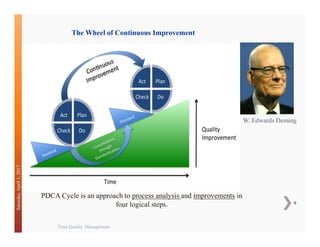
The Wheel of Continuous Improvement
W. Edwards Deming
PDCA Cycle is an approach to process analysis and improvements in
four logical steps.
Total Quality Management
10
Saturday,April1,2017
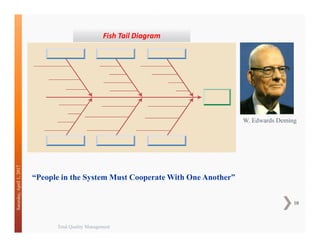
W. Edwards Deming
Fish Tail Diagram
“People in the System Must Cooperate With One Another”
Total Quality Management
11
Saturday,April1,2017
• show us a way of working together for improvement,
• provides tool box for improvement,
• establishes an approach that would break down barriers,
• encourage people to support each other
so TQM are guidelines that…
Total Quality Management
12
Saturday,April1,2017
the questions are ???:
• How to structure an organization with TQM?
• Are there any requirements given in TQM?
• Does it cover all the processes in the organization?
• Can TQM be used for standardization?
• Does TQM lead to ISO certification?
NO
Total Quality Management
13
Saturday,April1,2017
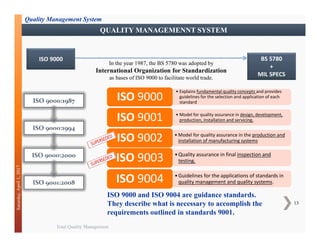
BS 5780
+
MIL SPECS
ISO 9000
In the year 1987, the BS 5780 was adopted by
International Organization for Standardization
as bases of ISO 9000 to facilitate world trade.
• Explains fundamental quality concepts and provides
guidelines for the selection and application of each
standard
ISO 9000
• Model for quality assurance in design, development,
production, installation and servicing.ISO 9001
• Model for quality assurance in the production and
installation of manufacturing systemsISO 9002
•Quality assurance in final inspection and
testing.ISO 9003
•Guidelines for the applications of standards in
quality management and quality systems.ISO 9004
ISO 9000 and ISO 9004 are guidance standards.
They describe what is necessary to accomplish the
requirements outlined in standards 9001.
ISO 9000:1987
ISO 9000:1994
ISO 9000:2000
ISO 9001:2008
Quality Management System
QUALITY MANAGEMENNT SYSTEM
Total Quality Management
14
Saturday,April1,2017
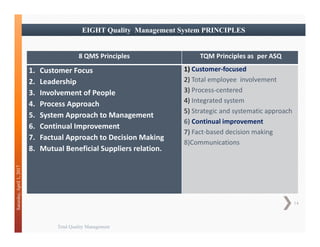
EIGHT Quality Management System PRINCIPLES
8 QMS Principles TQM Principles as per ASQ
1. Customer Focus
2. Leadership
3. Involvement of People
4. Process Approach
5. System Approach to Management
6. Continual Improvement
7. Factual Approach to Decision Making
8. Mutual Beneficial Suppliers relation.
1) Customer-focused
2) Total employee involvement
3) Process-centered
4) Integrated system
5) Strategic and systematic approach
6) Continual improvement
7) Fact-based decision making
8)Communications
Total Quality Management
15
Saturday,April1,2017
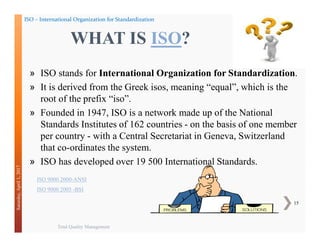
» ISO stands for International Organization for Standardization.
» It is derived from the Greek isos, meaning “equal”, which is the
root of the prefix “iso”.
» Founded in 1947, ISO is a network made up of the National
Standards Institutes of 162 countries - on the basis of one member
per country - with a Central Secretariat in Geneva, Switzerland
that co-ordinates the system.
» ISO has developed over 19 500 International Standards.
WHAT IS ISO?
ISO – International Organization for Standardization
ISO 9000 2000-ANSI
ISO 9000 2005 -BSI
Total Quality Management
16
Saturday,April1,2017
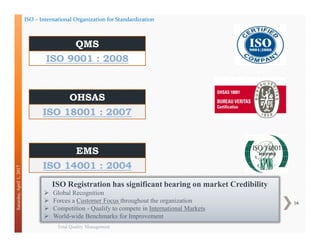
ISO 9001 : 2008
QMS
ISO 18001 : 2007
OHSAS
ISO 14001 : 2004
EMS
ISO – International Organization for Standardization
ISO Registration has significant bearing on market Credibility
 Global Recognition
 Forces a Customer Focus throughout the organization
 Competition - Qualify to compete in International Markets
 World-wide Benchmarks for Improvement
Total Quality Management
17
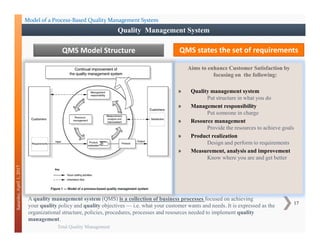
Saturday,April1,2017 Model of a Process-Based Quality Management System
Aims to enhance Customer Satisfaction by
focusing on the following:
» Quality management system
Put structure in what you do
» Management responsibility
Put someone in charge
» Resource management
Provide the resources to achieve goals
» Product realization
Design and perform to requirements
» Measurement, analysis and improvement
Know where you are and get better
A quality management system (QMS) is a collection of business processes focused on achieving
your quality policy and quality objectives — i.e. what your customer wants and needs. It is expressed as the
organizational structure, policies, procedures, processes and resources needed to implement quality
management.
QMS states the set of requirements
Quality Management System
QMS Model Structure
Total Quality Management
18
Saturday,April1,2017
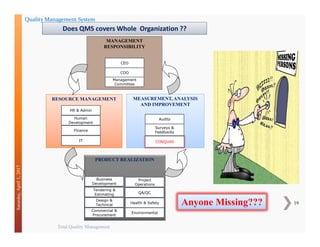
MANAGEMENT RESPONSIBILITY
- Management Commitment
- Policies, Objectives
- Customer Satisfaction
- Management Review
- Quality Planning
- Communication of Responsibility/Authority
RESOURCE MANAGEMENT
- Identification of Resources
- Management Approvals
- Implementation / Provision of Resources
- Competence, Awareness & Training of
Personnel
- Infrastructure & Facilities of Works
PRODUCT REALIZATION
- Project Requirements
- Tender Reviews
- Establishment of Processes/Procedures
- Mobilization of Resources
- Procurement of Materials
- Execution Methods
- Control of Resources and Products (Projects)
- Control of Measuring & Testing Equipment.
MEASUREMENT, ANALYSIS
AND IMPROVEMENT
- Client Feedbacks, Complaints
- Client Satisfaction Surveys
- Information about Competitors
- Process & Product Non conformances
- Internal Audits
- Financial Assessments
- Corrective & Preventive Actions.
Continual Improvement of Quality Management System
Product/Service
[Completed Projects]
Output
Customers
Requirements
Satisfaction
Customers
Input
Model of a Process-Based Quality Management System
MANAGEMENT
RESPONSIBILITY
MEASUREMENT, ANALYSIS
AND IMPROVEMENT
RESOURCE MANAGEMENT
Total Quality Management
19
Saturday,April1,2017
PRODUCT REALIZATION
Does QMS covers Whole Organization ??
Human
Development
Finance
Business
Development
Tendering &
Estimating
Commercial &
Procurement
Project
Operations
CEO
COO
Management
Committee
QA/QC
Quality Management System
IT
Design &
Technical
Health & Safety
Environmental
Anyone Missing???
HR & Admin
CONQUAS
Audits
Surveys &
Feedbacks
Total Quality Management
20
Saturday,April1,2017
Quality
Health & Safety
Environmental
CUSTOMER
SATISFACTION
Total Quality Management
ISO 9001 : 2008
ISO 18001 : 2007
ISO 14001 : 2004
QMS
OHSAS
EMS
INTEGRATED MANAGEMENT SYSTEM
Total Quality Management
21
Saturday,April1,2017
INSPECTION &
TESTINGS
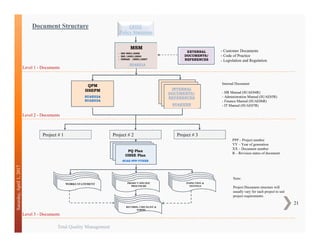
MSM
- ISO 9001:2008
- ISO 14001:2004
- OHSAS - 18001:2007
SUAE01A
EXTERNAL
DOCUMENTS/
REFERENCES
QPM
HSEPM
SUAE02A
SUAE03A
PQ Plan
OHSE Plan
SUAE-PPP-YYXXR
Internal Document
- HR Manual (SUAE04R)
- Administration Manual (SUAE05R)
- Finance Manual (SUAE06R)
- IT Manual (SUAE07R)
PPP – Project number
YY – Year of generation
XX – Document number
R – Revision status of document
- Customer Documents
- Code of Practice
- Legislation and Regulation
INTERNAL
DOCUMENTS/
REFERENCES
SUAEXXR
Project # 1
EXTERNAL
DOCUMENTS/
REFERENCES
QHSE
Policy Statement
Project # 2 Project # 3
WORKS STATEMENT
RECORDS, CHECKLIST &
FORMS
PROJECT SPECIFIC
PROCEDURE
Note:
Project Document structure will
usually vary for each project to suit
project requirements.
Document Structure
Level 1 - Documents
Level 2 - Documents
Level 3 - Documents
Total Quality Management
22
Saturday,April1,2017
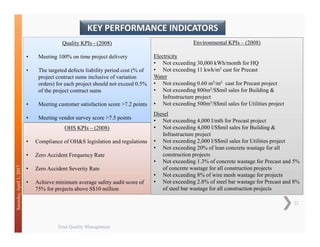
Quality KPIs - (2008)
• Meeting 100% on time project delivery
• The targeted defects liability period cost (% of
project contract sums inclusive of variation
orders) for each project should not exceed 0.5%
of the project contract sums
• Meeting customer satisfaction score >7.2 points
• Meeting vendor survey score >7.5 points
KEY PERFORMANCE INDICATORS
OHS KPIs – (2008)
• Compliance of OH&S legislation and regulations
• Zero Accident Frequency Rate
• Zero Accident Severity Rate
• Achieve minimum average safety audit score of
75% for projects above S$10 million
Environmental KPIs – (2008)
Electricity
• Not exceeding 30,000 kWh/month for HQ
• Not exceeding 11 kwh/m3 cast for Precast
Water
• Not exceeding 0.60 m3/m3 cast for Precast project
• Not exceeding 800m3/S$mil sales for Building &
Infrastructure project
• Not exceeding 500m3/S$mil sales for Utilities project
Diesel
• Not exceeding 4,000 l/mth for Precast project
• Not exceeding 4,000 l/S$mil sales for Building &
Infrastructure project
• Not exceeding 2,000 l/S$mil sales for Utilities project
• Not exceeding 20% of lean concrete wastage for all
construction projects
• Not exceeding 1.3% of concrete wastage for Precast and 5%
of concrete wastage for all construction projects
• Not exceeding 8% of wire mesh wastage for projects
• Not exceeding 2.8% of steel bar wastage for Precast and 8%
of steel bar wastage for all construction projects
Total Quality Management
23
Saturday,April1,2017
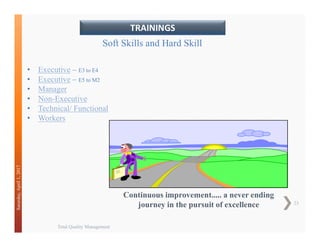
TRAININGS
• Executive – E3 to E4
• Executive – E5 to M2
• Manager
• Non-Executive
• Technical/ Functional
• Workers
H itc h h ik e r s
G u id e to
C o n ti n u o u s
Im p r o v e m e n t
Continuous improvement..... a never ending
journey in the pursuit of excellence
Soft Skills and Hard Skill
Total Quality Management
24
Saturday,April1,2017
TQM fails because:
» Top management sees no reason for change.
» Top management is not concerned for its staff.
» Top management is not committed to the TQM programme.
» The company loses interest in the programme after six months.
» The workforce and the management do not agree on what needs to happen.
» Urgent problems intervene.
» TQM is imposed on the workforce, which does not inwardly accept it.
» No performance measure or targets are set, so progress cannot be measured.
» Processes are not analyzed, systems are weak and procedures are not written down.
Reasons for FAILURE

Iso and tqm

  • 1.
    Total Quality Management (TQM) Saturday,April1,2017 1 TOTALQUALITY MANAGEMENT Total Quality Management Waqar Jan CONM 423
  • 2.
    PROCEDURES Write the manufacturingprocess PROCEDURES Write the manufacturing process Get it INSPECTED by InspectorsGet it INSPECTED by Inspectors Manufacturer/Supplier Of Ammunition Manufacturer/Supplier Of Ammunition Quality History Saturday,April1,2017 Total Quality Management 2 WWII
  • 3.
    Total Quality Management 3 Saturday,April1,2017 Qualityis Control & Inspection “Quality” became associated with “conformance” rather than “improvement” and “quality assurance” meant that “conformance is assured” through inspection. Quality History
  • 4.
    Total Quality Management 4 Saturday,April1,2017 TQMis an enhancement to the traditional way of doing things. TQM is defined as both philosophy and set of guiding principles that represent the foundation of a continuously improving organization. It is application of quantitative methods & human resources to improve all the processes within an organization and customers. 1) Long Term planning. 2) Focus on the Customer Satisfaction, both internally & externally. 3) Involvement of the entire work force. 4) Continuous improvement of business and production process. 5) Treating suppliers & Vendors as partners. 6) Establishing the performance measures.
  • 5.
    Total Quality Management 5 Saturday,April1,2017 Total:Made up of the whole (indicates everyone). Quality: Degree of excellence of a product or service provides Management: Act/ Art, Manner of handling, controlling & directing it.
  • 6.
    Total Quality Management 6 Saturday,April1,2017 Early1950’s Americans who took the messages of quality to Japan (Deming & Juran) Late 1950’s Japanese who developed new concepts in response to the Americans. (Ishikawa) 1970’s-1980’s Western gurus who followed the Japanese industrial success (Crosby) TQM History
  • 7.
    Total Quality Management 7 Saturday,April1,2017 WalterA Shewhart W. Edwards Deming Joseph M Juran Armand V Feigenbaum Kaoru Ishikawa Philip B Crosby Genichi Taguchi TQM History GURU means a teacher !! Walte A Shewhart created a method for quality control for production using Statistical Process Control first proposed in 1924. TQM GURU’S
  • 8.
    Total Quality Management 8 Saturday,April1,2017 W.Edwards Deming 1. Create a constant purpose toward improvement. 2. Adopt the new philosophy. 3. Stop depending on inspections. 4. Use a single supplier for any one item. 5. Improve constantly and forever. 6. Use training on the job. 7. Implement leadership. 8. Eliminate fear. 9. Break down barriers between departments. 10. Get rid of unclear slogans. 11. Eliminate management by objectives. 12. Remove barriers to pride of workmanship. 13. Implement education and self-improvement. 14. Make "transformation" everyone's job. Deming's 14-Point Philosophy Key Message 1- Eliminate Waste 2- Customer Awareness 3- Continual Improvement
  • 9.
    Total Quality Management 9 Saturday,April1,2017 TheWheel of Continuous Improvement W. Edwards Deming PDCA Cycle is an approach to process analysis and improvements in four logical steps.
  • 10.
    Total Quality Management 10 Saturday,April1,2017 W.Edwards Deming Fish Tail Diagram “People in the System Must Cooperate With One Another”
  • 11.
    Total Quality Management 11 Saturday,April1,2017 •show us a way of working together for improvement, • provides tool box for improvement, • establishes an approach that would break down barriers, • encourage people to support each other so TQM are guidelines that…
  • 12.
    Total Quality Management 12 Saturday,April1,2017 thequestions are ???: • How to structure an organization with TQM? • Are there any requirements given in TQM? • Does it cover all the processes in the organization? • Can TQM be used for standardization? • Does TQM lead to ISO certification? NO
  • 13.
    Total Quality Management 13 Saturday,April1,2017 BS5780 + MIL SPECS ISO 9000 In the year 1987, the BS 5780 was adopted by International Organization for Standardization as bases of ISO 9000 to facilitate world trade. • Explains fundamental quality concepts and provides guidelines for the selection and application of each standard ISO 9000 • Model for quality assurance in design, development, production, installation and servicing.ISO 9001 • Model for quality assurance in the production and installation of manufacturing systemsISO 9002 •Quality assurance in final inspection and testing.ISO 9003 •Guidelines for the applications of standards in quality management and quality systems.ISO 9004 ISO 9000 and ISO 9004 are guidance standards. They describe what is necessary to accomplish the requirements outlined in standards 9001. ISO 9000:1987 ISO 9000:1994 ISO 9000:2000 ISO 9001:2008 Quality Management System QUALITY MANAGEMENNT SYSTEM
  • 14.
    Total Quality Management 14 Saturday,April1,2017 EIGHTQuality Management System PRINCIPLES 8 QMS Principles TQM Principles as per ASQ 1. Customer Focus 2. Leadership 3. Involvement of People 4. Process Approach 5. System Approach to Management 6. Continual Improvement 7. Factual Approach to Decision Making 8. Mutual Beneficial Suppliers relation. 1) Customer-focused 2) Total employee involvement 3) Process-centered 4) Integrated system 5) Strategic and systematic approach 6) Continual improvement 7) Fact-based decision making 8)Communications
  • 15.
    Total Quality Management 15 Saturday,April1,2017 »ISO stands for International Organization for Standardization. » It is derived from the Greek isos, meaning “equal”, which is the root of the prefix “iso”. » Founded in 1947, ISO is a network made up of the National Standards Institutes of 162 countries - on the basis of one member per country - with a Central Secretariat in Geneva, Switzerland that co-ordinates the system. » ISO has developed over 19 500 International Standards. WHAT IS ISO? ISO – International Organization for Standardization ISO 9000 2000-ANSI ISO 9000 2005 -BSI
  • 16.
    Total Quality Management 16 Saturday,April1,2017 ISO9001 : 2008 QMS ISO 18001 : 2007 OHSAS ISO 14001 : 2004 EMS ISO – International Organization for Standardization ISO Registration has significant bearing on market Credibility  Global Recognition  Forces a Customer Focus throughout the organization  Competition - Qualify to compete in International Markets  World-wide Benchmarks for Improvement
  • 17.
    Total Quality Management 17 Saturday,April1,2017Model of a Process-Based Quality Management System Aims to enhance Customer Satisfaction by focusing on the following: » Quality management system Put structure in what you do » Management responsibility Put someone in charge » Resource management Provide the resources to achieve goals » Product realization Design and perform to requirements » Measurement, analysis and improvement Know where you are and get better A quality management system (QMS) is a collection of business processes focused on achieving your quality policy and quality objectives — i.e. what your customer wants and needs. It is expressed as the organizational structure, policies, procedures, processes and resources needed to implement quality management. QMS states the set of requirements Quality Management System QMS Model Structure
  • 18.
    Total Quality Management 18 Saturday,April1,2017 MANAGEMENTRESPONSIBILITY - Management Commitment - Policies, Objectives - Customer Satisfaction - Management Review - Quality Planning - Communication of Responsibility/Authority RESOURCE MANAGEMENT - Identification of Resources - Management Approvals - Implementation / Provision of Resources - Competence, Awareness & Training of Personnel - Infrastructure & Facilities of Works PRODUCT REALIZATION - Project Requirements - Tender Reviews - Establishment of Processes/Procedures - Mobilization of Resources - Procurement of Materials - Execution Methods - Control of Resources and Products (Projects) - Control of Measuring & Testing Equipment. MEASUREMENT, ANALYSIS AND IMPROVEMENT - Client Feedbacks, Complaints - Client Satisfaction Surveys - Information about Competitors - Process & Product Non conformances - Internal Audits - Financial Assessments - Corrective & Preventive Actions. Continual Improvement of Quality Management System Product/Service [Completed Projects] Output Customers Requirements Satisfaction Customers Input Model of a Process-Based Quality Management System
  • 19.
    MANAGEMENT RESPONSIBILITY MEASUREMENT, ANALYSIS AND IMPROVEMENT RESOURCEMANAGEMENT Total Quality Management 19 Saturday,April1,2017 PRODUCT REALIZATION Does QMS covers Whole Organization ?? Human Development Finance Business Development Tendering & Estimating Commercial & Procurement Project Operations CEO COO Management Committee QA/QC Quality Management System IT Design & Technical Health & Safety Environmental Anyone Missing??? HR & Admin CONQUAS Audits Surveys & Feedbacks
  • 20.
    Total Quality Management 20 Saturday,April1,2017 Quality Health& Safety Environmental CUSTOMER SATISFACTION Total Quality Management ISO 9001 : 2008 ISO 18001 : 2007 ISO 14001 : 2004 QMS OHSAS EMS INTEGRATED MANAGEMENT SYSTEM
  • 21.
    Total Quality Management 21 Saturday,April1,2017 INSPECTION& TESTINGS MSM - ISO 9001:2008 - ISO 14001:2004 - OHSAS - 18001:2007 SUAE01A EXTERNAL DOCUMENTS/ REFERENCES QPM HSEPM SUAE02A SUAE03A PQ Plan OHSE Plan SUAE-PPP-YYXXR Internal Document - HR Manual (SUAE04R) - Administration Manual (SUAE05R) - Finance Manual (SUAE06R) - IT Manual (SUAE07R) PPP – Project number YY – Year of generation XX – Document number R – Revision status of document - Customer Documents - Code of Practice - Legislation and Regulation INTERNAL DOCUMENTS/ REFERENCES SUAEXXR Project # 1 EXTERNAL DOCUMENTS/ REFERENCES QHSE Policy Statement Project # 2 Project # 3 WORKS STATEMENT RECORDS, CHECKLIST & FORMS PROJECT SPECIFIC PROCEDURE Note: Project Document structure will usually vary for each project to suit project requirements. Document Structure Level 1 - Documents Level 2 - Documents Level 3 - Documents
  • 22.
    Total Quality Management 22 Saturday,April1,2017 QualityKPIs - (2008) • Meeting 100% on time project delivery • The targeted defects liability period cost (% of project contract sums inclusive of variation orders) for each project should not exceed 0.5% of the project contract sums • Meeting customer satisfaction score >7.2 points • Meeting vendor survey score >7.5 points KEY PERFORMANCE INDICATORS OHS KPIs – (2008) • Compliance of OH&S legislation and regulations • Zero Accident Frequency Rate • Zero Accident Severity Rate • Achieve minimum average safety audit score of 75% for projects above S$10 million Environmental KPIs – (2008) Electricity • Not exceeding 30,000 kWh/month for HQ • Not exceeding 11 kwh/m3 cast for Precast Water • Not exceeding 0.60 m3/m3 cast for Precast project • Not exceeding 800m3/S$mil sales for Building & Infrastructure project • Not exceeding 500m3/S$mil sales for Utilities project Diesel • Not exceeding 4,000 l/mth for Precast project • Not exceeding 4,000 l/S$mil sales for Building & Infrastructure project • Not exceeding 2,000 l/S$mil sales for Utilities project • Not exceeding 20% of lean concrete wastage for all construction projects • Not exceeding 1.3% of concrete wastage for Precast and 5% of concrete wastage for all construction projects • Not exceeding 8% of wire mesh wastage for projects • Not exceeding 2.8% of steel bar wastage for Precast and 8% of steel bar wastage for all construction projects
  • 23.
    Total Quality Management 23 Saturday,April1,2017 TRAININGS •Executive – E3 to E4 • Executive – E5 to M2 • Manager • Non-Executive • Technical/ Functional • Workers H itc h h ik e r s G u id e to C o n ti n u o u s Im p r o v e m e n t Continuous improvement..... a never ending journey in the pursuit of excellence Soft Skills and Hard Skill
  • 24.
    Total Quality Management 24 Saturday,April1,2017 TQMfails because: » Top management sees no reason for change. » Top management is not concerned for its staff. » Top management is not committed to the TQM programme. » The company loses interest in the programme after six months. » The workforce and the management do not agree on what needs to happen. » Urgent problems intervene. » TQM is imposed on the workforce, which does not inwardly accept it. » No performance measure or targets are set, so progress cannot be measured. » Processes are not analyzed, systems are weak and procedures are not written down. Reasons for FAILURE