A
Seminar on
Total Quality Control
Presented by:-
Aakash D. Bhongade
132130015
(M. Tech 1st Year)
1
Concepts
2
 What is quality?
Dictionary has many definitions: “Essential characteristic,”
“Superior,” etc.
 Some definitions that are accepted in various organizations:
 “Quality is customer satisfaction,”
 “Quality is Fitness for Use.”
Quality is “fitness for use”
(Joseph Juran)
Quality is “conformance to requirements”
(Philip B. Crosby)
Quality of a product or services is its ability to satisfy the needs and
expectations of the customer
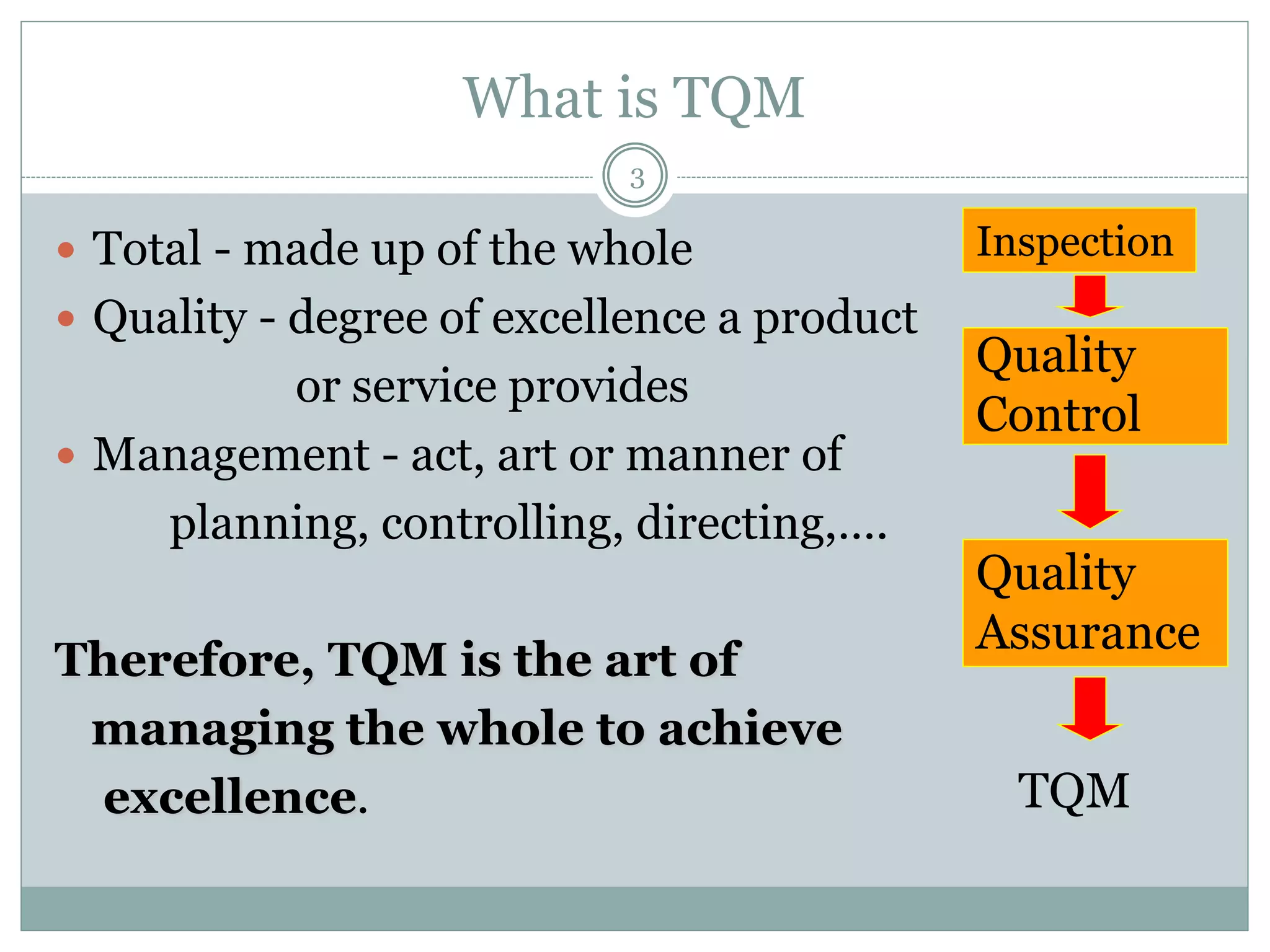
What is TQM
 Total - made up of the whole
 Quality - degree of excellence a product
or service provides
 Management - act, art or manner of
planning, controlling, directing,….
Therefore, TQM is the art of
managing the whole to achieve
excellence.
Inspection
Quality
Control
Quality
Assurance
TQM
3
What does TQM mean?
Total Quality Management means that the
organization's culture is defined by and supports the
constant attainment of customer satisfaction
through an integrated system of tools, techniques,
and training. This involves the continuous
improvement of organizational processes, resulting
in high quality products and services.
Quality
4
Why TQM?
Ford Motor Company had operating losses of $3.3
billion between 1980 and 1982.
Xerox market share dropped from 93% in 1971 to 40%
in 1981.
Attention to quality was seen as a way to combat the
competition.
5
The Three Quality Gurus
 Deming: the best known of the “early” pioneers, is credited
with popularizing quality control in Japan in early
1950s.Today, he is regarded as a national hero in that country
and is the father of the world famous Deming prize for quality.
 JURAN: Juran, like Deming was invited to Japan in 1954 by
the union of Japanese Scientists and engineers.
 Juran defines quality as fitness for use in terms of design,
conformance, availability, safety and field use. He focuses on
top-down management and technical methods rather than
worker pride and satisfaction.
6
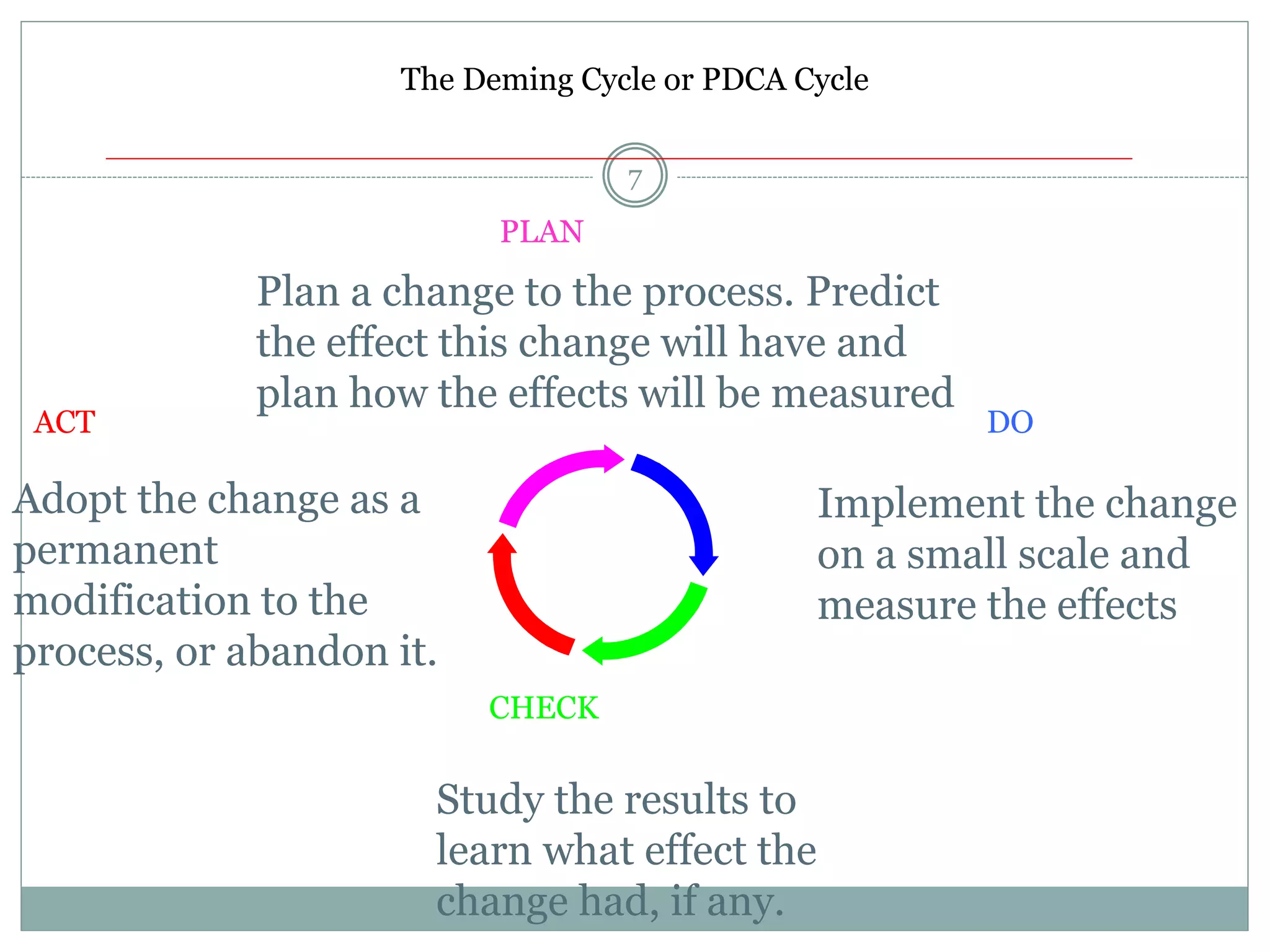
PLAN
CHECK
DOACT
The Deming Cycle or PDCA Cycle
Plan a change to the process. Predict
the effect this change will have and
plan how the effects will be measured
Implement the change
on a small scale and
measure the effects
Adopt the change as a
permanent
modification to the
process, or abandon it.
Study the results to
learn what effect the
change had, if any.
7
Philip Crosby: author of popular book Quality is
Free. His absolutes of quality are:
 Quality is defined as conformance to requirements, not
“goodness”
 The system for achieving quality is prevention, not appraisal.
 The performance standard is zero defects, not “that’s close
enough”
 The measurement of quality is the price of non-conformance,
not indexes.
8
Commonality of Themes of Quality Gurus
 Inspection is never the answer to quality improvement, nor is
“policing”.
 Involvement of leadership and top management is essential to
the necessary culture of commitment to quality.
 A program for quality requires organization-wide efforts and
long term commitment, accompanied by the necessary
investment in training.
 Quality is first and schedules are second.
9
TQM Six Basic Concepts
1. Leadership
2. Customer Satisfaction
3. Employee Involvement
4. Continuous Process Improvement
5. Supplier Partnership
6. Performance Measures
(All these present an excellent way to run
a business)
10
Elements of TQM
 Leadership
Top management vision, planning and support
 Employee involvement
All employees assume responsibility for inspecting the quality of their
work.
 Product/Process Excellence
Involves product design quality and monitoring the process for
continuous improvement.
11
Elements of TQM (cont’d)
 Continuous Improvement
A concept that recognizes that quality improvement is a journey with
no end and that there is a need for continually looking for new
approaches for improving quality.
 Customer Focus (on “Fitness for Use”)
Design quality
Specific characteristics of a product that determine its value in the
marketplace.
Conformance quality
The degree to which a product meets its design specifications.
12
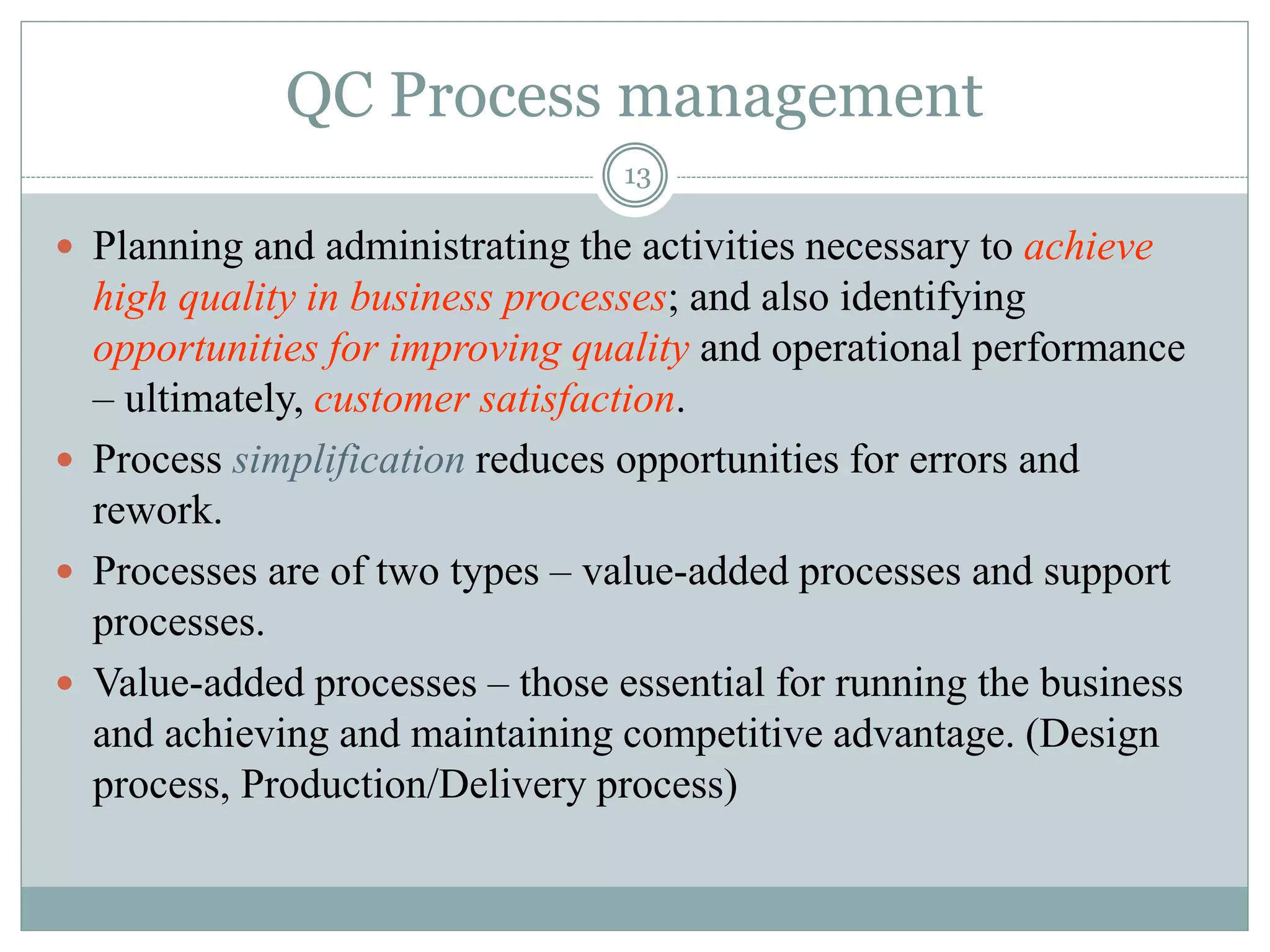
QC Process management
13
 Planning and administrating the activities necessary to achieve
high quality in business processes; and also identifying
opportunities for improving quality and operational performance
– ultimately, customer satisfaction.
 Process simplification reduces opportunities for errors and
rework.
 Processes are of two types – value-added processes and support
processes.
 Value-added processes – those essential for running the business
and achieving and maintaining competitive advantage. (Design
process, Production/Delivery process)
Process management
14
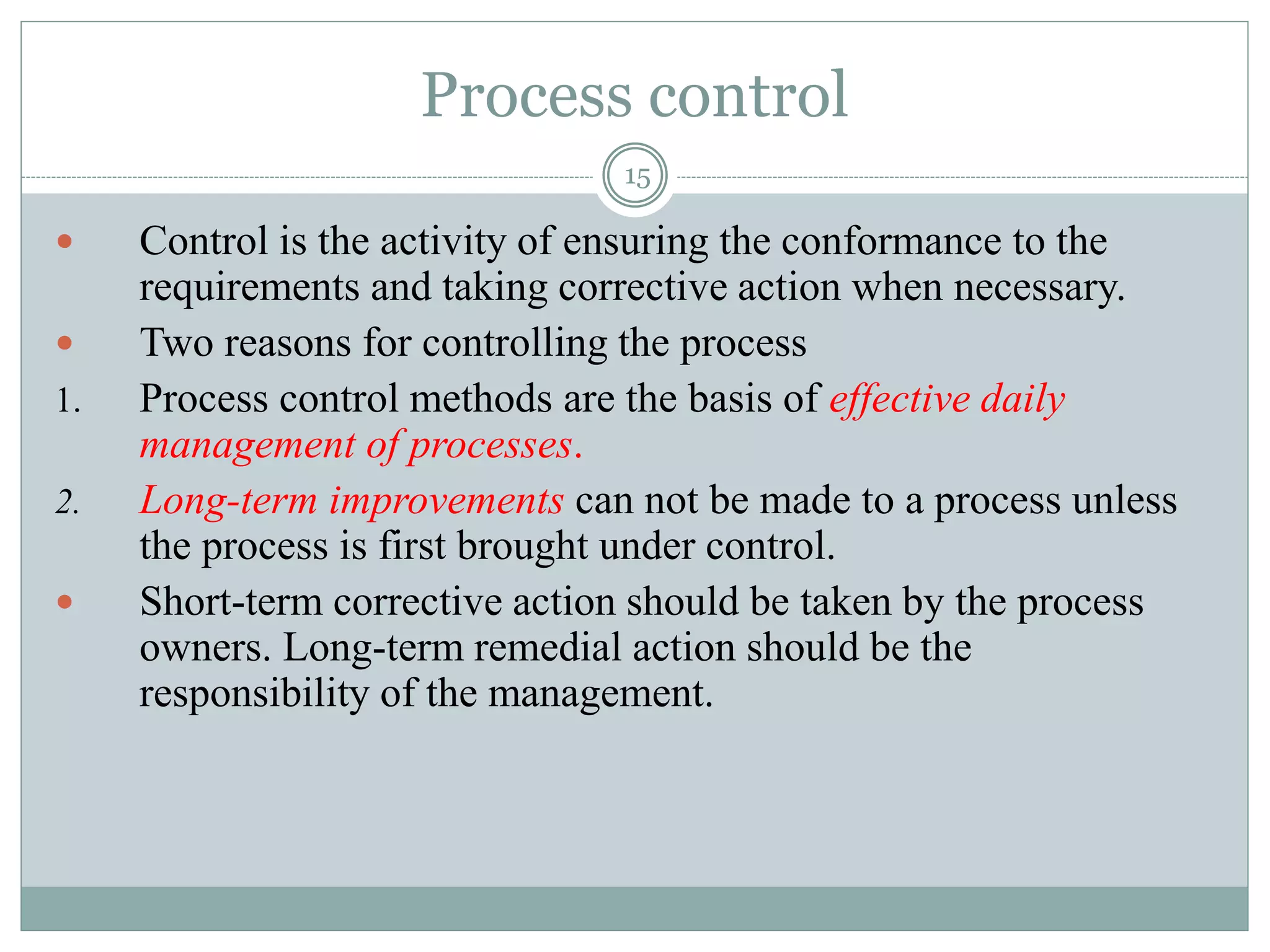
Process control
15
 Control is the activity of ensuring the conformance to the
requirements and taking corrective action when necessary.
 Two reasons for controlling the process
1. Process control methods are the basis of effective daily
management of processes.
2. Long-term improvements can not be made to a process unless
the process is first brought under control.
 Short-term corrective action should be taken by the process
owners. Long-term remedial action should be the
responsibility of the management.
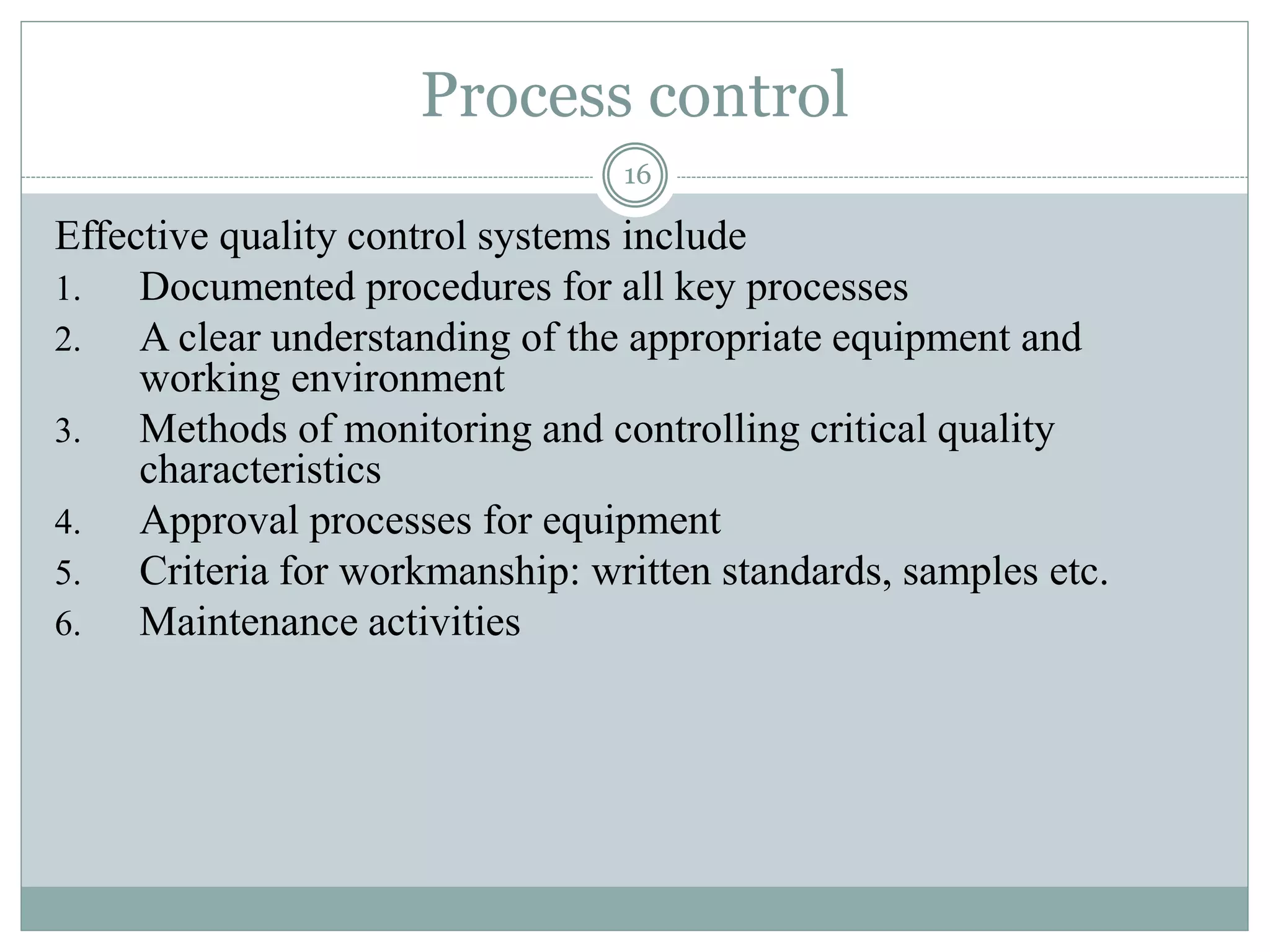
Process control
16
Effective quality control systems include
1. Documented procedures for all key processes
2. A clear understanding of the appropriate equipment and
working environment
3. Methods of monitoring and controlling critical quality
characteristics
4. Approval processes for equipment
5. Criteria for workmanship: written standards, samples etc.
6. Maintenance activities
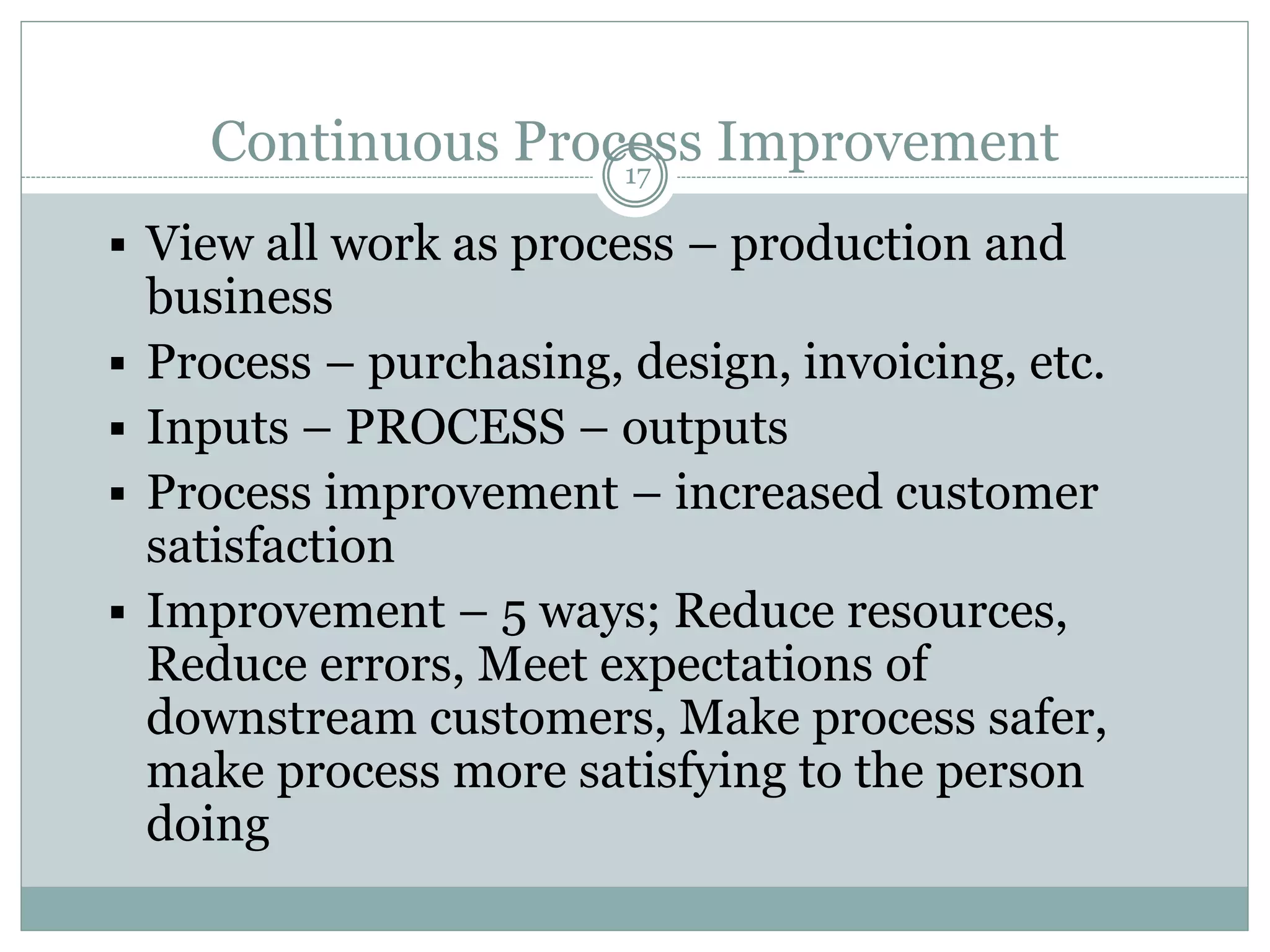
Continuous Process Improvement
 View all work as process – production and
business
 Process – purchasing, design, invoicing, etc.
 Inputs – PROCESS – outputs
 Process improvement – increased customer
satisfaction
 Improvement – 5 ways; Reduce resources,
Reduce errors, Meet expectations of
downstream customers, Make process safer,
make process more satisfying to the person
doing
17
Continuous Improvement
Inputs – processing – outputs
Input
Materials
Info, Data
People
Money
Process
Work methods
Procedures
Tools
Production – Cutting,
Welding, etc.
Bank –
deposit/withdrawal
process,
Kad Pintar Application
Process at NRD
Outputs
Products
Delivered service
In-process jobs –
forms signed,
drawing completed
Others
Also by-products,
wastes
Conditions
feedback
18
2. Histograms
1. Check Sheets
4. Control Charts
5. Run Charts
3. Scatter Diagrams
The Five TQM Tools to see quality
19
Check Sheets are simple documents
that are used for collecting data in
real-time.
A Check Sheet is typically a blank
form that is designed for the quick,
easy and efficient recording of the desired information,
which can be either quantitative or qualitative.
When the information is quantitative, the check sheet is
called a Tally Sheet.
Check Sheets
A histogram divides
up the range of
possible values in a
data set into classes or
groups.
For each group, a
rectangle is constructed
with a base length equal to the range of values in that
specific group, and an area proportional to the number
of observations falling into that group.
Histograms
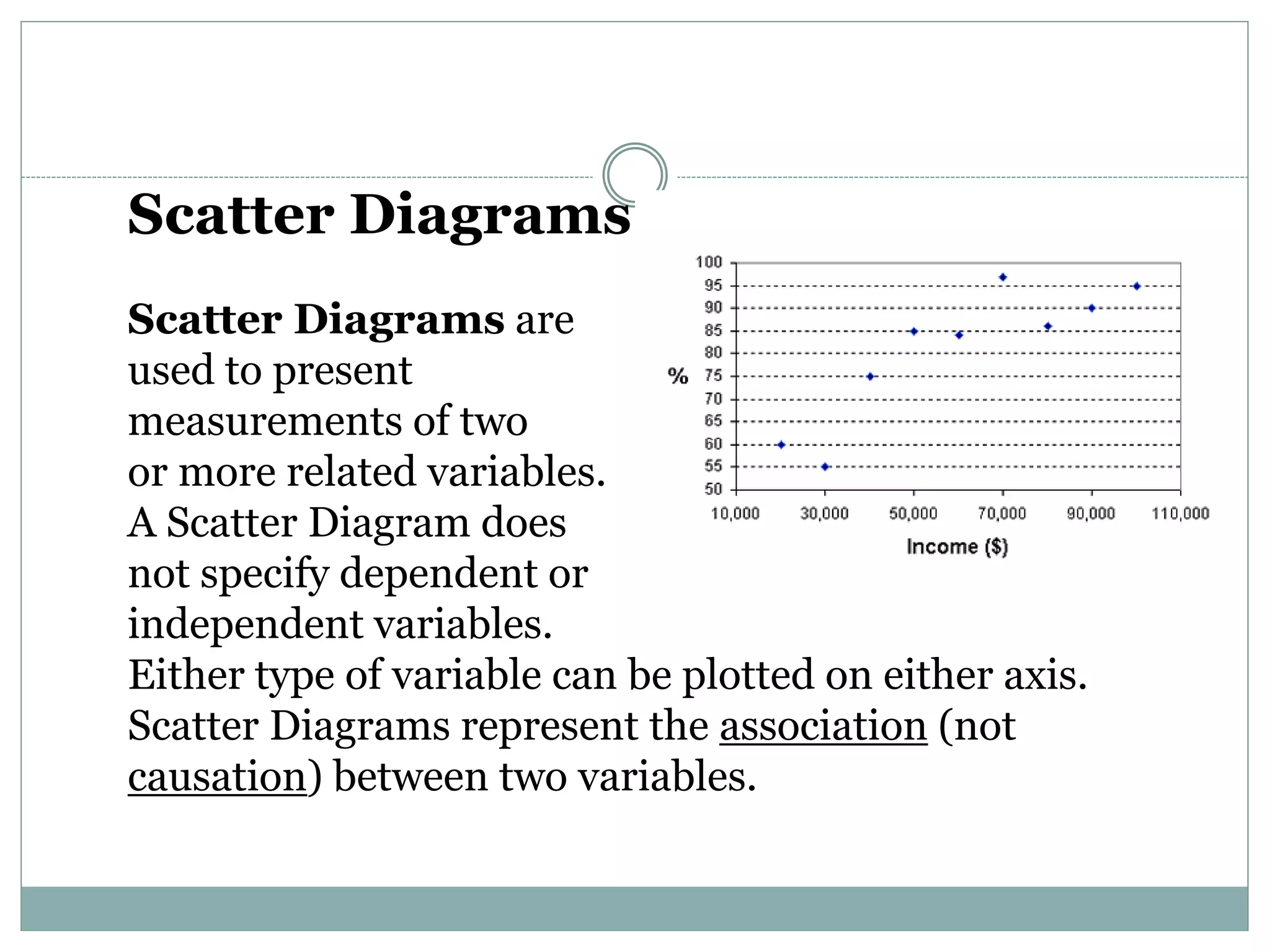
Scatter Diagrams are
used to present
measurements of two
or more related variables.
A Scatter Diagram does
not specify dependent or
independent variables.
Either type of variable can be plotted on either axis.
Scatter Diagrams represent the association (not
causation) between two variables.
Scatter Diagrams
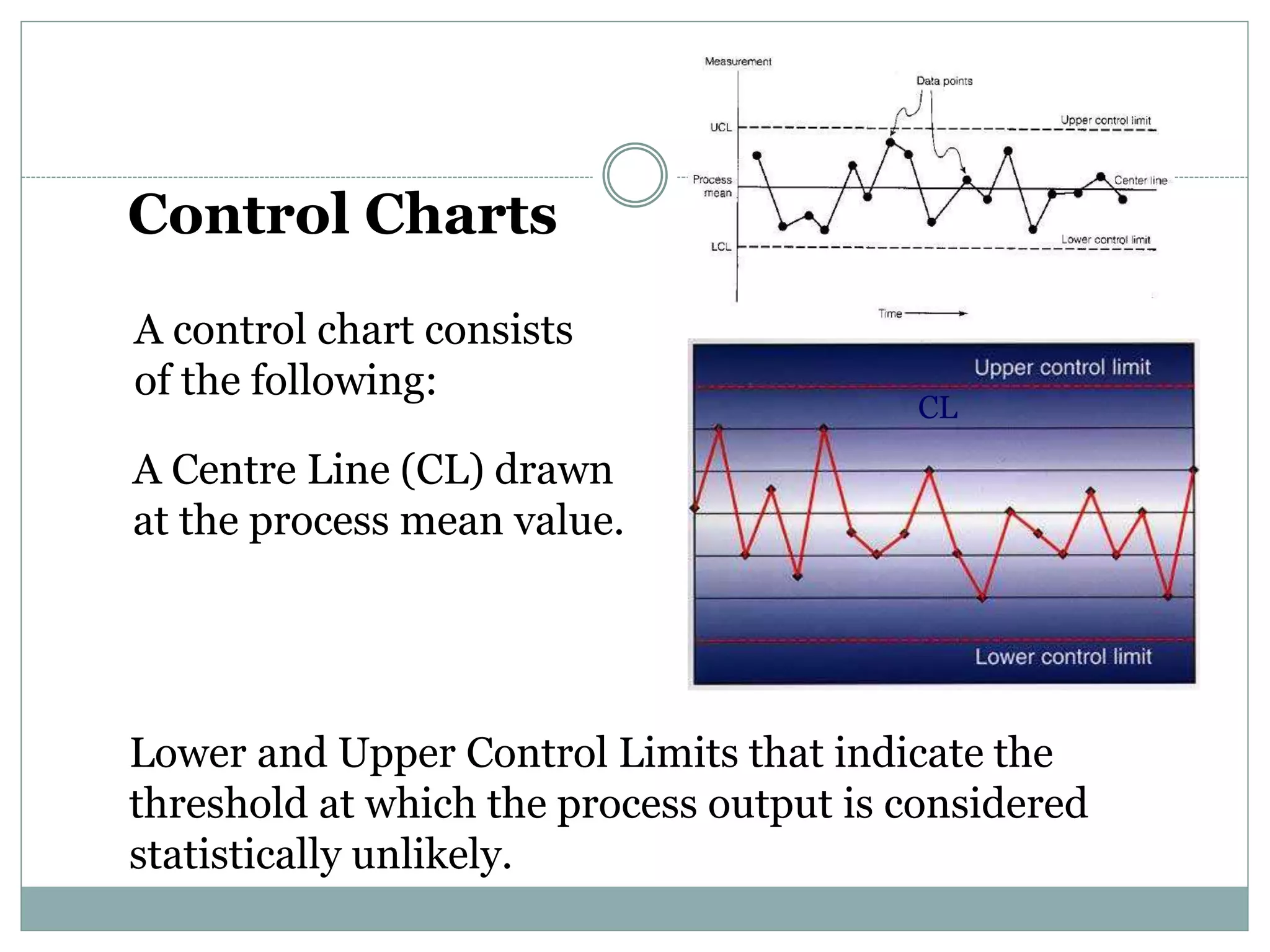
A control chart consists
of the following:
A Centre Line (CL) drawn
at the process mean value.
Lower and Upper Control Limits that indicate the
threshold at which the process output is considered
statistically unlikely.
Control Charts
CL
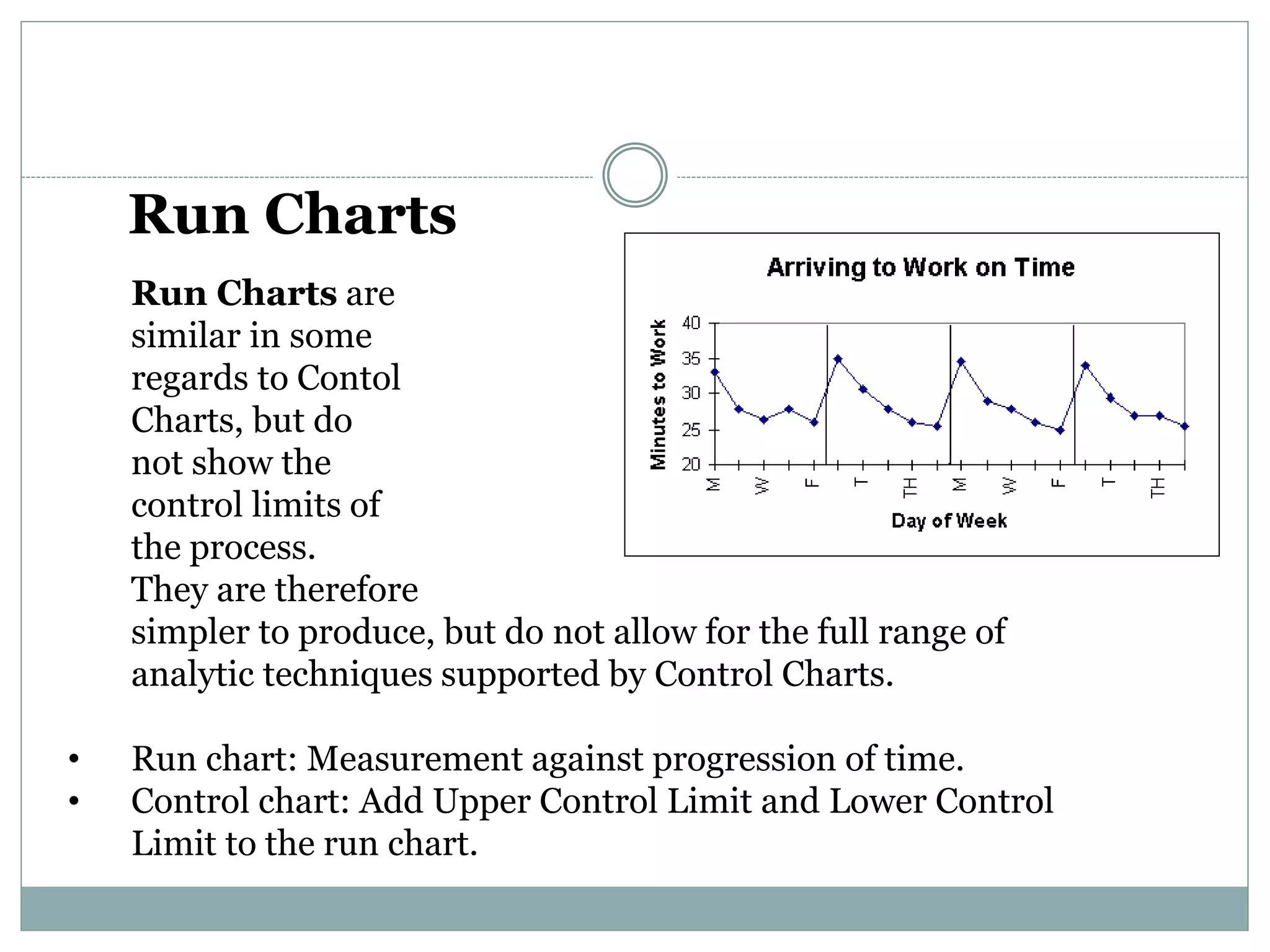
Run Charts are
similar in some
regards to Contol
Charts, but do
not show the
control limits of
the process.
They are therefore
simpler to produce, but do not allow for the full range of
analytic techniques supported by Control Charts.
• Run chart: Measurement against progression of time.
• Control chart: Add Upper Control Limit and Lower Control
Limit to the run chart.
Run Charts
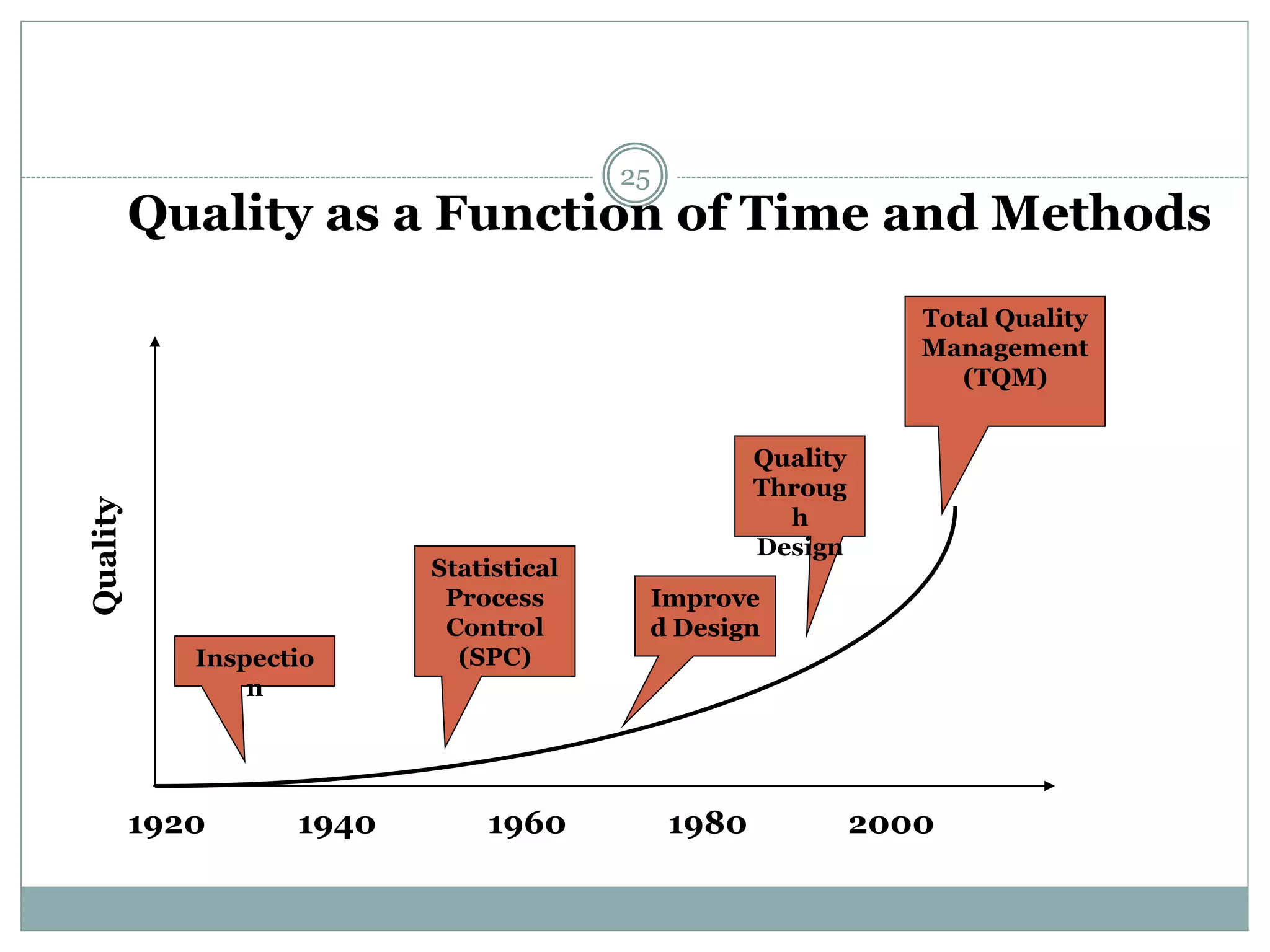
1920 1940 1960 1980 2000
Quality
Improve
d Design
Total Quality
Management
(TQM)
Statistical
Process
Control
(SPC)Inspectio
n
Quality
Throug
h
Design
Quality as a Function of Time and Methods
25
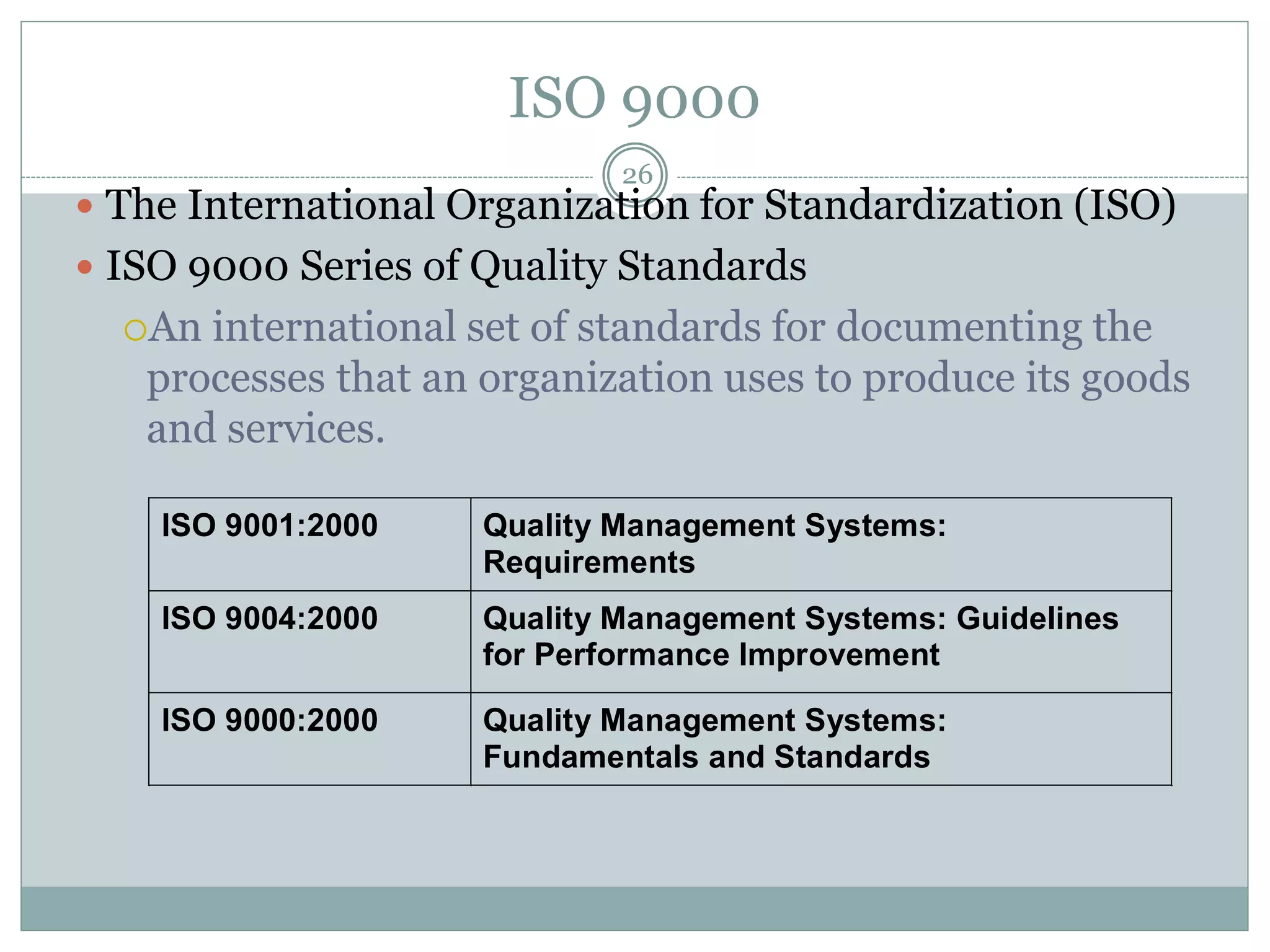
ISO 9000
 The International Organization for Standardization (ISO)
 ISO 9000 Series of Quality Standards
An international set of standards for documenting the
processes that an organization uses to produce its goods
and services.
ISO 9001:2000 Quality Management Systems:
Requirements
ISO 9004:2000 Quality Management Systems: Guidelines
for Performance Improvement
ISO 9000:2000 Quality Management Systems:
Fundamentals and Standards
26
27
ISO 9000: 2000
 Defines quality systems standards based on the premise that
certain generic characteristics of management principles can be
standardized.
 And that a well-designed, well-implemented and well managed
quality system provides confidence that outputs will meet
customer expectations and requirements.
 Standards are recognized by 100 countries including Japan and
USA.
 Intended to apply to all types of businesses. (Recently, B2B firm
bestroute.com became the first e-commerce company to get ISO
certification.)
28
ISO 9000: 2000
Created to meet five objectives:
1. Achieve, maintain, and seek to continuously improve product
quality in relation to the requirements.
2. Improve the quality of operations to continually meet
customers’ and stakeholders’ needs.
3. Provide confidence to internal management that quality
requirements are being met.
4. Provide confidence to the customers that quality requirements
are being met.
5. Provide confidence that quality system requirements are
fulfilled.
Benefits of TQM
 Greater customer loyalty
 Market share improvement
 Higher stock prices
 Reduced service calls
 Higher prices
 Greater productivity
29
Assuring Customer Satisfaction
 Service Recovery
How quickly a firm rectifies a service mistake has a strong effect on
establishing customer loyalty and creating customer satisfaction.
 Service Guarantees
Provide customer feedback on service operations
Effective guarantees
Unconditional
Easy to understand
Meaningful
Easy and painless to invoke
Easy and quick to collect on
30
Conclusion
Remember the earth revolves around the SUN.
Quality begets customers and customers beget quality. Let
us all have action plans to support quality, this will make
the world happy and earn us the profit (to industry),
Relations with customers (continuous process
improvement) and blessing of God Almighty.
“Actions are direct reflection of one’s intentions”
(Mahabharata)
31
Quality is a Journey,
not a Destination
32
33

Total quality control

  • 1.
    A Seminar on Total QualityControl Presented by:- Aakash D. Bhongade 132130015 (M. Tech 1st Year) 1
  • 2.
    Concepts 2  What isquality? Dictionary has many definitions: “Essential characteristic,” “Superior,” etc.  Some definitions that are accepted in various organizations:  “Quality is customer satisfaction,”  “Quality is Fitness for Use.” Quality is “fitness for use” (Joseph Juran) Quality is “conformance to requirements” (Philip B. Crosby) Quality of a product or services is its ability to satisfy the needs and expectations of the customer
  • 3.
    What is TQM Total - made up of the whole  Quality - degree of excellence a product or service provides  Management - act, art or manner of planning, controlling, directing,…. Therefore, TQM is the art of managing the whole to achieve excellence. Inspection Quality Control Quality Assurance TQM 3
  • 4.
    What does TQMmean? Total Quality Management means that the organization's culture is defined by and supports the constant attainment of customer satisfaction through an integrated system of tools, techniques, and training. This involves the continuous improvement of organizational processes, resulting in high quality products and services. Quality 4
  • 5.
    Why TQM? Ford MotorCompany had operating losses of $3.3 billion between 1980 and 1982. Xerox market share dropped from 93% in 1971 to 40% in 1981. Attention to quality was seen as a way to combat the competition. 5
  • 6.
    The Three QualityGurus  Deming: the best known of the “early” pioneers, is credited with popularizing quality control in Japan in early 1950s.Today, he is regarded as a national hero in that country and is the father of the world famous Deming prize for quality.  JURAN: Juran, like Deming was invited to Japan in 1954 by the union of Japanese Scientists and engineers.  Juran defines quality as fitness for use in terms of design, conformance, availability, safety and field use. He focuses on top-down management and technical methods rather than worker pride and satisfaction. 6
  • 7.
    PLAN CHECK DOACT The Deming Cycleor PDCA Cycle Plan a change to the process. Predict the effect this change will have and plan how the effects will be measured Implement the change on a small scale and measure the effects Adopt the change as a permanent modification to the process, or abandon it. Study the results to learn what effect the change had, if any. 7
  • 8.
    Philip Crosby: authorof popular book Quality is Free. His absolutes of quality are:  Quality is defined as conformance to requirements, not “goodness”  The system for achieving quality is prevention, not appraisal.  The performance standard is zero defects, not “that’s close enough”  The measurement of quality is the price of non-conformance, not indexes. 8
  • 9.
    Commonality of Themesof Quality Gurus  Inspection is never the answer to quality improvement, nor is “policing”.  Involvement of leadership and top management is essential to the necessary culture of commitment to quality.  A program for quality requires organization-wide efforts and long term commitment, accompanied by the necessary investment in training.  Quality is first and schedules are second. 9
  • 10.
    TQM Six BasicConcepts 1. Leadership 2. Customer Satisfaction 3. Employee Involvement 4. Continuous Process Improvement 5. Supplier Partnership 6. Performance Measures (All these present an excellent way to run a business) 10
  • 11.
    Elements of TQM Leadership Top management vision, planning and support  Employee involvement All employees assume responsibility for inspecting the quality of their work.  Product/Process Excellence Involves product design quality and monitoring the process for continuous improvement. 11
  • 12.
    Elements of TQM(cont’d)  Continuous Improvement A concept that recognizes that quality improvement is a journey with no end and that there is a need for continually looking for new approaches for improving quality.  Customer Focus (on “Fitness for Use”) Design quality Specific characteristics of a product that determine its value in the marketplace. Conformance quality The degree to which a product meets its design specifications. 12
  • 13.
    QC Process management 13 Planning and administrating the activities necessary to achieve high quality in business processes; and also identifying opportunities for improving quality and operational performance – ultimately, customer satisfaction.  Process simplification reduces opportunities for errors and rework.  Processes are of two types – value-added processes and support processes.  Value-added processes – those essential for running the business and achieving and maintaining competitive advantage. (Design process, Production/Delivery process)
  • 14.
  • 15.
    Process control 15  Controlis the activity of ensuring the conformance to the requirements and taking corrective action when necessary.  Two reasons for controlling the process 1. Process control methods are the basis of effective daily management of processes. 2. Long-term improvements can not be made to a process unless the process is first brought under control.  Short-term corrective action should be taken by the process owners. Long-term remedial action should be the responsibility of the management.
  • 16.
    Process control 16 Effective qualitycontrol systems include 1. Documented procedures for all key processes 2. A clear understanding of the appropriate equipment and working environment 3. Methods of monitoring and controlling critical quality characteristics 4. Approval processes for equipment 5. Criteria for workmanship: written standards, samples etc. 6. Maintenance activities
  • 17.
    Continuous Process Improvement View all work as process – production and business  Process – purchasing, design, invoicing, etc.  Inputs – PROCESS – outputs  Process improvement – increased customer satisfaction  Improvement – 5 ways; Reduce resources, Reduce errors, Meet expectations of downstream customers, Make process safer, make process more satisfying to the person doing 17
  • 18.
    Continuous Improvement Inputs –processing – outputs Input Materials Info, Data People Money Process Work methods Procedures Tools Production – Cutting, Welding, etc. Bank – deposit/withdrawal process, Kad Pintar Application Process at NRD Outputs Products Delivered service In-process jobs – forms signed, drawing completed Others Also by-products, wastes Conditions feedback 18
  • 19.
    2. Histograms 1. CheckSheets 4. Control Charts 5. Run Charts 3. Scatter Diagrams The Five TQM Tools to see quality 19
  • 20.
    Check Sheets aresimple documents that are used for collecting data in real-time. A Check Sheet is typically a blank form that is designed for the quick, easy and efficient recording of the desired information, which can be either quantitative or qualitative. When the information is quantitative, the check sheet is called a Tally Sheet. Check Sheets
  • 21.
    A histogram divides upthe range of possible values in a data set into classes or groups. For each group, a rectangle is constructed with a base length equal to the range of values in that specific group, and an area proportional to the number of observations falling into that group. Histograms
  • 22.
    Scatter Diagrams are usedto present measurements of two or more related variables. A Scatter Diagram does not specify dependent or independent variables. Either type of variable can be plotted on either axis. Scatter Diagrams represent the association (not causation) between two variables. Scatter Diagrams
  • 23.
    A control chartconsists of the following: A Centre Line (CL) drawn at the process mean value. Lower and Upper Control Limits that indicate the threshold at which the process output is considered statistically unlikely. Control Charts CL
  • 24.
    Run Charts are similarin some regards to Contol Charts, but do not show the control limits of the process. They are therefore simpler to produce, but do not allow for the full range of analytic techniques supported by Control Charts. • Run chart: Measurement against progression of time. • Control chart: Add Upper Control Limit and Lower Control Limit to the run chart. Run Charts
  • 25.
    1920 1940 19601980 2000 Quality Improve d Design Total Quality Management (TQM) Statistical Process Control (SPC)Inspectio n Quality Throug h Design Quality as a Function of Time and Methods 25
  • 26.
    ISO 9000  TheInternational Organization for Standardization (ISO)  ISO 9000 Series of Quality Standards An international set of standards for documenting the processes that an organization uses to produce its goods and services. ISO 9001:2000 Quality Management Systems: Requirements ISO 9004:2000 Quality Management Systems: Guidelines for Performance Improvement ISO 9000:2000 Quality Management Systems: Fundamentals and Standards 26
  • 27.
    27 ISO 9000: 2000 Defines quality systems standards based on the premise that certain generic characteristics of management principles can be standardized.  And that a well-designed, well-implemented and well managed quality system provides confidence that outputs will meet customer expectations and requirements.  Standards are recognized by 100 countries including Japan and USA.  Intended to apply to all types of businesses. (Recently, B2B firm bestroute.com became the first e-commerce company to get ISO certification.)
  • 28.
    28 ISO 9000: 2000 Createdto meet five objectives: 1. Achieve, maintain, and seek to continuously improve product quality in relation to the requirements. 2. Improve the quality of operations to continually meet customers’ and stakeholders’ needs. 3. Provide confidence to internal management that quality requirements are being met. 4. Provide confidence to the customers that quality requirements are being met. 5. Provide confidence that quality system requirements are fulfilled.
  • 29.
    Benefits of TQM Greater customer loyalty  Market share improvement  Higher stock prices  Reduced service calls  Higher prices  Greater productivity 29
  • 30.
    Assuring Customer Satisfaction Service Recovery How quickly a firm rectifies a service mistake has a strong effect on establishing customer loyalty and creating customer satisfaction.  Service Guarantees Provide customer feedback on service operations Effective guarantees Unconditional Easy to understand Meaningful Easy and painless to invoke Easy and quick to collect on 30
  • 31.
    Conclusion Remember the earthrevolves around the SUN. Quality begets customers and customers beget quality. Let us all have action plans to support quality, this will make the world happy and earn us the profit (to industry), Relations with customers (continuous process improvement) and blessing of God Almighty. “Actions are direct reflection of one’s intentions” (Mahabharata) 31
  • 32.
    Quality is aJourney, not a Destination 32
  • 33.