Chapter 17

Building and
Sustaining
Total Quality
Organizations

                1
Key Idea

Building and sustaining a TQ organization
requires a readiness for change, the
adoption of sound practices and
implementation strategies, and an
effective organizational infrastructure.
Why Adopt TQ Philosophy?

 Reaction to competitive threat to
  profitable survival
 An opportunity to improve


                                      3
Selling the TQ Concept

•   Learn to think like top     •   Focus on getting an early
    executives                      win, even if it is small
•   Position quality as a way   •   Ensure that efforts won’t
    to address priorities of        be undercut by corporate
    stakeholders
                                    accounting principles
•   Align objectives with
    those of senior             •   Develop allies, both
    management                      internal and external
•   Make arguments              •   Develop metrics for return
    quantitative                    on quality
•   Make the first pitch to     •   Never stop selling quality
    someone likely to be
    sympathetic
Corporate Culture and
Change

 Corporate   culture is a company’s
  value system and its collection of
  guiding principles
 Cultural values often seen in
  mission and vision statements


                                       5
Key Idea

Culture is reflected by the management policies
and actions that a company practices. Therefore,
organizations that believe in the principles of total
quality are more likely to implement the practices
successfully. Conversely, actions set culture in
motion. As total quality practices are used
routinely within an organization, its people learn
to believe in the principles, and cultural changes
can occur.
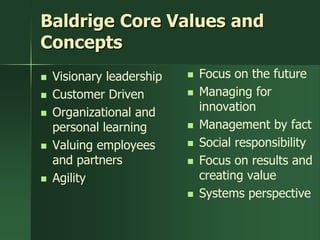
Baldrige Core Values and
Concepts
   Visionary leadership      Focus on the future
   Customer Driven           Managing for
   Organizational and         innovation
    personal learning         Management by fact
   Valuing employees         Social responsibility
    and partners              Focus on results and
   Agility                    creating value
                              Systems perspective
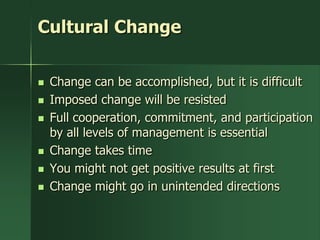
Cultural Change

   Change can be accomplished, but it is difficult
   Imposed change will be resisted
   Full cooperation, commitment, and participation
    by all levels of management is essential
   Change takes time
   You might not get positive results at first
   Change might go in unintended directions
Key Idea

Impatient managers often seek immediate
cultural change by adopting off-the-shelf quality
programs and practices, or by imitating other
successful organizations. In most cases, this
approach is setting themselves up for failure.
Building on Best Practices

   Universal best practices
    – Cycle time analysis
    – Process value analysis
    – Process simplification
    – Strategic planning
    – Formal supplier certification
      programs
Best Practices:
Infrastructure Design (1 of 3)
   Low performers
    – process management fundamentals
    – customer response
    – training and teamwork
    – benchmarking competitors
    – cost reduction
    – rewards for teamwork and quality
                                         11
Best Practices:
Infrastructure Design (2 of 3)
   Medium performers
    – use customer input and market
      research
    – select suppliers by quality
    – flexibility and cycle time reduction
    – compensation tied to quality and
      teamwork

                                             12
Best Practices:
Infrastructure Design (3 of 3)
   High performers
    – self-managed and cross-functional
      teams
    – strategic partnerships
    – benchmarking world-class companies
    – senior management compensation tied
      to quality
    – rapid response
                                       13
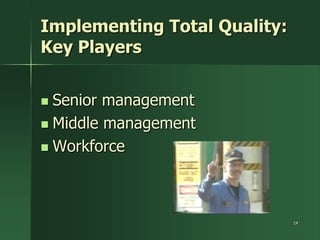
Implementing Total Quality:
Key Players


 Senior management
 Middle management

 Workforce


                              14
Key Idea

Organizations contemplating change must answer
some tough questions, such as, Why is the
change necessary? What will it do to my
organization (department, job)? What problems
will I encounter in making the change? and
perhaps the most important one — What’s in it for
me?
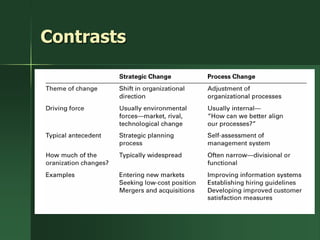
Strategic vs. Process Change

   Strategic change is broad in scope and stems
    from strategic objectives, which are generally
    externally focused and relate to significant
    customer, market, product/service, or
    technological opportunities and challenges.
   Process change is narrow in scope and deals
    with the operations of an organization. An
    accumulation of continuously improving
    process changes can lead to a positive and
    sustainable culture change.
Contrasts
Key Idea

Numerous barriers exist to successfully transform
organizations to a sustained culture of total
quality. Understanding these barriers can help
significantly in managing change processes.
Perhaps the most significant failure encountered
in most organizations is a lack of alignment
between components of the organizational
system.
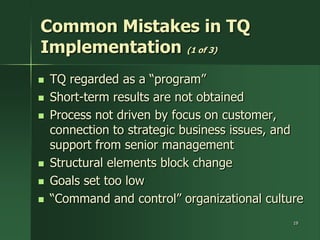
Common Mistakes in TQ
Implementation (1 of 3)
   TQ regarded as a ―program‖
   Short-term results are not obtained
   Process not driven by focus on customer,
    connection to strategic business issues, and
    support from senior management
   Structural elements block change
   Goals set too low
   ―Command and control‖ organizational culture
                                              19
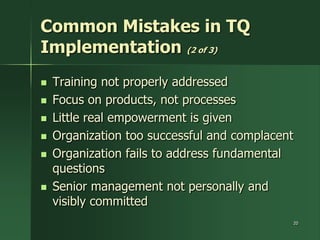
Common Mistakes in TQ
Implementation (2 of 3)
   Training not properly addressed
   Focus on products, not processes
   Little real empowerment is given
   Organization too successful and complacent
   Organization fails to address fundamental
    questions
   Senior management not personally and
    visibly committed
                                             20
Common Mistakes in TQ
Implementation (3 of 3)
   Overemphasis on teams for cross-functional
    problems
   Employees operate under belief that more
    data are always desirable
   Management fails to recognize that quality
    improvement is personal responsibility
   Organization does not see itself as collection
    of interrelated processes

                                                 21
Sustaining the Quality
Organization
   View quality as a journey (―Race without a
    finish line‖)
   Recognize that success takes time
   Create a ―learning organization‖
    –   Planning
    –   Execution of plans
    –   Assessment of progress
    –   Revision of plans based on assessment findings
   Use Baldrige assessment and feedback
Key Idea

Organizations are dynamic entities. Managers
must consider the dynamic component in order to
deal with instability in the environment, imperfect
plans, the need for innovation, and the common
human desire for variety and change.
Key Activities of Learning
Organizations
   Systematic problem solving
   Experimentation with new approaches
   Learning from their own experiences
    and history
   Learning from the experiences and
    best practices of others
   Transferring knowledge quickly and
    efficiently throughout the organization
Self Assessment: Basic
Elements
   Management involvement and leadership
   Product and process design
   Product control
   Customer and supplier communications
   Quality improvement
   Employee participation
   Education and training
   Quality information
Key Idea

Self-assessment should identify both strengths
and opportunities for improvement, creating a
basis for evolving toward higher levels of
performance. Thus, a major objective of most
self-assessment projects is the improvement of
organizational processes based on opportunities
identified by the evaluation.
Importance of Follow-Up of
Self-Assessment Results
   Many organizations derive little benefit from
    conducting self-assessment and achieve few
    of the process improvements suggested by
    self-study
   Reasons:
    – Managers do not sense a problem
    – Managers react negatively or by denial
    – Managers don’t know what to do with the
      information
Key Idea

Following up requires senior leaders to engage in
two types of activities: action planning and
subsequently tracking implementation progress.
Leveraging Self-Assessment
Findings
   Prepare to be humbled
   Talk through the findings
   Recognize institutional influences
   Grind out the follow-up
Implementing ISO 9000

   Start with a quality policy that
    identifies key objectives and basic
    procedures
   Develop a quality manual to document
    the procedures
   Use internal audits to maintain
    procedures
   Provide adequate resources
Implementing Six Sigma

   Committed leadership
   Integration with existing initiatives, business
    strategy, and performance measurement
   Process thinking
   Disciplined customer and market intelligence
    gathering
   A bottom line orientation
   Leadership in the trenches
   Training
   Continuous reinforcement and rewards
THE EVOLUTION OF QUALITY
MANAGEMENT

   W. Edwards Deming has been the
    most prominent.
   In the 1940s Deming worked at the
    Census Bureau, where he introduced
    the use of statistical process control to
    monitor the mammoth operation.
   In 1950 Deming began teaching
    statistical quality control to Japanese
    companies.
Quality Guru – Walter
Shewaht
   Working at Bell Laboratories in the
    1920s, he developed the technical tools
    such as control charts that formed the
    basis of statistical quality control;

   He and his colleagues at Bell Labs
    introduced the term quality assurance for
    their program to improve quality through
    the use of statistical control methods.
Quality Guru – W. Edwards
Deming
   A disciple of Shewart, he developed courses
    during World War II to teach statistical
    quality-control techniques to engineers and
    executives of companies that were military
    suppliers;
   after the war he began teaching statistical
    quality control to Japanese companies,
    initiating their quality movement.
Quality Guru – Joseph M.
Juran
   An author and consultant, he followed
    Deming to Japan in 1954;
   He focused on strategic quality planning
    within an annual quality program, setting
    goals for product quality and designing
    processes to achieve those goals;
   Quality improvement is achieved by focusing
    on projects to solve problems and securing
    breakthrough solutions.
Quality Guru – Armand
V. Feigenbaum
   In his 1951 book, Quality Control:
    Principles, Practices and Administration, he
    introduced the concept of total quality
    control and continuous quality improvement
    as a companywide strategic commitment
    requiring the involvement of all functions in
    the quality process, not just manufacturing;
   From 1958 to 1968 he was director of
    manufacturing operations and quality
    control at GE.
Quality Guru – Philip Crosby

   In his 1979 book, Quality Is Free, he emphasized
    that the costs of poor quality (including lost labor
    and equipment time, scrap, downtime and lost
    sales) far outweigh the cost of preventing poor
    quality;

   In his 1984 book, Quality Without Tears, he defined
    absolutes of quality management—quality is
    defined as conformance to requirements, quality
    results from prevention, the performance standard
    is ―zero defects.‖
Quality Guru – Kaoru
Ishikawa
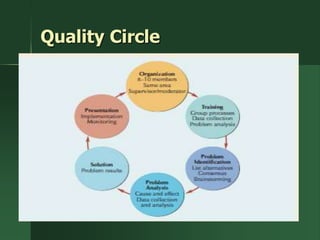
   This Tokyo University professor promoted use
    of quality circles and developed the ―fishbone‖
    (cause and effect) diagram to diagnose
    quality problems;

   He emphasized the importance of the internal
    customer, that is, that a quality organization
    is first necessary in order to produce quality
    products or services.
Quality Circle

Chapter17 total quality control

  • 1.
  • 2.
    Key Idea Building andsustaining a TQ organization requires a readiness for change, the adoption of sound practices and implementation strategies, and an effective organizational infrastructure.
  • 3.
    Why Adopt TQPhilosophy?  Reaction to competitive threat to profitable survival  An opportunity to improve 3
  • 4.
    Selling the TQConcept • Learn to think like top • Focus on getting an early executives win, even if it is small • Position quality as a way • Ensure that efforts won’t to address priorities of be undercut by corporate stakeholders accounting principles • Align objectives with those of senior • Develop allies, both management internal and external • Make arguments • Develop metrics for return quantitative on quality • Make the first pitch to • Never stop selling quality someone likely to be sympathetic
  • 5.
    Corporate Culture and Change Corporate culture is a company’s value system and its collection of guiding principles  Cultural values often seen in mission and vision statements 5
  • 6.
    Key Idea Culture isreflected by the management policies and actions that a company practices. Therefore, organizations that believe in the principles of total quality are more likely to implement the practices successfully. Conversely, actions set culture in motion. As total quality practices are used routinely within an organization, its people learn to believe in the principles, and cultural changes can occur.
  • 7.
    Baldrige Core Valuesand Concepts  Visionary leadership  Focus on the future  Customer Driven  Managing for  Organizational and innovation personal learning  Management by fact  Valuing employees  Social responsibility and partners  Focus on results and  Agility creating value  Systems perspective
  • 8.
    Cultural Change  Change can be accomplished, but it is difficult  Imposed change will be resisted  Full cooperation, commitment, and participation by all levels of management is essential  Change takes time  You might not get positive results at first  Change might go in unintended directions
  • 9.
    Key Idea Impatient managersoften seek immediate cultural change by adopting off-the-shelf quality programs and practices, or by imitating other successful organizations. In most cases, this approach is setting themselves up for failure.
  • 10.
    Building on BestPractices  Universal best practices – Cycle time analysis – Process value analysis – Process simplification – Strategic planning – Formal supplier certification programs
  • 11.
    Best Practices: Infrastructure Design(1 of 3)  Low performers – process management fundamentals – customer response – training and teamwork – benchmarking competitors – cost reduction – rewards for teamwork and quality 11
  • 12.
    Best Practices: Infrastructure Design(2 of 3)  Medium performers – use customer input and market research – select suppliers by quality – flexibility and cycle time reduction – compensation tied to quality and teamwork 12
  • 13.
    Best Practices: Infrastructure Design(3 of 3)  High performers – self-managed and cross-functional teams – strategic partnerships – benchmarking world-class companies – senior management compensation tied to quality – rapid response 13
  • 14.
    Implementing Total Quality: KeyPlayers  Senior management  Middle management  Workforce 14
  • 15.
    Key Idea Organizations contemplatingchange must answer some tough questions, such as, Why is the change necessary? What will it do to my organization (department, job)? What problems will I encounter in making the change? and perhaps the most important one — What’s in it for me?
  • 16.
    Strategic vs. ProcessChange  Strategic change is broad in scope and stems from strategic objectives, which are generally externally focused and relate to significant customer, market, product/service, or technological opportunities and challenges.  Process change is narrow in scope and deals with the operations of an organization. An accumulation of continuously improving process changes can lead to a positive and sustainable culture change.
  • 17.
  • 18.
    Key Idea Numerous barriersexist to successfully transform organizations to a sustained culture of total quality. Understanding these barriers can help significantly in managing change processes. Perhaps the most significant failure encountered in most organizations is a lack of alignment between components of the organizational system.
  • 19.
    Common Mistakes inTQ Implementation (1 of 3)  TQ regarded as a ―program‖  Short-term results are not obtained  Process not driven by focus on customer, connection to strategic business issues, and support from senior management  Structural elements block change  Goals set too low  ―Command and control‖ organizational culture 19
  • 20.
    Common Mistakes inTQ Implementation (2 of 3)  Training not properly addressed  Focus on products, not processes  Little real empowerment is given  Organization too successful and complacent  Organization fails to address fundamental questions  Senior management not personally and visibly committed 20
  • 21.
    Common Mistakes inTQ Implementation (3 of 3)  Overemphasis on teams for cross-functional problems  Employees operate under belief that more data are always desirable  Management fails to recognize that quality improvement is personal responsibility  Organization does not see itself as collection of interrelated processes 21
  • 22.
    Sustaining the Quality Organization  View quality as a journey (―Race without a finish line‖)  Recognize that success takes time  Create a ―learning organization‖ – Planning – Execution of plans – Assessment of progress – Revision of plans based on assessment findings  Use Baldrige assessment and feedback
  • 23.
    Key Idea Organizations aredynamic entities. Managers must consider the dynamic component in order to deal with instability in the environment, imperfect plans, the need for innovation, and the common human desire for variety and change.
  • 24.
    Key Activities ofLearning Organizations  Systematic problem solving  Experimentation with new approaches  Learning from their own experiences and history  Learning from the experiences and best practices of others  Transferring knowledge quickly and efficiently throughout the organization
  • 25.
    Self Assessment: Basic Elements  Management involvement and leadership  Product and process design  Product control  Customer and supplier communications  Quality improvement  Employee participation  Education and training  Quality information
  • 26.
    Key Idea Self-assessment shouldidentify both strengths and opportunities for improvement, creating a basis for evolving toward higher levels of performance. Thus, a major objective of most self-assessment projects is the improvement of organizational processes based on opportunities identified by the evaluation.
  • 27.
    Importance of Follow-Upof Self-Assessment Results  Many organizations derive little benefit from conducting self-assessment and achieve few of the process improvements suggested by self-study  Reasons: – Managers do not sense a problem – Managers react negatively or by denial – Managers don’t know what to do with the information
  • 28.
    Key Idea Following uprequires senior leaders to engage in two types of activities: action planning and subsequently tracking implementation progress.
  • 29.
    Leveraging Self-Assessment Findings  Prepare to be humbled  Talk through the findings  Recognize institutional influences  Grind out the follow-up
  • 30.
    Implementing ISO 9000  Start with a quality policy that identifies key objectives and basic procedures  Develop a quality manual to document the procedures  Use internal audits to maintain procedures  Provide adequate resources
  • 31.
    Implementing Six Sigma  Committed leadership  Integration with existing initiatives, business strategy, and performance measurement  Process thinking  Disciplined customer and market intelligence gathering  A bottom line orientation  Leadership in the trenches  Training  Continuous reinforcement and rewards
  • 32.
    THE EVOLUTION OFQUALITY MANAGEMENT  W. Edwards Deming has been the most prominent.  In the 1940s Deming worked at the Census Bureau, where he introduced the use of statistical process control to monitor the mammoth operation.  In 1950 Deming began teaching statistical quality control to Japanese companies.
  • 33.
    Quality Guru –Walter Shewaht  Working at Bell Laboratories in the 1920s, he developed the technical tools such as control charts that formed the basis of statistical quality control;  He and his colleagues at Bell Labs introduced the term quality assurance for their program to improve quality through the use of statistical control methods.
  • 34.
    Quality Guru –W. Edwards Deming  A disciple of Shewart, he developed courses during World War II to teach statistical quality-control techniques to engineers and executives of companies that were military suppliers;  after the war he began teaching statistical quality control to Japanese companies, initiating their quality movement.
  • 35.
    Quality Guru –Joseph M. Juran  An author and consultant, he followed Deming to Japan in 1954;  He focused on strategic quality planning within an annual quality program, setting goals for product quality and designing processes to achieve those goals;  Quality improvement is achieved by focusing on projects to solve problems and securing breakthrough solutions.
  • 36.
    Quality Guru –Armand V. Feigenbaum  In his 1951 book, Quality Control: Principles, Practices and Administration, he introduced the concept of total quality control and continuous quality improvement as a companywide strategic commitment requiring the involvement of all functions in the quality process, not just manufacturing;  From 1958 to 1968 he was director of manufacturing operations and quality control at GE.
  • 37.
    Quality Guru –Philip Crosby  In his 1979 book, Quality Is Free, he emphasized that the costs of poor quality (including lost labor and equipment time, scrap, downtime and lost sales) far outweigh the cost of preventing poor quality;  In his 1984 book, Quality Without Tears, he defined absolutes of quality management—quality is defined as conformance to requirements, quality results from prevention, the performance standard is ―zero defects.‖
  • 38.
    Quality Guru –Kaoru Ishikawa  This Tokyo University professor promoted use of quality circles and developed the ―fishbone‖ (cause and effect) diagram to diagnose quality problems;  He emphasized the importance of the internal customer, that is, that a quality organization is first necessary in order to produce quality products or services.
  • 39.