Topological sorting is a linear ordering of the vertices in a directed acyclic graph (DAG) where for every edge from vertex u to vertex v, u comes before v in the ordering. The algorithm uses a depth-first search approach with a stack to iteratively push and pop vertices as their adjacent vertices are explored. Breadth-first search also traverses a graph by exploring the neighbor vertices, but uses a queue rather than a stack and marks visited vertices to avoid getting stuck in cycles. The document provides pseudocode for both algorithms with an example graph to demonstrate the process.
Topological sorting:
Topological sortingfor Directed Acyclic Graph
(DAG) is a linear ordering of vertices such that for
every directed edge u v, vertex u comes before v in
the ordering.
Topological Sorting for a graph is not possible if the
graph is not a DAG.
For example, a topological sorting of the following
graph is “5 4 2 3 1 0”. There can be more than one
topological sorting for a graph.
3.
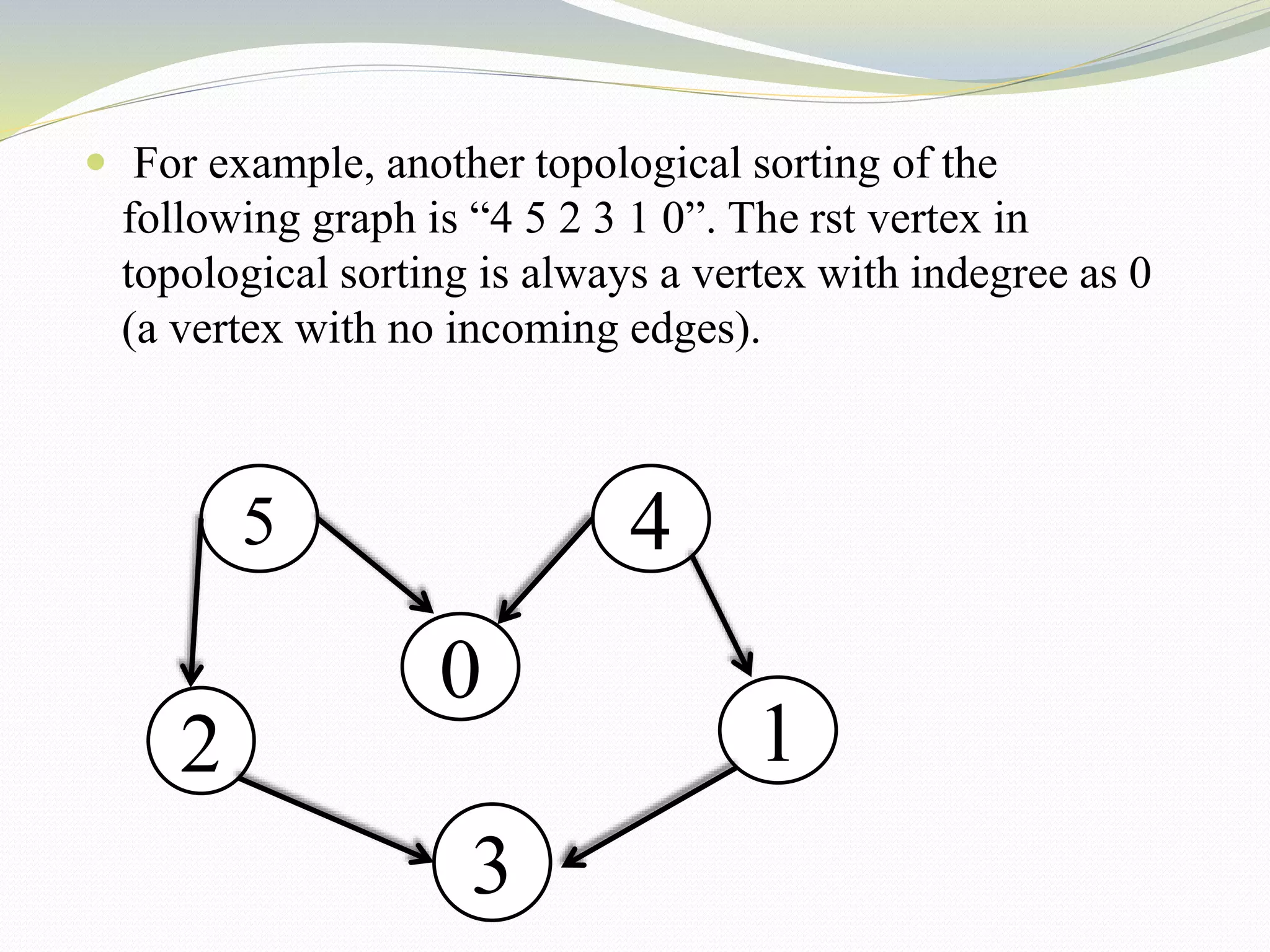
For example,another topological sorting of the
following graph is “4 5 2 3 1 0”. The rst vertex in
topological sorting is always a vertex with indegree as 0
(a vertex with no incoming edges).
5 4
0
2 1
3
4.
Algorithm to findtopological
sorting:
We recommend to first see the implementation of DFS.
We can modify DFS to find Topological Sorting of a
graph.
In DFS, we start from a vertex, we first print it and then
recursively call DFS for its adjacent vertices.
In topological sorting, we use a temporary stack. We
don’t print the vertex immediately, we first recursively
call topological sorting for all its adjacent vertices, then
push it to a stack.
Finally, print contents of the stack. Note that a vertex is
pushed to stack only when all of its adjacent vertices (and
their adjacent vertices and so on) are already in the stack.
5.
Breadth first traversal:
Breadth First Search (BFS) algorithm traverses a
graph in a breadthward motion and uses a queue to
remember to get the next vertex to start a search,
when a dead end occurs in any iteration.
Breadth First Traversal (or Search) for a graph is similar to
Breadth First Traversal of a tree (See method 2 of this
post).
The only catch here is, unlike trees, graphs may contain
cycles, so we may come to the same node again.
6.
Cont.,
To avoidprocessing a node more than once, we use a
Boolean visited array.
For simplicity, it is assumed that all vertices are reachable
from the starting vertex.
For example, in the following graph, we start traversal
from vertex 2.
When we come to vertex 0, we look for all adjacent
vertices of it.
2 is also an adjacent vertex of 0.
If we don’t mark visited vertices, then 2 will be
processed again and it will become a non-terminating
process.
7.
A Breadth FirstTraversal of the following graph is 2, 0,
3, 1.
start
0 1
2 3
cont.,
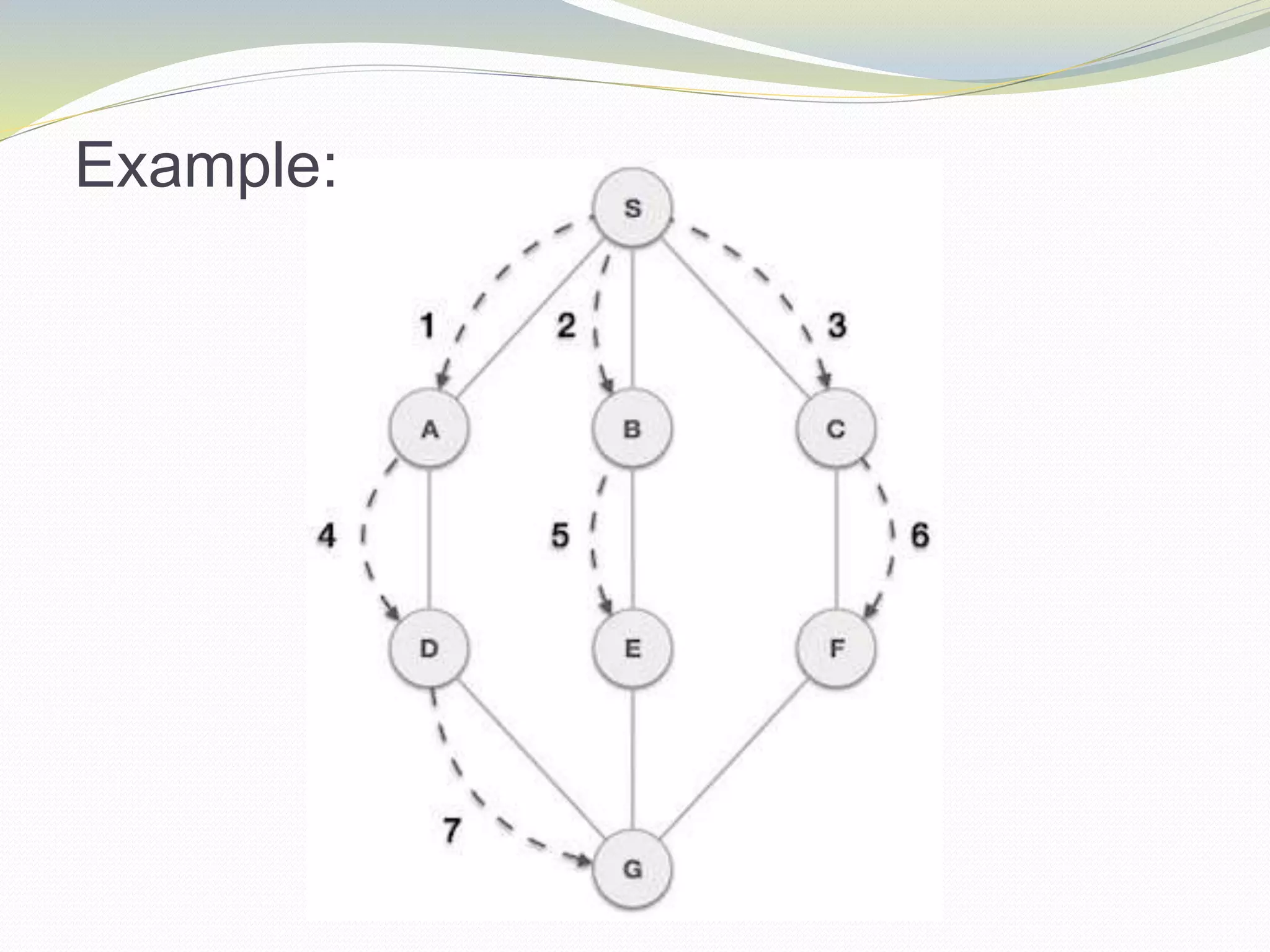
As inthe example given above, BFS algorithm traverses from
A to B to E to F first then to C and G lastly to D. It employs the
following rules. lastly to D. It employs the following rules.
Rule 1 − Visit the adjacent unvisited vertex. Mark it as visited.
Display it. Insert it in a − Visit the adjacent unvisited vertex.
Mark it as visited. Display it. Insert it in a queue. queue. Rule
Rule 2 − If no adjacent vertex is found, remove the first vertex
from the queue. − If no adjacent vertex is found, remove the
first vertex from the queue.
Rule 3 − Repeat Rule 1 and Rule 2 until the queue is empty.
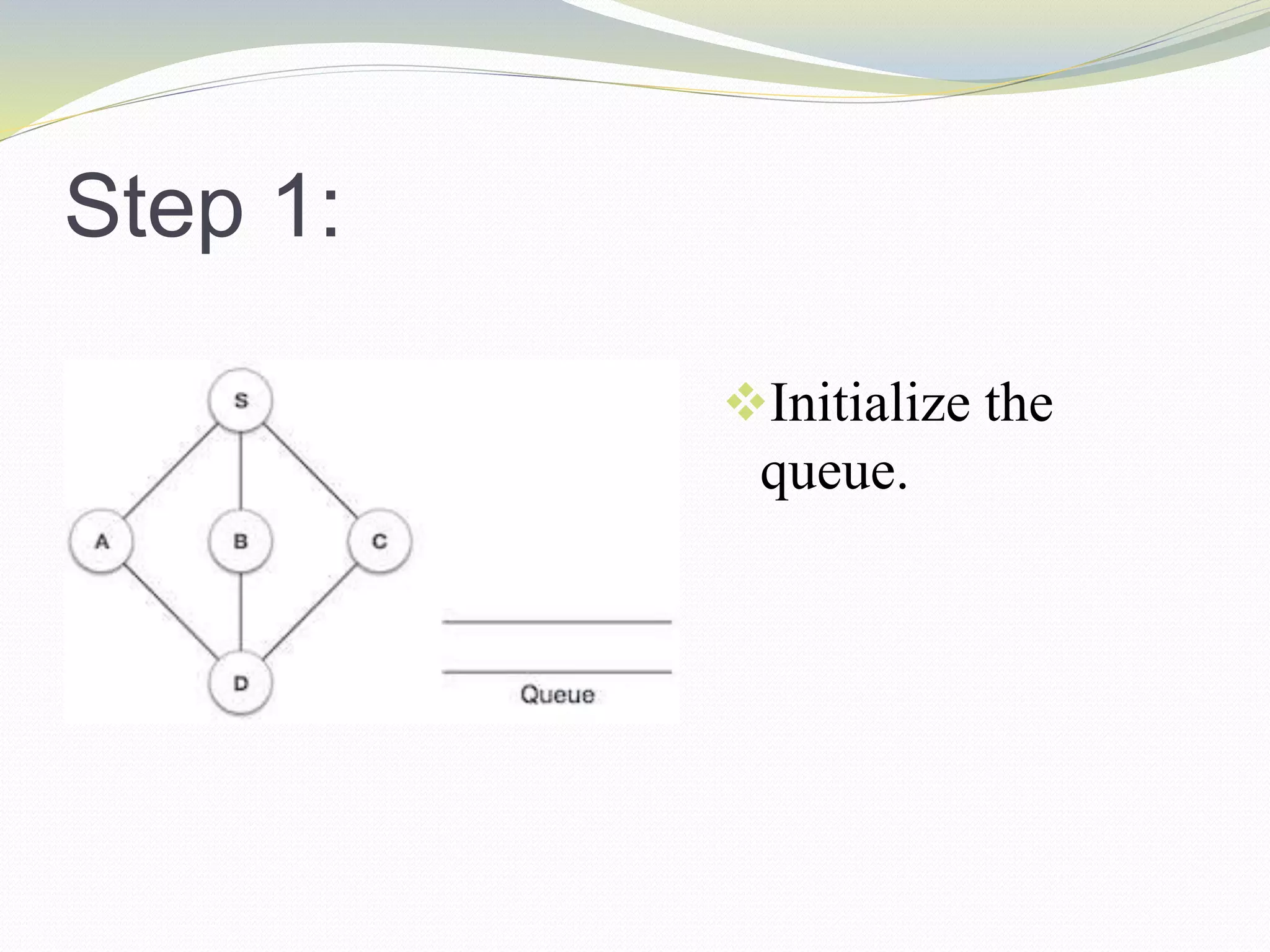
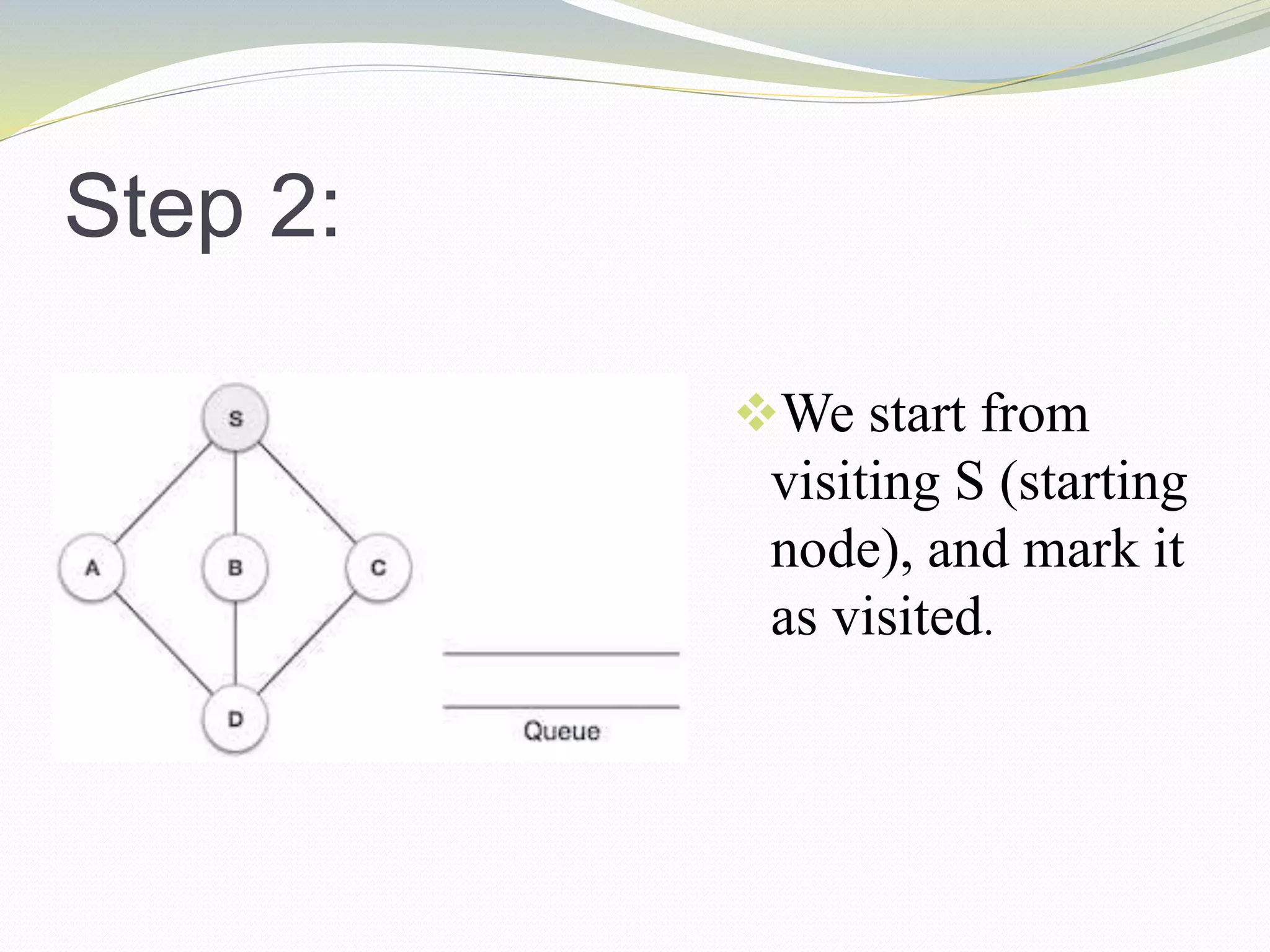
Step 2:
We startfrom
visiting S (starting
node), and mark it
as visited.
12.
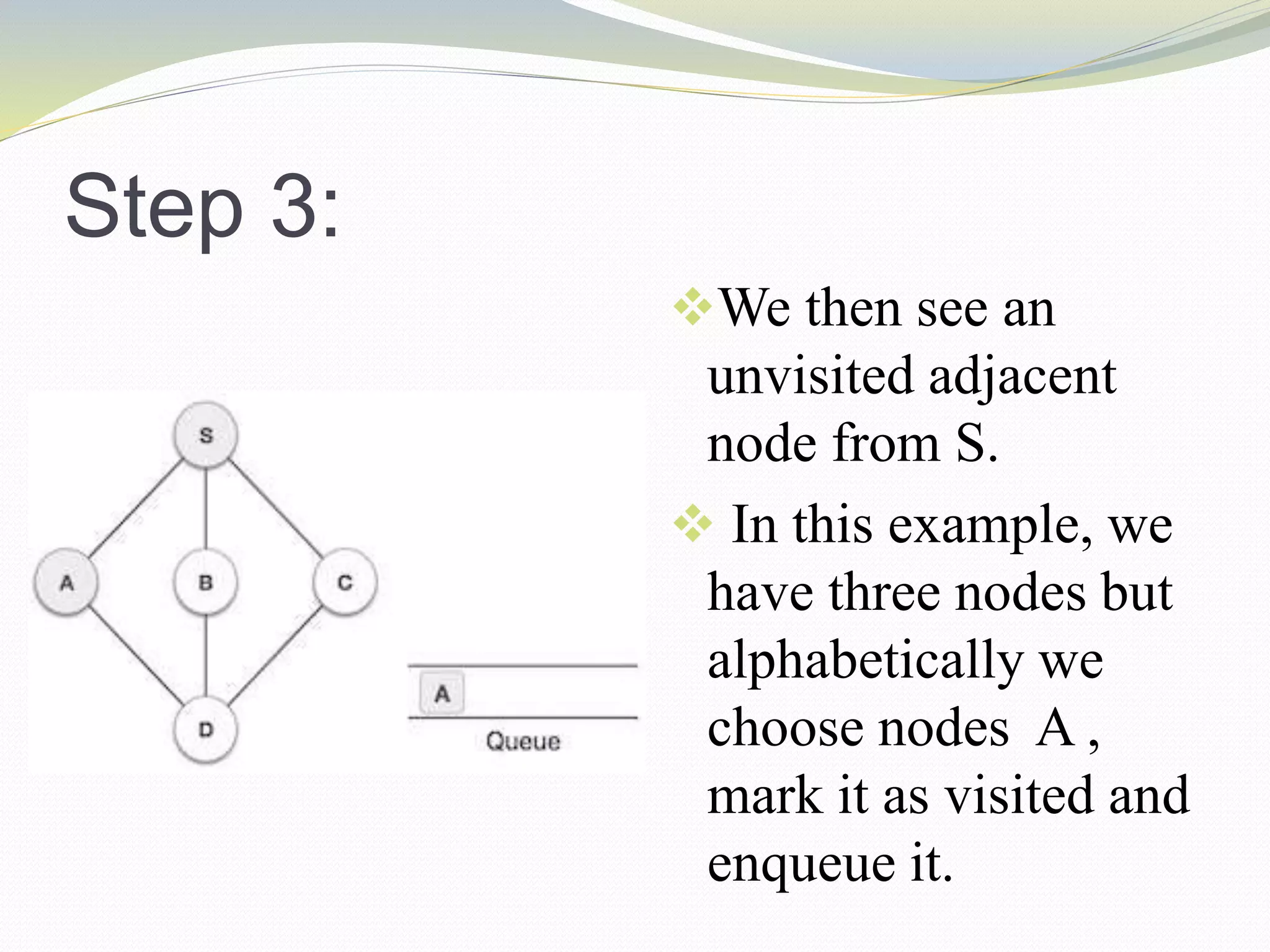
Step 3:
We thensee an
unvisited adjacent
node from S.
In this example, we
have three nodes but
alphabetically we
choose nodes A ,
mark it as visited and
enqueue it.
13.
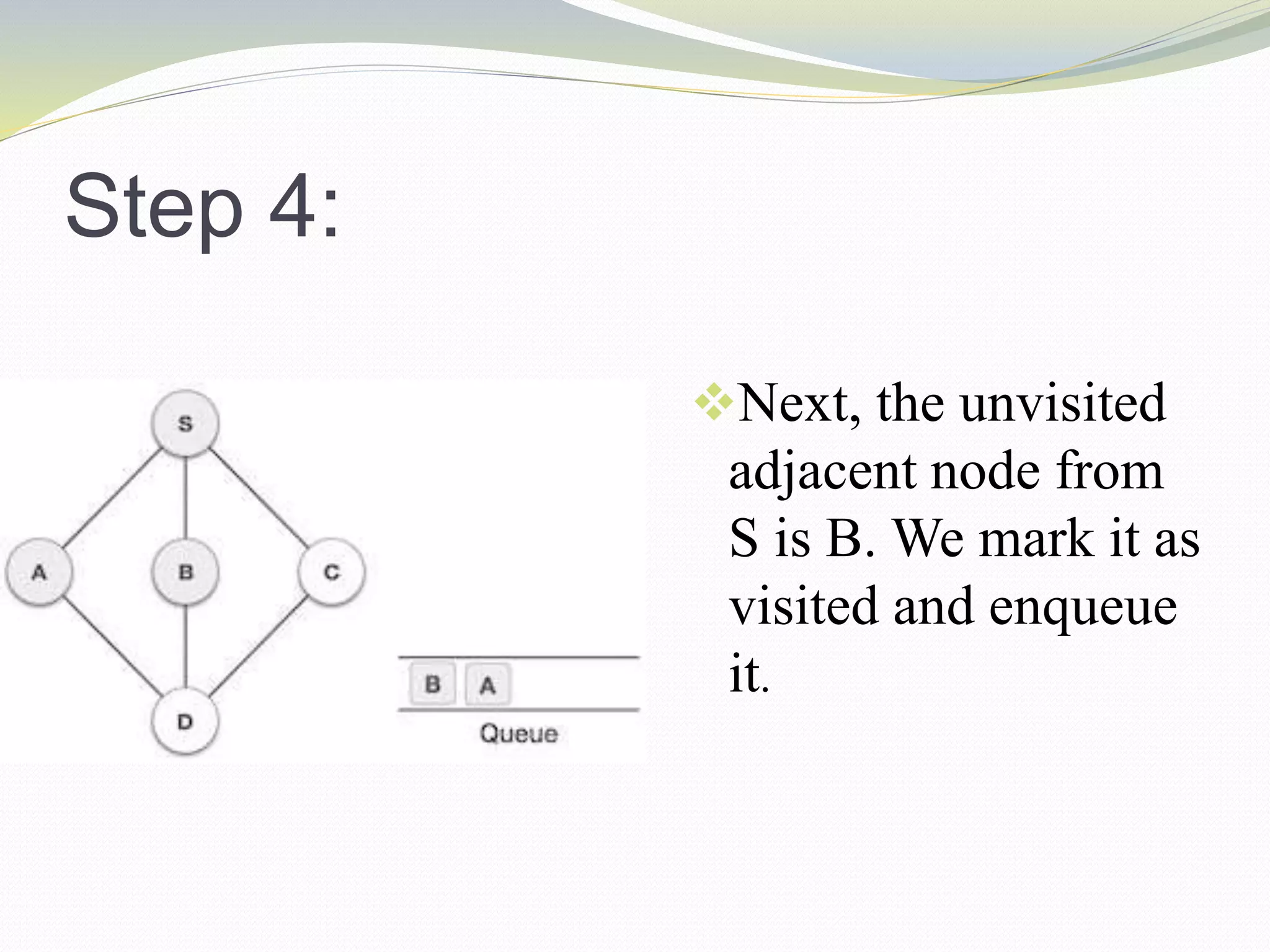
Step 4:
Next, theunvisited
adjacent node from
S is B. We mark it as
visited and enqueue
it.
14.
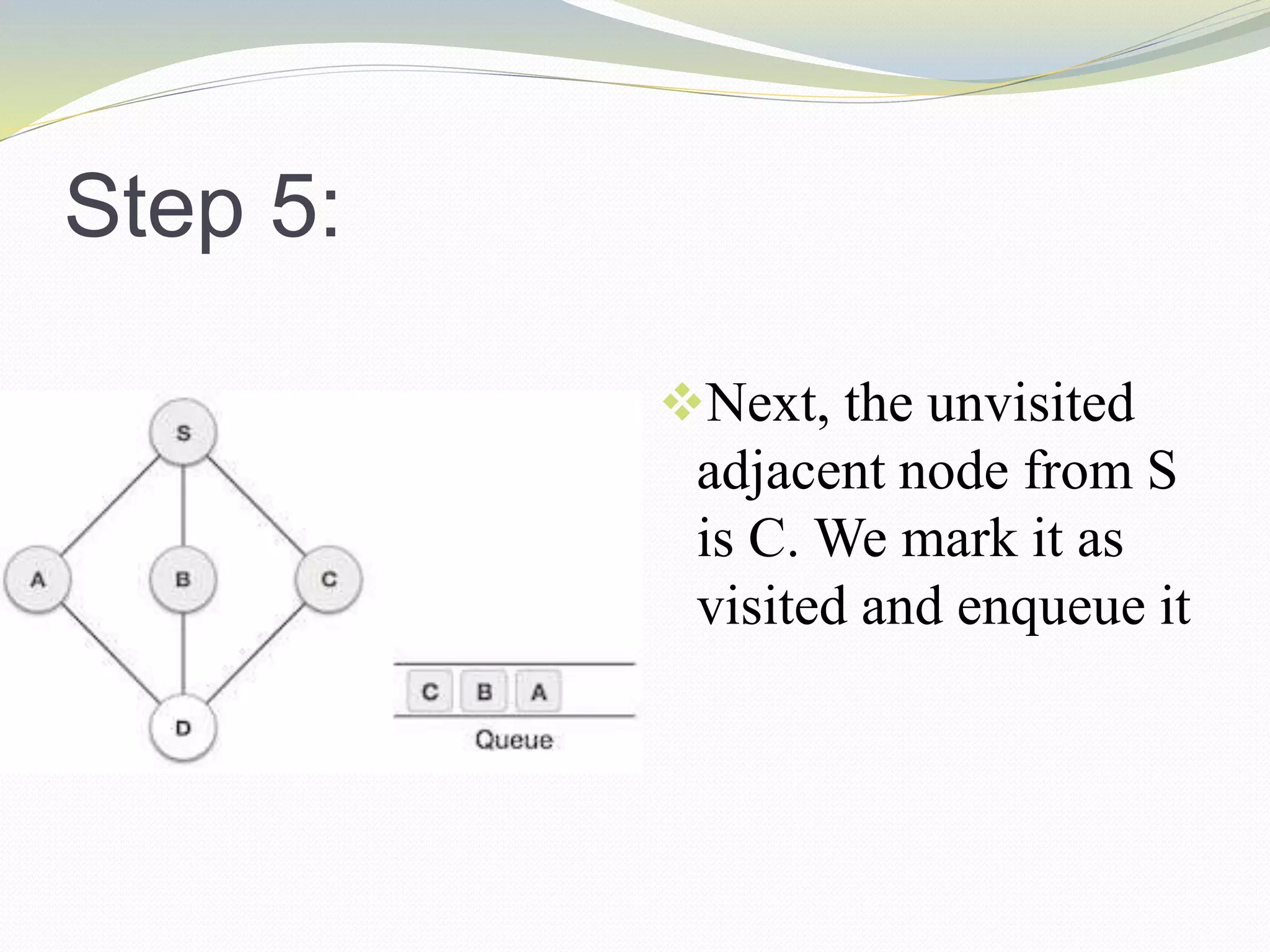
Step 5:
Next, theunvisited
adjacent node from S
is C. We mark it as
visited and enqueue it
15.
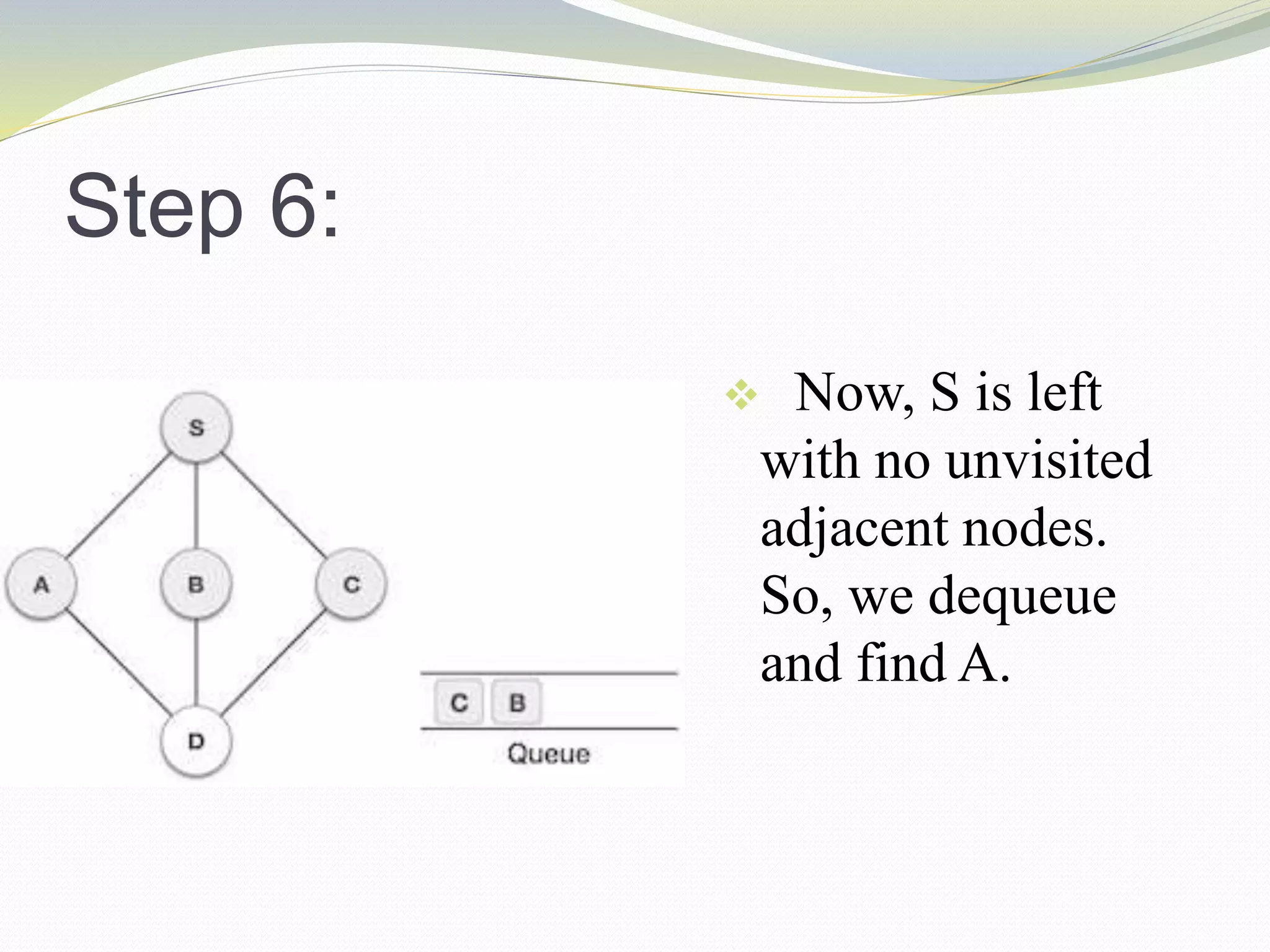
Step 6:
Now,S is left
with no unvisited
adjacent nodes.
So, we dequeue
and find A.
16.
Step 7:
From Awe have
D as unvisited
adjacent node. We
mark it as visited
and enqueue it








![Data Structures - Lecture 9 [Stack & Queue using Linked List]](https://cdn.slidesharecdn.com/ss_thumbnails/lecture-9stackqueueusinglinkedlist-150219032411-conversion-gate02-thumbnail.jpg?width=640&height=640&fit=bounds)


![Depth first search [dfs]](https://cdn.slidesharecdn.com/ss_thumbnails/depthfirstsearchdfs-190926145304-thumbnail.jpg?width=640&height=640&fit=bounds)


