GRAPH SEARCH ALGORITHMS Dept Futures Studies  2010-111
Graph Search Algorithms Systematic search of every edge and every vertex of a graph.
 Graph G=(V,E) is either directed or undirected.
Applications
Compilers
Networks
Routing, Searching, Clustering, etc.Dept Futures Studies  2010-112
Graph Traversal  Breadth First Search (BFS)
Start several paths at a time, and advance in each one step at a time
 Depth First Search (DFS)
Once a possible path is found, continue the search until the end of the path Dept Futures Studies  2010-113
Dept Futures Studies  2010-114Breadth-First SearchBreadth-first search starts at a given vertex s, which is at level 0.
In the first stage, we visit all the vertices that are at the distance of one edge away. When we visit there, we paint as "visited," the vertices adjacent to the start vertex s - these vertices are placed into level 1.
 In the second stage, we visit all the new vertices we can reach at the distance of two edges away from the source vertex s. These new vertices, which are adjacent to level 1 vertices and not previously assigned to a level, are placed into level 2, and so on.
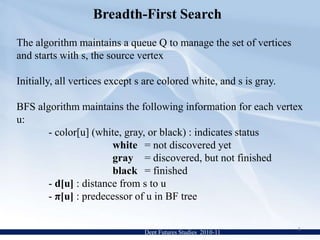
 The BFS traversal terminates when every vertex has been visited.Breadth-First SearchThe algorithm maintains a queue Q to manage the set of vertices and starts with s, the source vertexInitially, all vertices except s are colored white, and s is gray.BFS algorithm maintains the following information for each vertex u:	- color[u] (white, gray, or black) : indicates statuswhite 	= not discovered yetgray	= discovered, but not finishedblack	= finished	- d[u] : distance from s to u	- π[u] : predecessor of u in BF treeDept Futures Studies  2010-115
Each vertex is assigned a color.In general, a vertex is white before we start processing it,it is gray during the period the vertex is being processed, and it is black after the processing of the vertex is completed.Dept Futures Studies  2010-116
BFS AlgorithmInputs: Inputs are a graph(directed or undirected) G =(V, E) and a source vertex s, where s is an element of V. The adjacency list representation of a graph is used in this analysis.Dept Futures Studies  2010-117
Outputs: The outputs are a predecessor graph, which represents the paths travelled in the BFS traversal, and a collection of distances, which represent the distance of each of the vertices from the source vertex.Dept Futures Studies  2010-118
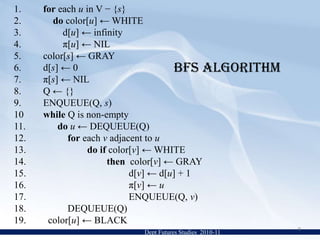
Dept Futures Studies  2010-1191.         for each u in V − {s}             2.             do color[u] ← WHITE3.                 d[u] ← infinity4.                 π[u] ← NIL5.         color[s] ← GRAY                 6.         d[s] ← 0                               7.         π[s] ← NIL                           8.         Q ← {}                              9.         ENQUEUE(Q, s)10        while Q is non-empty11.             dou ← DEQUEUE(Q)                    12.                 for each v adjacent to u                  13.                         do if color[v] ← WHITE       14.                                 then  color[v] ← GRAY15.                                          d[v] ← d[u] + 116.                                          π[v] ← u17.                                          ENQUEUE(Q, v)18.                 DEQUEUE(Q)19.         color[u] ← BLACKBFS Algorithm
1. Enqueue (Q,s)  2. while Q ≠  3.      do u Dequeue(Q) 4.      for each v adjacent to u 5.           doif color[v] = white 6.                then color[v]  gray 7.                       d[v]  d[u] + 1 8.                       [v]  u 9.                       Enqueue(Q,v)     10.     color[u]  blackNote:  If G is not connected, then BFS will not visit theentire graph (withoutsome extra provisionsin the algorithm)Dept Futures Studies  2010-1110
Graph G=(V, E)surtvwxyDept Futures Studies  2010-1111
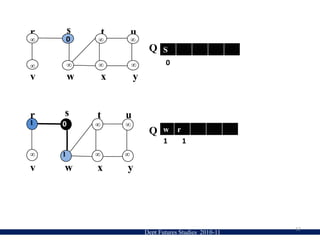
surt0∞∞∞Q0∞∞∞∞vwxysurt10∞∞Q1        1∞∞1∞vwxyDept Futures Studies  2010-1112
1rsut1rsut120∞210∞QQ1       2       21       2       2∞2∞∞212vwxyvwxyDept Futures Studies  2010-1113
rsrsutut11003232QQ2       2      32      3      3∞2123212vwxyvwxyDept Futures Studies  2010-1114
rsut1032Q3      3    3212vwxy3rsut1302Q3          3212vwxyDept Futures Studies  2010-1115
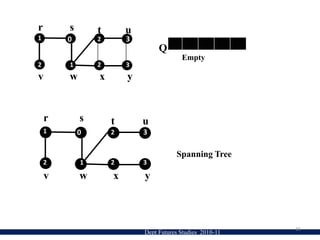
3rsut1302QEmpty3212vwxyrsut1302Spanning Tree3212vwxyDept Futures Studies  2010-1116
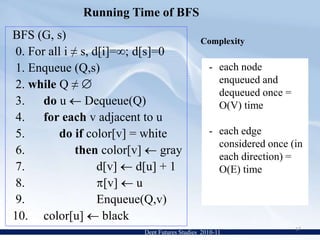
Complexityeach node enqueued and dequeued once = O(V) time
each edge considered once (in each direction) = O(E) timeRunning Time of BFSBFS (G, s)   0. For all i ≠ s, d[i]=∞; d[s]=0  1. Enqueue (Q,s)  2. while Q ≠  3.      do u Dequeue(Q) 4.      for each v adjacent to u 5.           doif color[v] = white 6.                then color[v]  gray 7.                       d[v]  d[u] + 1 8.                       [v]  u 9.                       Enqueue(Q,v)     10.     color[u]  blackDept Futures Studies  2010-1117
Running Time of BFSWe will denote the running time by T(m, n)where m is the number of edges and n is the number of vertices.Let V ′ subset of V be the set of vertices enqueued on Q. Then,T(m, n) =  O(m+ n)Dept Futures Studies  2010-1118
Analysis of Breadth-First SearchShortest-path distance (s,v) :  minimum number of edges in any path from vertex s to v.  If no path exists from s to v, then (s,v) = ∞ The ultimate goal of the proof of correctness is to show that d[v] = (s,v) when the algorithm is done and that a path is found from s to all reachable vertices.Dept Futures Studies  2010-1119
Analysis of Breadth-First SearchLemma 1:Let G = (V, E) be a directed or undirected graph, and let s be an arbitrary vertex in G.  Then for any edge (u, v)  E,(s,v) (s,u) + 1	Case 1:  If u is reachable from s, then so is v.  In this case, the shortest path from s to v can't be longer than the shortest path from s to u followed by the edge (u,v).  Case 2: If u is not reachable from s, then (s,u) = ∞ In either case, the lemma holds. Dept Futures Studies  2010-1120
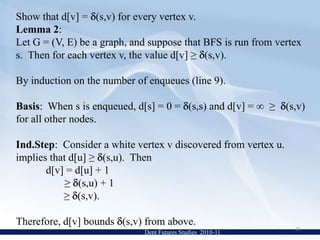
Show that d[v] = (s,v) for every vertex v.Lemma 2:Let G = (V, E) be a graph, and suppose that BFS is run from vertex s.  Then for each vertex v, the value d[v] ≥ (s,v).By induction on the number of enqueues (line 9).  Basis:  When s is enqueued, d[s] = 0 = (s,s) and d[v] = ∞  ≥  (s,v) for all other nodes.Ind.Step:  Consider a white vertex v discovered from vertex u.           implies that d[u] ≥ (s,u).  Then 	d[v] = d[u] + 1			       ≥ (s,u) + 1		                  ≥ (s,v).    		Therefore, d[v] bounds (s,v) from above.Dept Futures Studies  2010-1121

BFS

  • 1.
    GRAPH SEARCH ALGORITHMSDept Futures Studies 2010-111
  • 2.
    Graph Search AlgorithmsSystematic search of every edge and every vertex of a graph.
  • 3.
    Graph G=(V,E)is either directed or undirected.
  • 4.
  • 5.
  • 6.
  • 7.
    Routing, Searching, Clustering,etc.Dept Futures Studies 2010-112
  • 8.
    Graph Traversal Breadth First Search (BFS)
  • 9.
    Start several pathsat a time, and advance in each one step at a time
  • 10.
    Depth FirstSearch (DFS)
  • 11.
    Once a possiblepath is found, continue the search until the end of the path Dept Futures Studies 2010-113
  • 12.
    Dept Futures Studies 2010-114Breadth-First SearchBreadth-first search starts at a given vertex s, which is at level 0.
  • 13.
    In the firststage, we visit all the vertices that are at the distance of one edge away. When we visit there, we paint as "visited," the vertices adjacent to the start vertex s - these vertices are placed into level 1.
  • 14.
    In thesecond stage, we visit all the new vertices we can reach at the distance of two edges away from the source vertex s. These new vertices, which are adjacent to level 1 vertices and not previously assigned to a level, are placed into level 2, and so on.
  • 15.
    The BFStraversal terminates when every vertex has been visited.Breadth-First SearchThe algorithm maintains a queue Q to manage the set of vertices and starts with s, the source vertexInitially, all vertices except s are colored white, and s is gray.BFS algorithm maintains the following information for each vertex u: - color[u] (white, gray, or black) : indicates statuswhite = not discovered yetgray = discovered, but not finishedblack = finished - d[u] : distance from s to u - π[u] : predecessor of u in BF treeDept Futures Studies 2010-115
  • 16.
    Each vertex isassigned a color.In general, a vertex is white before we start processing it,it is gray during the period the vertex is being processed, and it is black after the processing of the vertex is completed.Dept Futures Studies 2010-116
  • 17.
    BFS AlgorithmInputs: Inputsare a graph(directed or undirected) G =(V, E) and a source vertex s, where s is an element of V. The adjacency list representation of a graph is used in this analysis.Dept Futures Studies 2010-117
  • 18.
    Outputs: The outputsare a predecessor graph, which represents the paths travelled in the BFS traversal, and a collection of distances, which represent the distance of each of the vertices from the source vertex.Dept Futures Studies 2010-118
  • 19.
    Dept Futures Studies 2010-1191.         for each u in V − {s}             2.             do color[u] ← WHITE3.                 d[u] ← infinity4.                 π[u] ← NIL5.         color[s] ← GRAY                 6.         d[s] ← 0                               7.         π[s] ← NIL                           8.         Q ← {}                              9.         ENQUEUE(Q, s)10        while Q is non-empty11.             dou ← DEQUEUE(Q)                    12.                 for each v adjacent to u                  13.                         do if color[v] ← WHITE       14.                                 then  color[v] ← GRAY15.                                          d[v] ← d[u] + 116.                                          π[v] ← u17.                                          ENQUEUE(Q, v)18.                 DEQUEUE(Q)19.         color[u] ← BLACKBFS Algorithm
  • 20.
    1. Enqueue (Q,s) 2. while Q ≠  3. do u Dequeue(Q) 4. for each v adjacent to u 5. doif color[v] = white 6. then color[v]  gray 7. d[v]  d[u] + 1 8. [v]  u 9. Enqueue(Q,v) 10. color[u]  blackNote: If G is not connected, then BFS will not visit theentire graph (withoutsome extra provisionsin the algorithm)Dept Futures Studies 2010-1110
  • 21.
    Graph G=(V, E)surtvwxyDeptFutures Studies 2010-1111
  • 22.
    surt0∞∞∞Q0∞∞∞∞vwxysurt10∞∞Q1 1∞∞1∞vwxyDept Futures Studies 2010-1112
  • 23.
    1rsut1rsut120∞210∞QQ1 2 21 2 2∞2∞∞212vwxyvwxyDept Futures Studies 2010-1113
  • 24.
    rsrsutut11003232QQ2 2 32 3 3∞2123212vwxyvwxyDept Futures Studies 2010-1114
  • 25.
    rsut1032Q3 3 3212vwxy3rsut1302Q3 3212vwxyDept Futures Studies 2010-1115
  • 26.
  • 27.
    Complexityeach node enqueuedand dequeued once = O(V) time
  • 28.
    each edge consideredonce (in each direction) = O(E) timeRunning Time of BFSBFS (G, s) 0. For all i ≠ s, d[i]=∞; d[s]=0 1. Enqueue (Q,s) 2. while Q ≠  3. do u Dequeue(Q) 4. for each v adjacent to u 5. doif color[v] = white 6. then color[v]  gray 7. d[v]  d[u] + 1 8. [v]  u 9. Enqueue(Q,v) 10. color[u]  blackDept Futures Studies 2010-1117
  • 29.
    Running Time ofBFSWe will denote the running time by T(m, n)where m is the number of edges and n is the number of vertices.Let V ′ subset of V be the set of vertices enqueued on Q. Then,T(m, n) = O(m+ n)Dept Futures Studies 2010-1118
  • 30.
    Analysis of Breadth-FirstSearchShortest-path distance (s,v) : minimum number of edges in any path from vertex s to v. If no path exists from s to v, then (s,v) = ∞ The ultimate goal of the proof of correctness is to show that d[v] = (s,v) when the algorithm is done and that a path is found from s to all reachable vertices.Dept Futures Studies 2010-1119
  • 31.
    Analysis of Breadth-FirstSearchLemma 1:Let G = (V, E) be a directed or undirected graph, and let s be an arbitrary vertex in G. Then for any edge (u, v)  E,(s,v) (s,u) + 1 Case 1: If u is reachable from s, then so is v. In this case, the shortest path from s to v can't be longer than the shortest path from s to u followed by the edge (u,v). Case 2: If u is not reachable from s, then (s,u) = ∞ In either case, the lemma holds. Dept Futures Studies 2010-1120
  • 32.
    Show that d[v]= (s,v) for every vertex v.Lemma 2:Let G = (V, E) be a graph, and suppose that BFS is run from vertex s. Then for each vertex v, the value d[v] ≥ (s,v).By induction on the number of enqueues (line 9). Basis: When s is enqueued, d[s] = 0 = (s,s) and d[v] = ∞ ≥ (s,v) for all other nodes.Ind.Step: Consider a white vertex v discovered from vertex u. implies that d[u] ≥ (s,u). Then d[v] = d[u] + 1 ≥ (s,u) + 1 ≥ (s,v). Therefore, d[v] bounds (s,v) from above.Dept Futures Studies 2010-1121