114/07/15 2
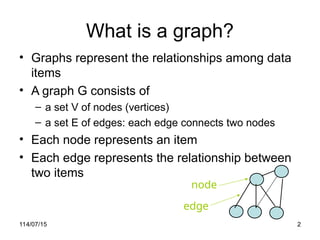
What isa graph?
• Graphs represent the relationships among data
items
• A graph G consists of
– a set V of nodes (vertices)
– a set E of edges: each edge connects two nodes
• Each node represents an item
• Each edge represents the relationship between
two items
node
edge
3.
114/07/15 3
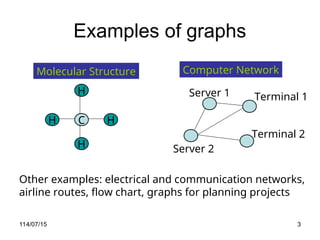
Examples ofgraphs
H
H
C H
H
Molecular Structure
Server 1
Server 2
Terminal 1
Terminal 2
Computer Network
Other examples: electrical and communication networks,
airline routes, flow chart, graphs for planning projects
4.
114/07/15 4
Formal Definitionof graph
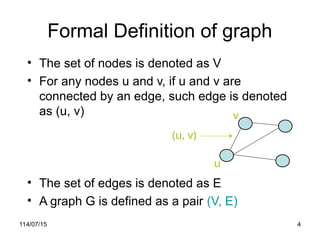
• The set of nodes is denoted as V
• For any nodes u and v, if u and v are
connected by an edge, such edge is denoted
as (u, v)
• The set of edges is denoted as E
• A graph G is defined as a pair (V, E)
v
u
(u, v)
5.
114/07/15 5
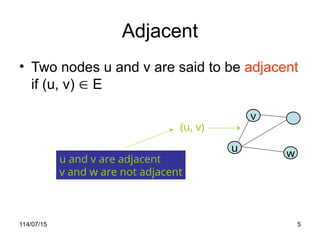
Adjacent
• Twonodes u and v are said to be adjacent
if (u, v) E
v
w
u
(u, v)
u and v are adjacent
v and w are not adjacent
6.
114/07/15 6
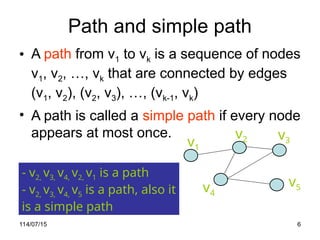
Path andsimple path
• A path from v1 to vk is a sequence of nodes
v1, v2, …, vk that are connected by edges
(v1, v2), (v2, v3), …, (vk-1, vk)
• A path is called a simple path if every node
appears at most once.
v1
v2
v4
v3
v5
- v2, v3, v4, v2, v1 is a path
- v2, v3, v4, v5 is a path, also it
is a simple path
7.
114/07/15 7
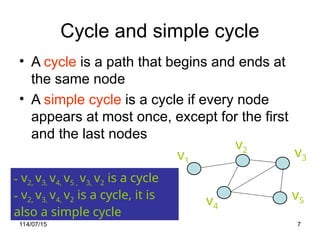
Cycle andsimple cycle
• A cycle is a path that begins and ends at
the same node
• A simple cycle is a cycle if every node
appears at most once, except for the first
and the last nodes
v1
v2
v4
v3
v5
- v2, v3, v4, v5 , v3, v2 is a cycle
- v2, v3, v4, v2 is a cycle, it is
also a simple cycle
8.
114/07/15 8
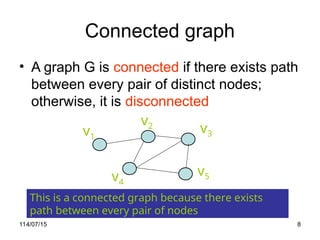
Connected graph
•A graph G is connected if there exists path
between every pair of distinct nodes;
otherwise, it is disconnected
v1
v4
v3
v5
v2
This is a connected graph because there exists
path between every pair of nodes
9.
114/07/15 9
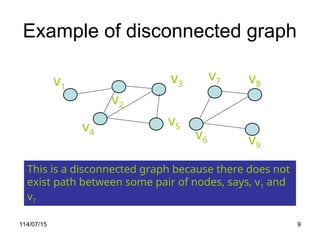
Example ofdisconnected graph
v1
v4
v3
v5
v2
This is a disconnected graph because there does not
exist path between some pair of nodes, says, v1 and
v7
v7
v6
v8
v9
10.
114/07/15 10
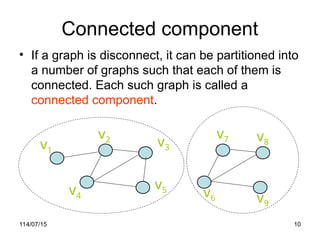
Connected component
•If a graph is disconnect, it can be partitioned into
a number of graphs such that each of them is
connected. Each such graph is called a
connected component.
v1
v4
v3
v5
v2 v7
v6
v8
v9
11.
114/07/15 11
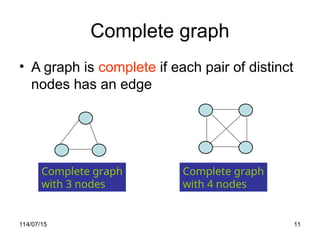
Complete graph
•A graph is complete if each pair of distinct
nodes has an edge
Complete graph
with 3 nodes
Complete graph
with 4 nodes
12.
114/07/15 12
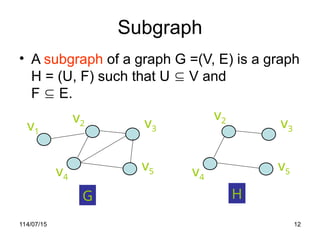
Subgraph
• Asubgraph of a graph G =(V, E) is a graph
H = (U, F) such that U V and
F E.
v1
v4
v3
v5
v2
G
v4
v3
v5
v2
H
13.
114/07/15 13
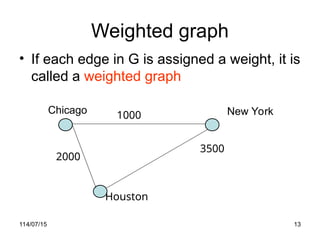
Weighted graph
•If each edge in G is assigned a weight, it is
called a weighted graph
Houston
Chicago 1000
2000
3500
New York
14.
114/07/15 14
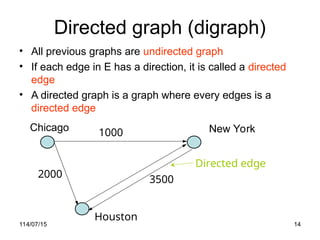
Directed graph(digraph)
• All previous graphs are undirected graph
• If each edge in E has a direction, it is called a directed
edge
• A directed graph is a graph where every edges is a
directed edge
Directed edge
Houston
Chicago 1000
2000 3500
New York
15.
114/07/15 15
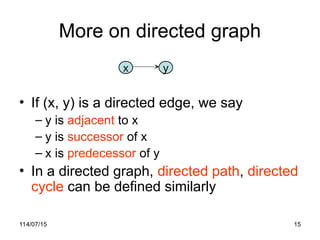
More ondirected graph
• If (x, y) is a directed edge, we say
– y is adjacent to x
– y is successor of x
– x is predecessor of y
• In a directed graph, directed path, directed
cycle can be defined similarly
y
x
114/07/15 17
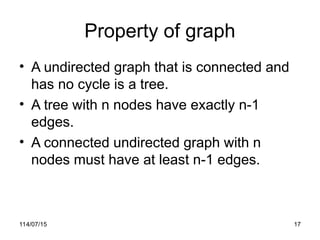
Property ofgraph
• A undirected graph that is connected and
has no cycle is a tree.
• A tree with n nodes have exactly n-1
edges.
• A connected undirected graph with n
nodes must have at least n-1 edges.
18.
114/07/15 18
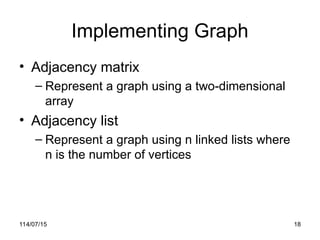
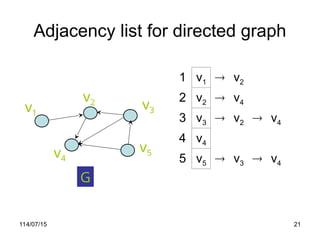
Implementing Graph
•Adjacency matrix
– Represent a graph using a two-dimensional
array
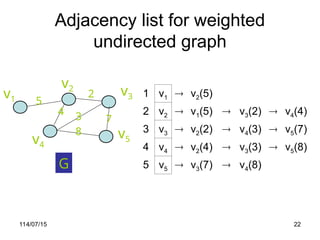
• Adjacency list
– Represent a graph using n linked lists where
n is the number of vertices
114/07/15 23
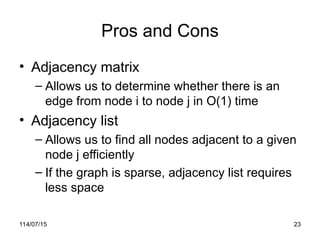
Pros andCons
• Adjacency matrix
– Allows us to determine whether there is an
edge from node i to node j in O(1) time
• Adjacency list
– Allows us to find all nodes adjacent to a given
node j efficiently
– If the graph is sparse, adjacency list requires
less space
114/07/15 25
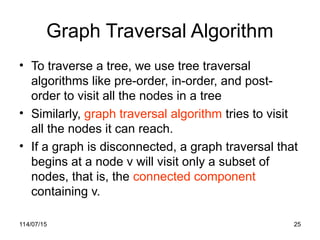
Graph TraversalAlgorithm
• To traverse a tree, we use tree traversal
algorithms like pre-order, in-order, and post-
order to visit all the nodes in a tree
• Similarly, graph traversal algorithm tries to visit
all the nodes it can reach.
• If a graph is disconnected, a graph traversal that
begins at a node v will visit only a subset of
nodes, that is, the connected component
containing v.
26.
114/07/15 26
Two basictraversal algorithms
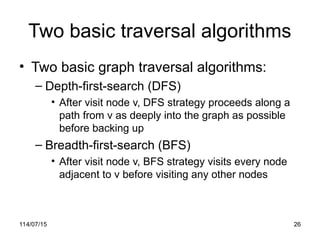
• Two basic graph traversal algorithms:
– Depth-first-search (DFS)
• After visit node v, DFS strategy proceeds along a
path from v as deeply into the graph as possible
before backing up
– Breadth-first-search (BFS)
• After visit node v, BFS strategy visits every node
adjacent to v before visiting any other nodes
27.
114/07/15 27
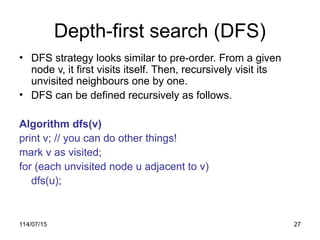
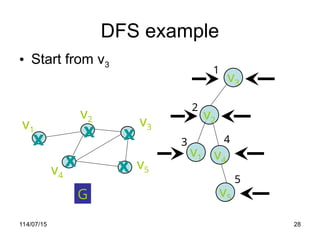
Depth-first search(DFS)
• DFS strategy looks similar to pre-order. From a given
node v, it first visits itself. Then, recursively visit its
unvisited neighbours one by one.
• DFS can be defined recursively as follows.
Algorithm dfs(v)
print v; // you can do other things!
mark v as visited;
for (each unvisited node u adjacent to v)
dfs(u);
114/07/15 29
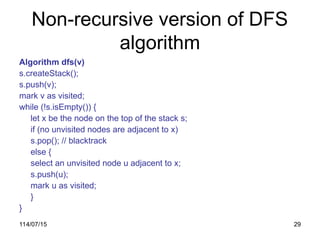
Non-recursive versionof DFS
algorithm
Algorithm dfs(v)
s.createStack();
s.push(v);
mark v as visited;
while (!s.isEmpty()) {
let x be the node on the top of the stack s;
if (no unvisited nodes are adjacent to x)
s.pop(); // blacktrack
else {
select an unvisited node u adjacent to x;
s.push(u);
mark u as visited;
}
}
30.
114/07/15 30
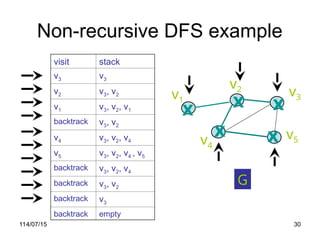
Non-recursive DFSexample
v1
v4
v3
v5
v2
G
visit stack
v3 v3
v2 v3, v2
v1 v3, v2, v1
backtrack v3, v2
v4 v3, v2, v4
v5 v3, v2, v4 , v5
backtrack v3, v2, v4
backtrack v3, v2
backtrack v3
backtrack empty
x
x
x
x x
31.
114/07/15 31
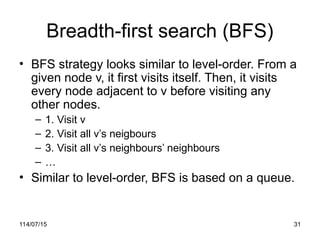
Breadth-first search(BFS)
• BFS strategy looks similar to level-order. From a
given node v, it first visits itself. Then, it visits
every node adjacent to v before visiting any
other nodes.
– 1. Visit v
– 2. Visit all v’s neigbours
– 3. Visit all v’s neighbours’ neighbours
– …
• Similar to level-order, BFS is based on a queue.
32.
114/07/15 32
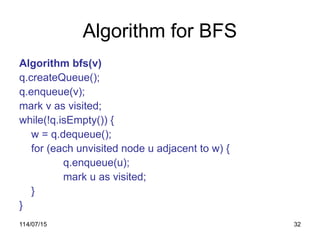
Algorithm forBFS
Algorithm bfs(v)
q.createQueue();
q.enqueue(v);
mark v as visited;
while(!q.isEmpty()) {
w = q.dequeue();
for (each unvisited node u adjacent to w) {
q.enqueue(u);
mark u as visited;
}
}
33.
114/07/15 33
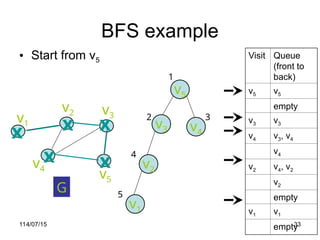
BFS example
•Start from v5
v5
1
v3
2
v4
3
v2
4
v1
5
v1
v4
v3
v5
v2
G
x
Visit Queue
(front to
back)
v5 v5
empty
v3 v3
v4 v3, v4
v4
v2 v4, v2
v2
empty
v1 v1
empty
x
x
x x
34.
114/07/15 34
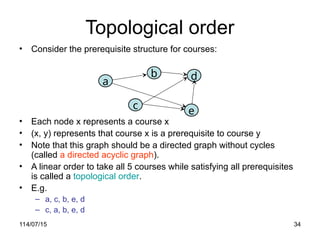
Topological order
•Consider the prerequisite structure for courses:
• Each node x represents a course x
• (x, y) represents that course x is a prerequisite to course y
• Note that this graph should be a directed graph without cycles
(called a directed acyclic graph).
• A linear order to take all 5 courses while satisfying all prerequisites
is called a topological order.
• E.g.
– a, c, b, e, d
– c, a, b, e, d
b d
e
c
a
35.
114/07/15 35
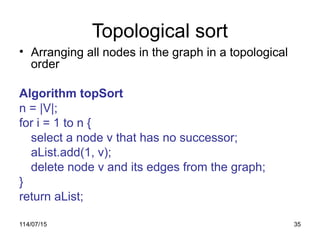
Topological sort
•Arranging all nodes in the graph in a topological
order
Algorithm topSort
n = |V|;
for i = 1 to n {
select a node v that has no successor;
aList.add(1, v);
delete node v and its edges from the graph;
}
return aList;
36.
114/07/15 36
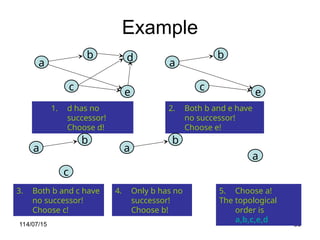
Example
b d
e
c
a
1.d has no
successor!
Choose d!
a
5. Choose a!
The topological
order is
a,b,c,e,d
2. Both b and e have
no successor!
Choose e!
b
e
c
a
3. Both b and c have
no successor!
Choose c!
b
c
a
4. Only b has no
successor!
Choose b!
b
a
37.
114/07/15 37
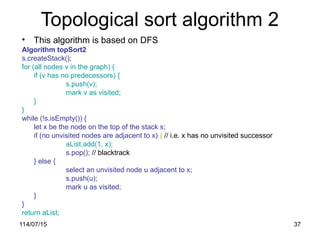
Topological sortalgorithm 2
• This algorithm is based on DFS
Algorithm topSort2
s.createStack();
for (all nodes v in the graph) {
if (v has no predecessors) {
s.push(v);
mark v as visited;
}
}
while (!s.isEmpty()) {
let x be the node on the top of the stack s;
if (no unvisited nodes are adjacent to x) { // i.e. x has no unvisited successor
aList.add(1, x);
s.pop(); // blacktrack
} else {
select an unvisited node u adjacent to x;
s.push(u);
mark u as visited;
}
}
return aList;
38.
114/07/15 38
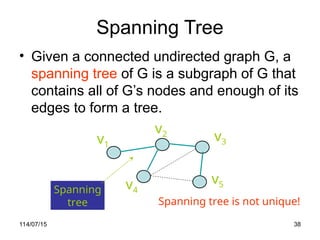
Spanning Tree
•Given a connected undirected graph G, a
spanning tree of G is a subgraph of G that
contains all of G’s nodes and enough of its
edges to form a tree.
v1
v4
v3
v5
v2
Spanning
tree Spanning tree is not unique!
39.
114/07/15 39
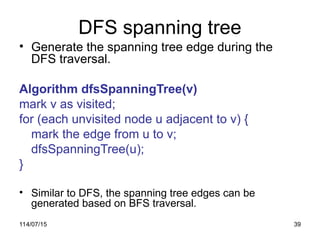
DFS spanningtree
• Generate the spanning tree edge during the
DFS traversal.
Algorithm dfsSpanningTree(v)
mark v as visited;
for (each unvisited node u adjacent to v) {
mark the edge from u to v;
dfsSpanningTree(u);
}
• Similar to DFS, the spanning tree edges can be
generated based on BFS traversal.
40.
114/07/15 40
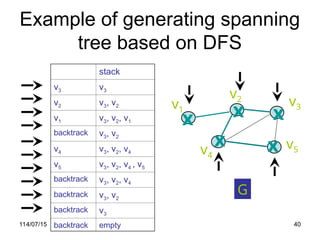
Example ofgenerating spanning
tree based on DFS
v1
v4
v3
v5
v2
G
stack
v3 v3
v2 v3, v2
v1 v3, v2, v1
backtrack v3, v2
v4 v3, v2, v4
v5 v3, v2, v4 , v5
backtrack v3, v2, v4
backtrack v3, v2
backtrack v3
backtrack empty
x
x
x
x x
41.
114/07/15 41
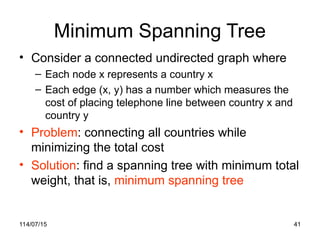
Minimum SpanningTree
• Consider a connected undirected graph where
– Each node x represents a country x
– Each edge (x, y) has a number which measures the
cost of placing telephone line between country x and
country y
• Problem: connecting all countries while
minimizing the total cost
• Solution: find a spanning tree with minimum total
weight, that is, minimum spanning tree
42.
114/07/15 42
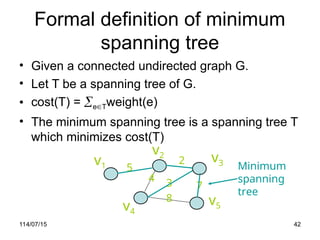
Formal definitionof minimum
spanning tree
• Given a connected undirected graph G.
• Let T be a spanning tree of G.
• cost(T) = eTweight(e)
• The minimum spanning tree is a spanning tree T
which minimizes cost(T)
v1
v4
v3
v5
v2
5
2
3 7
8
4
Minimum
spanning
tree
43.
114/07/15 43
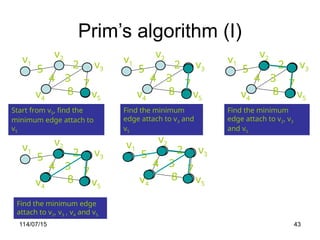
Prim’s algorithm(I)
Start from v5, find the
minimum edge attach to
v5
v2
v1
v4
v3
v5
5 2
3 7
8
4
Find the minimum
edge attach to v3 and
v5
v2
v1
v4
v3
v5
5 2
3 7
8
4
Find the minimum
edge attach to v2, v3
and v5
v2
v1
v4
v3
v5
5 2
3 7
8
4
v2
v1
v4
v3
v5
5 2
3 7
8
4
v2
v1
v4
v3
v5
5 2
3 7
8
4
Find the minimum edge
attach to v2, v3 , v4 and v5
44.
114/07/15 44
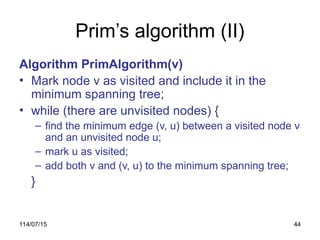
Prim’s algorithm(II)
Algorithm PrimAlgorithm(v)
• Mark node v as visited and include it in the
minimum spanning tree;
• while (there are unvisited nodes) {
– find the minimum edge (v, u) between a visited node v
and an unvisited node u;
– mark u as visited;
– add both v and (v, u) to the minimum spanning tree;
}
45.
114/07/15 45
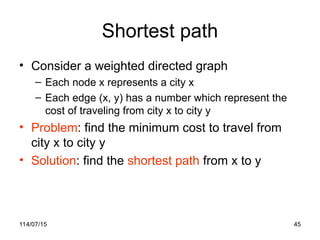
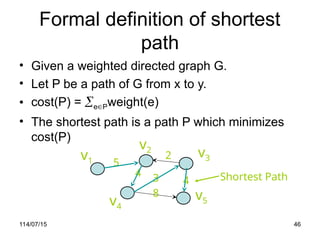
Shortest path
•Consider a weighted directed graph
– Each node x represents a city x
– Each edge (x, y) has a number which represent the
cost of traveling from city x to city y
• Problem: find the minimum cost to travel from
city x to city y
• Solution: find the shortest path from x to y
46.
114/07/15 46
Formal definitionof shortest
path
• Given a weighted directed graph G.
• Let P be a path of G from x to y.
• cost(P) = ePweight(e)
• The shortest path is a path P which minimizes
cost(P)
v2
v1
v4
v3
v5
5
2
3 4
8
4 Shortest Path
47.
114/07/15 47
Dijkstra’s algorithm
•Consider a graph G, each edge (u, v) has
a weight w(u, v) > 0.
• Suppose we want to find the shortest path
starting from v1 to any node vi
• Let VS be a subset of nodes in G
• Let cost[vi] be the weight of the shortest
path from v1 to vi that passes through
nodes in VS only.
48.
114/07/15 48
Example forDijkstra’s algorithm
v2
v1
v4
v3
v5
5
2
3 4
8
4
v VS cost[v1] cost[v2] cost[v3] cost[v4] cost[v5]
1 [v1] 0 5 ∞ ∞ ∞
114/07/15 52
Dijkstra’s algorithm
AlgorithmshortestPath()
n = number of nodes in the graph;
for i = 1 to n
cost[vi] = w(v1, vi);
VS = { v1 };
for step = 2 to n {
find the smallest cost[vi] s.t. vi is not in VS;
include vi to VS;
for (all nodes vj not in VS) {
if (cost[vj] > cost[vi] + w(vi, vj))
cost[vj] = cost[vi] + w(vi, vj);
}
}
53.
114/07/15 53
Summary
• Graphscan be used to represent many real-life
problems.
• There are numerous important graph algorithms.
• We have studied some basic concepts and
algorithms.
– Graph Traversal
– Topological Sort
– Spanning Tree
– Minimum Spanning Tree
– Shortest Path

![114/07/15 19
Adjacency matrix for directed graph
v1
v4
v3
v5
v2
G
1 2 3 4 5
v1 v2 v3 v4 v5
1 v1 0 1 0 0 0
2 v2 0 0 0 1 0
3 v3 0 1 0 1 0
4 v4 0 0 0 0 0
5 v5 0 0 1 1 0
Matrix[i][j] = 1 if (vi, vj)E
0 if (vi, vj)E](https://image.slidesharecdn.com/cs201-tree-graph-250715040401-4a8dff73/85/cs201-tree-graph-as-a-data-structure-ppt-19-320.jpg)
![114/07/15 20
Adjacency matrix for weighted
undirected graph
v1
v4
v3
v5
v2
G
1 2 3 4 5
v1 v2 v3 v4 v5
1 v1 ∞ 5 ∞ ∞ ∞
2 v2 5 ∞ 2 4 ∞
3 v3 0 2 ∞ 3 7
4 v4 ∞ 4 3 ∞ 8
5 v5 ∞ ∞ 7 8 ∞
Matrix[i][j] = w(vi, vj) if (vi, vj)E or (vj, vi)E
∞ otherwise
5
2
3 7
8
4](https://image.slidesharecdn.com/cs201-tree-graph-250715040401-4a8dff73/85/cs201-tree-graph-as-a-data-structure-ppt-20-320.jpg)
![114/07/15 47
Dijkstra’s algorithm
• Consider a graph G, each edge (u, v) has
a weight w(u, v) > 0.
• Suppose we want to find the shortest path
starting from v1 to any node vi
• Let VS be a subset of nodes in G
• Let cost[vi] be the weight of the shortest
path from v1 to vi that passes through
nodes in VS only.](https://image.slidesharecdn.com/cs201-tree-graph-250715040401-4a8dff73/85/cs201-tree-graph-as-a-data-structure-ppt-47-320.jpg)
![114/07/15 48
Example for Dijkstra’s algorithm
v2
v1
v4
v3
v5
5
2
3 4
8
4
v VS cost[v1] cost[v2] cost[v3] cost[v4] cost[v5]
1 [v1] 0 5 ∞ ∞ ∞](https://image.slidesharecdn.com/cs201-tree-graph-250715040401-4a8dff73/85/cs201-tree-graph-as-a-data-structure-ppt-48-320.jpg)
![114/07/15 49
Example for Dijkstra’s algorithm
v2
v1
v4
v3
v5
5
2
3 4
8
4
v VS cost[v1] cost[v2] cost[v3] cost[v4] cost[v5]
1 [v1] 0 5 ∞ ∞ ∞
2 v2 [v1, v2] 0 5 ∞ 9 ∞](https://image.slidesharecdn.com/cs201-tree-graph-250715040401-4a8dff73/85/cs201-tree-graph-as-a-data-structure-ppt-49-320.jpg)
![114/07/15 50
Example for Dijkstra’s algorithm
v2
v1
v4
v3
v5
5
2
3 4
8
4
v VS cost[v1] cost[v2] cost[v3] cost[v4] cost[v5]
1 [v1] 0 5 ∞ ∞ ∞
2 v2 [v1, v2] 0 5 ∞ 9 ∞
3 v4 [v1, v2, v4] 0 5 12 9 17](https://image.slidesharecdn.com/cs201-tree-graph-250715040401-4a8dff73/85/cs201-tree-graph-as-a-data-structure-ppt-50-320.jpg)
![114/07/15 51
Example for Dijkstra’s algorithm
v2
v1
v4
v3
v5
5
2
3 4
8
4
v VS cost[v1] cost[v2] cost[v3] cost[v4] cost[v5]
1 [v1] 0 5 ∞ ∞ ∞
2 v2 [v1, v2] 0 5 ∞ 9 ∞
3 v4 [v1, v2, v4] 0 5 12 9 17
4 v3 [v1, v2, v4, v3] 0 5 12 9 16
5 v5 [v1, v2, v4, v3, v5] 0 5 12 9 16](https://image.slidesharecdn.com/cs201-tree-graph-250715040401-4a8dff73/85/cs201-tree-graph-as-a-data-structure-ppt-51-320.jpg)
![114/07/15 52
Dijkstra’s algorithm
Algorithm shortestPath()
n = number of nodes in the graph;
for i = 1 to n
cost[vi] = w(v1, vi);
VS = { v1 };
for step = 2 to n {
find the smallest cost[vi] s.t. vi is not in VS;
include vi to VS;
for (all nodes vj not in VS) {
if (cost[vj] > cost[vi] + w(vi, vj))
cost[vj] = cost[vi] + w(vi, vj);
}
}](https://image.slidesharecdn.com/cs201-tree-graph-250715040401-4a8dff73/85/cs201-tree-graph-as-a-data-structure-ppt-52-320.jpg)