Topological sorting is a linear ordering of vertices in a directed acyclic graph (DAG). It is performed by recursively processing vertices with no incoming edges before others. The algorithm uses a stack to push vertices after processing their adjacent vertices. It has applications in project scheduling, circuit design, and detecting cyclic dependencies. The time complexity is O(V+E) where V is vertices and E is edges.
Topological Sort
•It isa Linear ordering of its vertices such that for
every directed edge uv for Vertex u to v , u
comes before vertex v in the ordering.
•Graph Should be Directed Acyclic Graph (DAG)
•Every DAG will have atleast one Topological
Ordering
3.
What is DirectedAcyclic Graph(DAG)
• All rooted trees have a topological ordering since the do not contain
any cycle.
• Topological Ordering
• Picking from the bottom once root of subtree has create out children the
procedure continues so that we have no node’’
• In DFS, we print a vertex and then recursively call DFS for its adjacent
vertices. In topological sorting, we need to print a vertex before its
adjacent vertices.
4.
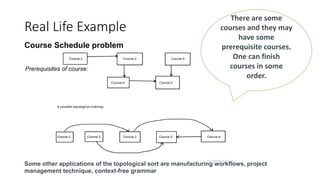
Real Life Example
Someother applications of the topological sort are manufacturing workflows, project
management technique, context-free grammar
Course Schedule problem
There are some
courses and they may
have some
prerequisite courses.
One can finish
courses in some
order.
Prerequisites of course:
5.
Algorithm of TopologicalSort
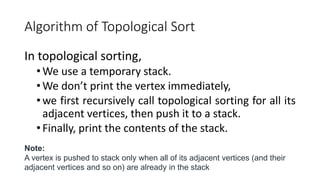
In topological sorting,
•We use a temporary stack.
•We don’t print the vertex immediately,
•we first recursively call topological sorting for all its
adjacent vertices, then push it to a stack.
•Finally, print the contents of the stack.
Note:
A vertex is pushed to stack only when all of its adjacent vertices (and their
adjacent vertices and so on) are already in the stack
6.
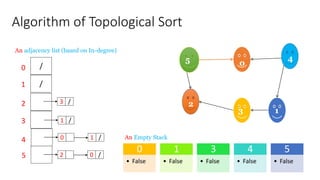
Algorithm of TopologicalSort
1
3
0
B
2
5 4
0
1
2
3 1 /
/
3 /
1 /
0
/
4
5 0 /
2
0
• False
1
• False
3
• False
4
• False
5
• False
An adjacency list (based on In-degree)
An Empty Stack
7.
Algorithm of TopologicalSort
0 1
Step -1
0
0 1 3 2
0
1
2
3 1 /
/
3 /
1 /
0
/
4
5 0 /
2
Topological Sort (0) , Visited [0] = true
Adjacent List is Empty No More recursion CALL
Topological Sort (1) , Visited [1] = true
Adjacent List is Empty No More recursion call
Step -2
Step -3 Topological Sort (2) , Visited [2] = true
Topological Sort (3) , Visited [3] = true
“1” is already Visited No More recursion call
8.
Algorithm of TopologicalSort
0 1 3 2 4 5
Step -4
0 1 3 2 4
5 4 3 2 1 0
0
1
2
3 1 /
/
3 /
1 /
0
/
4
5 0 /
2
Topological Sort (4) , Visited [4] = true
“0” ,“1” are already Visited No More recursion call
Topological Sort (5) , Visited [5] = true
“2” ,“0” are already Visited No More
recursion call
Step -5
Step -3
Print all elements of stack from top to
bottom
Topological Sort of the given graph
9.
Pseudocode of TopologicalSort
topoSort(int u, bool visited[], stack<int>&stk) {
visited[u] = true; //set as the node v is visited
for(int v = 0; v<NODE; v++) {
if(graph[u][v]) { //for all vertices v adjacent to u
if(!visited[v])
topoSort(v, visited, stk);
}
}
stk.push(u); //push starting vertex into the stack
}
10.
Computer Science Application
SystemDeadlock
Dependency resolution
Here B is the subclass of A and A is the subclass of B. This relationship is not possible. Java compiler
shows an error message
11.
Complexities
• Time Complexity:O(V + E) where V = Vertices, E = Edges.
• To determine the in-degree of each node, we will have to iterate through all
the edges of the graph. So the time complexity of this step is O(E).
• Next, look for nodes with in-degrees equal to 0. This will require us to iterate
through the entire array that stores the in-degrees of each node. The size of
this array is equal to V. So, the time complexity of this step is O(V).
• Auxiliary space: O(V), We have to create one array to store the in-
degrees of all the nodes. This will require O(V) space.
12.
Advantages
• Requires lineartime and linear space to perform.
• Effective in detecting cyclic dependencies.
• Can efficiently find feedback loops that should not exist in a
combinational circuit.
• Can be used to find the shortest path between two nodes in
a DAG in linear time.