BY:
Kirti Verma
AP, CSE
LNCTE
 Introduction
 Types of graph Traversal
 Depth-First Search
 Breadth-First Search
 Application of BFS and DFS
Graph traversal is also known as graph search
refers to the process of visiting each vertex in a graph.
Such traversals are classified by the order in which
the vertices are visited. Tree traversal is a special
case of graph traversal.
• Depth-first search (DFS) is an algorithm for traversing
or searching tree or graph data structures.
• DFS uses stack.
• If at any vertex, it encounters that all the adjacent
vertices are visited, then it backtracks until it finds the
first vertex having an adjacent vertex that has not
been traversed before.
• Then, it traverses that vertex, continues with its
adjacent vertices until it traverses all visited vertices
and has to backtrack again.
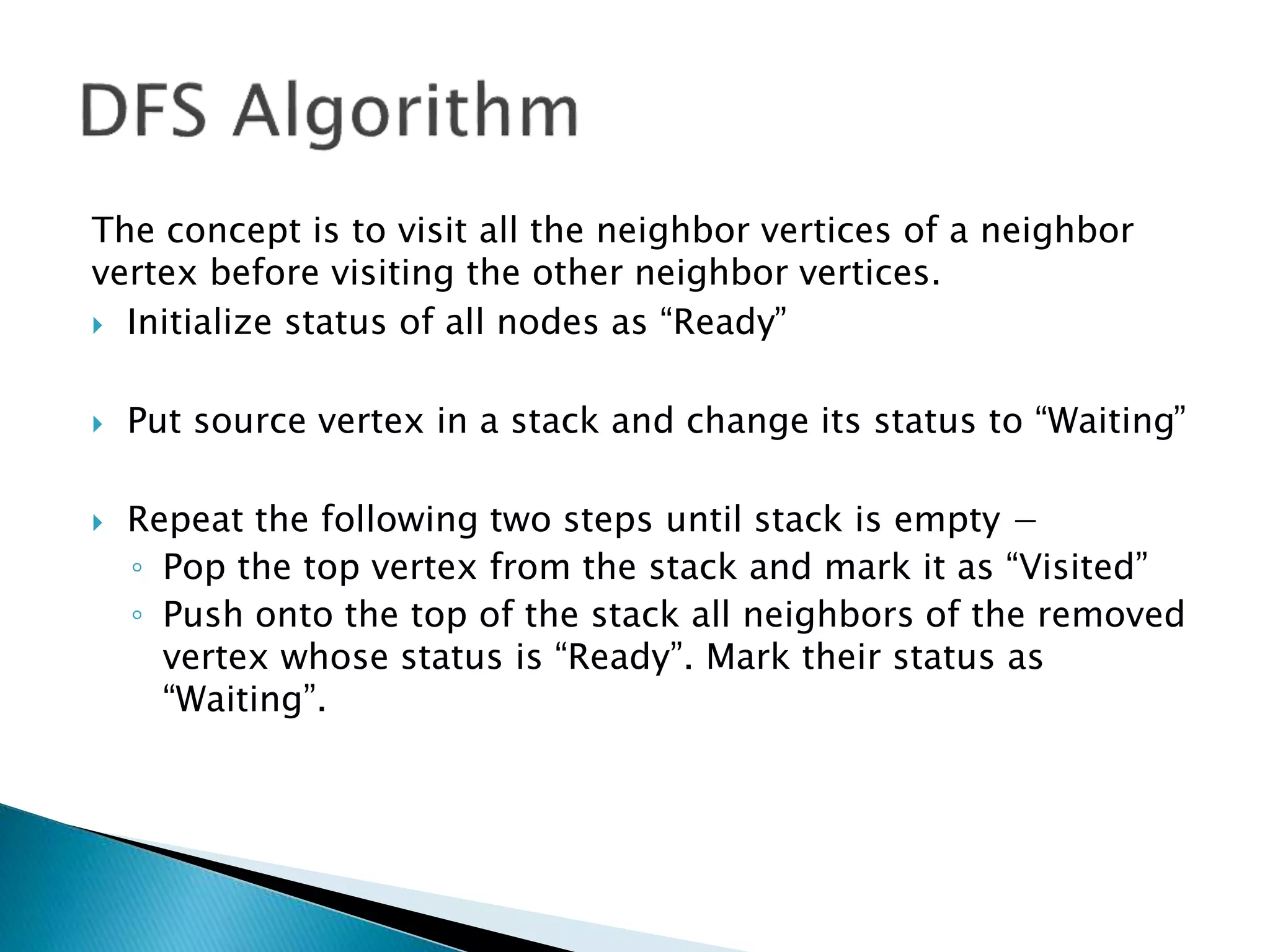
The concept is to visit all the neighbor vertices of a neighbor
vertex before visiting the other neighbor vertices.
 Initialize status of all nodes as “Ready”
 Put source vertex in a stack and change its status to “Waiting”
 Repeat the following two steps until stack is empty −
◦ Pop the top vertex from the stack and mark it as “Visited”
◦ Push onto the top of the stack all neighbors of the removed
vertex whose status is “Ready”. Mark their status as
“Waiting”.
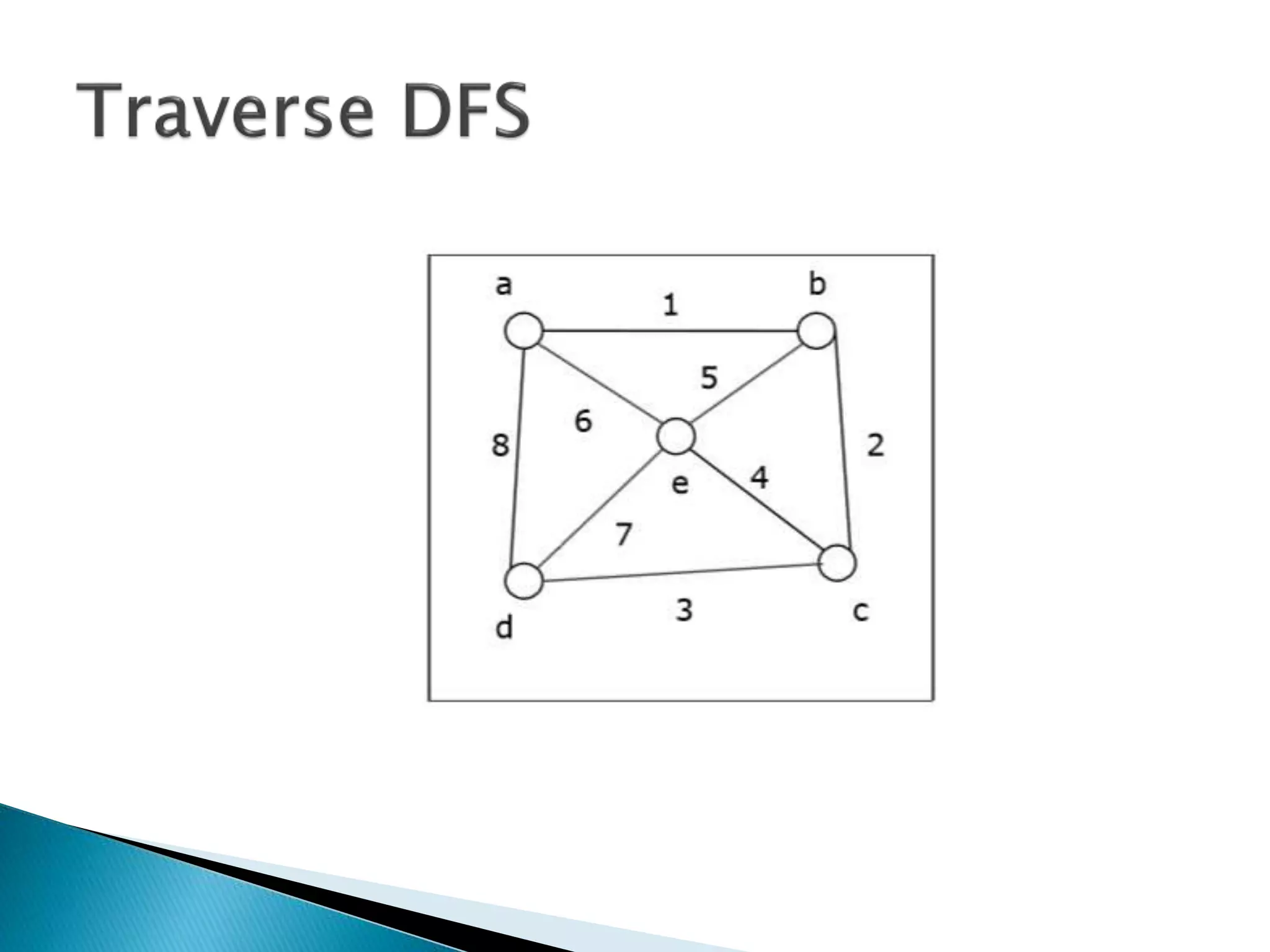
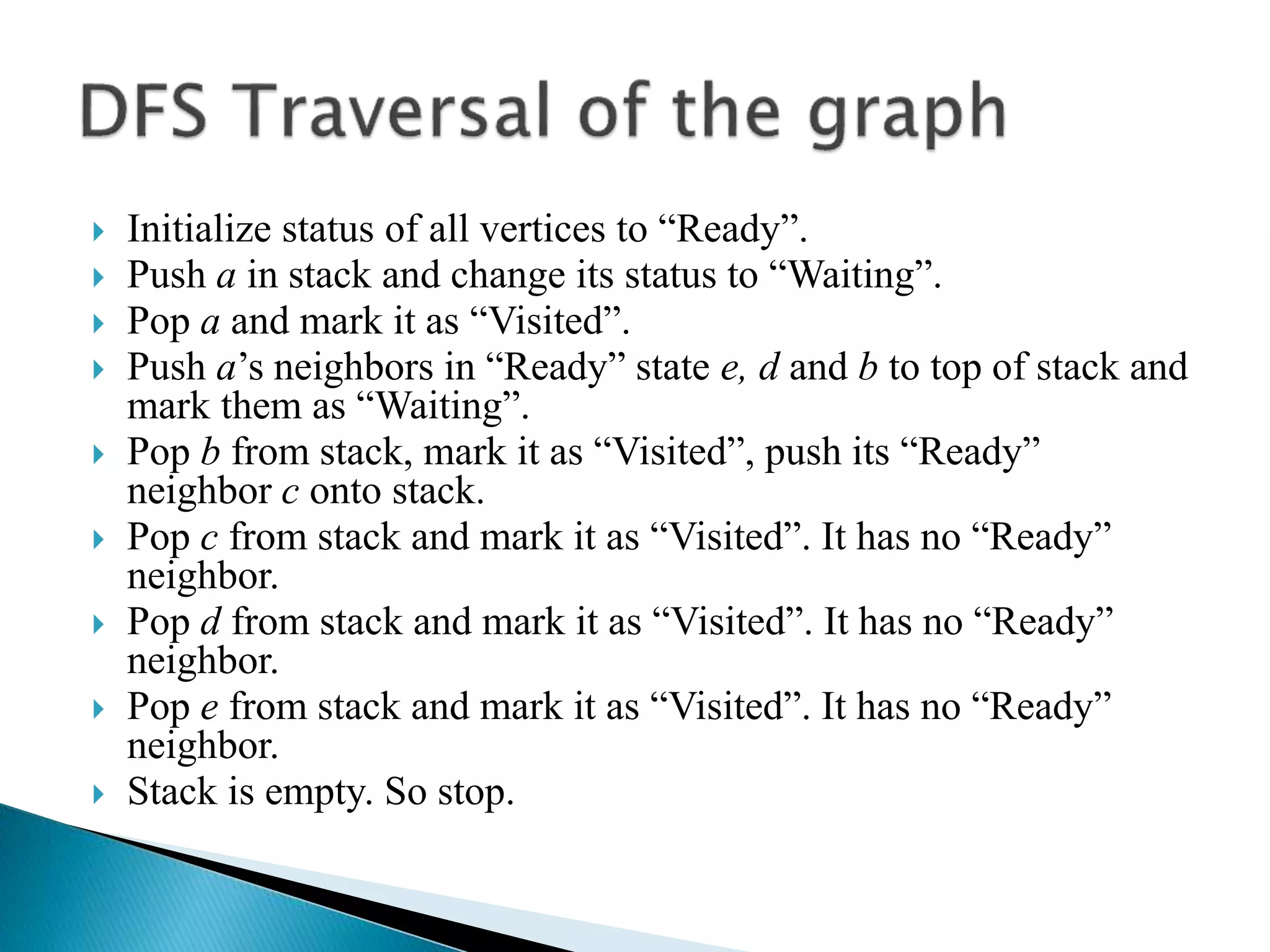
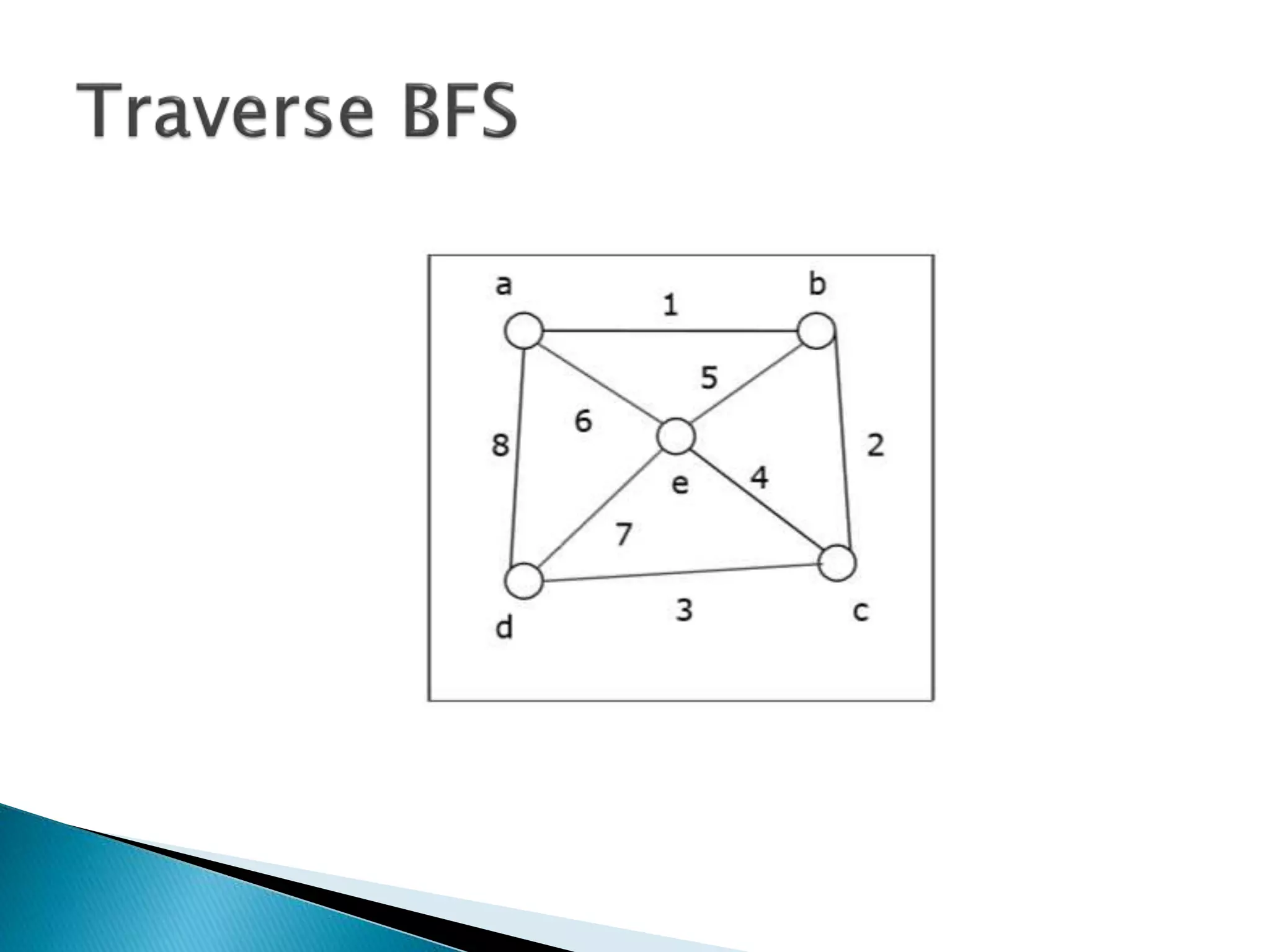
 Initialize status of all vertices to “Ready”.
 Push a in stack and change its status to “Waiting”.
 Pop a and mark it as “Visited”.
 Push a’s neighbors in “Ready” state e, d and b to top of stack and
mark them as “Waiting”.
 Pop b from stack, mark it as “Visited”, push its “Ready”
neighbor c onto stack.
 Pop c from stack and mark it as “Visited”. It has no “Ready”
neighbor.
 Pop d from stack and mark it as “Visited”. It has no “Ready”
neighbor.
 Pop e from stack and mark it as “Visited”. It has no “Ready”
neighbor.
 Stack is empty. So stop.
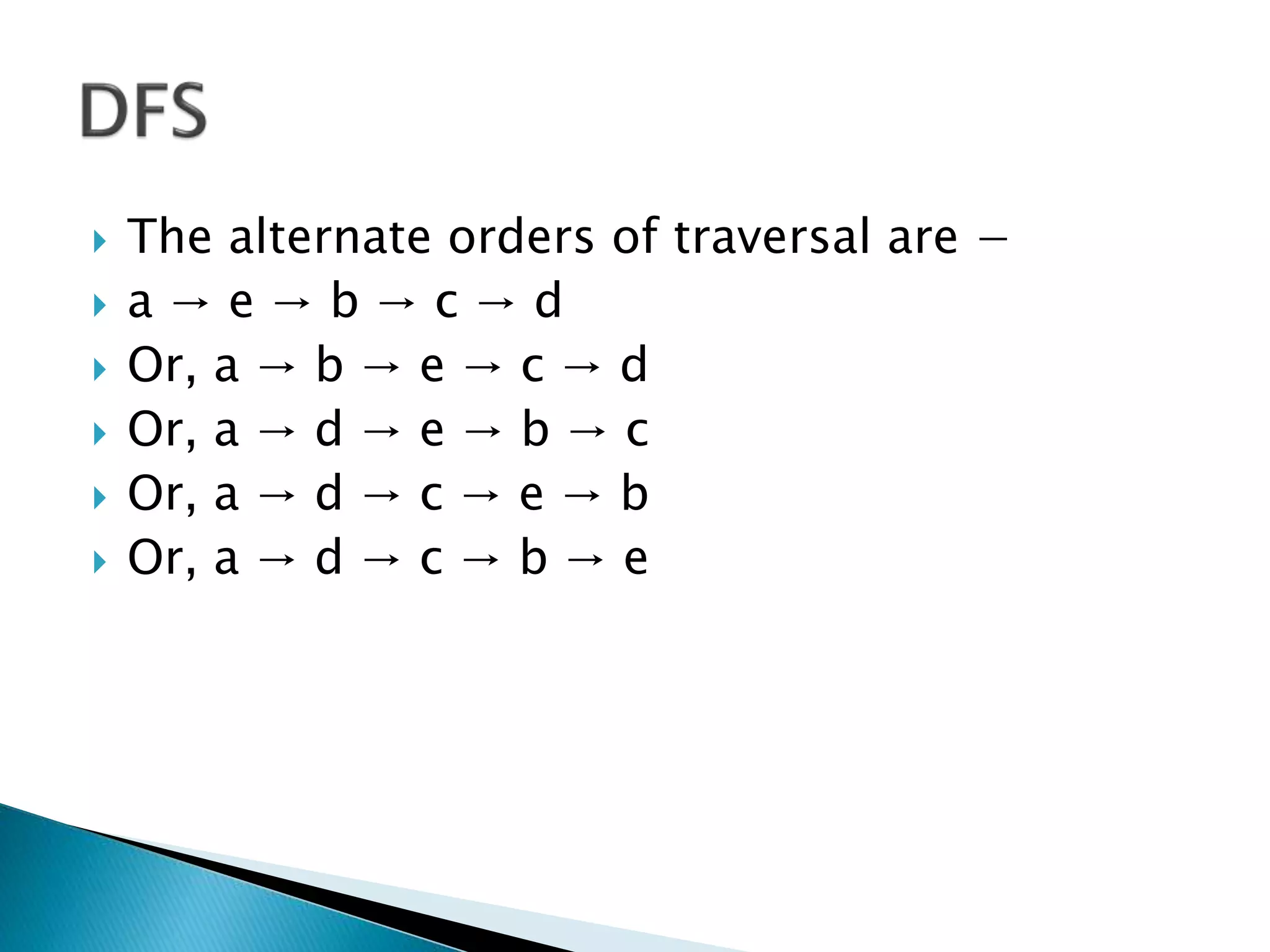
 The alternate orders of traversal are −
 a → e → b → c → d
 Or, a → b → e → c → d
 Or, a → d → e → b → c
 Or, a → d → c → e → b
 Or, a → d → c → b → e
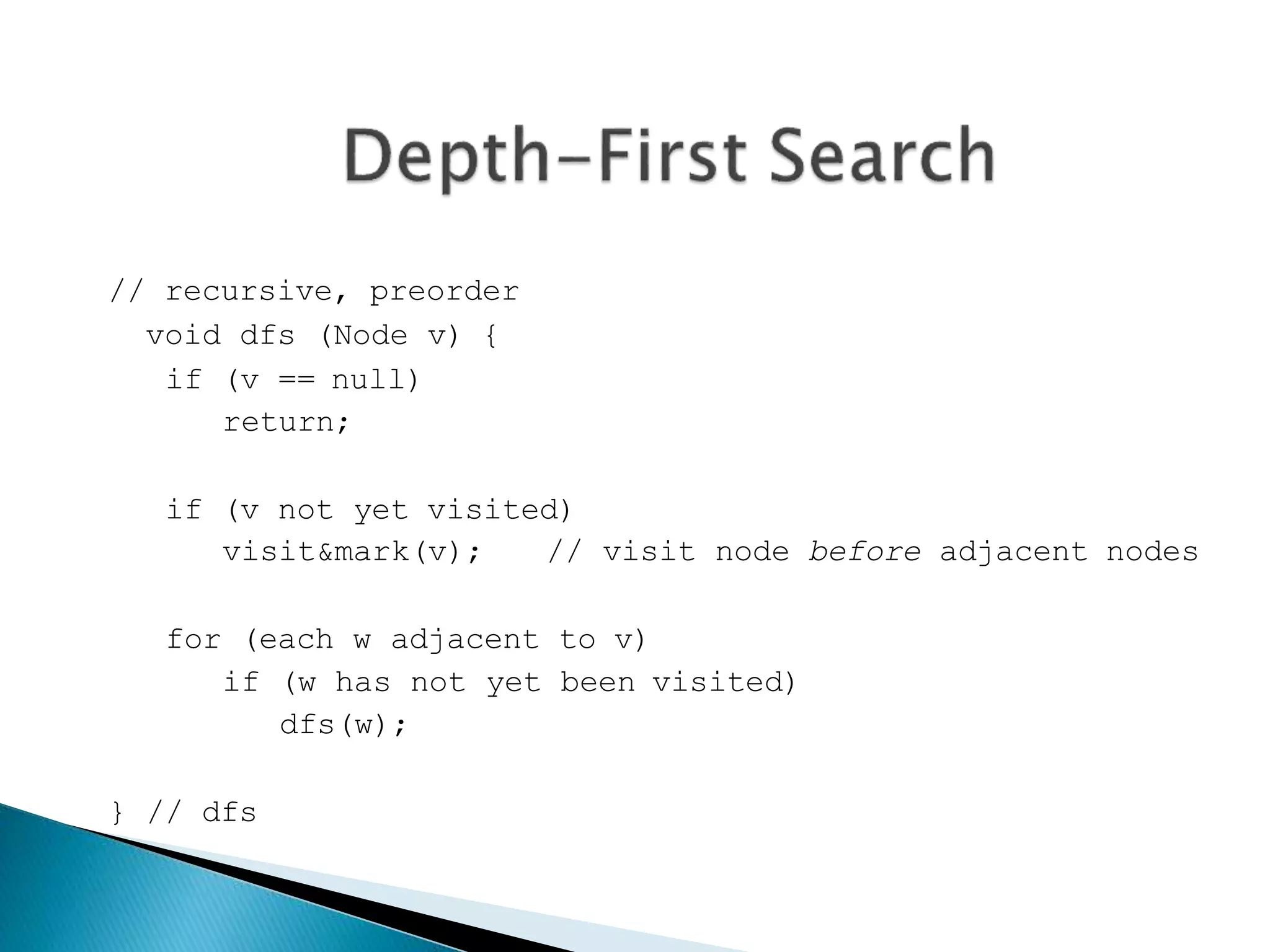
// recursive, preorder
void dfs (Node v) {
if (v == null)
return;
if (v not yet visited)
visit&mark(v); // visit node before adjacent nodes
for (each w adjacent to v)
if (w has not yet been visited)
dfs(w);
} // dfs
0
7
1
5
4
3
2
6
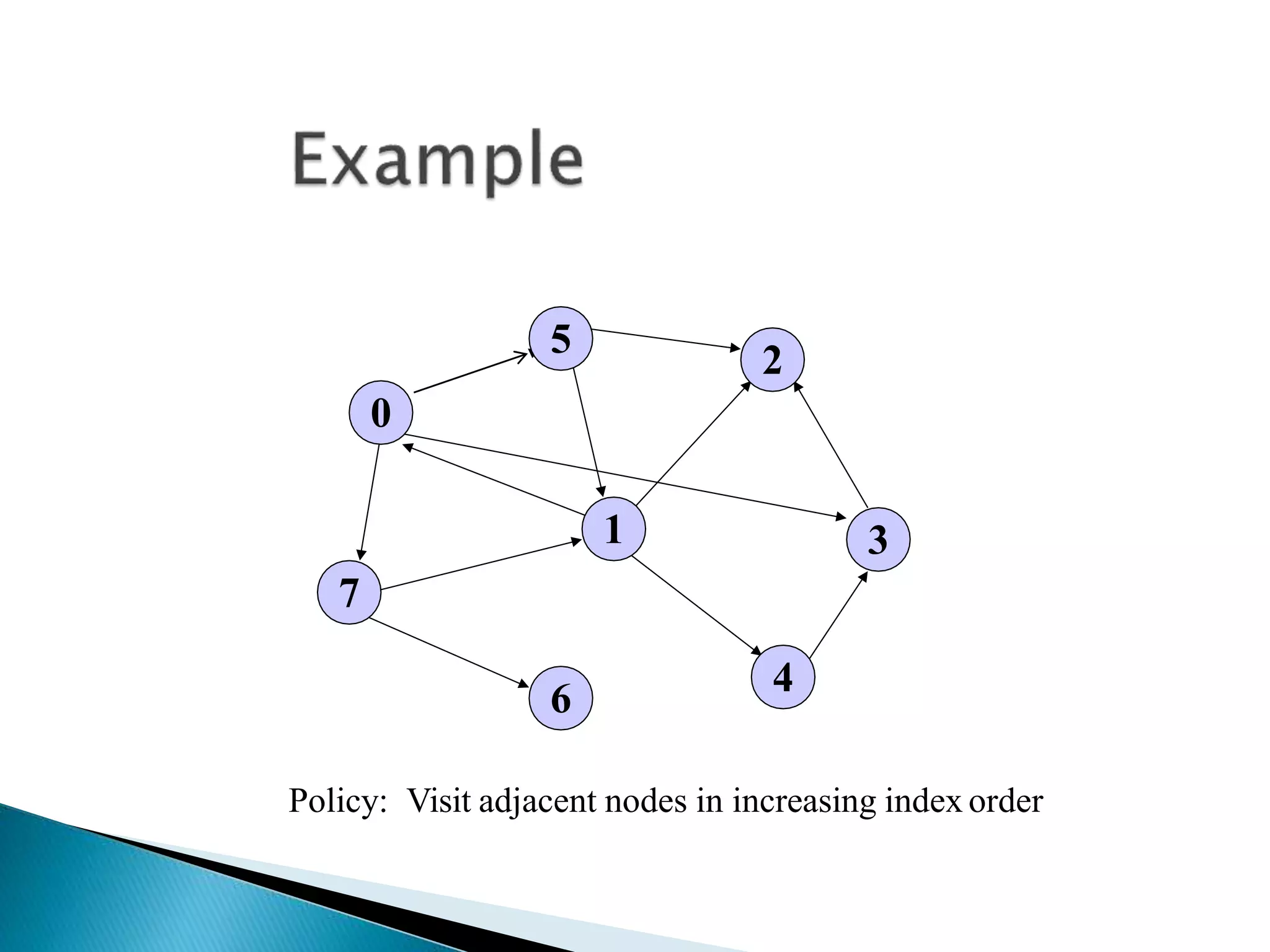
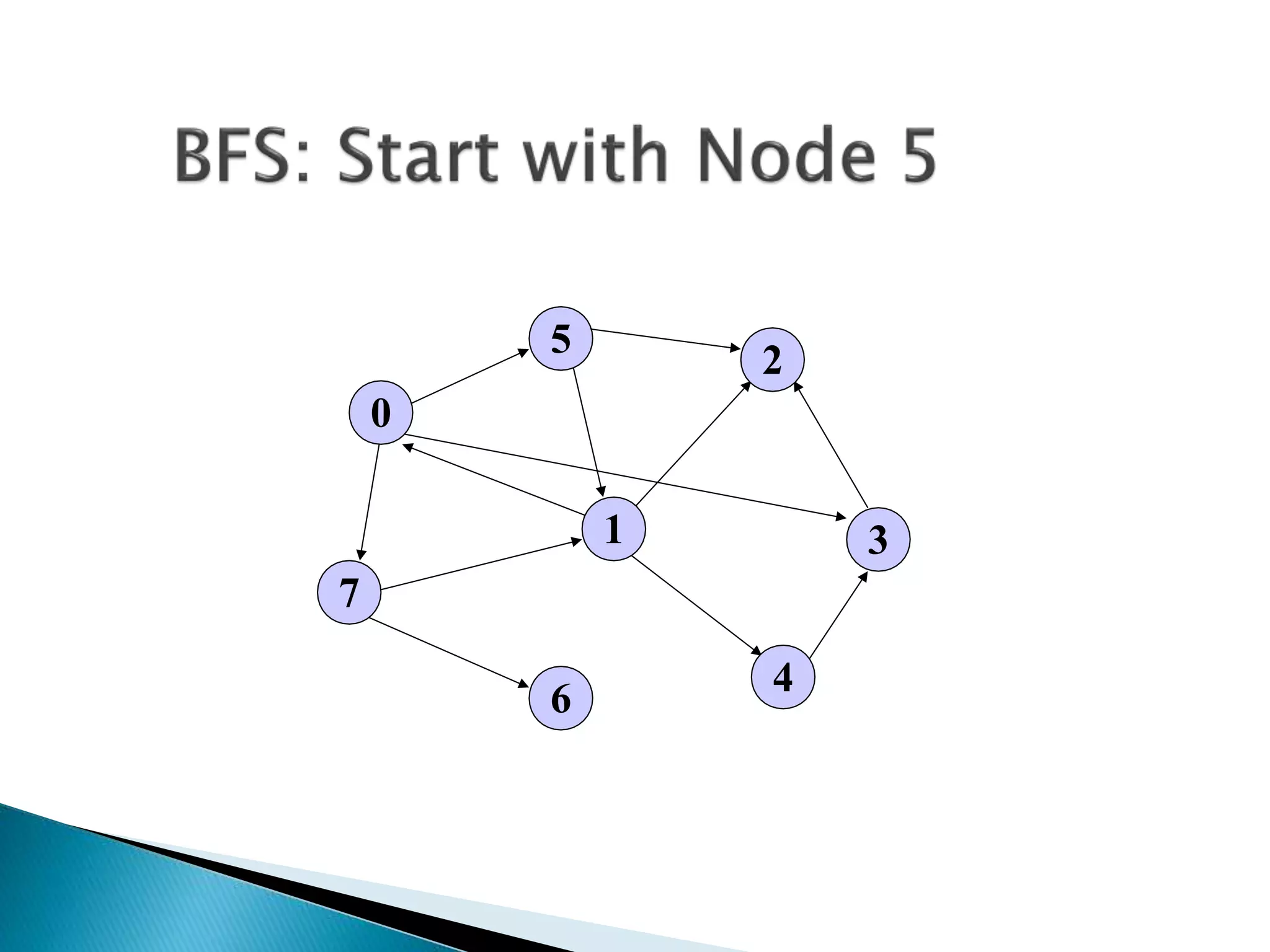
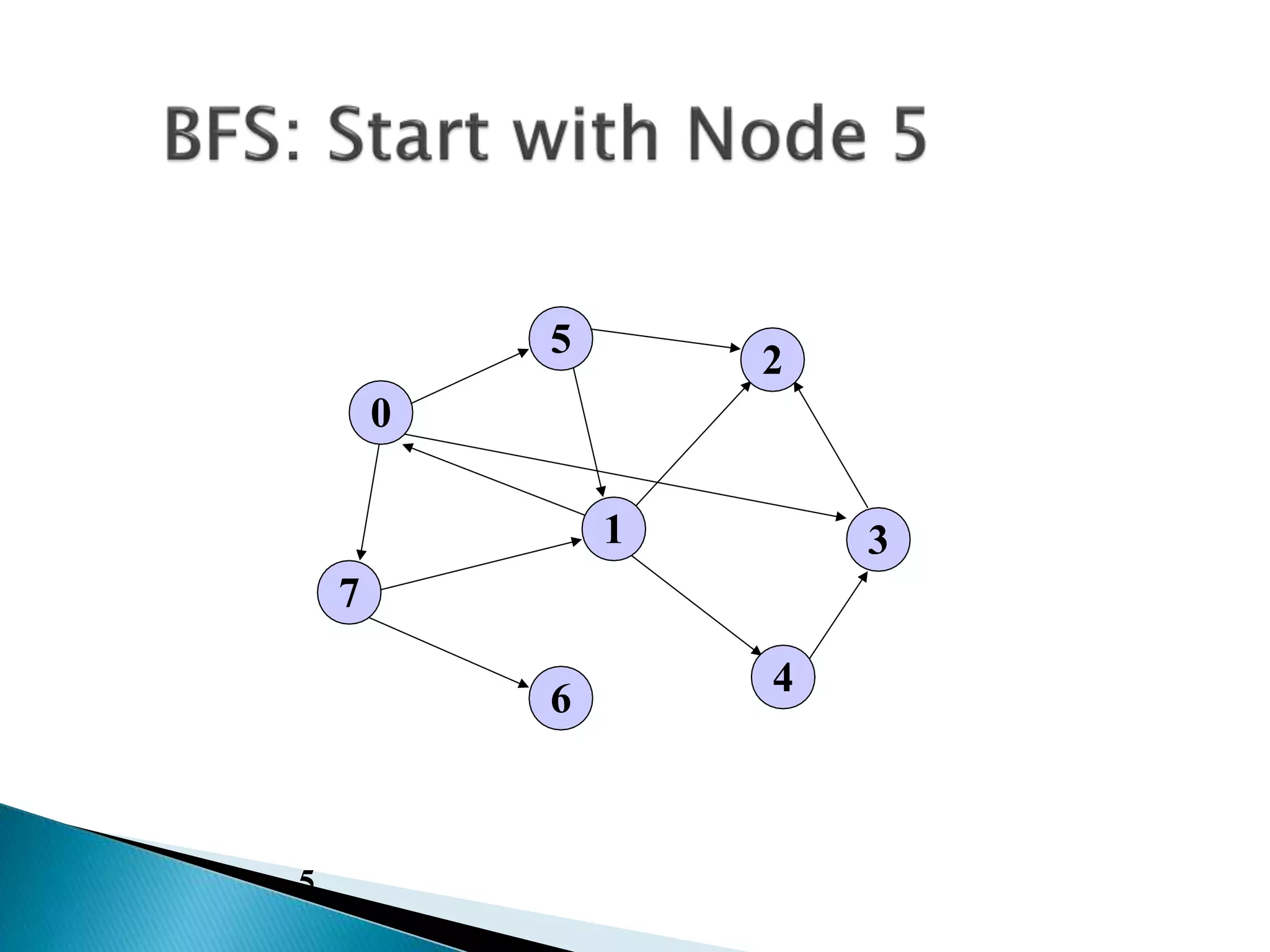
Policy: Visit adjacent nodes in increasing index order
0
7
1
5
4
3
2
6
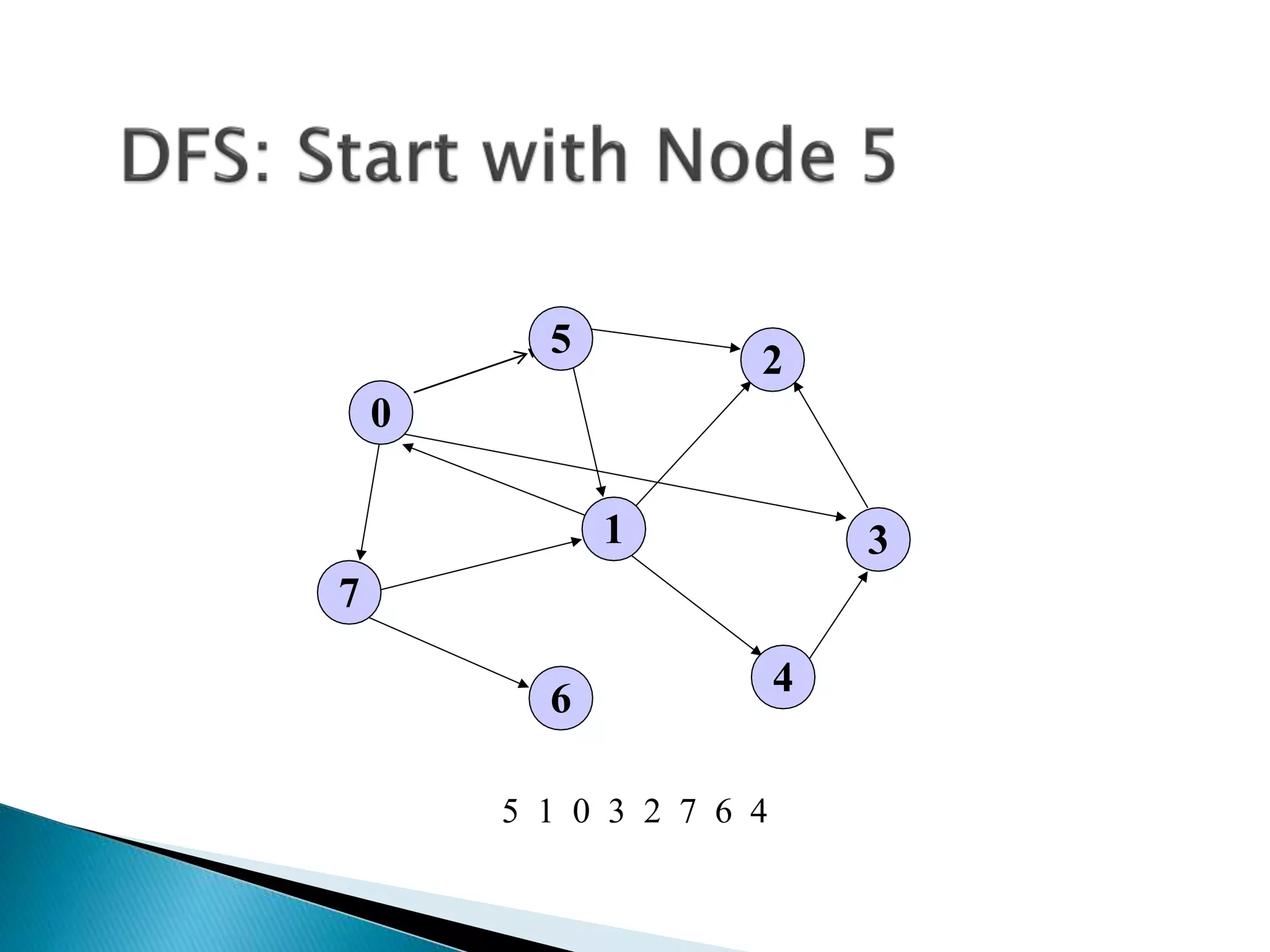
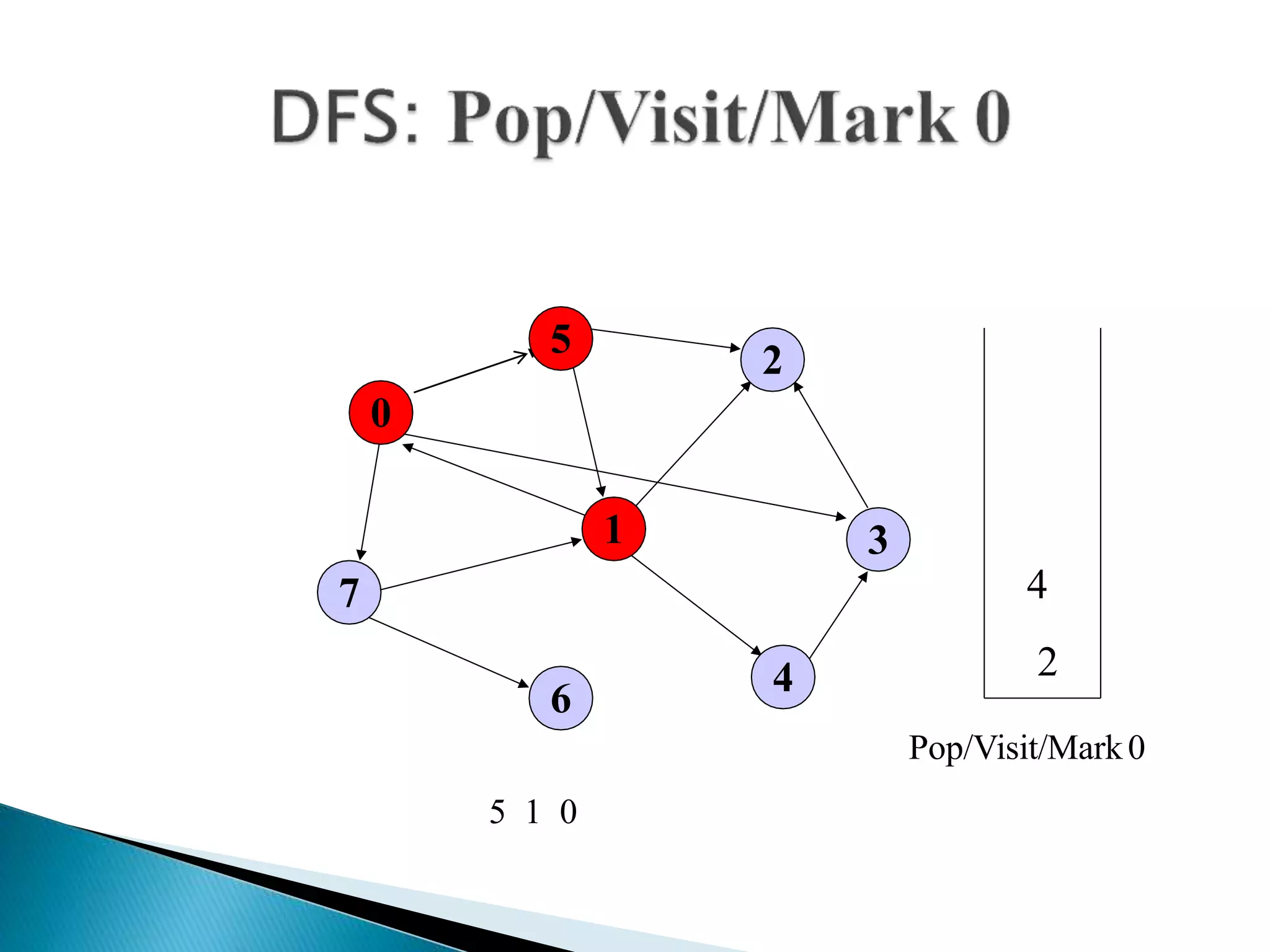
5 1 0 3 2 7 6 4
0
7
1
5
4
3
2
6
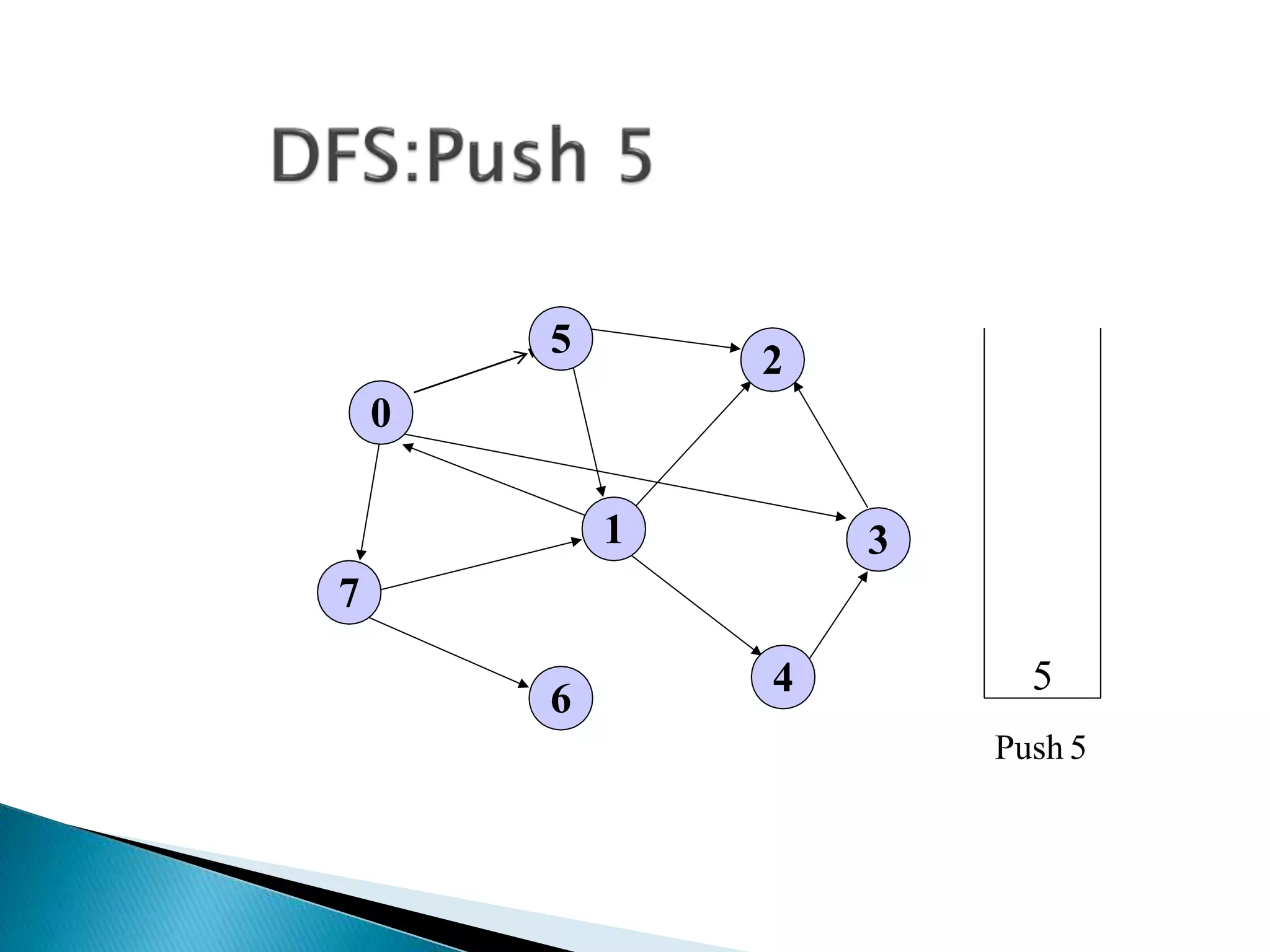
5
Push 5
0
7
1
5
4
3
2
6
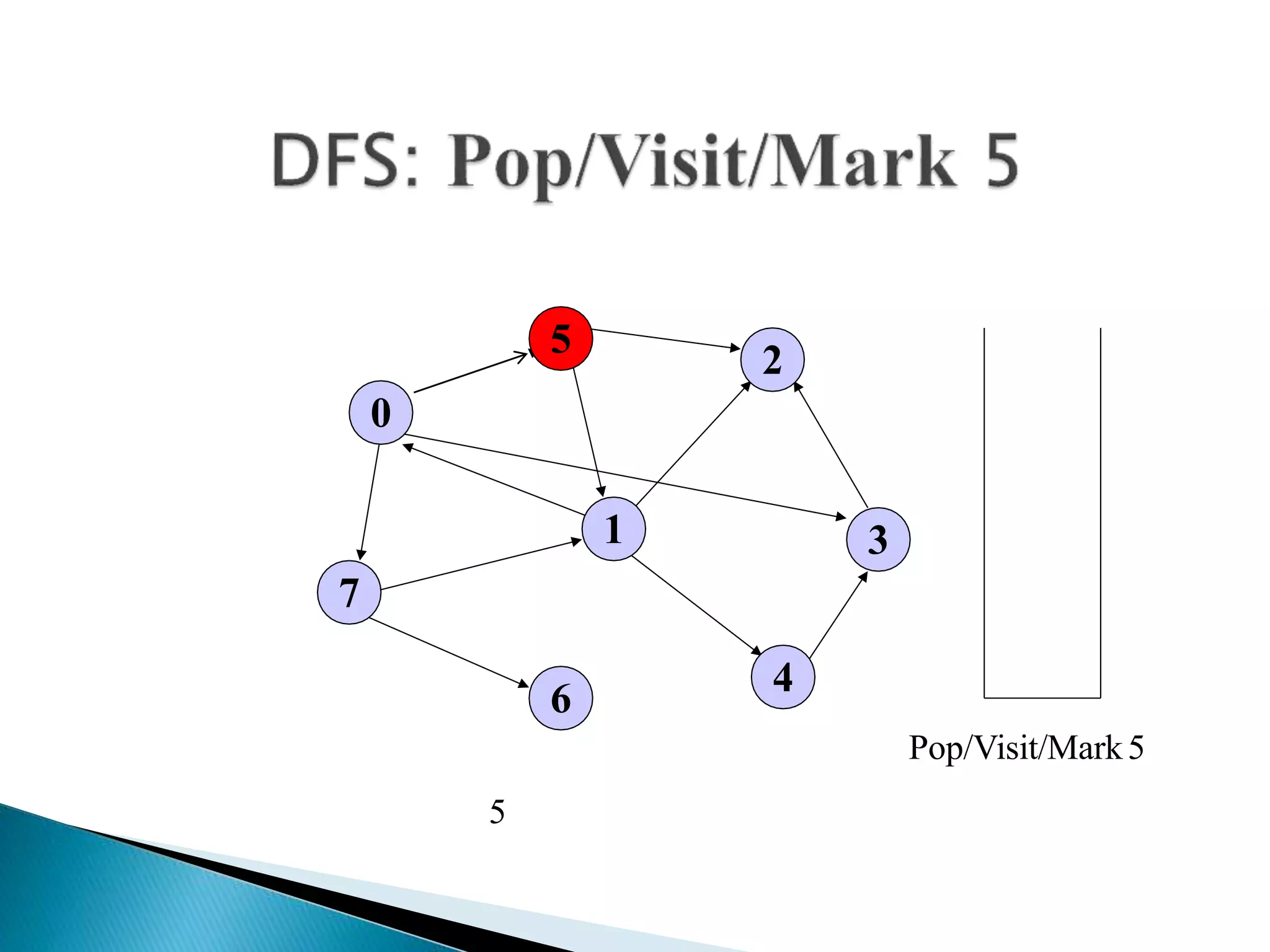
Pop/Visit/Mark5
5
0
7
1
5
4
3
2
6
1
2
5
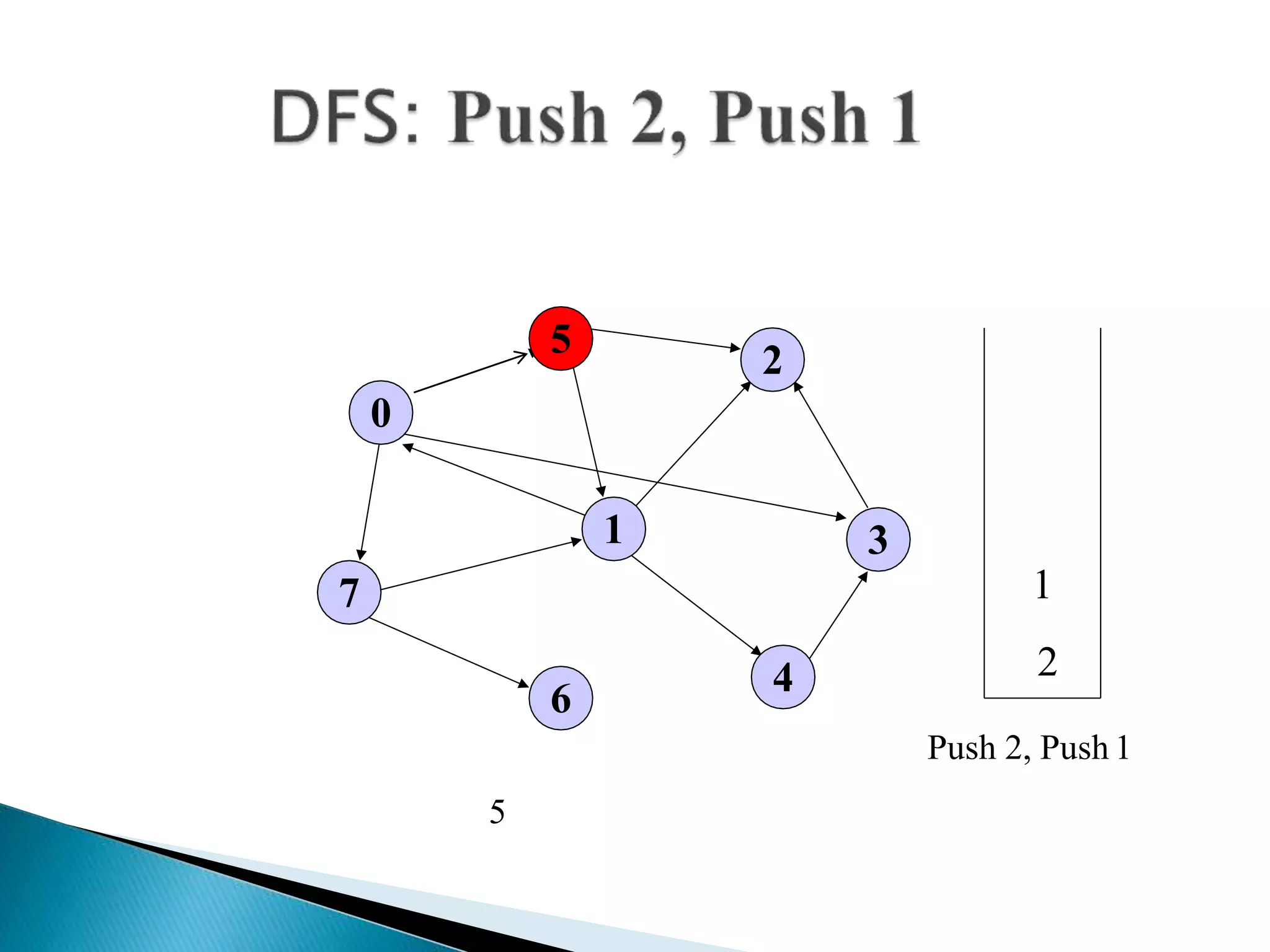
Push 2, Push 1
0
7
1
5
4
3
2
6
2
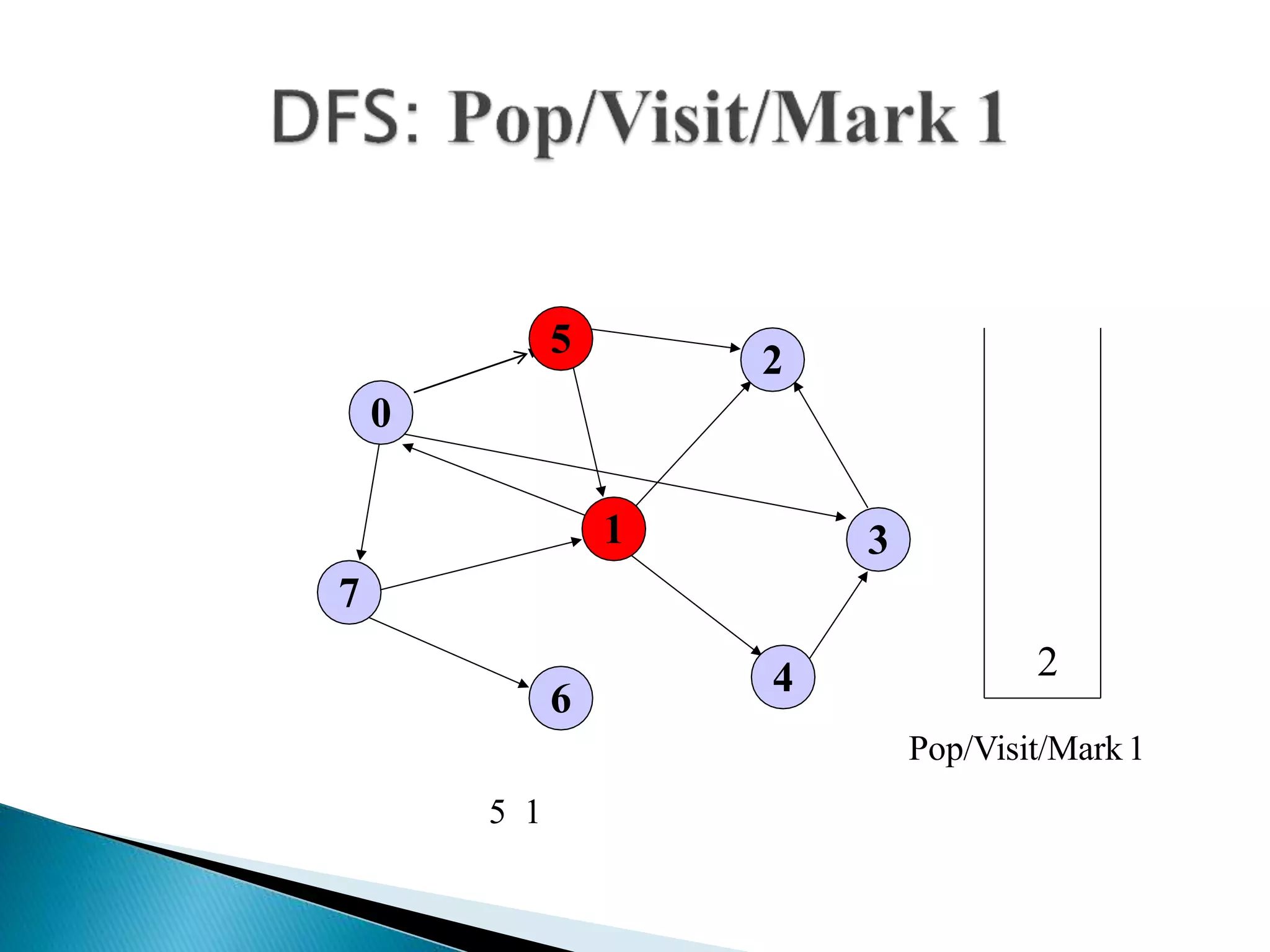
Pop/Visit/Mark1
5 1
0
7
1
5
4
3
2
6
0
4
2
5 1
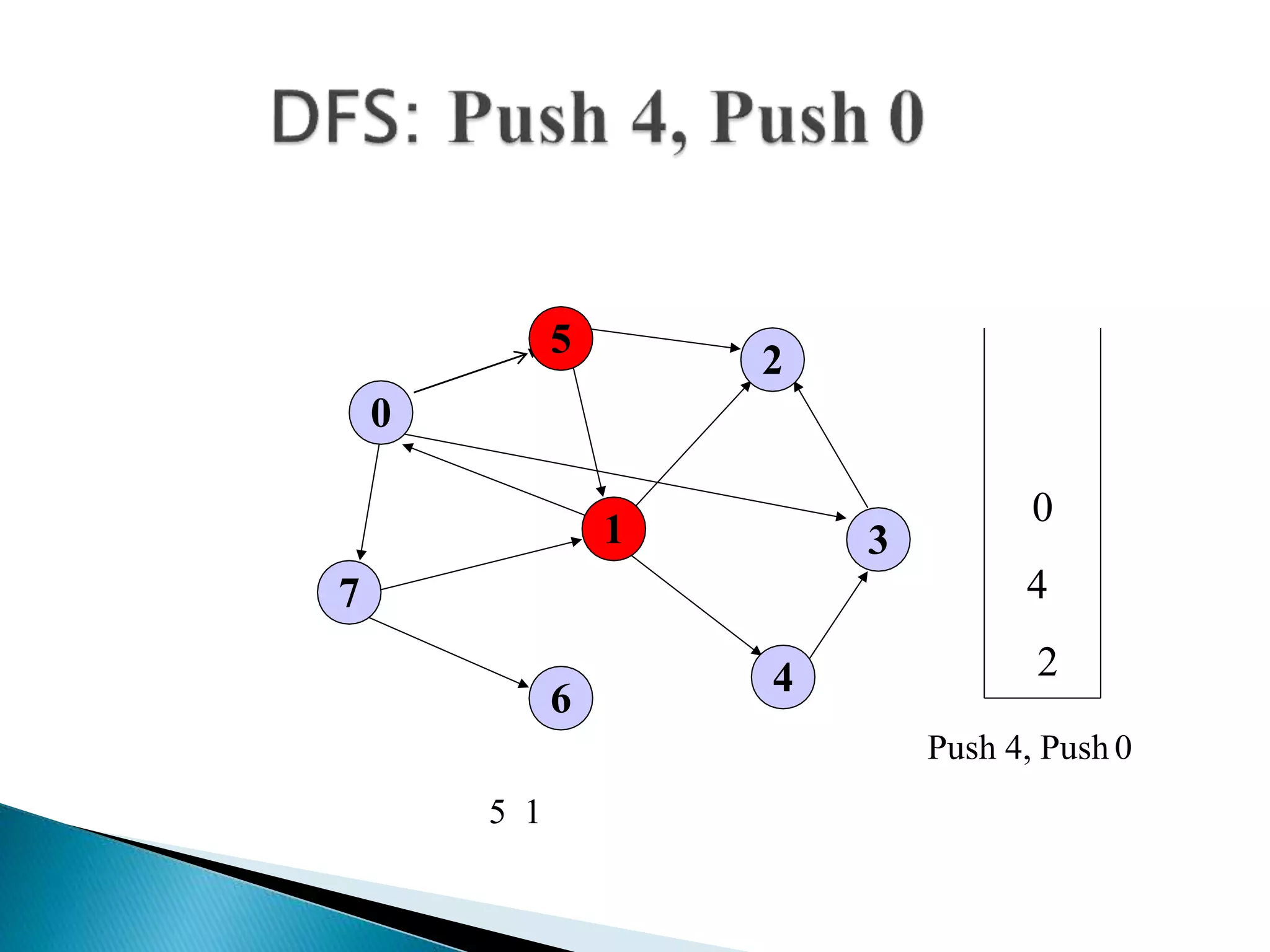
Push 4, Push 0
0
7
1
5
4
3
2
6
4
2
5 1 0
Pop/Visit/Mark0
0
7
1
5
4
3
2
6
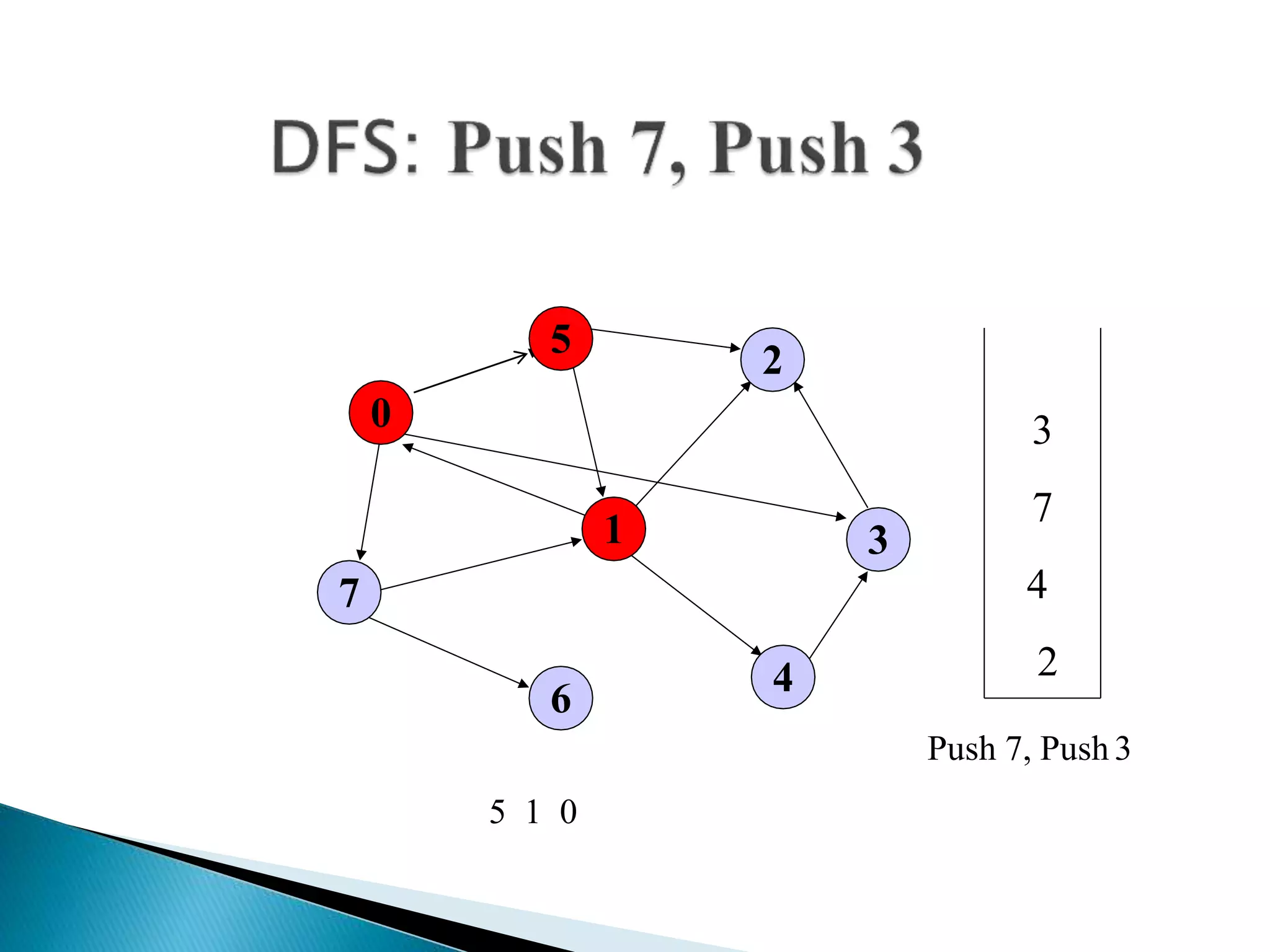
3
7
4
2
Push 7, Push 3
5 1 0
0
7
1
5
4
3
2
6
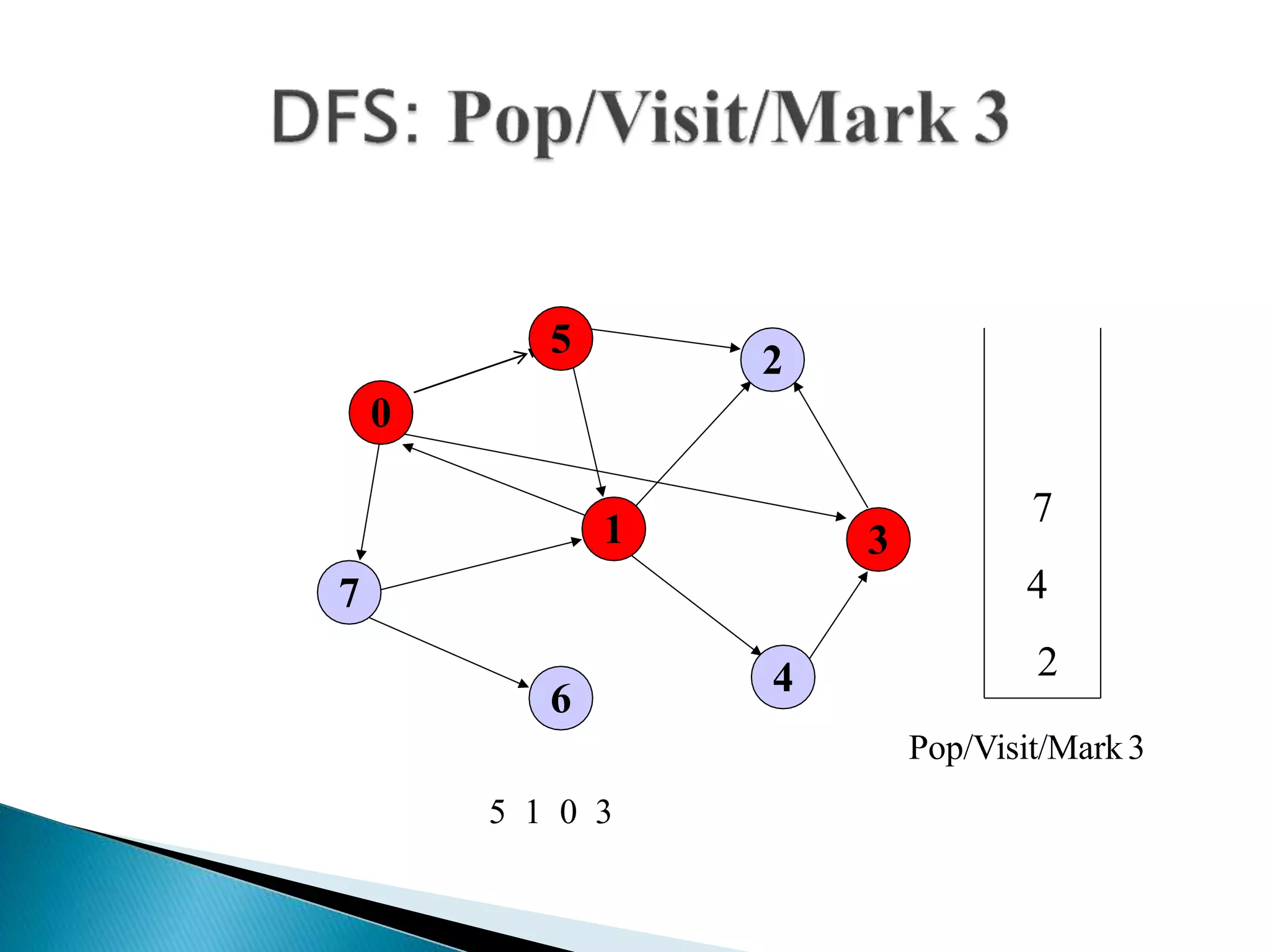
7
4
2
5 1 0 3
Pop/Visit/Mark3
0
7
1
5
4
3
2
6
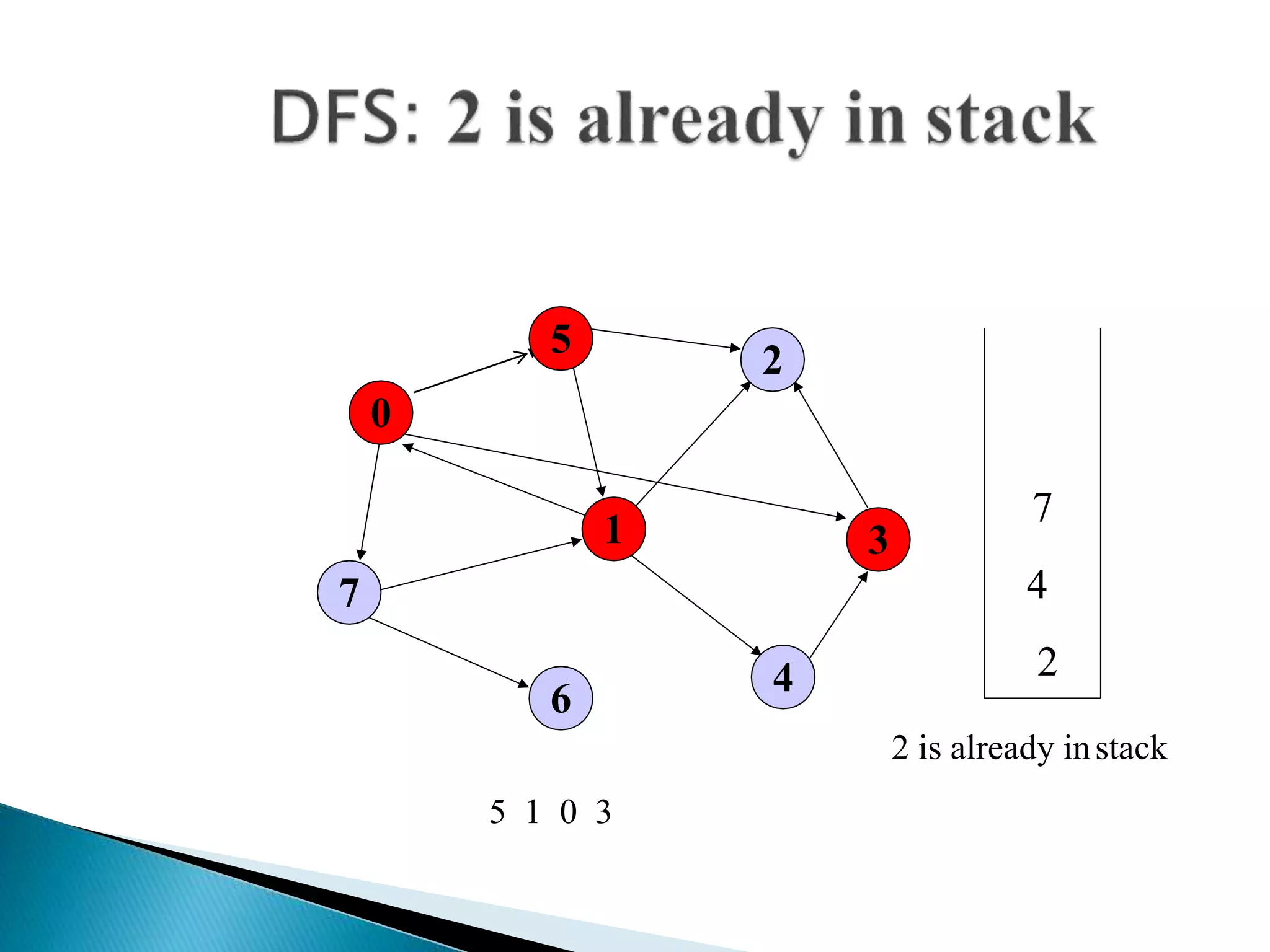
7
4
2
5 1 0 3
2 is already instack
0
7
1
5
4
3
2
6
7
4
2
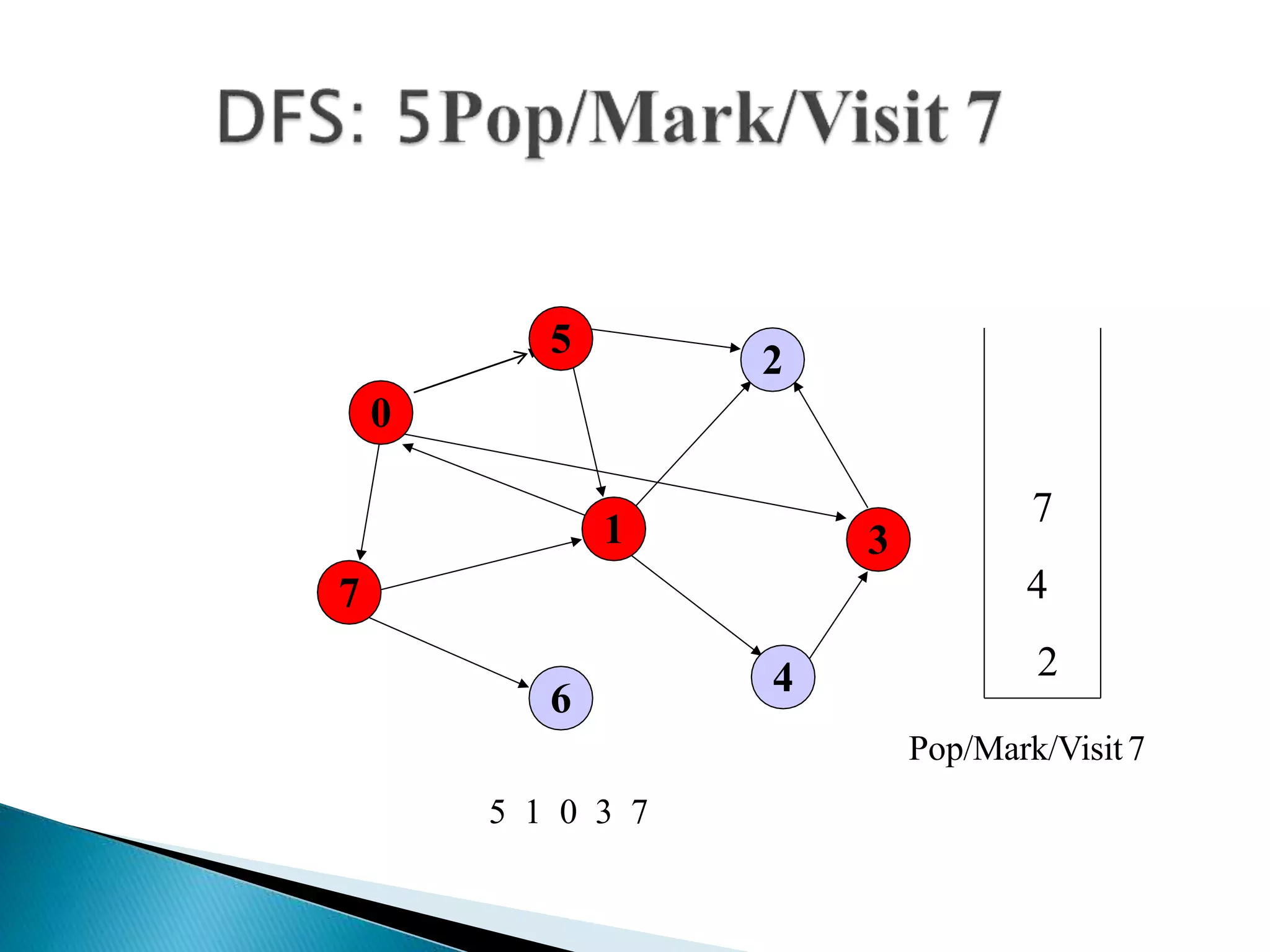
Pop/Mark/Visit7
5 1 0 3 7
0
7
1
5
4
3
2
6
6
4
2
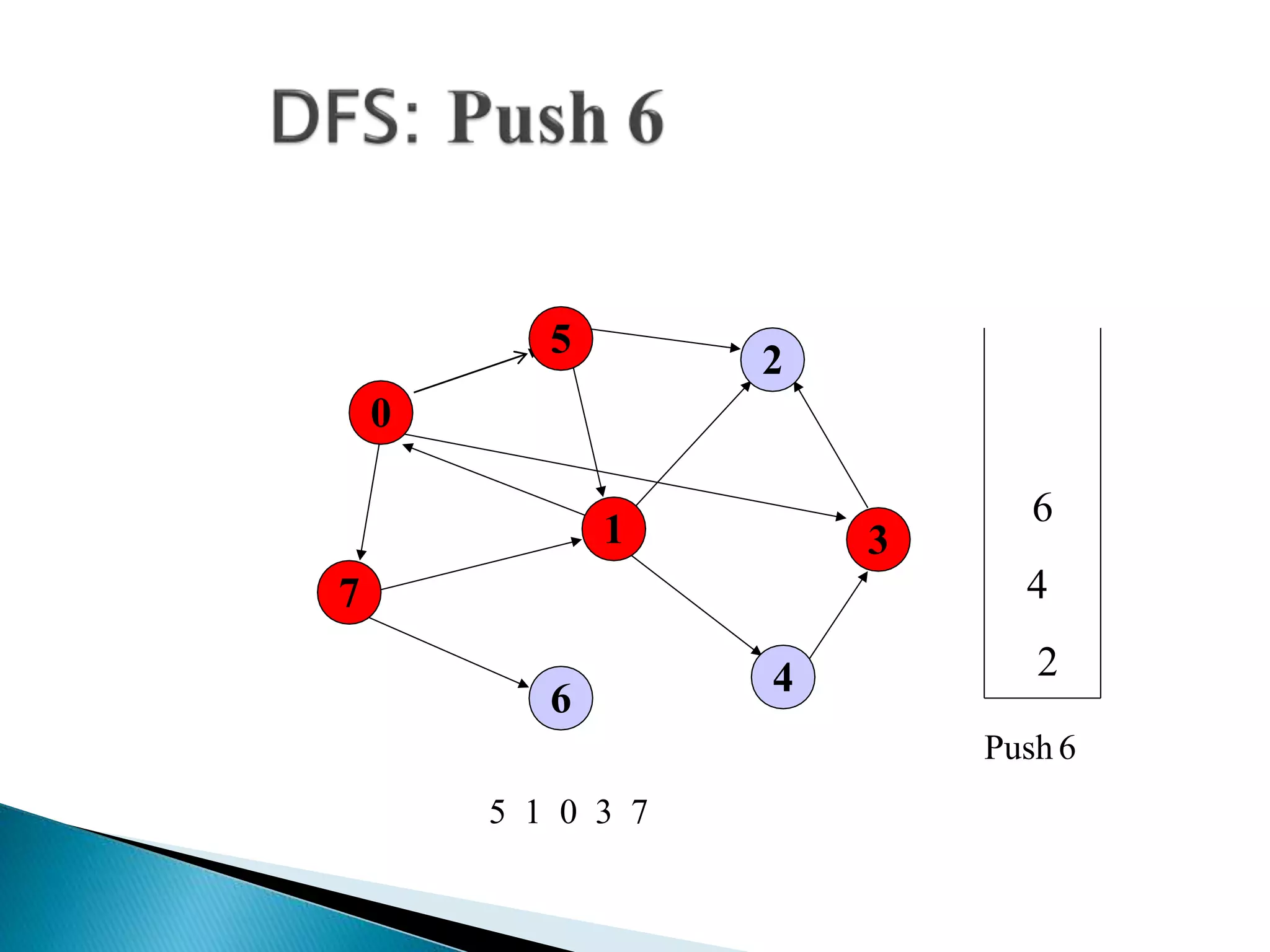
5 1 0 3 7
Push 6
0
7
1
5
4
3
2
6
4
2
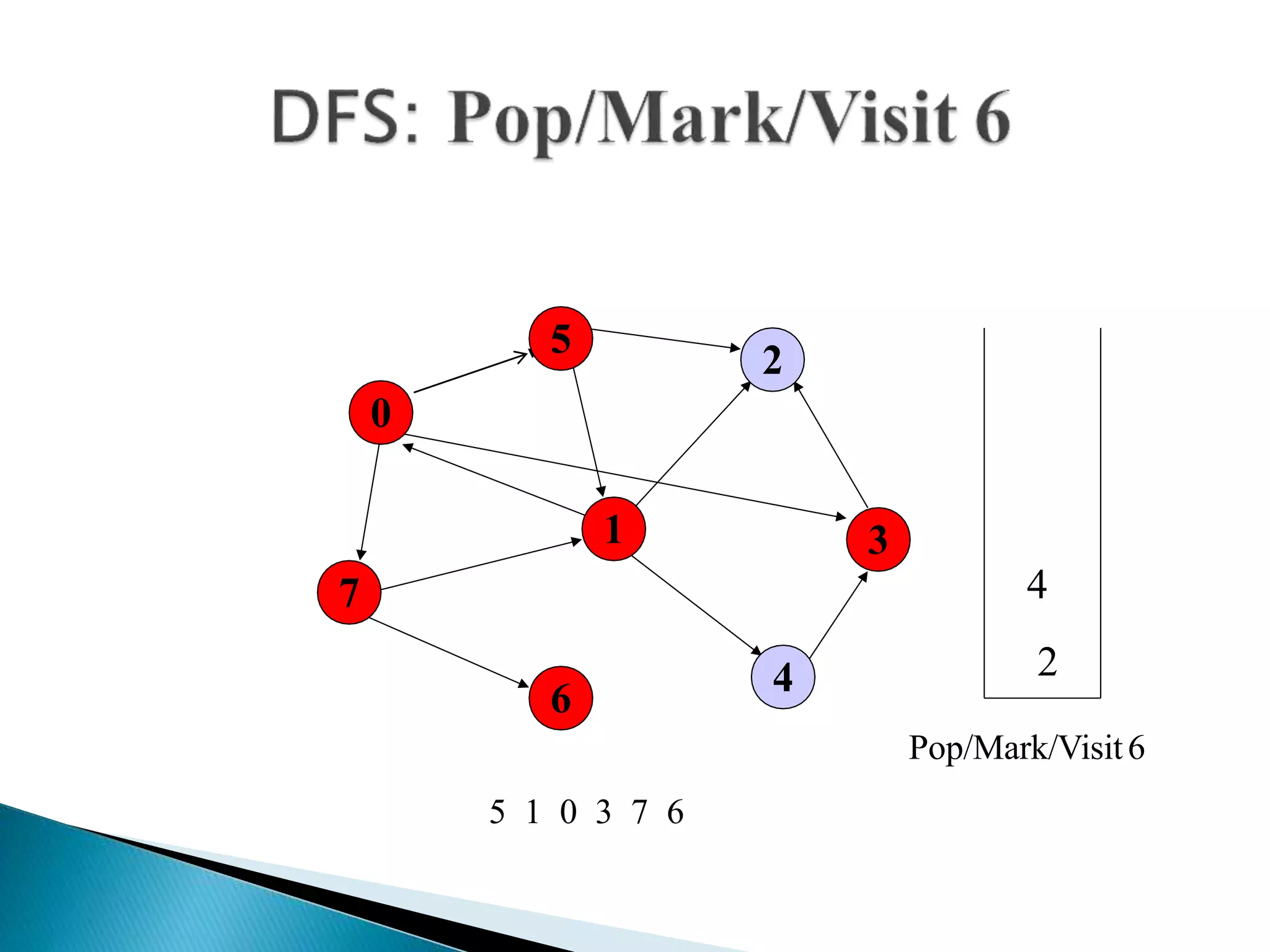
5 1 0 3 7 6
Pop/Mark/Visit6
0
7
1
5
4
3
2
6
2
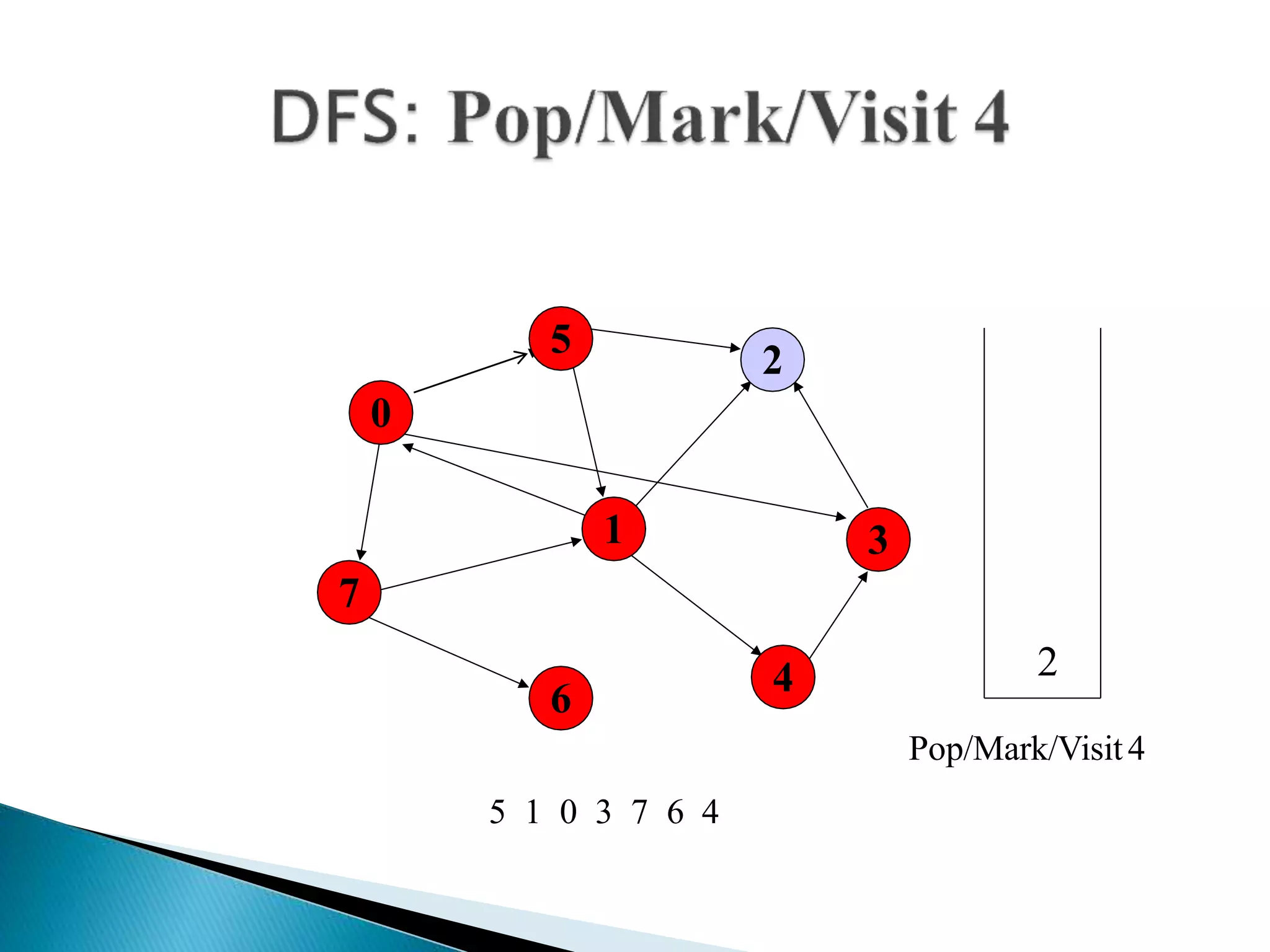
Pop/Mark/Visit4
5 1 0 3 7 6 4
0
7
1
5
4
3
2
6
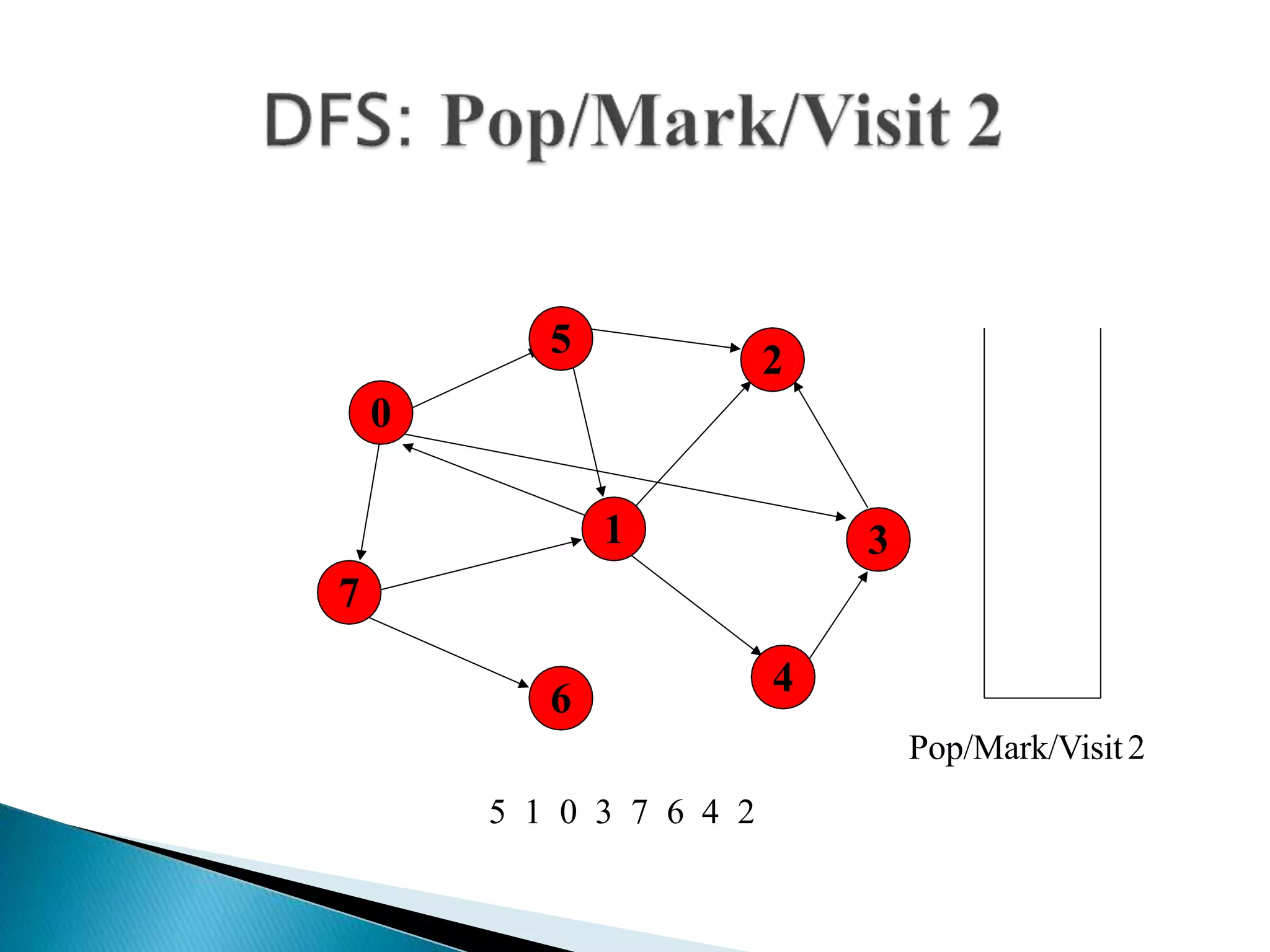
Pop/Mark/Visit2
5 1 0 3 7 6 4 2
0
7
1
5
4
3
2
6
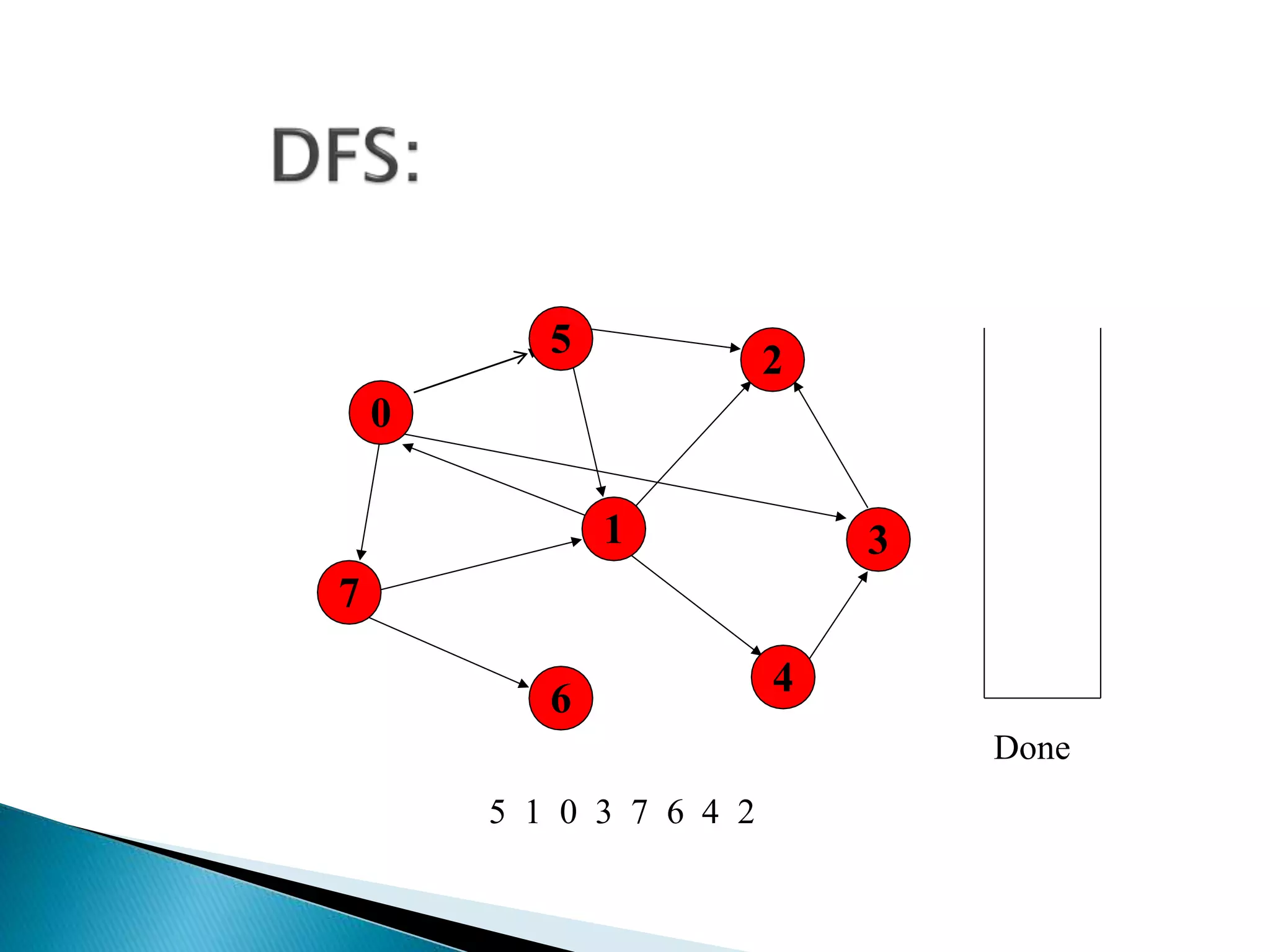
Done
5 1 0 3 7 6 4 2
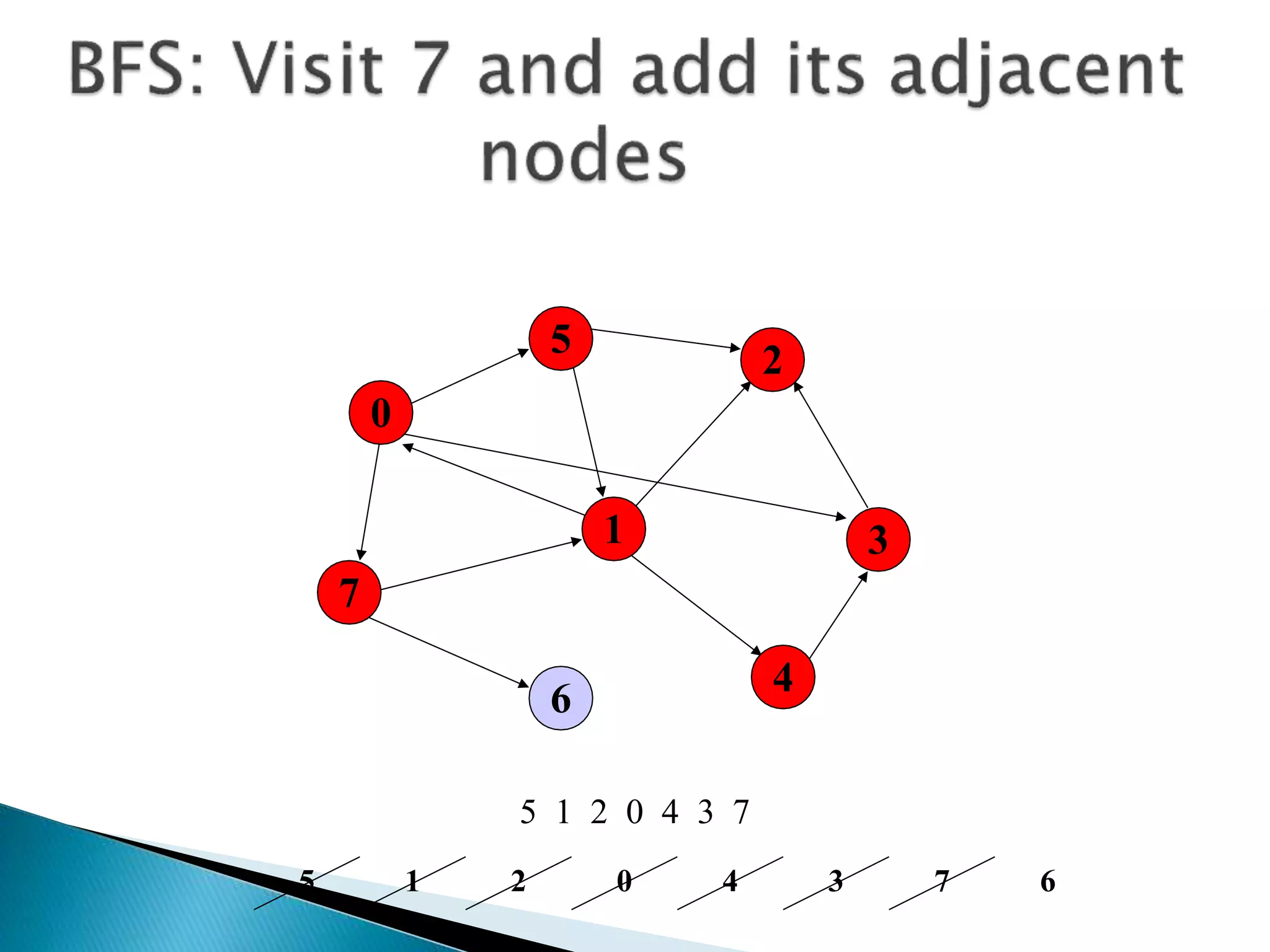
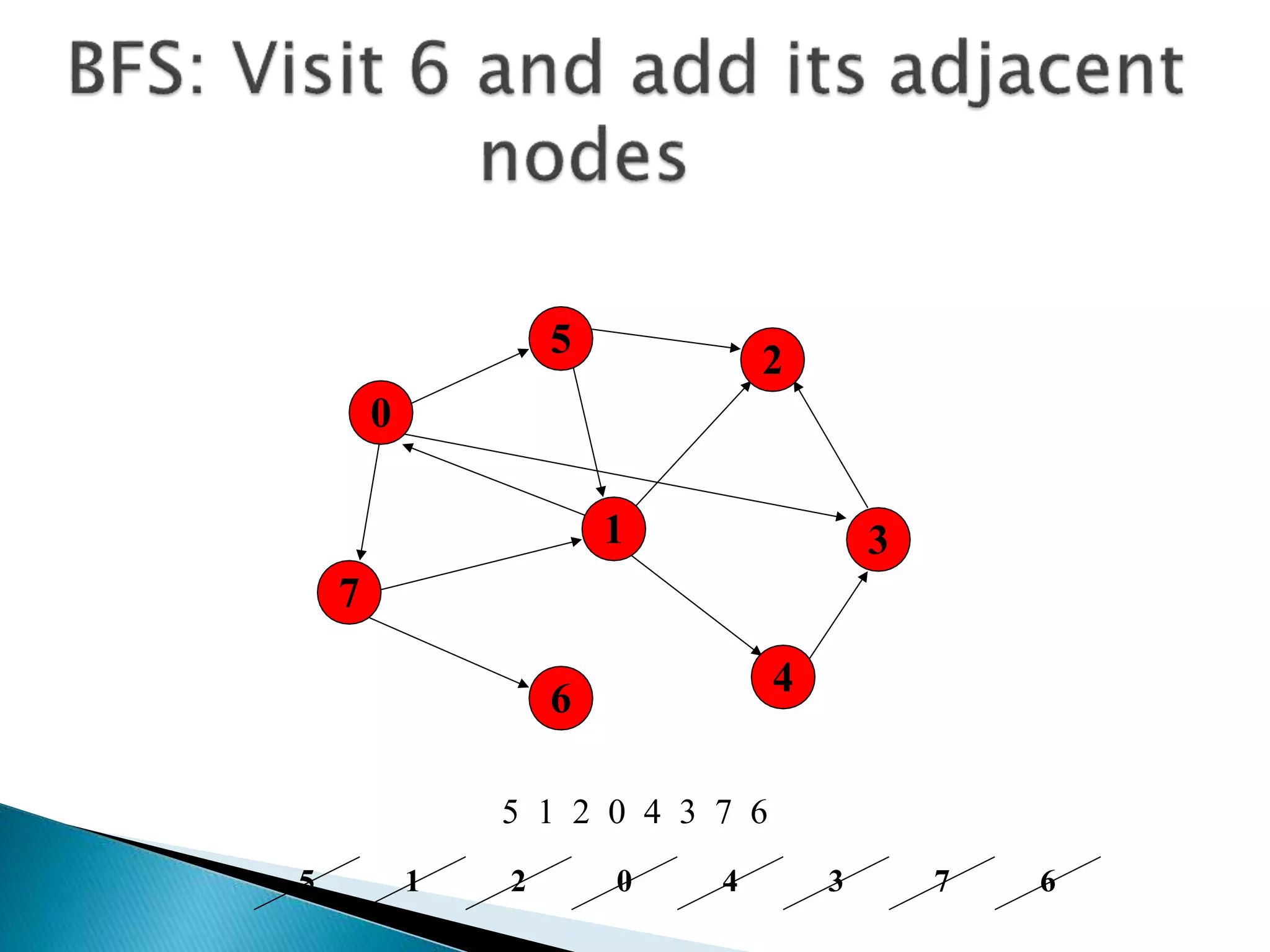
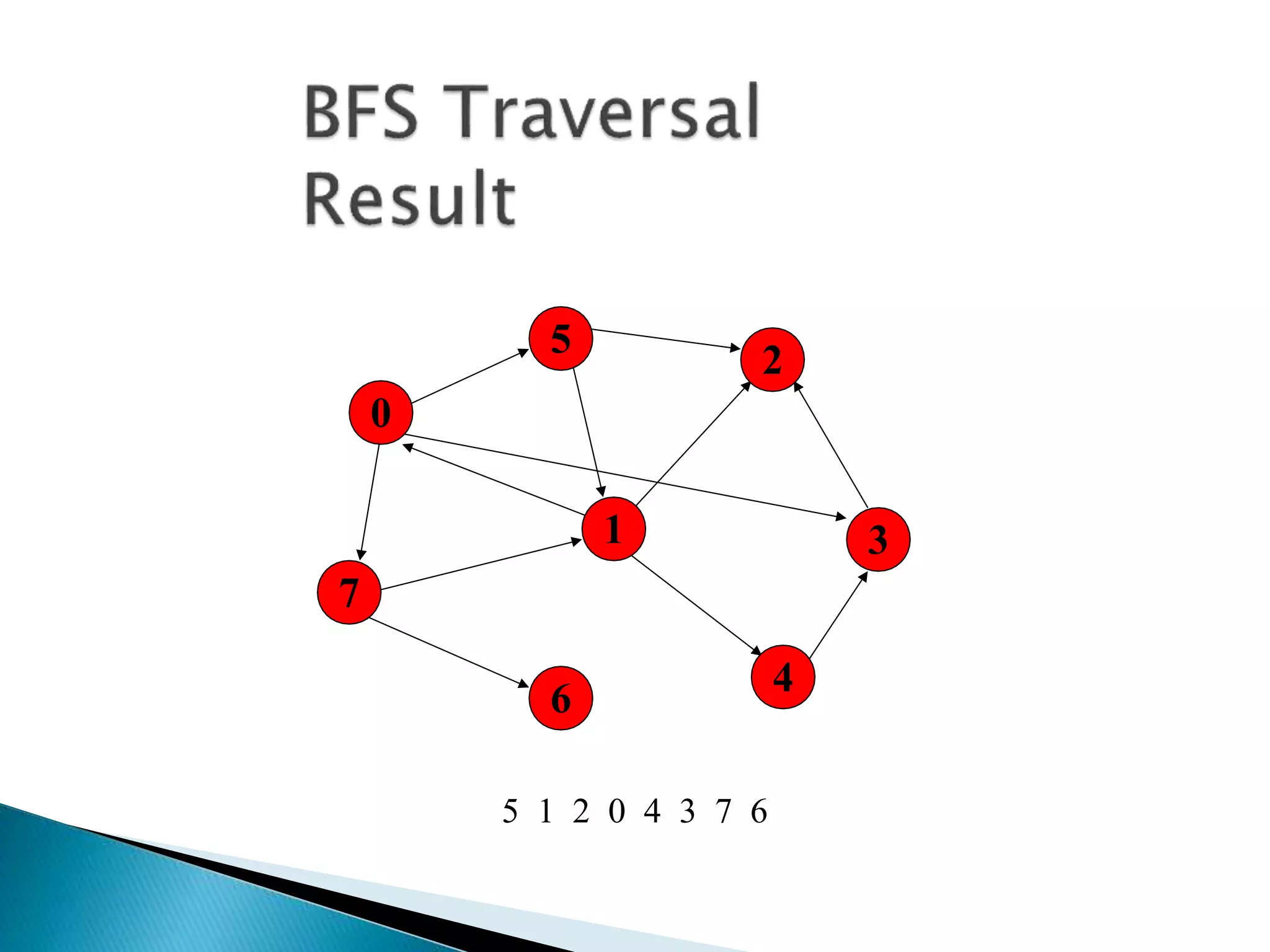
Breadth-first search (BFS) is an algorithm for
traversing or searching tree or graph data structures.
It uses queue.
 The concept is to visit all the neighbor vertices
before visiting other neighbor vertices of
neighbor vertices.
 Initialize status of all nodes as “Ready”.
 Put source vertex in a queue and change its
status to “Waiting”.
 Repeat the following two steps until queue is
empty −
◦ Remove the first vertex from the queue and mark it as
“Visited”.
◦ Add to the rear of queue all neighbors of the removed
vertex whose status is “Ready”. Mark their status as
“Waiting”.
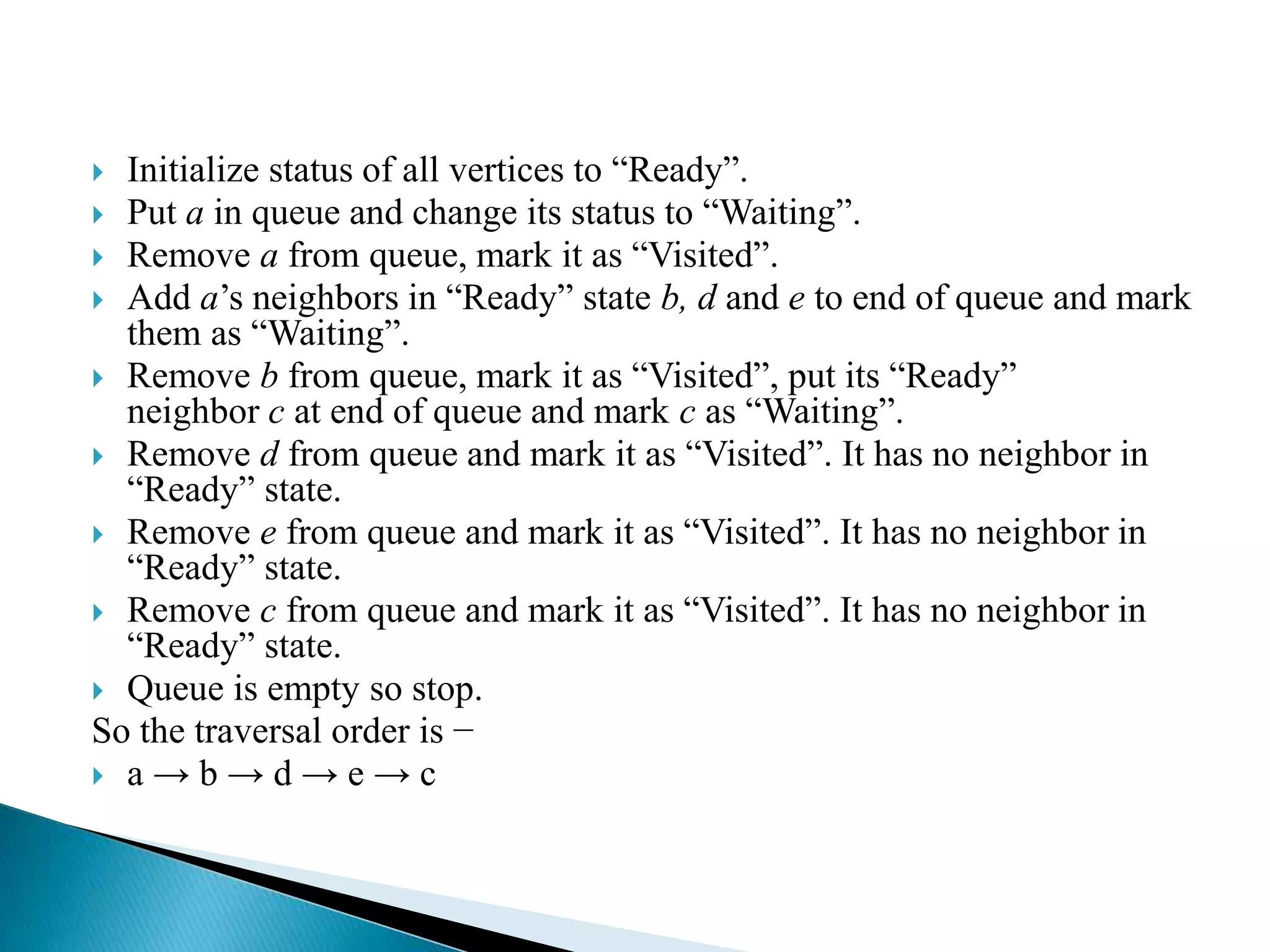
 Initialize status of all vertices to “Ready”.
 Put a in queue and change its status to “Waiting”.
 Remove a from queue, mark it as “Visited”.
 Add a’s neighbors in “Ready” state b, d and e to end of queue and mark
them as “Waiting”.
 Remove b from queue, mark it as “Visited”, put its “Ready”
neighbor c at end of queue and mark c as “Waiting”.
 Remove d from queue and mark it as “Visited”. It has no neighbor in
“Ready” state.
 Remove e from queue and mark it as “Visited”. It has no neighbor in
“Ready” state.
 Remove c from queue and mark it as “Visited”. It has no neighbor in
“Ready” state.
 Queue is empty so stop.
So the traversal order is −
 a → b → d → e → c
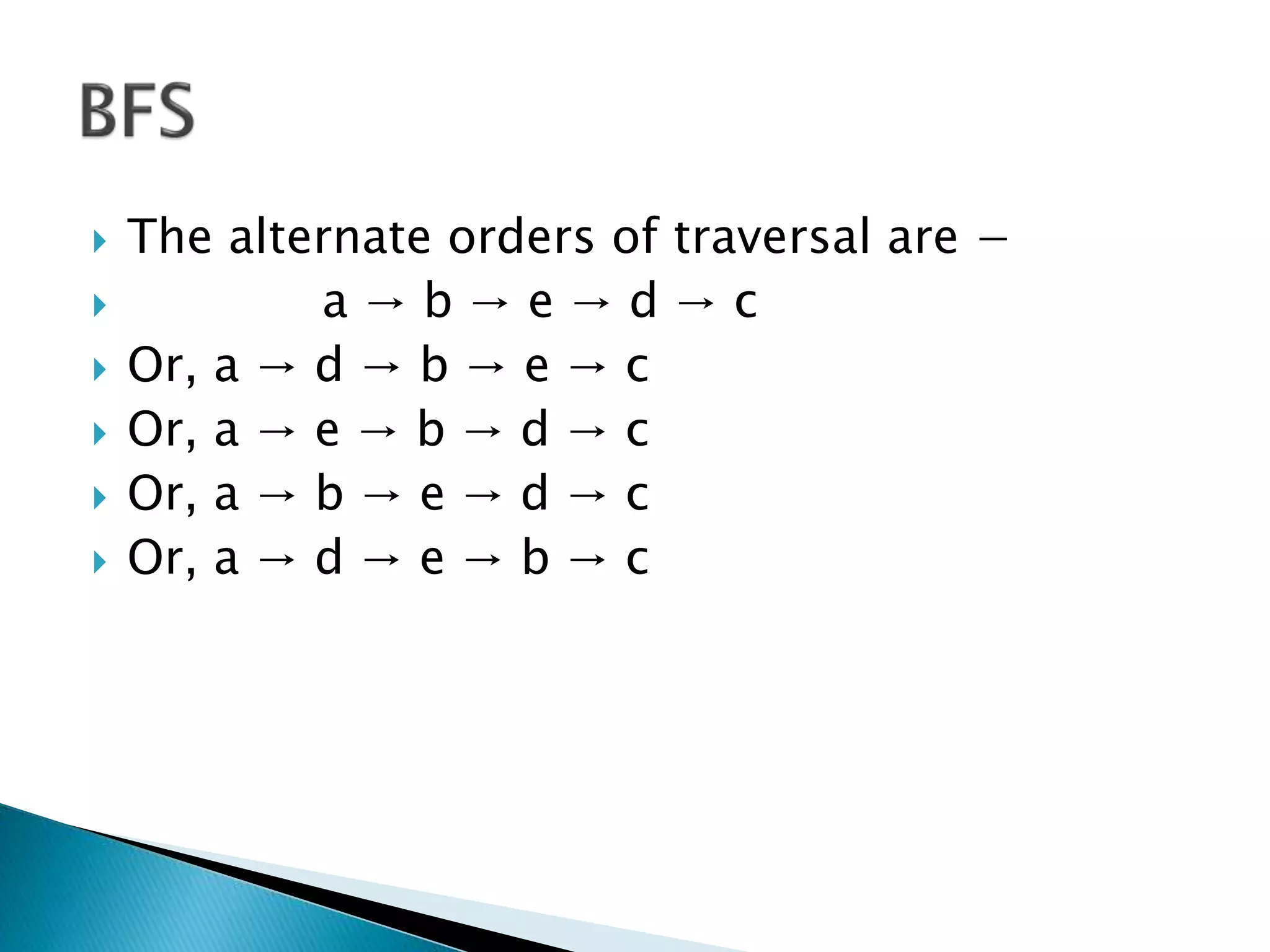
 The alternate orders of traversal are −
 a → b → e → d → c
 Or, a → d → b → e → c
 Or, a → e → b → d → c
 Or, a → b → e → d → c
 Or, a → d → e → b → c
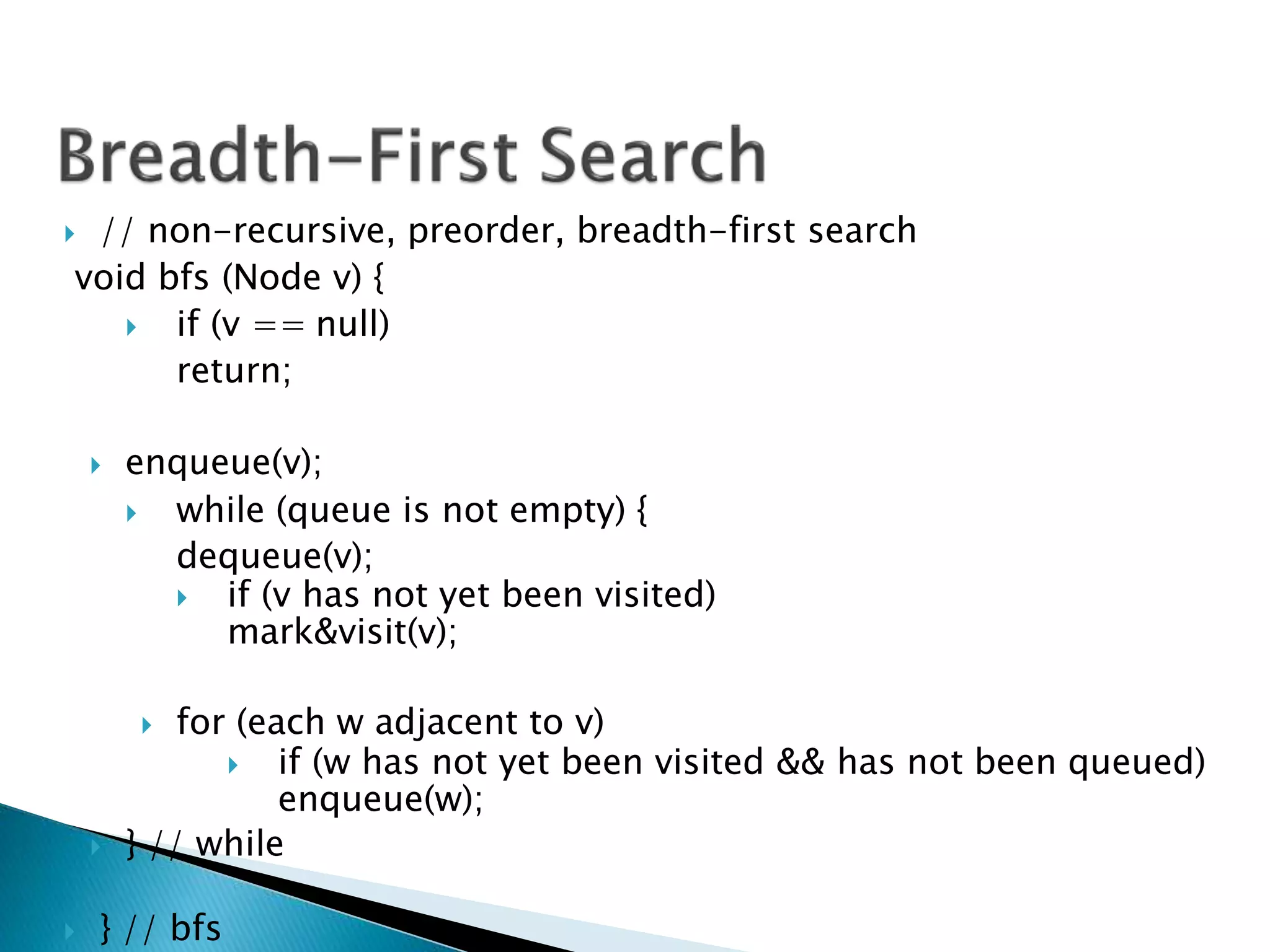
 // non-recursive, preorder, breadth-first search
void bfs (Node v) {
 if (v == null)
return;
 enqueue(v);
 while (queue is not empty) {
dequeue(v);
 if (v has not yet been visited)
mark&visit(v);
 for (each w adjacent to v)
 if (w has not yet been visited && has not been queued)
enqueue(w);
 } // while
 } // bfs
7
1
5
4
3
2
6
0
7
1
5
4
3
2
6
0
5
7
1
5
4
3
2
6
0
5
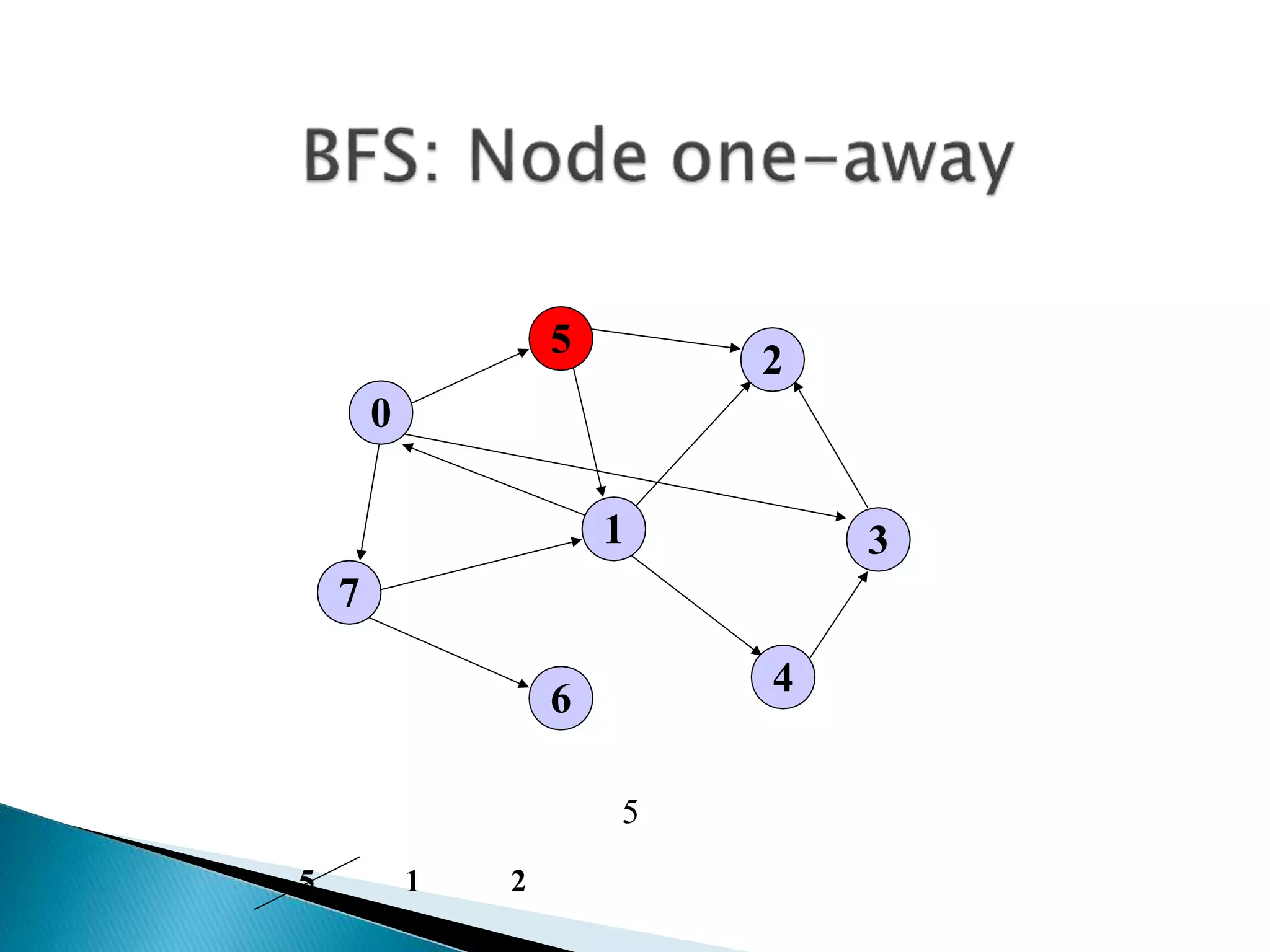
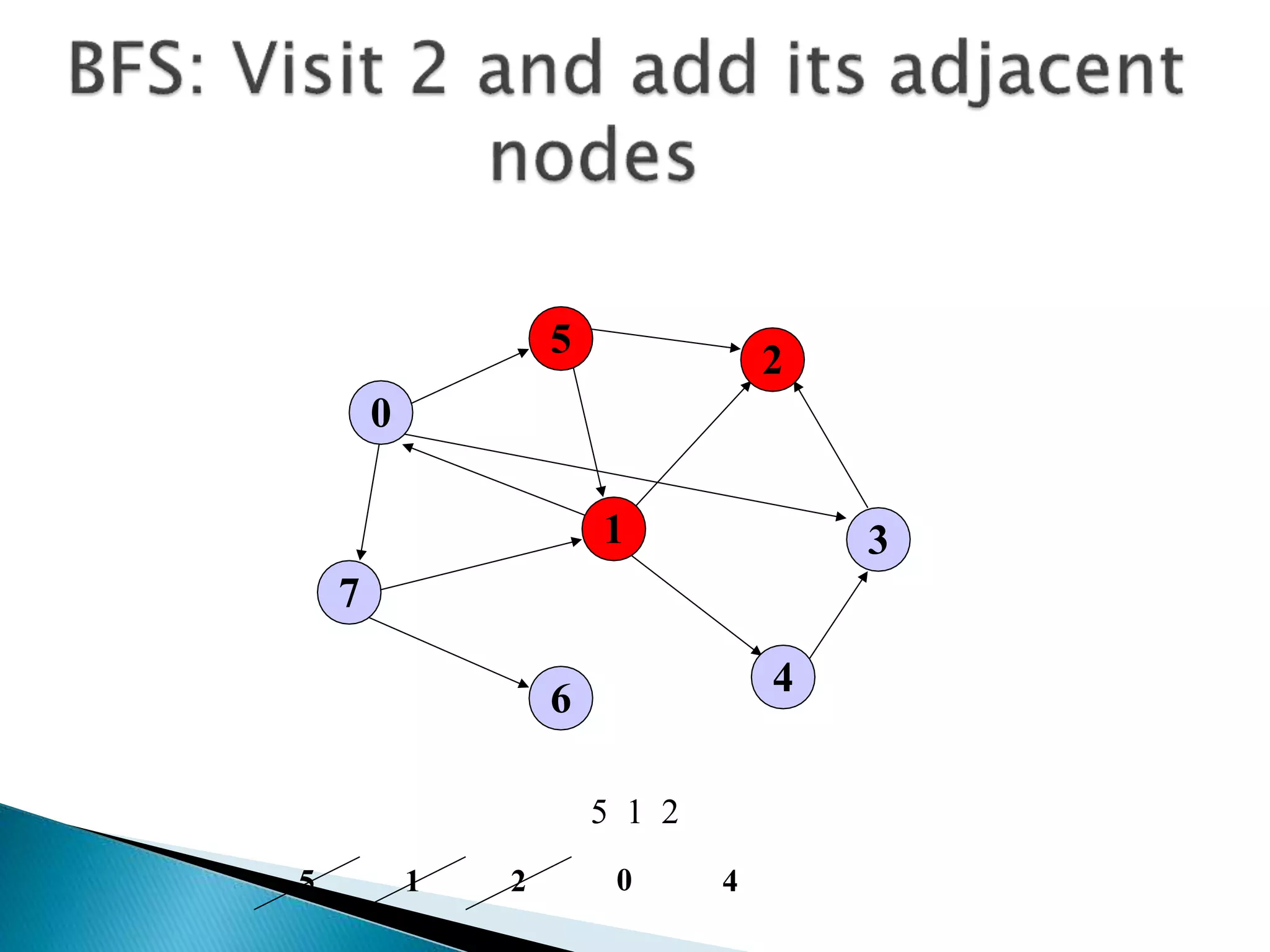
5 1 2
7
1
5
4
3
2
6
0
5 1
0
5 1 2 4
7
1
5
4
3
2
6
0
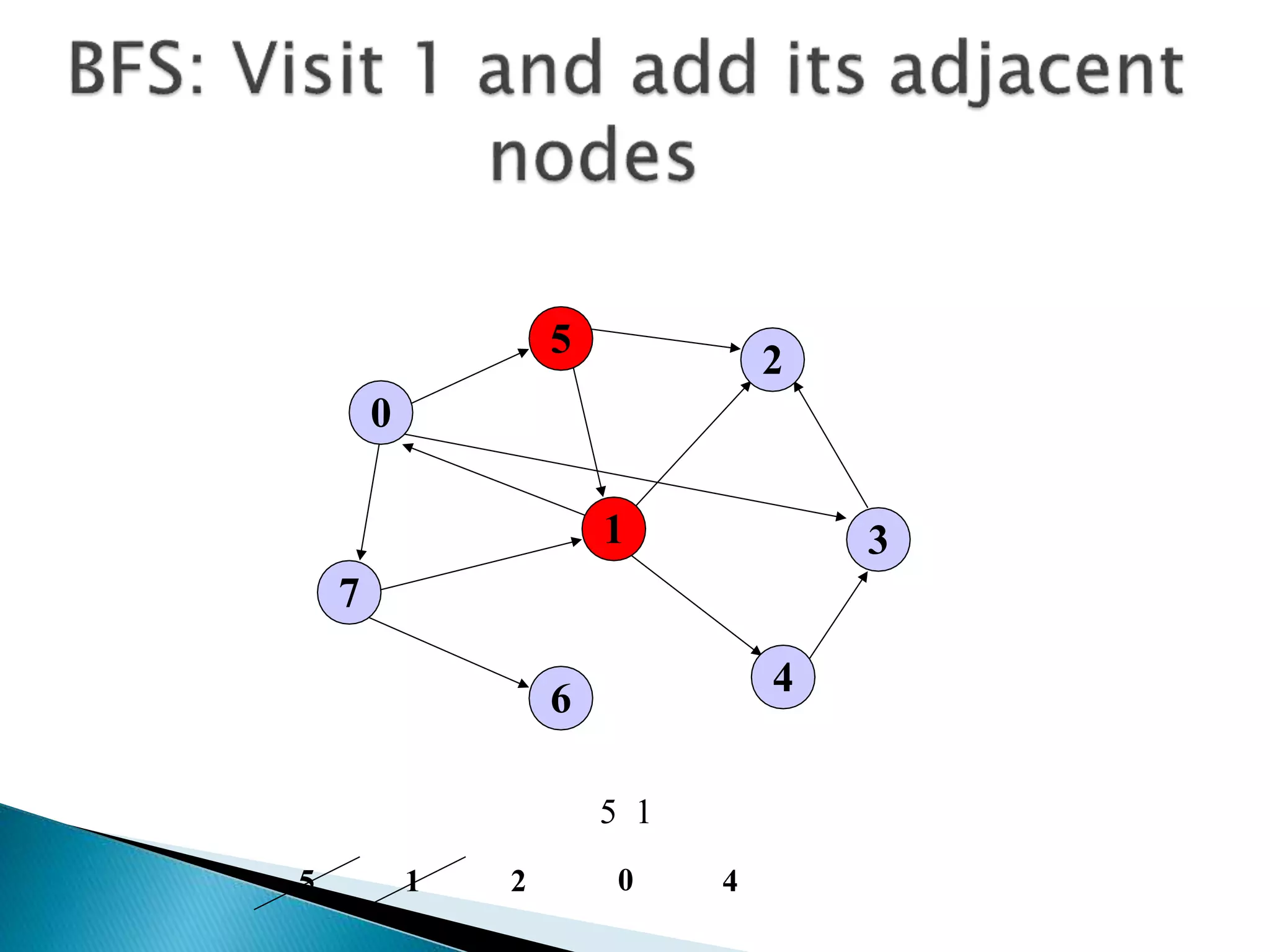
5 1 2
0
5 1 2 4
7
1
5
4
3
2
6
0
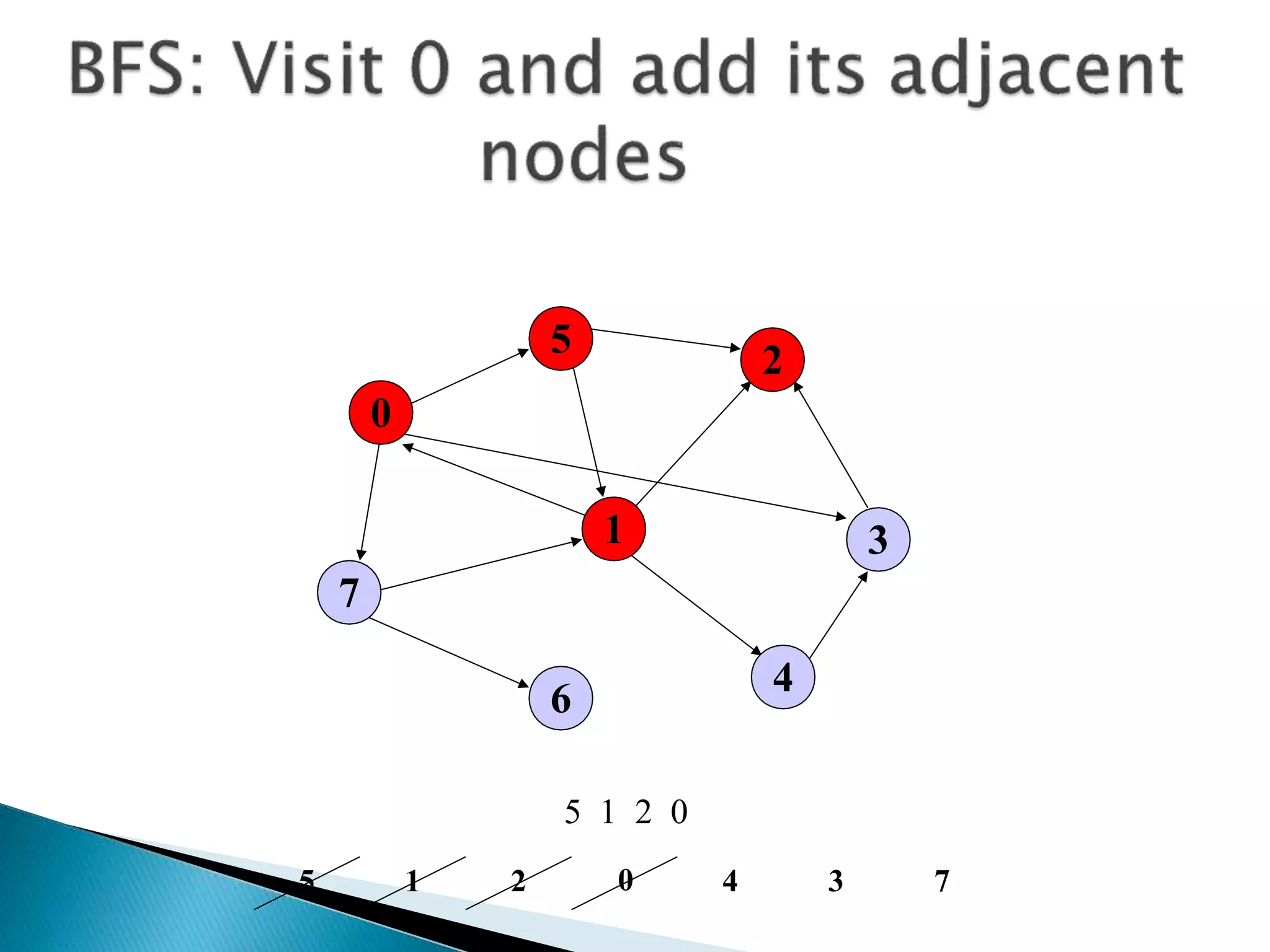
5 1 2 0
0
5 1 2 4 3 7
7
1
5
4
3
2
6
0
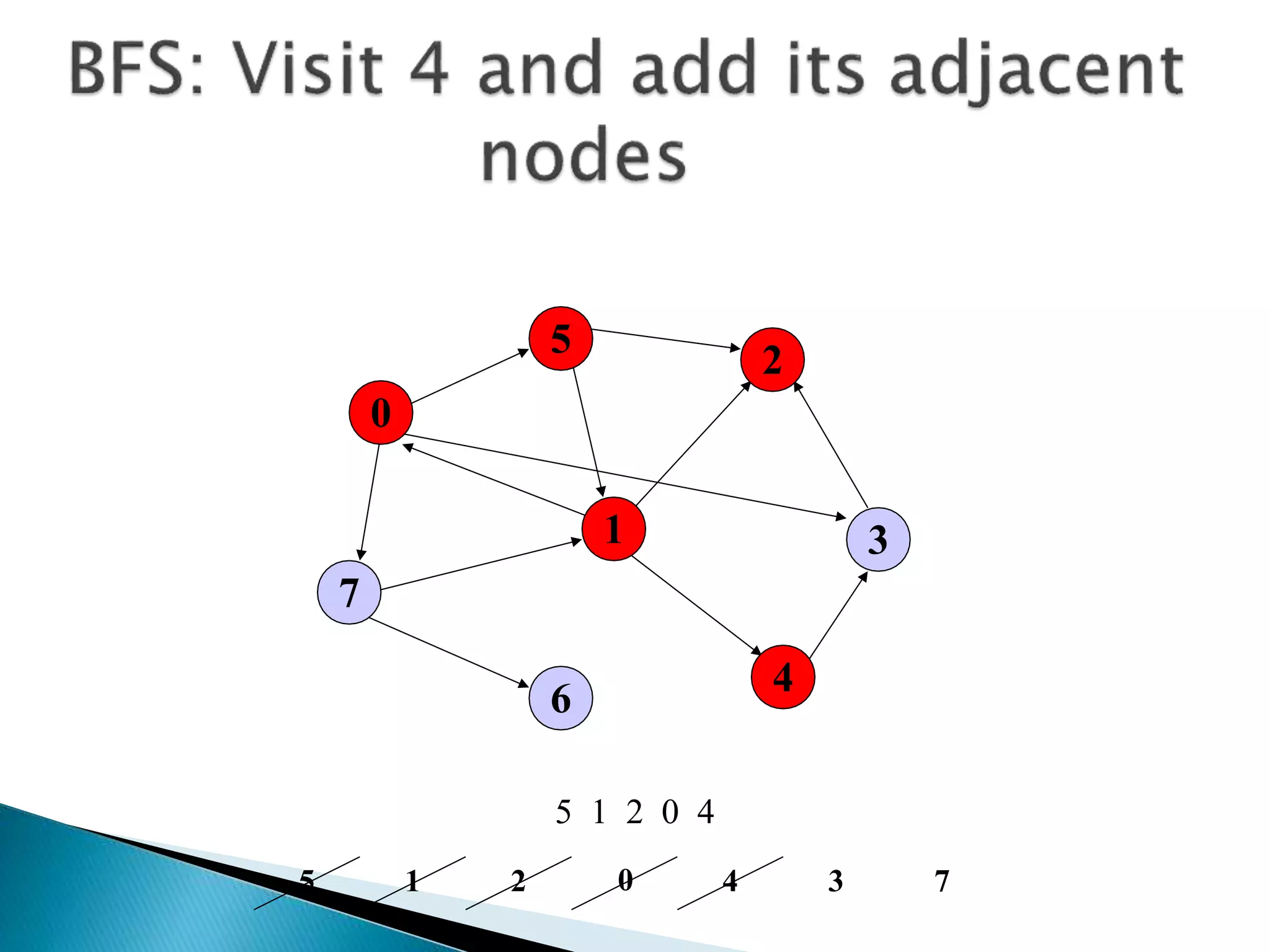
5 1 2 0 4
0
5 1 2 4 3 7
7
1
5
4
3
2
6
0
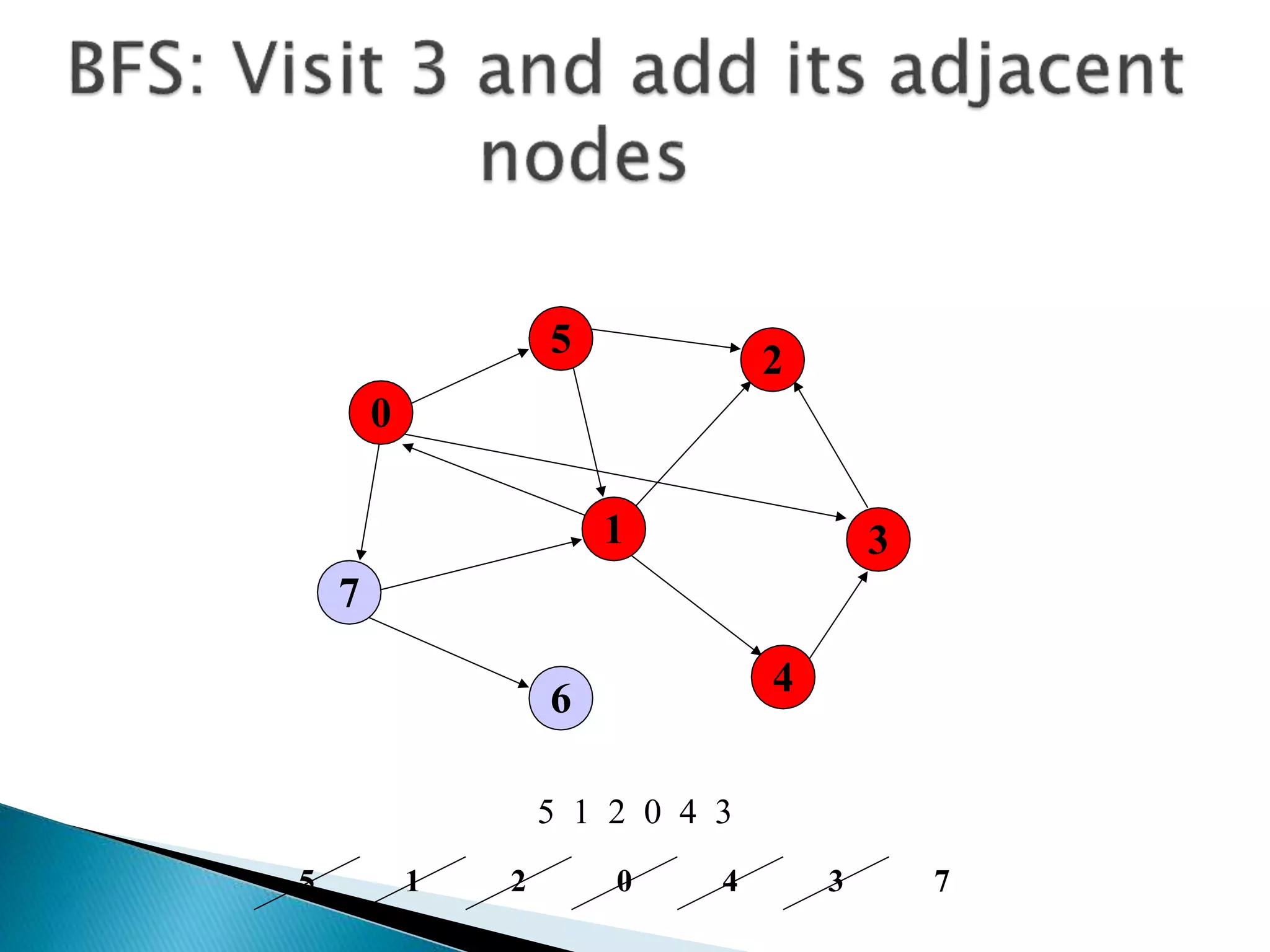
5 1 2 0 4 3
5 1 2 0 4 3 7
7
1
5
4
3
2
6
0
5 1 2 0 4 3 7
5 1 2 0 4 3 7 6
7
1
5
4
3
2
6
0
5 1 2 0 4 3 7 6
5 1 2 0 4 3 7 6
7
1
5
4
3
2
6
5 1 2 0 4 3 7 6
0
•
•
•
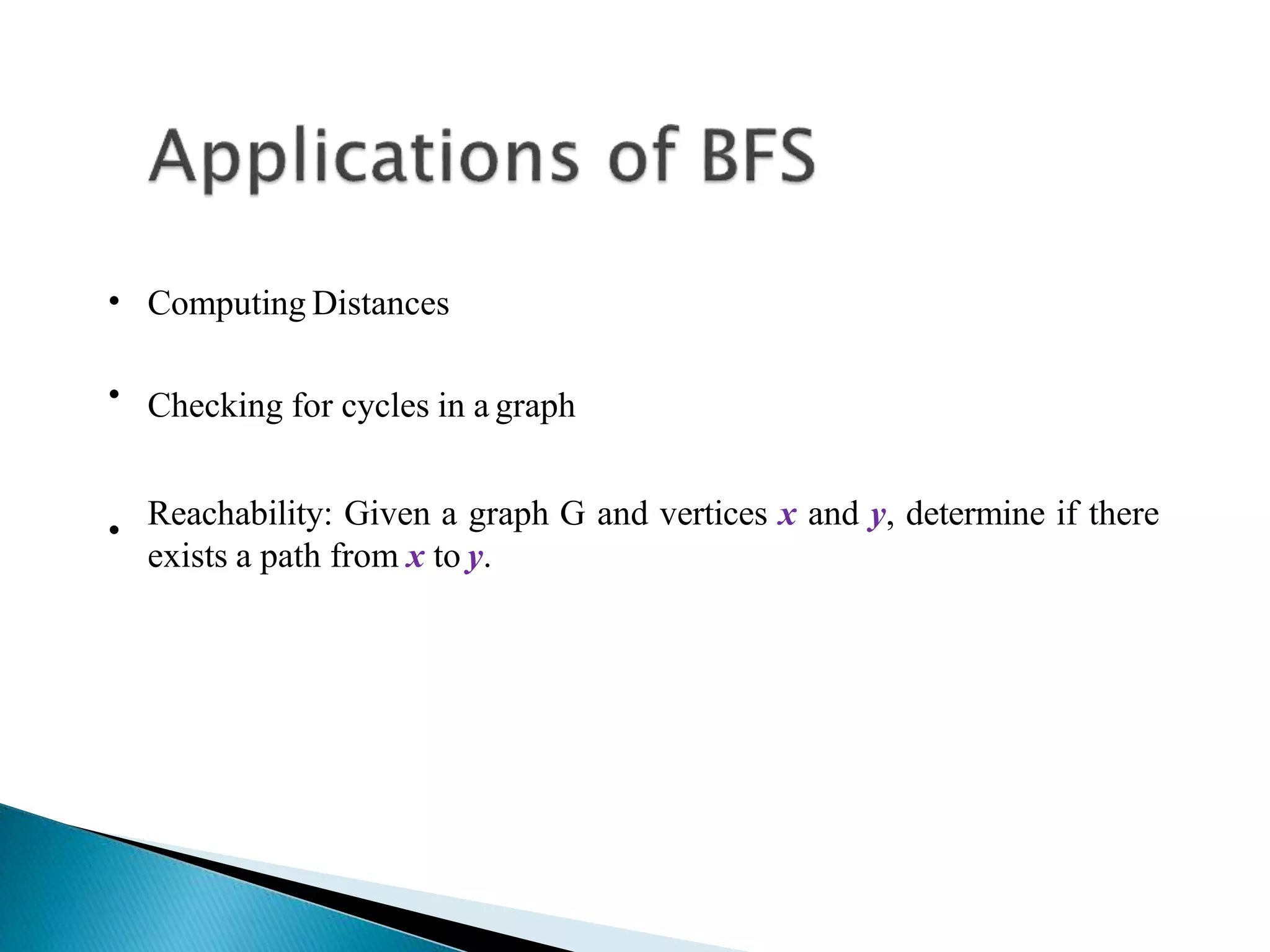
Computing Distances
Checking for cycles in a graph
Reachability: Given a graph G and vertices x and y, determine if there
exists a path from x to y.
• Checking for Biconnected Graph: A graph is biconnected if removal of
any vertex does not affect connectivity of the other vertices. Used to
test if network is robust to failure of certain nodes. A single DFS
traversal algorithm.

Breath first Search and Depth first search

  • 1.
  • 2.
     Introduction  Typesof graph Traversal  Depth-First Search  Breadth-First Search  Application of BFS and DFS
  • 3.
    Graph traversal isalso known as graph search refers to the process of visiting each vertex in a graph. Such traversals are classified by the order in which the vertices are visited. Tree traversal is a special case of graph traversal.
  • 4.
    • Depth-first search(DFS) is an algorithm for traversing or searching tree or graph data structures. • DFS uses stack. • If at any vertex, it encounters that all the adjacent vertices are visited, then it backtracks until it finds the first vertex having an adjacent vertex that has not been traversed before. • Then, it traverses that vertex, continues with its adjacent vertices until it traverses all visited vertices and has to backtrack again.
  • 5.
    The concept isto visit all the neighbor vertices of a neighbor vertex before visiting the other neighbor vertices.  Initialize status of all nodes as “Ready”  Put source vertex in a stack and change its status to “Waiting”  Repeat the following two steps until stack is empty − ◦ Pop the top vertex from the stack and mark it as “Visited” ◦ Push onto the top of the stack all neighbors of the removed vertex whose status is “Ready”. Mark their status as “Waiting”.
  • 7.
     Initialize statusof all vertices to “Ready”.  Push a in stack and change its status to “Waiting”.  Pop a and mark it as “Visited”.  Push a’s neighbors in “Ready” state e, d and b to top of stack and mark them as “Waiting”.  Pop b from stack, mark it as “Visited”, push its “Ready” neighbor c onto stack.  Pop c from stack and mark it as “Visited”. It has no “Ready” neighbor.  Pop d from stack and mark it as “Visited”. It has no “Ready” neighbor.  Pop e from stack and mark it as “Visited”. It has no “Ready” neighbor.  Stack is empty. So stop.
  • 8.
     The alternateorders of traversal are −  a → e → b → c → d  Or, a → b → e → c → d  Or, a → d → e → b → c  Or, a → d → c → e → b  Or, a → d → c → b → e
  • 9.
    // recursive, preorder voiddfs (Node v) { if (v == null) return; if (v not yet visited) visit&mark(v); // visit node before adjacent nodes for (each w adjacent to v) if (w has not yet been visited) dfs(w); } // dfs
  • 10.
    0 7 1 5 4 3 2 6 Policy: Visit adjacentnodes in increasing index order
  • 11.
  • 12.
  • 13.
  • 14.
  • 15.
  • 16.
  • 17.
  • 18.
  • 19.
    0 7 1 5 4 3 2 6 7 4 2 5 1 03 Pop/Visit/Mark3
  • 20.
    0 7 1 5 4 3 2 6 7 4 2 5 1 03 2 is already instack
  • 21.
  • 22.
  • 23.
    0 7 1 5 4 3 2 6 4 2 5 1 03 7 6 Pop/Mark/Visit6
  • 24.
  • 25.
  • 26.
  • 27.
    Breadth-first search (BFS)is an algorithm for traversing or searching tree or graph data structures. It uses queue.
  • 28.
     The conceptis to visit all the neighbor vertices before visiting other neighbor vertices of neighbor vertices.  Initialize status of all nodes as “Ready”.  Put source vertex in a queue and change its status to “Waiting”.  Repeat the following two steps until queue is empty − ◦ Remove the first vertex from the queue and mark it as “Visited”. ◦ Add to the rear of queue all neighbors of the removed vertex whose status is “Ready”. Mark their status as “Waiting”.
  • 30.
     Initialize statusof all vertices to “Ready”.  Put a in queue and change its status to “Waiting”.  Remove a from queue, mark it as “Visited”.  Add a’s neighbors in “Ready” state b, d and e to end of queue and mark them as “Waiting”.  Remove b from queue, mark it as “Visited”, put its “Ready” neighbor c at end of queue and mark c as “Waiting”.  Remove d from queue and mark it as “Visited”. It has no neighbor in “Ready” state.  Remove e from queue and mark it as “Visited”. It has no neighbor in “Ready” state.  Remove c from queue and mark it as “Visited”. It has no neighbor in “Ready” state.  Queue is empty so stop. So the traversal order is −  a → b → d → e → c
  • 31.
     The alternateorders of traversal are −  a → b → e → d → c  Or, a → d → b → e → c  Or, a → e → b → d → c  Or, a → b → e → d → c  Or, a → d → e → b → c
  • 32.
     // non-recursive,preorder, breadth-first search void bfs (Node v) {  if (v == null) return;  enqueue(v);  while (queue is not empty) { dequeue(v);  if (v has not yet been visited) mark&visit(v);  for (each w adjacent to v)  if (w has not yet been visited && has not been queued) enqueue(w);  } // while  } // bfs
  • 33.
  • 34.
  • 35.
  • 36.
  • 37.
  • 38.
    7 1 5 4 3 2 6 0 5 1 20 0 5 1 2 4 3 7
  • 39.
    7 1 5 4 3 2 6 0 5 1 20 4 0 5 1 2 4 3 7
  • 40.
    7 1 5 4 3 2 6 0 5 1 20 4 3 5 1 2 0 4 3 7
  • 41.
    7 1 5 4 3 2 6 0 5 1 20 4 3 7 5 1 2 0 4 3 7 6
  • 42.
    7 1 5 4 3 2 6 0 5 1 20 4 3 7 6 5 1 2 0 4 3 7 6
  • 43.
  • 44.
    • • • Computing Distances Checking forcycles in a graph Reachability: Given a graph G and vertices x and y, determine if there exists a path from x to y.
  • 45.
    • Checking forBiconnected Graph: A graph is biconnected if removal of any vertex does not affect connectivity of the other vertices. Used to test if network is robust to failure of certain nodes. A single DFS traversal algorithm.