By
M.Archana,
I-Msc(CS)
 Genetic Algorithm (GA) is a search-based
optimization technique based on the
principles of Genetics and Natural Selection.
 It is frequently used to find optimal or near-
optimal solutions to difficult problems which
otherwise would take a lifetime to solve.
 It is frequently used to solve optimization
problems, in research, and in machine
learning.
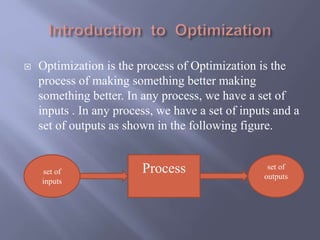
 Optimization is the process of Optimization is the
process of making something better making
something better. In any process, we have a set of
inputs . In any process, we have a set of inputs and a
set of outputs as shown in the following figure.
Process set of
outputs
set of
inputs
 Nature has always been a great source of inspiration
to all mankind.
 Genetic Algorithms (GAs) are search based
algorithms based on the concepts of natural
selection and genetics.
 GAs are a search based algorithms based on the
concepts of natural selection and genetics.
 GAs are a subset of a much larger branch of
computation known as subset of a much larger
branch of computation known as Evolutionary
Computation
 Does not require any derivative information (which may not
be available for many real world problems).
 Is faster and more efficient as compared to the traditional
methods.
 Has very good parallel capabilities
 Optimizes both continuous and discrete functions and also
multi-objective problems.
 Provides a list of “good” solutions and not just a single
solution.
 Always gets an answer to the problem, which gets better
over the time.
 Useful when the search space is very large and there are a
large number of parameters involved
 GAs are not suited for all problems, especially
problems which are simple and for which derivative
information is available
 Fitness value is calculated repeatedly which might
be computationally expensive for some problems.
 Being stochastic, there are no guarantees on the
optimality or the quality of the solution.
 If not implemented properly, the GA may not
converge to the optimal solution.
 Genetic Algorithms have the ability to deliver a
“good-enough” solution “fast-enough”. This makes
genetic algorithms attractive for use in solving
optimization problems. The reasons why GAs are
needed are as follows −
 Solving Difficult Problems
 Failure of Gradient Based Methods
 Getting a Good Solution Fast
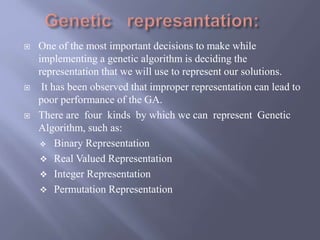
 One of the most important decisions to make while
implementing a genetic algorithm is deciding the
representation that we will use to represent our solutions.
 It has been observed that improper representation can lead to
poor performance of the GA.
 There are four kinds by which we can represent Genetic
Algorithm, such as:
 Binary Representation
 Real Valued Representation
 Integer Representation
 Permutation Representation
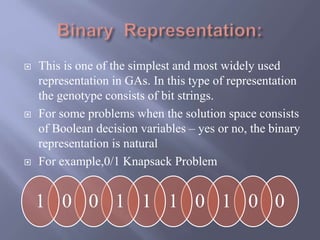
 This is one of the simplest and most widely used
representation in GAs. In this type of representation
the genotype consists of bit strings.
 For some problems when the solution space consists
of Boolean decision variables – yes or no, the binary
representation is natural
 For example,0/1 Knapsack Problem
0010111001
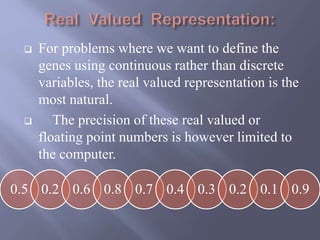
 For problems where we want to define the
genes using continuous rather than discrete
variables, the real valued representation is the
most natural.
 The precision of these real valued or
floating point numbers is however limited to
the computer.
0.5 0.2 0.6 0.8 0.7 0.4 0.3 0.2 0.1 0.9
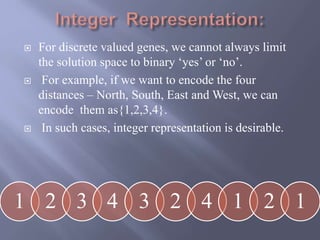
 For discrete valued genes, we cannot always limit
the solution space to binary ‘yes’ or ‘no’.
 For example, if we want to encode the four
distances – North, South, East and West, we can
encode them as{1,2,3,4}.
 In such cases, integer representation is desirable.
1 2 3 4 3 2 4 1 2 1
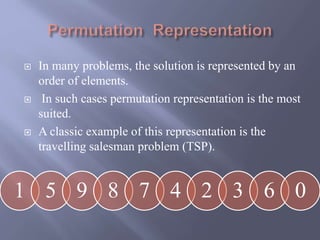
 In many problems, the solution is represented by an
order of elements.
 In such cases permutation representation is the most
suited.
 A classic example of this representation is the
travelling salesman problem (TSP).
1 5 9 8 7 4 2 3 6 0
THANK YOU!!!

Genetic algorithm

  • 1.
  • 2.
     Genetic Algorithm(GA) is a search-based optimization technique based on the principles of Genetics and Natural Selection.  It is frequently used to find optimal or near- optimal solutions to difficult problems which otherwise would take a lifetime to solve.  It is frequently used to solve optimization problems, in research, and in machine learning.
  • 3.
     Optimization isthe process of Optimization is the process of making something better making something better. In any process, we have a set of inputs . In any process, we have a set of inputs and a set of outputs as shown in the following figure. Process set of outputs set of inputs
  • 4.
     Nature hasalways been a great source of inspiration to all mankind.  Genetic Algorithms (GAs) are search based algorithms based on the concepts of natural selection and genetics.  GAs are a search based algorithms based on the concepts of natural selection and genetics.  GAs are a subset of a much larger branch of computation known as subset of a much larger branch of computation known as Evolutionary Computation
  • 5.
     Does notrequire any derivative information (which may not be available for many real world problems).  Is faster and more efficient as compared to the traditional methods.  Has very good parallel capabilities  Optimizes both continuous and discrete functions and also multi-objective problems.  Provides a list of “good” solutions and not just a single solution.  Always gets an answer to the problem, which gets better over the time.  Useful when the search space is very large and there are a large number of parameters involved
  • 6.
     GAs arenot suited for all problems, especially problems which are simple and for which derivative information is available  Fitness value is calculated repeatedly which might be computationally expensive for some problems.  Being stochastic, there are no guarantees on the optimality or the quality of the solution.  If not implemented properly, the GA may not converge to the optimal solution.
  • 7.
     Genetic Algorithmshave the ability to deliver a “good-enough” solution “fast-enough”. This makes genetic algorithms attractive for use in solving optimization problems. The reasons why GAs are needed are as follows −  Solving Difficult Problems  Failure of Gradient Based Methods  Getting a Good Solution Fast
  • 9.
     One ofthe most important decisions to make while implementing a genetic algorithm is deciding the representation that we will use to represent our solutions.  It has been observed that improper representation can lead to poor performance of the GA.  There are four kinds by which we can represent Genetic Algorithm, such as:  Binary Representation  Real Valued Representation  Integer Representation  Permutation Representation
  • 10.
     This isone of the simplest and most widely used representation in GAs. In this type of representation the genotype consists of bit strings.  For some problems when the solution space consists of Boolean decision variables – yes or no, the binary representation is natural  For example,0/1 Knapsack Problem 0010111001
  • 11.
     For problemswhere we want to define the genes using continuous rather than discrete variables, the real valued representation is the most natural.  The precision of these real valued or floating point numbers is however limited to the computer. 0.5 0.2 0.6 0.8 0.7 0.4 0.3 0.2 0.1 0.9
  • 12.
     For discretevalued genes, we cannot always limit the solution space to binary ‘yes’ or ‘no’.  For example, if we want to encode the four distances – North, South, East and West, we can encode them as{1,2,3,4}.  In such cases, integer representation is desirable. 1 2 3 4 3 2 4 1 2 1
  • 13.
     In manyproblems, the solution is represented by an order of elements.  In such cases permutation representation is the most suited.  A classic example of this representation is the travelling salesman problem (TSP). 1 5 9 8 7 4 2 3 6 0
  • 15.