WHAT IS ADIODE?
THE "ONE-WAY VALVE" OF ELECTRONICS
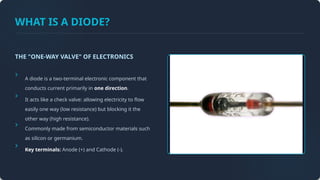
A diode is a two-terminal electronic component that
conducts current primarily in one direction.
It acts like a check valve: allowing electricity to flow
easily one way (low resistance) but blocking it the
other way (high resistance).
Commonly made from semiconductor materials such
as silicon or germanium.
Key terminals: Anode (+) and Cathode (-).
3.
THE PN JUNCTION
Whenjoined, a Depletion Region forms at the boundary, creating a potential barrier that stops current until voltage is applied.
P-TYPE SEMICONDUCTOR
Created by doping silicon with Trivalent
impurities (like Boron). This creates an
abundance of "Holes" (positive charge carriers).
It seeks electrons.
N-TYPE SEMICONDUCTOR
Created by doping with Pentavalent impurities
(like Phosphorus). This creates an excess of
"Electrons" (negative charge carriers). It has free
electrons to give.
4.
BIASING CONDITIONS
FORWARD BIAS
Anode(+) connected to Positive,
Cathode (-) to Negative. The
potential barrier is overcome.
Current flows freely.
REVERSE BIAS
Anode (+) to Negative, Cathode
(-) to Positive. The depletion
region widens. No current
flows (except negligible
leakage).
BREAKDOWN
If reverse voltage exceeds the
limit (Breakdown Voltage), the
diode fails or conducts heavily
(Zener effect). Critical limit.
5.
V-I CHARACTERISTIC CURVE
Thegraph shows the non-linear behavior. Current remains zero until the forward voltage exceeds the Knee Voltage (~0.7V for
Silicon), after which it rises exponentially.
6.
COMMON TYPES OFDIODES
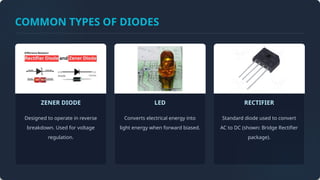
ZENER DIODE
Designed to operate in reverse
breakdown. Used for voltage
regulation.
LED
Converts electrical energy into
light energy when forward biased.
RECTIFIER
Standard diode used to convert
AC to DC (shown: Bridge Rectifier
package).
7.
THE ZENER DIODE
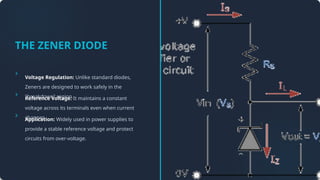
VoltageRegulation: Unlike standard diodes,
Zeners are designed to work safely in the
"breakdown" region.
Reference Voltage: It maintains a constant
voltage across its terminals even when current
changes.
Application: Widely used in power supplies to
provide a stable reference voltage and protect
circuits from over-voltage.
8.
LIGHT EMITTING DIODE(LED)
ILLUMINATING TECHNOLOGY
Principle: Electroluminescence. When electrons
recombine with holes, energy is released as photons
(light).
Color: Determined by the energy band gap of the
semiconductor material (e.g., Gallium Arsenide).
Efficiency: Highly efficient compared to incandescent
bulbs, with longer lifespans and lower heat output.
9.
APPLICATIONS
Rectification: Converting ACpower to DC power
(Chargers, PSUs).
Signal Clipping: Limiting voltage levels to protect
sensitive circuits.
Reverse Polarity Protection: Preventing damage if a
battery is inserted backwards.
Logic Gates: Building blocks of digital logic (AND/OR
gates).
POWER SUPPLIES
Essential for AC/DC conversion.
PROTECTION
Safeguards sensitive
ICs.
10.
RECTIFICATION: AC TODC
HALF-WAVE RECTIFIER
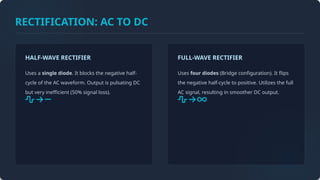
Uses a single diode. It blocks the negative half-
cycle of the AC waveform. Output is pulsating DC
but very inefficient (50% signal loss).
FULL-WAVE RECTIFIER
Uses four diodes (Bridge configuration). It flips
the negative half-cycle to positive. Utilizes the full
AC signal, resulting in smoother DC output.
11.
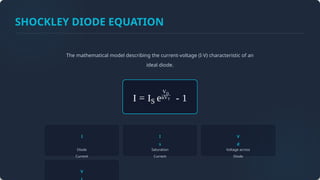
SHOCKLEY DIODE EQUATION
Themathematical model describing the current-voltage (I-V) characteristic of an
ideal diode.
I
Diode
Current
I
s
Saturation
Current
V
d
Voltage across
Diode
V
12.
Q & A
Thankyou for your
attention.
contact@example.co
m
www.example.co
m