DISTANCE MEASURING
EQUIPMENT
A. Concept
Distance Measuring
Equipment (DME) means a
measurement system that
provides the flight crew with
information about the
distance from the aircraft’s
position to a ground station.
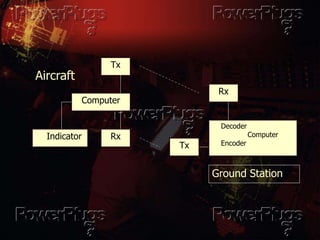
Computer
Rx
Tx
Indicator
Aircraft
Decoder
Computer
EncoderTx
Rx
Ground Station
The airborne DME (interrogator)
includes:
• Transmitter
• Receiver
• Timing circuits
• Distance indicator
The ground-based DME (transponder)
consists of:
• Transmitter
• Decoder/encoder computer-time delay
• Receiver
The time of travel of the RF
wave is measured from aircraft
to ground, and back to the
aircraft. The airborne unit
subtracts the ground delay time
of 50 µs, divides by 2, then
displays the distance in NM.
The DME operates in the ultra-high
frequency (UHF) band and therefore is
restricted to line-of-sight transmission.
However its frequency can be "paired"
with VOR or ILS or localizer (LOC)
frequencies. The receiving equipment in
most aircraft provide for automatic
DME selection through a coupled
VOR/lLS receiver. Selection of the
appropriate VOR or ILS frequency
automatically tunes the DME.
B. DME Components & Operations
The transceiver that sends out the
interrogating signal to the ground station
contains an internal computer to measure
the time interval that elapses until the
response. The antenna, used for both
transmission and reception, is a very
small "sharks fin" normally mounted on
the underside of the aircraft. Modern
DME controls incorporate digital
readouts of frequency, DME and
groundspeed information.
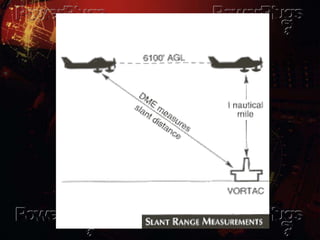
The DME displays
information in the form of
distance to the station and
the aircraft's groundspeed.
The distance to the station
is a slant range, expressed
in nautical miles.
The DME receiver can
express groundspeed in
knots. the groundspeed
information allows the pilot
to make accurate estimates
of time of arrival and
accurate checks of aircraft
progress.
A pilot with DME may pinpoint
aircraft position using the
radial of a VORTAC and the
distance information from the
same VORTAC; whereas a
pilot without DME must use
radials from two stations to
get a position fix.
The pilot also can use DME to
establish intersections and
holding patterns. When so
equipped and cleared by ATC,
pilots can establish holding
patterns by reference to
radials and DME.

Distance measuring equipment

  • 1.
  • 2.
    A. Concept Distance Measuring Equipment(DME) means a measurement system that provides the flight crew with information about the distance from the aircraft’s position to a ground station.
  • 3.
  • 4.
    The airborne DME(interrogator) includes: • Transmitter • Receiver • Timing circuits • Distance indicator The ground-based DME (transponder) consists of: • Transmitter • Decoder/encoder computer-time delay • Receiver
  • 5.
    The time oftravel of the RF wave is measured from aircraft to ground, and back to the aircraft. The airborne unit subtracts the ground delay time of 50 µs, divides by 2, then displays the distance in NM.
  • 6.
    The DME operatesin the ultra-high frequency (UHF) band and therefore is restricted to line-of-sight transmission. However its frequency can be "paired" with VOR or ILS or localizer (LOC) frequencies. The receiving equipment in most aircraft provide for automatic DME selection through a coupled VOR/lLS receiver. Selection of the appropriate VOR or ILS frequency automatically tunes the DME.
  • 7.
    B. DME Components& Operations The transceiver that sends out the interrogating signal to the ground station contains an internal computer to measure the time interval that elapses until the response. The antenna, used for both transmission and reception, is a very small "sharks fin" normally mounted on the underside of the aircraft. Modern DME controls incorporate digital readouts of frequency, DME and groundspeed information.
  • 8.
    The DME displays informationin the form of distance to the station and the aircraft's groundspeed. The distance to the station is a slant range, expressed in nautical miles.
  • 10.
    The DME receivercan express groundspeed in knots. the groundspeed information allows the pilot to make accurate estimates of time of arrival and accurate checks of aircraft progress.
  • 11.
    A pilot withDME may pinpoint aircraft position using the radial of a VORTAC and the distance information from the same VORTAC; whereas a pilot without DME must use radials from two stations to get a position fix.
  • 12.
    The pilot alsocan use DME to establish intersections and holding patterns. When so equipped and cleared by ATC, pilots can establish holding patterns by reference to radials and DME.