Intercepting and Tracking VOR’s Ideal for IFR Students by Derek W Beck May 2008 (revised Nov 2008) Animations require viewing in slideshow mode You may copy, distribute, display this copyrighted work — and derivative works based upon it — but only if they give credit to Derek W Beck and abide by the other license requirements listed here. This work and its derivatives may not be sold without permission from Derek W Beck. You may distribute derivative works only under a license identical to the licenses listed here and only if these licenses are explicitly depicted somewhere on the derivative work. This document is provided for informational use only. Consult the aircraft manual and appropriate FAA handbooks to double-check all information. © Derek W Beck 2008. Some Rights Reserved.  www.derekbeck.com   Licensed under  Creative Commons Attribution-Noncommercial-Share Alike License .
Objective Develop an understanding of how to use VOR for navigation and how to track along a VOR radial
Content What is a VOR and How Does it Work? Tuning and Identifying a VOR Flying to a VOR Station Station Passage Intercepting a VOR Course Tracking a Course (Wind Correction) Reverse Sensing VOR Intersections VOR Failures Quiz
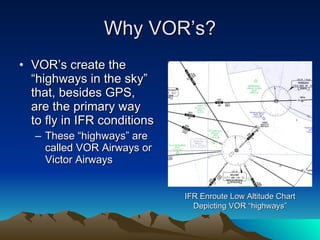
Why VOR’s? VOR’s create the “highways in the sky” that, besides GPS, are the primary way to fly in IFR conditions These “highways” are called VOR Airways or Victor Airways IFR Enroute Low Altitude Chart Depicting VOR “highways”
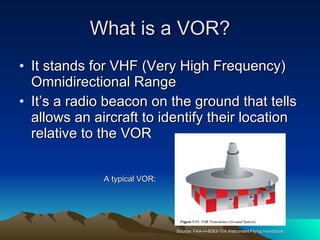
What is a VOR? It stands for VHF (Very High Frequency) Omnidirectional Range It’s a radio beacon on the ground that tells allows an aircraft to identify their location relative to the VOR Source: FAA-H-8083-15A Instrument Flying Handbook A typical VOR:
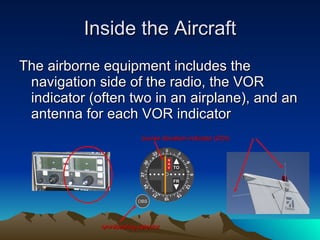
Inside the Aircraft The airborne equipment includes the navigation side of the radio, the VOR indicator (often two in an airplane), and an antenna for each VOR indicator OBS NAV omnibearing selector course deviation indicator (CDI) TO FR
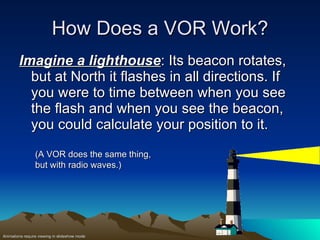
How Does a VOR Work? Imagine a lighthouse : Its beacon rotates, but at North it flashes in all directions. If you were to time between when you see the flash and when you see the beacon, you could calculate your position to it.  (A VOR does the same thing, but with radio waves.) Animations require viewing in slideshow mode
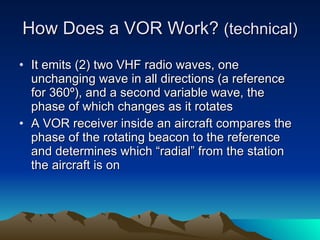
How Does a VOR Work?  (technical) It emits (2) two VHF radio waves, one unchanging wave in all directions (a reference for 360º), and a second variable wave, the phase of which changes as it rotates A VOR receiver inside an aircraft compares the phase of the rotating beacon to the reference and determines which “radial” from the station the aircraft is on
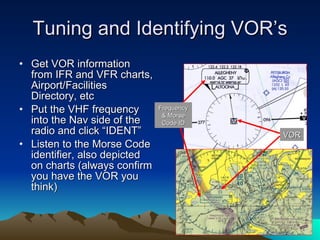
Tuning and Identifying VOR’s Get VOR information from IFR and VFR charts, Airport/Facilities Directory, etc Put the VHF frequency into the Nav side of the radio and click “IDENT” Listen to the Morse Code identifier, also depicted on charts (always confirm you have the VOR you think) VOR Frequency & Morse Code ID
Using a VOR Let’s go to the station…
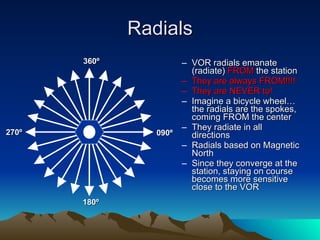
Radials VOR radials emanate (radiate)  FROM  the station They are always FROM!!!! They are NEVER to! Imagine a bicycle wheel… the radials are the spokes, coming FROM the center They radiate in all directions Radials based on Magnetic North Since they converge at the station, staying on course becomes more sensitive close to the VOR 360º 090º 180º 270º
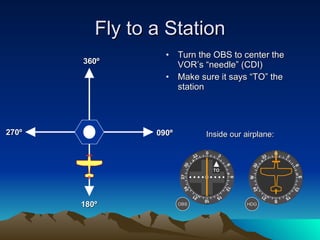
Fly to a Station Turn the OBS to center the VOR’s “needle” (CDI) Make sure it says “TO” the station 360º 090º 180º 270º HDG Inside our airplane: OBS TO
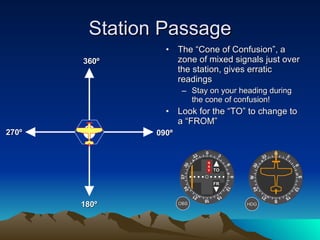
Station Passage The “Cone of Confusion”, a zone of mixed signals just over the station, gives erratic readings Stay on your heading during the cone of confusion! Look for the “TO” to change to a “FROM” 360º 090º 180º 270º HDG OBS NAV TO FR
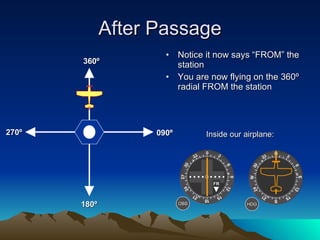
After Passage Notice it now says “FROM” the station You are now flying on the 360º radial FROM the station 360º 090º 180º 270º HDG Inside our airplane: OBS FR
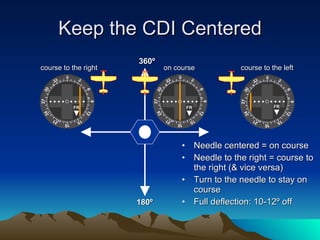
Keep the CDI Centered Needle centered = on course Needle to the right = course to the right (& vice versa) Turn to the needle to stay on course Full deflection: 10-12º off  360º 180º course to the right course to the left on course FR FR FR
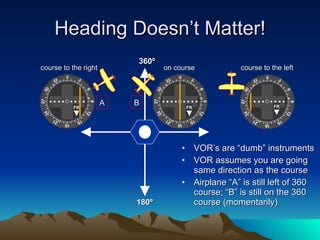
Heading Doesn’t Matter! VOR’s are “dumb” instruments VOR assumes you are going same direction as the course Airplane “A” is still left of 360 course; “B” is still on the 360 course (momentarily) 360º 180º course to the right course to the left on course A B FR FR FR
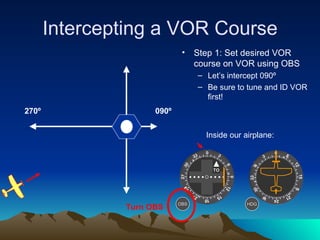
Intercepting a VOR Course 090º Inside our airplane: Step 1: Set desired VOR course on VOR using OBS Let’s intercept 090º Be sure to tune and ID VOR first! Turn OBS 270º OBS HDG TO
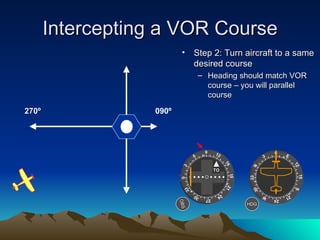
Intercepting a VOR Course HDG OBS Step 2: Turn aircraft to a same desired course Heading should match VOR course – you will parallel course 270º 090º TO
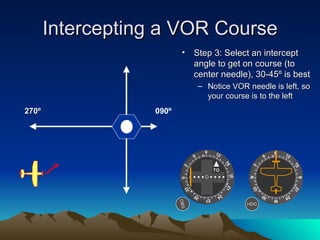
Intercepting a VOR Course HDG OBS Step 3: Select an intercept angle to get on course (to center needle), 30-45º is best Notice VOR needle is left, so your course is to the left 270º 090º TO
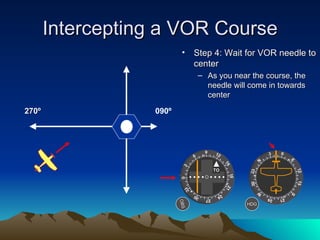
Intercepting a VOR Course HDG OBS Step 4: Wait for VOR needle to center As you near the course, the needle will come in towards center 270º 090º TO
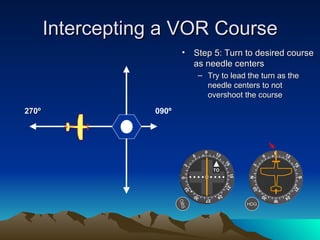
Intercepting a VOR Course HDG OBS Step 5: Turn to desired course as needle centers Try to lead the turn as the needle centers to not overshoot the course 270º 090º TO
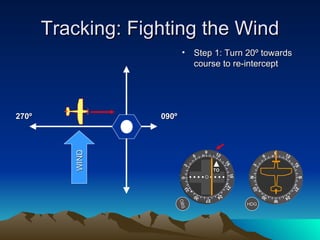
Tracking: Fighting the Wind HDG OBS Step 1: Turn 20º towards course to re-intercept 090º 270º WIND TO
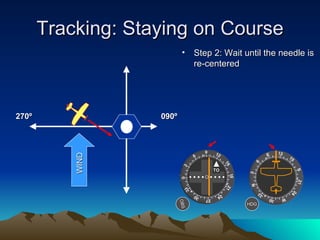
Tracking: Staying on Course HDG OBS Step 2: Wait until the needle is re-centered 090º 270º WIND TO
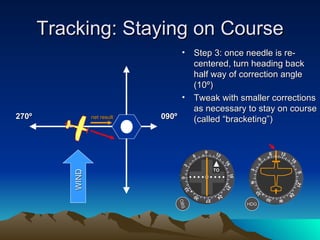
Tracking: Staying on Course HDG OBS Step 3: once needle is re-centered, turn heading back half way of correction angle (10º) Tweak with smaller corrections as necessary to stay on course (called “bracketing”) 090º 270º WIND net result TO
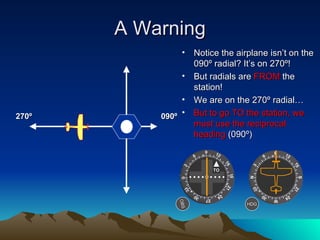
A Warning HDG OBS Notice the airplane isn’t on the 090º radial? It’s on 270º! But radials are  FROM  the station!  We are on the 270º radial… But to go TO the station, we must use the reciprocal heading  (090º) 090º 270º TO
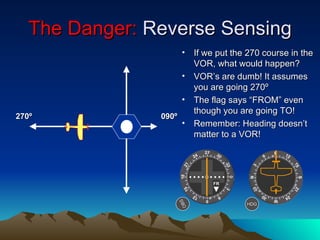
The Danger:  Reverse Sensing HDG OBS If we put the 270 course in the VOR, what would happen? VOR’s are dumb! It assumes you are going 270º The flag says “FROM” even though you are going TO! Remember: Heading doesn’t matter to a VOR! 090º 270º FR
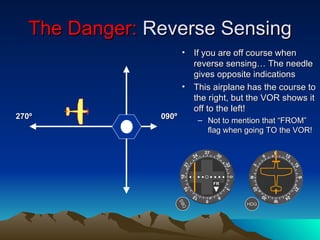
The Danger:  Reverse Sensing HDG OBS If you are off course when reverse sensing… The needle gives opposite indications This airplane has the course to the right, but the VOR shows it off to the left! Not to mention that “FROM” flag when going TO the VOR! 090º 270º FR
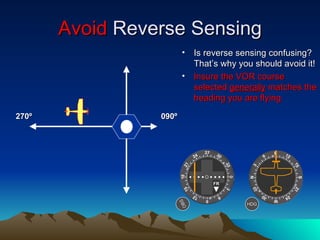
Avoid  Reverse Sensing HDG OBS Is reverse sensing confusing? That’s why you should avoid it! Insure the VOR course selected  generally  matches the heading you are flying 090º 270º FR
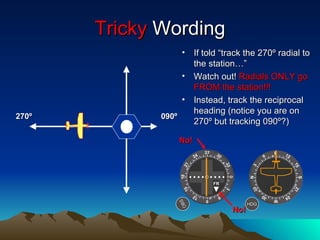
Tricky  Wording HDG OBS If told “track the 270º radial to the station…” Watch out!  Radials ONLY go FROM the station!!!  Instead, track the reciprocal heading (notice you are on 270º but tracking 090º?) 090º 270º No! No! FR
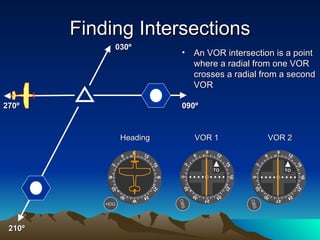
Finding Intersections An VOR intersection is a point where a radial from one VOR crosses a radial from a second VOR 090º 270º OBS OBS Heading  VOR 1  VOR 2 210º 030º HDG TO TO
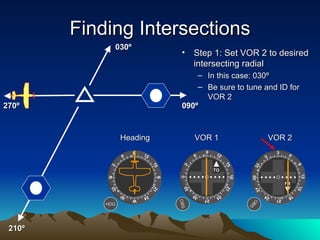
Finding Intersections Step 1: Set VOR 2 to desired intersecting radial  In this case: 030º  Be sure to tune and ID for VOR 2 OBS OBS Heading  VOR 1  VOR 2 HDG 090º 270º 210º 030º TO FR
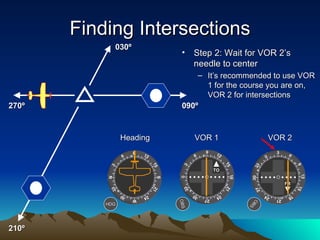
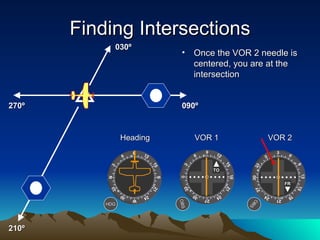
Finding Intersections Step 2: Wait for VOR 2’s needle to center It’s recommended to use VOR 1 for the course you are on, VOR 2 for intersections 090º 270º OBS OBS Heading  VOR 1  VOR 2 210º 030º HDG TO FR
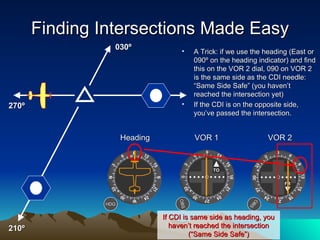
Finding Intersections Made Easy A Trick: if we use the heading (East or 090º on the heading indicator) and find this on the VOR 2 dial, 090 on VOR 2 is the same side as the CDI needle: “Same Side Safe” (you haven’t reached the intersection yet) If the CDI is on the opposite side, you’ve passed the intersection. 270º OBS OBS Heading  VOR 1  VOR 2 210º 030º HDG If CDI is same side as heading, you haven’t reached the intersection (“Same Side Safe”) TO FR
Finding Intersections Once the VOR 2 needle is centered, you are at the intersection 090º 270º OBS OBS Heading  VOR 1  VOR 2 210º 030º HDG TO FR
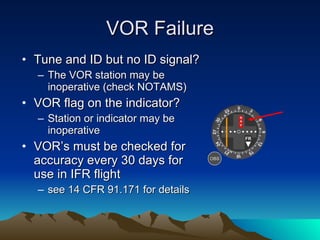
VOR Failure Tune and ID but no ID signal?  The VOR station may be inoperative (check NOTAMS) VOR flag on the indicator?  Station or indicator may be inoperative VOR’s must be checked for accuracy every 30 days for use in IFR flight  see 14 CFR 91.171 for details OBS NAV FR
Quiz Time!
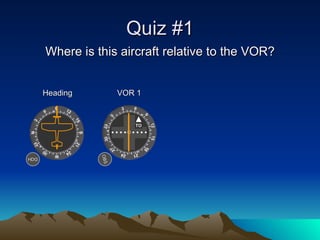
Quiz #1 Where is this aircraft relative to the VOR? OBS Heading  VOR 1 HDG TO
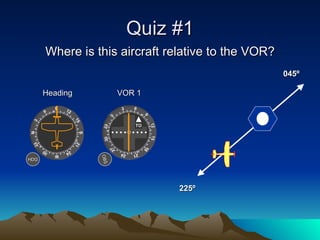
Quiz #1 Where is this aircraft relative to the VOR? OBS Heading  VOR 1 HDG 225º 045º TO
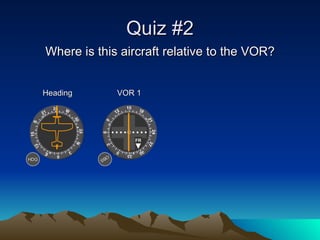
Quiz #2 Where is this aircraft relative to the VOR? OBS Heading  VOR 1 HDG FR
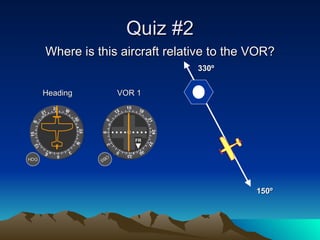
Quiz #2 Where is this aircraft relative to the VOR? OBS Heading  VOR 1 HDG 330º 150º FR
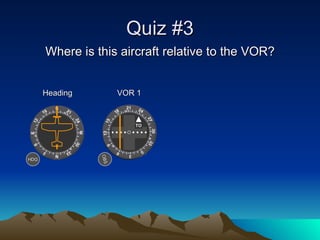
Quiz #3 Where is this aircraft relative to the VOR? OBS Heading  VOR 1 HDG TO
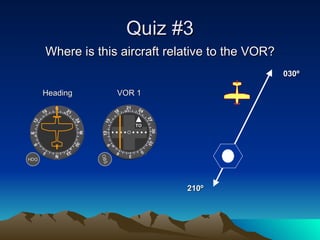
Quiz #3 Where is this aircraft relative to the VOR? OBS Heading  VOR 1 HDG 210º 030º TO
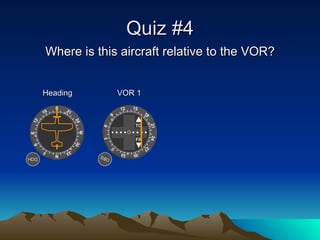
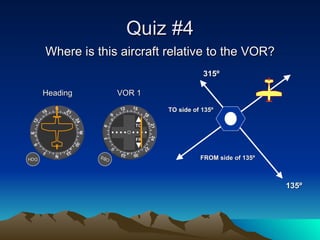
Quiz #4 Where is this aircraft relative to the VOR? OBS Heading  VOR 1 HDG TO FR
Quiz #4 Where is this aircraft relative to the VOR? OBS Heading  VOR 1 HDG 315º 135º TO side of 135º FROM side of 135º TO FR
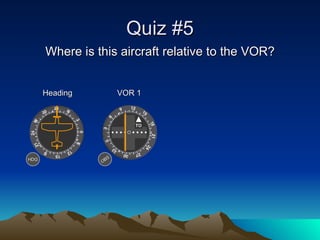
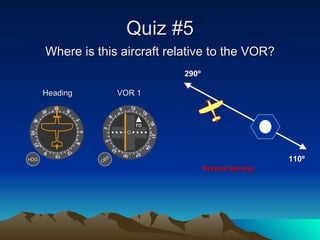
Quiz #5 Where is this aircraft relative to the VOR? OBS Heading  VOR 1 HDG TO
Quiz #5 Where is this aircraft relative to the VOR? OBS Heading  VOR 1 HDG 110º 290º Reverse Sensing TO
Further Reading FAA-H-8083-15A Instrument Flying Handbook Chapter 7 FAA-H-8083-25 Pilot’s Handbook of Aeronautical Knowledge Chapter 14

Vor navigation and_tracking

  • 1.
    Intercepting and TrackingVOR’s Ideal for IFR Students by Derek W Beck May 2008 (revised Nov 2008) Animations require viewing in slideshow mode You may copy, distribute, display this copyrighted work — and derivative works based upon it — but only if they give credit to Derek W Beck and abide by the other license requirements listed here. This work and its derivatives may not be sold without permission from Derek W Beck. You may distribute derivative works only under a license identical to the licenses listed here and only if these licenses are explicitly depicted somewhere on the derivative work. This document is provided for informational use only. Consult the aircraft manual and appropriate FAA handbooks to double-check all information. © Derek W Beck 2008. Some Rights Reserved. www.derekbeck.com Licensed under Creative Commons Attribution-Noncommercial-Share Alike License .
  • 2.
    Objective Develop anunderstanding of how to use VOR for navigation and how to track along a VOR radial
  • 3.
    Content What isa VOR and How Does it Work? Tuning and Identifying a VOR Flying to a VOR Station Station Passage Intercepting a VOR Course Tracking a Course (Wind Correction) Reverse Sensing VOR Intersections VOR Failures Quiz
  • 4.
    Why VOR’s? VOR’screate the “highways in the sky” that, besides GPS, are the primary way to fly in IFR conditions These “highways” are called VOR Airways or Victor Airways IFR Enroute Low Altitude Chart Depicting VOR “highways”
  • 5.
    What is aVOR? It stands for VHF (Very High Frequency) Omnidirectional Range It’s a radio beacon on the ground that tells allows an aircraft to identify their location relative to the VOR Source: FAA-H-8083-15A Instrument Flying Handbook A typical VOR:
  • 6.
    Inside the AircraftThe airborne equipment includes the navigation side of the radio, the VOR indicator (often two in an airplane), and an antenna for each VOR indicator OBS NAV omnibearing selector course deviation indicator (CDI) TO FR
  • 7.
    How Does aVOR Work? Imagine a lighthouse : Its beacon rotates, but at North it flashes in all directions. If you were to time between when you see the flash and when you see the beacon, you could calculate your position to it. (A VOR does the same thing, but with radio waves.) Animations require viewing in slideshow mode
  • 8.
    How Does aVOR Work? (technical) It emits (2) two VHF radio waves, one unchanging wave in all directions (a reference for 360º), and a second variable wave, the phase of which changes as it rotates A VOR receiver inside an aircraft compares the phase of the rotating beacon to the reference and determines which “radial” from the station the aircraft is on
  • 9.
    Tuning and IdentifyingVOR’s Get VOR information from IFR and VFR charts, Airport/Facilities Directory, etc Put the VHF frequency into the Nav side of the radio and click “IDENT” Listen to the Morse Code identifier, also depicted on charts (always confirm you have the VOR you think) VOR Frequency & Morse Code ID
  • 10.
    Using a VORLet’s go to the station…
  • 11.
    Radials VOR radialsemanate (radiate) FROM the station They are always FROM!!!! They are NEVER to! Imagine a bicycle wheel… the radials are the spokes, coming FROM the center They radiate in all directions Radials based on Magnetic North Since they converge at the station, staying on course becomes more sensitive close to the VOR 360º 090º 180º 270º
  • 12.
    Fly to aStation Turn the OBS to center the VOR’s “needle” (CDI) Make sure it says “TO” the station 360º 090º 180º 270º HDG Inside our airplane: OBS TO
  • 13.
    Station Passage The“Cone of Confusion”, a zone of mixed signals just over the station, gives erratic readings Stay on your heading during the cone of confusion! Look for the “TO” to change to a “FROM” 360º 090º 180º 270º HDG OBS NAV TO FR
  • 14.
    After Passage Noticeit now says “FROM” the station You are now flying on the 360º radial FROM the station 360º 090º 180º 270º HDG Inside our airplane: OBS FR
  • 15.
    Keep the CDICentered Needle centered = on course Needle to the right = course to the right (& vice versa) Turn to the needle to stay on course Full deflection: 10-12º off 360º 180º course to the right course to the left on course FR FR FR
  • 16.
    Heading Doesn’t Matter!VOR’s are “dumb” instruments VOR assumes you are going same direction as the course Airplane “A” is still left of 360 course; “B” is still on the 360 course (momentarily) 360º 180º course to the right course to the left on course A B FR FR FR
  • 17.
    Intercepting a VORCourse 090º Inside our airplane: Step 1: Set desired VOR course on VOR using OBS Let’s intercept 090º Be sure to tune and ID VOR first! Turn OBS 270º OBS HDG TO
  • 18.
    Intercepting a VORCourse HDG OBS Step 2: Turn aircraft to a same desired course Heading should match VOR course – you will parallel course 270º 090º TO
  • 19.
    Intercepting a VORCourse HDG OBS Step 3: Select an intercept angle to get on course (to center needle), 30-45º is best Notice VOR needle is left, so your course is to the left 270º 090º TO
  • 20.
    Intercepting a VORCourse HDG OBS Step 4: Wait for VOR needle to center As you near the course, the needle will come in towards center 270º 090º TO
  • 21.
    Intercepting a VORCourse HDG OBS Step 5: Turn to desired course as needle centers Try to lead the turn as the needle centers to not overshoot the course 270º 090º TO
  • 22.
    Tracking: Fighting theWind HDG OBS Step 1: Turn 20º towards course to re-intercept 090º 270º WIND TO
  • 23.
    Tracking: Staying onCourse HDG OBS Step 2: Wait until the needle is re-centered 090º 270º WIND TO
  • 24.
    Tracking: Staying onCourse HDG OBS Step 3: once needle is re-centered, turn heading back half way of correction angle (10º) Tweak with smaller corrections as necessary to stay on course (called “bracketing”) 090º 270º WIND net result TO
  • 25.
    A Warning HDGOBS Notice the airplane isn’t on the 090º radial? It’s on 270º! But radials are FROM the station! We are on the 270º radial… But to go TO the station, we must use the reciprocal heading (090º) 090º 270º TO
  • 26.
    The Danger: Reverse Sensing HDG OBS If we put the 270 course in the VOR, what would happen? VOR’s are dumb! It assumes you are going 270º The flag says “FROM” even though you are going TO! Remember: Heading doesn’t matter to a VOR! 090º 270º FR
  • 27.
    The Danger: Reverse Sensing HDG OBS If you are off course when reverse sensing… The needle gives opposite indications This airplane has the course to the right, but the VOR shows it off to the left! Not to mention that “FROM” flag when going TO the VOR! 090º 270º FR
  • 28.
    Avoid ReverseSensing HDG OBS Is reverse sensing confusing? That’s why you should avoid it! Insure the VOR course selected generally matches the heading you are flying 090º 270º FR
  • 29.
    Tricky WordingHDG OBS If told “track the 270º radial to the station…” Watch out! Radials ONLY go FROM the station!!! Instead, track the reciprocal heading (notice you are on 270º but tracking 090º?) 090º 270º No! No! FR
  • 30.
    Finding Intersections AnVOR intersection is a point where a radial from one VOR crosses a radial from a second VOR 090º 270º OBS OBS Heading VOR 1 VOR 2 210º 030º HDG TO TO
  • 31.
    Finding Intersections Step1: Set VOR 2 to desired intersecting radial In this case: 030º Be sure to tune and ID for VOR 2 OBS OBS Heading VOR 1 VOR 2 HDG 090º 270º 210º 030º TO FR
  • 32.
    Finding Intersections Step2: Wait for VOR 2’s needle to center It’s recommended to use VOR 1 for the course you are on, VOR 2 for intersections 090º 270º OBS OBS Heading VOR 1 VOR 2 210º 030º HDG TO FR
  • 33.
    Finding Intersections MadeEasy A Trick: if we use the heading (East or 090º on the heading indicator) and find this on the VOR 2 dial, 090 on VOR 2 is the same side as the CDI needle: “Same Side Safe” (you haven’t reached the intersection yet) If the CDI is on the opposite side, you’ve passed the intersection. 270º OBS OBS Heading VOR 1 VOR 2 210º 030º HDG If CDI is same side as heading, you haven’t reached the intersection (“Same Side Safe”) TO FR
  • 34.
    Finding Intersections Oncethe VOR 2 needle is centered, you are at the intersection 090º 270º OBS OBS Heading VOR 1 VOR 2 210º 030º HDG TO FR
  • 35.
    VOR Failure Tuneand ID but no ID signal? The VOR station may be inoperative (check NOTAMS) VOR flag on the indicator? Station or indicator may be inoperative VOR’s must be checked for accuracy every 30 days for use in IFR flight see 14 CFR 91.171 for details OBS NAV FR
  • 36.
  • 37.
    Quiz #1 Whereis this aircraft relative to the VOR? OBS Heading VOR 1 HDG TO
  • 38.
    Quiz #1 Whereis this aircraft relative to the VOR? OBS Heading VOR 1 HDG 225º 045º TO
  • 39.
    Quiz #2 Whereis this aircraft relative to the VOR? OBS Heading VOR 1 HDG FR
  • 40.
    Quiz #2 Whereis this aircraft relative to the VOR? OBS Heading VOR 1 HDG 330º 150º FR
  • 41.
    Quiz #3 Whereis this aircraft relative to the VOR? OBS Heading VOR 1 HDG TO
  • 42.
    Quiz #3 Whereis this aircraft relative to the VOR? OBS Heading VOR 1 HDG 210º 030º TO
  • 43.
    Quiz #4 Whereis this aircraft relative to the VOR? OBS Heading VOR 1 HDG TO FR
  • 44.
    Quiz #4 Whereis this aircraft relative to the VOR? OBS Heading VOR 1 HDG 315º 135º TO side of 135º FROM side of 135º TO FR
  • 45.
    Quiz #5 Whereis this aircraft relative to the VOR? OBS Heading VOR 1 HDG TO
  • 46.
    Quiz #5 Whereis this aircraft relative to the VOR? OBS Heading VOR 1 HDG 110º 290º Reverse Sensing TO
  • 47.
    Further Reading FAA-H-8083-15AInstrument Flying Handbook Chapter 7 FAA-H-8083-25 Pilot’s Handbook of Aeronautical Knowledge Chapter 14