Aviation Communication Systems
Slide Title
• Make Effective Presentations
• Using Awesome Backgrounds
• Engage your Audience
• Capture Audience Attention
Contents
1)Introduction
2)History
3)Frequency Bands
4)Aviation Communication SystemArchitecture
5)Aviation system in Pakistan
6)Aviation Communication solution provider
7) SATCOM training and Jobs
How satellites safeguard your safe passage
• Satellite-aided ATC
When an aircraft is out of range of VHF/UHF radio, such as in oceanic airspace, satellite services
enable satellite-aided air traffic control (ATC). The ability to have reliable communications with
ground-based controllers at all times, on all major oceanic routes, is an important safety feature.
• Automatic dependent surveillance (ADS)
Satellite communication facilitates the automatic reporting of an aircraft’s real-time position,
including altitude, speed and heading, via satellite to air traffic control centres, helping controllers
know where an aircraft is at all times.
• Controller / pilot datalink communications (CPDLC)
Satellite communication also enables the Aircraft Communications Addressing and Reporting
System (ACARS) routing instructions, clearances and other messages that need to be sent directly to
the cockpit as electronic data messages
• Voice services
Satellite services also support air traffic control and critical airline voice communications when the
aircraft is out of VHF radio range. The aircraft systems are set up so that cockpit communications
have priority over any of the passenger communications, so maximizing safety and reliability.
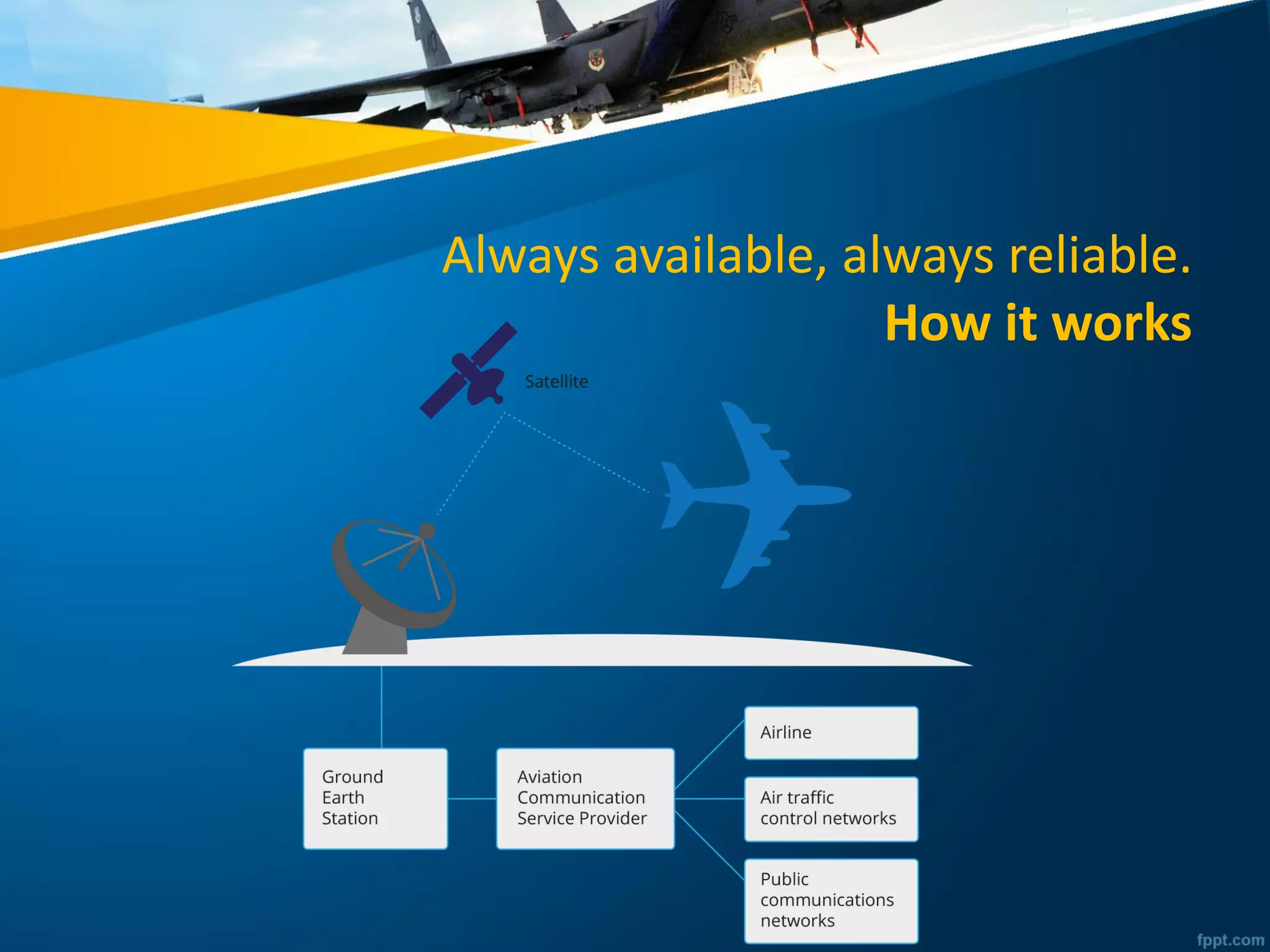
Always available, always reliable.
How it works
History
• TheFirst World War brought about an urgent need for
communications. Voice communications from ground-to-air
and from aircraft to aircraft were established
• In the 1930s, the first all radio-controlled blind-landing was
accomplished. By the end of the decade, use of high frequency
radio waves was explored and included the advent of high-
frequency radar.
• World War II injected urgency into the development of aircraft radio
communication and navigation. Communication radios, despite
their size, were essential on board aircraft. Very high frequencies
were developed for communication and navigationalpurposes.
Radio Frequency
• Airband or aircraft band is the name for a group of
frequencies in the VHF radio spectrum allocated to radio
communication in aviation. Different sections of the band
are used for radio navigational aids and air traffic control.
• VHF is used for line-of-sight ground-to-aircraft and
aircraft-to-aircraft communications, land mobile and
maritime mobile communications, amateur
radio, weather radio.
• Frequency range for VHF is 30 to 300 MHz
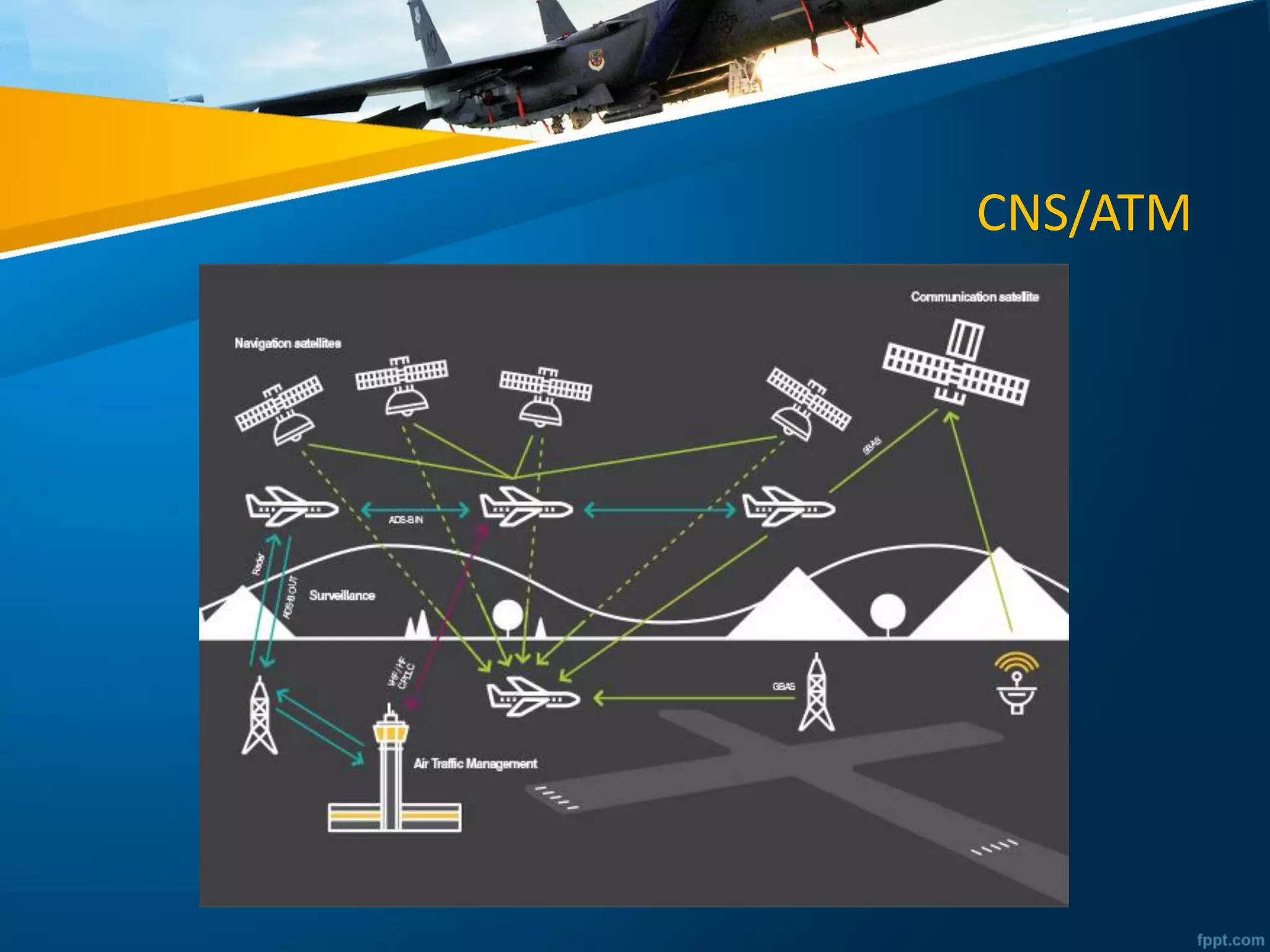
CNS/ATM
CNS/ATM
• In aviation CNS stands for Clear Communication,
accurate Navigation and Surveillance-based control
and guidance have long been important for safe and
efficient flying.
• Communications, navigation and surveillance
systems, employing digital technologies, including
satellite navigation systems together with various
levels of automation, applied in support of a
seamless global air traffic management system.
CNS
Communication
VHF can transmit information only as fast as a person can speak coherently.
Technology such as controller-pilot data link communications (CPDLC) can
significantly reduce the demand for bandwidth and time.
Navigation
Required navigation performance (RNP) equipment must have on-board
performance monitoring and alerting systems to provide assurance the
system is working properly
Surveillance
automatic dependent surveillance-broadcast (ADS-B). This technology uses
GNSS equipment and a transponder-like broadcaster to determine the
aircraft’s height, position and speed, and broadcasts this, along with its
identity, twice per second.
Benefits
The main benefits of CNS/ATM are:
• increased aircraft capacity, especially in congested
airspace
• increased schedule flexibility
• better flight path efficiency
• less disruption due to delays and diversions
Aviation system in Pakistan
Air Traffic Management (ATM) Pakistan
• Air traffic services are used to manage the safe and
orderly flow of aircraft into, out of, and across
Pakistan airspace including those portions of high
seas for which the responsibility has been delegated
to Pakistan under Regional Air Navigation
Agreements.
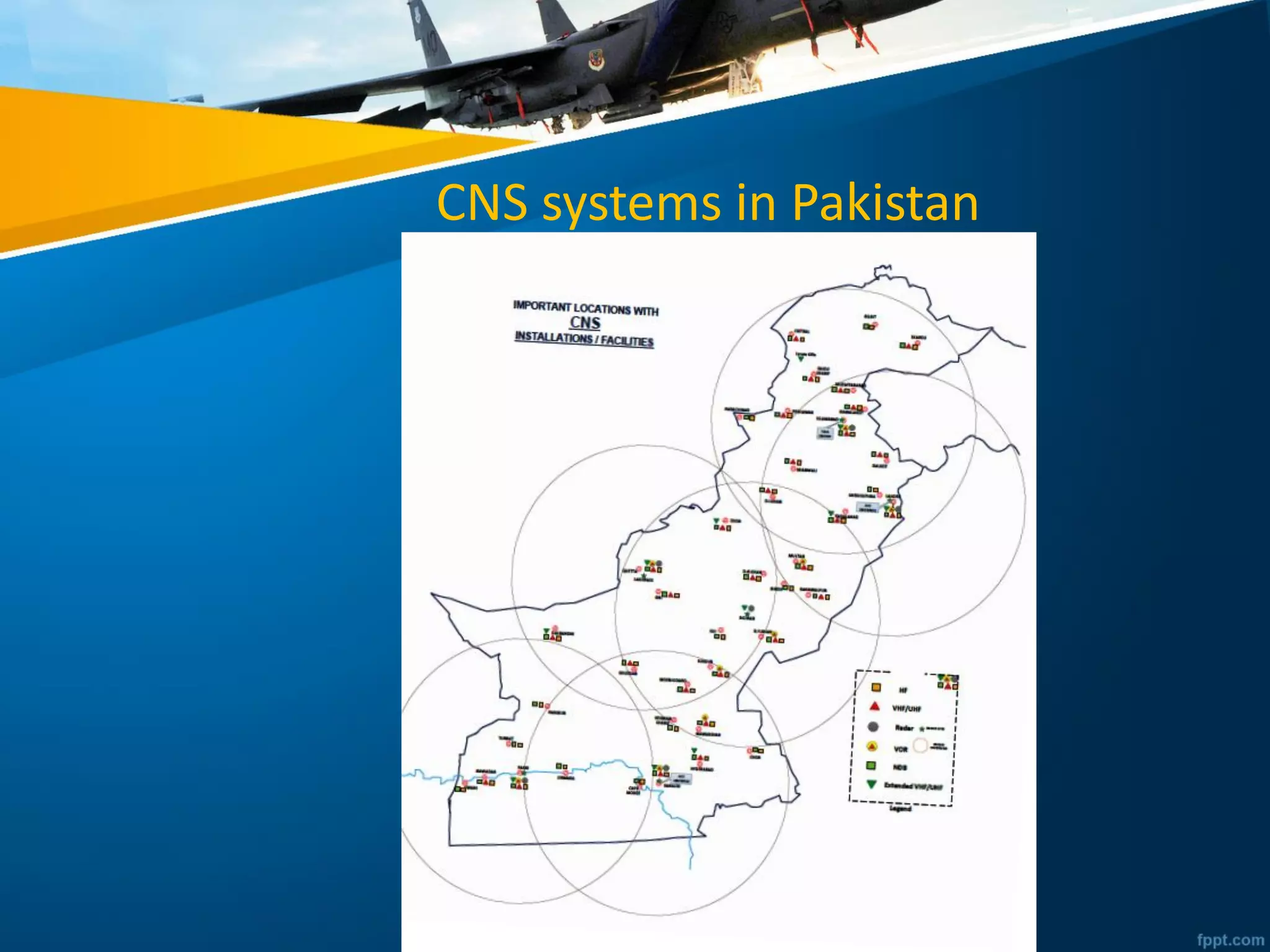
CNS systems in Pakistan
PAKISTAN AERONAUTICAL COMPLEX KAMRA
• ARF “AIRCRAFT REBUILD FACTORY”
• MRF “MIRAGE REBUILD FACTORY”
• AMF “AIRCRAFT MANUFACTURING FACTORY”
International Aeradio Pakistan (Pvt.) Ltd [IAL]
• Aviation
Extensively involved in complete aviation solutions
ranging from Turnkey ATC Supply & Integration,
Surveillance, Security & Screening, Communications,
Air Navigation and Air Traffic Control.
Aviation Communication solution provider
• Inmarsat provides the ultimate inflight connectivity for
the entire aircraft, from voice and safety communications
in the cockpit to high-speed, reliable broadband in the
cabin.
• Iridium is the only mobile voice and data satellite
communications network that spans the entire globe.
Iridium enables connections between people,
organizations and assets to and from anywhere, in real
time.
SATCOM training and Jobs
• MS GNSS (Global Navigation Satellite Services) @ IST
• SUPARCO SATCOM Training for Satellite remote
sensing and GIS ( Geo Informatics)

Aviation communication system - TelecomAcadmey.com

  • 1.
  • 2.
    Slide Title • MakeEffective Presentations • Using Awesome Backgrounds • Engage your Audience • Capture Audience Attention
  • 3.
    Contents 1)Introduction 2)History 3)Frequency Bands 4)Aviation CommunicationSystemArchitecture 5)Aviation system in Pakistan 6)Aviation Communication solution provider 7) SATCOM training and Jobs
  • 4.
    How satellites safeguardyour safe passage • Satellite-aided ATC When an aircraft is out of range of VHF/UHF radio, such as in oceanic airspace, satellite services enable satellite-aided air traffic control (ATC). The ability to have reliable communications with ground-based controllers at all times, on all major oceanic routes, is an important safety feature. • Automatic dependent surveillance (ADS) Satellite communication facilitates the automatic reporting of an aircraft’s real-time position, including altitude, speed and heading, via satellite to air traffic control centres, helping controllers know where an aircraft is at all times. • Controller / pilot datalink communications (CPDLC) Satellite communication also enables the Aircraft Communications Addressing and Reporting System (ACARS) routing instructions, clearances and other messages that need to be sent directly to the cockpit as electronic data messages • Voice services Satellite services also support air traffic control and critical airline voice communications when the aircraft is out of VHF radio range. The aircraft systems are set up so that cockpit communications have priority over any of the passenger communications, so maximizing safety and reliability.
  • 5.
    Always available, alwaysreliable. How it works
  • 6.
    History • TheFirst WorldWar brought about an urgent need for communications. Voice communications from ground-to-air and from aircraft to aircraft were established • In the 1930s, the first all radio-controlled blind-landing was accomplished. By the end of the decade, use of high frequency radio waves was explored and included the advent of high- frequency radar. • World War II injected urgency into the development of aircraft radio communication and navigation. Communication radios, despite their size, were essential on board aircraft. Very high frequencies were developed for communication and navigationalpurposes.
  • 7.
    Radio Frequency • Airbandor aircraft band is the name for a group of frequencies in the VHF radio spectrum allocated to radio communication in aviation. Different sections of the band are used for radio navigational aids and air traffic control. • VHF is used for line-of-sight ground-to-aircraft and aircraft-to-aircraft communications, land mobile and maritime mobile communications, amateur radio, weather radio. • Frequency range for VHF is 30 to 300 MHz
  • 8.
  • 9.
    CNS/ATM • In aviationCNS stands for Clear Communication, accurate Navigation and Surveillance-based control and guidance have long been important for safe and efficient flying. • Communications, navigation and surveillance systems, employing digital technologies, including satellite navigation systems together with various levels of automation, applied in support of a seamless global air traffic management system.
  • 10.
    CNS Communication VHF can transmitinformation only as fast as a person can speak coherently. Technology such as controller-pilot data link communications (CPDLC) can significantly reduce the demand for bandwidth and time. Navigation Required navigation performance (RNP) equipment must have on-board performance monitoring and alerting systems to provide assurance the system is working properly Surveillance automatic dependent surveillance-broadcast (ADS-B). This technology uses GNSS equipment and a transponder-like broadcaster to determine the aircraft’s height, position and speed, and broadcasts this, along with its identity, twice per second.
  • 11.
    Benefits The main benefitsof CNS/ATM are: • increased aircraft capacity, especially in congested airspace • increased schedule flexibility • better flight path efficiency • less disruption due to delays and diversions
  • 12.
    Aviation system inPakistan Air Traffic Management (ATM) Pakistan • Air traffic services are used to manage the safe and orderly flow of aircraft into, out of, and across Pakistan airspace including those portions of high seas for which the responsibility has been delegated to Pakistan under Regional Air Navigation Agreements.
  • 13.
  • 14.
    PAKISTAN AERONAUTICAL COMPLEXKAMRA • ARF “AIRCRAFT REBUILD FACTORY” • MRF “MIRAGE REBUILD FACTORY” • AMF “AIRCRAFT MANUFACTURING FACTORY”
  • 15.
    International Aeradio Pakistan(Pvt.) Ltd [IAL] • Aviation Extensively involved in complete aviation solutions ranging from Turnkey ATC Supply & Integration, Surveillance, Security & Screening, Communications, Air Navigation and Air Traffic Control.
  • 16.
    Aviation Communication solutionprovider • Inmarsat provides the ultimate inflight connectivity for the entire aircraft, from voice and safety communications in the cockpit to high-speed, reliable broadband in the cabin. • Iridium is the only mobile voice and data satellite communications network that spans the entire globe. Iridium enables connections between people, organizations and assets to and from anywhere, in real time.
  • 17.
    SATCOM training andJobs • MS GNSS (Global Navigation Satellite Services) @ IST • SUPARCO SATCOM Training for Satellite remote sensing and GIS ( Geo Informatics)