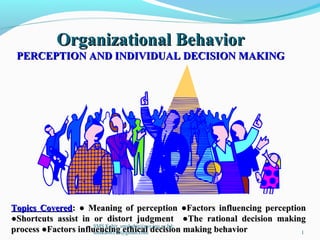
Organizational BehaviorOrganizational Behavior
PERCEPTION AND INDIVIDUAL DECISION MAKINGPERCEPTION AND INDIVIDUAL DECISION MAKING
Topics CoveredTopics Covered: ● Meaning of perception ●Factors influencing perception: ● Meaning of perception ●Factors influencing perception
●Shortcuts assist in or distort judgment ●The rational decision making●Shortcuts assist in or distort judgment ●The rational decision making
process ●Factors influencing ethical decision making behaviorprocess ●Factors influencing ethical decision making behaviorSMS Kabir, smskabir@psy.jnu.ac.bd;
smskabir218@gmail.com 1
MEANING OF PERCEPTIONMEANING OF PERCEPTION
A process by which individualsA process by which individuals
organize and interpret theirorganize and interpret their
sensory impressions in order tosensory impressions in order to
give meaning to theirgive meaning to their
environment.environment.
People's behavior is based onPeople's behavior is based on
their perception of what realitytheir perception of what reality
is, not on reality itself.is, not on reality itself.
SMS Kabir, smskabir@psy.jnu.ac.bd;
smskabir218@gmail.com 2
FACTORS INF LUENCING PERCEPTIONFACTORS INF LUENCING PERCEPTION
A number of factors operate toA number of factors operate to
shape and sometimes distortshape and sometimes distort
perception:perception:
1. The perceiver1. The perceiver
2. The target2. The target
3. The situation3. The situation
SMS Kabir, smskabir@psy.jnu.ac.bd;
smskabir218@gmail.com 3
FACTORS INF LUENCING PERCEPTION
PerceiverPerceiver
■■When an individual looks at a targetWhen an individual looks at a target
and attempts to interpret what he orand attempts to interpret what he or
she sees, that interpretation is heavilyshe sees, that interpretation is heavily
influenced by personal characteristicsinfluenced by personal characteristics
of the individual perceiver.of the individual perceiver.
■■Among the more relevant personalAmong the more relevant personal
characteristics affecting perception arecharacteristics affecting perception are
attitudes, Motives, interests, postattitudes, Motives, interests, post
experience and expectations.experience and expectations.
SMS Kabir, smskabir@psy.jnu.ac.bd;
smskabir218@gmail.com 4
TargetTarget
■■Characteristics of the target can affectCharacteristics of the target can affect
what is perceived.what is perceived.
SituationSituation
■■Elements in the surroundingElements in the surrounding
environment influence our perceptions.environment influence our perceptions.
■■The time at which an object or event isThe time at which an object or event is
seen can influence attention as canseen can influence attention as can
location, light, heat or any number oflocation, light, heat or any number of
situational factors.situational factors.
FACTORS INF LUENCING PERCEPTION
SMS Kabir, smskabir@psy.jnu.ac.bd;
smskabir218@gmail.com 5
SHORTCUTS ASSIST IN ORSHORTCUTS ASSIST IN OR
DISTORT JUDGMENTDISTORT JUDGMENT
We use a number of shortcuts when we judgeWe use a number of shortcuts when we judge
others. These shortcuts assist but sometimesothers. These shortcuts assist but sometimes
distort the judgment. These are:distort the judgment. These are:
1.1. Selective perceptionSelective perception: People selectively: People selectively
interpret what they see on the basis of theirinterpret what they see on the basis of their
interests, background, experience and attitudes.interests, background, experience and attitudes.
2.2. Halo effectHalo effect: When we draw Q general: When we draw Q general
impression about an individual on the basis of aimpression about an individual on the basis of a
single characteristic such as intelligence,single characteristic such as intelligence,
sociability or appearance, a halo effect issociability or appearance, a halo effect is
operating.operating.
SMS Kabir, smskabir@psy.jnu.ac.bd;
smskabir218@gmail.com 6
3.3. Contrast effectContrast effect: Evaluation of person's: Evaluation of person's
characteristics that are affected bycharacteristics that are affected by
comparisons with other people recentlycomparisons with other people recently
encountered who rank higher or lower onencountered who rank higher or lower on
the same characteristics.the same characteristics.
4.4. ProjectionProjection: It is easy to judge others if we: It is easy to judge others if we
assume that they are similar to us.assume that they are similar to us.
5.5. StereotypingStereotyping: When we judge someone on: When we judge someone on
the basis of our perception of the group tothe basis of our perception of the group to
which he or she belongs, we are using thewhich he or she belongs, we are using the
shortcut called stereotyping.shortcut called stereotyping.
SHORTCUTS ASSIST IN OR DISTORT JUDGMENTSHORTCUTS ASSIST IN OR DISTORT JUDGMENT
SMS Kabir, smskabir@psy.jnu.ac.bd;
smskabir218@gmail.com 7
RATIONAL DECISION MAKING‑RATIONAL DECISION MAKING‑
PROCESS/MODELPROCESS/MODEL
A decision making model that describes how theA decision making model that describes how the
individuals should behave in order to maximize someindividuals should behave in order to maximize some
outcome. The six steps decision-making model is:outcome. The six steps decision-making model is:
1.1. Define the problemDefine the problem: A problem exists when there is a: A problem exists when there is a
discrepancy between an existing and a desired state ofdiscrepancy between an existing and a desired state of
affairs.affairs.
2.2. Identify the decision criteriaIdentify the decision criteria: This step brings the: This step brings the
decision maker's interests, values and similar personaldecision maker's interests, values and similar personal
preferences into the process.preferences into the process.
3.3. Allocate weights to the criteriaAllocate weights to the criteria: Decision maker to: Decision maker to
weight the previously identified criteria in order toweight the previously identified criteria in order to
give them the correct priority in the decision.give them the correct priority in the decision.
SMS Kabir, smskabir@psy.jnu.ac.bd;
smskabir218@gmail.com 8
4.4. Develop the alternativesDevelop the alternatives: Decision maker: Decision maker
to generate possible alternatives that couldto generate possible alternatives that could
succeed in resolving the problem.succeed in resolving the problem.
5.5. Evaluate the alternativesEvaluate the alternatives: Once the: Once the
alternatives have been generated, thealternatives have been generated, the
decision maker must critically analyze anddecision maker must critically analyze and
evaluate each one.evaluate each one.
6.6. Select the best alternativeSelect the best alternative: The final step: The final step
requires computing the optimal decision.requires computing the optimal decision.
This is done by evaluating each alternativeThis is done by evaluating each alternative
against the weighted criteria and selectingagainst the weighted criteria and selecting
the alternative with the highest total score.the alternative with the highest total score.
RATIONAL DECISION MAKING PROCESS/MODEL‑RATIONAL DECISION MAKING PROCESS/MODEL‑
SMS Kabir, smskabir@psy.jnu.ac.bd;
smskabir218@gmail.com 9
FACTORS INFLUENCING ETHICALFACTORS INFLUENCING ETHICAL
DECISION MAKING BEHAVIORDECISION MAKING BEHAVIOR
Ethical or unethical actions areEthical or unethical actions are
largely a function of both thelargely a function of both the
individual's characteristics and theindividual's characteristics and the
environment in which he or sheenvironment in which he or she
works.works.
1.1. Stages of moral developmentStages of moral development: A: A
person's capacity to judge what isperson's capacity to judge what is
morally right.morally right.
SMS Kabir, smskabir@psy.jnu.ac.bd;
smskabir218@gmail.com 10
2.2. Organizational environmentOrganizational environment: An: An
employee's perception ofemployee's perception of
organizational expectations.organizational expectations.
Written codes of ethics, highWritten codes of ethics, high
moral behavior by seniormoral behavior by senior
management, rewards for ethicalmanagement, rewards for ethical
behavior, punishment forbehavior, punishment for
unethical behavior are someunethical behavior are some
examples of organizationalexamples of organizational
environment.environment.
FACTORS INFLUENCING ETHICALFACTORS INFLUENCING ETHICAL
DECISION MAKING BEHAVIORDECISION MAKING BEHAVIOR
SMS Kabir, smskabir@psy.jnu.ac.bd;
smskabir218@gmail.com 11
3.3. Locus of ControlLocus of Control: It is a: It is a
personality characteristics thatpersonality characteristics that
taps the extent to which peopletaps the extent to which people
believe they are responsible forbelieve they are responsible for
the events in their lives (whatthe events in their lives (what
happens to them in life is due tohappens to them in life is due to
their luck or chance).their luck or chance).
FACTORS INFLUENCING ETHICALFACTORS INFLUENCING ETHICAL
DECISION MAKING BEHAVIORDECISION MAKING BEHAVIOR
SMS Kabir, smskabir@psy.jnu.ac.bd;
smskabir218@gmail.com 12
SMS Kabir, smskabir@psy.jnu.ac.bd;
smskabir218@gmail.com 13

Perception and Individual Decision Making

  • 1.
    Organizational BehaviorOrganizational Behavior PERCEPTIONAND INDIVIDUAL DECISION MAKINGPERCEPTION AND INDIVIDUAL DECISION MAKING Topics CoveredTopics Covered: ● Meaning of perception ●Factors influencing perception: ● Meaning of perception ●Factors influencing perception ●Shortcuts assist in or distort judgment ●The rational decision making●Shortcuts assist in or distort judgment ●The rational decision making process ●Factors influencing ethical decision making behaviorprocess ●Factors influencing ethical decision making behaviorSMS Kabir, smskabir@psy.jnu.ac.bd; smskabir218@gmail.com 1
  • 2.
    MEANING OF PERCEPTIONMEANINGOF PERCEPTION A process by which individualsA process by which individuals organize and interpret theirorganize and interpret their sensory impressions in order tosensory impressions in order to give meaning to theirgive meaning to their environment.environment. People's behavior is based onPeople's behavior is based on their perception of what realitytheir perception of what reality is, not on reality itself.is, not on reality itself. SMS Kabir, smskabir@psy.jnu.ac.bd; smskabir218@gmail.com 2
  • 3.
    FACTORS INF LUENCINGPERCEPTIONFACTORS INF LUENCING PERCEPTION A number of factors operate toA number of factors operate to shape and sometimes distortshape and sometimes distort perception:perception: 1. The perceiver1. The perceiver 2. The target2. The target 3. The situation3. The situation SMS Kabir, smskabir@psy.jnu.ac.bd; smskabir218@gmail.com 3
  • 4.
    FACTORS INF LUENCINGPERCEPTION PerceiverPerceiver ■■When an individual looks at a targetWhen an individual looks at a target and attempts to interpret what he orand attempts to interpret what he or she sees, that interpretation is heavilyshe sees, that interpretation is heavily influenced by personal characteristicsinfluenced by personal characteristics of the individual perceiver.of the individual perceiver. ■■Among the more relevant personalAmong the more relevant personal characteristics affecting perception arecharacteristics affecting perception are attitudes, Motives, interests, postattitudes, Motives, interests, post experience and expectations.experience and expectations. SMS Kabir, smskabir@psy.jnu.ac.bd; smskabir218@gmail.com 4
  • 5.
    TargetTarget ■■Characteristics of thetarget can affectCharacteristics of the target can affect what is perceived.what is perceived. SituationSituation ■■Elements in the surroundingElements in the surrounding environment influence our perceptions.environment influence our perceptions. ■■The time at which an object or event isThe time at which an object or event is seen can influence attention as canseen can influence attention as can location, light, heat or any number oflocation, light, heat or any number of situational factors.situational factors. FACTORS INF LUENCING PERCEPTION SMS Kabir, smskabir@psy.jnu.ac.bd; smskabir218@gmail.com 5
  • 6.
    SHORTCUTS ASSIST INORSHORTCUTS ASSIST IN OR DISTORT JUDGMENTDISTORT JUDGMENT We use a number of shortcuts when we judgeWe use a number of shortcuts when we judge others. These shortcuts assist but sometimesothers. These shortcuts assist but sometimes distort the judgment. These are:distort the judgment. These are: 1.1. Selective perceptionSelective perception: People selectively: People selectively interpret what they see on the basis of theirinterpret what they see on the basis of their interests, background, experience and attitudes.interests, background, experience and attitudes. 2.2. Halo effectHalo effect: When we draw Q general: When we draw Q general impression about an individual on the basis of aimpression about an individual on the basis of a single characteristic such as intelligence,single characteristic such as intelligence, sociability or appearance, a halo effect issociability or appearance, a halo effect is operating.operating. SMS Kabir, smskabir@psy.jnu.ac.bd; smskabir218@gmail.com 6
  • 7.
    3.3. Contrast effectContrasteffect: Evaluation of person's: Evaluation of person's characteristics that are affected bycharacteristics that are affected by comparisons with other people recentlycomparisons with other people recently encountered who rank higher or lower onencountered who rank higher or lower on the same characteristics.the same characteristics. 4.4. ProjectionProjection: It is easy to judge others if we: It is easy to judge others if we assume that they are similar to us.assume that they are similar to us. 5.5. StereotypingStereotyping: When we judge someone on: When we judge someone on the basis of our perception of the group tothe basis of our perception of the group to which he or she belongs, we are using thewhich he or she belongs, we are using the shortcut called stereotyping.shortcut called stereotyping. SHORTCUTS ASSIST IN OR DISTORT JUDGMENTSHORTCUTS ASSIST IN OR DISTORT JUDGMENT SMS Kabir, smskabir@psy.jnu.ac.bd; smskabir218@gmail.com 7
  • 8.
    RATIONAL DECISION MAKING‑RATIONALDECISION MAKING‑ PROCESS/MODELPROCESS/MODEL A decision making model that describes how theA decision making model that describes how the individuals should behave in order to maximize someindividuals should behave in order to maximize some outcome. The six steps decision-making model is:outcome. The six steps decision-making model is: 1.1. Define the problemDefine the problem: A problem exists when there is a: A problem exists when there is a discrepancy between an existing and a desired state ofdiscrepancy between an existing and a desired state of affairs.affairs. 2.2. Identify the decision criteriaIdentify the decision criteria: This step brings the: This step brings the decision maker's interests, values and similar personaldecision maker's interests, values and similar personal preferences into the process.preferences into the process. 3.3. Allocate weights to the criteriaAllocate weights to the criteria: Decision maker to: Decision maker to weight the previously identified criteria in order toweight the previously identified criteria in order to give them the correct priority in the decision.give them the correct priority in the decision. SMS Kabir, smskabir@psy.jnu.ac.bd; smskabir218@gmail.com 8
  • 9.
    4.4. Develop thealternativesDevelop the alternatives: Decision maker: Decision maker to generate possible alternatives that couldto generate possible alternatives that could succeed in resolving the problem.succeed in resolving the problem. 5.5. Evaluate the alternativesEvaluate the alternatives: Once the: Once the alternatives have been generated, thealternatives have been generated, the decision maker must critically analyze anddecision maker must critically analyze and evaluate each one.evaluate each one. 6.6. Select the best alternativeSelect the best alternative: The final step: The final step requires computing the optimal decision.requires computing the optimal decision. This is done by evaluating each alternativeThis is done by evaluating each alternative against the weighted criteria and selectingagainst the weighted criteria and selecting the alternative with the highest total score.the alternative with the highest total score. RATIONAL DECISION MAKING PROCESS/MODEL‑RATIONAL DECISION MAKING PROCESS/MODEL‑ SMS Kabir, smskabir@psy.jnu.ac.bd; smskabir218@gmail.com 9
  • 10.
    FACTORS INFLUENCING ETHICALFACTORSINFLUENCING ETHICAL DECISION MAKING BEHAVIORDECISION MAKING BEHAVIOR Ethical or unethical actions areEthical or unethical actions are largely a function of both thelargely a function of both the individual's characteristics and theindividual's characteristics and the environment in which he or sheenvironment in which he or she works.works. 1.1. Stages of moral developmentStages of moral development: A: A person's capacity to judge what isperson's capacity to judge what is morally right.morally right. SMS Kabir, smskabir@psy.jnu.ac.bd; smskabir218@gmail.com 10
  • 11.
    2.2. Organizational environmentOrganizationalenvironment: An: An employee's perception ofemployee's perception of organizational expectations.organizational expectations. Written codes of ethics, highWritten codes of ethics, high moral behavior by seniormoral behavior by senior management, rewards for ethicalmanagement, rewards for ethical behavior, punishment forbehavior, punishment for unethical behavior are someunethical behavior are some examples of organizationalexamples of organizational environment.environment. FACTORS INFLUENCING ETHICALFACTORS INFLUENCING ETHICAL DECISION MAKING BEHAVIORDECISION MAKING BEHAVIOR SMS Kabir, smskabir@psy.jnu.ac.bd; smskabir218@gmail.com 11
  • 12.
    3.3. Locus ofControlLocus of Control: It is a: It is a personality characteristics thatpersonality characteristics that taps the extent to which peopletaps the extent to which people believe they are responsible forbelieve they are responsible for the events in their lives (whatthe events in their lives (what happens to them in life is due tohappens to them in life is due to their luck or chance).their luck or chance). FACTORS INFLUENCING ETHICALFACTORS INFLUENCING ETHICAL DECISION MAKING BEHAVIORDECISION MAKING BEHAVIOR SMS Kabir, smskabir@psy.jnu.ac.bd; smskabir218@gmail.com 12
  • 13.