Slide content created by Joseph B. Mosca, Monmouth University.
Copyright © Houghton Mifflin Company. All rights reserved.
17
Ready Notes
Managing
Leadership and
Influence Processes
For in-class note taking, choose Handouts
or Notes Pages from the print options, with
three slides per page.
Copyright © Houghton Mifflin Company. All rights reserved. 17 - 3
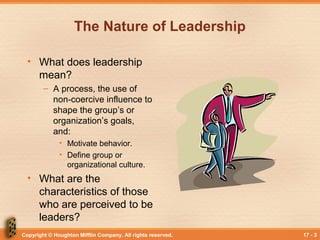
The Nature of Leadership
• What does leadership
mean?
– A process, the use of
non-coercive influence to
shape the group’s or
organization’s goals,
and:
• Motivate behavior.
• Define group or
organizational culture.
• What are the
characteristics of those
who are perceived to be
leaders?
Copyright © Houghton Mifflin Company. All rights reserved. 17 - 4
Copyright © Houghton Mifflin Company. All rights reserved. 17 - 5
Who Are Leaders?
• People who:
– Can influence the
behaviors of others.
– Are able to influence
without having to rely
on force.
– Are accepted by
others as leaders.
Copyright © Houghton Mifflin Company. All rights reserved. 17 - 6
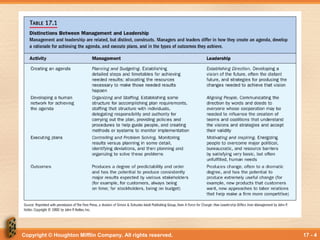
Leadership Versus Management
• MANAGEMENT:
– Planning and
budgeting.
– Organizing and
staffing.
– Controlling and
problem solving.
– Producing a degree
of predictability.
• LEADERSHIP:
– Establishing
direction.
– Aligning people.
– Motivating and
inspiring.
– Producing change,
often to a dramatic
degree.
Copyright © Houghton Mifflin Company. All rights reserved. 17 - 7
Power and Leadership
• What is power?
– The ability to affect the
behavior of others.
• Legitimate power:
– Power granted through
the organizational
structure, it is the power
accorded people
occupying particular
positions as defined by
the organization.
Copyright © Houghton Mifflin Company. All rights reserved. 17 - 8
Reward Power Defined
• Reward power:
– The power to give or
withhold rewards,
such as:
• Salary increases.
• Bonuses.
• Promotion.
• Recommendation.
Copyright © Houghton Mifflin Company. All rights reserved. 17 - 9
Types of Power
• Coercive power:
– The power to force
compliance by means of
psychological, emotional,
or physical threat.
• Referent power:
– The personal power that
accrues to someone
based on identification,
imitation, loyalty, or
charisma.
Copyright © Houghton Mifflin Company. All rights reserved. 17 - 10
What Is Expert Power?
• The personal power
that accrues to
someone based on
the information or
expertise that they
possess.
Copyright © Houghton Mifflin Company. All rights reserved. 17 - 11
Michigan Studies on Leadership Behavior
• Job-centered leader:
– Leaders who pay close
attention to an employ’s
job and work procedures
involved with that job.
• Employee-centered
leader:
– Leaders who develop
cohesive work groups
and ensure employee
satisfaction.
Copyright © Houghton Mifflin Company. All rights reserved. 17 - 12
Ohio State Leadership Studies
• Initiating-structure behavior:
– Leaders who define the leader-subordinate
roles so that everyone knows what is
expected, establish formal lines of
communication, and determine how tasks
will be performed.
• Consideration behavior:
– Leaders who show concern for
subordinates and attempt to establish a
friendly and supportive climate.
Copyright © Houghton Mifflin Company. All rights reserved. 17 - 13
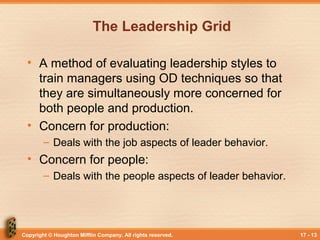
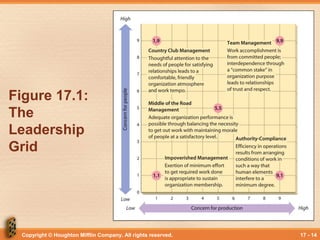
The Leadership Grid
• A method of evaluating leadership styles to
train managers using OD techniques so that
they are simultaneously more concerned for
both people and production.
• Concern for production:
– Deals with the job aspects of leader behavior.
• Concern for people:
– Deals with the people aspects of leader behavior.
Copyright © Houghton Mifflin Company. All rights reserved. 17 - 14
Figure 17.1:
The
Leadership
Grid
Copyright © Houghton Mifflin Company. All rights reserved. 17 - 15
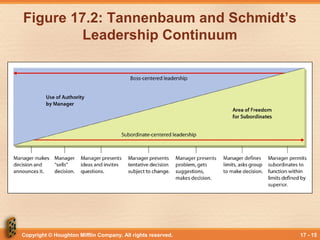
Figure 17.2: Tannenbaum and Schmidt’s
Leadership Continuum
Copyright © Houghton Mifflin Company. All rights reserved. 17 - 16
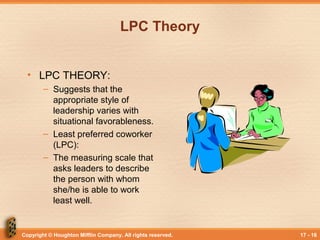
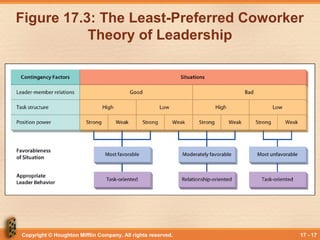
LPC Theory
• LPC THEORY:
– Suggests that the
appropriate style of
leadership varies with
situational favorableness.
– Least preferred coworker
(LPC):
– The measuring scale that
asks leaders to describe
the person with whom
she/he is able to work
least well.
Copyright © Houghton Mifflin Company. All rights reserved. 17 - 17
Figure 17.3: The Least-Preferred Coworker
Theory of Leadership
Copyright © Houghton Mifflin Company. All rights reserved. 17 - 18
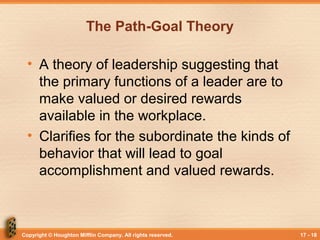
The Path-Goal Theory
• A theory of leadership suggesting that
the primary functions of a leader are to
make valued or desired rewards
available in the workplace.
• Clarifies for the subordinate the kinds of
behavior that will lead to goal
accomplishment and valued rewards.
Copyright © Houghton Mifflin Company. All rights reserved. 17 - 19
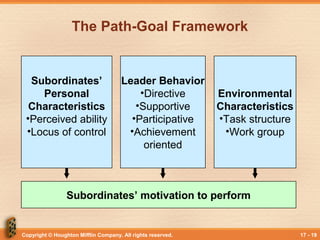
Subordinates’ motivation to perform
The Path-Goal Framework
Subordinates’
Personal
Characteristics
•Perceived ability
•Locus of control
Leader Behavior
•Directive
•Supportive
•Participative
•Achievement
oriented
Environmental
Characteristics
•Task structure
•Work group
Copyright © Houghton Mifflin Company. All rights reserved. 17 - 20
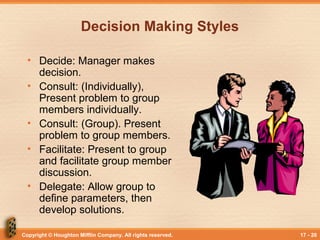
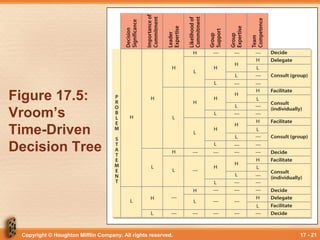
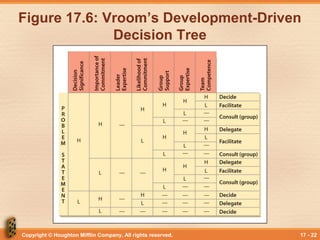
Decision Making Styles
• Decide: Manager makes
decision.
• Consult: (Individually),
Present problem to group
members individually.
• Consult: (Group). Present
problem to group members.
• Facilitate: Present to group
and facilitate group member
discussion.
• Delegate: Allow group to
define parameters, then
develop solutions.
Copyright © Houghton Mifflin Company. All rights reserved. 17 - 21
Figure 17.5:
Vroom’s
Time-Driven
Decision Tree
Copyright © Houghton Mifflin Company. All rights reserved. 17 - 22
Figure 17.6: Vroom’s Development-Driven
Decision Tree
Copyright © Houghton Mifflin Company. All rights reserved. 17 - 23
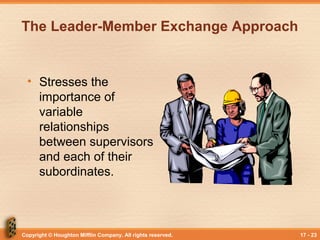
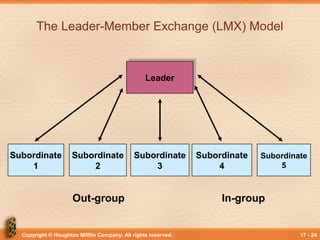
The Leader-Member Exchange Approach
• Stresses the
importance of
variable
relationships
between supervisors
and each of their
subordinates.
Copyright © Houghton Mifflin Company. All rights reserved. 17 - 24
The Leader-Member Exchange (LMX) Model
LeaderLeader
Subordinate
1
Subordinate
2
Subordinate
3
Subordinate
4
Subordinate
5
Out-group In-group
Copyright © Houghton Mifflin Company. All rights reserved. 17 - 25
Related Perspectives on Leadership
• Substitutes for leadership:
– Identifies situations in which leader behaviors are
neutralized or replaced by characteristics of
subordinates, the task, and the organization.
• Charismatic leadership:
– Assumes that charisma in an individual
characteristic of the leader.
• Charisma:
– A form of interpersonal attraction that inspires
support and acceptance.
Copyright © Houghton Mifflin Company. All rights reserved. 17 - 26
Transformational Leadership
• Leadership that
goes beyond
ordinary
expectations by
transmitting a sense
of mission,
stimulating learning
experiences, and
inspiring new ways
of thinking.
Copyright © Houghton Mifflin Company. All rights reserved. 17 - 27
Political Behavior in Organizations
• Political behavior:
– Activities carried out for
the specific purpose of
acquiring, developing,
and using power and
other resources to obtain
one’s preferred
outcomes.
• Impression
management:
– A direct and intentional
effort by someone to
enhance his/her image in
the eyes of others.

Managing Leadership and Influence Processes

  • 1.
    Slide content createdby Joseph B. Mosca, Monmouth University. Copyright © Houghton Mifflin Company. All rights reserved. 17 Ready Notes Managing Leadership and Influence Processes For in-class note taking, choose Handouts or Notes Pages from the print options, with three slides per page.
  • 3.
    Copyright © HoughtonMifflin Company. All rights reserved. 17 - 3 The Nature of Leadership • What does leadership mean? – A process, the use of non-coercive influence to shape the group’s or organization’s goals, and: • Motivate behavior. • Define group or organizational culture. • What are the characteristics of those who are perceived to be leaders?
  • 4.
    Copyright © HoughtonMifflin Company. All rights reserved. 17 - 4
  • 5.
    Copyright © HoughtonMifflin Company. All rights reserved. 17 - 5 Who Are Leaders? • People who: – Can influence the behaviors of others. – Are able to influence without having to rely on force. – Are accepted by others as leaders.
  • 6.
    Copyright © HoughtonMifflin Company. All rights reserved. 17 - 6 Leadership Versus Management • MANAGEMENT: – Planning and budgeting. – Organizing and staffing. – Controlling and problem solving. – Producing a degree of predictability. • LEADERSHIP: – Establishing direction. – Aligning people. – Motivating and inspiring. – Producing change, often to a dramatic degree.
  • 7.
    Copyright © HoughtonMifflin Company. All rights reserved. 17 - 7 Power and Leadership • What is power? – The ability to affect the behavior of others. • Legitimate power: – Power granted through the organizational structure, it is the power accorded people occupying particular positions as defined by the organization.
  • 8.
    Copyright © HoughtonMifflin Company. All rights reserved. 17 - 8 Reward Power Defined • Reward power: – The power to give or withhold rewards, such as: • Salary increases. • Bonuses. • Promotion. • Recommendation.
  • 9.
    Copyright © HoughtonMifflin Company. All rights reserved. 17 - 9 Types of Power • Coercive power: – The power to force compliance by means of psychological, emotional, or physical threat. • Referent power: – The personal power that accrues to someone based on identification, imitation, loyalty, or charisma.
  • 10.
    Copyright © HoughtonMifflin Company. All rights reserved. 17 - 10 What Is Expert Power? • The personal power that accrues to someone based on the information or expertise that they possess.
  • 11.
    Copyright © HoughtonMifflin Company. All rights reserved. 17 - 11 Michigan Studies on Leadership Behavior • Job-centered leader: – Leaders who pay close attention to an employ’s job and work procedures involved with that job. • Employee-centered leader: – Leaders who develop cohesive work groups and ensure employee satisfaction.
  • 12.
    Copyright © HoughtonMifflin Company. All rights reserved. 17 - 12 Ohio State Leadership Studies • Initiating-structure behavior: – Leaders who define the leader-subordinate roles so that everyone knows what is expected, establish formal lines of communication, and determine how tasks will be performed. • Consideration behavior: – Leaders who show concern for subordinates and attempt to establish a friendly and supportive climate.
  • 13.
    Copyright © HoughtonMifflin Company. All rights reserved. 17 - 13 The Leadership Grid • A method of evaluating leadership styles to train managers using OD techniques so that they are simultaneously more concerned for both people and production. • Concern for production: – Deals with the job aspects of leader behavior. • Concern for people: – Deals with the people aspects of leader behavior.
  • 14.
    Copyright © HoughtonMifflin Company. All rights reserved. 17 - 14 Figure 17.1: The Leadership Grid
  • 15.
    Copyright © HoughtonMifflin Company. All rights reserved. 17 - 15 Figure 17.2: Tannenbaum and Schmidt’s Leadership Continuum
  • 16.
    Copyright © HoughtonMifflin Company. All rights reserved. 17 - 16 LPC Theory • LPC THEORY: – Suggests that the appropriate style of leadership varies with situational favorableness. – Least preferred coworker (LPC): – The measuring scale that asks leaders to describe the person with whom she/he is able to work least well.
  • 17.
    Copyright © HoughtonMifflin Company. All rights reserved. 17 - 17 Figure 17.3: The Least-Preferred Coworker Theory of Leadership
  • 18.
    Copyright © HoughtonMifflin Company. All rights reserved. 17 - 18 The Path-Goal Theory • A theory of leadership suggesting that the primary functions of a leader are to make valued or desired rewards available in the workplace. • Clarifies for the subordinate the kinds of behavior that will lead to goal accomplishment and valued rewards.
  • 19.
    Copyright © HoughtonMifflin Company. All rights reserved. 17 - 19 Subordinates’ motivation to perform The Path-Goal Framework Subordinates’ Personal Characteristics •Perceived ability •Locus of control Leader Behavior •Directive •Supportive •Participative •Achievement oriented Environmental Characteristics •Task structure •Work group
  • 20.
    Copyright © HoughtonMifflin Company. All rights reserved. 17 - 20 Decision Making Styles • Decide: Manager makes decision. • Consult: (Individually), Present problem to group members individually. • Consult: (Group). Present problem to group members. • Facilitate: Present to group and facilitate group member discussion. • Delegate: Allow group to define parameters, then develop solutions.
  • 21.
    Copyright © HoughtonMifflin Company. All rights reserved. 17 - 21 Figure 17.5: Vroom’s Time-Driven Decision Tree
  • 22.
    Copyright © HoughtonMifflin Company. All rights reserved. 17 - 22 Figure 17.6: Vroom’s Development-Driven Decision Tree
  • 23.
    Copyright © HoughtonMifflin Company. All rights reserved. 17 - 23 The Leader-Member Exchange Approach • Stresses the importance of variable relationships between supervisors and each of their subordinates.
  • 24.
    Copyright © HoughtonMifflin Company. All rights reserved. 17 - 24 The Leader-Member Exchange (LMX) Model LeaderLeader Subordinate 1 Subordinate 2 Subordinate 3 Subordinate 4 Subordinate 5 Out-group In-group
  • 25.
    Copyright © HoughtonMifflin Company. All rights reserved. 17 - 25 Related Perspectives on Leadership • Substitutes for leadership: – Identifies situations in which leader behaviors are neutralized or replaced by characteristics of subordinates, the task, and the organization. • Charismatic leadership: – Assumes that charisma in an individual characteristic of the leader. • Charisma: – A form of interpersonal attraction that inspires support and acceptance.
  • 26.
    Copyright © HoughtonMifflin Company. All rights reserved. 17 - 26 Transformational Leadership • Leadership that goes beyond ordinary expectations by transmitting a sense of mission, stimulating learning experiences, and inspiring new ways of thinking.
  • 27.
    Copyright © HoughtonMifflin Company. All rights reserved. 17 - 27 Political Behavior in Organizations • Political behavior: – Activities carried out for the specific purpose of acquiring, developing, and using power and other resources to obtain one’s preferred outcomes. • Impression management: – A direct and intentional effort by someone to enhance his/her image in the eyes of others.