Values, Perception, Decision making
Spring 2018
Thursday 1145 – 245
OB one kenobi
Perception
 What is perception?
 It is a process by which we organize & interpret
sensory impression in order to give meaning to our
environment
 What do we perceive?
 We see the world differently from each other as
individuals. Our behaviour is based on what our
perception of the world is. It is how we perceive the
world behaviorally that is important
Perception 2
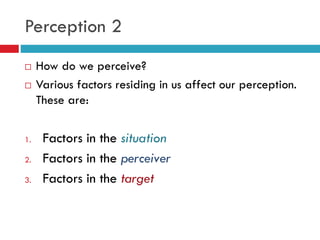
 How do we perceive?
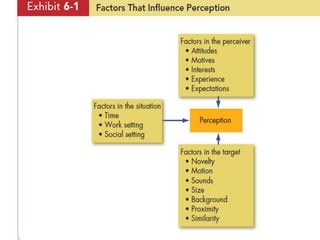
 Various factors residing in us affect our perception.
These are:
1. Factors in the situation
2. Factors in the perceiver
3. Factors in the target
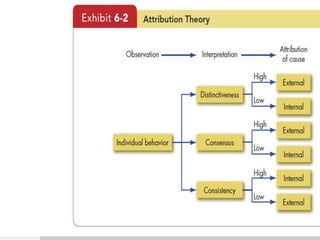
Perceiving others: Attribution Theory
 In this we attribute behaviour to Internal and
External factors
 We determine based on distinctiveness displayed in
different situations,
 By looking for consensus, and by looking for
consistency in people’s actions
 But this can also result in fundamental attribution
error and self serving bias
Shortcuts in Perceiving others
 Sometimes when we choose to judge a situation
quickly we don’t take all the facts into account. We
use:
 Selective perception
 Halo Effect
 Contrast Effects
 Stereotyping
 Self fulfilling prophecy
 Selective perception
Any characteristic that makes a person, object, or
event stand out will increase the probability that we
see that characteristic, rather than the whole package
of characteristics.
 Halo Effect
When we draw a general impression about an
individual on the basis of a single characteristic, such
as intelligence, likeability, or appearance
Shortcuts in Perceiving others
 Contrast Effects
The concept that our reaction to one person is often
influenced by other people we have recently
encountered.
 Stereotyping
 When we judge someone on the basis of our
perception of the group to which he or she belongs,
we are using the shortcut called stereotyping.
Shortcuts in Perceiving others
 Self fulfilling prophecy
A concept that proposes a person will behave in ways
consistent with how he or she is perceived by others.
Shortcuts in Perceiving others
Specific Applications of Shortcuts in
Organizations
 1. Employment Interview
 Few people are hired without an interview. Interviewers
often make perceptual judgments that might be inaccurate
with early impressions that quickly become entrenched
 2. Performance Expectations
 People try to validate perceptions of reality even when these
are faulty. Self-fulfilling prophecy describes how an
individual’s behavior is determined by others’ expectations.
 3. Performance Evaluation
 Subjective evaluations, though necessary, are
problematic because of all the errors discussed which
affect them
Decision Making
 To make a decision on a complex problem,
most of us try to reduce the complexity as
much as possible and then to address the
simplified model
 In OB we know that perceptions, values,
cultural values and embedded beliefs are also
parts of a problem and cannot always be
reduced or simplified
Decision Making 2
 Simplifying a problem that extract their
essential features in order to make a decision,
is known as Bounded Rationality
which are the limitations on a person’s ability to
interpret, process, and act on information.
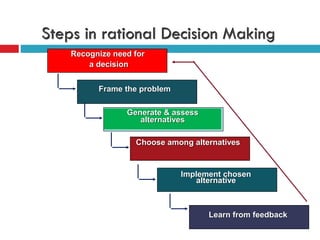
Steps in rational Decision Making
Recognize need for
a decision
Frame the problem
Generate & assess
alternatives
Choose among alternatives
Implement chosen
alternative
Learn from feedback
Decision Making 3
 Sometimes decision making is done based on
intuition which is a subconscious process created
from distilling one’s experience
Decision Making Biases
1. Overconfidence bias
Overestimating the accuracy of our predictions
because of being overconfident
2. Anchoring bias
A tendency to fixate on initial information as a
starting point.
Decision Making Biases
3. Confirmation bias
The rational decision-making process assumes we
objectively gather information. But we don’t. We
selectively gather it. we seek out information that
reaffirms our past choices, and we discount information
that contradicts them
4. Availability bias
is our tendency to base judgments on information
readily available such as vivid, emotional events
Decision making: Errors or Distortions
1. Escalation of commitment
A distortion that creeps into decisions is a tendency to
escalate commitment, even when there is evidence to
suggest that the decision is wrong
2. Randomness error
 This is our tendency to believe we can predict the
outcome of random events. Decision making suffers
when we try to create meaning in random events.
Decision making: Errors
3. Winner’s curse
suggests that the winning participants of a competitive
bidding (or auction) typically pay too much for the
item and that the curse grows stronger with a larger
number of bidders
4. Hindsight bias
The tendency to believe falsely, after an outcome of
an event is actually known, that one would have
accurately predicted that outcome.
Reducing Biases and Errors
 1. Focus on Goals
 2. Look for Information That Disconfirms Your
Beliefs.
 3. Don’t Try to Create Meaning out of Random
Events
 4. Increase Your Options.
Reducing Biases and Errors
 Focus on Goals
 Without goals, you can’t be rational, you don’t know
what information you need, you don’t know which
information is relevant and which is irrelevant, you’ll
find it difficult to choose between alternatives, and
you’re far more likely to experience regret over the
choices you make. Clear goals make decision
making easier and help you eliminate options that
are inconsistent with your interests.
Reducing Biases and Errors
 2. Look for Information That Disconfirms Your
Beliefs.
 One of the most effective means for counteracting
overconfidence and the confirmation and hindsight
biases is to actively look for information that
contradicts your beliefs and assumptions. When we
overtly consider various ways we could be wrong,
we challenge our tendencies to think we’re smarter
than we actually are.
Reducing Biases and Errors
 3. Don’t Try to Create Meaning out of Random
Events.
 The educated mind has been trained to look for cause-
and-effect relationships. When something happens, we
ask why. And when we can’t find reasons, we often
invent them. You have to accept that there are events in
life that are outside your control. Ask yourself if
patterns can be meaningfully explained or whether
they are merely coincidence. Don’t attempt to create
meaning out of coincidence.
Reducing Biases and Errors
 4. Increase Your Options.
 No matter how many options you’ve identified, your
final choice can be no better than the best of the
option set you’ve selected. This argues for
increasing your decision alternatives and for using
creativity in developing a wide range of diverse
choices. The more alternatives you can generate,
and the more diverse those alternatives, the greater
your chance of finding an outstanding one.
Influences on Decision Making:
Individual Differences
 Decision making in practice is characterized by
bounded rationality, common biases and errors, and
the use of intuition.
 But individual differences also create deviations
from the rational model. Now we will look at two
such differences: personality and gender.
Personality: Influences on Decision
Making
 Specific facets of conscientiousness might affect escalation
of commitment:
 1. Achievement-striving people are more likely to
escalate their commitment
 2. Dutiful people are less likely to do so
 Achievement-oriented people hate to fail, so they escalate
their commitment, hoping to forestall failure. Also, these
individuals appear more susceptible to the hindsight bias
(looking back to justify actions)
 Dutiful people, however, are more inclined to do what they
see as best for the organization.
Personality: Influences on Decision
Making
 Those with high self-esteem are strongly motivated
to maintain it, so they use the self-serving bias to
preserve it. They blame others for their failures
while taking credit for successes
Gender : Influences on Decision
Making
 Rumination refers to reflecting at length. Women
often take much longer to reach a decision:
spending much more time than men analyzing the
past, present, and future – from overanalyzing
problems before making a decision and to
rehashing a decision.
 Plus Side: This means careful consideration of
problems & choices.
 Minus Side: This makes problems harder to solve
and increases regret over past decisions
Mental Ability : Influences on
Decision Making
 People with higher levels of mental ability are able to
process information more quickly, solve problems more
accurately, and learn faster.
 Higher mental ability tends to allow people avoid
issues. Smart people also fall prey to anchoring,
overconfidence, and escalation of commitment, so being
smart doesn’t alert you to being too confident or
emotionally defensive
 Once warned about decision-making errors, more
intelligent people learn more quickly to avoid them.
They are also better able to avoid logical errors like
false syllogisms or incorrect interpretation of data
Culture : Influences on Decision
Making
 Cultures differ in their time orientation, the importance
of rationality, their belief in the ability of people to
solve problems, and their preference for collective
decision making.
 We need to recognize that the cultural background of a
decision maker can significantly influence the selection
of problems, the depth of analysis, the importance
placed on logic and rationality, and whether
organizational decisions should be made autocratically
or collectively

OB-6 Perception and decision making.pdf

  • 1.
    Values, Perception, Decisionmaking Spring 2018 Thursday 1145 – 245 OB one kenobi
  • 2.
    Perception  What isperception?  It is a process by which we organize & interpret sensory impression in order to give meaning to our environment  What do we perceive?  We see the world differently from each other as individuals. Our behaviour is based on what our perception of the world is. It is how we perceive the world behaviorally that is important
  • 4.
    Perception 2  Howdo we perceive?  Various factors residing in us affect our perception. These are: 1. Factors in the situation 2. Factors in the perceiver 3. Factors in the target
  • 5.
    Perceiving others: AttributionTheory  In this we attribute behaviour to Internal and External factors  We determine based on distinctiveness displayed in different situations,  By looking for consensus, and by looking for consistency in people’s actions  But this can also result in fundamental attribution error and self serving bias
  • 7.
    Shortcuts in Perceivingothers  Sometimes when we choose to judge a situation quickly we don’t take all the facts into account. We use:  Selective perception  Halo Effect  Contrast Effects  Stereotyping  Self fulfilling prophecy
  • 8.
     Selective perception Anycharacteristic that makes a person, object, or event stand out will increase the probability that we see that characteristic, rather than the whole package of characteristics.  Halo Effect When we draw a general impression about an individual on the basis of a single characteristic, such as intelligence, likeability, or appearance Shortcuts in Perceiving others
  • 9.
     Contrast Effects Theconcept that our reaction to one person is often influenced by other people we have recently encountered.  Stereotyping  When we judge someone on the basis of our perception of the group to which he or she belongs, we are using the shortcut called stereotyping. Shortcuts in Perceiving others
  • 10.
     Self fulfillingprophecy A concept that proposes a person will behave in ways consistent with how he or she is perceived by others. Shortcuts in Perceiving others
  • 12.
    Specific Applications ofShortcuts in Organizations  1. Employment Interview  Few people are hired without an interview. Interviewers often make perceptual judgments that might be inaccurate with early impressions that quickly become entrenched  2. Performance Expectations  People try to validate perceptions of reality even when these are faulty. Self-fulfilling prophecy describes how an individual’s behavior is determined by others’ expectations.  3. Performance Evaluation  Subjective evaluations, though necessary, are problematic because of all the errors discussed which affect them
  • 13.
    Decision Making  Tomake a decision on a complex problem, most of us try to reduce the complexity as much as possible and then to address the simplified model  In OB we know that perceptions, values, cultural values and embedded beliefs are also parts of a problem and cannot always be reduced or simplified
  • 14.
    Decision Making 2 Simplifying a problem that extract their essential features in order to make a decision, is known as Bounded Rationality which are the limitations on a person’s ability to interpret, process, and act on information.
  • 15.
    Steps in rationalDecision Making Recognize need for a decision Frame the problem Generate & assess alternatives Choose among alternatives Implement chosen alternative Learn from feedback
  • 16.
    Decision Making 3 Sometimes decision making is done based on intuition which is a subconscious process created from distilling one’s experience
  • 17.
    Decision Making Biases 1.Overconfidence bias Overestimating the accuracy of our predictions because of being overconfident 2. Anchoring bias A tendency to fixate on initial information as a starting point.
  • 18.
    Decision Making Biases 3.Confirmation bias The rational decision-making process assumes we objectively gather information. But we don’t. We selectively gather it. we seek out information that reaffirms our past choices, and we discount information that contradicts them 4. Availability bias is our tendency to base judgments on information readily available such as vivid, emotional events
  • 19.
    Decision making: Errorsor Distortions 1. Escalation of commitment A distortion that creeps into decisions is a tendency to escalate commitment, even when there is evidence to suggest that the decision is wrong 2. Randomness error  This is our tendency to believe we can predict the outcome of random events. Decision making suffers when we try to create meaning in random events.
  • 20.
    Decision making: Errors 3.Winner’s curse suggests that the winning participants of a competitive bidding (or auction) typically pay too much for the item and that the curse grows stronger with a larger number of bidders 4. Hindsight bias The tendency to believe falsely, after an outcome of an event is actually known, that one would have accurately predicted that outcome.
  • 21.
    Reducing Biases andErrors  1. Focus on Goals  2. Look for Information That Disconfirms Your Beliefs.  3. Don’t Try to Create Meaning out of Random Events  4. Increase Your Options.
  • 22.
    Reducing Biases andErrors  Focus on Goals  Without goals, you can’t be rational, you don’t know what information you need, you don’t know which information is relevant and which is irrelevant, you’ll find it difficult to choose between alternatives, and you’re far more likely to experience regret over the choices you make. Clear goals make decision making easier and help you eliminate options that are inconsistent with your interests.
  • 23.
    Reducing Biases andErrors  2. Look for Information That Disconfirms Your Beliefs.  One of the most effective means for counteracting overconfidence and the confirmation and hindsight biases is to actively look for information that contradicts your beliefs and assumptions. When we overtly consider various ways we could be wrong, we challenge our tendencies to think we’re smarter than we actually are.
  • 24.
    Reducing Biases andErrors  3. Don’t Try to Create Meaning out of Random Events.  The educated mind has been trained to look for cause- and-effect relationships. When something happens, we ask why. And when we can’t find reasons, we often invent them. You have to accept that there are events in life that are outside your control. Ask yourself if patterns can be meaningfully explained or whether they are merely coincidence. Don’t attempt to create meaning out of coincidence.
  • 25.
    Reducing Biases andErrors  4. Increase Your Options.  No matter how many options you’ve identified, your final choice can be no better than the best of the option set you’ve selected. This argues for increasing your decision alternatives and for using creativity in developing a wide range of diverse choices. The more alternatives you can generate, and the more diverse those alternatives, the greater your chance of finding an outstanding one.
  • 26.
    Influences on DecisionMaking: Individual Differences  Decision making in practice is characterized by bounded rationality, common biases and errors, and the use of intuition.  But individual differences also create deviations from the rational model. Now we will look at two such differences: personality and gender.
  • 27.
    Personality: Influences onDecision Making  Specific facets of conscientiousness might affect escalation of commitment:  1. Achievement-striving people are more likely to escalate their commitment  2. Dutiful people are less likely to do so  Achievement-oriented people hate to fail, so they escalate their commitment, hoping to forestall failure. Also, these individuals appear more susceptible to the hindsight bias (looking back to justify actions)  Dutiful people, however, are more inclined to do what they see as best for the organization.
  • 28.
    Personality: Influences onDecision Making  Those with high self-esteem are strongly motivated to maintain it, so they use the self-serving bias to preserve it. They blame others for their failures while taking credit for successes
  • 29.
    Gender : Influenceson Decision Making  Rumination refers to reflecting at length. Women often take much longer to reach a decision: spending much more time than men analyzing the past, present, and future – from overanalyzing problems before making a decision and to rehashing a decision.  Plus Side: This means careful consideration of problems & choices.  Minus Side: This makes problems harder to solve and increases regret over past decisions
  • 30.
    Mental Ability :Influences on Decision Making  People with higher levels of mental ability are able to process information more quickly, solve problems more accurately, and learn faster.  Higher mental ability tends to allow people avoid issues. Smart people also fall prey to anchoring, overconfidence, and escalation of commitment, so being smart doesn’t alert you to being too confident or emotionally defensive  Once warned about decision-making errors, more intelligent people learn more quickly to avoid them. They are also better able to avoid logical errors like false syllogisms or incorrect interpretation of data
  • 31.
    Culture : Influenceson Decision Making  Cultures differ in their time orientation, the importance of rationality, their belief in the ability of people to solve problems, and their preference for collective decision making.  We need to recognize that the cultural background of a decision maker can significantly influence the selection of problems, the depth of analysis, the importance placed on logic and rationality, and whether organizational decisions should be made autocratically or collectively