


Monday, October 1, 2018Monday, October 1, 2018
ObjectivesObjectives
 What is TeachingWhat is Teaching
 Why TeachingWhy Teaching
 Types of TeachingTypes of Teaching
 Teaching MethodsTeaching Methods
 Effective TeachingEffective Teaching
 How Best to TeachHow Best to Teach
 How to Assess TeachingHow to Assess Teaching
 What Teachers Can Do.What Teachers Can Do. Monday, October 1, 2018Monday, October 1, 2018SMS Kabir, Psychologist;SMS Kabir, Psychologist;
2
What is Teaching?What is Teaching?
 a process intended for learning.a process intended for learning.
 purposeful direction andpurposeful direction and
management of the learningmanagement of the learning
process.process.
 an art of communicating aan art of communicating a
message with impact onmessage with impact on
audience.audience.
Monday, October 1, 2018Monday, October 1, 2018SMS Kabir, Psychologist;SMS Kabir, Psychologist;
3
Why TeachingWhy TeachingWhy TeachingWhy Teaching
 Teaching creates knowledgeTeaching creates knowledge
and awareness.and awareness.
 Teaching helps to bringTeaching helps to bring
change in life-change in life-
▪▪Change inChange in thoughtthought
▪▪Change inChange in emotionemotion, and, and
▪▪Change inChange in behaviorbehavior..
Monday, October 1, 2018Monday, October 1, 2018SMS Kabir, Psychologist;SMS Kabir, Psychologist;
4
SMS Kabir, Psychologist;SMS Kabir, Psychologist; Monday, October 1, 2018Monday, October 1, 2018
 ActiveActive
 PassivePassive
 LearnerLearner
OrientedOriented
 TeacherTeacher
OrientedOriented
Types of TeachingTypes of TeachingTypes of TeachingTypes of Teaching
5
Monday, October 1, 2018Monday, October 1, 2018SMS Kabir, Psychologist;SMS Kabir, Psychologist;
1.1. LectureLecture
2.2. Lecture discussionLecture discussion
3.3. SeminarSeminar
4.4. SymposiumSymposium
5.5. Panel discussionPanel discussion
6.6. Group discussionGroup discussion
7.7. TutorialsTutorials
8.8. Role playRole play
9.9. IntegratedIntegrated
teachingteaching
10.10. Talking pointTalking point
sessionssessions
11.11. WorkshopsWorkshops
12.12. ConferencesConferences
Teaching MethodsTeaching Methods
6
Criteria of Effective TeachingCriteria of Effective Teaching
Monday, October 1, 2018Monday, October 1, 2018SMS Kabir, Psychologist;SMS Kabir, Psychologist;
 Good Concept (Good Concept (thorough preparationthorough preparation))
 Organized Content (Organized Content (lesson planninglesson planning))
 Good Quality and optimum quantityGood Quality and optimum quantity
 SequenceSequence
 RelevanceRelevance
 Learner oriented.Learner oriented.
EFFECTIVE TEACHINGEFFECTIVE TEACHING
7
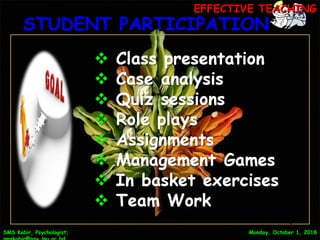
STUDENT PARTICIPATIONSTUDENT PARTICIPATION
Monday, October 1, 2018Monday, October 1, 2018SMS Kabir, Psychologist;SMS Kabir, Psychologist;
EFFECTIVE TEACHINGEFFECTIVE TEACHING
8
STUDENT CENTRIC ACTIVITIESSTUDENT CENTRIC ACTIVITIES
SMS Kabir, Psychologist;SMS Kabir, Psychologist; Monday, October 1, 2018Monday, October 1, 2018
Foundation CoursesFoundation Courses
Mentoring & counselling sessionsMentoring & counselling sessions
on regular basison regular basis
Extra classes for weak studentsExtra classes for weak students
for individual subjectfor individual subject
Tagging weak students with starTagging weak students with star
performersperformers
Orientation programmesOrientation programmes 9
EFFECTIVE TEACHINGEFFECTIVE TEACHING
Monday, October 1, 2018Monday, October 1, 2018SMS Kabir, Psychologist;SMS Kabir, Psychologist;
Value added programmesValue added programmes
Personality developmentPersonality development
classesclasses
Guest lecturesGuest lectures
Organizational observationOrganizational observation
visitvisit
Project work.Project work.
STUDENT CENTRIC ACTIVITIESSTUDENT CENTRIC ACTIVITIES
10
EFFECTIVE TEACHINGEFFECTIVE TEACHING
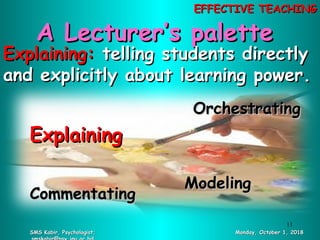
A Lecturer’s paletteA Lecturer’s palette
Explaining:Explaining: telling students directlytelling students directly
and explicitly about learning power.and explicitly about learning power.
OrchestratingOrchestrating
CommentatingCommentating
ModelingModeling
ExplainingExplaining
Monday, October 1, 2018Monday, October 1, 2018SMS Kabir, Psychologist;SMS Kabir, Psychologist;
11
EFFECTIVE TEACHINGEFFECTIVE TEACHING
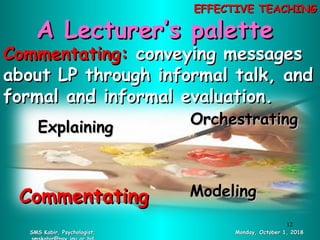
Commentating:Commentating: conveying messagesconveying messages
about LP through informal talk, andabout LP through informal talk, and
formal and informal evaluation.formal and informal evaluation.
OrchestratingOrchestrating
CommentatingCommentating ModelingModeling
ExplainingExplaining
A Lecturer’s paletteA Lecturer’s palette
SMS Kabir, Psychologist;SMS Kabir, Psychologist; Monday, October 1, 2018Monday, October 1, 2018
12
EFFECTIVE TEACHINGEFFECTIVE TEACHING
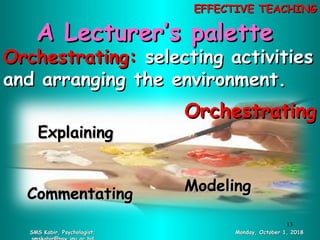
Orchestrating:Orchestrating: selecting activitiesselecting activities
and arranging the environment.and arranging the environment.
OrchestratingOrchestrating
CommentatingCommentating ModelingModeling
ExplainingExplaining
A Lecturer’s paletteA Lecturer’s palette
SMS Kabir, Psychologist;SMS Kabir, Psychologist; Monday, October 1, 2018Monday, October 1, 2018
13
EFFECTIVE TEACHINGEFFECTIVE TEACHING
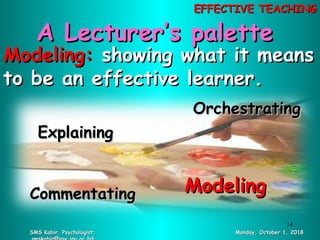
Modeling:Modeling: showing what it meansshowing what it means
to be an effective learner.to be an effective learner.
OrchestratingOrchestrating
CommentatingCommentating ModelingModeling
ExplainingExplaining
A Lecturer’s paletteA Lecturer’s palette
SMS Kabir, Psychologist;SMS Kabir, Psychologist; Monday, October 1, 2018Monday, October 1, 2018
14
EFFECTIVE TEACHINGEFFECTIVE TEACHING
Monday, October 1, 2018Monday, October 1, 2018SMS Kabir, Psychologist;SMS Kabir, Psychologist;
HowBesttoteachHowBesttoteach
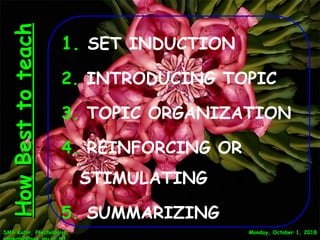
1. SET INDUCTION
2. INTRODUCING TOPIC
3. TOPIC ORGANIZATION
4. REINFORCING OR
STIMULATING
5. SUMMARIZING 15
SET INDUCTIONSET INDUCTION
Monday, October 1, 2018Monday, October 1, 2018SMS Kabir, Psychologist;SMS Kabir, Psychologist;
11
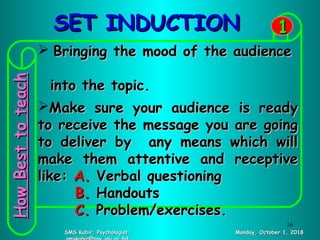
 Bringing the mood of the audienceBringing the mood of the audience
into the topic.into the topic.
Make sure your audience is readyMake sure your audience is ready
to receive the message you are goingto receive the message you are going
to deliver by any means which willto deliver by any means which will
make them attentive and receptivemake them attentive and receptive
like:like: A.A. Verbal questioningVerbal questioning
B.B. HandoutsHandouts
C.C. Problem/exercises.Problem/exercises.
HowBesttoteachHowBesttoteach
16
INTRODUCING TOPICINTRODUCING TOPIC
Monday, October 1, 2018Monday, October 1, 2018SMS Kabir, Psychologist;SMS Kabir, Psychologist;
22
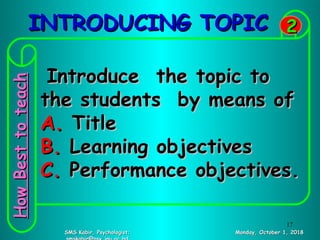
Introduce the topic toIntroduce the topic to
the students by means ofthe students by means of
A.A. TitleTitle
B.B. Learning objectivesLearning objectives
C.C. Performance objectives.Performance objectives.
HowBesttoteachHowBesttoteach
17
ORGANIZING THE TOPICORGANIZING THE TOPIC
Monday, October 1, 2018Monday, October 1, 2018SMS Kabir, Psychologist;SMS Kabir, Psychologist;
33
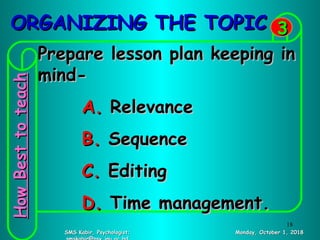
Prepare lesson plan keeping inPrepare lesson plan keeping in
mind-mind-
A.A. RelevanceRelevance
B.B. SequenceSequence
C.C. EditingEditing
D.D. Time management.Time management.
HowBesttoteachHowBesttoteach
18
REINFORCINGREINFORCING
Monday, October 1, 2018Monday, October 1, 2018SMS Kabir, Psychologist;SMS Kabir, Psychologist;
44
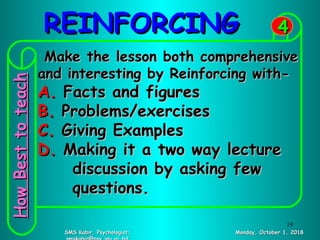
Make the lesson both comprehensiveMake the lesson both comprehensive
and interesting by Reinforcing with-and interesting by Reinforcing with-
A.A. Facts and figuresFacts and figures
B.B. Problems/exercisesProblems/exercises
C.C. Giving ExamplesGiving Examples
D.D. Making it a two way lectureMaking it a two way lecture
discussion by asking fewdiscussion by asking few
questions.questions.
HowBesttoteachHowBesttoteach
19
STIMULATIONSTIMULATION
Monday, October 1, 2018Monday, October 1, 2018SMS Kabir, Psychologist;SMS Kabir, Psychologist;
44
Make it more interesting and lively byMake it more interesting and lively by
A.A. Repetition of the main pointsRepetition of the main points
B.B. Stressing the important onesStressing the important ones
C.C. Pauses to make something morePauses to make something more
effectiveeffective
D.D. Relevant personal experiencesRelevant personal experiences
E.E. Purposeful body movements,Purposeful body movements,
gestures, voice modulations, eyegestures, voice modulations, eye
contact etc.contact etc.
HowBesttoteachHowBesttoteach
20
SUMMARIZINGSUMMARIZING
Monday, October 1, 2018Monday, October 1, 2018SMS Kabir, Psychologist;SMS Kabir, Psychologist;
55
Summarize your lecture-Summarize your lecture-
 By checking whether you have explained allBy checking whether you have explained all
the learning objectives you have chosen.the learning objectives you have chosen.
 Just repeat your learning objectives givingJust repeat your learning objectives giving
stress on main points.stress on main points.
 Please note that summarization is notPlease note that summarization is not
evaluation or assessment of impact of yourevaluation or assessment of impact of your
lecture.lecture.
 It completes just delivery of lecture, butIt completes just delivery of lecture, but
does not measure the impact of lecture ondoes not measure the impact of lecture on
the audience.the audience.
HowBesttoteachHowBesttoteach
21
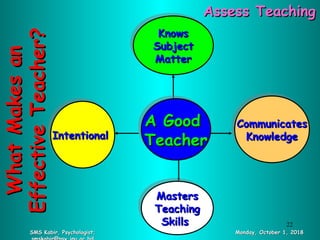
IntentionalIntentionalIntentionalIntentional
MastersMasters
TeachingTeaching
SkillsSkills
MastersMasters
TeachingTeaching
SkillsSkills
CommunicatesCommunicates
KnowledgeKnowledge
CommunicatesCommunicates
KnowledgeKnowledge
KnowsKnows
SubjectSubject
MatterMatter
KnowsKnows
SubjectSubject
MatterMatter
A GoodA Good
TeacherTeacher
A GoodA Good
TeacherTeacher
WhatMakesanWhatMakesan
EffectiveTeacher?EffectiveTeacher?
Monday, October 1, 2018Monday, October 1, 2018SMS Kabir, Psychologist;SMS Kabir, Psychologist;
Assess TeachingAssess Teaching
22
Assess TeachingAssess Teaching
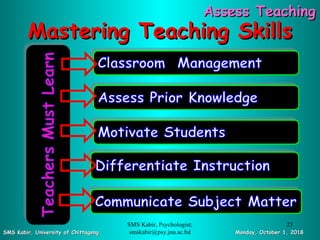
Mastering Teaching SkillsMastering Teaching Skills
SMS Kabir, University of ChittagongSMS Kabir, University of Chittagong Monday, October 1, 2018Monday, October 1, 2018
SMS Kabir, Psychologist;
smskabir@psy.jnu.ac.bd
23
Monday, October 1, 2018Monday, October 1, 2018SMS Kabir, University of ChittagongSMS Kabir, University of Chittagong
Assess TeachingAssess Teaching
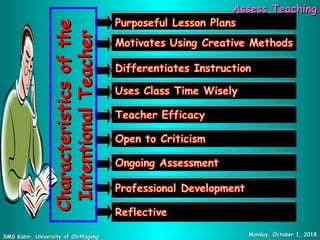
CharacteristicsoftheCharacteristicsofthe
IntentionalTeacherIntentionalTeacher
Monday, October 1, 2018Monday, October 1, 2018SMS Kabir, Psychologist;SMS Kabir, Psychologist;
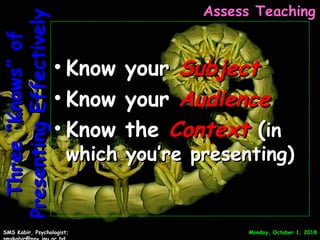
Assess TeachingAssess TeachingThree“Knows”ofThree“Knows”of
PresentingEffectivelyPresentingEffectively
• Know yourKnow your SubjectSubject
• Know yourKnow your AudienceAudience
• Know theKnow the ContextContext ((inin
which you’re presenting)which you’re presenting)
25
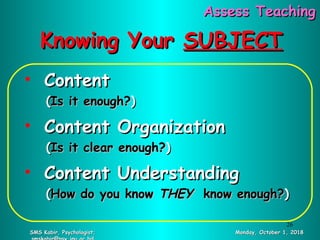
Knowing YourKnowing Your SUBJECTSUBJECT
• ContentContent
((Is it enough?Is it enough?))
• Content OrganizationContent Organization
((Is it clear enough?Is it clear enough?))
• Content UnderstandingContent Understanding
((How do you knowHow do you know THEYTHEY know enough?know enough?))
Monday, October 1, 2018Monday, October 1, 2018SMS Kabir, Psychologist;SMS Kabir, Psychologist;
Assess TeachingAssess Teaching
26
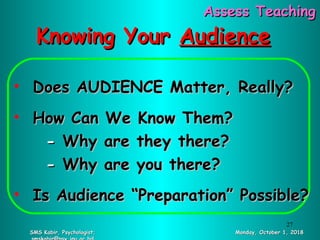
Knowing YourKnowing Your AudienceAudience
• Does AUDIENCE Matter, Really?Does AUDIENCE Matter, Really?
• How Can We Know Them?How Can We Know Them?
-- Why are they there?Why are they there?
-- Why are you there?Why are you there?
• Is Audience “Preparation” Possible?Is Audience “Preparation” Possible?
Monday, October 1, 2018Monday, October 1, 2018SMS Kabir, Psychologist;SMS Kabir, Psychologist;
Assess TeachingAssess Teaching
27
Know theKnow the ContextContext
How Do Different Contexts Shape YourHow Do Different Contexts Shape Your
Presentation Goals? Strategies? Approach?Presentation Goals? Strategies? Approach?
• WHEREWHERE Are You Presenting?Are You Presenting?
• WHATWHAT Are You Presenting?Are You Presenting?
• HOW & With or FOR WhomHOW & With or FOR Whom
Are You Presenting?Are You Presenting?
Monday, October 1, 2018Monday, October 1, 2018SMS Kabir, Psychologist;SMS Kabir, Psychologist;
Assess TeachingAssess Teaching
28
SMS Kabir, Psychologist;SMS Kabir, Psychologist; Monday, October 1, 2018Monday, October 1, 2018
Assess TeachingAssess Teaching
ManagingtheStudentsManagingtheStudents Don’t throw the blame on theDon’t throw the blame on the
students for your failure tostudents for your failure to
create an impact with yourcreate an impact with your
lecture.lecture.
Students are immature, lessStudents are immature, less
skilled, emotional and You areskilled, emotional and You are
mature, more skilled andmature, more skilled and
composed.composed.
Best way to control the studentsBest way to control the students
is by giving them best lectures.is by giving them best lectures.
29
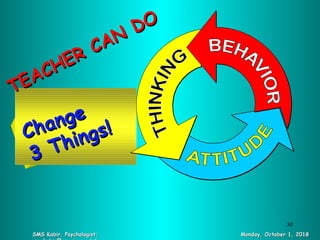
Change
Change
3 Things!
3 Things!
SMS Kabir, Psychologist;SMS Kabir, Psychologist; Monday, October 1, 2018Monday, October 1, 2018
TEACHER CAN
DO
TEACHER CAN
DO
30
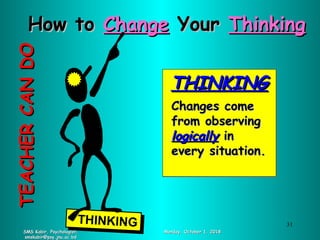
How toHow to ChangeChange YourYour ThinkingThinking
THINKINGTHINKING
THINKINGTHINKINGTHINKINGTHINKING
Changes comeChanges come
from observingfrom observing
logicallylogically inin
every situation.every situation.
SMS Kabir, Psychologist;SMS Kabir, Psychologist;
smskabir@psy.jnu.ac.bdsmskabir@psy.jnu.ac.bd
Monday, October 1, 2018Monday, October 1, 2018
TEACHERCANDOTEACHERCANDO
31
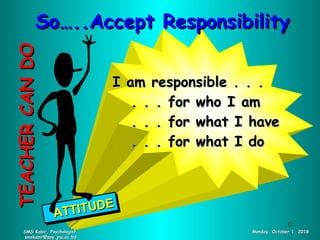
I am responsible . . .I am responsible . . .
. . . for who I am. . . for who I am
. . . for what I have. . . for what I have
. . . for what I do. . . for what I do
ATTITUDE
ATTITUDE
ATTITUDE
ATTITUDE
So…..Accept ResponsibilitySo…..Accept Responsibility
SMS Kabir, Psychologist;SMS Kabir, Psychologist;
smskabir@psy.jnu.ac.bdsmskabir@psy.jnu.ac.bd
Monday, October 1, 2018Monday, October 1, 2018
TEACHERCANDOTEACHERCANDO
32
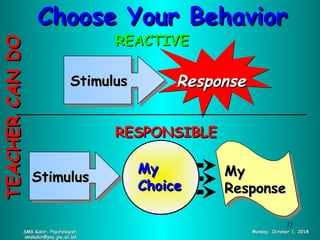
Choose Your BehaviorChoose Your Behavior
REACTIVEREACTIVE
ResponseResponse
RESPONSIBLERESPONSIBLE
MyMy
ResponseResponse
MyMy
ChoiceChoice
StimulusStimulus
StimulusStimulus
SMS Kabir, Psychologist;SMS Kabir, Psychologist;
smskabir@psy.jnu.ac.bdsmskabir@psy.jnu.ac.bd
Monday, October 1, 2018Monday, October 1, 2018
TEACHERCANDOTEACHERCANDO
33
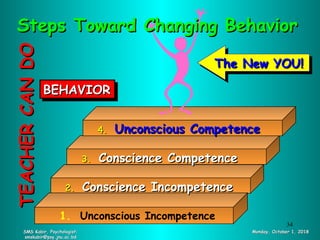
1. Unconscious Incompetence
2.2. Conscience IncompetenceConscience Incompetence
3.3. Conscience CompetenceConscience Competence
4.4. Unconscious CompetenceUnconscious Competence
BEHAVIORBEHAVIORBEHAVIORBEHAVIOR
The New YOU!The New YOU!The New YOU!The New YOU!
SMS Kabir, Psychologist;SMS Kabir, Psychologist;
smskabir@psy.jnu.ac.bdsmskabir@psy.jnu.ac.bd
Monday, October 1, 2018Monday, October 1, 2018
Steps Toward Changing BehaviorSteps Toward Changing BehaviorTEACHERCANDOTEACHERCANDO
34
SMS Kabir, Psychologist;SMS Kabir, Psychologist;
smskabir@psy.jnu.ac.bdsmskabir@psy.jnu.ac.bd
Monday, October 1, 2018Monday, October 1, 2018
TEACHERCANDOTEACHERCANDO
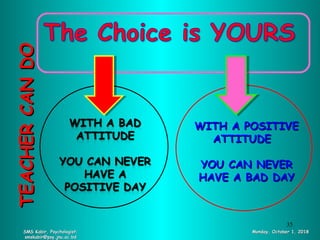
WITH A POSITIVEWITH A POSITIVE
ATTITUDEATTITUDE
YOU CAN NEVERYOU CAN NEVER
HAVE A BAD DAYHAVE A BAD DAY
35
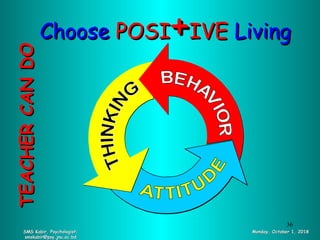
ChooseChoose POSIPOSI++IVEIVE LivingLiving
SMS Kabir, Psychologist;SMS Kabir, Psychologist;
smskabir@psy.jnu.ac.bdsmskabir@psy.jnu.ac.bd
Monday, October 1, 2018Monday, October 1, 2018
TEACHERCANDOTEACHERCANDO
36
Monday, October 1, 2018Monday, October 1, 2018SMS Kabir, Psychologist;SMS Kabir, Psychologist;
37
?QuestionsQuestions
?AnswersAnswers
Monday, October 1, 2018Monday, October 1, 2018SMS Kabir, Psychologist;SMS Kabir, Psychologist;
38
Monday, October 1, 2018 SMS Kabir, Psychologist;
smskabir@psy.jnu.ac.bd
39

Effective teaching

  • 1.
    Monday, October 1,2018Monday, October 1, 2018
  • 2.
    ObjectivesObjectives  What isTeachingWhat is Teaching  Why TeachingWhy Teaching  Types of TeachingTypes of Teaching  Teaching MethodsTeaching Methods  Effective TeachingEffective Teaching  How Best to TeachHow Best to Teach  How to Assess TeachingHow to Assess Teaching  What Teachers Can Do.What Teachers Can Do. Monday, October 1, 2018Monday, October 1, 2018SMS Kabir, Psychologist;SMS Kabir, Psychologist; 2
  • 3.
    What is Teaching?Whatis Teaching?  a process intended for learning.a process intended for learning.  purposeful direction andpurposeful direction and management of the learningmanagement of the learning process.process.  an art of communicating aan art of communicating a message with impact onmessage with impact on audience.audience. Monday, October 1, 2018Monday, October 1, 2018SMS Kabir, Psychologist;SMS Kabir, Psychologist; 3
  • 4.
    Why TeachingWhy TeachingWhyTeachingWhy Teaching  Teaching creates knowledgeTeaching creates knowledge and awareness.and awareness.  Teaching helps to bringTeaching helps to bring change in life-change in life- ▪▪Change inChange in thoughtthought ▪▪Change inChange in emotionemotion, and, and ▪▪Change inChange in behaviorbehavior.. Monday, October 1, 2018Monday, October 1, 2018SMS Kabir, Psychologist;SMS Kabir, Psychologist; 4
  • 5.
    SMS Kabir, Psychologist;SMSKabir, Psychologist; Monday, October 1, 2018Monday, October 1, 2018  ActiveActive  PassivePassive  LearnerLearner OrientedOriented  TeacherTeacher OrientedOriented Types of TeachingTypes of TeachingTypes of TeachingTypes of Teaching 5
  • 6.
    Monday, October 1,2018Monday, October 1, 2018SMS Kabir, Psychologist;SMS Kabir, Psychologist; 1.1. LectureLecture 2.2. Lecture discussionLecture discussion 3.3. SeminarSeminar 4.4. SymposiumSymposium 5.5. Panel discussionPanel discussion 6.6. Group discussionGroup discussion 7.7. TutorialsTutorials 8.8. Role playRole play 9.9. IntegratedIntegrated teachingteaching 10.10. Talking pointTalking point sessionssessions 11.11. WorkshopsWorkshops 12.12. ConferencesConferences Teaching MethodsTeaching Methods 6
  • 7.
    Criteria of EffectiveTeachingCriteria of Effective Teaching Monday, October 1, 2018Monday, October 1, 2018SMS Kabir, Psychologist;SMS Kabir, Psychologist;  Good Concept (Good Concept (thorough preparationthorough preparation))  Organized Content (Organized Content (lesson planninglesson planning))  Good Quality and optimum quantityGood Quality and optimum quantity  SequenceSequence  RelevanceRelevance  Learner oriented.Learner oriented. EFFECTIVE TEACHINGEFFECTIVE TEACHING 7
  • 8.
    STUDENT PARTICIPATIONSTUDENT PARTICIPATION Monday,October 1, 2018Monday, October 1, 2018SMS Kabir, Psychologist;SMS Kabir, Psychologist; EFFECTIVE TEACHINGEFFECTIVE TEACHING 8
  • 9.
    STUDENT CENTRIC ACTIVITIESSTUDENTCENTRIC ACTIVITIES SMS Kabir, Psychologist;SMS Kabir, Psychologist; Monday, October 1, 2018Monday, October 1, 2018 Foundation CoursesFoundation Courses Mentoring & counselling sessionsMentoring & counselling sessions on regular basison regular basis Extra classes for weak studentsExtra classes for weak students for individual subjectfor individual subject Tagging weak students with starTagging weak students with star performersperformers Orientation programmesOrientation programmes 9 EFFECTIVE TEACHINGEFFECTIVE TEACHING
  • 10.
    Monday, October 1,2018Monday, October 1, 2018SMS Kabir, Psychologist;SMS Kabir, Psychologist; Value added programmesValue added programmes Personality developmentPersonality development classesclasses Guest lecturesGuest lectures Organizational observationOrganizational observation visitvisit Project work.Project work. STUDENT CENTRIC ACTIVITIESSTUDENT CENTRIC ACTIVITIES 10 EFFECTIVE TEACHINGEFFECTIVE TEACHING
  • 11.
    A Lecturer’s paletteALecturer’s palette Explaining:Explaining: telling students directlytelling students directly and explicitly about learning power.and explicitly about learning power. OrchestratingOrchestrating CommentatingCommentating ModelingModeling ExplainingExplaining Monday, October 1, 2018Monday, October 1, 2018SMS Kabir, Psychologist;SMS Kabir, Psychologist; 11 EFFECTIVE TEACHINGEFFECTIVE TEACHING
  • 12.
    Commentating:Commentating: conveying messagesconveyingmessages about LP through informal talk, andabout LP through informal talk, and formal and informal evaluation.formal and informal evaluation. OrchestratingOrchestrating CommentatingCommentating ModelingModeling ExplainingExplaining A Lecturer’s paletteA Lecturer’s palette SMS Kabir, Psychologist;SMS Kabir, Psychologist; Monday, October 1, 2018Monday, October 1, 2018 12 EFFECTIVE TEACHINGEFFECTIVE TEACHING
  • 13.
    Orchestrating:Orchestrating: selecting activitiesselectingactivities and arranging the environment.and arranging the environment. OrchestratingOrchestrating CommentatingCommentating ModelingModeling ExplainingExplaining A Lecturer’s paletteA Lecturer’s palette SMS Kabir, Psychologist;SMS Kabir, Psychologist; Monday, October 1, 2018Monday, October 1, 2018 13 EFFECTIVE TEACHINGEFFECTIVE TEACHING
  • 14.
    Modeling:Modeling: showing whatit meansshowing what it means to be an effective learner.to be an effective learner. OrchestratingOrchestrating CommentatingCommentating ModelingModeling ExplainingExplaining A Lecturer’s paletteA Lecturer’s palette SMS Kabir, Psychologist;SMS Kabir, Psychologist; Monday, October 1, 2018Monday, October 1, 2018 14 EFFECTIVE TEACHINGEFFECTIVE TEACHING
  • 15.
    Monday, October 1,2018Monday, October 1, 2018SMS Kabir, Psychologist;SMS Kabir, Psychologist; HowBesttoteachHowBesttoteach 1. SET INDUCTION 2. INTRODUCING TOPIC 3. TOPIC ORGANIZATION 4. REINFORCING OR STIMULATING 5. SUMMARIZING 15
  • 16.
    SET INDUCTIONSET INDUCTION Monday,October 1, 2018Monday, October 1, 2018SMS Kabir, Psychologist;SMS Kabir, Psychologist; 11  Bringing the mood of the audienceBringing the mood of the audience into the topic.into the topic. Make sure your audience is readyMake sure your audience is ready to receive the message you are goingto receive the message you are going to deliver by any means which willto deliver by any means which will make them attentive and receptivemake them attentive and receptive like:like: A.A. Verbal questioningVerbal questioning B.B. HandoutsHandouts C.C. Problem/exercises.Problem/exercises. HowBesttoteachHowBesttoteach 16
  • 17.
    INTRODUCING TOPICINTRODUCING TOPIC Monday,October 1, 2018Monday, October 1, 2018SMS Kabir, Psychologist;SMS Kabir, Psychologist; 22 Introduce the topic toIntroduce the topic to the students by means ofthe students by means of A.A. TitleTitle B.B. Learning objectivesLearning objectives C.C. Performance objectives.Performance objectives. HowBesttoteachHowBesttoteach 17
  • 18.
    ORGANIZING THE TOPICORGANIZINGTHE TOPIC Monday, October 1, 2018Monday, October 1, 2018SMS Kabir, Psychologist;SMS Kabir, Psychologist; 33 Prepare lesson plan keeping inPrepare lesson plan keeping in mind-mind- A.A. RelevanceRelevance B.B. SequenceSequence C.C. EditingEditing D.D. Time management.Time management. HowBesttoteachHowBesttoteach 18
  • 19.
    REINFORCINGREINFORCING Monday, October 1,2018Monday, October 1, 2018SMS Kabir, Psychologist;SMS Kabir, Psychologist; 44 Make the lesson both comprehensiveMake the lesson both comprehensive and interesting by Reinforcing with-and interesting by Reinforcing with- A.A. Facts and figuresFacts and figures B.B. Problems/exercisesProblems/exercises C.C. Giving ExamplesGiving Examples D.D. Making it a two way lectureMaking it a two way lecture discussion by asking fewdiscussion by asking few questions.questions. HowBesttoteachHowBesttoteach 19
  • 20.
    STIMULATIONSTIMULATION Monday, October 1,2018Monday, October 1, 2018SMS Kabir, Psychologist;SMS Kabir, Psychologist; 44 Make it more interesting and lively byMake it more interesting and lively by A.A. Repetition of the main pointsRepetition of the main points B.B. Stressing the important onesStressing the important ones C.C. Pauses to make something morePauses to make something more effectiveeffective D.D. Relevant personal experiencesRelevant personal experiences E.E. Purposeful body movements,Purposeful body movements, gestures, voice modulations, eyegestures, voice modulations, eye contact etc.contact etc. HowBesttoteachHowBesttoteach 20
  • 21.
    SUMMARIZINGSUMMARIZING Monday, October 1,2018Monday, October 1, 2018SMS Kabir, Psychologist;SMS Kabir, Psychologist; 55 Summarize your lecture-Summarize your lecture-  By checking whether you have explained allBy checking whether you have explained all the learning objectives you have chosen.the learning objectives you have chosen.  Just repeat your learning objectives givingJust repeat your learning objectives giving stress on main points.stress on main points.  Please note that summarization is notPlease note that summarization is not evaluation or assessment of impact of yourevaluation or assessment of impact of your lecture.lecture.  It completes just delivery of lecture, butIt completes just delivery of lecture, but does not measure the impact of lecture ondoes not measure the impact of lecture on the audience.the audience. HowBesttoteachHowBesttoteach 21
  • 22.
  • 23.
    Assess TeachingAssess Teaching MasteringTeaching SkillsMastering Teaching Skills SMS Kabir, University of ChittagongSMS Kabir, University of Chittagong Monday, October 1, 2018Monday, October 1, 2018 SMS Kabir, Psychologist; smskabir@psy.jnu.ac.bd 23
  • 24.
    Monday, October 1,2018Monday, October 1, 2018SMS Kabir, University of ChittagongSMS Kabir, University of Chittagong Assess TeachingAssess Teaching CharacteristicsoftheCharacteristicsofthe IntentionalTeacherIntentionalTeacher
  • 25.
    Monday, October 1,2018Monday, October 1, 2018SMS Kabir, Psychologist;SMS Kabir, Psychologist; Assess TeachingAssess TeachingThree“Knows”ofThree“Knows”of PresentingEffectivelyPresentingEffectively • Know yourKnow your SubjectSubject • Know yourKnow your AudienceAudience • Know theKnow the ContextContext ((inin which you’re presenting)which you’re presenting) 25
  • 26.
    Knowing YourKnowing YourSUBJECTSUBJECT • ContentContent ((Is it enough?Is it enough?)) • Content OrganizationContent Organization ((Is it clear enough?Is it clear enough?)) • Content UnderstandingContent Understanding ((How do you knowHow do you know THEYTHEY know enough?know enough?)) Monday, October 1, 2018Monday, October 1, 2018SMS Kabir, Psychologist;SMS Kabir, Psychologist; Assess TeachingAssess Teaching 26
  • 27.
    Knowing YourKnowing YourAudienceAudience • Does AUDIENCE Matter, Really?Does AUDIENCE Matter, Really? • How Can We Know Them?How Can We Know Them? -- Why are they there?Why are they there? -- Why are you there?Why are you there? • Is Audience “Preparation” Possible?Is Audience “Preparation” Possible? Monday, October 1, 2018Monday, October 1, 2018SMS Kabir, Psychologist;SMS Kabir, Psychologist; Assess TeachingAssess Teaching 27
  • 28.
    Know theKnow theContextContext How Do Different Contexts Shape YourHow Do Different Contexts Shape Your Presentation Goals? Strategies? Approach?Presentation Goals? Strategies? Approach? • WHEREWHERE Are You Presenting?Are You Presenting? • WHATWHAT Are You Presenting?Are You Presenting? • HOW & With or FOR WhomHOW & With or FOR Whom Are You Presenting?Are You Presenting? Monday, October 1, 2018Monday, October 1, 2018SMS Kabir, Psychologist;SMS Kabir, Psychologist; Assess TeachingAssess Teaching 28
  • 29.
    SMS Kabir, Psychologist;SMSKabir, Psychologist; Monday, October 1, 2018Monday, October 1, 2018 Assess TeachingAssess Teaching ManagingtheStudentsManagingtheStudents Don’t throw the blame on theDon’t throw the blame on the students for your failure tostudents for your failure to create an impact with yourcreate an impact with your lecture.lecture. Students are immature, lessStudents are immature, less skilled, emotional and You areskilled, emotional and You are mature, more skilled andmature, more skilled and composed.composed. Best way to control the studentsBest way to control the students is by giving them best lectures.is by giving them best lectures. 29
  • 30.
    Change Change 3 Things! 3 Things! SMSKabir, Psychologist;SMS Kabir, Psychologist; Monday, October 1, 2018Monday, October 1, 2018 TEACHER CAN DO TEACHER CAN DO 30
  • 31.
    How toHow toChangeChange YourYour ThinkingThinking THINKINGTHINKING THINKINGTHINKINGTHINKINGTHINKING Changes comeChanges come from observingfrom observing logicallylogically inin every situation.every situation. SMS Kabir, Psychologist;SMS Kabir, Psychologist; smskabir@psy.jnu.ac.bdsmskabir@psy.jnu.ac.bd Monday, October 1, 2018Monday, October 1, 2018 TEACHERCANDOTEACHERCANDO 31
  • 32.
    I am responsible. . .I am responsible . . . . . . for who I am. . . for who I am . . . for what I have. . . for what I have . . . for what I do. . . for what I do ATTITUDE ATTITUDE ATTITUDE ATTITUDE So…..Accept ResponsibilitySo…..Accept Responsibility SMS Kabir, Psychologist;SMS Kabir, Psychologist; smskabir@psy.jnu.ac.bdsmskabir@psy.jnu.ac.bd Monday, October 1, 2018Monday, October 1, 2018 TEACHERCANDOTEACHERCANDO 32
  • 33.
    Choose Your BehaviorChooseYour Behavior REACTIVEREACTIVE ResponseResponse RESPONSIBLERESPONSIBLE MyMy ResponseResponse MyMy ChoiceChoice StimulusStimulus StimulusStimulus SMS Kabir, Psychologist;SMS Kabir, Psychologist; smskabir@psy.jnu.ac.bdsmskabir@psy.jnu.ac.bd Monday, October 1, 2018Monday, October 1, 2018 TEACHERCANDOTEACHERCANDO 33
  • 34.
    1. Unconscious Incompetence 2.2.Conscience IncompetenceConscience Incompetence 3.3. Conscience CompetenceConscience Competence 4.4. Unconscious CompetenceUnconscious Competence BEHAVIORBEHAVIORBEHAVIORBEHAVIOR The New YOU!The New YOU!The New YOU!The New YOU! SMS Kabir, Psychologist;SMS Kabir, Psychologist; smskabir@psy.jnu.ac.bdsmskabir@psy.jnu.ac.bd Monday, October 1, 2018Monday, October 1, 2018 Steps Toward Changing BehaviorSteps Toward Changing BehaviorTEACHERCANDOTEACHERCANDO 34
  • 35.
    SMS Kabir, Psychologist;SMSKabir, Psychologist; smskabir@psy.jnu.ac.bdsmskabir@psy.jnu.ac.bd Monday, October 1, 2018Monday, October 1, 2018 TEACHERCANDOTEACHERCANDO WITH A POSITIVEWITH A POSITIVE ATTITUDEATTITUDE YOU CAN NEVERYOU CAN NEVER HAVE A BAD DAYHAVE A BAD DAY 35
  • 36.
    ChooseChoose POSIPOSI++IVEIVE LivingLiving SMSKabir, Psychologist;SMS Kabir, Psychologist; smskabir@psy.jnu.ac.bdsmskabir@psy.jnu.ac.bd Monday, October 1, 2018Monday, October 1, 2018 TEACHERCANDOTEACHERCANDO 36
  • 37.
    Monday, October 1,2018Monday, October 1, 2018SMS Kabir, Psychologist;SMS Kabir, Psychologist; 37
  • 38.
    ?QuestionsQuestions ?AnswersAnswers Monday, October 1,2018Monday, October 1, 2018SMS Kabir, Psychologist;SMS Kabir, Psychologist; 38
  • 39.
    Monday, October 1,2018 SMS Kabir, Psychologist; smskabir@psy.jnu.ac.bd 39

Editor's Notes

  • #2 Understanding the Psychology of Students Port City University, Chittagong As a trainer
  • #3 Objectives What is Teaching Purpose of Teaching Types of Teaching Various Teaching Methods Qualities of Good Teaching How Best to Teach How to Assess Teaching What Teachers Can Do Change Three Things
  • #4 What is Teaching? a process intended for learning. purposeful direction and management of the learning process. an art of communicating a message with impact on audience.
  • #5 Why Teaching Teaching creates knowledge, awareness and feelings in the taught and brings about behavioral change. Teaching helps to bring change in life- ▪Change in thought ▪Change in emotion, and ▪Change in behavior.
  • #6 Types of Teaching Active Passive Learner Oriented Teacher Oriented
  • #7 Teaching Methods 1. Lecture 2. Lecture discussion 3. Seminar 4. Symposium 5. Panel discussion 6. Group discussion 7. Tutorials 8. Role play 9. Integrated teaching 10. Talking point sessions 11. Workshops 12. Conferences
  • #8 Criteria of Good Teaching Good Concept (thorough preparation) Organized Content (lesson planning) Good Quality and optimum quantity Sequence Relevance Learner oriented.
  • #9 STUDENT PARTICIPATION Class presentation Case analysis Quiz sessions Role plays Assignments Management Games In basket exercises Team Work
  • #10 STUDENT CENTRIC ACTIVITIES Foundation Courses Mentoring & counselling sessions on regular basis Extra classes for weak students for individual subject Tagging weak students with star performers Orientation programmes
  • #11 STUDENT CENTRIC ACTIVITIES Value added programmes Personality development classes Guest lectures Organizational observation visit Project work
  • #12 Alistair Smith defines teaching as an intervention which allows learning to occur: Teaching is an intervention which provides opportunities for learners to share meaningful experience and, as a consequence of reflection, change behaviours and make informed choices. Teaching, at its best, structures and directs experience, provides access to relevant information and knowledge, challenges belief and provides systemic tools of thought. Mortimore (1999) defines pedagogy as ‘any conscious activity designed by one person to bring about learning in another’. Question of effectiveness is all about ‘fitness for purpose’. The evidence suggests that a particular pedagogy will be effective if it is: clear about its goals imbued with high expectations and capable of providing motivation technically competent and appropriate to its purpose theoretically sophisticated. In terms of BLP the following teacher’s/lecturer’s palatte is posited.
  • #13 Alistair Smith defines teaching as an intervention which allows learning to occur: Teaching is an intervention which provides opportunities for learners to share meaningful experience and, as a consequence of reflection, change behaviours and make informed choices. Teaching, at its best, structures and directs experience, provides access to relevant information and knowledge, challenges belief and provides systemic tools of thought. Mortimore (1999) defines pedagogy as ‘any conscious activity designed by one person to bring about learning in another’. Question of effectiveness is all about ‘fitness for purpose’. The evidence suggests that a particular pedagogy will be effective if it is: clear about its goals imbued with high expectations and capable of providing motivation technically competent and appropriate to its purpose theoretically sophisticated. In terms of BLP the following teacher’s/lecturer’s palatte is posited.
  • #14 Alistair Smith defines teaching as an intervention which allows learning to occur: Teaching is an intervention which provides opportunities for learners to share meaningful experience and, as a consequence of reflection, change behaviours and make informed choices. Teaching, at its best, structures and directs experience, provides access to relevant information and knowledge, challenges belief and provides systemic tools of thought. Mortimore (1999) defines pedagogy as ‘any conscious activity designed by one person to bring about learning in another’. Question of effectiveness is all about ‘fitness for purpose’. The evidence suggests that a particular pedagogy will be effective if it is: clear about its goals imbued with high expectations and capable of providing motivation technically competent and appropriate to its purpose theoretically sophisticated. In terms of BLP the following teacher’s/lecturer’s palatte is posited.
  • #15 Alistair Smith defines teaching as an intervention which allows learning to occur: Teaching is an intervention which provides opportunities for learners to share meaningful experience and, as a consequence of reflection, change behaviors and make informed choices. Teaching, at its best, structures and directs experience, provides access to relevant information and knowledge, challenges belief and provides systemic tools of thought. Mortimore (1999) defines pedagogy as ‘any conscious activity designed by one person to bring about learning in another’. Question of effectiveness is all about ‘fitness for purpose’. The evidence suggests that a particular pedagogy will be effective if it is: clear about its goals imbued with high expectations and capable of providing motivation technically competent and appropriate to its purpose theoretically sophisticated. In terms of BLP the following teacher’s/lecturer’s palatte is posited.
  • #16 HOW TO TEACH? SET INDUCTION INTRODUCING TOPIC TOPIC ORGANIZATION REINFORCING OR STIMULATING SUMMARIZING
  • #17 SET INDUCTION Bringing the mood of the audience into the topic. Make sure that your audience is ready to receive the message you are going to deliver by any means which will make them attentive and receptive like: Verbal questioning Handouts Problem/exercises
  • #18 INTRODUCING TOPIC Introduce the topic to the students by means of Title Learning objectives Performance objectives
  • #19 ORGANIZING THE TOPIC Prepare lesson plan keeping in mind- Relevance Sequence Editing Time management
  • #20 REINFORCING Make the lesson both comprehensive and interesting by Reinforcing with Facts and figures Problems/exercises Giving Examples Making it a two way lecture discussion by asking few questions (particularly the students who are not attentive).
  • #21 STIMULATION Make it more interesting and lively by Repetition of the main points Stressing the important ones Pauses to make something more effective Relevant personal experiences Purposeful body movements, gestures, voice modulations, eye contact etc.
  • #22 Summarize your lecture By checking whether you have explained all the learning objectives you have chosen. Just repeat your learning objectives giving stress on main points. Please note that summarization is not evaluation or assessment of impact of your lecture. It completes just delivery of lecture, but does not measure the impact of lecture on the audience.
  • #23 What Makes a Good Teacher? Mastering Teaching Skills Intentional Teacher Knows Subject Matter Communicates Knowledge/ Managing the Students Comm
  • #24 Mastering Teaching Skills Classroom Management Assess Prior Knowledge Motivate Students Differentiate Instruction Communicate Subject Matter
  • #25 Characteristics of the Intentional Teacher Purposeful lesson plans Motivates using creative methods Differentiates instruction Uses class time wisely Teacher efficacy Open to criticism Ongoing assessment Professional development Reflective
  • #26  Three Knows of Presenting Effectively Know your subject Know your audience Know your context in which you’re presenting
  • #27 Knowing Your Subject Content (Is it enough?) Content
  • #28 Knowing Your Audience Does Audience matter, really? How can we know them? why are they there? why are you there? Is Audience preparation possible?
  • #29 Know the Context How do different contexts shape your presentation goals? Strategies? Approach? Where Are You Presenting? What Are You Presenting? How & With or For Whom Are You Presenting?
  • #30 Managing the Students Don’t throw the blame on the students for your failure to create an impact with your lecture. Students are immature, less skilled, emotional and You are mature, more skilled and composed. Best way to control the students is by giving them best lectures.
  • #31 Teacher Can Do Change 3 Things Thinking Behaviour Attitude
  • #32 How to Change Your Thinking Thinking Changes come from observing logically in every situation
  • #33 Accept Responsibility I am responsible For who I am For what I have For what I do
  • #34 Choose Your Behaviour
  • #35 Steps Toward Changing Behavior Unconscious Incompetence Conscience Incompetence Conscience Competence Unconscious Competence
  • #36 The Choice is Yours With a bad Attitude You can never have a positive day With a positive attitude You can never have a bad day
  • #37 Choose Positive Living Thinking Behavior Attitude