1
TOPIC 3
INTERIM FINANCIAL REPORTING
(MFRS 134)
2
LEARNING OUTCOMES
At the end of the topic, students should
be
able to:
1. Explain the content of interim reporting
2. Explain the recognition &
measurement
3. Explain the disclosure requirement
3
DEFINITION
A financial report containing either a
complete set of financial statements or
a set of condensed financial statements
for an interim period.
Interim period is a financial reporting
period shorter than a full financial year
(e.g. half-yearly or quarterly)
The reports cover current period, year
to date and comparatives.
THE IMPORTANCE OF INTERIM
REPORTING
Investors consider that the interim financial reporting
is of more value than annual financial information
which enables them to analyze the actual
performances and also to revise their projections.
Interim financial reports provide price-sensitive data
to investors.
Timely and reliable interim financial reporting
improves the ability of investors, creditors, tax
authorities and others to understand an enterprise's
capacity to generate earnings and cash flows and its
financial condition and liquidity.
4
5
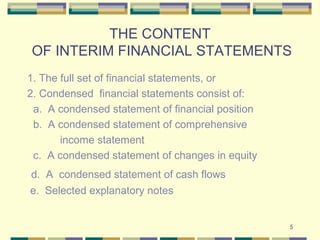
THE CONTENT
OF INTERIM FINANCIAL STATEMENTS
1. The full set of financial statements, or
2. Condensed financial statements consist of:
a. A condensed statement of financial position
b. A condensed statement of comprehensive
income statement
c. A condensed statement of changes in equity
d. A condensed statement of cash flows
e. Selected explanatory notes
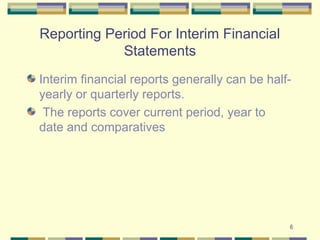
Reporting Period For Interim Financial
Statements
Interim financial reports generally can be half-
yearly or quarterly reports.
The reports cover current period, year to
date and comparatives
6
7
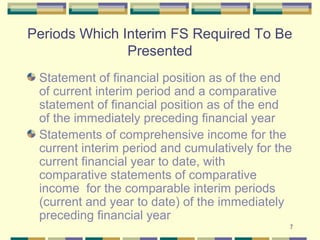
Periods Which Interim FS Required To Be
Presented
Statement of financial position as of the end
of current interim period and a comparative
statement of financial position as of the end
of the immediately preceding financial year
Statements of comprehensive income for the
current interim period and cumulatively for the
current financial year to date, with
comparative statements of comparative
income for the comparable interim periods
(current and year to date) of the immediately
preceding financial year
8
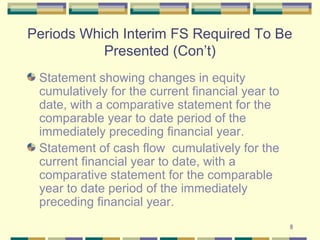
Periods Which Interim FS Required To Be
Presented (Con’t)
Statement showing changes in equity
cumulatively for the current financial year to
date, with a comparative statement for the
comparable year to date period of the
immediately preceding financial year.
Statement of cash flow cumulatively for the
current financial year to date, with a
comparative statement for the comparable
year to date period of the immediately
preceding financial year.
9
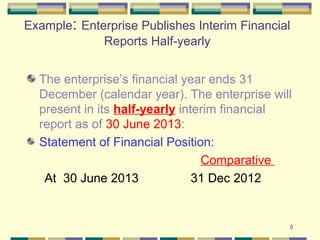
Example: Enterprise Publishes Interim Financial
Reports Half-yearly
The enterprise’s financial year ends 31
December (calendar year). The enterprise will
present in its half-yearly interim financial
report as of 30 June 2013:
Statement of Financial Position:
Comparative
At 30 June 2013 31 Dec 2012
10
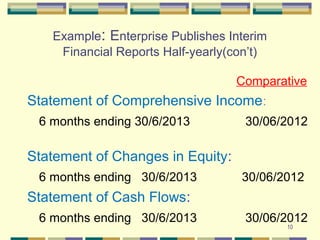
Example: Enterprise Publishes Interim
Financial Reports Half-yearly(con’t)
Comparative
Statement of Comprehensive Income:
6 months ending 30/6/2013 30/06/2012
Statement of Changes in Equity:
6 months ending 30/6/2013 30/06/2012
Statement of Cash Flows:
6 months ending 30/6/2013 30/06/2012
RECOGNITION & MEASUREMENT
In deciding to recognise, measure, classify or
disclose an item for an interim report, materiality is
assessed in relation to the interim period financial
data.
There might be more estimates in an interim report
as compared to annual fianancial statements.
If the estimate of an item reported in an interim
report has changed significantly during the final
interim period but no separate financial report is
published for the final interim period, the nature and
amount of the change should be disclosed in the
annual financial statements.
11
12
RECOGNITION & MEASUREMENT
(CON’T)
The principles for recognising assets, liabilities,
income and expenses are the same as in the annual
financial statements.
The frequency of interim reporting (annually, half-
yearly or quarterly) should not effect the
measurement of annual result, thus measurement
should be made on year-to-date basis
13
1. Depreciation- is based on the asset in use during the period
2. Impairment loss – is done at the end of Interim Period (IP). If
the impairment loss estimates changes in the subsequent
period, the original estimate is changed. No retrospective
adjustment is required.
3. R&D – The determination of capitalising development cost
has to be done at the end of each IP.
4. Inventories – at the end of each IP, there is a need to
determine value of inventories (often use estimates).
5. Tax Expense – The tax expense is the best estimate of the
weighted average annual income tax rate expected for the full
financial year. If tax rate changes, the income tax for
subsequent period is adjusted. Malaysia – the tax rate is flat
rate – no adjustment.
14
Illustration
Inventories – As at 30 Sept 2013, ACB Bhd
estimated that the net realizable value of its
inventories were RM100,000. The cost of these
inventories were RM110,000. It is estimated that by
the end of Dec 2013, its net realizable value will go
up to RM115,000.
For 3rd
quarter Interim reports:
In this case, even if the company estimated the NRV
of the inventories to rise above its cost at year end,
the company is required to WRITE DOWN the value
of the inventory to its NRV & recognize loss in its 3rd
Quarter interim Financial statements.
Accounting Policies
The accounting policies applied in the interim
financial statements have to be the same as
that applied in the annual financial
statements.
If there are changes in the accounting
policies after the date of the most recent
annual statements, the new policies should
be applied in the interim financial statements.
15
Revenue Received Seasonally, Cyclically
Or Occasionally
Revenues that are received seasonally, cyclically or
occasionally within a financial year should not be
anticipated or deferred as of an interim date if
anticipation or deferral would not be suitable at the
end of entity’s financial year.
Examples dividend revenue, royalties and
government grant-should be recognized when they
occur.
16
Costs Incurred Unevenly During The
Financial Year
Costs that are incurred unevenly during an
entity’s financial year shall be anticipated or
deferred for interim reporting purpose if, and
only if, it is also suitable to anticipate or defer
that type of cost at the end of financial year
17
DISCLOSURE REQUIREMENT
An entity shall include in its interim financial report an
explanation of events and transactions that are significant to an
understanding of the changes in financial position and
performance of the entity since the end of the last annual
reporting period.
Information disclosed in relation to those events and
transactions shall update the relevant information presented in
the most recent annual financial report.
18
DISCLOSURE REQUIREMENT (CON’T)
The following is a list of events and transactions for which
disclosures would be required if they are significant: the list is not
exhaustive.
(a) the write-down of inventories to net realisable value and the
reversal of such a write-down;
(b) recognition of a loss from the impairment of financial assets,
property, plant and equipment, intangible assets, or other
assets, and the reversal of such an impairment loss;
(c) the reversal of any provisions for the costs of restructuring;
(d) acquisitions and disposals of items of property, plant and
equipment;
19
DISCLOSURE REQUIREMENT (CON’T)
(e) commitments for the purchase of property, plant and
equipment;
(f) litigation settlements;
(g) corrections of prior period errors;
(h) changes in the business or economic circumstances that affect
the fair value of the entity’s financial assets and financial
liabilities, whether those assets or liabilities are recognised at
fair value or amortised cost;
(i) any loan default or breach of a loan agreement that has not
been
remedied on or before the end of the reporting period;
(j) related party transactions;
20
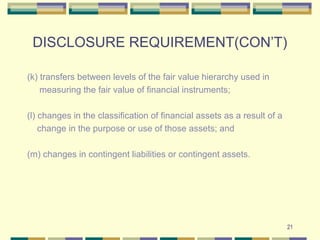
DISCLOSURE REQUIREMENT(CON’T)
(k) transfers between levels of the fair value hierarchy used in
measuring the fair value of financial instruments;
(l) changes in the classification of financial assets as a result of a
change in the purpose or use of those assets; and
(m) changes in contingent liabilities or contingent assets.
21
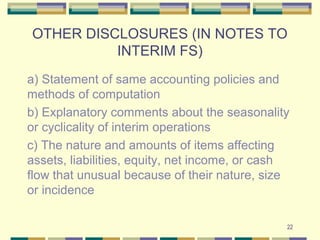
OTHER DISCLOSURES (IN NOTES TO
INTERIM FS)
a) Statement of same accounting policies and
methods of computation
b) Explanatory comments about the seasonality
or cyclicality of interim operations
c) The nature and amounts of items affecting
assets, liabilities, equity, net income, or cash
flow that unusual because of their nature, size
or incidence
22
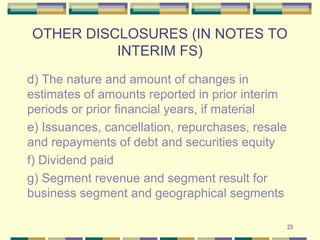
OTHER DISCLOSURES (IN NOTES TO
INTERIM FS)
d) The nature and amount of changes in
estimates of amounts reported in prior interim
periods or prior financial years, if material
e) Issuances, cancellation, repurchases, resale
and repayments of debt and securities equity
f) Dividend paid
g) Segment revenue and segment result for
business segment and geographical segments
23
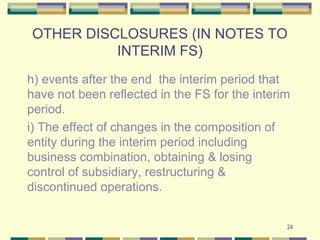
OTHER DISCLOSURES (IN NOTES TO
INTERIM FS)
h) events after the end the interim period that
have not been reflected in the FS for the interim
period.
i) The effect of changes in the composition of
entity during the interim period including
business combination, obtaining & losing
control of subsidiary, restructuring &
discontinued operations.
24

Topic 3 interim_financial_reporting

  • 1.
    1 TOPIC 3 INTERIM FINANCIALREPORTING (MFRS 134)
  • 2.
    2 LEARNING OUTCOMES At theend of the topic, students should be able to: 1. Explain the content of interim reporting 2. Explain the recognition & measurement 3. Explain the disclosure requirement
  • 3.
    3 DEFINITION A financial reportcontaining either a complete set of financial statements or a set of condensed financial statements for an interim period. Interim period is a financial reporting period shorter than a full financial year (e.g. half-yearly or quarterly) The reports cover current period, year to date and comparatives.
  • 4.
    THE IMPORTANCE OFINTERIM REPORTING Investors consider that the interim financial reporting is of more value than annual financial information which enables them to analyze the actual performances and also to revise their projections. Interim financial reports provide price-sensitive data to investors. Timely and reliable interim financial reporting improves the ability of investors, creditors, tax authorities and others to understand an enterprise's capacity to generate earnings and cash flows and its financial condition and liquidity. 4
  • 5.
    5 THE CONTENT OF INTERIMFINANCIAL STATEMENTS 1. The full set of financial statements, or 2. Condensed financial statements consist of: a. A condensed statement of financial position b. A condensed statement of comprehensive income statement c. A condensed statement of changes in equity d. A condensed statement of cash flows e. Selected explanatory notes
  • 6.
    Reporting Period ForInterim Financial Statements Interim financial reports generally can be half- yearly or quarterly reports. The reports cover current period, year to date and comparatives 6
  • 7.
    7 Periods Which InterimFS Required To Be Presented Statement of financial position as of the end of current interim period and a comparative statement of financial position as of the end of the immediately preceding financial year Statements of comprehensive income for the current interim period and cumulatively for the current financial year to date, with comparative statements of comparative income for the comparable interim periods (current and year to date) of the immediately preceding financial year
  • 8.
    8 Periods Which InterimFS Required To Be Presented (Con’t) Statement showing changes in equity cumulatively for the current financial year to date, with a comparative statement for the comparable year to date period of the immediately preceding financial year. Statement of cash flow cumulatively for the current financial year to date, with a comparative statement for the comparable year to date period of the immediately preceding financial year.
  • 9.
    9 Example: Enterprise PublishesInterim Financial Reports Half-yearly The enterprise’s financial year ends 31 December (calendar year). The enterprise will present in its half-yearly interim financial report as of 30 June 2013: Statement of Financial Position: Comparative At 30 June 2013 31 Dec 2012
  • 10.
    10 Example: Enterprise PublishesInterim Financial Reports Half-yearly(con’t) Comparative Statement of Comprehensive Income: 6 months ending 30/6/2013 30/06/2012 Statement of Changes in Equity: 6 months ending 30/6/2013 30/06/2012 Statement of Cash Flows: 6 months ending 30/6/2013 30/06/2012
  • 11.
    RECOGNITION & MEASUREMENT Indeciding to recognise, measure, classify or disclose an item for an interim report, materiality is assessed in relation to the interim period financial data. There might be more estimates in an interim report as compared to annual fianancial statements. If the estimate of an item reported in an interim report has changed significantly during the final interim period but no separate financial report is published for the final interim period, the nature and amount of the change should be disclosed in the annual financial statements. 11
  • 12.
    12 RECOGNITION & MEASUREMENT (CON’T) Theprinciples for recognising assets, liabilities, income and expenses are the same as in the annual financial statements. The frequency of interim reporting (annually, half- yearly or quarterly) should not effect the measurement of annual result, thus measurement should be made on year-to-date basis
  • 13.
    13 1. Depreciation- isbased on the asset in use during the period 2. Impairment loss – is done at the end of Interim Period (IP). If the impairment loss estimates changes in the subsequent period, the original estimate is changed. No retrospective adjustment is required. 3. R&D – The determination of capitalising development cost has to be done at the end of each IP. 4. Inventories – at the end of each IP, there is a need to determine value of inventories (often use estimates). 5. Tax Expense – The tax expense is the best estimate of the weighted average annual income tax rate expected for the full financial year. If tax rate changes, the income tax for subsequent period is adjusted. Malaysia – the tax rate is flat rate – no adjustment.
  • 14.
    14 Illustration Inventories – Asat 30 Sept 2013, ACB Bhd estimated that the net realizable value of its inventories were RM100,000. The cost of these inventories were RM110,000. It is estimated that by the end of Dec 2013, its net realizable value will go up to RM115,000. For 3rd quarter Interim reports: In this case, even if the company estimated the NRV of the inventories to rise above its cost at year end, the company is required to WRITE DOWN the value of the inventory to its NRV & recognize loss in its 3rd Quarter interim Financial statements.
  • 15.
    Accounting Policies The accountingpolicies applied in the interim financial statements have to be the same as that applied in the annual financial statements. If there are changes in the accounting policies after the date of the most recent annual statements, the new policies should be applied in the interim financial statements. 15
  • 16.
    Revenue Received Seasonally,Cyclically Or Occasionally Revenues that are received seasonally, cyclically or occasionally within a financial year should not be anticipated or deferred as of an interim date if anticipation or deferral would not be suitable at the end of entity’s financial year. Examples dividend revenue, royalties and government grant-should be recognized when they occur. 16
  • 17.
    Costs Incurred UnevenlyDuring The Financial Year Costs that are incurred unevenly during an entity’s financial year shall be anticipated or deferred for interim reporting purpose if, and only if, it is also suitable to anticipate or defer that type of cost at the end of financial year 17
  • 18.
    DISCLOSURE REQUIREMENT An entityshall include in its interim financial report an explanation of events and transactions that are significant to an understanding of the changes in financial position and performance of the entity since the end of the last annual reporting period. Information disclosed in relation to those events and transactions shall update the relevant information presented in the most recent annual financial report. 18
  • 19.
    DISCLOSURE REQUIREMENT (CON’T) Thefollowing is a list of events and transactions for which disclosures would be required if they are significant: the list is not exhaustive. (a) the write-down of inventories to net realisable value and the reversal of such a write-down; (b) recognition of a loss from the impairment of financial assets, property, plant and equipment, intangible assets, or other assets, and the reversal of such an impairment loss; (c) the reversal of any provisions for the costs of restructuring; (d) acquisitions and disposals of items of property, plant and equipment; 19
  • 20.
    DISCLOSURE REQUIREMENT (CON’T) (e)commitments for the purchase of property, plant and equipment; (f) litigation settlements; (g) corrections of prior period errors; (h) changes in the business or economic circumstances that affect the fair value of the entity’s financial assets and financial liabilities, whether those assets or liabilities are recognised at fair value or amortised cost; (i) any loan default or breach of a loan agreement that has not been remedied on or before the end of the reporting period; (j) related party transactions; 20
  • 21.
    DISCLOSURE REQUIREMENT(CON’T) (k) transfersbetween levels of the fair value hierarchy used in measuring the fair value of financial instruments; (l) changes in the classification of financial assets as a result of a change in the purpose or use of those assets; and (m) changes in contingent liabilities or contingent assets. 21
  • 22.
    OTHER DISCLOSURES (INNOTES TO INTERIM FS) a) Statement of same accounting policies and methods of computation b) Explanatory comments about the seasonality or cyclicality of interim operations c) The nature and amounts of items affecting assets, liabilities, equity, net income, or cash flow that unusual because of their nature, size or incidence 22
  • 23.
    OTHER DISCLOSURES (INNOTES TO INTERIM FS) d) The nature and amount of changes in estimates of amounts reported in prior interim periods or prior financial years, if material e) Issuances, cancellation, repurchases, resale and repayments of debt and securities equity f) Dividend paid g) Segment revenue and segment result for business segment and geographical segments 23
  • 24.
    OTHER DISCLOSURES (INNOTES TO INTERIM FS) h) events after the end the interim period that have not been reflected in the FS for the interim period. i) The effect of changes in the composition of entity during the interim period including business combination, obtaining & losing control of subsidiary, restructuring & discontinued operations. 24