INTANGIBLE ASSETS IAS 38 N R GOVINDARAJAN CHARTERED ACCOUNTANT FCA,AICWA,DISA,CISA
OVERVIEW Introduction Applicability Basic criterion Recognition and Measurement Government Grants Exchange of Assets When to expense off?
Overview Subsequent recognition Amortisation Determination of useful life Residual value Review of amortisation Derecognition Disclosures
Overview Internally generated IA Research phase Development phase Cost of internally generated IA
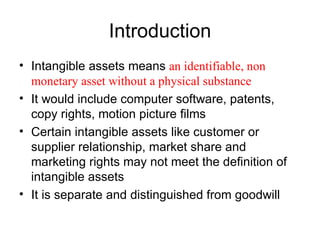
Introduction Intangible assets means  an identifiable, non monetary asset without a physical substance It would include computer software, patents, copy rights, motion picture films Certain intangible assets like customer or supplier relationship, market share and marketing rights may not meet the definition of intangible assets It is separate and distinguished from goodwill
Applicability Applicable to all intangible assets other than: Those covered by other standards Financial assets – IAS 32 The recognition and measurement of exploration and evaluation assets – IFRS 6 Expenditure on the development and extraction of minerals, oil and natural gas
Basic criterion Identifiability Control over the resource Existence of future economic benefits
Identifiability An asset can be said to be “identifiable” if it is either separable or arises from contractual or legal rights It is said to be separable, if it is capable of being separated or divided from the entity and sold transferred, licensed, rented or exchanged, either individually or together with a related contract, asset or liability
Control Basis of control is nothing but the power of an entity to obtain future economic benefits flowing from the underlying resource It also means restriction of access of others to those benefits Power is obtained through enforceable legal right Eg: Economic benefits derived from market and technical knowledge – protected by legal rights like copy rights
Economic benefits Future economic benefits may be: Revenue from sale of products Cost savings Other benefits from the use of the assets Eg: use of intellectual property in a production process resulting in cost savings rather than increase in future revenues
Recognition and Measurement For the purposes of recognition and measurement an entity should: Meet the definition criteria Meet the recognition criteria Three additional conditions are to be met for the recognition of Intangible assets
Recognition An intangible asset shall be recognised if, and only if: (a) it is probable that the expected future economic benefits that are attributable to the asset will flow to the entity; and (b) the cost of the asset can be measured reliably. An entity shall assess the probability of expected future economic benefits using reasonable and supportable assumptions that represent management’s best estimate of the set of economic conditions that will exist over the useful life of the asset.   ( c)   An intangible asset shall be measured initially at cost.
Cost of intangible asset When acquired: It consists of purchase price including import duties and non refundable purchase taxes but excluding rebates and discounts It would also include any directly attributable cost of preparing an asset for its intended use. Eg: Professional fees and testing costs
Acquisition through Grants Airport landing rights Quotas Import licences Treated as deferred income or deducted from the cost of the asset It can also be accounted at net value which may be the nominal amount paid plus directly attributed expenses
Exchange of assets If an IA is acquired in exchange of a non monetary asset it is measured at FV It should be noted that: The transaction should have commercial substance FV of asset given up or acquired is reliably measureable Commercial substance is evaluated on the basis of expected change in future cash flows Case study
Acquisition of IA in Business combinations They are recognised if: Separable from other tangible or intangible assets Arise from contractual or legal rights Recognised initially at FV FV should be reliably measurable When it is not possible to separate the asset from another tangible or intangible asset then it is recognised as a single asset separately from goodwill eg: Publishing rights and subscriber data base
Fair value measurement Observable market price of the same asset Observable market price of the similar assets Accounting valuation approach – eg discounted cash flow
Recognition of expeses on IA If the expenditure fails the definiton and/ or recognition criteria then it is treated as expenditure and not as IA In case it is acquired in a business combination and cannot be recognised as IA then it is recognised as a part of GW Eg: research exp, development exp until certain conditions are fullfilled, cost of training, advertisement and promotional activities Write back off expenditure and treating as IA is prohibited
Subsequent recognition It can be done either under: Cost model  Revaluation model Cost model: Carried at cost less accumulated amortisation and accumulated impairment losses Impairment charge writing back is allowed
Subsequent recognition Revaluation model: Carried at revalued amount (fv) less subsequent accumulated amortisation and subsequent accumulated impairment losses No revaluation of IA is allowed if it was recognised as an asset earlier Initial recognition is always at cost
Amortisation All intangibles have to catagorised into assets having indefinite or finite useful lives If it has finite useful life it is to be amortised over its useful life Intangible assets having indefinite useful lives shall not be amortised but tested for impairment every year Review of the lives of the assets should also be done in each period as circumstances could change and its effect may be on the useful lives
Amortisation The carrying amount of an IA  is reduced by the impairment charge and the balance is then amortised over the useful life of the asset The impairment charge is to be routed through P&L account Amortisation of IA having a finite useful life does not cease if the asset is no longer used unless it is fully depreciated or it is NCAHS – IFRS 5 Method of amortisation is determined by the pattern in which the asset’s future economic benefit is expected to be consumed  If it is not reliably possible, then SLM is followed Amortisation charge for each period is routed through P&L
Determination of useful life Useful determination is mandated and that decides whether the IA is to be amortised or not IAS 38 distinguishes ‘ indefinite from infinite’ Indefinite does not mean infinite useful life to the IA Determination of useful life is based on various factors as listed out in Para 90 It takes into account economic, legal and contractual factors – Para 96
Residual value In general, the residual value of an IA with a finite useful life is assumed as NIL There are two exceptions It can be positive if there is a commitment from a third party to acquire the asset at the end of its useful life There exists an active market for such asset The residual value is reviewed at the end of each period Change in the residual value is treated as change in the accoungting estimate as per IAS 8
Review of amortisation Method  and period of amortisation of IA with finite useful life is done at the end of each financial year In case of IA with infinite useful lives, review is done to determine whether circumstances and events support that it is so or otherwise If it becomes finite, it has to be amortised over its useful life
Derecognition Derecognition takes place if: The asset is disposed There are no future economic benefits expected from its use or disposal Depending upon the method of disposal – sale, donation, finance lease or sale and lease back the respective IFRS would apply
Derecognition Profit or loss arising from the disposal of IA should be determined as the difference between the carrying amounts and the net disposal proceeds It is carried through P&L account The consideration of disposal is recognised at FV
Internally generated IA To assess whether an internally generated IA meets the criteria for recognition it can be classified into two phases Reseach phase  Development phase If an entity cannot distinguish between the two phases, then, it is deemed to be incurred in the research phase
Research phase No IA is recognised from an expenditure incurred in the research phase In this phase an entity cannot demonstrate that an intangible asset exists that will generate probable future economic benefits Research expenditure is recognised in P&L as and when incurred
Research phase Examples of research activities: (a) activities aimed at obtaining new knowledge; (b) the search for, evaluation and final selection of, applications of research findings or other knowledge; (c) the search for alternatives for materials, devices, products, processes, systems or services; and (d) the formulation, design, evaluation and final selection of possible alternatives for new or improved materials, devices, products, processes, systems or services
Development phase An intangible asset arising from development (or from the development phase of an internal project) shall be recognised if, and only if, an entity can demonstrate all of the following: (a) the technical feasibility of completing the intangible asset so that it will be available for use or sale. (b) its intention to complete the intangible asset and use or sell it. (c) its ability to use or sell the intangible asset. (d) how the intangible asset will generate probable future economic benefits.   (e) the availability of adequate technical, financial and other resources to complete the development and to use or sell the intangible asset. (f) its ability to measure reliably the expenditure attributable to the intangible asset during its development   Para 57 gives further conditions for recognition of development phase activities as Intangible Asset
Development phase Examples of development activities: (a) the design, construction and testing of pre-production or pre-use prototypes and models; (b) the design of tools, jigs, moulds and dies involving new technology; (c) the design, construction and operation of a pilot plant that is not of a scale economically feasible for commercial  production; and (d) the design, construction and testing of a chosen alternative for new or improved materials, devices, products, processes, systems or services
Disclosures Paras 118 to 128 would apply Accounting policy disclosures P&L disclosures Disclosures in notes Balance sheet disclosures
IA not in the acquirer’s books also to be recognised Recognised based on carrying amount Business combinations No need if there are no indications of impairment To be done for IA with infinite life IA > 10 years and not available for use Impairment test Allowed if active market exists silent Revaluation model STOP AMORTISATION NO SUCH ITEMS NCAHS No presumption  10 years with rebuttable presumption Period of amortisation Only impairment test No such items – amortisation required IA with indefinite life  Allowed for IA with active markets Not allowed Revaluation  IFRS IGAAP Particulars
case studies
Thank you [email_address]

Intangible assets ias 38

  • 1.
    INTANGIBLE ASSETS IAS38 N R GOVINDARAJAN CHARTERED ACCOUNTANT FCA,AICWA,DISA,CISA
  • 2.
    OVERVIEW Introduction ApplicabilityBasic criterion Recognition and Measurement Government Grants Exchange of Assets When to expense off?
  • 3.
    Overview Subsequent recognitionAmortisation Determination of useful life Residual value Review of amortisation Derecognition Disclosures
  • 4.
    Overview Internally generatedIA Research phase Development phase Cost of internally generated IA
  • 5.
    Introduction Intangible assetsmeans an identifiable, non monetary asset without a physical substance It would include computer software, patents, copy rights, motion picture films Certain intangible assets like customer or supplier relationship, market share and marketing rights may not meet the definition of intangible assets It is separate and distinguished from goodwill
  • 6.
    Applicability Applicable toall intangible assets other than: Those covered by other standards Financial assets – IAS 32 The recognition and measurement of exploration and evaluation assets – IFRS 6 Expenditure on the development and extraction of minerals, oil and natural gas
  • 7.
    Basic criterion IdentifiabilityControl over the resource Existence of future economic benefits
  • 8.
    Identifiability An assetcan be said to be “identifiable” if it is either separable or arises from contractual or legal rights It is said to be separable, if it is capable of being separated or divided from the entity and sold transferred, licensed, rented or exchanged, either individually or together with a related contract, asset or liability
  • 9.
    Control Basis ofcontrol is nothing but the power of an entity to obtain future economic benefits flowing from the underlying resource It also means restriction of access of others to those benefits Power is obtained through enforceable legal right Eg: Economic benefits derived from market and technical knowledge – protected by legal rights like copy rights
  • 10.
    Economic benefits Futureeconomic benefits may be: Revenue from sale of products Cost savings Other benefits from the use of the assets Eg: use of intellectual property in a production process resulting in cost savings rather than increase in future revenues
  • 11.
    Recognition and MeasurementFor the purposes of recognition and measurement an entity should: Meet the definition criteria Meet the recognition criteria Three additional conditions are to be met for the recognition of Intangible assets
  • 12.
    Recognition An intangibleasset shall be recognised if, and only if: (a) it is probable that the expected future economic benefits that are attributable to the asset will flow to the entity; and (b) the cost of the asset can be measured reliably. An entity shall assess the probability of expected future economic benefits using reasonable and supportable assumptions that represent management’s best estimate of the set of economic conditions that will exist over the useful life of the asset. ( c) An intangible asset shall be measured initially at cost.
  • 13.
    Cost of intangibleasset When acquired: It consists of purchase price including import duties and non refundable purchase taxes but excluding rebates and discounts It would also include any directly attributable cost of preparing an asset for its intended use. Eg: Professional fees and testing costs
  • 14.
    Acquisition through GrantsAirport landing rights Quotas Import licences Treated as deferred income or deducted from the cost of the asset It can also be accounted at net value which may be the nominal amount paid plus directly attributed expenses
  • 15.
    Exchange of assetsIf an IA is acquired in exchange of a non monetary asset it is measured at FV It should be noted that: The transaction should have commercial substance FV of asset given up or acquired is reliably measureable Commercial substance is evaluated on the basis of expected change in future cash flows Case study
  • 16.
    Acquisition of IAin Business combinations They are recognised if: Separable from other tangible or intangible assets Arise from contractual or legal rights Recognised initially at FV FV should be reliably measurable When it is not possible to separate the asset from another tangible or intangible asset then it is recognised as a single asset separately from goodwill eg: Publishing rights and subscriber data base
  • 17.
    Fair value measurementObservable market price of the same asset Observable market price of the similar assets Accounting valuation approach – eg discounted cash flow
  • 18.
    Recognition of expeseson IA If the expenditure fails the definiton and/ or recognition criteria then it is treated as expenditure and not as IA In case it is acquired in a business combination and cannot be recognised as IA then it is recognised as a part of GW Eg: research exp, development exp until certain conditions are fullfilled, cost of training, advertisement and promotional activities Write back off expenditure and treating as IA is prohibited
  • 19.
    Subsequent recognition Itcan be done either under: Cost model Revaluation model Cost model: Carried at cost less accumulated amortisation and accumulated impairment losses Impairment charge writing back is allowed
  • 20.
    Subsequent recognition Revaluationmodel: Carried at revalued amount (fv) less subsequent accumulated amortisation and subsequent accumulated impairment losses No revaluation of IA is allowed if it was recognised as an asset earlier Initial recognition is always at cost
  • 21.
    Amortisation All intangibleshave to catagorised into assets having indefinite or finite useful lives If it has finite useful life it is to be amortised over its useful life Intangible assets having indefinite useful lives shall not be amortised but tested for impairment every year Review of the lives of the assets should also be done in each period as circumstances could change and its effect may be on the useful lives
  • 22.
    Amortisation The carryingamount of an IA is reduced by the impairment charge and the balance is then amortised over the useful life of the asset The impairment charge is to be routed through P&L account Amortisation of IA having a finite useful life does not cease if the asset is no longer used unless it is fully depreciated or it is NCAHS – IFRS 5 Method of amortisation is determined by the pattern in which the asset’s future economic benefit is expected to be consumed If it is not reliably possible, then SLM is followed Amortisation charge for each period is routed through P&L
  • 23.
    Determination of usefullife Useful determination is mandated and that decides whether the IA is to be amortised or not IAS 38 distinguishes ‘ indefinite from infinite’ Indefinite does not mean infinite useful life to the IA Determination of useful life is based on various factors as listed out in Para 90 It takes into account economic, legal and contractual factors – Para 96
  • 24.
    Residual value Ingeneral, the residual value of an IA with a finite useful life is assumed as NIL There are two exceptions It can be positive if there is a commitment from a third party to acquire the asset at the end of its useful life There exists an active market for such asset The residual value is reviewed at the end of each period Change in the residual value is treated as change in the accoungting estimate as per IAS 8
  • 25.
    Review of amortisationMethod and period of amortisation of IA with finite useful life is done at the end of each financial year In case of IA with infinite useful lives, review is done to determine whether circumstances and events support that it is so or otherwise If it becomes finite, it has to be amortised over its useful life
  • 26.
    Derecognition Derecognition takesplace if: The asset is disposed There are no future economic benefits expected from its use or disposal Depending upon the method of disposal – sale, donation, finance lease or sale and lease back the respective IFRS would apply
  • 27.
    Derecognition Profit orloss arising from the disposal of IA should be determined as the difference between the carrying amounts and the net disposal proceeds It is carried through P&L account The consideration of disposal is recognised at FV
  • 28.
    Internally generated IATo assess whether an internally generated IA meets the criteria for recognition it can be classified into two phases Reseach phase Development phase If an entity cannot distinguish between the two phases, then, it is deemed to be incurred in the research phase
  • 29.
    Research phase NoIA is recognised from an expenditure incurred in the research phase In this phase an entity cannot demonstrate that an intangible asset exists that will generate probable future economic benefits Research expenditure is recognised in P&L as and when incurred
  • 30.
    Research phase Examplesof research activities: (a) activities aimed at obtaining new knowledge; (b) the search for, evaluation and final selection of, applications of research findings or other knowledge; (c) the search for alternatives for materials, devices, products, processes, systems or services; and (d) the formulation, design, evaluation and final selection of possible alternatives for new or improved materials, devices, products, processes, systems or services
  • 31.
    Development phase Anintangible asset arising from development (or from the development phase of an internal project) shall be recognised if, and only if, an entity can demonstrate all of the following: (a) the technical feasibility of completing the intangible asset so that it will be available for use or sale. (b) its intention to complete the intangible asset and use or sell it. (c) its ability to use or sell the intangible asset. (d) how the intangible asset will generate probable future economic benefits. (e) the availability of adequate technical, financial and other resources to complete the development and to use or sell the intangible asset. (f) its ability to measure reliably the expenditure attributable to the intangible asset during its development Para 57 gives further conditions for recognition of development phase activities as Intangible Asset
  • 32.
    Development phase Examplesof development activities: (a) the design, construction and testing of pre-production or pre-use prototypes and models; (b) the design of tools, jigs, moulds and dies involving new technology; (c) the design, construction and operation of a pilot plant that is not of a scale economically feasible for commercial production; and (d) the design, construction and testing of a chosen alternative for new or improved materials, devices, products, processes, systems or services
  • 33.
    Disclosures Paras 118to 128 would apply Accounting policy disclosures P&L disclosures Disclosures in notes Balance sheet disclosures
  • 34.
    IA not inthe acquirer’s books also to be recognised Recognised based on carrying amount Business combinations No need if there are no indications of impairment To be done for IA with infinite life IA > 10 years and not available for use Impairment test Allowed if active market exists silent Revaluation model STOP AMORTISATION NO SUCH ITEMS NCAHS No presumption 10 years with rebuttable presumption Period of amortisation Only impairment test No such items – amortisation required IA with indefinite life Allowed for IA with active markets Not allowed Revaluation IFRS IGAAP Particulars
  • 35.
  • 36.