Accounting for financial instruments
IFRS 9
2
»Classifying financial instruments
»Recognising and derecognising financial assets
»Impairment of financial assets
Note: other aspects of accounting for financial instruments have
been covered in other sessions at this workshop.
Overview
Definitions
4
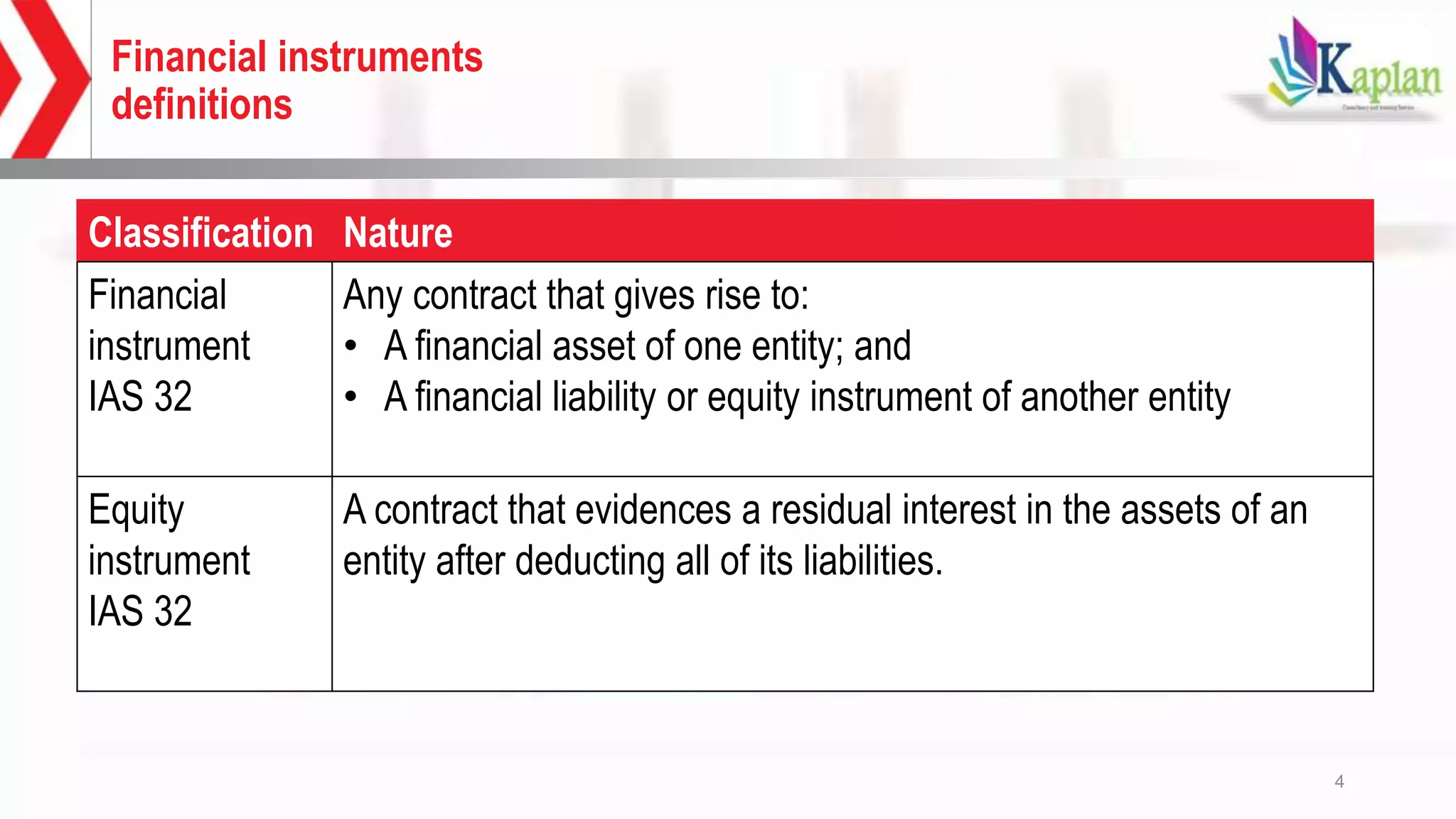
Financial instruments
definitions
Classification Nature
Financial
instrument
IAS 32
Any contract that gives rise to:
• A financial asset of one entity; and
• A financial liability or equity instrument of another entity
Equity
instrument
IAS 32
A contract that evidences a residual interest in the assets of an
entity after deducting all of its liabilities.
4
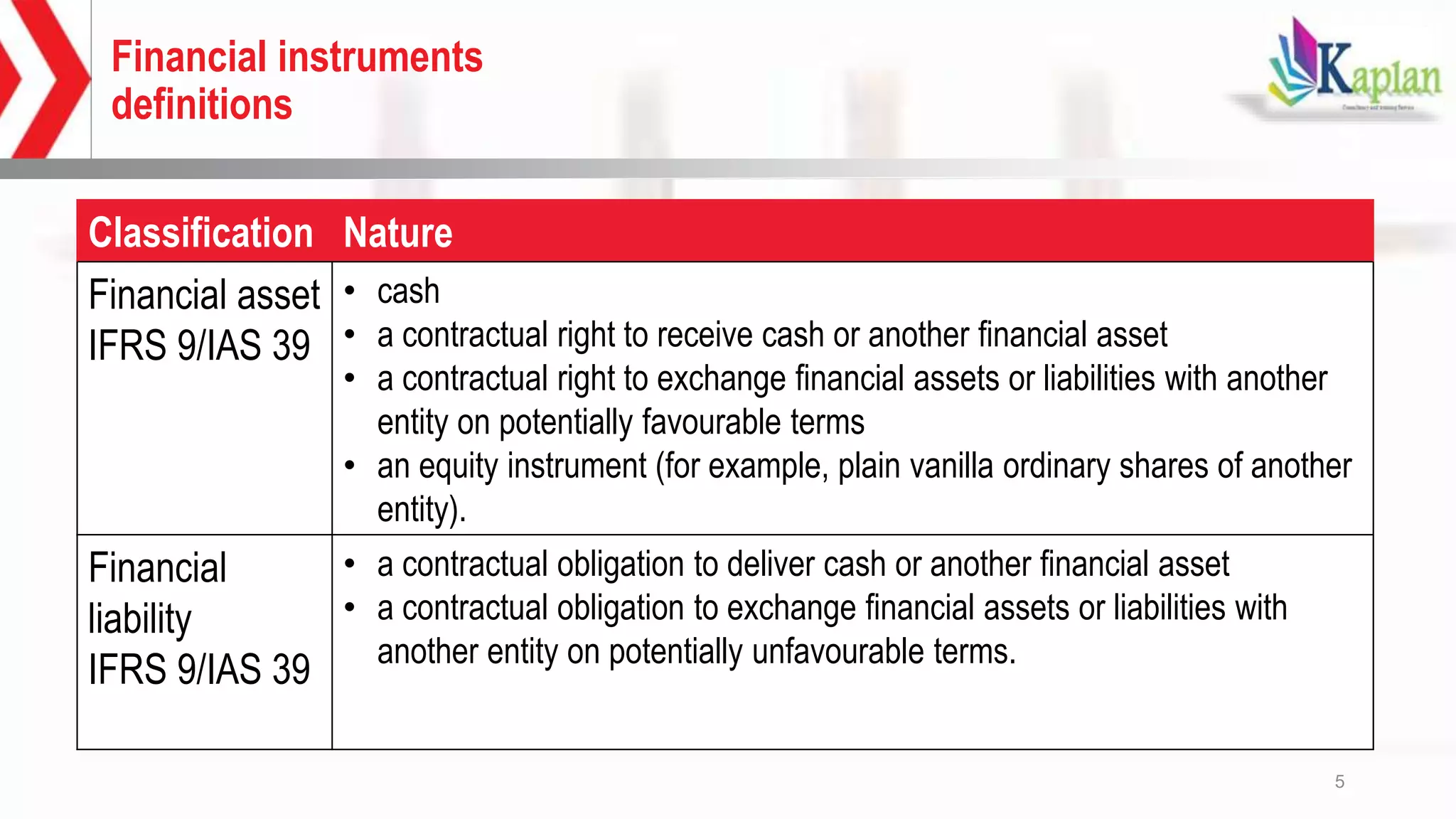
5
Financial instruments
definitions
Classification Nature
Financial asset
IFRS 9/IAS 39
• cash
• a contractual right to receive cash or another financial asset
• a contractual right to exchange financial assets or liabilities with another
entity on potentially favourable terms
• an equity instrument (for example, plain vanilla ordinary shares of another
entity).
Financial
liability
IFRS 9/IAS 39
• a contractual obligation to deliver cash or another financial asset
• a contractual obligation to exchange financial assets or liabilities with
another entity on potentially unfavourable terms.
5
6
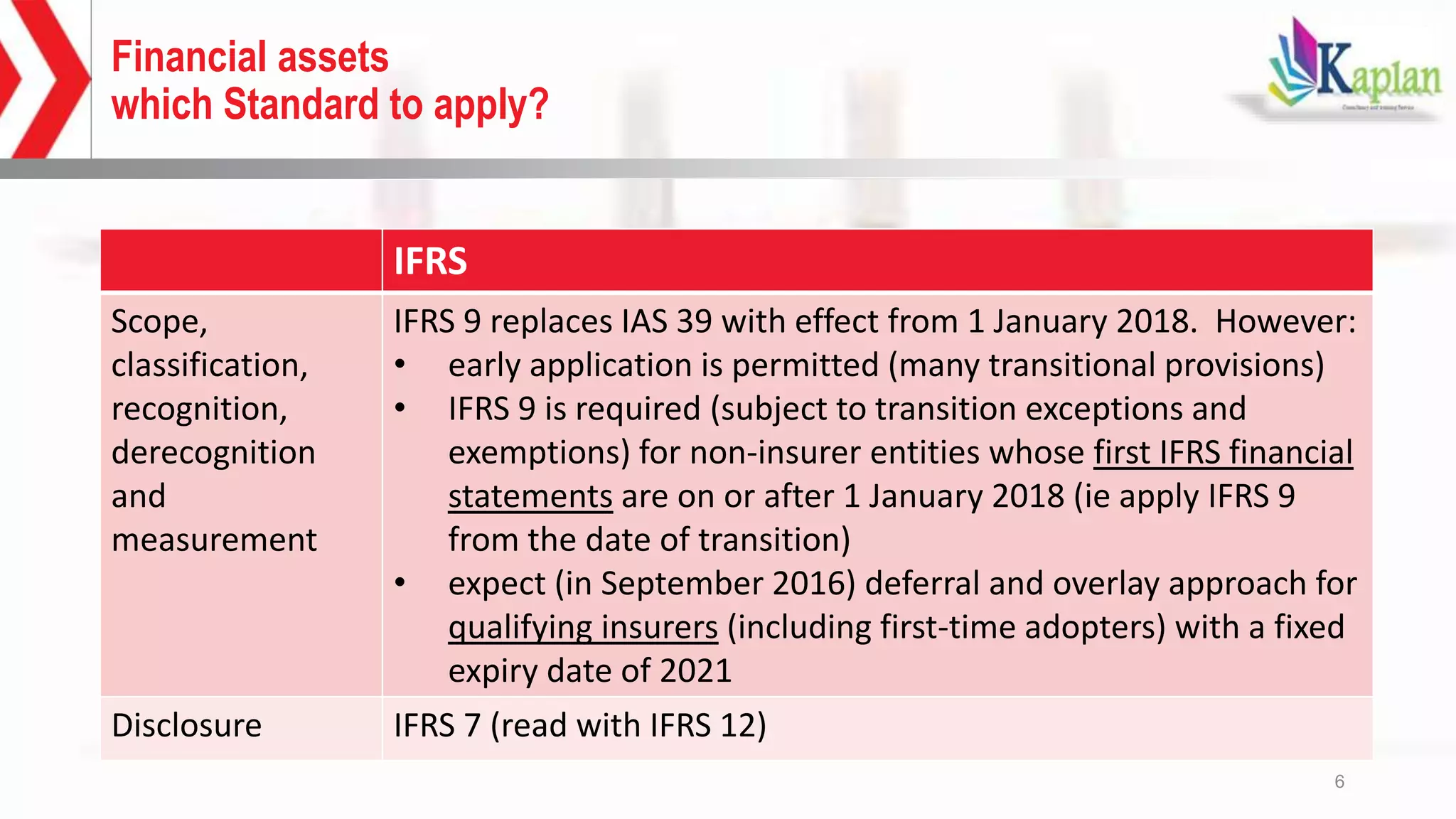
Financial assets
which Standard to apply?
IFRS
Scope,
classification,
recognition,
derecognition
and
measurement
IFRS 9 replaces IAS 39 with effect from 1 January 2018. However:
• early application is permitted (many transitional provisions)
• IFRS 9 is required (subject to transition exceptions and
exemptions) for non-insurer entities whose first IFRS financial
statements are on or after 1 January 2018 (ie apply IFRS 9
from the date of transition)
• expect (in September 2016) deferral and overlay approach for
qualifying insurers (including first-time adopters) with a fixed
expiry date of 2021
Disclosure IFRS 7 (read with IFRS 12)
7
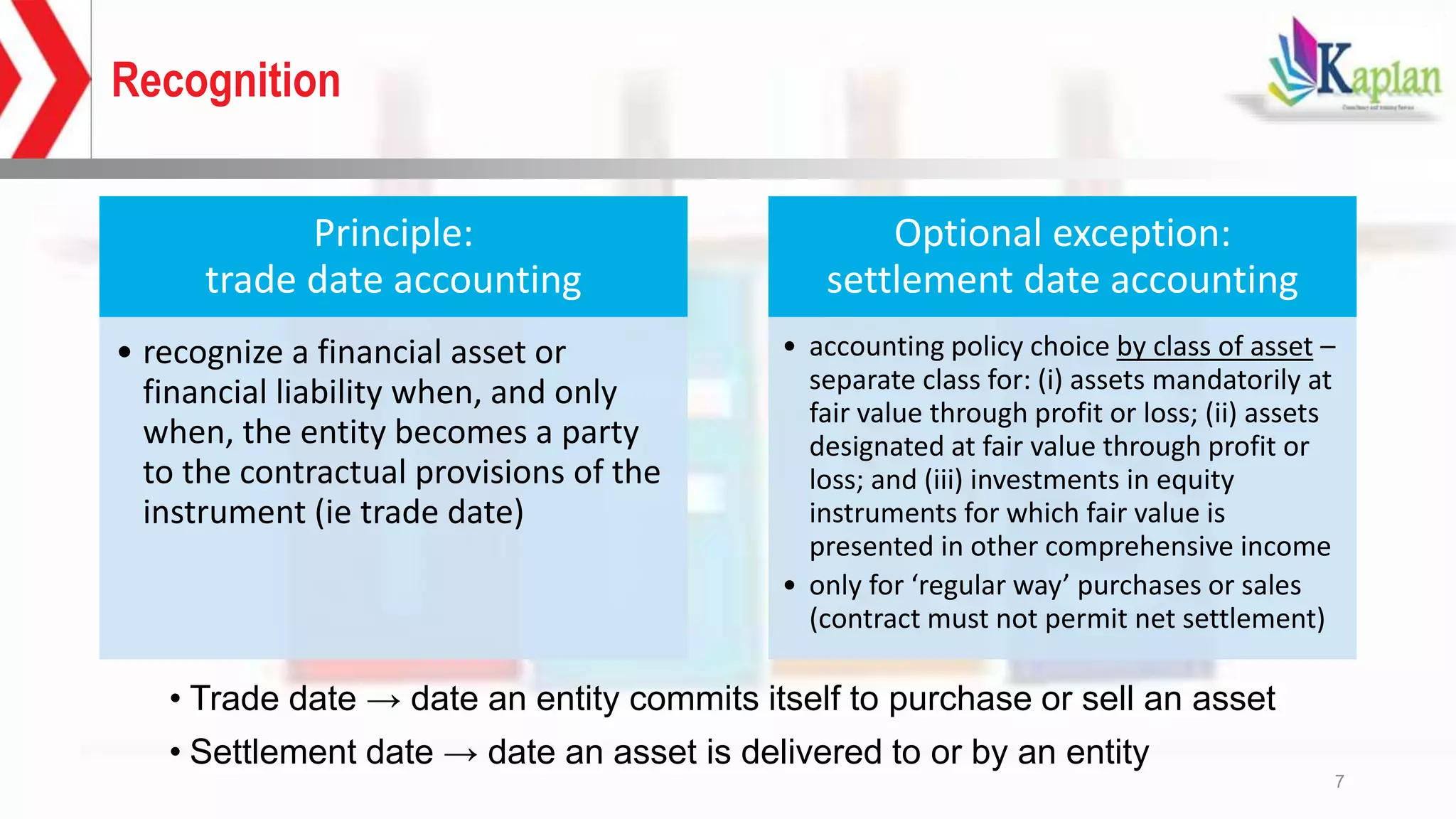
Recognition
Principle:
trade date accounting
• recognize a financial asset or
financial liability when, and only
when, the entity becomes a party
to the contractual provisions of the
instrument (ie trade date)
Optional exception:
settlement date accounting
• accounting policy choice by class of asset –
separate class for: (i) assets mandatorily at
fair value through profit or loss; (ii) assets
designated at fair value through profit or
loss; and (iii) investments in equity
instruments for which fair value is
presented in other comprehensive income
• only for ‘regular way’ purchases or sales
(contract must not permit net settlement)
• Trade date → date an entity commits itself to purchase or sell an asset
• Settlement date → date an asset is delivered to or by an entity
Derecognition financial assets (IFRS 9)
9
Derecognition
Issue
Complicated when
Definition
• When should an entity
remove a financial asset
from its financial position?
• An entity has ongoing
involvement with a
transferred financial asset
• Removal of a previously
recognised financial asset
from the statement of
financial position
10
Derecognition
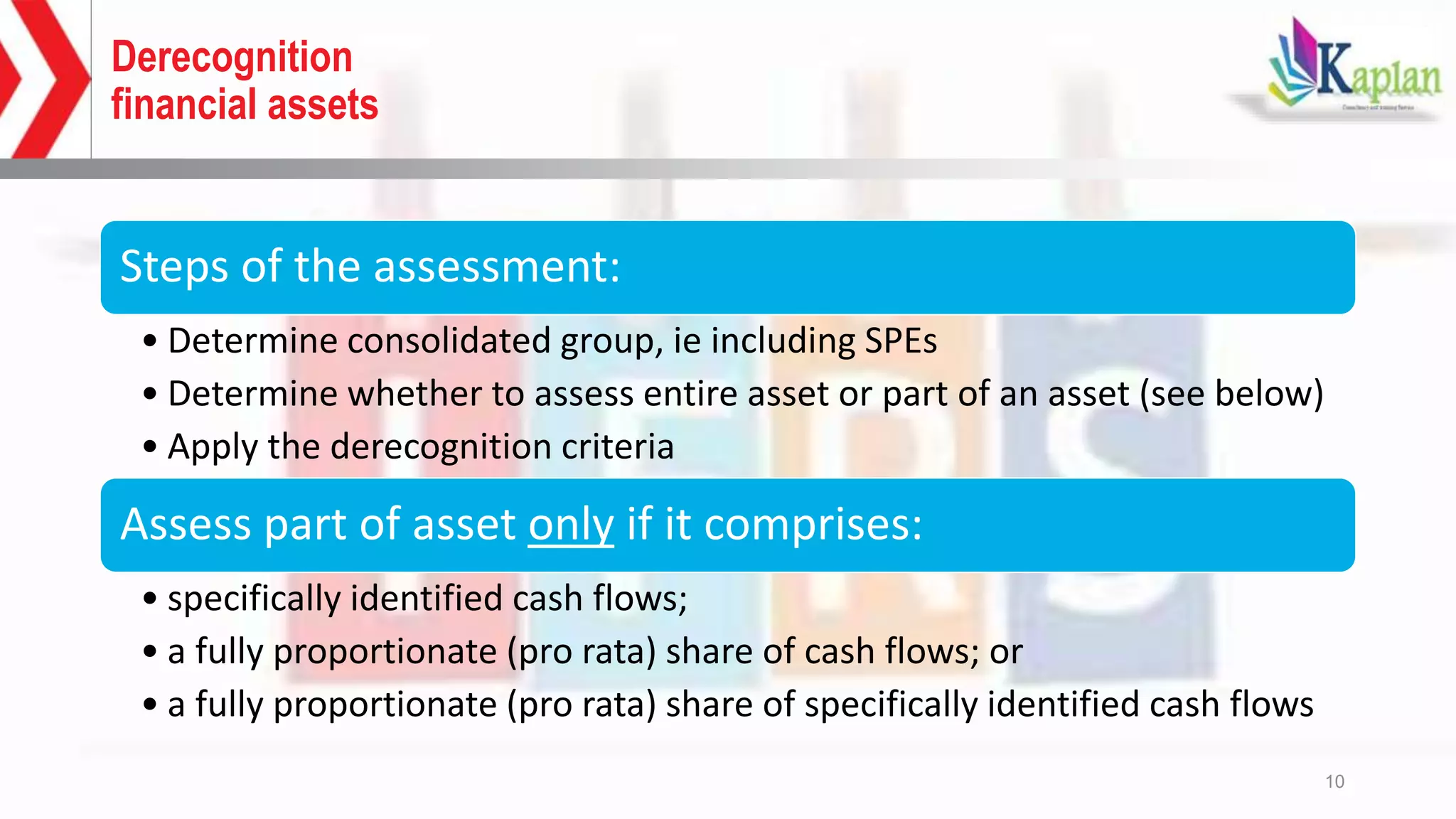
financial assets
Steps of the assessment:
• Determine consolidated group, ie including SPEs
• Determine whether to assess entire asset or part of an asset (see below)
• Apply the derecognition criteria
Assess part of asset only if it comprises:
• specifically identified cash flows;
• a fully proportionate (pro rata) share of cash flows; or
• a fully proportionate (pro rata) share of specifically identified cash flows
11
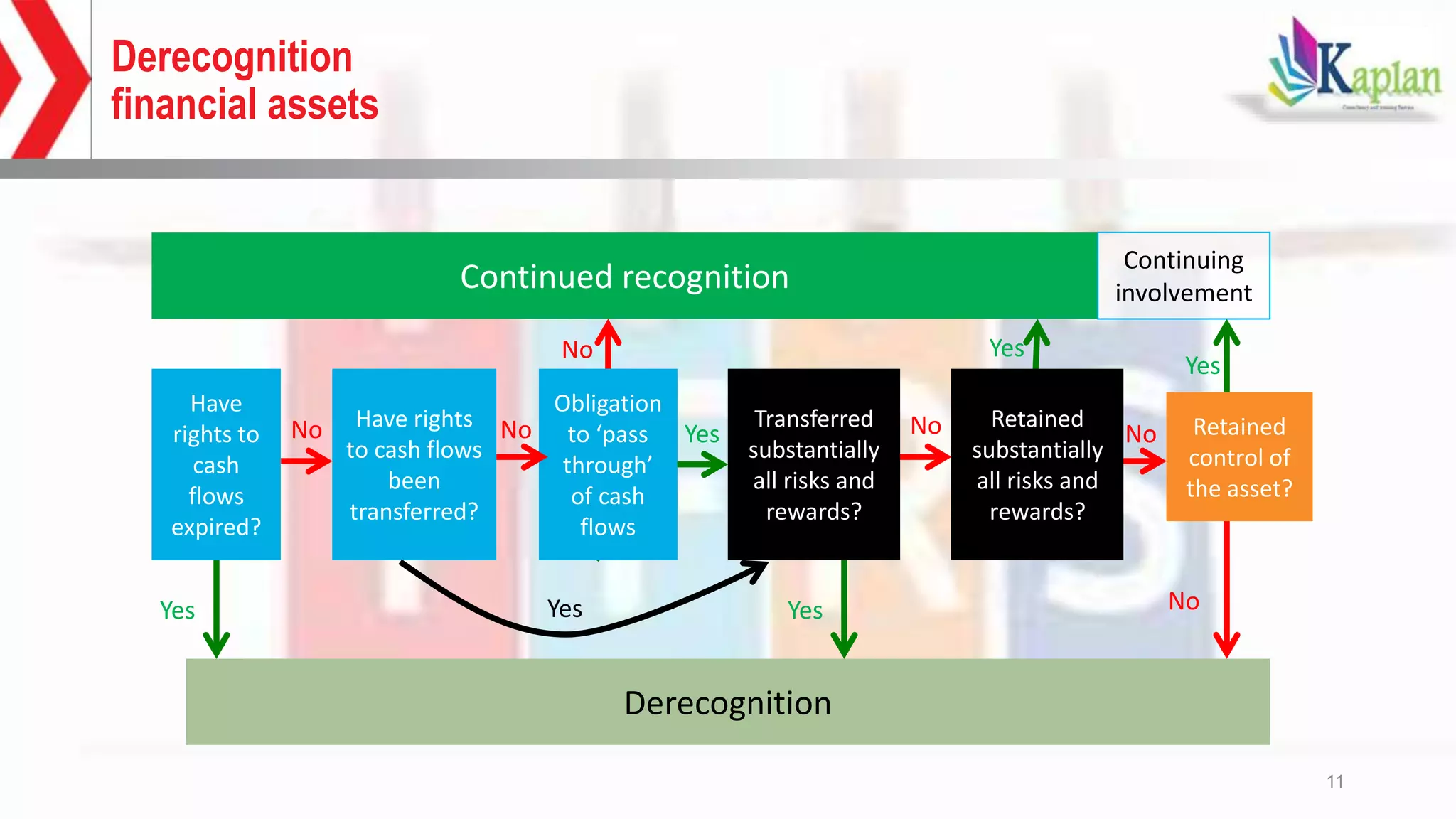
Derecognition
financial assets 11
Derecognition
Continued recognition
Continuing
involvement
Have
rights to
cash
flows
expired?
Transferred
substantially
all risks and
rewards?
Retained
substantially
all risks and
rewards?
Retained
control of
the asset?
Have rights
to cash flows
been
transferred?
Yes
No
Obligation
to ‘pass
through’
of cash
flows
No
YesYes
Yes
No
No No
Yes
No
Yes
13
Financial assets
write-off
No reasonable expectations
of recovering a financial
asset in its entirety or a
portion thereof
Reduce the
gross
carrying
amount
Write-off → a
derecognition event
15
Transfers of financial assets that do not qualify for derecognition
Substantially all risks and rewards of ownership of
transferred asset retained
• continue to recognise transferred asset in its entirety
• consideration received →recognise financial liability
• recognise any income on the transferred asset and any
expense incurred on the financial liability
17
Continuing involvement in only a part of transferred financial assets
Allocate previous
carrying amount
between the part that
continues to be
recognised and the part
derecognised on the
basis of the relative fair
values
Recognise gain or loss
equal to difference
between carrying
amount (measured at
date of derecognition)
allocated to the part
derecognised and
consideration received
19
Judgements and estimates
derecognition of financial assets
»determining whether substantially all the risks and rewards of
ownership of a transferred asset have been transferred; and
»if neither party has substantially all the risks and rewards of
ownership, determining which party has control.
Classification of financial assets (IFRS
9)
21
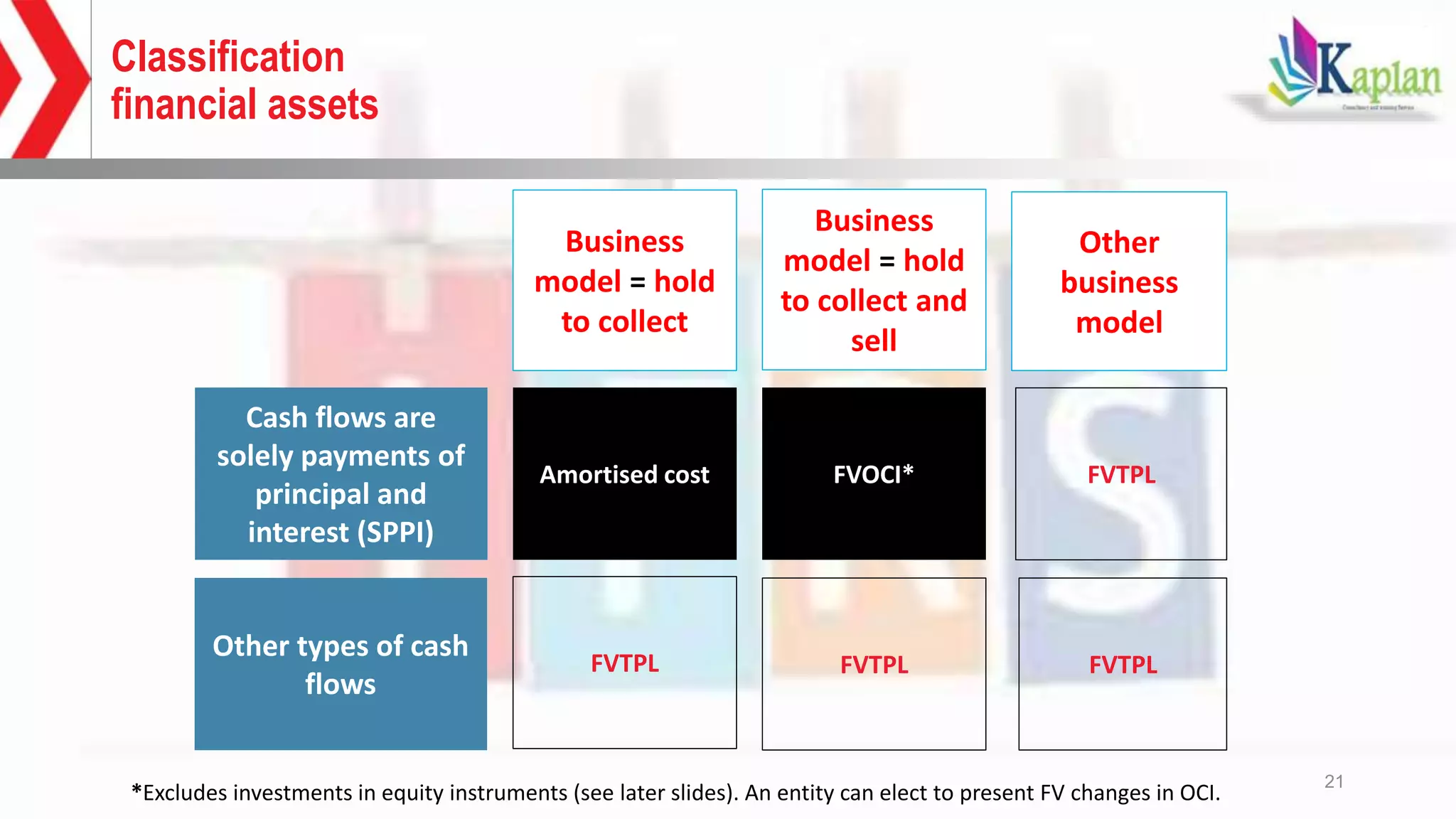
Classification
financial assets
Cash flows are
solely payments of
principal and
interest (SPPI)
Business
model = hold
to collect
Business
model = hold
to collect and
sell
Other
business
model
Other types of cash
flows
Amortised cost FVOCI*
FVTPL FVTPL
FVTPL
FVTPL
*Excludes investments in equity instruments (see later slides). An entity can elect to present FV changes in OCI.
22
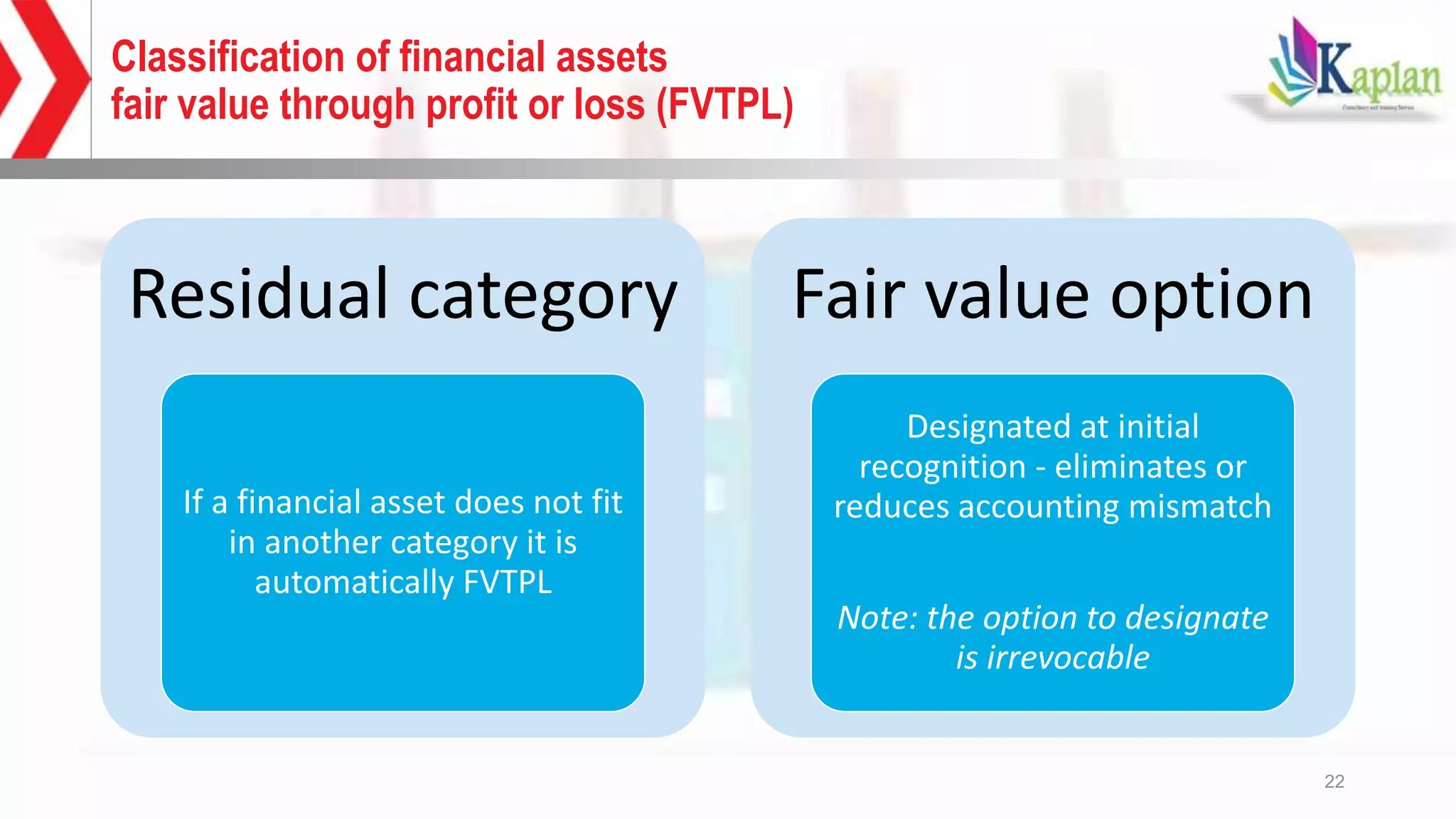
Classification of financial assets
fair value through profit or loss (FVTPL)
Residual category
If a financial asset does not fit
in another category it is
automatically FVTPL
Fair value option
Designated at initial
recognition - eliminates or
reduces accounting mismatch
Note: the option to designate
is irrevocable
24
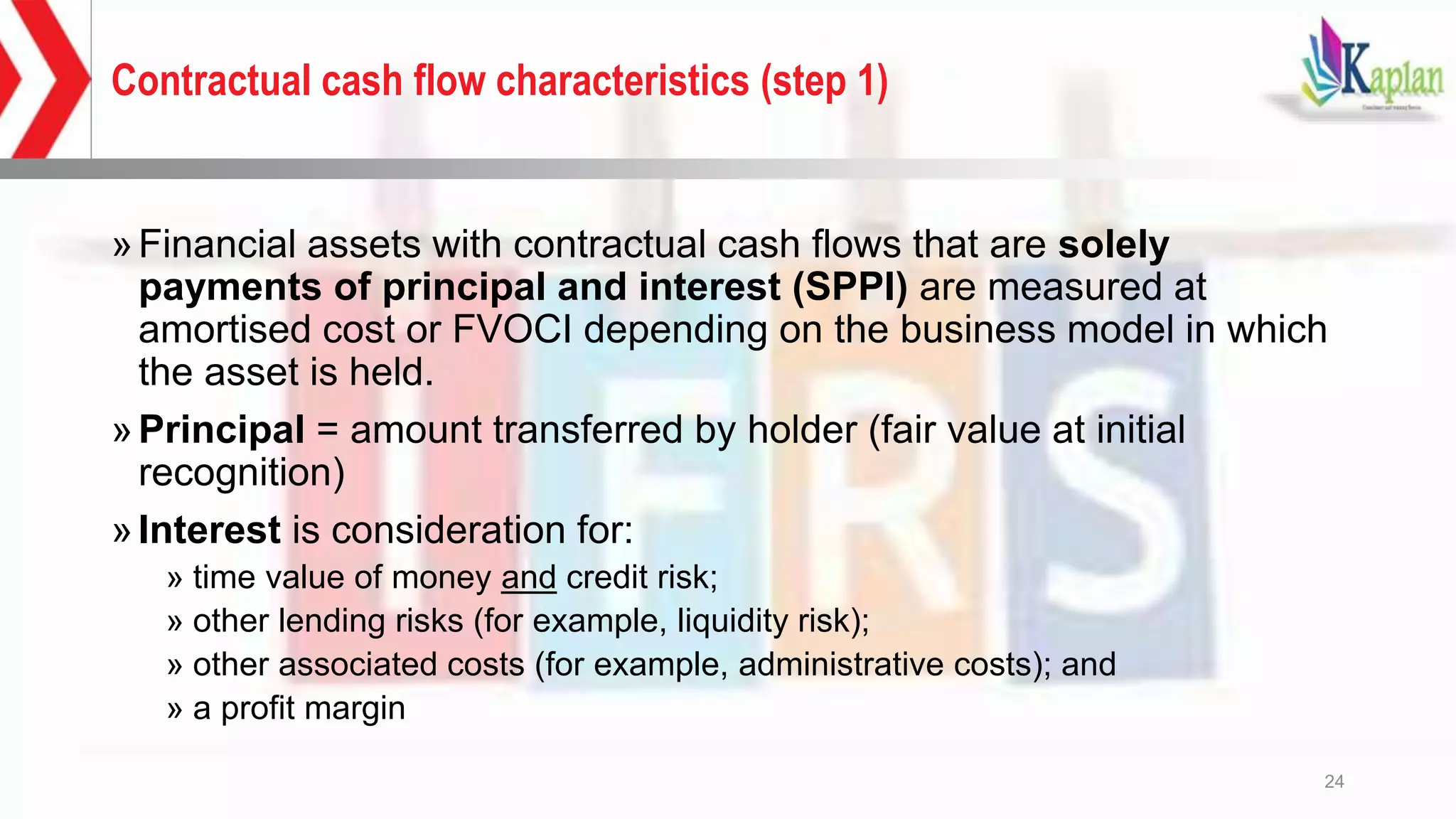
Contractual cash flow characteristics (step 1)
»Financial assets with contractual cash flows that are solely
payments of principal and interest (SPPI) are measured at
amortised cost or FVOCI depending on the business model in which
the asset is held.
»Principal = amount transferred by holder (fair value at initial
recognition)
»Interest is consideration for:
» time value of money and credit risk;
» other lending risks (for example, liquidity risk);
» other associated costs (for example, administrative costs); and
» a profit margin
25
Types of business model (step 2)
Holding assets in order
to collect contractual
cash flows
Realise cash flows by
collecting contractual
payments over the life of
the instrument
Typically involve lower
frequency and value of
sales
Measurement: amortised
cost
Both collecting
contractual cash flows
and selling financial
assets
Both collecting
contractual cash flows
and selling – sale
integral to achieving the
objective of the
business model
Typically involve greater
frequency and value of
sales
Measurement: FVOCI
Other business models
Neither held to collect nor
held to collect and for sale
Collection of contractual
cash flows is incidental to
the objective of the model
Measurement: FVTPL
30
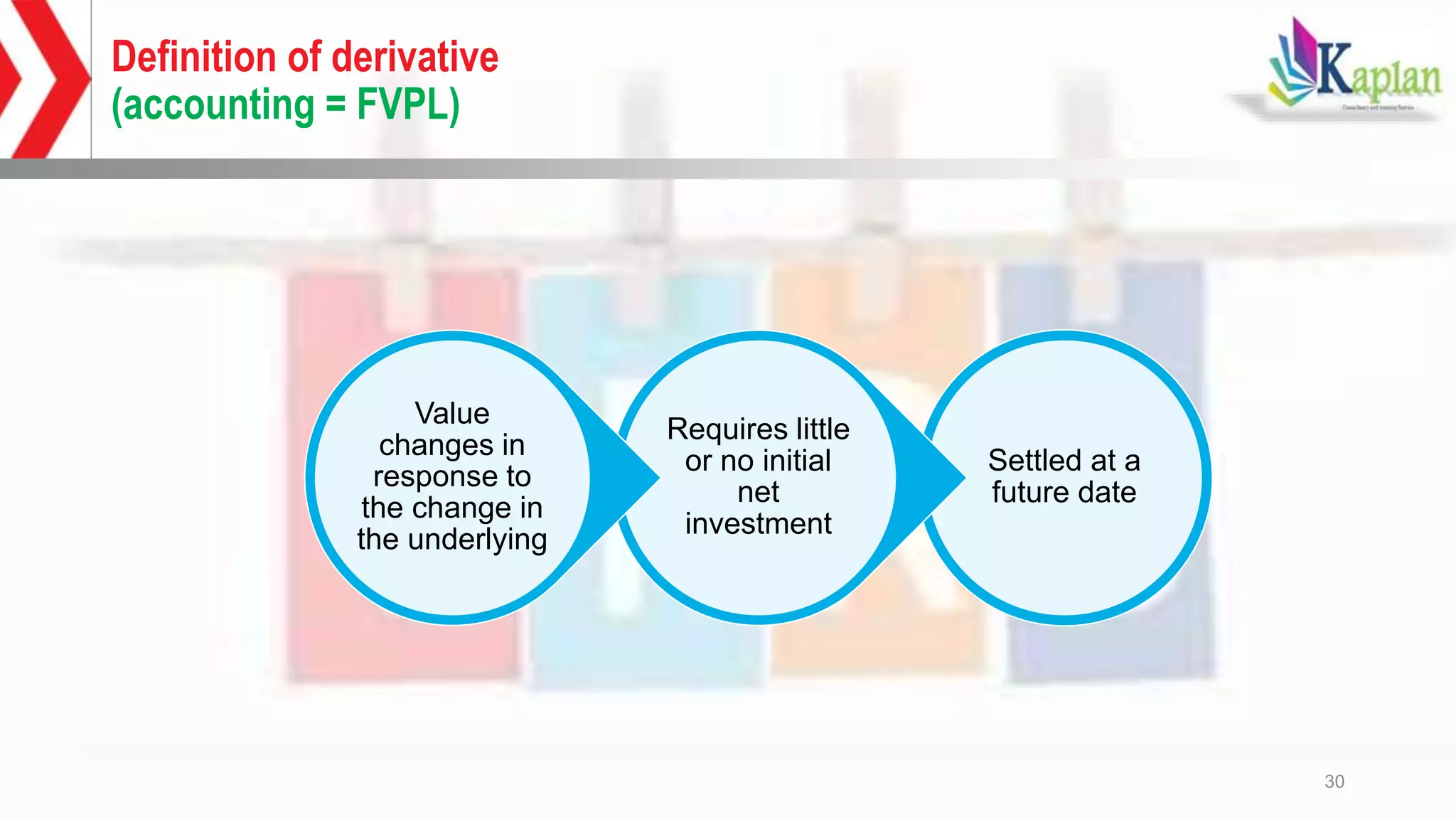
Definition of derivative
(accounting = FVPL)
Settled at a
future date
Requires little
or no initial
net
investment
Value
changes in
response to
the change in
the underlying
31
Examples of derivatives and underlyings
(accounting = FVPL)
Type of contract Main pricing-settlement variable
(underlying variable)
Interest rate swap Interest rates
Currency swap (foreign exchange swap) Currency rates
Commodity swap Commodity prices
Equity swap Equity prices (equity of another entity)
Purchased or written treasury bond option (call or put) Interest rates
Interest rate futures linked to government debt Interest rates
Currency futures Currency rates
Currency forward Currency rates
Commodity forward Commodity prices
Equity forward Equity prices (equity of another entity)
32
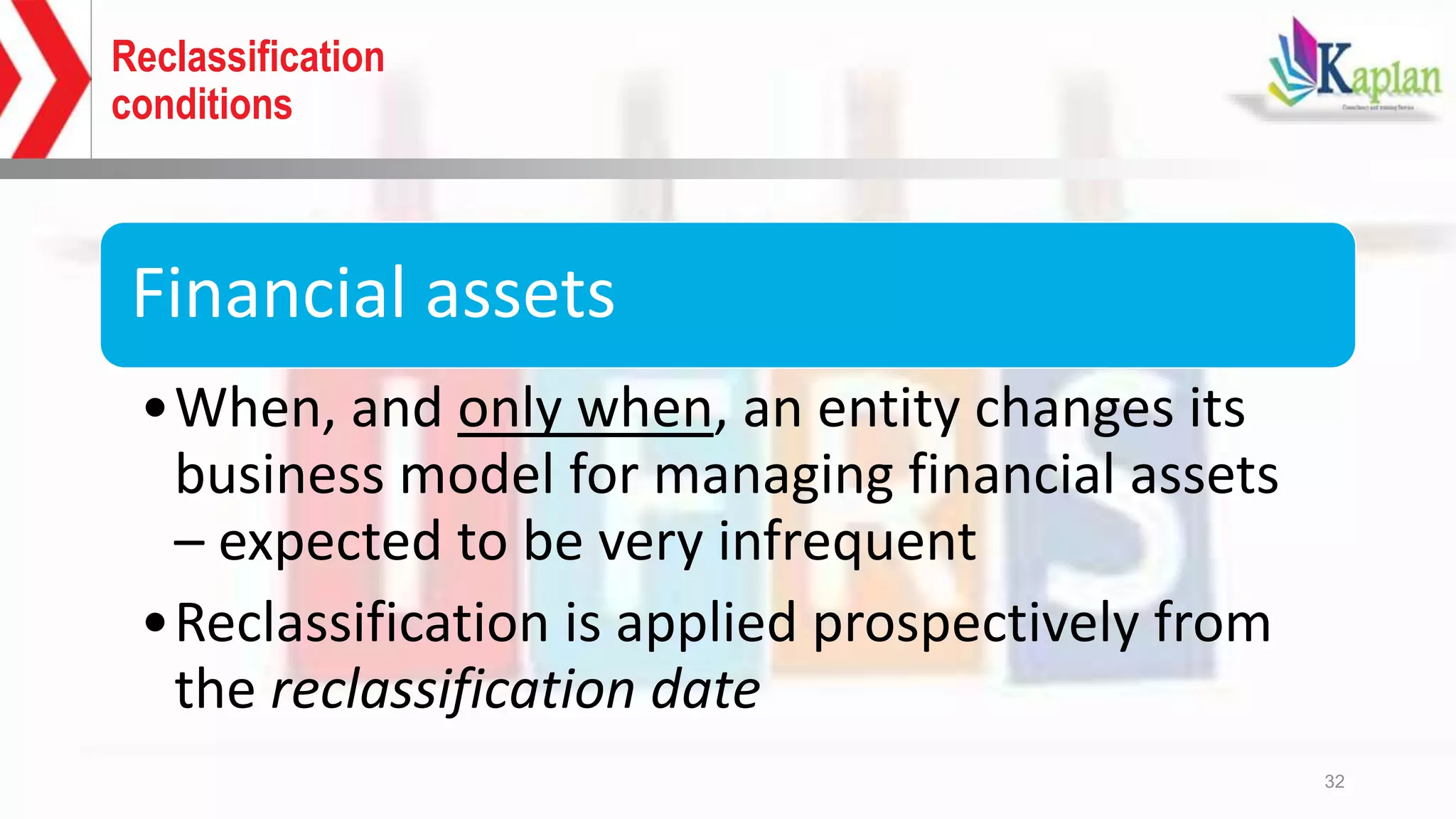
Reclassification
conditions
Financial assets
•When, and only when, an entity changes its
business model for managing financial assets
– expected to be very infrequent
•Reclassification is applied prospectively from
the reclassification date
Measurement of financial assets:
an introduction
35
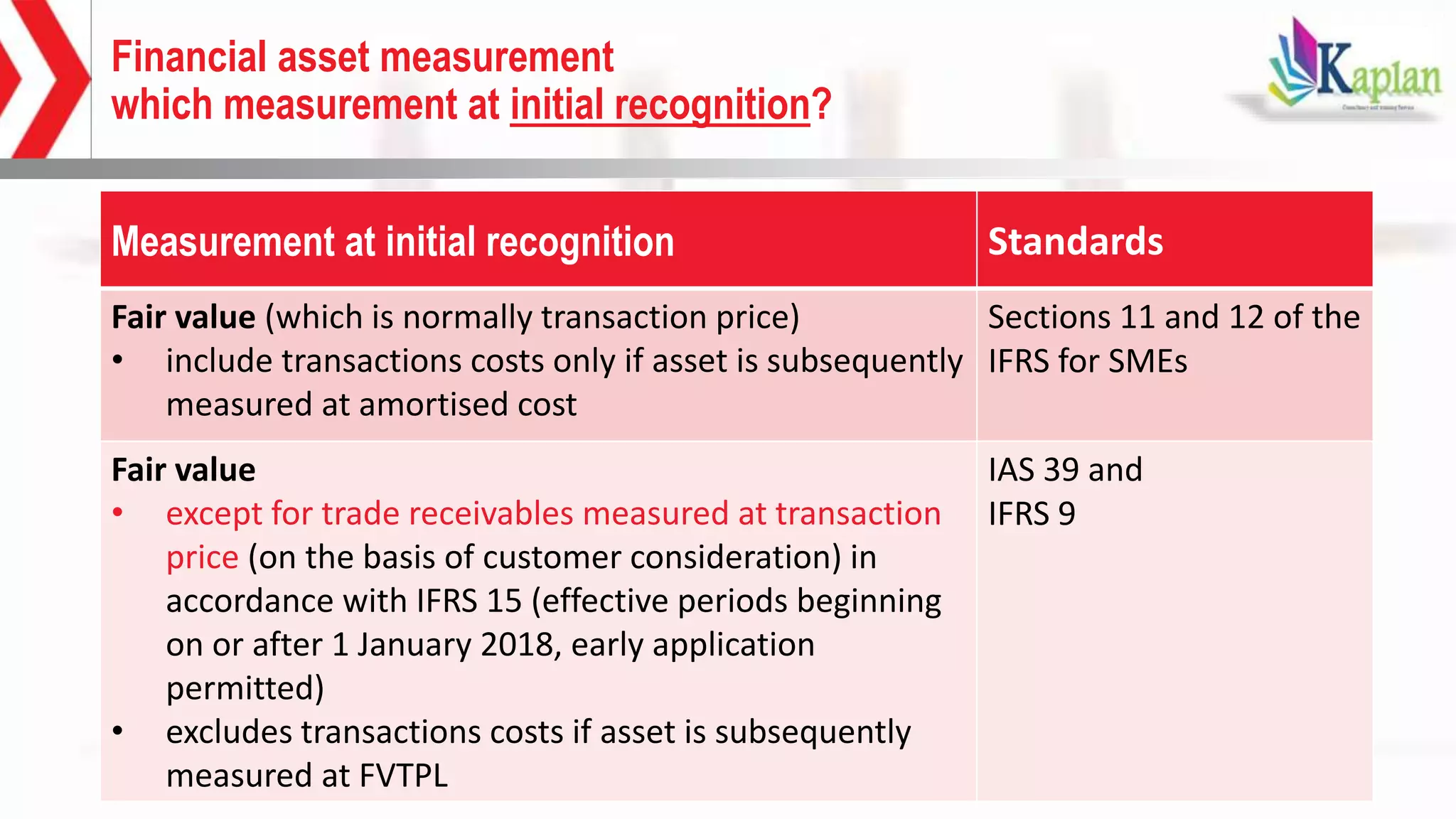
Financial asset measurement
which measurement at initial recognition?
Measurement at initial recognition Standards
Fair value (which is normally transaction price)
• include transactions costs only if asset is subsequently
measured at amortised cost
Sections 11 and 12 of the
IFRS for SMEs
Fair value
• except for trade receivables measured at transaction
price (on the basis of customer consideration) in
accordance with IFRS 15 (effective periods beginning
on or after 1 January 2018, early application
permitted)
• excludes transactions costs if asset is subsequently
measured at FVTPL
IAS 39 and
IFRS 9
37
Measurement at initial recognition 37
Initial
carrying
amount
Measured at
FVTPL
Initial
carrying
amount
Measured at
other than
FVTPL
Fair value
Adjusted for
transaction costs
AssetAsset or Liability Liability
Initial
carrying
amount
=
Measured at
other than
FVTPL
39
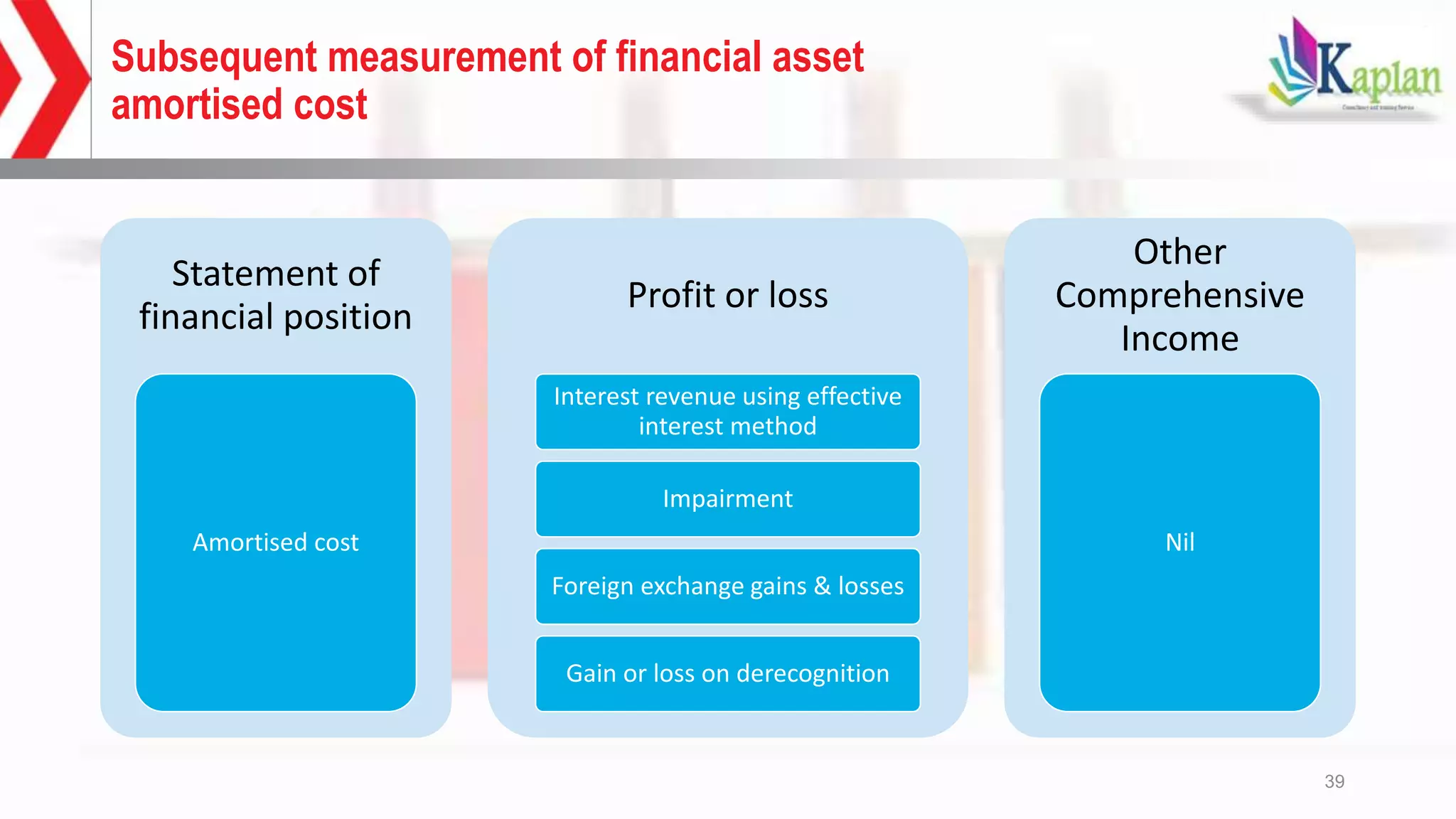
Subsequent measurement of financial asset
amortised cost
Statement of
financial position
Amortised cost
Profit or loss
Interest revenue using effective
interest method
Impairment
Foreign exchange gains & losses
Gain or loss on derecognition
Other
Comprehensive
Income
Nil
40
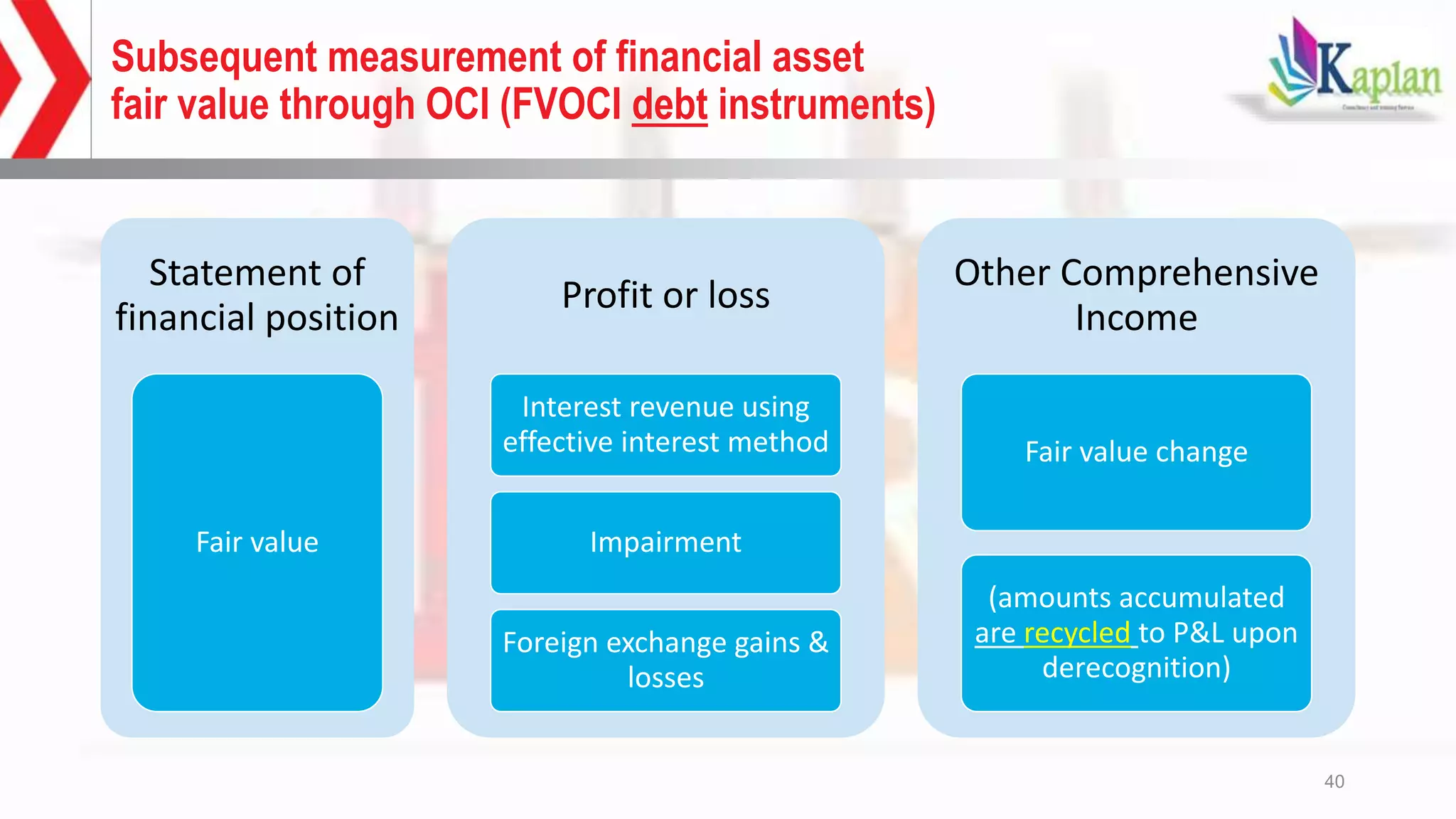
Subsequent measurement of financial asset
fair value through OCI (FVOCI debt instruments)
Statement of
financial position
Fair value
Profit or loss
Interest revenue using
effective interest method
Impairment
Foreign exchange gains &
losses
Other Comprehensive
Income
Fair value change
(amounts accumulated
are recycled to P&L upon
derecognition)
41
Subsequent measurement of financial asset
fair value through OCI (investments in equity instruments)
Statement of
financial position
Fair value
Profit or loss
Dividends
Other Comprehensive Income
Changes in fair value and
foreign exchange component
(amounts accumulated never
recycled to P&L → may be
transferred within equity)
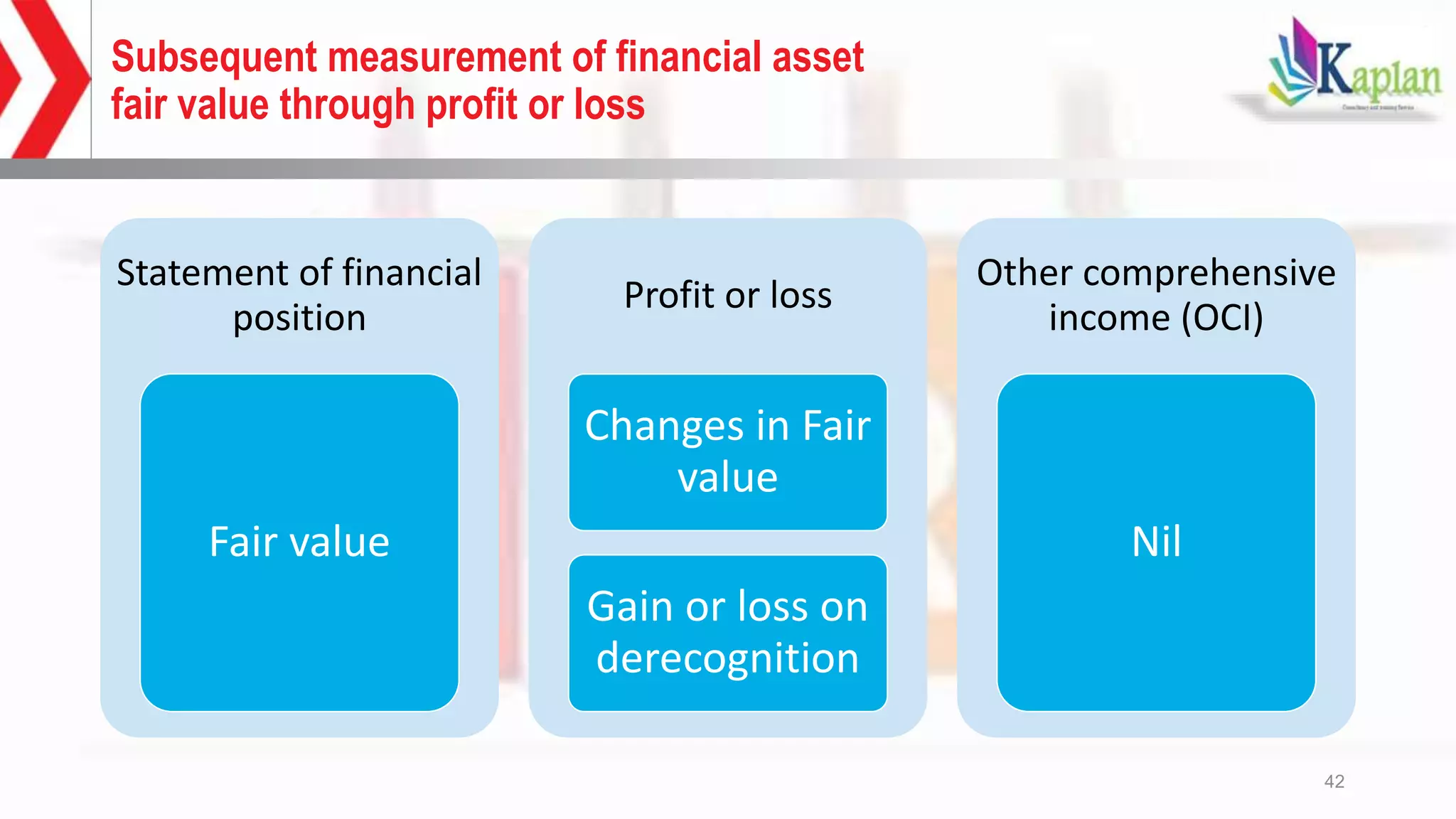
42
Subsequent measurement of financial asset
fair value through profit or loss
Statement of financial
position
Fair value
Profit or loss
Changes in Fair
value
Gain or loss on
derecognition
Other comprehensive
income (OCI)
Nil
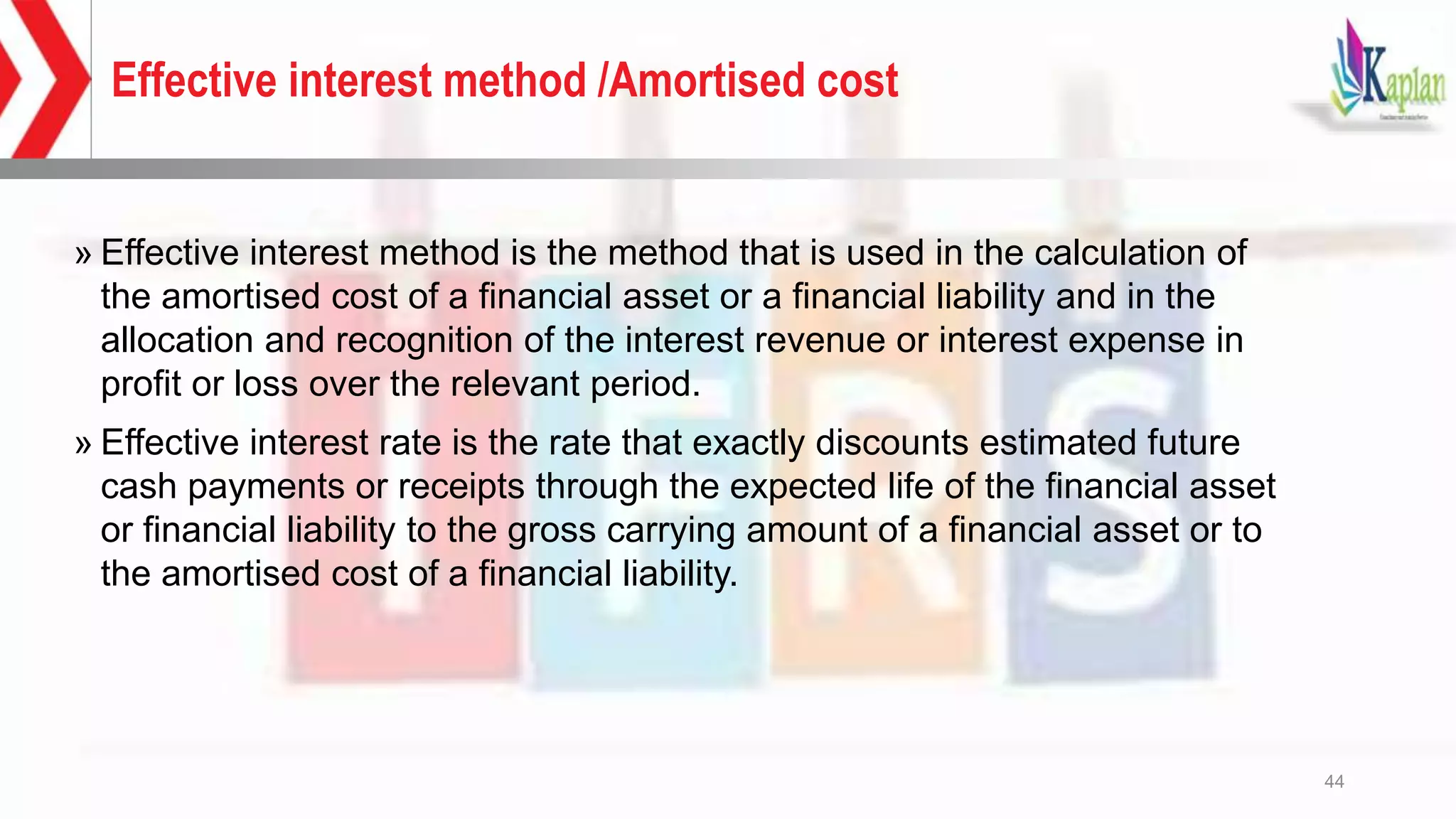
44
Effective interest method /Amortised cost
» Effective interest method is the method that is used in the calculation of
the amortised cost of a financial asset or a financial liability and in the
allocation and recognition of the interest revenue or interest expense in
profit or loss over the relevant period.
» Effective interest rate is the rate that exactly discounts estimated future
cash payments or receipts through the expected life of the financial asset
or financial liability to the gross carrying amount of a financial asset or to
the amortised cost of a financial liability.
IFRS 9 (expected loss model): impairment of
financial assets carried at cost or amortised
cost
47
Summary: impairment requirements at reporting date
Is the financial instrument a purchased or
originated credit-impaired financial asset?
Is the simplified approach for trade receivables,
contract assets and lease receivables applicable?
Does the financial instrument have low credit risk
at the reporting date?
Has there been a significant increase in credit risk
since initial recognition?
Recognise lifetime expected credit losses
Is the financial instrument a credit-impaired
financial asset?
Calculate a credit-adjusted
effective interest rate and
always recognise a loss
allowance for changes in
lifetime expected credit
losses
Is the low credit risk
simplification applied?
Recognise 12-month
expected credit losses and
calculate interest revenue
on gross carrying amount
No
No
No
Yes
And
Yes
Yes
No
No
Yes
Yes
48
48
Change in credit risk since initial recognition
Interest revenue
Gross basis
‘Performing’
(12 month expected loss)
‘Under-performing’
(life-time expected loss)
(rebuttable
presumption =
+30 days past due)
‘Non-performing’
(lifetime expected loss)
(rebuttable
presumption = earlier
than 90 days past due)
Impairment recognition
12-month
expected credit losses
Lifetime
expected credit losses
Overview of the impairment requirements
Stage 1 Stage 2 Stage 3
Lifetime
expected credit losses
When significant increase in credit risk occurs
Gross basis Net basis
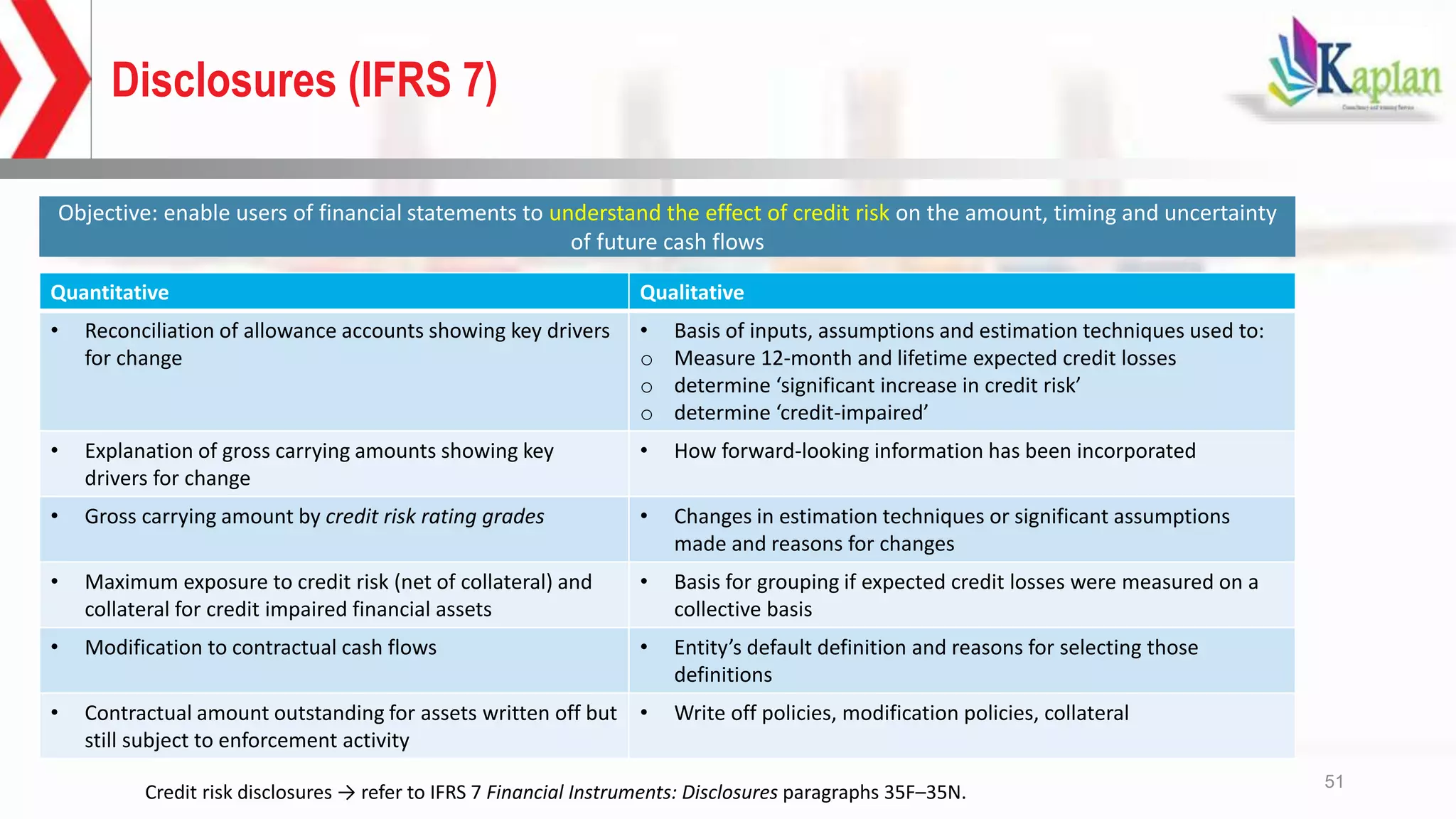
51
Disclosures (IFRS 7)
Quantitative Qualitative
• Reconciliation of allowance accounts showing key drivers
for change
• Basis of inputs, assumptions and estimation techniques used to:
o Measure 12-month and lifetime expected credit losses
o determine ‘significant increase in credit risk’
o determine ‘credit-impaired’
• Explanation of gross carrying amounts showing key
drivers for change
• How forward-looking information has been incorporated
• Gross carrying amount by credit risk rating grades • Changes in estimation techniques or significant assumptions
made and reasons for changes
• Maximum exposure to credit risk (net of collateral) and
collateral for credit impaired financial assets
• Basis for grouping if expected credit losses were measured on a
collective basis
• Modification to contractual cash flows • Entity’s default definition and reasons for selecting those
definitions
• Contractual amount outstanding for assets written off but
still subject to enforcement activity
• Write off policies, modification policies, collateral
Objective: enable users of financial statements to understand the effect of credit risk on the amount, timing and uncertainty
of future cash flows
Credit risk disclosures → refer to IFRS 7 Financial Instruments: Disclosures paragraphs 35F–35N.

New ifrs 9

  • 1.
    Accounting for financialinstruments IFRS 9
  • 2.
    2 »Classifying financial instruments »Recognisingand derecognising financial assets »Impairment of financial assets Note: other aspects of accounting for financial instruments have been covered in other sessions at this workshop. Overview
  • 3.
  • 4.
    4 Financial instruments definitions Classification Nature Financial instrument IAS32 Any contract that gives rise to: • A financial asset of one entity; and • A financial liability or equity instrument of another entity Equity instrument IAS 32 A contract that evidences a residual interest in the assets of an entity after deducting all of its liabilities. 4
  • 5.
    5 Financial instruments definitions Classification Nature Financialasset IFRS 9/IAS 39 • cash • a contractual right to receive cash or another financial asset • a contractual right to exchange financial assets or liabilities with another entity on potentially favourable terms • an equity instrument (for example, plain vanilla ordinary shares of another entity). Financial liability IFRS 9/IAS 39 • a contractual obligation to deliver cash or another financial asset • a contractual obligation to exchange financial assets or liabilities with another entity on potentially unfavourable terms. 5
  • 6.
    6 Financial assets which Standardto apply? IFRS Scope, classification, recognition, derecognition and measurement IFRS 9 replaces IAS 39 with effect from 1 January 2018. However: • early application is permitted (many transitional provisions) • IFRS 9 is required (subject to transition exceptions and exemptions) for non-insurer entities whose first IFRS financial statements are on or after 1 January 2018 (ie apply IFRS 9 from the date of transition) • expect (in September 2016) deferral and overlay approach for qualifying insurers (including first-time adopters) with a fixed expiry date of 2021 Disclosure IFRS 7 (read with IFRS 12)
  • 7.
    7 Recognition Principle: trade date accounting •recognize a financial asset or financial liability when, and only when, the entity becomes a party to the contractual provisions of the instrument (ie trade date) Optional exception: settlement date accounting • accounting policy choice by class of asset – separate class for: (i) assets mandatorily at fair value through profit or loss; (ii) assets designated at fair value through profit or loss; and (iii) investments in equity instruments for which fair value is presented in other comprehensive income • only for ‘regular way’ purchases or sales (contract must not permit net settlement) • Trade date → date an entity commits itself to purchase or sell an asset • Settlement date → date an asset is delivered to or by an entity
  • 8.
  • 9.
    9 Derecognition Issue Complicated when Definition • Whenshould an entity remove a financial asset from its financial position? • An entity has ongoing involvement with a transferred financial asset • Removal of a previously recognised financial asset from the statement of financial position
  • 10.
    10 Derecognition financial assets Steps ofthe assessment: • Determine consolidated group, ie including SPEs • Determine whether to assess entire asset or part of an asset (see below) • Apply the derecognition criteria Assess part of asset only if it comprises: • specifically identified cash flows; • a fully proportionate (pro rata) share of cash flows; or • a fully proportionate (pro rata) share of specifically identified cash flows
  • 11.
    11 Derecognition financial assets 11 Derecognition Continuedrecognition Continuing involvement Have rights to cash flows expired? Transferred substantially all risks and rewards? Retained substantially all risks and rewards? Retained control of the asset? Have rights to cash flows been transferred? Yes No Obligation to ‘pass through’ of cash flows No YesYes Yes No No No Yes No Yes
  • 12.
    13 Financial assets write-off No reasonableexpectations of recovering a financial asset in its entirety or a portion thereof Reduce the gross carrying amount Write-off → a derecognition event
  • 13.
    15 Transfers of financialassets that do not qualify for derecognition Substantially all risks and rewards of ownership of transferred asset retained • continue to recognise transferred asset in its entirety • consideration received →recognise financial liability • recognise any income on the transferred asset and any expense incurred on the financial liability
  • 14.
    17 Continuing involvement inonly a part of transferred financial assets Allocate previous carrying amount between the part that continues to be recognised and the part derecognised on the basis of the relative fair values Recognise gain or loss equal to difference between carrying amount (measured at date of derecognition) allocated to the part derecognised and consideration received
  • 15.
    19 Judgements and estimates derecognitionof financial assets »determining whether substantially all the risks and rewards of ownership of a transferred asset have been transferred; and »if neither party has substantially all the risks and rewards of ownership, determining which party has control.
  • 16.
  • 17.
    21 Classification financial assets Cash flowsare solely payments of principal and interest (SPPI) Business model = hold to collect Business model = hold to collect and sell Other business model Other types of cash flows Amortised cost FVOCI* FVTPL FVTPL FVTPL FVTPL *Excludes investments in equity instruments (see later slides). An entity can elect to present FV changes in OCI.
  • 18.
    22 Classification of financialassets fair value through profit or loss (FVTPL) Residual category If a financial asset does not fit in another category it is automatically FVTPL Fair value option Designated at initial recognition - eliminates or reduces accounting mismatch Note: the option to designate is irrevocable
  • 19.
    24 Contractual cash flowcharacteristics (step 1) »Financial assets with contractual cash flows that are solely payments of principal and interest (SPPI) are measured at amortised cost or FVOCI depending on the business model in which the asset is held. »Principal = amount transferred by holder (fair value at initial recognition) »Interest is consideration for: » time value of money and credit risk; » other lending risks (for example, liquidity risk); » other associated costs (for example, administrative costs); and » a profit margin
  • 20.
    25 Types of businessmodel (step 2) Holding assets in order to collect contractual cash flows Realise cash flows by collecting contractual payments over the life of the instrument Typically involve lower frequency and value of sales Measurement: amortised cost Both collecting contractual cash flows and selling financial assets Both collecting contractual cash flows and selling – sale integral to achieving the objective of the business model Typically involve greater frequency and value of sales Measurement: FVOCI Other business models Neither held to collect nor held to collect and for sale Collection of contractual cash flows is incidental to the objective of the model Measurement: FVTPL
  • 21.
    30 Definition of derivative (accounting= FVPL) Settled at a future date Requires little or no initial net investment Value changes in response to the change in the underlying
  • 22.
    31 Examples of derivativesand underlyings (accounting = FVPL) Type of contract Main pricing-settlement variable (underlying variable) Interest rate swap Interest rates Currency swap (foreign exchange swap) Currency rates Commodity swap Commodity prices Equity swap Equity prices (equity of another entity) Purchased or written treasury bond option (call or put) Interest rates Interest rate futures linked to government debt Interest rates Currency futures Currency rates Currency forward Currency rates Commodity forward Commodity prices Equity forward Equity prices (equity of another entity)
  • 23.
    32 Reclassification conditions Financial assets •When, andonly when, an entity changes its business model for managing financial assets – expected to be very infrequent •Reclassification is applied prospectively from the reclassification date
  • 24.
    Measurement of financialassets: an introduction
  • 25.
    35 Financial asset measurement whichmeasurement at initial recognition? Measurement at initial recognition Standards Fair value (which is normally transaction price) • include transactions costs only if asset is subsequently measured at amortised cost Sections 11 and 12 of the IFRS for SMEs Fair value • except for trade receivables measured at transaction price (on the basis of customer consideration) in accordance with IFRS 15 (effective periods beginning on or after 1 January 2018, early application permitted) • excludes transactions costs if asset is subsequently measured at FVTPL IAS 39 and IFRS 9
  • 26.
    37 Measurement at initialrecognition 37 Initial carrying amount Measured at FVTPL Initial carrying amount Measured at other than FVTPL Fair value Adjusted for transaction costs AssetAsset or Liability Liability Initial carrying amount = Measured at other than FVTPL
  • 27.
    39 Subsequent measurement offinancial asset amortised cost Statement of financial position Amortised cost Profit or loss Interest revenue using effective interest method Impairment Foreign exchange gains & losses Gain or loss on derecognition Other Comprehensive Income Nil
  • 28.
    40 Subsequent measurement offinancial asset fair value through OCI (FVOCI debt instruments) Statement of financial position Fair value Profit or loss Interest revenue using effective interest method Impairment Foreign exchange gains & losses Other Comprehensive Income Fair value change (amounts accumulated are recycled to P&L upon derecognition)
  • 29.
    41 Subsequent measurement offinancial asset fair value through OCI (investments in equity instruments) Statement of financial position Fair value Profit or loss Dividends Other Comprehensive Income Changes in fair value and foreign exchange component (amounts accumulated never recycled to P&L → may be transferred within equity)
  • 30.
    42 Subsequent measurement offinancial asset fair value through profit or loss Statement of financial position Fair value Profit or loss Changes in Fair value Gain or loss on derecognition Other comprehensive income (OCI) Nil
  • 31.
    44 Effective interest method/Amortised cost » Effective interest method is the method that is used in the calculation of the amortised cost of a financial asset or a financial liability and in the allocation and recognition of the interest revenue or interest expense in profit or loss over the relevant period. » Effective interest rate is the rate that exactly discounts estimated future cash payments or receipts through the expected life of the financial asset or financial liability to the gross carrying amount of a financial asset or to the amortised cost of a financial liability.
  • 32.
    IFRS 9 (expectedloss model): impairment of financial assets carried at cost or amortised cost
  • 33.
    47 Summary: impairment requirementsat reporting date Is the financial instrument a purchased or originated credit-impaired financial asset? Is the simplified approach for trade receivables, contract assets and lease receivables applicable? Does the financial instrument have low credit risk at the reporting date? Has there been a significant increase in credit risk since initial recognition? Recognise lifetime expected credit losses Is the financial instrument a credit-impaired financial asset? Calculate a credit-adjusted effective interest rate and always recognise a loss allowance for changes in lifetime expected credit losses Is the low credit risk simplification applied? Recognise 12-month expected credit losses and calculate interest revenue on gross carrying amount No No No Yes And Yes Yes No No Yes Yes
  • 34.
    48 48 Change in creditrisk since initial recognition Interest revenue Gross basis ‘Performing’ (12 month expected loss) ‘Under-performing’ (life-time expected loss) (rebuttable presumption = +30 days past due) ‘Non-performing’ (lifetime expected loss) (rebuttable presumption = earlier than 90 days past due) Impairment recognition 12-month expected credit losses Lifetime expected credit losses Overview of the impairment requirements Stage 1 Stage 2 Stage 3 Lifetime expected credit losses When significant increase in credit risk occurs Gross basis Net basis
  • 35.
    51 Disclosures (IFRS 7) QuantitativeQualitative • Reconciliation of allowance accounts showing key drivers for change • Basis of inputs, assumptions and estimation techniques used to: o Measure 12-month and lifetime expected credit losses o determine ‘significant increase in credit risk’ o determine ‘credit-impaired’ • Explanation of gross carrying amounts showing key drivers for change • How forward-looking information has been incorporated • Gross carrying amount by credit risk rating grades • Changes in estimation techniques or significant assumptions made and reasons for changes • Maximum exposure to credit risk (net of collateral) and collateral for credit impaired financial assets • Basis for grouping if expected credit losses were measured on a collective basis • Modification to contractual cash flows • Entity’s default definition and reasons for selecting those definitions • Contractual amount outstanding for assets written off but still subject to enforcement activity • Write off policies, modification policies, collateral Objective: enable users of financial statements to understand the effect of credit risk on the amount, timing and uncertainty of future cash flows Credit risk disclosures → refer to IFRS 7 Financial Instruments: Disclosures paragraphs 35F–35N.