FINANCIAL REPORTING
 Financial Reporting is the disclosure of financial results and related
information to management and external stakeholders about how a company is
performing over a specific period of time.
 It is a large collective document that summarizes the financial earning and
spending of a given business over a specified period of time in great details that
have effect of company financial position and performance.
 On the basis of period of time, it has been classified into two categories-
 Annual Financial Reporting
 Interim financial Reporting
ANNUAL FINANCIAL REPORTING
 Annual Financial Report means a financial report containing a complete set of
financial statements (as described in Ind AS 1, Presentation of Financial Statements)
for a financial year.
 Financial Year [Sec. 2 (41) of the companies Act, 2013] in relation to any company or
body corporate, means
 the period ending on the 31st day of March every year,
 where it has been incorporated on or after the 1st day of January of a year,
the period ending on the 31st day of March of the following year,
 where a company or body corporate, which is a holding company or a subsidiary or
associate company of a company incorporated outside India and is required to
follow a different financial year for consolidation of its accounts outside India, the
Central Government may, on an application made by that company or body corporate
in such form and manner as may be prescribed, allow any period as its financial year,
whether or not that period is a year.
INTERIM FINANCIAL REPORTING
 Interim financial report means a financial report containing either a
complete set of financial statements (as described in Ind AS 1, Presentation
of Financial Statements, or a set of condensed financial statements (as
described in this Standard) for an interim period.
 Interim period is a financial reporting period shorter than a full financial
year.
 Exception for Interim Financial Reporting
 Incorporation- company has been incorporated on Jan 1, 2019 and the period
ending on 31st March, 2020. Financial Report i.e. Annual Financial Report of
the company is made up of 3 months (a financial year for the company).
 Liquidation in the mid of Financial year. Company prepares financial report as
its last annual financial report.
 Incorporated outside India (describes in the definition of financial Year) etc.
OBJECTIVES OF-
 Interim Financial Reporting
 Timely and reliable interim financial reporting improves the ability of
investors, creditors, and others to understand an entity’s capacity to generate
earnings and cash flows and its financial condition and liquidity.
 The information shall normally be reported on a Financial year- to-date basis.
 Ind AS 34
 To prescribe the minimum content of an interim financial report and
 to prescribe the principles for recognition and measurement in complete or
condensed financial statements for an interim period.
COMPONENTS OF COMPLETE SET OF FINANCIAL
STATEMENTS
A complete set of financial statements comprises:
a. a balance sheet as at the end of the period ;
b. a statement of profit and loss for the period;
c. Statement of changes in equity for the period;
d. a statement of cash flows for the period;
e. notes, comprising significant accounting policies and other explanatory
information;
ea. comparative information in respect of the preceding period; and
f. a balance sheet as at the beginning of the preceding period when an
entity applies an accounting policy retrospectively or makes a retrospective
restatement of items in its financial statements, or when it reclassifies items
in its financial statements.
COMPONENTS OF A SET OF CONDENSED
FINANCIAL STATEMENTS
An interim financial report shall include, at a minimum, the following
components:
a. a condensed balance sheet ;
b. a condensed statement of profit and loss;
c. a condensed statement of changes in equity;
d. a condensed statement of cash flows; and
e. selected explanatory notes.
PRESENTATION AND DISCLOSURES OF
INTERIM FINANCIAL REPORT
Source: https://resource.cdn.icai.org/56825bos46132cp2u2.pdf
 Form and content of Interim financial report
PRESENTATION AND DISCLOSURES OF
INTERIM FINANCIAL REPORT
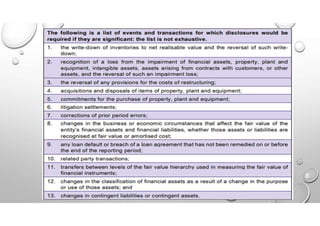
 Significant Events and Transactions-
 To understand the changes in financial position and performance
An entity shall include in its interim financial report an explanation of event
and transactions that are significant to an understanding of the changes in
financial position and performance of the entity since the end of the last annua
reporting period.
 To Access to the most recent annual financial report: A user of an
entity’s interim financial report will have access to the most recent annua
financial report of that entity.
 List of significant events and transactions:
PRESENTATION AND DISCLOSURES OF
INTERIM FINANCIAL REPORT
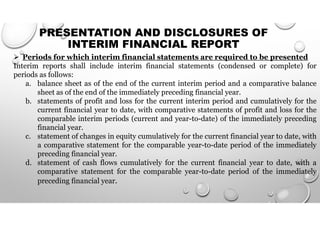
 Periods for which interim financial statements are required to be presented
Interim reports shall include interim financial statements (condensed or complete) for
periods as follows:
a. balance sheet as of the end of the current interim period and a comparative balance
sheet as of the end of the immediately preceding financial year.
b. statements of profit and loss for the current interim period and cumulatively for the
current financial year to date, with comparative statements of profit and loss for the
comparable interim periods (current and year-to-date) of the immediately preceding
financial year.
c. statement of changes in equity cumulatively for the current financial year to date, with
a comparative statement for the comparable year-to-date period of the immediately
preceding financial year.
d. statement of cash flows cumulatively for the current financial year to date, with a
comparative statement for the comparable year-to-date period of the immediately
preceding financial year.
PRESENTATION AND DISCLOSURES OF
INTERIM FINANCIAL REPORT
 Materiality:
 In deciding how to recognize, measure, classify, or disclose an item for interim financial
reporting purposes, materiality shall be assessed in relation to the interim period financial
data.
 Materiality concept is the accounting concept that concern about the relevance of
information, and the size and nature of transactions that report in the financial
statements.
 The materiality concept is used to determine what’s important enough to be included in
and what can be omitted from a financial statement.
 In making assessments of materiality, it shall be recognized that interim measurements
may rely on estimates to a greater extent than measurements of annual financial data.
 Judgement is always required in assessing materiality, Ind AS 34 bases the recognition and
disclosure decision on data for the interim period by itself for reasons of understandability
of the interim figures.
RECOGNITION AND MEASUREMENT
 Same Accounting Policies as Annual
 Financial statements as are applied in its annual financial statements,
except for accounting policy changes made after the date of the most recent
annual financial statements that are to be reflected in the next annual
financial statements.
 A change in accounting policy, other than one for which the transition is
specified by a new Ind AS, shall be reflected by restating the financial
statements of prior interim periods of the current financial year and the
comparable interim periods of any prior financial years that will be restated
in the annual financial statements in accordance with Ind AS 8
 The frequency of an entity’s reporting (annual, half-yearly, or quarterly)
shall not affect the measurement of its annual results.
RECOGNITION AND MEASUREMENT
 Same Accounting Policies as Annual
 Year-to-date measurements may involve changes in estimates of amounts
reported in prior interim periods of the current financial year. But the
principles for recognizing assets, liabilities, income, and expenses for
interim periods are the same as in annual financial statements.
 For example- income tax expense is recognized in each interim period
based on the best estimate of the weighted average annual income tax rate
expected for the full financial year. Amounts accrued for income tax
expense in one interim period may have to be adjusted in a subsequent
interim period of that financial year if the estimate of the annual income tax
rate changes.
RECOGNITION AND MEASUREMENT
 Revenues received seasonally, cyclically, or occasionally
 Revenues that are received seasonally, cyclically, or occasionally within a
financial year shall not be anticipated or deferred as of an interim date if
anticipation or deferral would not be appropriate at the end of the entity’s
financial year.
 Such revenues are recognized when they occur.
 Examples include dividend revenue, royalties, and government grants,
seasonal revenues of retailers.
RECOGNITION AND MEASUREMENT
 Costs incurred unevenly during the financial year
 Costs that are incurred unevenly during an entity’s financial year shall be
anticipated or deferred for interim reporting purposes if, and only if, it is
also appropriate to anticipate or defer that type of cost at the end of the
financial year.
RECOGNITION AND MEASUREMENT
 Use of estimates
 The measurement procedures to be followed in an interim financial report
shall be designed to ensure that the resulting information is reliable and
that all material financial information that is relevant to an understanding
of the financial position or performance of the entity is appropriately
disclosed.
 Measurements in both annual and interim financial reports are often based
on reasonable estimates, the preparation of interim financial reports
generally will require a greater use of estimation methods than annual
financial reports.

Ind as 34

  • 2.
    FINANCIAL REPORTING  FinancialReporting is the disclosure of financial results and related information to management and external stakeholders about how a company is performing over a specific period of time.  It is a large collective document that summarizes the financial earning and spending of a given business over a specified period of time in great details that have effect of company financial position and performance.  On the basis of period of time, it has been classified into two categories-  Annual Financial Reporting  Interim financial Reporting
  • 3.
    ANNUAL FINANCIAL REPORTING Annual Financial Report means a financial report containing a complete set of financial statements (as described in Ind AS 1, Presentation of Financial Statements) for a financial year.  Financial Year [Sec. 2 (41) of the companies Act, 2013] in relation to any company or body corporate, means  the period ending on the 31st day of March every year,  where it has been incorporated on or after the 1st day of January of a year, the period ending on the 31st day of March of the following year,  where a company or body corporate, which is a holding company or a subsidiary or associate company of a company incorporated outside India and is required to follow a different financial year for consolidation of its accounts outside India, the Central Government may, on an application made by that company or body corporate in such form and manner as may be prescribed, allow any period as its financial year, whether or not that period is a year.
  • 4.
    INTERIM FINANCIAL REPORTING Interim financial report means a financial report containing either a complete set of financial statements (as described in Ind AS 1, Presentation of Financial Statements, or a set of condensed financial statements (as described in this Standard) for an interim period.  Interim period is a financial reporting period shorter than a full financial year.  Exception for Interim Financial Reporting  Incorporation- company has been incorporated on Jan 1, 2019 and the period ending on 31st March, 2020. Financial Report i.e. Annual Financial Report of the company is made up of 3 months (a financial year for the company).  Liquidation in the mid of Financial year. Company prepares financial report as its last annual financial report.  Incorporated outside India (describes in the definition of financial Year) etc.
  • 5.
    OBJECTIVES OF-  InterimFinancial Reporting  Timely and reliable interim financial reporting improves the ability of investors, creditors, and others to understand an entity’s capacity to generate earnings and cash flows and its financial condition and liquidity.  The information shall normally be reported on a Financial year- to-date basis.  Ind AS 34  To prescribe the minimum content of an interim financial report and  to prescribe the principles for recognition and measurement in complete or condensed financial statements for an interim period.
  • 6.
    COMPONENTS OF COMPLETESET OF FINANCIAL STATEMENTS A complete set of financial statements comprises: a. a balance sheet as at the end of the period ; b. a statement of profit and loss for the period; c. Statement of changes in equity for the period; d. a statement of cash flows for the period; e. notes, comprising significant accounting policies and other explanatory information; ea. comparative information in respect of the preceding period; and f. a balance sheet as at the beginning of the preceding period when an entity applies an accounting policy retrospectively or makes a retrospective restatement of items in its financial statements, or when it reclassifies items in its financial statements.
  • 7.
    COMPONENTS OF ASET OF CONDENSED FINANCIAL STATEMENTS An interim financial report shall include, at a minimum, the following components: a. a condensed balance sheet ; b. a condensed statement of profit and loss; c. a condensed statement of changes in equity; d. a condensed statement of cash flows; and e. selected explanatory notes.
  • 8.
    PRESENTATION AND DISCLOSURESOF INTERIM FINANCIAL REPORT Source: https://resource.cdn.icai.org/56825bos46132cp2u2.pdf  Form and content of Interim financial report
  • 9.
    PRESENTATION AND DISCLOSURESOF INTERIM FINANCIAL REPORT  Significant Events and Transactions-  To understand the changes in financial position and performance An entity shall include in its interim financial report an explanation of event and transactions that are significant to an understanding of the changes in financial position and performance of the entity since the end of the last annua reporting period.  To Access to the most recent annual financial report: A user of an entity’s interim financial report will have access to the most recent annua financial report of that entity.  List of significant events and transactions:
  • 11.
    PRESENTATION AND DISCLOSURESOF INTERIM FINANCIAL REPORT  Periods for which interim financial statements are required to be presented Interim reports shall include interim financial statements (condensed or complete) for periods as follows: a. balance sheet as of the end of the current interim period and a comparative balance sheet as of the end of the immediately preceding financial year. b. statements of profit and loss for the current interim period and cumulatively for the current financial year to date, with comparative statements of profit and loss for the comparable interim periods (current and year-to-date) of the immediately preceding financial year. c. statement of changes in equity cumulatively for the current financial year to date, with a comparative statement for the comparable year-to-date period of the immediately preceding financial year. d. statement of cash flows cumulatively for the current financial year to date, with a comparative statement for the comparable year-to-date period of the immediately preceding financial year.
  • 12.
    PRESENTATION AND DISCLOSURESOF INTERIM FINANCIAL REPORT  Materiality:  In deciding how to recognize, measure, classify, or disclose an item for interim financial reporting purposes, materiality shall be assessed in relation to the interim period financial data.  Materiality concept is the accounting concept that concern about the relevance of information, and the size and nature of transactions that report in the financial statements.  The materiality concept is used to determine what’s important enough to be included in and what can be omitted from a financial statement.  In making assessments of materiality, it shall be recognized that interim measurements may rely on estimates to a greater extent than measurements of annual financial data.  Judgement is always required in assessing materiality, Ind AS 34 bases the recognition and disclosure decision on data for the interim period by itself for reasons of understandability of the interim figures.
  • 13.
    RECOGNITION AND MEASUREMENT Same Accounting Policies as Annual  Financial statements as are applied in its annual financial statements, except for accounting policy changes made after the date of the most recent annual financial statements that are to be reflected in the next annual financial statements.  A change in accounting policy, other than one for which the transition is specified by a new Ind AS, shall be reflected by restating the financial statements of prior interim periods of the current financial year and the comparable interim periods of any prior financial years that will be restated in the annual financial statements in accordance with Ind AS 8  The frequency of an entity’s reporting (annual, half-yearly, or quarterly) shall not affect the measurement of its annual results.
  • 14.
    RECOGNITION AND MEASUREMENT Same Accounting Policies as Annual  Year-to-date measurements may involve changes in estimates of amounts reported in prior interim periods of the current financial year. But the principles for recognizing assets, liabilities, income, and expenses for interim periods are the same as in annual financial statements.  For example- income tax expense is recognized in each interim period based on the best estimate of the weighted average annual income tax rate expected for the full financial year. Amounts accrued for income tax expense in one interim period may have to be adjusted in a subsequent interim period of that financial year if the estimate of the annual income tax rate changes.
  • 15.
    RECOGNITION AND MEASUREMENT Revenues received seasonally, cyclically, or occasionally  Revenues that are received seasonally, cyclically, or occasionally within a financial year shall not be anticipated or deferred as of an interim date if anticipation or deferral would not be appropriate at the end of the entity’s financial year.  Such revenues are recognized when they occur.  Examples include dividend revenue, royalties, and government grants, seasonal revenues of retailers.
  • 16.
    RECOGNITION AND MEASUREMENT Costs incurred unevenly during the financial year  Costs that are incurred unevenly during an entity’s financial year shall be anticipated or deferred for interim reporting purposes if, and only if, it is also appropriate to anticipate or defer that type of cost at the end of the financial year.
  • 17.
    RECOGNITION AND MEASUREMENT Use of estimates  The measurement procedures to be followed in an interim financial report shall be designed to ensure that the resulting information is reliable and that all material financial information that is relevant to an understanding of the financial position or performance of the entity is appropriately disclosed.  Measurements in both annual and interim financial reports are often based on reasonable estimates, the preparation of interim financial reports generally will require a greater use of estimation methods than annual financial reports.