1
TOPIC
2
RECEIVABLE
SACCOUNTS/ NOTES
RECEIVABLE
2
Learning Objectives
1. Define receivables and identify the
different types of receivables.
2. Explain accounting issues related to
recognition and valuation of accounts
receivable.
3. Assignment and Factoring of Accounts
Receivables
3
Learning Objectives
4. Explain accounting issues related to
recognition and valuation of notes
receivable.
5. Explain how receivables are reported and
analysed.
4
Section 1:Section 1:
Definition and typesDefinition and types
of receivablesof receivables
Receivable -Definition
Amounts due from individuals and companies.
5
Accounts receivables
Receivable associated with the normal operating
activities of a business
e.g. Credit sales of goods & services to customers
Expected to be collected generally within 30 to 90
days.
Most significant type of claim held by company.
Often called trade receivables.
6
Notes receivables
Receivables that are evidenced by a formal written
promise to pay a certain sum of money at a specified date
Normally requires payment of interest and extends for
time periods of 60-90 days or longer
Notes receivables give holder a stronger legal claim to
assets than accounts receivable
Promissory note is a negotiable instrument and may be
transferred to another party by endorsement
7
Other receivables
Non-trade receivable
Include all other types of receivable
Arise from a variety of transactions
e.g. Sale of property, advances to directors &
employees, claim for losses or damages.
8
9
Section 2:Section 2:
Accounting issues -Accounting issues -
recognition & valuationrecognition & valuation
of accounts receivablesof accounts receivables
Accounts Receivable – Issues
Recognition and valuation of accounts
receivable
√ Trade discounts
- Cash discounts
√ Sales returns and allowances
√ Valuation of trade debtors
10
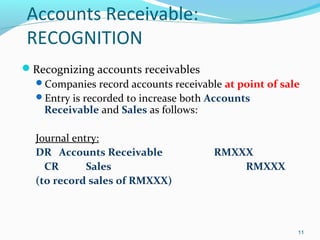
Accounts Receivable:
RECOGNITION
Recognizing accounts receivables
Companies record accounts receivable at point of sale
Entry is recorded to increase both Accounts
Receivable and Sales as follows:
Journal entry:
DR Accounts Receivable RMXXX
CR Sales RMXXX
(to record sales of RMXXX)
11
RECORDING DISCOUNTS
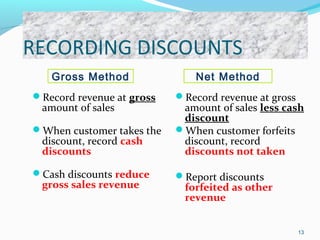
There are two methods:
(1) Gross method records discounts when taken by
customers.
(2) Net method records discounts not taken by
customers.
12
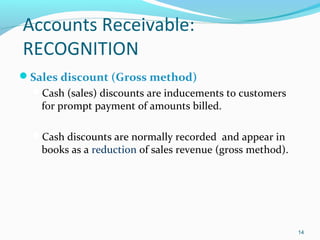
RECORDING DISCOUNTS
Record revenue at gross
amount of sales
When customer takes the
discount, record cash
discounts
Cash discounts reduce
gross sales revenue
Record revenue at gross
amount of sales less cash
discount
When customer forfeits
discount, record
discounts not taken
Report discounts
forfeited as other
revenue
13
Gross Method Net Method
Accounts Receivable:
RECOGNITION
Sales discount (Gross method)
Cash (sales) discounts are inducements to customers
for prompt payment of amounts billed.
Cash discounts are normally recorded and appear in
books as a reduction of sales revenue (gross method).
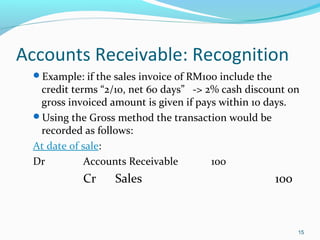
14
Accounts Receivable: Recognition
Example: if the sales invoice of RM100 include the
credit terms “2/10, net 60 days” -> 2% cash discount on
gross invoiced amount is given if pays within 10 days.
Using the Gross method the transaction would be
recorded as follows:
At date of sale:
Dr Accounts Receivable 100
Cr Sales 100
15
Accounts Receivable: Recognition
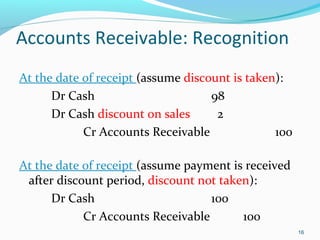
At the date of receipt (assume discount is taken):
Dr Cash 98
Dr Cash discount on sales 2
Cr Accounts Receivable 100
At the date of receipt (assume payment is received
after discount period, discount not taken):
Dr Cash 100
Cr Accounts Receivable 100
16
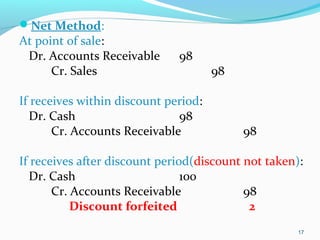
Net Method:
At point of sale:
Dr. Accounts Receivable 98
Cr. Sales 98
If receives within discount period:
Dr. Cash 98
Cr. Accounts Receivable 98
If receives after discount period(discount not taken):
Dr. Cash 100
Cr. Accounts Receivable 98
Discount forfeited 2
17
Accounts Receivable:
RECOGNITION
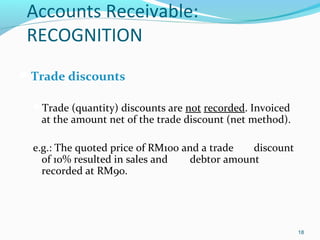
Trade discounts
Trade (quantity) discounts are not recorded. Invoiced
at the amount net of the trade discount (net method).
e.g.: The quoted price of RM100 and a trade discount
of 10% resulted in sales and debtor amount
recorded at RM90.
18
Accounts Receivable:
RECOGNITION
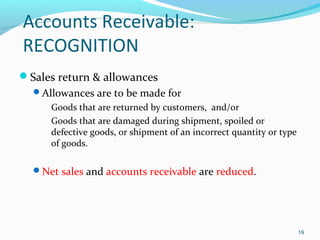
Sales return & allowances
Allowances are to be made for
 Goods that are returned by customers, and/or
 Goods that are damaged during shipment, spoiled or
defective goods, or shipment of an incorrect quantity or type
of goods.
Net sales and accounts receivable are reduced.
19
Accounts Receivable: Recognition
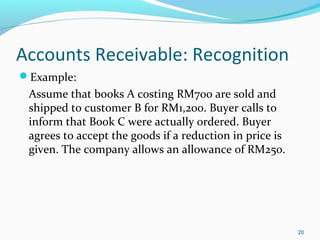
Example:
Assume that books A costing RM700 are sold and
shipped to customer B for RM1,200. Buyer calls to
inform that Book C were actually ordered. Buyer
agrees to accept the goods if a reduction in price is
given. The company allows an allowance of RM250.
20
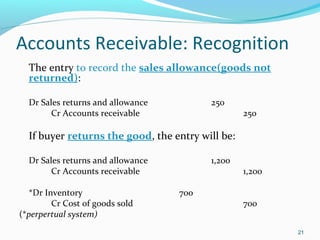
Accounts Receivable: Recognition
The entry to record the sales allowance(goods not
returned):
Dr Sales returns and allowance 250
Cr Accounts receivable 250
If buyer returns the good, the entry will be:
Dr Sales returns and allowance 1,200
Cr Accounts receivable 1,200
*Dr Inventory 700
Cr Cost of goods sold 700
(*perpertual system)
21
VALUATION OF ACCOUNTS
RECEIVABLE
According to MFRS 139, loan and receivable
are valued at amortized cost.
For short-lived debts such as trade receivables
on normal commercial term, the carrying
amount is the amount of debts less any
doubtful debt allowances.
22
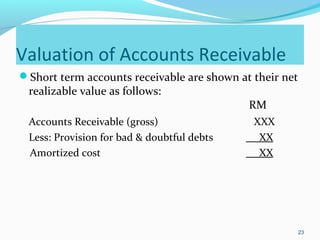
Valuation of Accounts Receivable
Short term accounts receivable are shown at their net
realizable value as follows:
RM
Accounts Receivable (gross) XXX
Less: Provision for bad & doubtful debts _ XX
Amortized cost XX
23
Uncollectibles of Accounts
Receivables
It is common for companies to have uncollected
receivables.
Journal entries involved:
Dr. Bad debts expense
Cr. Allowance for doubtful debts
Companies have to estimate
If cannot – may make direct write off of the
uncollectible debts
24
Methods to estimate bad debts:
i. percentage of sales method
ii. percentage of receivables method
iii. Age receivables analysis
However, MFRS 139 only allow the third
method.
- Focus is on providing an estimate of
accounts receivable value
- Uses past collection experience to
estimate bad debt expense
- Bad debt expense in the current year is
calculated by taking into account the existing
balance in the provision for bad & doubtful
debts 25
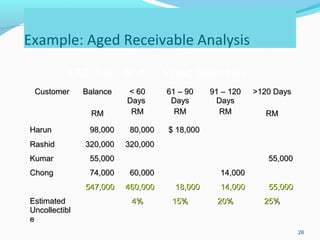
Example: Aged Receivable Analysis
26
ABC Sdn. Bhd. - Aging Schedule
CustomerCustomer BalanceBalance
RMRM
< 60< 60
DaysDays
RMRM
61 – 9061 – 90
DaysDays
RMRM
91 – 12091 – 120
DaysDays
RMRM
>120 Days>120 Days
RMRM
HarunHarun 98,00098,000 80,00080,000 $ 18,000$ 18,000
RashidRashid 320,000320,000 320,000320,000
KumarKumar 55,00055,000 55,00055,000
ChongChong 74,00074,000 60,00060,000 14,00014,000
547,000547,000 460,000460,000 18,00018,000 14,00014,000 55,00055,000
EstimatedEstimated
UncollectiblUncollectibl
ee
4%4% 15%15% 20%20% 25%25%
27
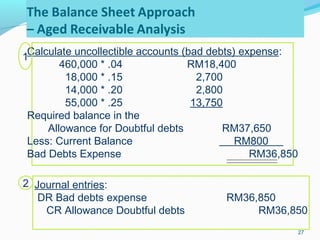
Calculate uncollectible accounts (bad debts) expense:
460,000 * .04 RM18,400
18,000 * .15 2,700
14,000 * .20 2,800
55,000 * .25 13,750
Required balance in the
Allowance for Doubtful debts RM37,650
Less: Current Balance RM800
Bad Debts Expense RM36,850
1
2 Journal entries:
DR Bad debts expense RM36,850
CR Allowance Doubtful debts RM36,850
28
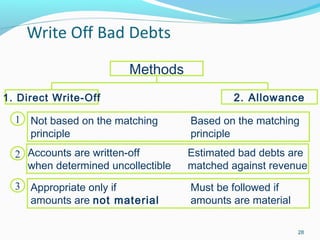
Methods
1. Direct Write-Off 2. Allowance
Not based on the matching Based on the matching
principle principle
1
Accounts are written-off Estimated bad debts are
when determined uncollectible matched against revenue
2
Appropriate only if Must be followed if
amounts are not material amounts are material
3
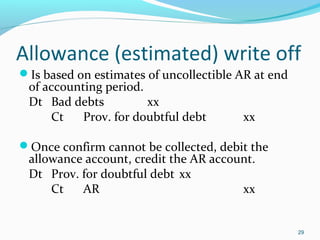
Allowance (estimated) write off
Is based on estimates of uncollectible AR at end
of accounting period.
Dt Bad debts xx
Ct Prov. for doubtful debt xx
Once confirm cannot be collected, debit the
allowance account, credit the AR account.
Dt Prov. for doubtful debt xx
Ct AR xx
29
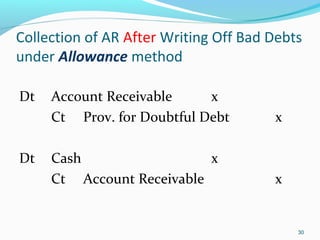
Collection of AR After Writing Off Bad Debts
under Allowance method
Dt Account Receivable x
Ct Prov. for Doubtful Debt x
Dt Cash x
Ct Account Receivable x
30
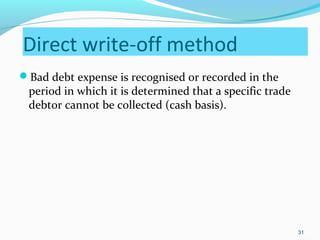
Direct write-off method
Bad debt expense is recognised or recorded in the
period in which it is determined that a specific trade
debtor cannot be collected (cash basis).
31
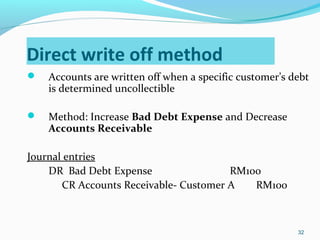
Direct write off method
 Accounts are written off when a specific customer’s debt
is determined uncollectible
 Method: Increase Bad Debt Expense and Decrease
Accounts Receivable
Journal entries
DR Bad Debt Expense RM100
CR Accounts Receivable- Customer A RM100
32
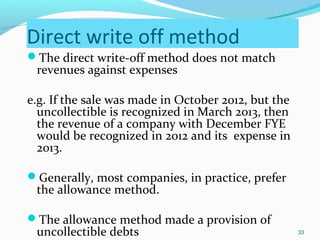
Direct write off method
The direct write-off method does not match
revenues against expenses
e.g. If the sale was made in October 2012, but the
uncollectible is recognized in March 2013, then
the revenue of a company with December FYE
would be recognized in 2012 and its expense in
2013.
Generally, most companies, in practice, prefer
the allowance method.
The allowance method made a provision of
uncollectible debts 33
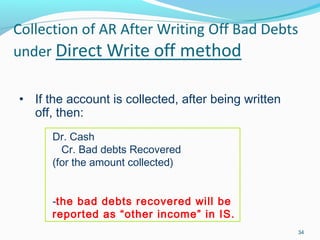
34
• If the account is collected, after being written
off, then:
Dr. Cash
Cr. Bad debts Recovered
(for the amount collected)
-the bad debts recovered will be
reported as “other income” in IS.
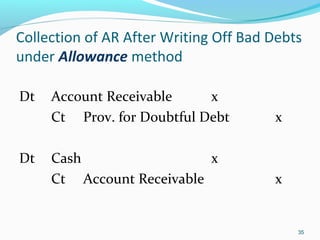
Collection of AR After Writing Off Bad Debts
under Allowance method
Dt Account Receivable x
Ct Prov. for Doubtful Debt x
Dt Cash x
Ct Account Receivable x
35
36
Section 3:Section 3:
Assignment &Assignment &
Factoring ofFactoring of
Accounts ReceivablesAccounts Receivables
The holder of accounts or notes receivable may
transfer them for cash.
The transfer may be:
 assignment (secured borrowing) or
 factoring (a sale of receivables)
Assigning/pledging accounts receivable means
using them as collateral for a loan. Holder retains
ownership.
Factoring accounts receivable means selling them.
Factoring can be with recourse or without
recourse. Recourse refers to ultimate
responsibility for payment.
37
Why use receivables as a source of cash?
Providing customer financing is mandatory in many
industries, e.g. autos, industrial and farm equipment,
durable goods.
Access to normal financing may be unavailable or
expensive, e.g., further borrowing may violate
existing debt covenants.
Seller may prefer to leave billing and collection to a
more specialized agency.
Receivables financing may be cheaper than debt, as
the former conveys ownership rights to the
purchaser.
38
Assignment of receivables
Trade debt may be assigned or pledged with a
banker to obtain funds to meet company’s cash
needs.
Trade debts are used as collaterals to obtain the
financing.
Risk of bad debts are not passed on to the banker
because it has the full recourse on the company in
the event that the trade debtors are unable to
settle their debts.
39
Assignment of receivables
Bill of exchange – trade debt financing arrangements
to acknowledge its liability.
The trade debts are remained in the accounting
records and the cash received and the corresponding
bill payable should be recognized in the accounts.
40
Assignment of receivables
Transferor records for note payable and finance charge. No
effect on accounting for accounts receivable.
Transferor collects accounts receivable.
Transferor records sales returns and sales discounts.
Transferor absorbs bad debts expense.
Transferor records interest expense on notes payable.
Transferor pays on the note periodically from collections.
Meanwhile, the banker will record for note receivables,Meanwhile, the banker will record for note receivables,
finance revenue, interest revenue and cash paid and received.finance revenue, interest revenue and cash paid and received.
41
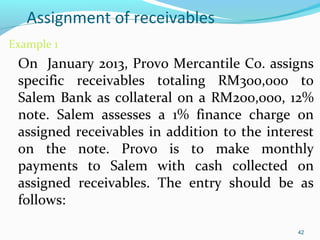
Assignment of receivables
Example 1
On January 2013, Provo Mercantile Co. assigns
specific receivables totaling RM300,000 to
Salem Bank as collateral on a RM200,000, 12%
note. Salem assesses a 1% finance charge on
assigned receivables in addition to the interest
on the note. Provo is to make monthly
payments to Salem with cash collected on
assigned receivables. The entry should be as
follows:
42
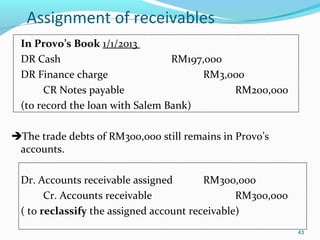
Assignment of receivables
In Provo’s Book 1/1/2013
DR Cash RM197,000
DR Finance charge RM3,000
CR Notes payable RM200,000
(to record the loan with Salem Bank)
The trade debts of RM300,000 still remains in Provo’s
accounts.
Dr. Accounts receivable assigned RM300,000
Cr. Accounts receivable RM300,000
( to reclassify the assigned account receivable)
43
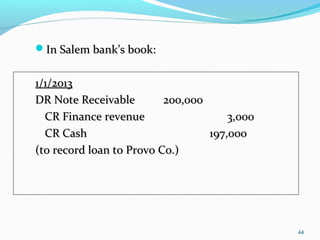
In Salem bank’s book:In Salem bank’s book:
1/1/20131/1/2013
DR Note ReceivableDR Note Receivable 200,000200,000
CR Finance revenueCR Finance revenue 3,0003,000
CR CashCR Cash 197,000197,000
(to record loan to Provo Co.)(to record loan to Provo Co.)
44
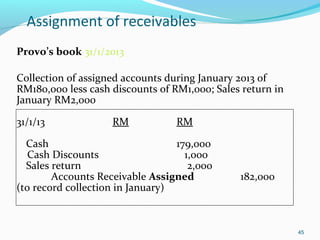
Assignment of receivables
Provo’s book 31/1/2013
Collection of assigned accounts during January 2013 of
RM180,000 less cash discounts of RM1,000; Sales return in
January RM2,000
31/1/13 RM RM
Cash 179,000
Cash Discounts 1,000
Sales return 2,000
Accounts Receivable Assigned 182,000
(to record collection in January)
45
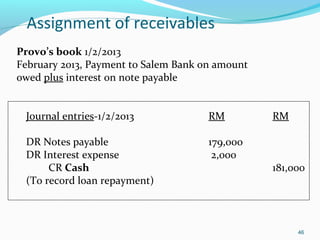
Assignment of receivables
Provo’s book 1/2/2013
February 2013, Payment to Salem Bank on amount
owed plus interest on note payable
Journal entries-1/2/2013 RM RM
DR Notes payable 179,000
DR Interest expense 2,000
CR Cash 181,000
(To record loan repayment)
46
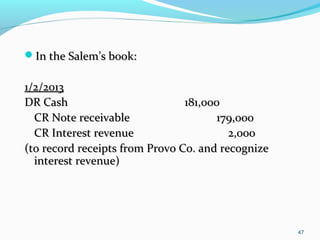
In the Salem’s book:In the Salem’s book:
1/2/20131/2/2013
DR CashDR Cash 181,000181,000
CR Note receivableCR Note receivable 179,000179,000
CR Interest revenueCR Interest revenue 2,0002,000
(to record receipts from Provo Co. and recognize(to record receipts from Provo Co. and recognize
interest revenue)interest revenue)
47
Assignment of receivables
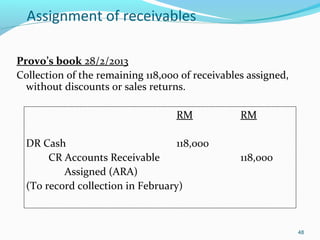
Provo’s book 28/2/2013
Collection of the remaining 118,000 of receivables assigned,
without discounts or sales returns.
RM RM
DR Cash 118,000
CR Accounts Receivable 118,000
Assigned (ARA)
(To record collection in February)
48
Assignment of receivables
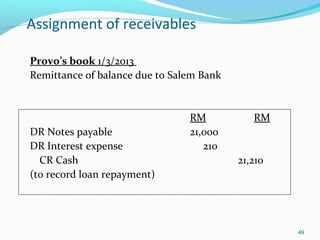
Provo’s book 1/3/2013
Remittance of balance due to Salem Bank
RM RM
DR Notes payable 21,000
DR Interest expense 210
CR Cash 21,210
(to record loan repayment)
49
Assignment of receivables
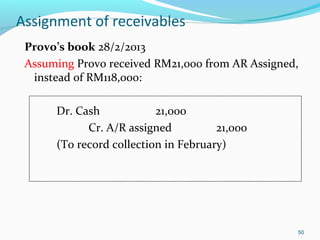
Provo’s book 28/2/2013
Assuming Provo received RM21,000 from AR Assigned,
instead of RM118,000:
Dr. Cash 21,000
Cr. A/R assigned 21,000
(To record collection in February)
50
Assignment of receivables
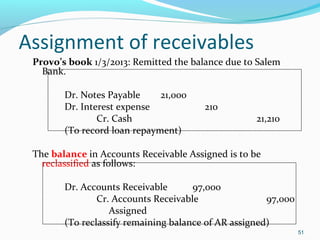
Provo’s book 1/3/2013: Remitted the balance due to Salem
Bank.
Dr. Notes Payable 21,000
Dr. Interest expense 210
Cr. Cash 21,210
(To record loan repayment)
The balance in Accounts Receivable Assigned is to be
reclassified as follows:
Dr. Accounts Receivable 97,000
Cr. Accounts Receivable 97,000
Assigned
(To reclassify remaining balance of AR assigned)
51
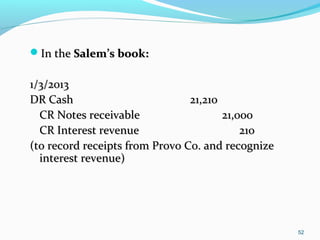
In theIn the Salem’s book:Salem’s book:
1/3/20131/3/2013
DR CashDR Cash 21,21021,210
CR Notes receivableCR Notes receivable 21,00021,000
CR Interest revenueCR Interest revenue 210210
(to record receipts from Provo Co. and recognize(to record receipts from Provo Co. and recognize
interest revenue)interest revenue)
52
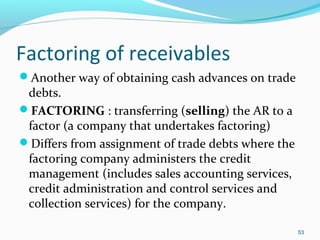
Factoring of receivables
Another way of obtaining cash advances on trade
debts.
FACTORING : transferring (selling) the AR to a
factor (a company that undertakes factoring)
Differs from assignment of trade debts where the
factoring company administers the credit
management (includes sales accounting services,
credit administration and control services and
collection services) for the company.
53
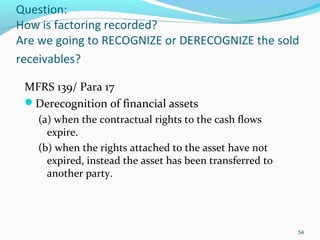
Question:
How is factoring recorded?
Are we going to RECOGNIZE or DERECOGNIZE the sold
receivables?
MFRS 139/ Para 17
Derecognition of financial assets
(a) when the contractual rights to the cash flows
expire.
(b) when the rights attached to the asset have not
expired, instead the asset has been transferred to
another party.
54
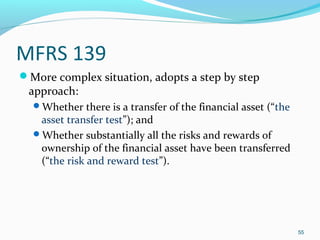
MFRS 139
More complex situation, adopts a step by step
approach:
Whether there is a transfer of the financial asset (“the
asset transfer test”); and
Whether substantially all the risks and rewards of
ownership of the financial asset have been transferred
(“the risk and reward test”).
55
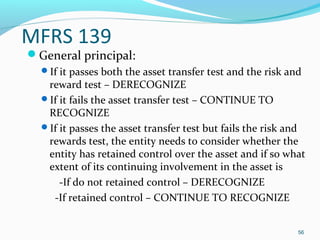
MFRS 139
General principal:
If it passes both the asset transfer test and the risk and
reward test – DERECOGNIZE
If it fails the asset transfer test – CONTINUE TO
RECOGNIZE
If it passes the asset transfer test but fails the risk and
rewards test, the entity needs to consider whether the
entity has retained control over the asset and if so what
extent of its continuing involvement in the asset is
-If do not retained control – DERECOGNIZE
-If retained control – CONTINUE TO RECOGNIZE
56
Factoring of receivables
 Two types of debt factoring:
1. Debt factoring with recourse
2. Debt factoring without recourse
57
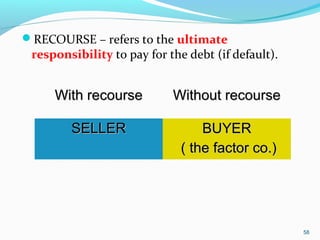
RECOURSE – refers to the ultimate
responsibility to pay for the debt (if default).
With recourseWith recourse Without recourseWithout recourse
SELLERSELLER BUYERBUYER
( the factor co.)( the factor co.)
58
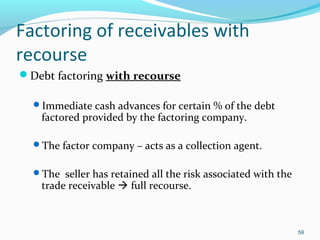
Factoring of receivables with
recourse
Debt factoring with recourse
Immediate cash advances for certain % of the debt
factored provided by the factoring company.
The factor company – acts as a collection agent.
The seller has retained all the risk associated with the
trade receivable  full recourse.
59
Factoring of receivables with recourse
(cont.)
Therefore, the trade receivables would be retained
on the BS as assets and the proceeds received would
be recognized as a liability.
As and when the trade debtors settled and the cash
was passed over to the factor, the trade receivables
and liability would be reduced.
60
Factoring of receivables with
recourse (Example 1)
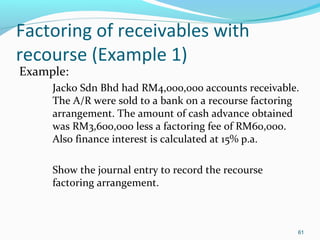
Example:
Jacko Sdn Bhd had RM4,000,000 accounts receivable.
The A/R were sold to a bank on a recourse factoring
arrangement. The amount of cash advance obtained
was RM3,600,000 less a factoring fee of RM60,000.
Also finance interest is calculated at 15% p.a.
Show the journal entry to record the recourse
factoring arrangement.
61
Factoring of receivables with
recourse (Example 1)
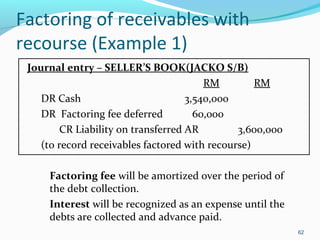
Journal entry – SELLER’S BOOK(JACKO S/B)
RM RM
DR Cash 3,540,000
DR Factoring fee deferred 60,000
CR Liability on transferred AR 3,600,000
(to record receivables factored with recourse)
Factoring fee will be amortized over the period of
the debt collection.
Interest will be recognized as an expense until the
debts are collected and advance paid.
62
Receivables factoring with recourse
(Example 2)
Textiles Corporation factors RM500,000 of accounts
receivable with Cotton Bank Berhad on a recourse
basis.
The Cotton Bank Berhad assesses a finance charge
of 3% of the amount of accounts receivable and
retain an amount equal to 5% of the accounts
receivable.
63
Receivables factoring with
recourse (Example 2)
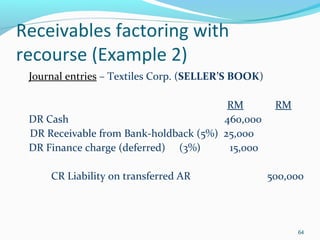
Journal entries – Textiles Corp. (SELLER’S BOOK)
RM RM
DR Cash 460,000
DR Receivable from Bank-holdback (5%) 25,000
DR Finance charge (deferred) (3%) 15,000
CR Liability on transferred AR 500,000
64
Receivables factoring with
recourse (Example 2)
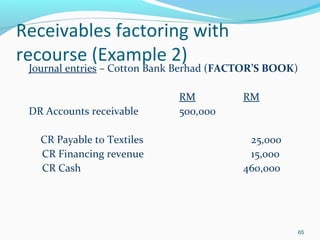
Journal entries – Cotton Bank Berhad (FACTOR’S BOOK)
RM RM
DR Accounts receivable 500,000
CR Payable to Textiles 25,000
CR Financing revenue 15,000
CR Cash 460,000
65
Example 2- Receivables factoring with
recourse: Collection of AR
Assume RM20,000 was uncollectible and
there were RM7,000 sales return and
allowances, sales discount of RM5,000. The
remaining amount was collected by the
bank.
66
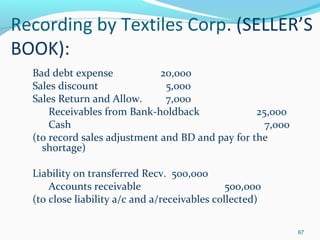
Recording by Textiles Corp. (SELLER’S
BOOK):
Bad debt expense 20,000
Sales discount 5,000
Sales Return and Allow. 7,000
Receivables from Bank-holdback 25,000
Cash 7,000
(to record sales adjustment and BD and pay for the
shortage)
Liability on transferred Recv. 500,000
Accounts receivable 500,000
(to close liability a/c and a/receivables collected)
67
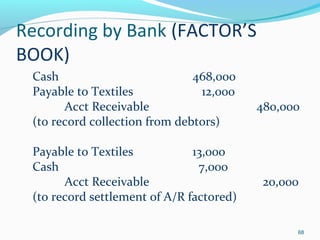
Recording by Bank (FACTOR’S
BOOK)
Cash 468,000
Payable to Textiles 12,000
Acct Receivable 480,000
(to record collection from debtors)
Payable to Textiles 13,000
Cash 7,000
Acct Receivable 20,000
(to record settlement of A/R factored)
68
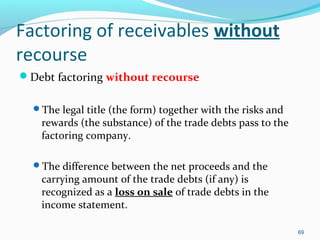
Factoring of receivables without
recourse
Debt factoring without recourse
The legal title (the form) together with the risks and
rewards (the substance) of the trade debts pass to the
factoring company.
The difference between the net proceeds and the
carrying amount of the trade debts (if any) is
recognized as a loss on sale of trade debts in the
income statement.
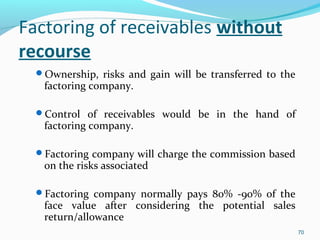
69
Factoring of receivables without
recourse
Ownership, risks and gain will be transferred to the
factoring company.
Control of receivables would be in the hand of
factoring company.
Factoring company will charge the commission based
on the risks associated
Factoring company normally pays 80% -90% of the
face value after considering the potential sales
return/allowance
70
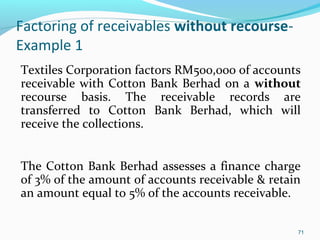
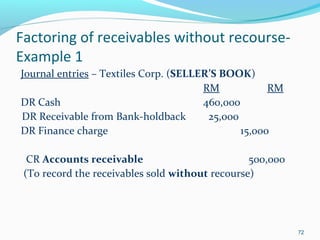
Factoring of receivables without recourse-
Example 1
Textiles Corporation factors RM500,000 of accounts
receivable with Cotton Bank Berhad on a without
recourse basis. The receivable records are
transferred to Cotton Bank Berhad, which will
receive the collections.
The Cotton Bank Berhad assesses a finance charge
of 3% of the amount of accounts receivable & retain
an amount equal to 5% of the accounts receivable.
71
Factoring of receivables without recourse-
Example 1
Journal entries – Textiles Corp. (SELLER’S BOOK)
RM RM
DR Cash 460,000
DR Receivable from Bank-holdback 25,000
DR Finance charge 15,000
CR Accounts receivable 500,000
(To record the receivables sold without recourse)
72
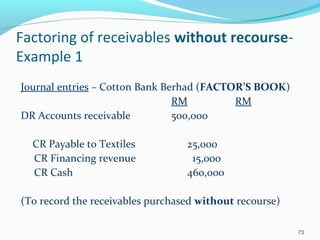
Factoring of receivables without recourse-
Example 1
Journal entries – Cotton Bank Berhad (FACTOR’S BOOK)
RM RM
DR Accounts receivable 500,000
CR Payable to Textiles 25,000
CR Financing revenue 15,000
CR Cash 460,000
(To record the receivables purchased without recourse)
73
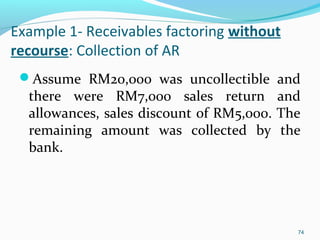
Example 1- Receivables factoring without
recourse: Collection of AR
Assume RM20,000 was uncollectible and
there were RM7,000 sales return and
allowances, sales discount of RM5,000. The
remaining amount was collected by the
bank.
74
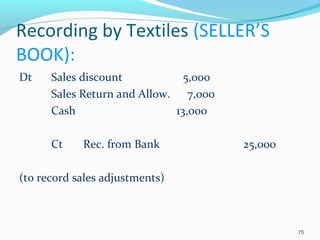
Recording by Textiles (SELLER’S
BOOK):
Dt Sales discount 5,000
Sales Return and Allow. 7,000
Cash 13,000
Ct Rec. from Bank 25,000
(to record sales adjustments)
75
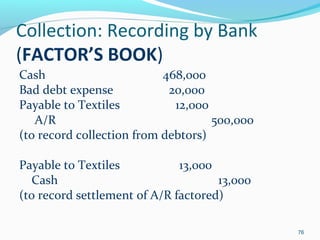
Collection: Recording by Bank
(FACTOR’S BOOK)
Cash 468,000
Bad debt expense 20,000
Payable to Textiles 12,000
A/R 500,000
(to record collection from debtors)
Payable to Textiles 13,000
Cash 13,000
(to record settlement of A/R factored)
76
77
Section 4:Section 4:
Notes receivableNotes receivable
Introduction
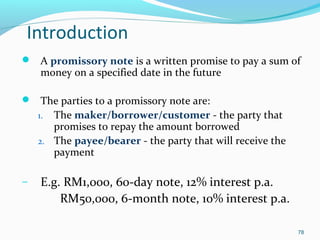
 A promissory note is a written promise to pay a sum of
money on a specified date in the future
 The parties to a promissory note are:
1. The maker/borrower/customer - the party that
promises to repay the amount borrowed
2. The payee/bearer - the party that will receive the
payment
– E.g. RM1,000, 60-day note, 12% interest p.a.
RM50,000, 6-month note, 10% interest p.a.
78
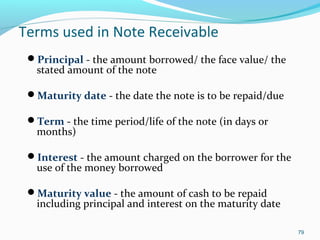
Terms used in Note Receivable
Principal - the amount borrowed/ the face value/ the
stated amount of the note
Maturity date - the date the note is to be repaid/due
Term - the time period/life of the note (in days or
months)
Interest - the amount charged on the borrower for the
use of the money borrowed
Maturity value - the amount of cash to be repaid
including principal and interest on the maturity date
79
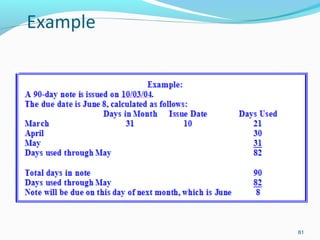
Due date
The life of a note may be expressed in months or days.
When the life of a note is expressed in terms of months, the
due date is found by counting the months from the date of
issue.
When the due date is stated in terms of days, it is necessary
to count the exact number of days to determine the
maturity date.
In counting the life of a note, the date the note is issued is
omitted but the due date is included.
80
Example
81
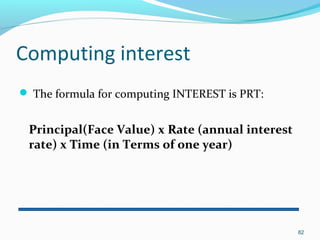
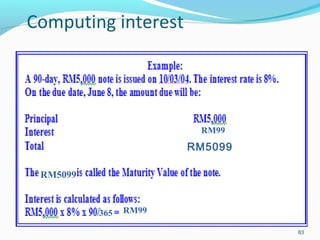
Computing interest
 The formula for computing INTEREST is PRT:
PPrincipal(Face Value) x RRate (annual interest
rate) x TTime (in Terms of one year)
82
Computing interest
83
365 RM99
RM99
RM5099
RM5099
Entries to record notes receivables
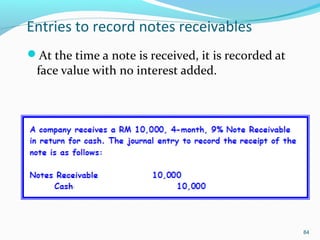
At the time a note is received, it is recorded at
face value with no interest added.
84
Entries to record notes receivables
Notes receivable are reported at their cash (net) realizable
value
A note is honored when it is paid in full at maturity
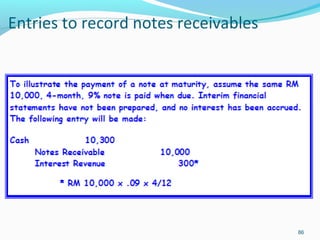
Interest revenue is recorded when the note is paid.
However, if interim financial statements are prepared,
interest on notes receivable is accrued and shown as
interest revenue as it is earned.
85
Entries to record notes receivables
86
Entries to record notes receivables
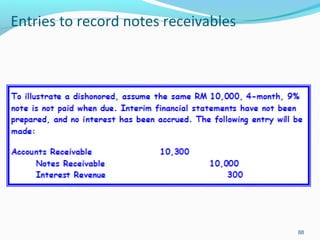
If a note is not paid in full at maturity, it is called a
dishonored note. If it can reasonably be assumed
that the amount due will ultimately be collected, it is
usually transferred to an Account Receivable.
87
Entries to record notes receivables
88
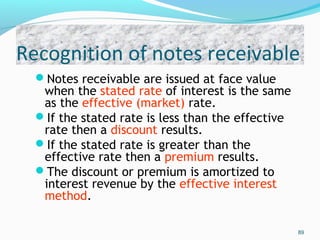
Recognition of notes receivable
Notes receivable are issued at face value
when the stated rate of interest is the same
as the effective (market) rate.
If the stated rate is less than the effective
rate then a discount results.
If the stated rate is greater than the
effective rate then a premium results.
The discount or premium is amortized to
interest revenue by the effective interest
method.
89
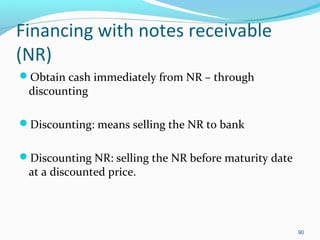
Financing with notes receivable
(NR)
Obtain cash immediately from NR – through
discounting
Discounting: means selling the NR to bank
Discounting NR: selling the NR before maturity date
at a discounted price.
90
91
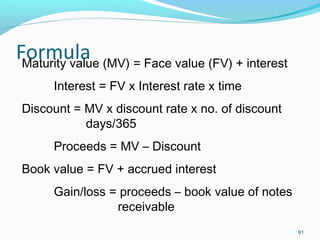
Maturity value (MV) = Face value (FV) + interest
Interest = FV x Interest rate x time
Discount = MV x discount rate x no. of discount
days/365
Proceeds = MV – Discount
Book value = FV + accrued interest
Gain/loss = proceeds – book value of notes
receivable
92
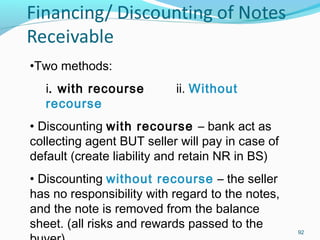
•Two methods:
i. with recourse ii. Without
recourse
• Discounting with recourse – bank act as
collecting agent BUT seller will pay in case of
default (create liability and retain NR in BS)
• Discounting without recourse – the seller
has no responsibility with regard to the notes,
and the note is removed from the balance
sheet. (all risks and rewards passed to the
93
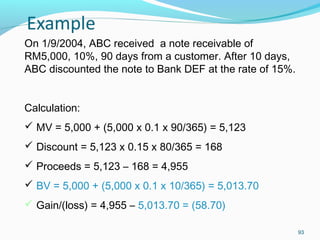
On 1/9/2004, ABC received a note receivable of
RM5,000, 10%, 90 days from a customer. After 10 days,
ABC discounted the note to Bank DEF at the rate of 15%.
Calculation:
 MV = 5,000 + (5,000 x 0.1 x 90/365) = 5,123
 Discount = 5,123 x 0.15 x 80/365 = 168
 Proceeds = 5,123 – 168 = 4,955
 BV = 5,000 + (5,000 x 0.1 x 10/365) = 5,013.70
 Gain/(loss) = 4,955 – 5,013.70 = (58.70)
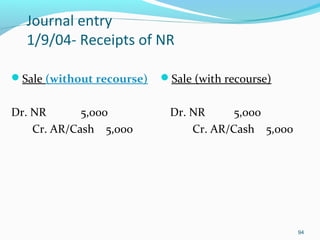
Journal entry
1/9/04- Receipts of NR
Sale (without recourse)
Dr. NR 5,000
Cr. AR/Cash 5,000
Sale (with recourse)
Dr. NR 5,000
Cr. AR/Cash 5,000
94
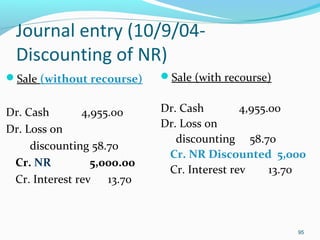
Journal entry (10/9/04-
Discounting of NR)
Sale (without recourse)
Dr. Cash 4,955.00
Dr. Loss on
discounting 58.70
Cr. NR 5,000.00
Cr. Interest rev 13.70
Sale (with recourse)
Dr. Cash 4,955.00
Dr. Loss on
discounting 58.70
Cr. NR Discounted 5,000
Cr. Interest rev 13.70
95
Journal entry
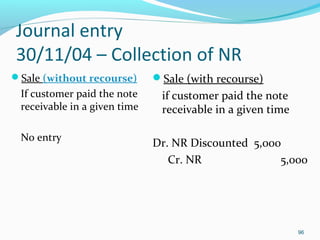
30/11/04 – Collection of NR
Sale (without recourse)
If customer paid the note
receivable in a given time
No entry
Sale (with recourse)
if customer paid the note
receivable in a given time
Dr. NR Discounted 5,000
Cr. NR 5,000
96
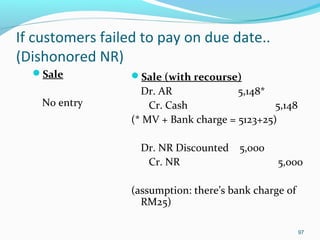
If customers failed to pay on due date..
(Dishonored NR)
Sale
No entry
Sale (with recourse)
Dr. AR 5,148*
Cr. Cash 5,148
(* MV + Bank charge = 5123+25)
Dr. NR Discounted 5,000
Cr. NR 5,000
(assumption: there’s bank charge of
RM25)
97
98
Section 5:Section 5:
PresentationPresentation
in balance sheetin balance sheet
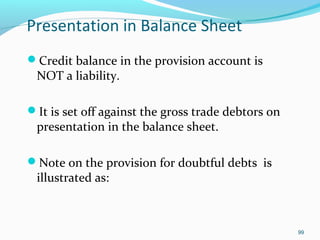
Presentation in Balance Sheet
Credit balance in the provision account is
NOT a liability.
It is set off against the gross trade debtors on
presentation in the balance sheet.
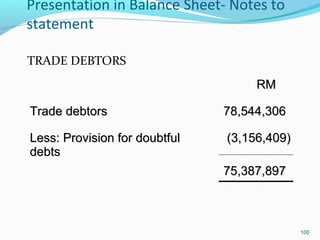
Note on the provision for doubtful debts is
illustrated as:
99
Presentation in Balance Sheet- Notes to
statement
TRADE DEBTORS
RMRM
Trade debtorsTrade debtors 78,544,30678,544,306
Less: Provision for doubtfulLess: Provision for doubtful
debtsdebts
(3,156,409)(3,156,409)
75,387,89775,387,897
100
Presentation in Balance Sheet
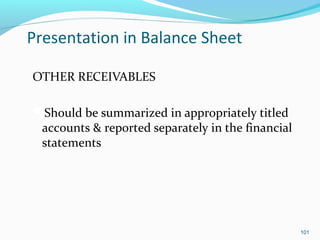
OTHER RECEIVABLES
Should be summarized in appropriately titled
accounts & reported separately in the financial
statements
101
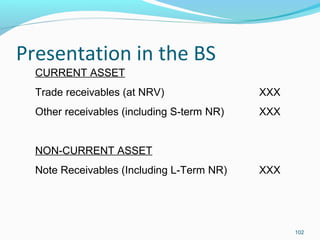
Presentation in the BS
102
CURRENT ASSET
Trade receivables (at NRV) XXX
Other receivables (including S-term NR) XXX
NON-CURRENT ASSET
Note Receivables (Including L-Term NR) XXX
Ratio
The ratio used to assess the liquidity of
receivables is the receivables turnover ratio.
Receivables turnover ratio measures the number
of times, on average, receivables are collected
during the period.
103

Chapter2 receivable edited2013

  • 1.
  • 2.
    2 Learning Objectives 1. Definereceivables and identify the different types of receivables. 2. Explain accounting issues related to recognition and valuation of accounts receivable. 3. Assignment and Factoring of Accounts Receivables
  • 3.
    3 Learning Objectives 4. Explainaccounting issues related to recognition and valuation of notes receivable. 5. Explain how receivables are reported and analysed.
  • 4.
    4 Section 1:Section 1: Definitionand typesDefinition and types of receivablesof receivables
  • 5.
    Receivable -Definition Amounts duefrom individuals and companies. 5
  • 6.
    Accounts receivables Receivable associatedwith the normal operating activities of a business e.g. Credit sales of goods & services to customers Expected to be collected generally within 30 to 90 days. Most significant type of claim held by company. Often called trade receivables. 6
  • 7.
    Notes receivables Receivables thatare evidenced by a formal written promise to pay a certain sum of money at a specified date Normally requires payment of interest and extends for time periods of 60-90 days or longer Notes receivables give holder a stronger legal claim to assets than accounts receivable Promissory note is a negotiable instrument and may be transferred to another party by endorsement 7
  • 8.
    Other receivables Non-trade receivable Includeall other types of receivable Arise from a variety of transactions e.g. Sale of property, advances to directors & employees, claim for losses or damages. 8
  • 9.
    9 Section 2:Section 2: Accountingissues -Accounting issues - recognition & valuationrecognition & valuation of accounts receivablesof accounts receivables
  • 10.
    Accounts Receivable –Issues Recognition and valuation of accounts receivable √ Trade discounts - Cash discounts √ Sales returns and allowances √ Valuation of trade debtors 10
  • 11.
    Accounts Receivable: RECOGNITION Recognizing accountsreceivables Companies record accounts receivable at point of sale Entry is recorded to increase both Accounts Receivable and Sales as follows: Journal entry: DR Accounts Receivable RMXXX CR Sales RMXXX (to record sales of RMXXX) 11
  • 12.
    RECORDING DISCOUNTS There aretwo methods: (1) Gross method records discounts when taken by customers. (2) Net method records discounts not taken by customers. 12
  • 13.
    RECORDING DISCOUNTS Record revenueat gross amount of sales When customer takes the discount, record cash discounts Cash discounts reduce gross sales revenue Record revenue at gross amount of sales less cash discount When customer forfeits discount, record discounts not taken Report discounts forfeited as other revenue 13 Gross Method Net Method
  • 14.
    Accounts Receivable: RECOGNITION Sales discount(Gross method) Cash (sales) discounts are inducements to customers for prompt payment of amounts billed. Cash discounts are normally recorded and appear in books as a reduction of sales revenue (gross method). 14
  • 15.
    Accounts Receivable: Recognition Example:if the sales invoice of RM100 include the credit terms “2/10, net 60 days” -> 2% cash discount on gross invoiced amount is given if pays within 10 days. Using the Gross method the transaction would be recorded as follows: At date of sale: Dr Accounts Receivable 100 Cr Sales 100 15
  • 16.
    Accounts Receivable: Recognition Atthe date of receipt (assume discount is taken): Dr Cash 98 Dr Cash discount on sales 2 Cr Accounts Receivable 100 At the date of receipt (assume payment is received after discount period, discount not taken): Dr Cash 100 Cr Accounts Receivable 100 16
  • 17.
    Net Method: At pointof sale: Dr. Accounts Receivable 98 Cr. Sales 98 If receives within discount period: Dr. Cash 98 Cr. Accounts Receivable 98 If receives after discount period(discount not taken): Dr. Cash 100 Cr. Accounts Receivable 98 Discount forfeited 2 17
  • 18.
    Accounts Receivable: RECOGNITION Trade discounts Trade(quantity) discounts are not recorded. Invoiced at the amount net of the trade discount (net method). e.g.: The quoted price of RM100 and a trade discount of 10% resulted in sales and debtor amount recorded at RM90. 18
  • 19.
    Accounts Receivable: RECOGNITION Sales return& allowances Allowances are to be made for  Goods that are returned by customers, and/or  Goods that are damaged during shipment, spoiled or defective goods, or shipment of an incorrect quantity or type of goods. Net sales and accounts receivable are reduced. 19
  • 20.
    Accounts Receivable: Recognition Example: Assumethat books A costing RM700 are sold and shipped to customer B for RM1,200. Buyer calls to inform that Book C were actually ordered. Buyer agrees to accept the goods if a reduction in price is given. The company allows an allowance of RM250. 20
  • 21.
    Accounts Receivable: Recognition Theentry to record the sales allowance(goods not returned): Dr Sales returns and allowance 250 Cr Accounts receivable 250 If buyer returns the good, the entry will be: Dr Sales returns and allowance 1,200 Cr Accounts receivable 1,200 *Dr Inventory 700 Cr Cost of goods sold 700 (*perpertual system) 21
  • 22.
    VALUATION OF ACCOUNTS RECEIVABLE Accordingto MFRS 139, loan and receivable are valued at amortized cost. For short-lived debts such as trade receivables on normal commercial term, the carrying amount is the amount of debts less any doubtful debt allowances. 22
  • 23.
    Valuation of AccountsReceivable Short term accounts receivable are shown at their net realizable value as follows: RM Accounts Receivable (gross) XXX Less: Provision for bad & doubtful debts _ XX Amortized cost XX 23
  • 24.
    Uncollectibles of Accounts Receivables Itis common for companies to have uncollected receivables. Journal entries involved: Dr. Bad debts expense Cr. Allowance for doubtful debts Companies have to estimate If cannot – may make direct write off of the uncollectible debts 24
  • 25.
    Methods to estimatebad debts: i. percentage of sales method ii. percentage of receivables method iii. Age receivables analysis However, MFRS 139 only allow the third method. - Focus is on providing an estimate of accounts receivable value - Uses past collection experience to estimate bad debt expense - Bad debt expense in the current year is calculated by taking into account the existing balance in the provision for bad & doubtful debts 25
  • 26.
    Example: Aged ReceivableAnalysis 26 ABC Sdn. Bhd. - Aging Schedule CustomerCustomer BalanceBalance RMRM < 60< 60 DaysDays RMRM 61 – 9061 – 90 DaysDays RMRM 91 – 12091 – 120 DaysDays RMRM >120 Days>120 Days RMRM HarunHarun 98,00098,000 80,00080,000 $ 18,000$ 18,000 RashidRashid 320,000320,000 320,000320,000 KumarKumar 55,00055,000 55,00055,000 ChongChong 74,00074,000 60,00060,000 14,00014,000 547,000547,000 460,000460,000 18,00018,000 14,00014,000 55,00055,000 EstimatedEstimated UncollectiblUncollectibl ee 4%4% 15%15% 20%20% 25%25%
  • 27.
    27 Calculate uncollectible accounts(bad debts) expense: 460,000 * .04 RM18,400 18,000 * .15 2,700 14,000 * .20 2,800 55,000 * .25 13,750 Required balance in the Allowance for Doubtful debts RM37,650 Less: Current Balance RM800 Bad Debts Expense RM36,850 1 2 Journal entries: DR Bad debts expense RM36,850 CR Allowance Doubtful debts RM36,850
  • 28.
    28 Methods 1. Direct Write-Off2. Allowance Not based on the matching Based on the matching principle principle 1 Accounts are written-off Estimated bad debts are when determined uncollectible matched against revenue 2 Appropriate only if Must be followed if amounts are not material amounts are material 3
  • 29.
    Allowance (estimated) writeoff Is based on estimates of uncollectible AR at end of accounting period. Dt Bad debts xx Ct Prov. for doubtful debt xx Once confirm cannot be collected, debit the allowance account, credit the AR account. Dt Prov. for doubtful debt xx Ct AR xx 29
  • 30.
    Collection of ARAfter Writing Off Bad Debts under Allowance method Dt Account Receivable x Ct Prov. for Doubtful Debt x Dt Cash x Ct Account Receivable x 30
  • 31.
    Direct write-off method Baddebt expense is recognised or recorded in the period in which it is determined that a specific trade debtor cannot be collected (cash basis). 31
  • 32.
    Direct write offmethod  Accounts are written off when a specific customer’s debt is determined uncollectible  Method: Increase Bad Debt Expense and Decrease Accounts Receivable Journal entries DR Bad Debt Expense RM100 CR Accounts Receivable- Customer A RM100 32
  • 33.
    Direct write offmethod The direct write-off method does not match revenues against expenses e.g. If the sale was made in October 2012, but the uncollectible is recognized in March 2013, then the revenue of a company with December FYE would be recognized in 2012 and its expense in 2013. Generally, most companies, in practice, prefer the allowance method. The allowance method made a provision of uncollectible debts 33
  • 34.
    34 • If theaccount is collected, after being written off, then: Dr. Cash Cr. Bad debts Recovered (for the amount collected) -the bad debts recovered will be reported as “other income” in IS.
  • 35.
    Collection of ARAfter Writing Off Bad Debts under Allowance method Dt Account Receivable x Ct Prov. for Doubtful Debt x Dt Cash x Ct Account Receivable x 35
  • 36.
    36 Section 3:Section 3: Assignment&Assignment & Factoring ofFactoring of Accounts ReceivablesAccounts Receivables
  • 37.
    The holder ofaccounts or notes receivable may transfer them for cash. The transfer may be:  assignment (secured borrowing) or  factoring (a sale of receivables) Assigning/pledging accounts receivable means using them as collateral for a loan. Holder retains ownership. Factoring accounts receivable means selling them. Factoring can be with recourse or without recourse. Recourse refers to ultimate responsibility for payment. 37
  • 38.
    Why use receivablesas a source of cash? Providing customer financing is mandatory in many industries, e.g. autos, industrial and farm equipment, durable goods. Access to normal financing may be unavailable or expensive, e.g., further borrowing may violate existing debt covenants. Seller may prefer to leave billing and collection to a more specialized agency. Receivables financing may be cheaper than debt, as the former conveys ownership rights to the purchaser. 38
  • 39.
    Assignment of receivables Tradedebt may be assigned or pledged with a banker to obtain funds to meet company’s cash needs. Trade debts are used as collaterals to obtain the financing. Risk of bad debts are not passed on to the banker because it has the full recourse on the company in the event that the trade debtors are unable to settle their debts. 39
  • 40.
    Assignment of receivables Billof exchange – trade debt financing arrangements to acknowledge its liability. The trade debts are remained in the accounting records and the cash received and the corresponding bill payable should be recognized in the accounts. 40
  • 41.
    Assignment of receivables Transferorrecords for note payable and finance charge. No effect on accounting for accounts receivable. Transferor collects accounts receivable. Transferor records sales returns and sales discounts. Transferor absorbs bad debts expense. Transferor records interest expense on notes payable. Transferor pays on the note periodically from collections. Meanwhile, the banker will record for note receivables,Meanwhile, the banker will record for note receivables, finance revenue, interest revenue and cash paid and received.finance revenue, interest revenue and cash paid and received. 41
  • 42.
    Assignment of receivables Example1 On January 2013, Provo Mercantile Co. assigns specific receivables totaling RM300,000 to Salem Bank as collateral on a RM200,000, 12% note. Salem assesses a 1% finance charge on assigned receivables in addition to the interest on the note. Provo is to make monthly payments to Salem with cash collected on assigned receivables. The entry should be as follows: 42
  • 43.
    Assignment of receivables InProvo’s Book 1/1/2013 DR Cash RM197,000 DR Finance charge RM3,000 CR Notes payable RM200,000 (to record the loan with Salem Bank) The trade debts of RM300,000 still remains in Provo’s accounts. Dr. Accounts receivable assigned RM300,000 Cr. Accounts receivable RM300,000 ( to reclassify the assigned account receivable) 43
  • 44.
    In Salem bank’sbook:In Salem bank’s book: 1/1/20131/1/2013 DR Note ReceivableDR Note Receivable 200,000200,000 CR Finance revenueCR Finance revenue 3,0003,000 CR CashCR Cash 197,000197,000 (to record loan to Provo Co.)(to record loan to Provo Co.) 44
  • 45.
    Assignment of receivables Provo’sbook 31/1/2013 Collection of assigned accounts during January 2013 of RM180,000 less cash discounts of RM1,000; Sales return in January RM2,000 31/1/13 RM RM Cash 179,000 Cash Discounts 1,000 Sales return 2,000 Accounts Receivable Assigned 182,000 (to record collection in January) 45
  • 46.
    Assignment of receivables Provo’sbook 1/2/2013 February 2013, Payment to Salem Bank on amount owed plus interest on note payable Journal entries-1/2/2013 RM RM DR Notes payable 179,000 DR Interest expense 2,000 CR Cash 181,000 (To record loan repayment) 46
  • 47.
    In the Salem’sbook:In the Salem’s book: 1/2/20131/2/2013 DR CashDR Cash 181,000181,000 CR Note receivableCR Note receivable 179,000179,000 CR Interest revenueCR Interest revenue 2,0002,000 (to record receipts from Provo Co. and recognize(to record receipts from Provo Co. and recognize interest revenue)interest revenue) 47
  • 48.
    Assignment of receivables Provo’sbook 28/2/2013 Collection of the remaining 118,000 of receivables assigned, without discounts or sales returns. RM RM DR Cash 118,000 CR Accounts Receivable 118,000 Assigned (ARA) (To record collection in February) 48
  • 49.
    Assignment of receivables Provo’sbook 1/3/2013 Remittance of balance due to Salem Bank RM RM DR Notes payable 21,000 DR Interest expense 210 CR Cash 21,210 (to record loan repayment) 49
  • 50.
    Assignment of receivables Provo’sbook 28/2/2013 Assuming Provo received RM21,000 from AR Assigned, instead of RM118,000: Dr. Cash 21,000 Cr. A/R assigned 21,000 (To record collection in February) 50
  • 51.
    Assignment of receivables Provo’sbook 1/3/2013: Remitted the balance due to Salem Bank. Dr. Notes Payable 21,000 Dr. Interest expense 210 Cr. Cash 21,210 (To record loan repayment) The balance in Accounts Receivable Assigned is to be reclassified as follows: Dr. Accounts Receivable 97,000 Cr. Accounts Receivable 97,000 Assigned (To reclassify remaining balance of AR assigned) 51
  • 52.
    In theIn theSalem’s book:Salem’s book: 1/3/20131/3/2013 DR CashDR Cash 21,21021,210 CR Notes receivableCR Notes receivable 21,00021,000 CR Interest revenueCR Interest revenue 210210 (to record receipts from Provo Co. and recognize(to record receipts from Provo Co. and recognize interest revenue)interest revenue) 52
  • 53.
    Factoring of receivables Anotherway of obtaining cash advances on trade debts. FACTORING : transferring (selling) the AR to a factor (a company that undertakes factoring) Differs from assignment of trade debts where the factoring company administers the credit management (includes sales accounting services, credit administration and control services and collection services) for the company. 53
  • 54.
    Question: How is factoringrecorded? Are we going to RECOGNIZE or DERECOGNIZE the sold receivables? MFRS 139/ Para 17 Derecognition of financial assets (a) when the contractual rights to the cash flows expire. (b) when the rights attached to the asset have not expired, instead the asset has been transferred to another party. 54
  • 55.
    MFRS 139 More complexsituation, adopts a step by step approach: Whether there is a transfer of the financial asset (“the asset transfer test”); and Whether substantially all the risks and rewards of ownership of the financial asset have been transferred (“the risk and reward test”). 55
  • 56.
    MFRS 139 General principal: Ifit passes both the asset transfer test and the risk and reward test – DERECOGNIZE If it fails the asset transfer test – CONTINUE TO RECOGNIZE If it passes the asset transfer test but fails the risk and rewards test, the entity needs to consider whether the entity has retained control over the asset and if so what extent of its continuing involvement in the asset is -If do not retained control – DERECOGNIZE -If retained control – CONTINUE TO RECOGNIZE 56
  • 57.
    Factoring of receivables Two types of debt factoring: 1. Debt factoring with recourse 2. Debt factoring without recourse 57
  • 58.
    RECOURSE – refersto the ultimate responsibility to pay for the debt (if default). With recourseWith recourse Without recourseWithout recourse SELLERSELLER BUYERBUYER ( the factor co.)( the factor co.) 58
  • 59.
    Factoring of receivableswith recourse Debt factoring with recourse Immediate cash advances for certain % of the debt factored provided by the factoring company. The factor company – acts as a collection agent. The seller has retained all the risk associated with the trade receivable  full recourse. 59
  • 60.
    Factoring of receivableswith recourse (cont.) Therefore, the trade receivables would be retained on the BS as assets and the proceeds received would be recognized as a liability. As and when the trade debtors settled and the cash was passed over to the factor, the trade receivables and liability would be reduced. 60
  • 61.
    Factoring of receivableswith recourse (Example 1) Example: Jacko Sdn Bhd had RM4,000,000 accounts receivable. The A/R were sold to a bank on a recourse factoring arrangement. The amount of cash advance obtained was RM3,600,000 less a factoring fee of RM60,000. Also finance interest is calculated at 15% p.a. Show the journal entry to record the recourse factoring arrangement. 61
  • 62.
    Factoring of receivableswith recourse (Example 1) Journal entry – SELLER’S BOOK(JACKO S/B) RM RM DR Cash 3,540,000 DR Factoring fee deferred 60,000 CR Liability on transferred AR 3,600,000 (to record receivables factored with recourse) Factoring fee will be amortized over the period of the debt collection. Interest will be recognized as an expense until the debts are collected and advance paid. 62
  • 63.
    Receivables factoring withrecourse (Example 2) Textiles Corporation factors RM500,000 of accounts receivable with Cotton Bank Berhad on a recourse basis. The Cotton Bank Berhad assesses a finance charge of 3% of the amount of accounts receivable and retain an amount equal to 5% of the accounts receivable. 63
  • 64.
    Receivables factoring with recourse(Example 2) Journal entries – Textiles Corp. (SELLER’S BOOK) RM RM DR Cash 460,000 DR Receivable from Bank-holdback (5%) 25,000 DR Finance charge (deferred) (3%) 15,000 CR Liability on transferred AR 500,000 64
  • 65.
    Receivables factoring with recourse(Example 2) Journal entries – Cotton Bank Berhad (FACTOR’S BOOK) RM RM DR Accounts receivable 500,000 CR Payable to Textiles 25,000 CR Financing revenue 15,000 CR Cash 460,000 65
  • 66.
    Example 2- Receivablesfactoring with recourse: Collection of AR Assume RM20,000 was uncollectible and there were RM7,000 sales return and allowances, sales discount of RM5,000. The remaining amount was collected by the bank. 66
  • 67.
    Recording by TextilesCorp. (SELLER’S BOOK): Bad debt expense 20,000 Sales discount 5,000 Sales Return and Allow. 7,000 Receivables from Bank-holdback 25,000 Cash 7,000 (to record sales adjustment and BD and pay for the shortage) Liability on transferred Recv. 500,000 Accounts receivable 500,000 (to close liability a/c and a/receivables collected) 67
  • 68.
    Recording by Bank(FACTOR’S BOOK) Cash 468,000 Payable to Textiles 12,000 Acct Receivable 480,000 (to record collection from debtors) Payable to Textiles 13,000 Cash 7,000 Acct Receivable 20,000 (to record settlement of A/R factored) 68
  • 69.
    Factoring of receivableswithout recourse Debt factoring without recourse The legal title (the form) together with the risks and rewards (the substance) of the trade debts pass to the factoring company. The difference between the net proceeds and the carrying amount of the trade debts (if any) is recognized as a loss on sale of trade debts in the income statement. 69
  • 70.
    Factoring of receivableswithout recourse Ownership, risks and gain will be transferred to the factoring company. Control of receivables would be in the hand of factoring company. Factoring company will charge the commission based on the risks associated Factoring company normally pays 80% -90% of the face value after considering the potential sales return/allowance 70
  • 71.
    Factoring of receivableswithout recourse- Example 1 Textiles Corporation factors RM500,000 of accounts receivable with Cotton Bank Berhad on a without recourse basis. The receivable records are transferred to Cotton Bank Berhad, which will receive the collections. The Cotton Bank Berhad assesses a finance charge of 3% of the amount of accounts receivable & retain an amount equal to 5% of the accounts receivable. 71
  • 72.
    Factoring of receivableswithout recourse- Example 1 Journal entries – Textiles Corp. (SELLER’S BOOK) RM RM DR Cash 460,000 DR Receivable from Bank-holdback 25,000 DR Finance charge 15,000 CR Accounts receivable 500,000 (To record the receivables sold without recourse) 72
  • 73.
    Factoring of receivableswithout recourse- Example 1 Journal entries – Cotton Bank Berhad (FACTOR’S BOOK) RM RM DR Accounts receivable 500,000 CR Payable to Textiles 25,000 CR Financing revenue 15,000 CR Cash 460,000 (To record the receivables purchased without recourse) 73
  • 74.
    Example 1- Receivablesfactoring without recourse: Collection of AR Assume RM20,000 was uncollectible and there were RM7,000 sales return and allowances, sales discount of RM5,000. The remaining amount was collected by the bank. 74
  • 75.
    Recording by Textiles(SELLER’S BOOK): Dt Sales discount 5,000 Sales Return and Allow. 7,000 Cash 13,000 Ct Rec. from Bank 25,000 (to record sales adjustments) 75
  • 76.
    Collection: Recording byBank (FACTOR’S BOOK) Cash 468,000 Bad debt expense 20,000 Payable to Textiles 12,000 A/R 500,000 (to record collection from debtors) Payable to Textiles 13,000 Cash 13,000 (to record settlement of A/R factored) 76
  • 77.
    77 Section 4:Section 4: NotesreceivableNotes receivable
  • 78.
    Introduction  A promissorynote is a written promise to pay a sum of money on a specified date in the future  The parties to a promissory note are: 1. The maker/borrower/customer - the party that promises to repay the amount borrowed 2. The payee/bearer - the party that will receive the payment – E.g. RM1,000, 60-day note, 12% interest p.a. RM50,000, 6-month note, 10% interest p.a. 78
  • 79.
    Terms used inNote Receivable Principal - the amount borrowed/ the face value/ the stated amount of the note Maturity date - the date the note is to be repaid/due Term - the time period/life of the note (in days or months) Interest - the amount charged on the borrower for the use of the money borrowed Maturity value - the amount of cash to be repaid including principal and interest on the maturity date 79
  • 80.
    Due date The lifeof a note may be expressed in months or days. When the life of a note is expressed in terms of months, the due date is found by counting the months from the date of issue. When the due date is stated in terms of days, it is necessary to count the exact number of days to determine the maturity date. In counting the life of a note, the date the note is issued is omitted but the due date is included. 80
  • 81.
  • 82.
    Computing interest  Theformula for computing INTEREST is PRT: PPrincipal(Face Value) x RRate (annual interest rate) x TTime (in Terms of one year) 82
  • 83.
  • 84.
    Entries to recordnotes receivables At the time a note is received, it is recorded at face value with no interest added. 84
  • 85.
    Entries to recordnotes receivables Notes receivable are reported at their cash (net) realizable value A note is honored when it is paid in full at maturity Interest revenue is recorded when the note is paid. However, if interim financial statements are prepared, interest on notes receivable is accrued and shown as interest revenue as it is earned. 85
  • 86.
    Entries to recordnotes receivables 86
  • 87.
    Entries to recordnotes receivables If a note is not paid in full at maturity, it is called a dishonored note. If it can reasonably be assumed that the amount due will ultimately be collected, it is usually transferred to an Account Receivable. 87
  • 88.
    Entries to recordnotes receivables 88
  • 89.
    Recognition of notesreceivable Notes receivable are issued at face value when the stated rate of interest is the same as the effective (market) rate. If the stated rate is less than the effective rate then a discount results. If the stated rate is greater than the effective rate then a premium results. The discount or premium is amortized to interest revenue by the effective interest method. 89
  • 90.
    Financing with notesreceivable (NR) Obtain cash immediately from NR – through discounting Discounting: means selling the NR to bank Discounting NR: selling the NR before maturity date at a discounted price. 90
  • 91.
    91 Maturity value (MV)= Face value (FV) + interest Interest = FV x Interest rate x time Discount = MV x discount rate x no. of discount days/365 Proceeds = MV – Discount Book value = FV + accrued interest Gain/loss = proceeds – book value of notes receivable
  • 92.
    92 •Two methods: i. withrecourse ii. Without recourse • Discounting with recourse – bank act as collecting agent BUT seller will pay in case of default (create liability and retain NR in BS) • Discounting without recourse – the seller has no responsibility with regard to the notes, and the note is removed from the balance sheet. (all risks and rewards passed to the
  • 93.
    93 On 1/9/2004, ABCreceived a note receivable of RM5,000, 10%, 90 days from a customer. After 10 days, ABC discounted the note to Bank DEF at the rate of 15%. Calculation:  MV = 5,000 + (5,000 x 0.1 x 90/365) = 5,123  Discount = 5,123 x 0.15 x 80/365 = 168  Proceeds = 5,123 – 168 = 4,955  BV = 5,000 + (5,000 x 0.1 x 10/365) = 5,013.70  Gain/(loss) = 4,955 – 5,013.70 = (58.70)
  • 94.
    Journal entry 1/9/04- Receiptsof NR Sale (without recourse) Dr. NR 5,000 Cr. AR/Cash 5,000 Sale (with recourse) Dr. NR 5,000 Cr. AR/Cash 5,000 94
  • 95.
    Journal entry (10/9/04- Discountingof NR) Sale (without recourse) Dr. Cash 4,955.00 Dr. Loss on discounting 58.70 Cr. NR 5,000.00 Cr. Interest rev 13.70 Sale (with recourse) Dr. Cash 4,955.00 Dr. Loss on discounting 58.70 Cr. NR Discounted 5,000 Cr. Interest rev 13.70 95
  • 96.
    Journal entry 30/11/04 –Collection of NR Sale (without recourse) If customer paid the note receivable in a given time No entry Sale (with recourse) if customer paid the note receivable in a given time Dr. NR Discounted 5,000 Cr. NR 5,000 96
  • 97.
    If customers failedto pay on due date.. (Dishonored NR) Sale No entry Sale (with recourse) Dr. AR 5,148* Cr. Cash 5,148 (* MV + Bank charge = 5123+25) Dr. NR Discounted 5,000 Cr. NR 5,000 (assumption: there’s bank charge of RM25) 97
  • 98.
  • 99.
    Presentation in BalanceSheet Credit balance in the provision account is NOT a liability. It is set off against the gross trade debtors on presentation in the balance sheet. Note on the provision for doubtful debts is illustrated as: 99
  • 100.
    Presentation in BalanceSheet- Notes to statement TRADE DEBTORS RMRM Trade debtorsTrade debtors 78,544,30678,544,306 Less: Provision for doubtfulLess: Provision for doubtful debtsdebts (3,156,409)(3,156,409) 75,387,89775,387,897 100
  • 101.
    Presentation in BalanceSheet OTHER RECEIVABLES Should be summarized in appropriately titled accounts & reported separately in the financial statements 101
  • 102.
    Presentation in theBS 102 CURRENT ASSET Trade receivables (at NRV) XXX Other receivables (including S-term NR) XXX NON-CURRENT ASSET Note Receivables (Including L-Term NR) XXX
  • 103.
    Ratio The ratio usedto assess the liquidity of receivables is the receivables turnover ratio. Receivables turnover ratio measures the number of times, on average, receivables are collected during the period. 103