Accounting Standard 25 Interim Financial Reporting
Contents Objective Scope Form and Content of an interim financial statement Period for which interim financial statements are required to be presented Disclosure in Annual Financial Statements Recognition and Measurement Examples of applying the recognition and measurement principles Comparison Issues
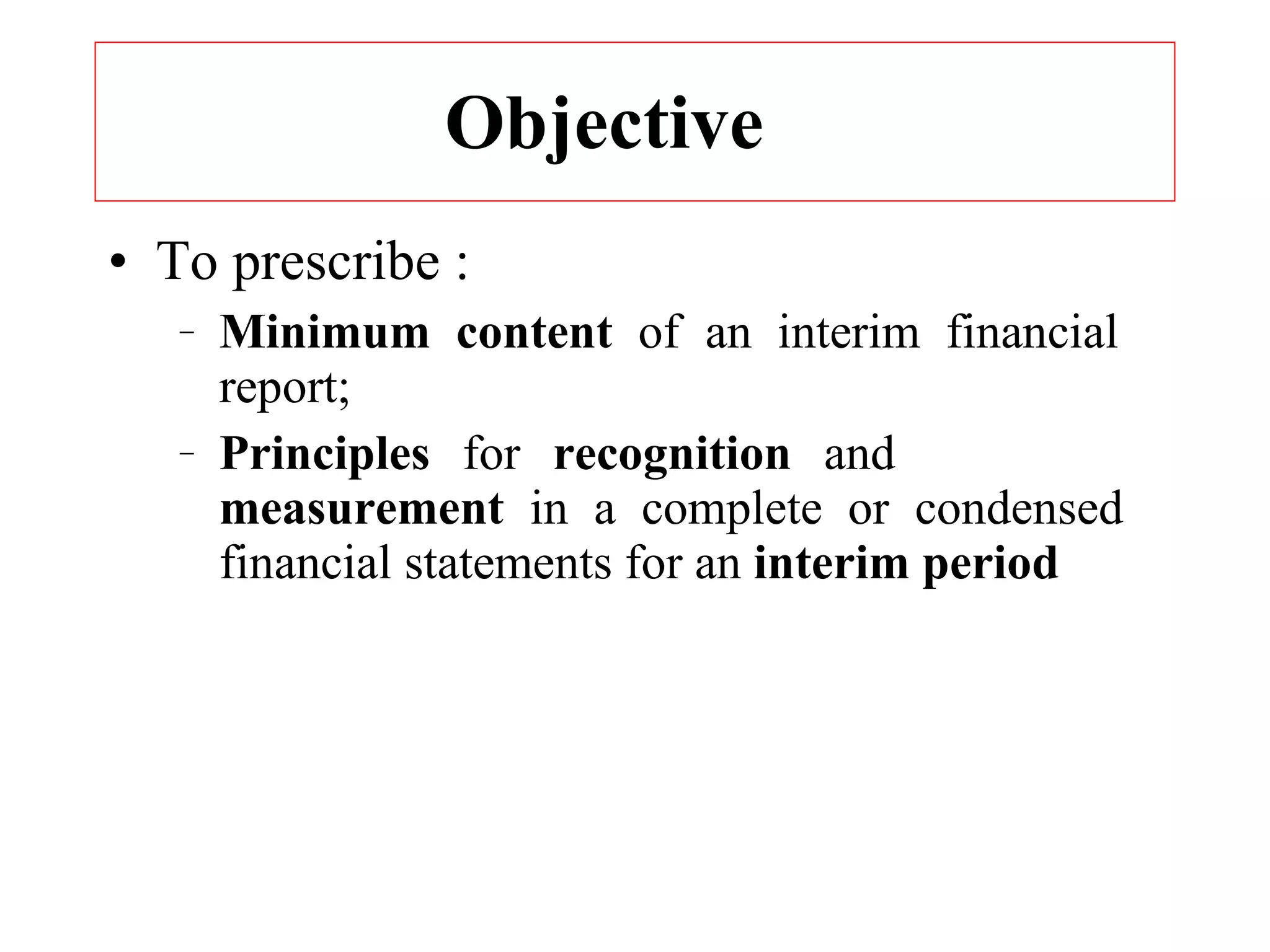
Objective  To prescribe : Minimum content  of an interim financial  report; Principles  for  recognition  and  measurement  in a complete or condensed  financial statements for an  interim period
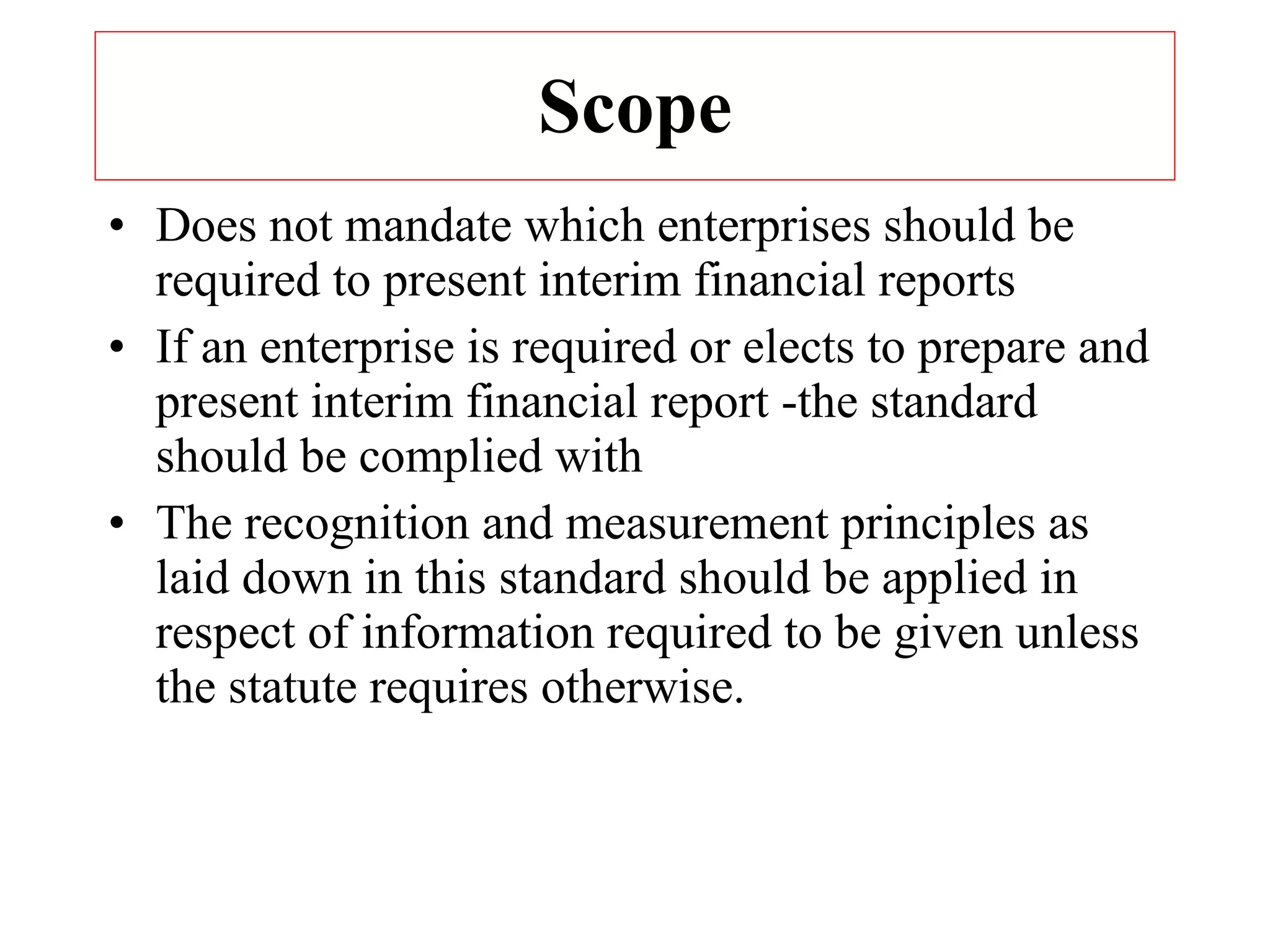
Scope Does not mandate which enterprises should be required to present interim financial reports If an enterprise is required or elects to prepare and present interim financial report -the standard should be complied with The recognition and measurement principles as laid down in this standard should be applied in respect of information required to be given unless the statute requires otherwise.
Scope... Cash flow statement, complete or condensed to be prepared if the enterprise presents cash flow statement for the purpose of its annual financial report
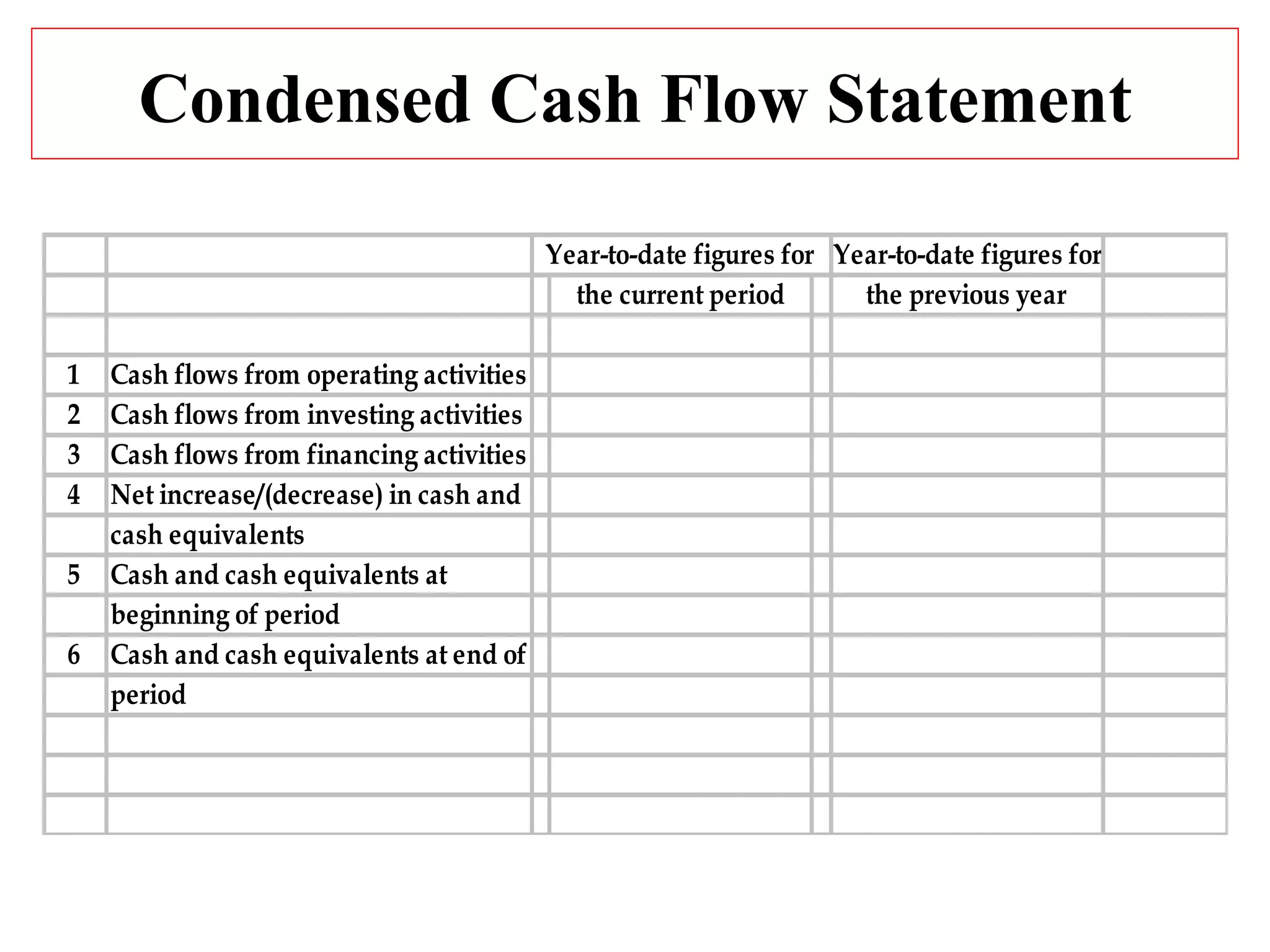
Minimum Components of an Interim Financial Report An interim financial report should include -condensed balance sheet -condensed statement of profit and loss -condensed cash flow statement and  - selected explanatory notes
Form & Content of an Interim Financial Statement  Complete set of financial statements should conform to the requirements applicable to annual financial statements. Condensed set of financial statements should at minimum have each headings or subheadings that were included in the latest annual financial statements.
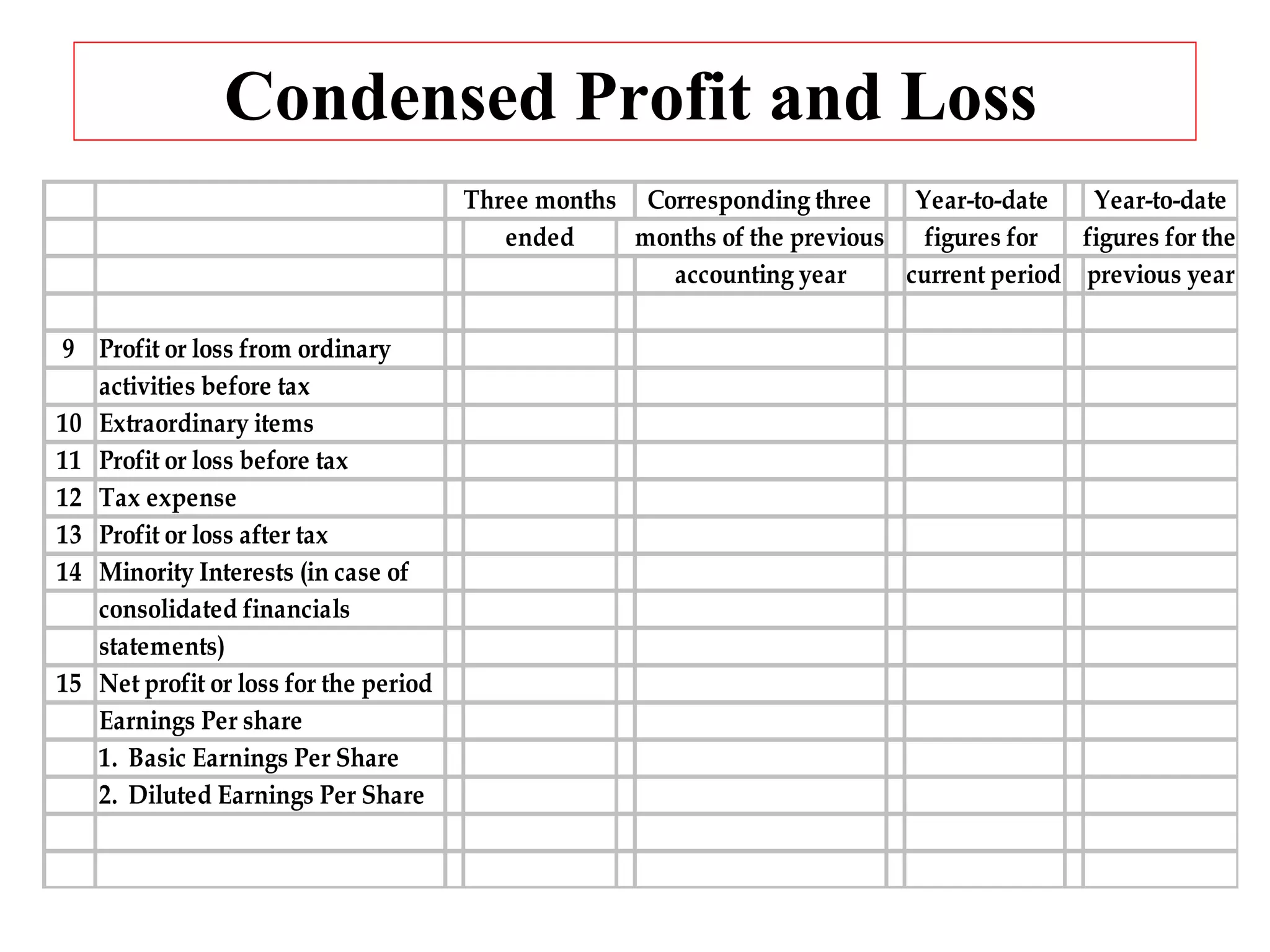
Form & Content... If EPS is disclosed in the annual financial statement then the same needs to be disclosed on the face of the  interim  statement of profit and loss; If consolidated annual financial statements are prepared then interim consolidated statements need to be prepared in addition to the separate financial statements.
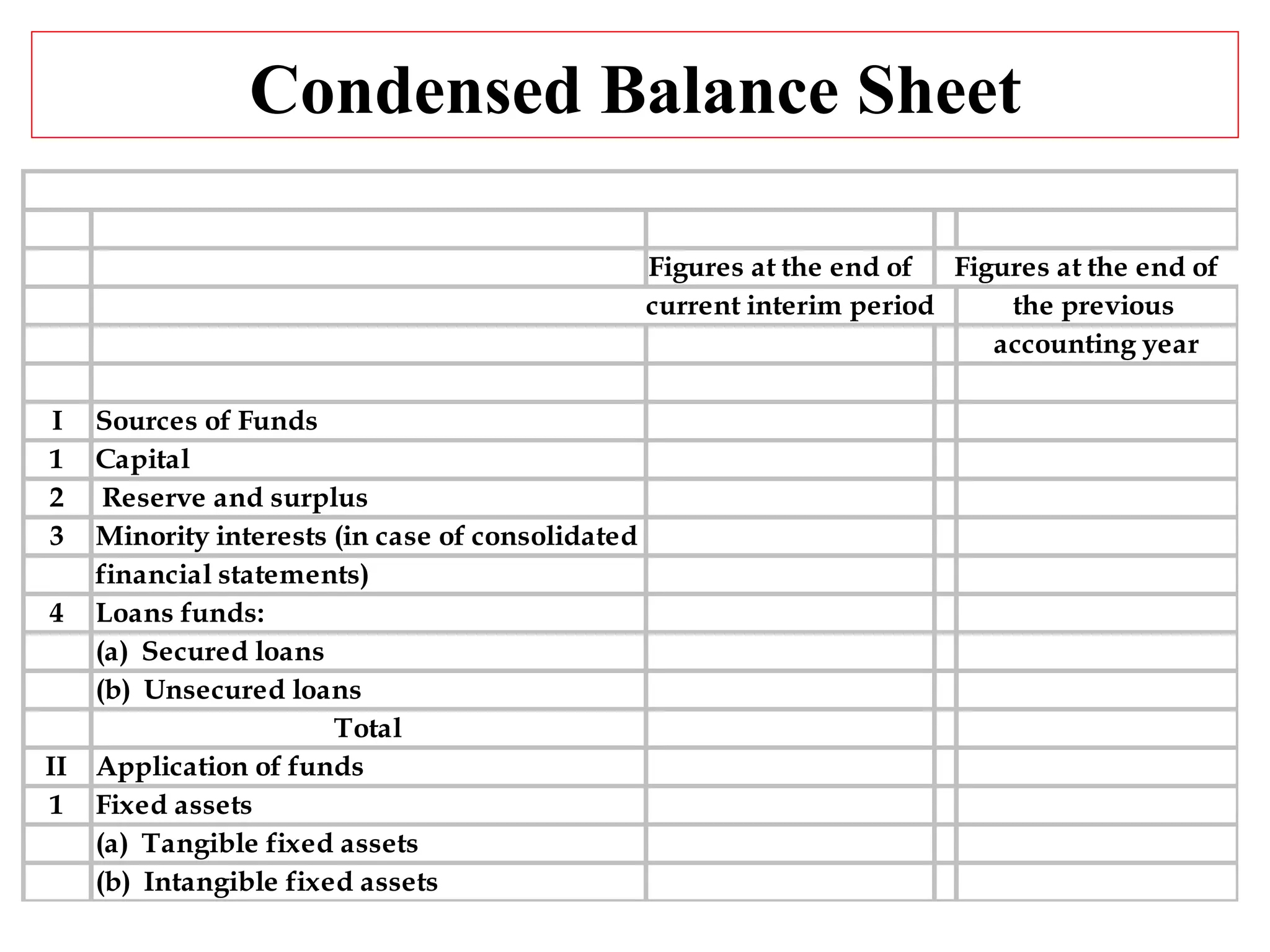
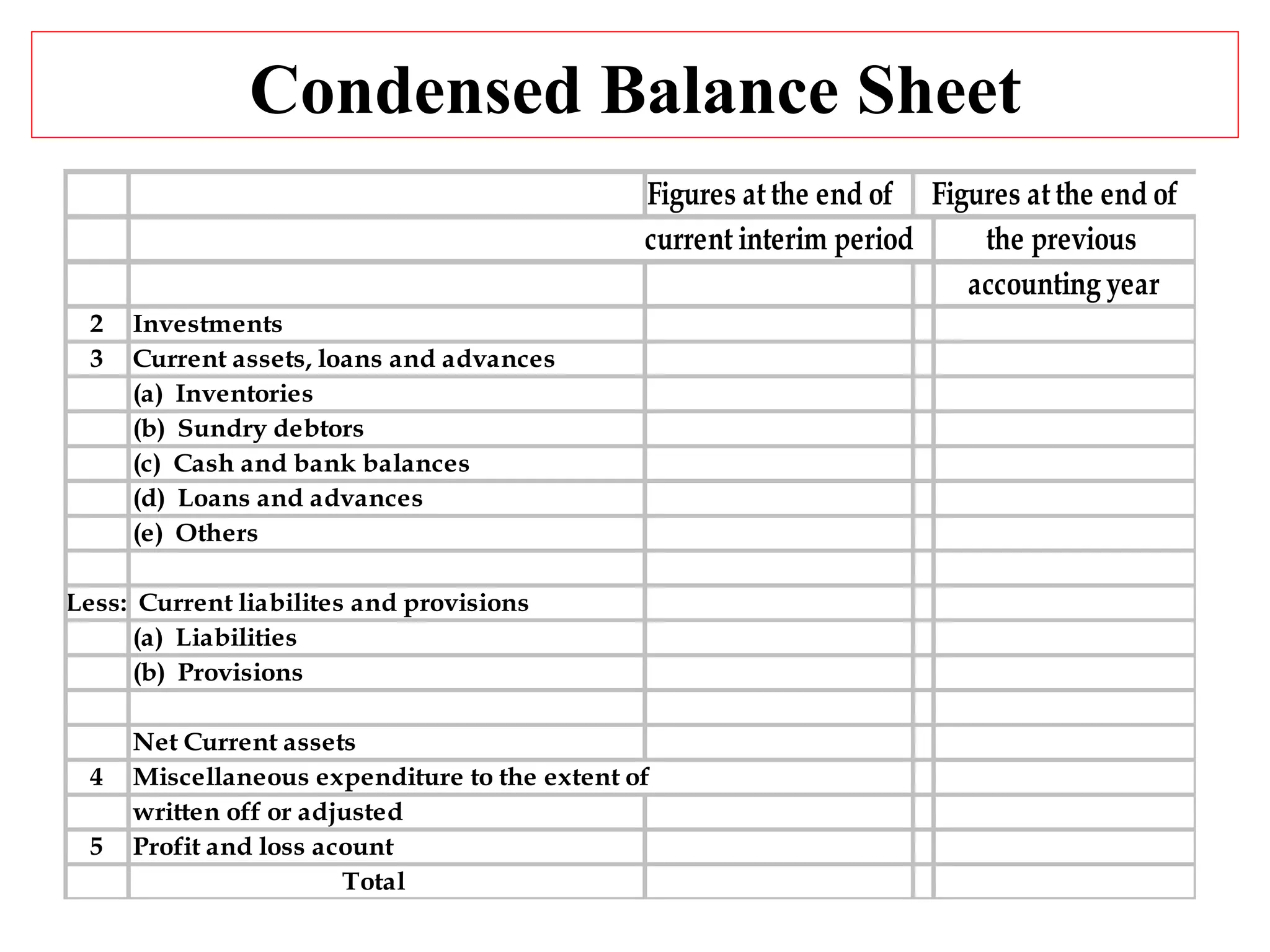
Condensed Balance Sheet
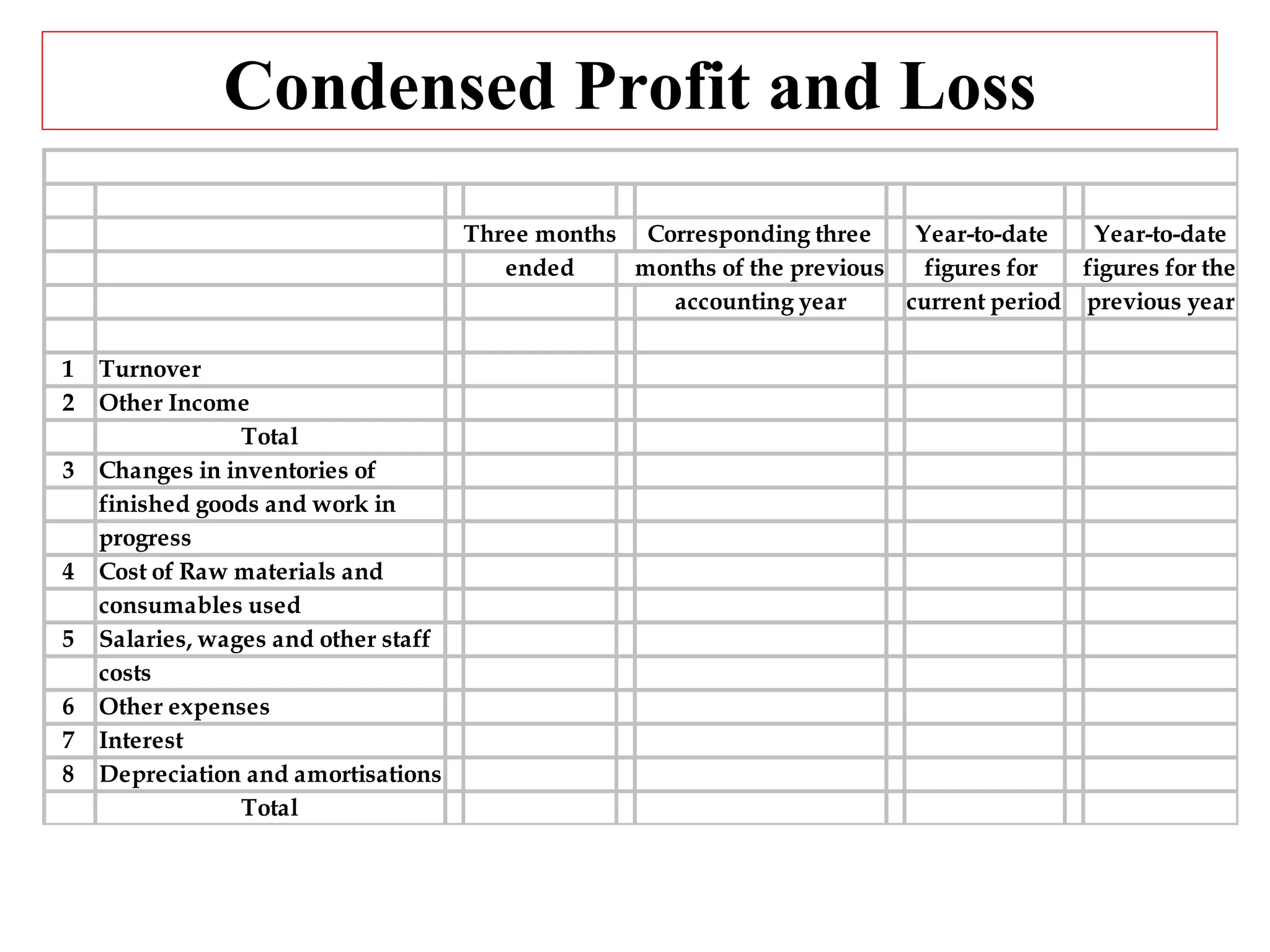
Condensed Profit and Loss
Condensed Cash Flow Statement
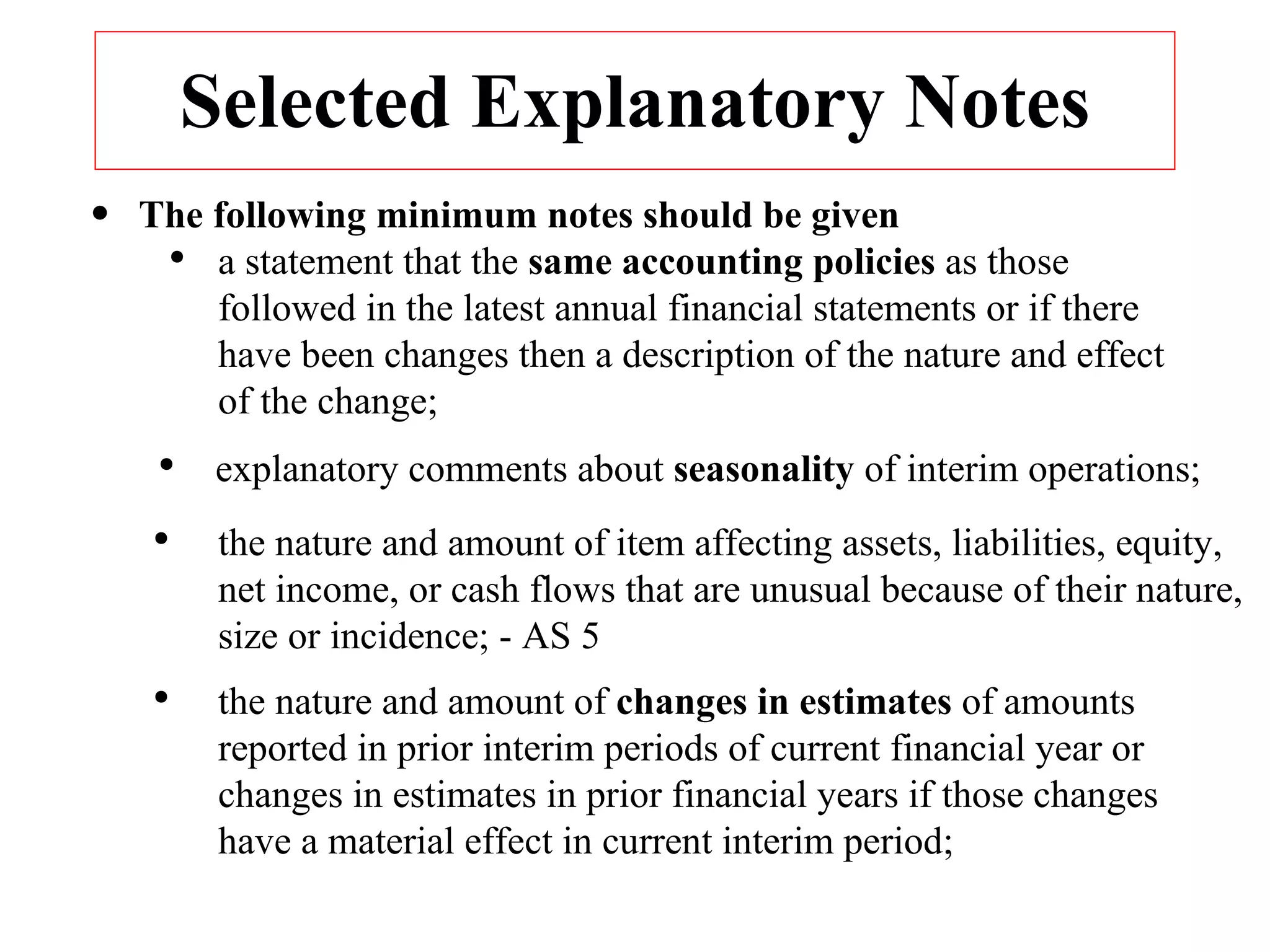
Selected Explanatory Notes The following minimum notes should be given a statement that the  same accounting policies  as those followed in the latest annual financial statements or if there have been changes then a description of the nature and effect of the change; explanatory comments about  seasonality  of interim operations; the nature and amount of item affecting assets, liabilities, equity, net income, or cash flows that are unusual because of their nature, size or incidence; - AS 5 the nature and amount of  changes in estimates  of amounts reported in prior interim periods of current financial year or changes in estimates in prior financial years if those changes have a material effect in current interim period;
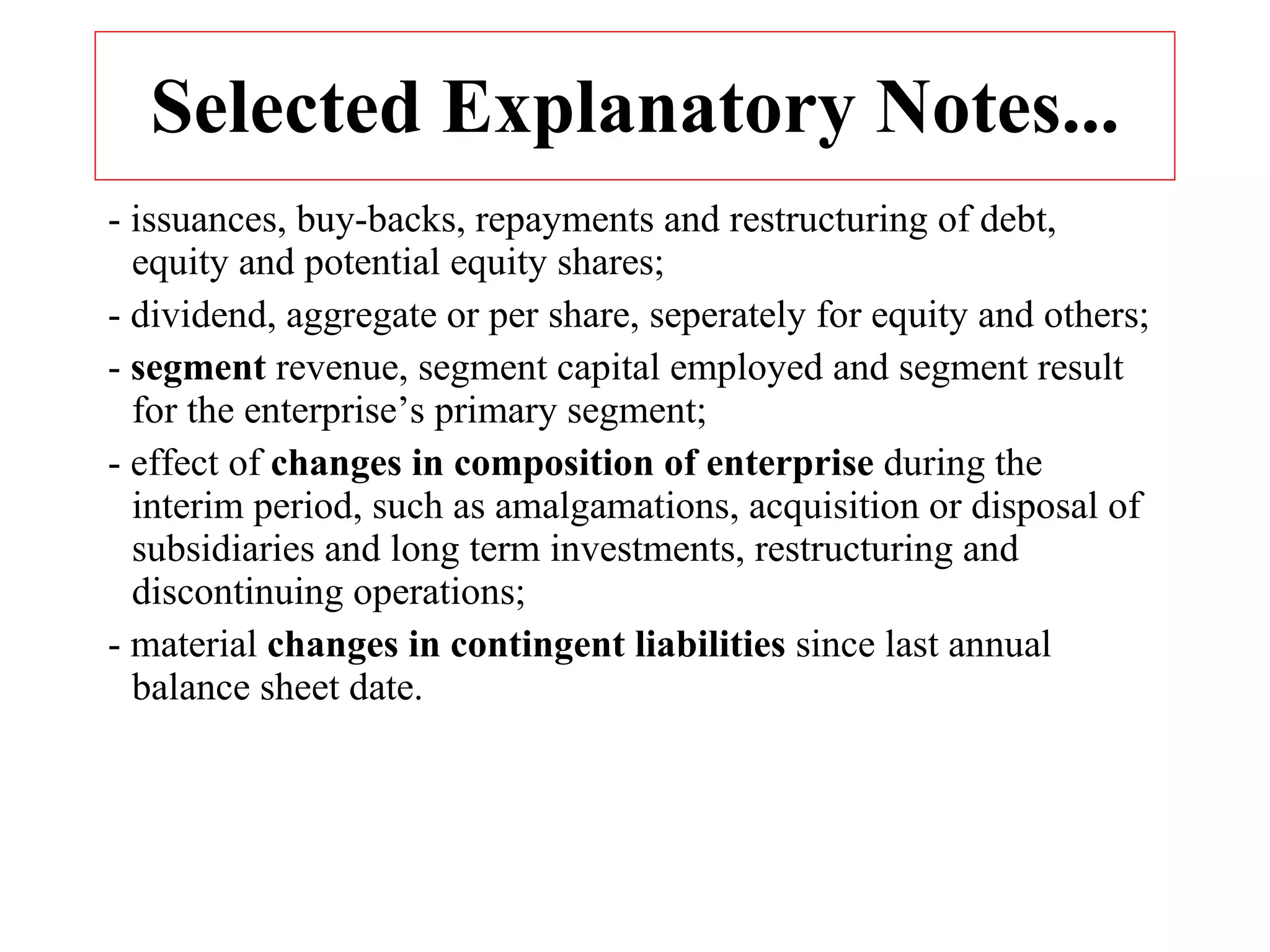
Selected Explanatory Notes... - issuances, buy-backs, repayments and restructuring of debt, equity and potential equity shares; - dividend, aggregate or per share, seperately for equity and others; -  segment  revenue, segment capital employed and segment result for the enterprise’s primary segment; - effect of  changes in composition of enterprise  during the interim period, such as amalgamations, acquisition or disposal of subsidiaries and long term investments, restructuring and discontinuing operations; - material  changes in contingent liabilities  since last annual balance sheet date.
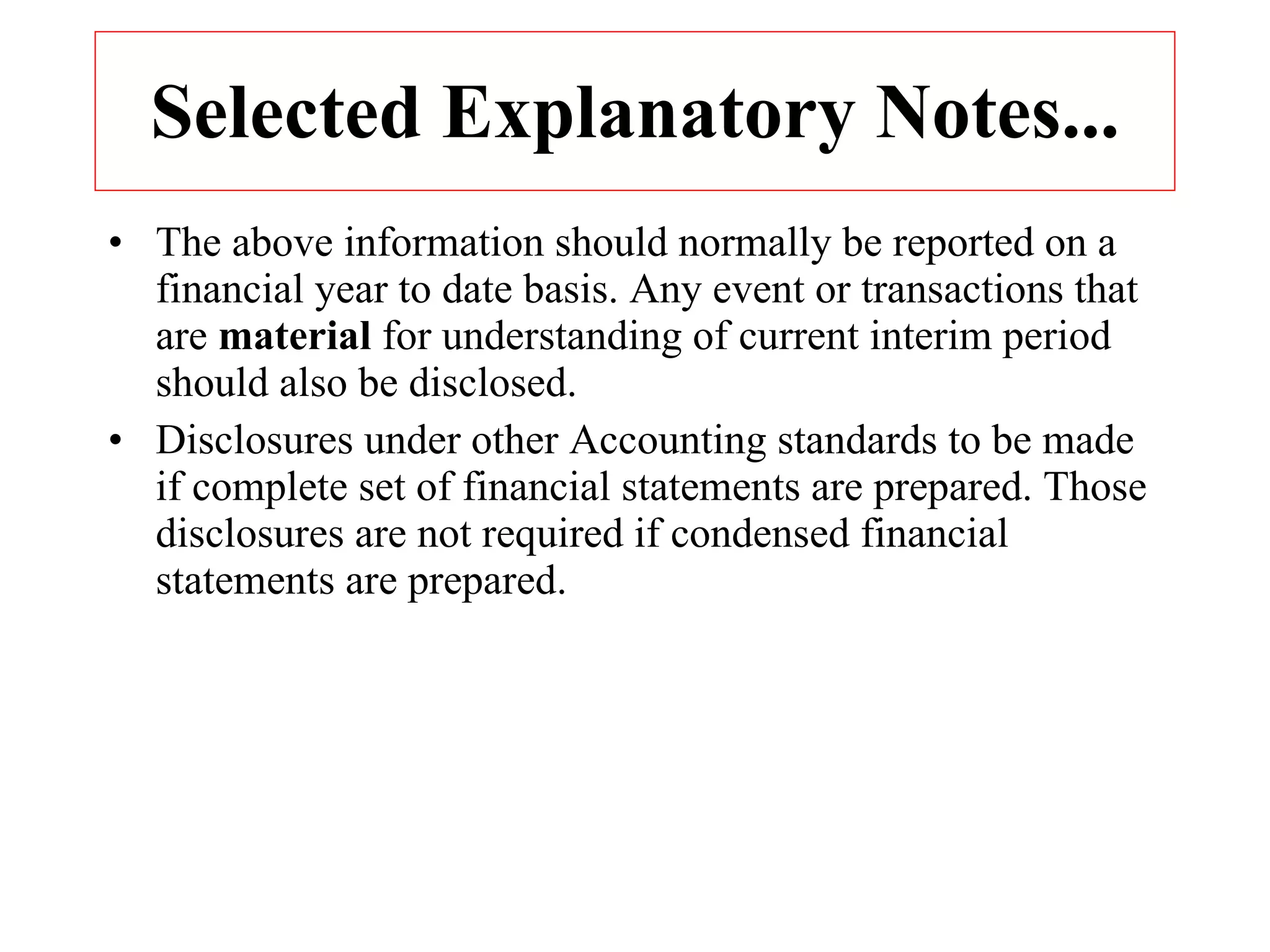
Selected Explanatory Notes... The above information should normally be reported on a financial year to date basis. Any event or transactions that are  material  for understanding of current interim period should also be disclosed. Disclosures under other Accounting standards to be made if complete set of financial statements are prepared. Those disclosures are not required if condensed financial statements are prepared.
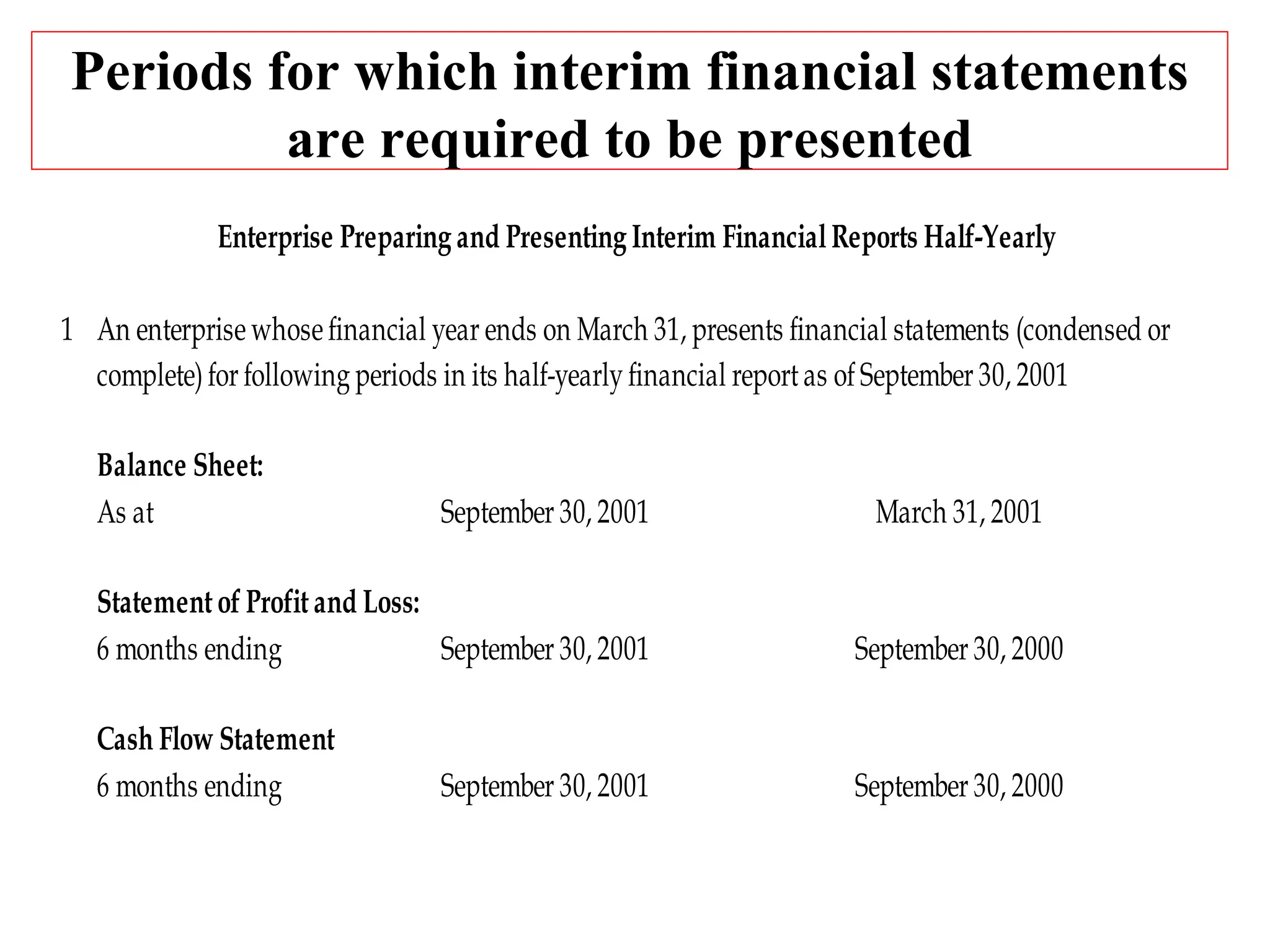
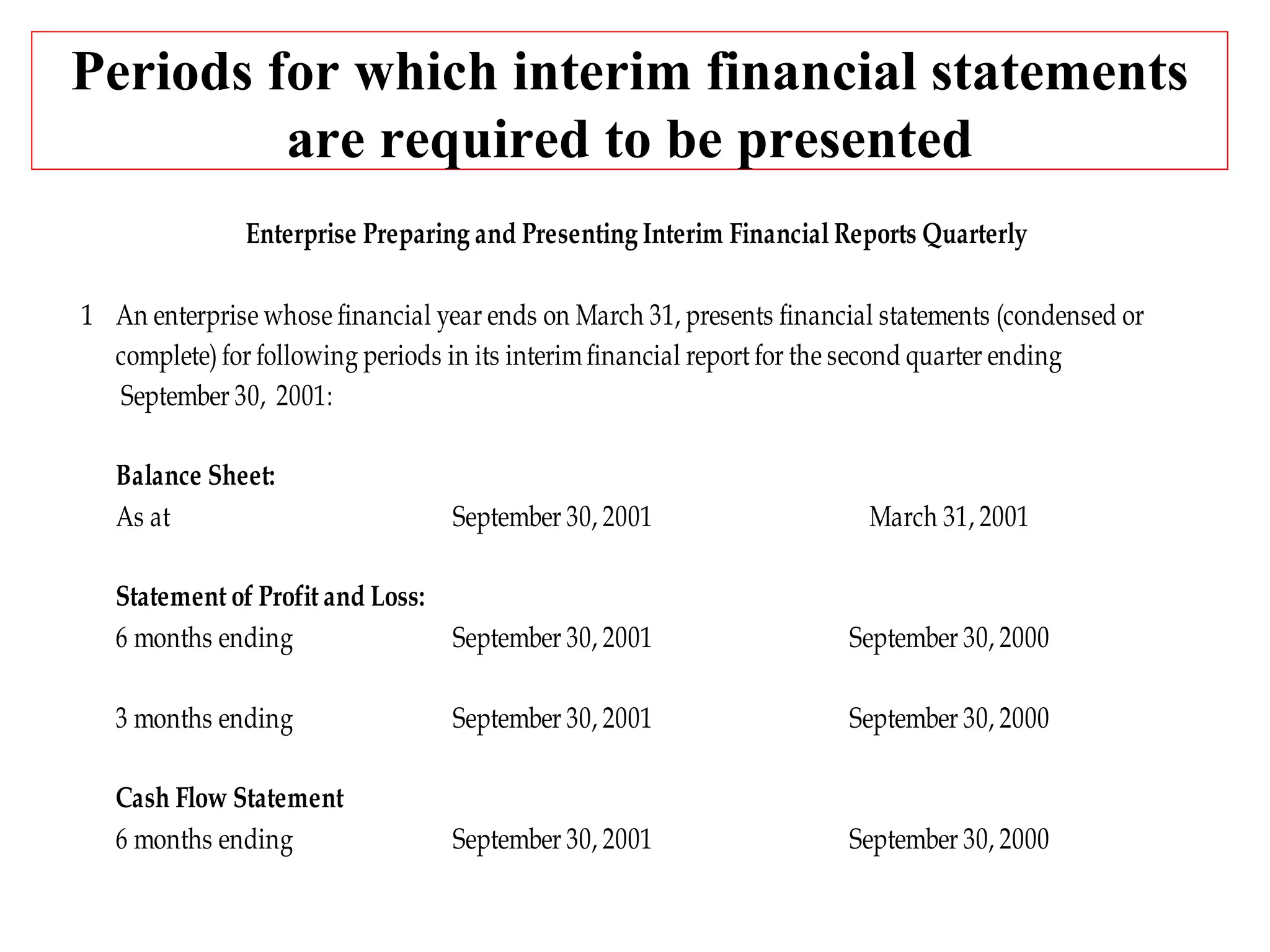
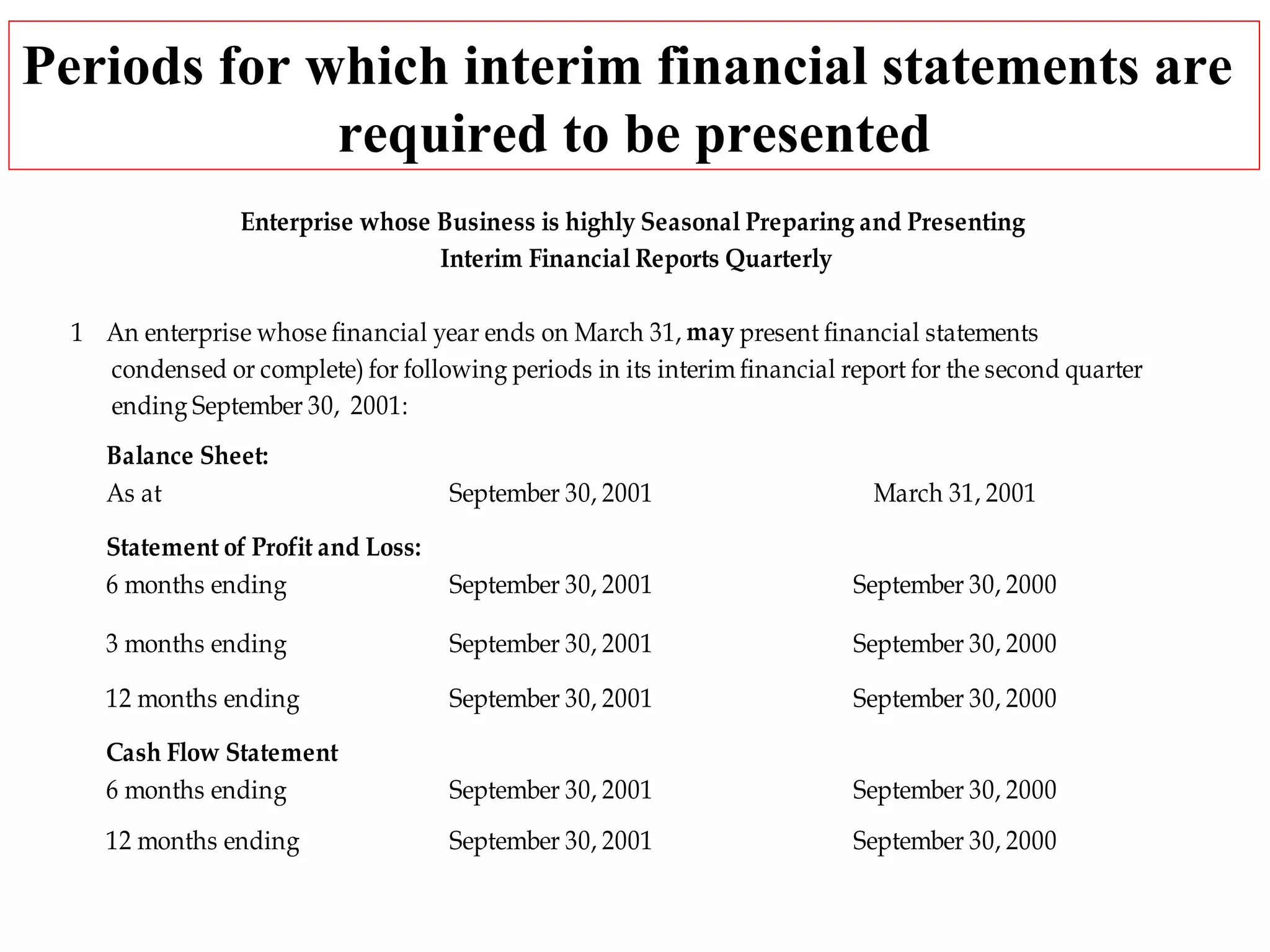
Periods for which interim financial statements are required to be presented
Periods for which interim financial statements are  required to be presented
Disclosure in Annual Financial Statements An enterprise may not prepare separate financial report for  final interim period .  However, disclosures need to be made in the annual financial statements of significant change in the estimates. e.g.estimates relating to inventory write downs, restructuring, or impairment losses reported in the earlier interim periods.
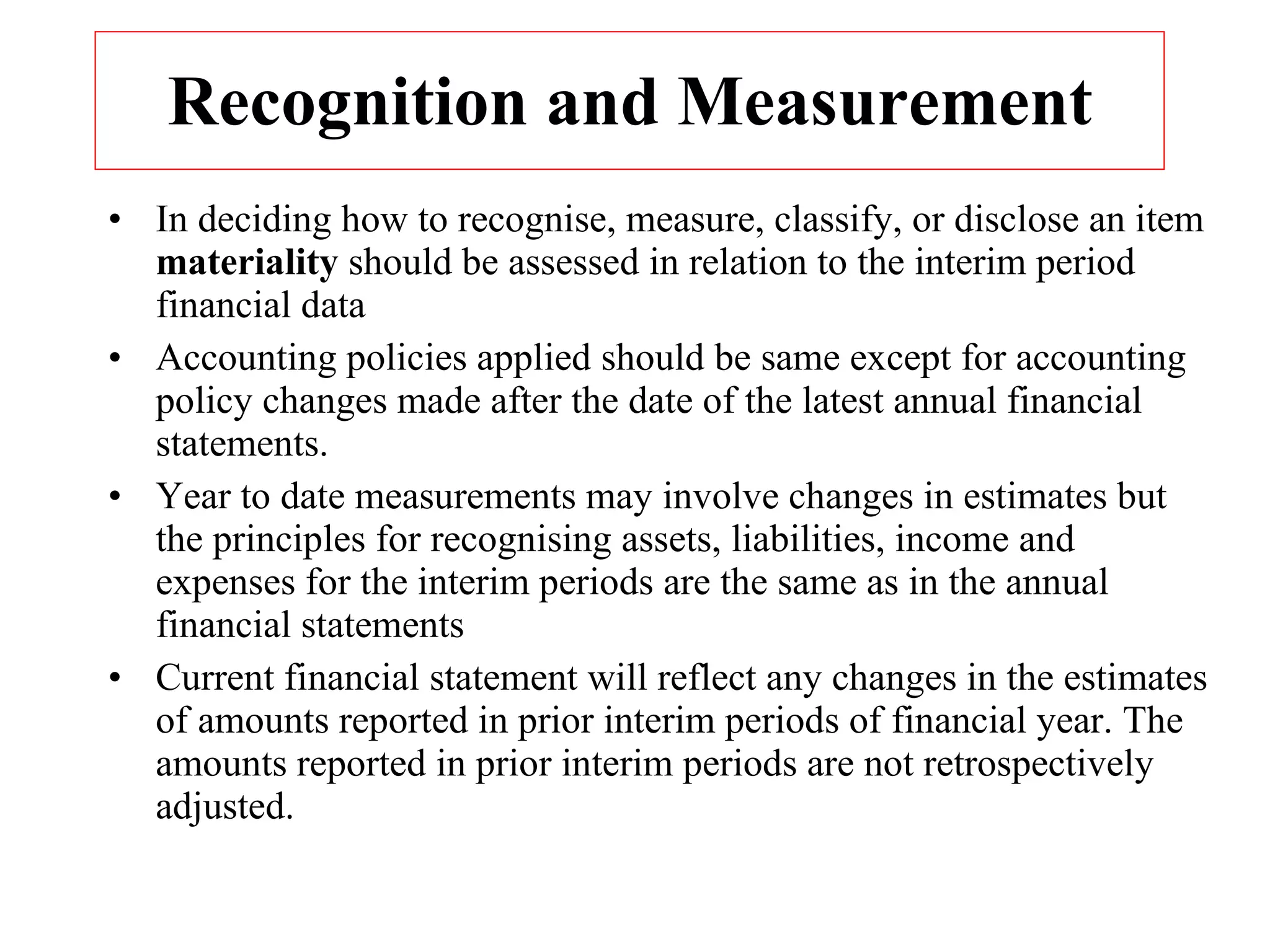
Recognition and Measurement In deciding how to recognise, measure, classify, or disclose an item  materiality  should be assessed in relation to the interim period financial data  Accounting policies applied should be same except for accounting policy changes made after the date of the latest annual financial statements.  Year to date measurements may involve changes in estimates but the principles for recognising assets, liabilities, income and expenses for the interim periods are the same as in the annual financial statements  Current financial statement will reflect any changes in the estimates of amounts reported in prior interim periods of financial year. The amounts reported in prior interim periods are not retrospectively adjusted.
Recognition and Measurement ... Revenues received seasonally or occasionally within a financial year should be recognised when they occur. Costs incurred unevenly during a financial year should be anticipated or deferred for interim reporting purposes if it is appropriate to anticipate or defer that type of cost at the end of the financial year. Preparation of interim financial reports require greater use of estimation as compared to annual financial reports .
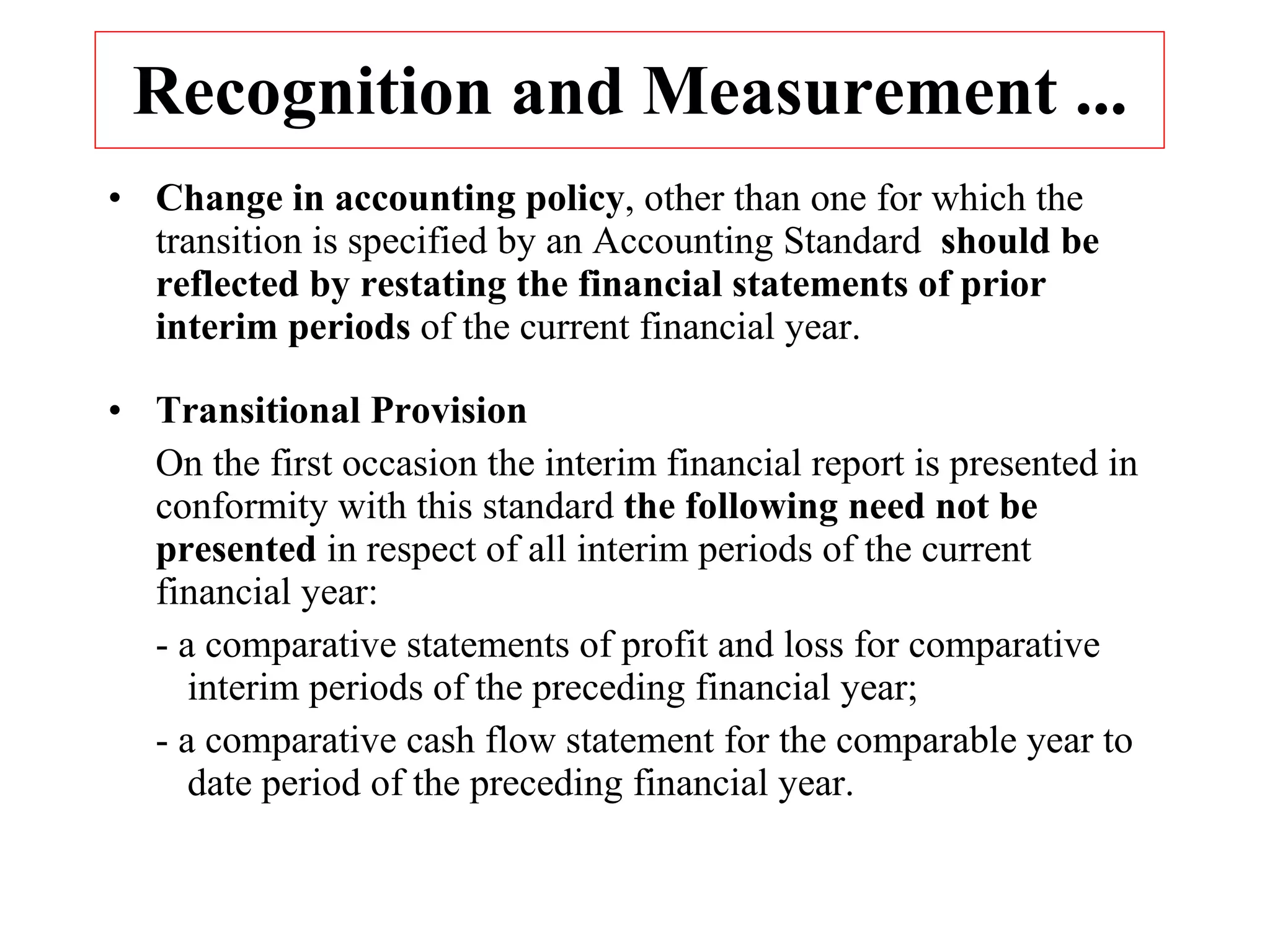
Recognition and Measurement ... Change in accounting policy , other than one for which the transition is specified by an Accounting Standard  should be reflected by restating the financial statements of prior interim periods  of the current financial year. Transitional Provision On the first occasion the interim financial report is presented in conformity with this standard  the following need not be   presented  in respect of all interim periods of the current financial year: - a comparative statements of profit and loss for comparative  interim periods of the preceding financial year; - a comparative cash flow statement for the comparable year to  date period of the preceding financial year.
Examples of Applying the recognition and measurement principles  Gratuity and other defined benefit schemes- actuarial valuation not necessary Major planned periodic maintenance or overhaul- not to anticipate unless an event has caused the enterprise to have a present obligation Year end bonuses- to be anticipated only if the bonus is a legal obligation and a reliable estimate of the obligation can be made Intangible assets- deferring costs as assets in an interim balance sheet to meet the recognition criteria later in financial year is not justified. Provisions - obligation should exist on the reporting date
Examples of Applying the recognition and measurement principles Other planned but irregularly occurring costs- to be recognised only if the costs have been incurred. Contractual or anticipated purchase price changes- contractual rebates and discounts are recognised but discretionary rebates & discounts are not recognised. Depreciation and amortisation- only on assets owned during the interim period. Inventories- similar as year end Foreign currency translation gains and losses- same principles as at year end ie in accordance with AS 11 Impairment of Assets- same impairment tests, recognition  and reversal criteria as at year end.
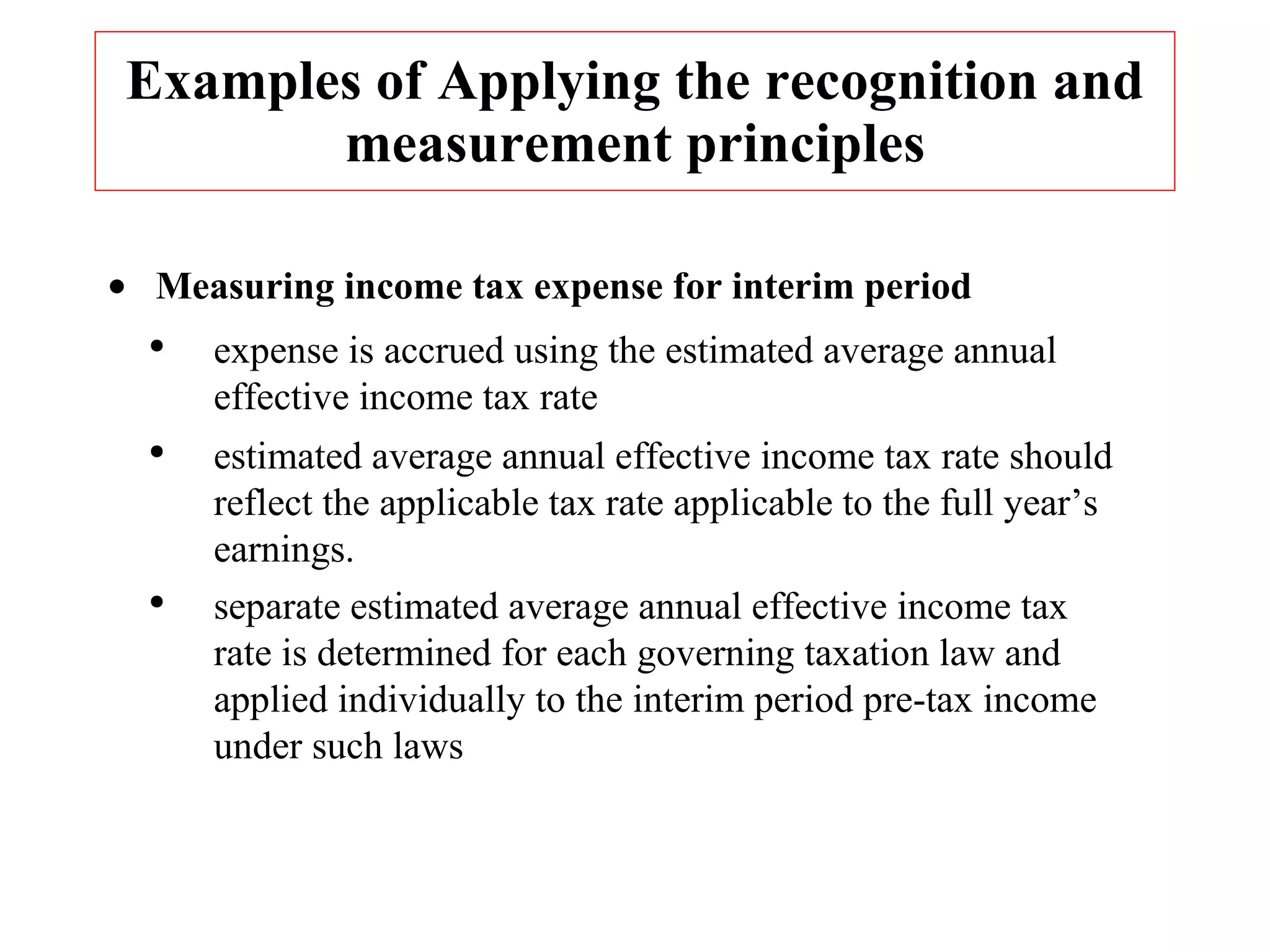
Examples of Applying the recognition and measurement principles Measuring income tax expense for interim period expense is accrued using the estimated average annual effective income tax rate estimated average annual effective income tax rate should reflect the applicable tax rate applicable to the full year’s earnings. separate estimated average annual effective income tax rate is determined for each governing taxation law and applied individually to the interim period pre-tax income under such laws
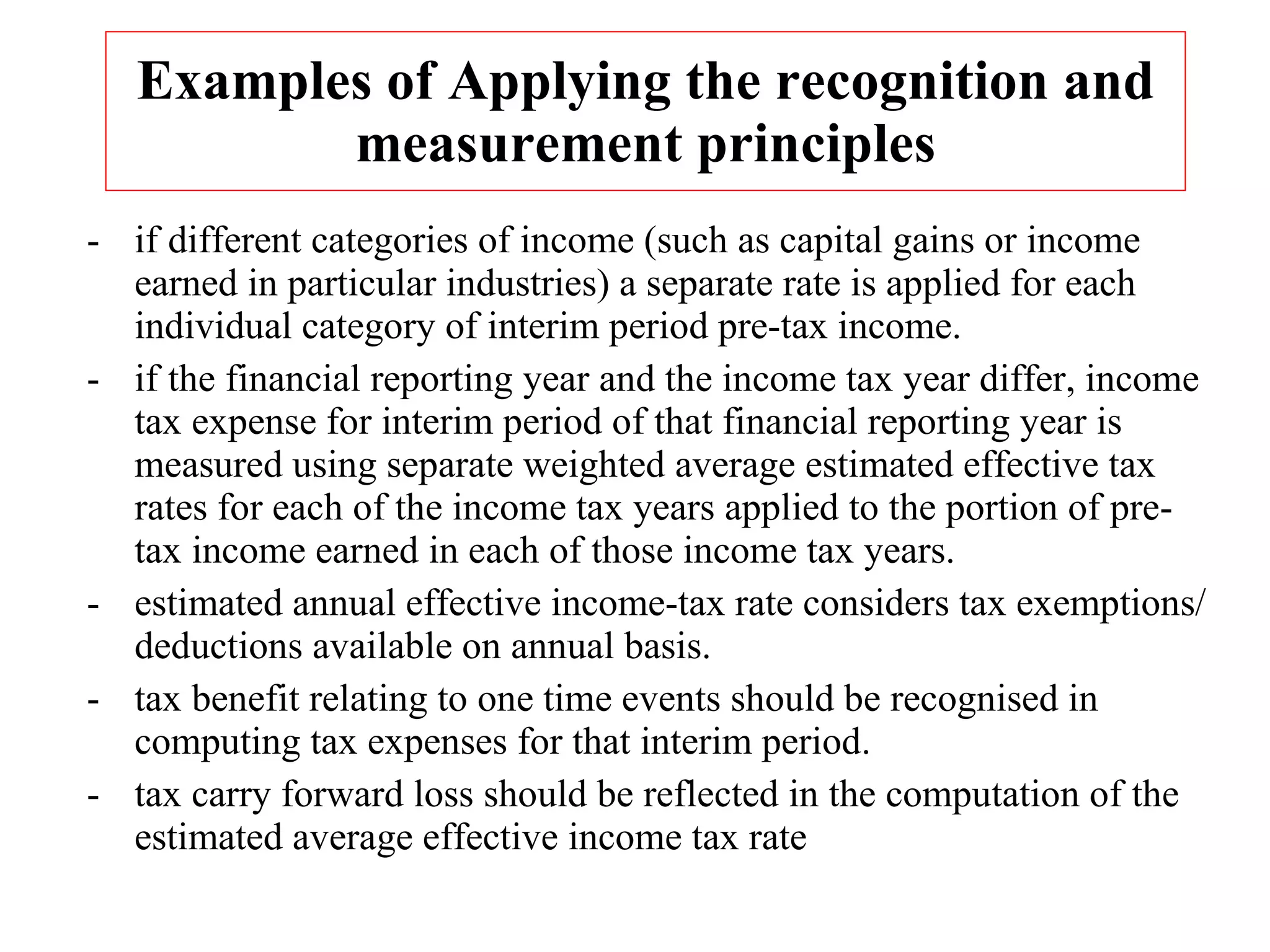
Examples of Applying the recognition and measurement principles -  if different categories of income (such as capital gains or income earned in particular industries) a separate rate is applied for each individual category of interim period pre-tax income. - if the financial reporting year and the income tax year differ, income tax expense for interim period of that financial reporting year is measured using separate weighted average estimated effective tax rates for each of the income tax years applied to the portion of pre-tax income earned in each of those income tax years. -  estimated annual effective income-tax rate considers tax exemptions/ deductions available on annual basis. -  tax benefit relating to one time events should be recognised in computing tax expenses for that interim period. - tax carry forward loss should be reflected in the computation of the estimated average effective income tax rate
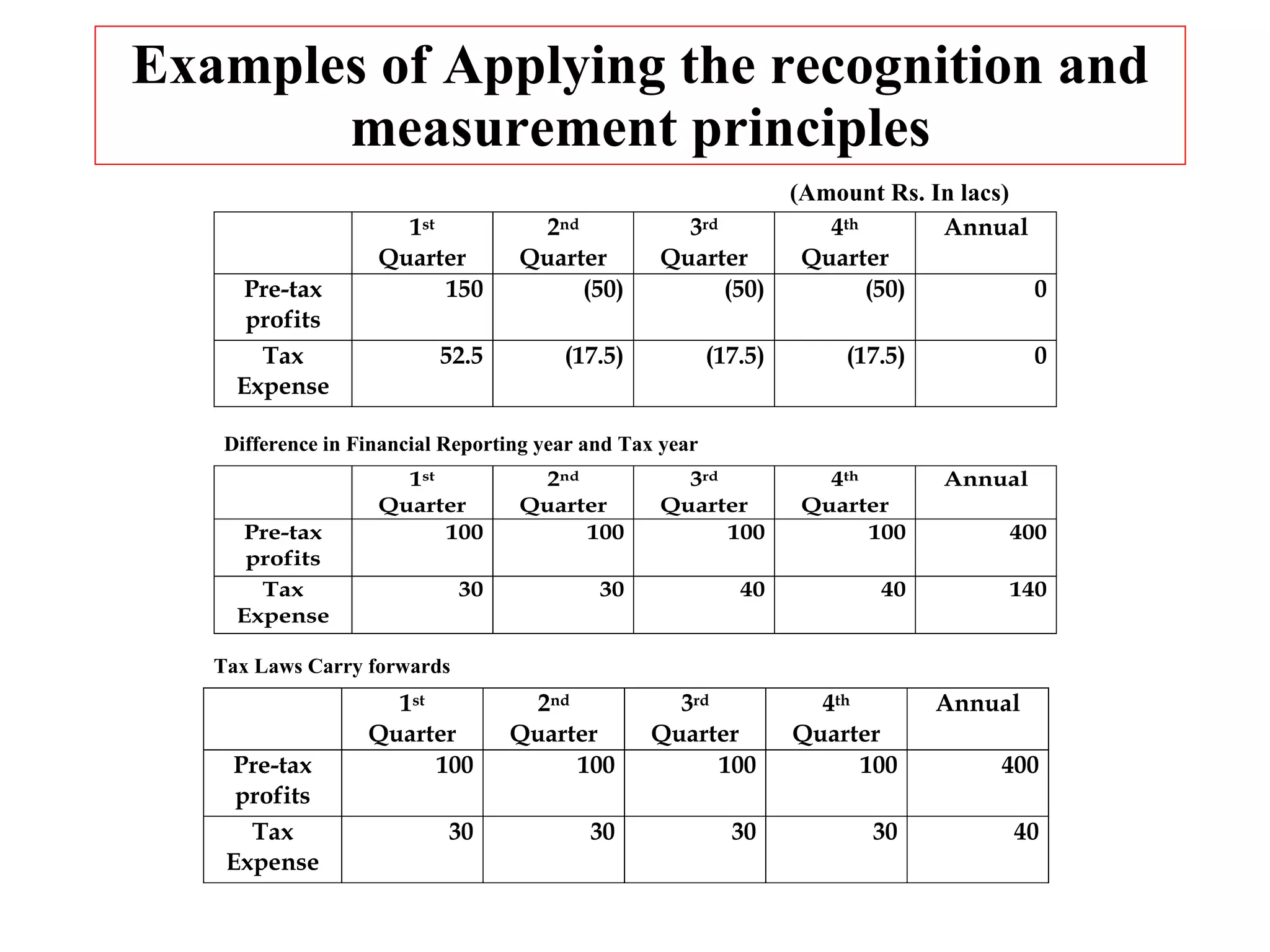
Examples of Applying the recognition and measurement principles (Amount Rs. In lacs) Tax Laws Carry forwards Difference in Financial Reporting year and Tax year
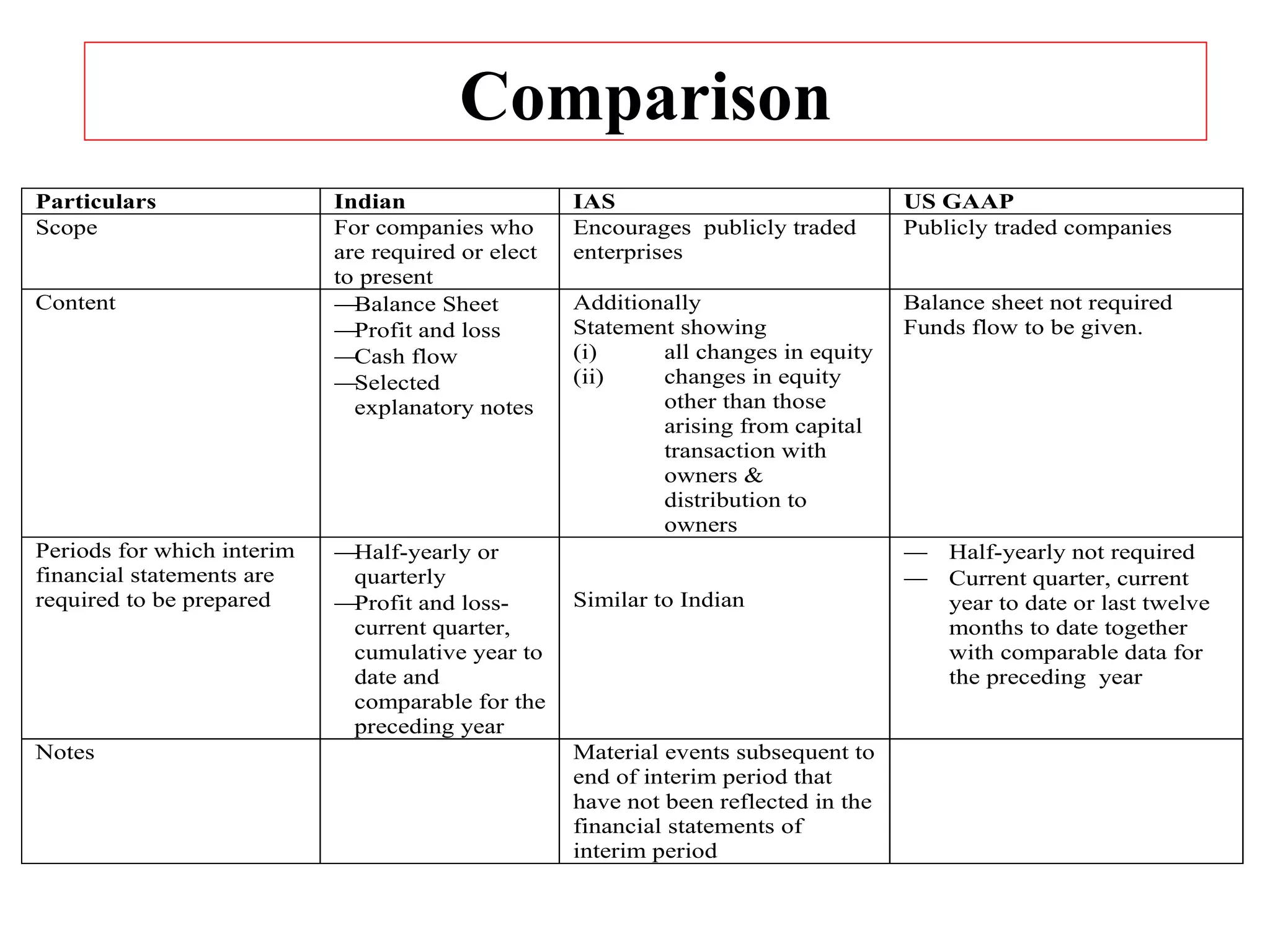
Comparison
THANK YOU

As 25 Interim Financial Reporting

  • 1.
    Accounting Standard 25Interim Financial Reporting
  • 2.
    Contents Objective ScopeForm and Content of an interim financial statement Period for which interim financial statements are required to be presented Disclosure in Annual Financial Statements Recognition and Measurement Examples of applying the recognition and measurement principles Comparison Issues
  • 3.
    Objective Toprescribe : Minimum content of an interim financial report; Principles for recognition and measurement in a complete or condensed financial statements for an interim period
  • 4.
    Scope Does notmandate which enterprises should be required to present interim financial reports If an enterprise is required or elects to prepare and present interim financial report -the standard should be complied with The recognition and measurement principles as laid down in this standard should be applied in respect of information required to be given unless the statute requires otherwise.
  • 5.
    Scope... Cash flowstatement, complete or condensed to be prepared if the enterprise presents cash flow statement for the purpose of its annual financial report
  • 6.
    Minimum Components ofan Interim Financial Report An interim financial report should include -condensed balance sheet -condensed statement of profit and loss -condensed cash flow statement and - selected explanatory notes
  • 7.
    Form & Contentof an Interim Financial Statement Complete set of financial statements should conform to the requirements applicable to annual financial statements. Condensed set of financial statements should at minimum have each headings or subheadings that were included in the latest annual financial statements.
  • 8.
    Form & Content...If EPS is disclosed in the annual financial statement then the same needs to be disclosed on the face of the interim statement of profit and loss; If consolidated annual financial statements are prepared then interim consolidated statements need to be prepared in addition to the separate financial statements.
  • 9.
  • 10.
  • 11.
  • 12.
  • 13.
  • 14.
    Selected Explanatory NotesThe following minimum notes should be given a statement that the same accounting policies as those followed in the latest annual financial statements or if there have been changes then a description of the nature and effect of the change; explanatory comments about seasonality of interim operations; the nature and amount of item affecting assets, liabilities, equity, net income, or cash flows that are unusual because of their nature, size or incidence; - AS 5 the nature and amount of changes in estimates of amounts reported in prior interim periods of current financial year or changes in estimates in prior financial years if those changes have a material effect in current interim period;
  • 15.
    Selected Explanatory Notes...- issuances, buy-backs, repayments and restructuring of debt, equity and potential equity shares; - dividend, aggregate or per share, seperately for equity and others; - segment revenue, segment capital employed and segment result for the enterprise’s primary segment; - effect of changes in composition of enterprise during the interim period, such as amalgamations, acquisition or disposal of subsidiaries and long term investments, restructuring and discontinuing operations; - material changes in contingent liabilities since last annual balance sheet date.
  • 16.
    Selected Explanatory Notes...The above information should normally be reported on a financial year to date basis. Any event or transactions that are material for understanding of current interim period should also be disclosed. Disclosures under other Accounting standards to be made if complete set of financial statements are prepared. Those disclosures are not required if condensed financial statements are prepared.
  • 17.
    Periods for whichinterim financial statements are required to be presented
  • 18.
    Periods for whichinterim financial statements are required to be presented
  • 19.
    Periods for whichinterim financial statements are required to be presented
  • 20.
    Disclosure in AnnualFinancial Statements An enterprise may not prepare separate financial report for final interim period . However, disclosures need to be made in the annual financial statements of significant change in the estimates. e.g.estimates relating to inventory write downs, restructuring, or impairment losses reported in the earlier interim periods.
  • 21.
    Recognition and MeasurementIn deciding how to recognise, measure, classify, or disclose an item materiality should be assessed in relation to the interim period financial data Accounting policies applied should be same except for accounting policy changes made after the date of the latest annual financial statements. Year to date measurements may involve changes in estimates but the principles for recognising assets, liabilities, income and expenses for the interim periods are the same as in the annual financial statements Current financial statement will reflect any changes in the estimates of amounts reported in prior interim periods of financial year. The amounts reported in prior interim periods are not retrospectively adjusted.
  • 22.
    Recognition and Measurement... Revenues received seasonally or occasionally within a financial year should be recognised when they occur. Costs incurred unevenly during a financial year should be anticipated or deferred for interim reporting purposes if it is appropriate to anticipate or defer that type of cost at the end of the financial year. Preparation of interim financial reports require greater use of estimation as compared to annual financial reports .
  • 23.
    Recognition and Measurement... Change in accounting policy , other than one for which the transition is specified by an Accounting Standard should be reflected by restating the financial statements of prior interim periods of the current financial year. Transitional Provision On the first occasion the interim financial report is presented in conformity with this standard the following need not be presented in respect of all interim periods of the current financial year: - a comparative statements of profit and loss for comparative interim periods of the preceding financial year; - a comparative cash flow statement for the comparable year to date period of the preceding financial year.
  • 24.
    Examples of Applyingthe recognition and measurement principles Gratuity and other defined benefit schemes- actuarial valuation not necessary Major planned periodic maintenance or overhaul- not to anticipate unless an event has caused the enterprise to have a present obligation Year end bonuses- to be anticipated only if the bonus is a legal obligation and a reliable estimate of the obligation can be made Intangible assets- deferring costs as assets in an interim balance sheet to meet the recognition criteria later in financial year is not justified. Provisions - obligation should exist on the reporting date
  • 25.
    Examples of Applyingthe recognition and measurement principles Other planned but irregularly occurring costs- to be recognised only if the costs have been incurred. Contractual or anticipated purchase price changes- contractual rebates and discounts are recognised but discretionary rebates & discounts are not recognised. Depreciation and amortisation- only on assets owned during the interim period. Inventories- similar as year end Foreign currency translation gains and losses- same principles as at year end ie in accordance with AS 11 Impairment of Assets- same impairment tests, recognition and reversal criteria as at year end.
  • 26.
    Examples of Applyingthe recognition and measurement principles Measuring income tax expense for interim period expense is accrued using the estimated average annual effective income tax rate estimated average annual effective income tax rate should reflect the applicable tax rate applicable to the full year’s earnings. separate estimated average annual effective income tax rate is determined for each governing taxation law and applied individually to the interim period pre-tax income under such laws
  • 27.
    Examples of Applyingthe recognition and measurement principles - if different categories of income (such as capital gains or income earned in particular industries) a separate rate is applied for each individual category of interim period pre-tax income. - if the financial reporting year and the income tax year differ, income tax expense for interim period of that financial reporting year is measured using separate weighted average estimated effective tax rates for each of the income tax years applied to the portion of pre-tax income earned in each of those income tax years. - estimated annual effective income-tax rate considers tax exemptions/ deductions available on annual basis. - tax benefit relating to one time events should be recognised in computing tax expenses for that interim period. - tax carry forward loss should be reflected in the computation of the estimated average effective income tax rate
  • 28.
    Examples of Applyingthe recognition and measurement principles (Amount Rs. In lacs) Tax Laws Carry forwards Difference in Financial Reporting year and Tax year
  • 29.
  • 30.