IND AS 21
The Effects of Changes in
Foreign Exchange Rates
CA. Nirmal Ghorawat
B. Com(Hons), ACA
OBJECTIVE
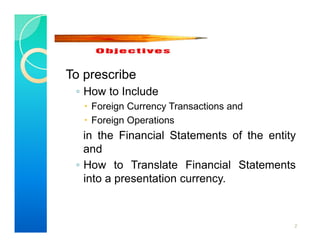
To prescribe
◦ How to Include
Foreign Currency Transactions and
Foreign Operations
in the Financial Statements of the entity
and
◦ How to Translate Financial Statements
into a presentation currency.
2
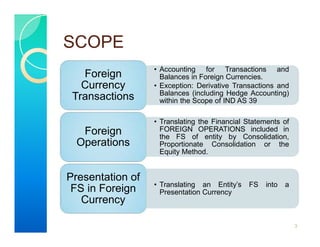
SCOPE
• Accounting for Transactions and
Balances in Foreign Currencies.
• Exception: Derivative Transactions and
Balances (including Hedge Accounting)
within the Scope of IND AS 39
Foreign
Currency
Transactions
• Translating the Financial Statements of
FOREIGN OPERATIONS included in
the FS of entity by Consolidation,
Proportionate Consolidation or the
Equity Method.
Foreign
Operations
• Translating an Entity’s FS into a
Presentation Currency
Presentation of
FS in Foreign
Currency
3
FUNCTIONAL CURRENCY
Currency of the
‘PRIMARY ECONOMIC
ENVIRONMENT’ in
which the Entity
operates.
Primary Economic
Environment is
normally the one in
which the Entity
PRIMARILY
GENERATES AND
EXPENDS CASH.
4
FUNCTIONAL CURRENCY
PRIMARY INDICATORS
◦ The Currency that determines the Sales prices of
its goods and services and Operating Costs.
Sales
Prices of its
Goods and
Services
Operating
Costs
5
EXAMPLE 1
Q What is the Functional Currency?
Facts Entity A is incorporated in UAE (Dinar). (Capital)
It has a Branch in Singapore (Singapore Dollar)
from where it sells Computers.
All Sales are denominated in CHD (100%).
Goods sold are imported from China (Yuan) (50%)
Labour & Operating Cost in CHD (40%)
Head Office & Corporate Expenses (Dinar) (5%)
Borrowing Costs & Profits (Dinar) (5%)
A SINGAPORE DOLLAR (CHD)
6
FUNCTIONAL CURRENCY
SECONDARY INDICATORS
◦ Currency of Generation of Funds from Financing
Activities – Issue of Debt and Equity Instruments.
◦ Currency of Retention of Receipts from
Operating Activities
Financing
Activities
Retention of
Receipts from
Operating
Activities
• Equity
• Debt
7
EXAMPLE 2
Q What is the Functional Currency?
Facts Entity A is incorporated in UAE (Dinar). (Capital)
It has a Branch in Singapore (Singapore Dollar) &
in Malaysia (Malaysian Rupiah) from where it sells
Computers.
Sales - CHD (40%), MRU (20%), Exports-USD
(40%)
Goods sold are imported from China (Yuan) (30%)
& India (INR) (20%)
Operating Cost in CHD (32%), MRU (08%)
Head Office & Corporate Expenses (Dinar) (5%)
Borrowing Costs & Profits (Dinar) (5%)
A UAE DINAR
8
FUNCTIONAL CURRENCY OF
FOREIGN OPERATIONS
ADDITIONAL INDICATORS
◦ Autonomy – Activities of Foreign Operation are
Extension of the Reporting Entity or carried with
a Significant Degree of Autonomy.
◦ Volume of Transactions with the Reporting Entity
◦ Impact of Cash Flows of Foreign Operation on
the Reporting Entity.
◦ Ability to service Debt Obligations without resort
to Reporting Entity.
9
EXAMPLE 3
Q What is the Functional Currency?
Treasury – Invests surplus money received from
Subsidiaries in European Bond Markets & is a PE in
Mauritius.
A USD (UNITED STATES DOLLAR)
10
Holding Company
(USD)
(Operating Company)
Subsidiary 1
(INR)
TREASURY Department
Subsidiary 2
(Yuan)
Subsidiary
(JPY)
Subsidiary 3
(AUD)
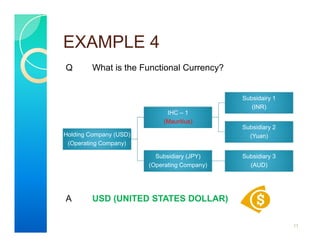
EXAMPLE 4
Q What is the Functional Currency?
A USD (UNITED STATES DOLLAR)
11
Holding Company (USD)
(Operating Company)
IHC – 1
(Mauritius)
Subsidairy 1
(INR)
Subsidiary 2
(Yuan)
Subsidiary (JPY)
(Operating Company)
Subsidiary 3
(AUD)
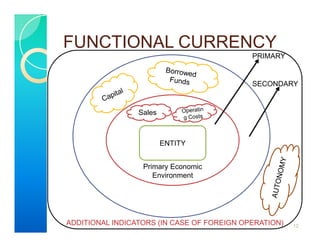
FUNCTIONAL CURRENCY
12
ENTITY
Primary Economic
Environment
Sales
PRIMARY
SECONDARY
ADDITIONAL INDICATORS (IN CASE OF FOREIGN OPERATION)
FUNCTIONAL CURRENCY
When Indicators are mixed and Functional
Currency is not obvious, MANAGEMENT
uses its JUDGEMENT.
PRIMARY
SECONDARY
ADDITIONAL
(ONLY FOR FOREIGN OPERATIONS)
13
CHANGE IN FUNCTIONAL
CURRENCY
FUNCTIONAL CURRENCY is
Used CONSISTENTLY
NOT Changed unless there is a
Change in Underlying Transactions,
Events and Conditions (primary
economic environment)
If Changed, then apply
TRANSLATION procedures
PROSPECTIVELY.
14
DEFINITIONS
15
Foreign
Currency
Currency other than ‘functional currency’.
Spot Exchange
Rate
The ‘exchange rate’ for immediate delivery.
Monetary items units of currency held and
assets and liabilities to be received or paid in a fixed or
determinable number of units of currency
INITIAL RECOGNITION
Of FOREIGN CURRENCY TRANSACTION
In FUNCTIONAL CURRENCY
By applying SPOT EXCHANGE RATE
(b/w Functional Currency & Foreign Currency)
At the Date of Transaction
Average Rate is permitted, if the exchange
rates don’t fluctuate significantly.
16
SUBSEQUENT
MEASUREMENT
Items Translation Rate Recognition of
Exchange Differences
on Settlement or
Translation
Monetary Items Closing Rate on
Balance Sheet Date
To Profit or Loss #
Non-Monetary Items at
Historical Cost
Rate as at Date of
Transaction
Equity : If Gain or Loss
is recognized in Equity.
PL : If Gain or Loss is
recognized in PL.
Non-Monetary Items at
Fair Value
Rate as at Date of Fair
Value Determination
# Exchange differences arising on monetary items that form part of a reporting
entity’s net investment in foreign operation shall be recognized, in consolidated
financial statements initially as a separate component of equity and recognized in
profit or loss on Disposal of the net investment.
17
EXAMPLE 5 - TRANSLATION
Items of BS Monetary or
Non-Monetary
P&L, Equity or
None
Rate
Loans &
Receivable
M P & L Closing Rate
Available for Sale
(AFS) Equity
Investment
NM at FV Equity (OCI) Rate as at Date
of Determination
of Fair Value
PPE (Fixed
Assets)
NM at Cost Equity Rate as at Date
of Purchase
Investment
Property at FV
NM at FV P & L Rate as at Date
of Determination
of Fair Value
Prepaid
Expenses
NM NA Rate as at Date
of Transaction
Deferred
Revenue
NM NA Rate as at Date
of Transaction
18
TRANSLATION TO
PRESENTATION CURRENCY *
Items Translation Rate Recognition of Exchange
Difference
Assets and Liabilities
(including Comparatives)
Closing Rate on Balance
Sheet Date
As a Separate Component
of Equity.
Income and Expenses
(including Comparatives)
Exchange Rate at the date
of the transaction #
Equity
(including Comparatives)
Historic Rate or Closing
Rate (Management Policy)
19
* Except that of an entity whose functional currency is the currency of
a hyperinflationary economy.
# Average Rate is permitted, if the exchange rates don’t fluctuate
significantly.
SUMMARY
1
• Determine Functional
Currency
2
• Re-measurement of
Foreign Currency Items
into Functional Currency.
3
• Translation of Functional
Currency to Presentation
Currency
20
DISCLOSURES
21
1. The amount of Exchange
Differences recognised in P&L
except for those arising on
Financial Instruments measured at
Fair Value through P & L (IAS 39);
2. Net exchange differences classified
as a separate component of equity,
and a reconciliation of the amount
of such exchange differences at the
beginning and end of the period.
DISCLOSURES
22
3. Presentation Currency is Not
Functional Currency – the said
Fact, disclosure of Functional
Currency, reason for using a
different presentation currency.
4. Change in the Functional Currency
of the Reporting Entity or a
Significant foreign operation – the
said Fact and the reason for the
change in the Functional Currency.
23

Ind as 21 forex

  • 1.
    IND AS 21 TheEffects of Changes in Foreign Exchange Rates CA. Nirmal Ghorawat B. Com(Hons), ACA
  • 2.
    OBJECTIVE To prescribe ◦ Howto Include Foreign Currency Transactions and Foreign Operations in the Financial Statements of the entity and ◦ How to Translate Financial Statements into a presentation currency. 2
  • 3.
    SCOPE • Accounting forTransactions and Balances in Foreign Currencies. • Exception: Derivative Transactions and Balances (including Hedge Accounting) within the Scope of IND AS 39 Foreign Currency Transactions • Translating the Financial Statements of FOREIGN OPERATIONS included in the FS of entity by Consolidation, Proportionate Consolidation or the Equity Method. Foreign Operations • Translating an Entity’s FS into a Presentation Currency Presentation of FS in Foreign Currency 3
  • 4.
    FUNCTIONAL CURRENCY Currency ofthe ‘PRIMARY ECONOMIC ENVIRONMENT’ in which the Entity operates. Primary Economic Environment is normally the one in which the Entity PRIMARILY GENERATES AND EXPENDS CASH. 4
  • 5.
    FUNCTIONAL CURRENCY PRIMARY INDICATORS ◦The Currency that determines the Sales prices of its goods and services and Operating Costs. Sales Prices of its Goods and Services Operating Costs 5
  • 6.
    EXAMPLE 1 Q Whatis the Functional Currency? Facts Entity A is incorporated in UAE (Dinar). (Capital) It has a Branch in Singapore (Singapore Dollar) from where it sells Computers. All Sales are denominated in CHD (100%). Goods sold are imported from China (Yuan) (50%) Labour & Operating Cost in CHD (40%) Head Office & Corporate Expenses (Dinar) (5%) Borrowing Costs & Profits (Dinar) (5%) A SINGAPORE DOLLAR (CHD) 6
  • 7.
    FUNCTIONAL CURRENCY SECONDARY INDICATORS ◦Currency of Generation of Funds from Financing Activities – Issue of Debt and Equity Instruments. ◦ Currency of Retention of Receipts from Operating Activities Financing Activities Retention of Receipts from Operating Activities • Equity • Debt 7
  • 8.
    EXAMPLE 2 Q Whatis the Functional Currency? Facts Entity A is incorporated in UAE (Dinar). (Capital) It has a Branch in Singapore (Singapore Dollar) & in Malaysia (Malaysian Rupiah) from where it sells Computers. Sales - CHD (40%), MRU (20%), Exports-USD (40%) Goods sold are imported from China (Yuan) (30%) & India (INR) (20%) Operating Cost in CHD (32%), MRU (08%) Head Office & Corporate Expenses (Dinar) (5%) Borrowing Costs & Profits (Dinar) (5%) A UAE DINAR 8
  • 9.
    FUNCTIONAL CURRENCY OF FOREIGNOPERATIONS ADDITIONAL INDICATORS ◦ Autonomy – Activities of Foreign Operation are Extension of the Reporting Entity or carried with a Significant Degree of Autonomy. ◦ Volume of Transactions with the Reporting Entity ◦ Impact of Cash Flows of Foreign Operation on the Reporting Entity. ◦ Ability to service Debt Obligations without resort to Reporting Entity. 9
  • 10.
    EXAMPLE 3 Q Whatis the Functional Currency? Treasury – Invests surplus money received from Subsidiaries in European Bond Markets & is a PE in Mauritius. A USD (UNITED STATES DOLLAR) 10 Holding Company (USD) (Operating Company) Subsidiary 1 (INR) TREASURY Department Subsidiary 2 (Yuan) Subsidiary (JPY) Subsidiary 3 (AUD)
  • 11.
    EXAMPLE 4 Q Whatis the Functional Currency? A USD (UNITED STATES DOLLAR) 11 Holding Company (USD) (Operating Company) IHC – 1 (Mauritius) Subsidairy 1 (INR) Subsidiary 2 (Yuan) Subsidiary (JPY) (Operating Company) Subsidiary 3 (AUD)
  • 12.
  • 13.
    FUNCTIONAL CURRENCY When Indicatorsare mixed and Functional Currency is not obvious, MANAGEMENT uses its JUDGEMENT. PRIMARY SECONDARY ADDITIONAL (ONLY FOR FOREIGN OPERATIONS) 13
  • 14.
    CHANGE IN FUNCTIONAL CURRENCY FUNCTIONALCURRENCY is Used CONSISTENTLY NOT Changed unless there is a Change in Underlying Transactions, Events and Conditions (primary economic environment) If Changed, then apply TRANSLATION procedures PROSPECTIVELY. 14
  • 15.
    DEFINITIONS 15 Foreign Currency Currency other than‘functional currency’. Spot Exchange Rate The ‘exchange rate’ for immediate delivery. Monetary items units of currency held and assets and liabilities to be received or paid in a fixed or determinable number of units of currency
  • 16.
    INITIAL RECOGNITION Of FOREIGNCURRENCY TRANSACTION In FUNCTIONAL CURRENCY By applying SPOT EXCHANGE RATE (b/w Functional Currency & Foreign Currency) At the Date of Transaction Average Rate is permitted, if the exchange rates don’t fluctuate significantly. 16
  • 17.
    SUBSEQUENT MEASUREMENT Items Translation RateRecognition of Exchange Differences on Settlement or Translation Monetary Items Closing Rate on Balance Sheet Date To Profit or Loss # Non-Monetary Items at Historical Cost Rate as at Date of Transaction Equity : If Gain or Loss is recognized in Equity. PL : If Gain or Loss is recognized in PL. Non-Monetary Items at Fair Value Rate as at Date of Fair Value Determination # Exchange differences arising on monetary items that form part of a reporting entity’s net investment in foreign operation shall be recognized, in consolidated financial statements initially as a separate component of equity and recognized in profit or loss on Disposal of the net investment. 17
  • 18.
    EXAMPLE 5 -TRANSLATION Items of BS Monetary or Non-Monetary P&L, Equity or None Rate Loans & Receivable M P & L Closing Rate Available for Sale (AFS) Equity Investment NM at FV Equity (OCI) Rate as at Date of Determination of Fair Value PPE (Fixed Assets) NM at Cost Equity Rate as at Date of Purchase Investment Property at FV NM at FV P & L Rate as at Date of Determination of Fair Value Prepaid Expenses NM NA Rate as at Date of Transaction Deferred Revenue NM NA Rate as at Date of Transaction 18
  • 19.
    TRANSLATION TO PRESENTATION CURRENCY* Items Translation Rate Recognition of Exchange Difference Assets and Liabilities (including Comparatives) Closing Rate on Balance Sheet Date As a Separate Component of Equity. Income and Expenses (including Comparatives) Exchange Rate at the date of the transaction # Equity (including Comparatives) Historic Rate or Closing Rate (Management Policy) 19 * Except that of an entity whose functional currency is the currency of a hyperinflationary economy. # Average Rate is permitted, if the exchange rates don’t fluctuate significantly.
  • 20.
    SUMMARY 1 • Determine Functional Currency 2 •Re-measurement of Foreign Currency Items into Functional Currency. 3 • Translation of Functional Currency to Presentation Currency 20
  • 21.
    DISCLOSURES 21 1. The amountof Exchange Differences recognised in P&L except for those arising on Financial Instruments measured at Fair Value through P & L (IAS 39); 2. Net exchange differences classified as a separate component of equity, and a reconciliation of the amount of such exchange differences at the beginning and end of the period.
  • 22.
    DISCLOSURES 22 3. Presentation Currencyis Not Functional Currency – the said Fact, disclosure of Functional Currency, reason for using a different presentation currency. 4. Change in the Functional Currency of the Reporting Entity or a Significant foreign operation – the said Fact and the reason for the change in the Functional Currency.
  • 23.