Point of discussion…
Meaning & Definition of Book - Keeping
Features of Book - keeping
Objectives of Book - keeping
Meaning & Definition of Accountancy
Branches of Accounting
Basic accounting Terminologies
Meaning & Definition…
Book keeping is a process of recording business transitions in the books of
accounts in a very systematic manner
According to J.R. Batilobi :
“ Book – Keeping is an art of recording business dealings in a set
of books.”
According to Nocth Cott :
“ Book – Keeping is an art of recording in the books of accounts
the monetary aspects of commercial or financial transactions.”
Features of Book keeping
1、It is the process of recording business transition
2、Monetary transactions are only recorded
3、Recording is made in given set of books of accounts
4、For specific period
5、Art of recording business transactions scientifically
Objectives of Book keeping …
Permanent record
To know the P&L
To know the total amount of Capital
To know the total assets and liabilities
To know the progress of the business
To know Legal requirement and tax liabilites
Meaning & Definition of Accountancy
Accountancy includes Book keeping & classifying, summarizing and
interpreting of the business transactions.
According to Kohler :
“ Accountancy refers to the entire body of theory and process of
accounting.”
According to Robert N. Anthony :
“ Nearly every business enterprise has an accounting system. It is
a means of collecting, summarizing, analyzing and reporting in
monetary terms information about the business transactions,”
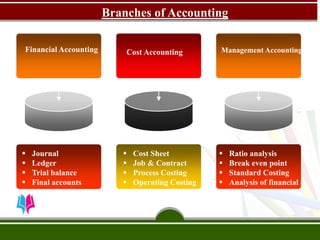
Branches of Accounting
Financial Accounting Cost Accounting Management Accounting
 Journal
 Ledger
 Trial balance
 Final accounts
 Cost Sheet
 Job & Contract
 Process Costing
 Operating Costing
 Ratio analysis
 Break even point
 Standard Costing
 Analysis of financial S
Basic accounting Terminologies
 Business Transaction
 Entry & Narration
 Goods
 Profit & Loss
 Assets, Liabilities & Net worth
 Capital & Drawing
 Expenditure and types of expenditure
 Discount
 Good will
 Bad debts
 Debtors and creditors
 Solvent & Insolvent
 Accounting Year
 Folio, Insurance, Freight Deposit
Business Transaction
Any dealing of business that involves buying and selling of goods and
services in exchange of value be called as business transaction.
 Cash Transaction
 Credit Transactions
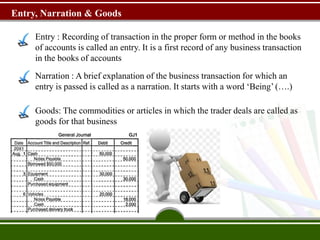
Entry : Recording of transaction in the proper form or method in the books
of accounts is called an entry. It is a first record of any business transaction
in the books of accounts
Entry, Narration & Goods
Narration : A brief explanation of the business transaction for which an
entry is passed is called as a narration. It starts with a word ‘Being’ (….)
Goods: The commodities or articles in which the trader deals are called as
goods for that business
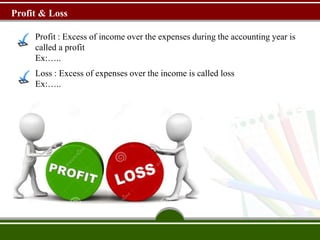
Profit : Excess of income over the expenses during the accounting year is
called a profit
Ex:…..
Profit & Loss
Loss : Excess of expenses over the income is called loss
Ex:…..
Assets, Liabilities & Net worth
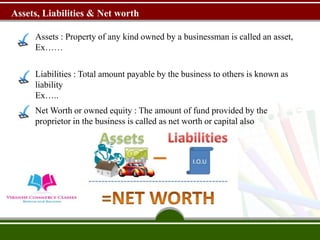
Assets : Property of any kind owned by a businessman is called an asset,
Ex……
Liabilities : Total amount payable by the business to others is known as
liability
Ex…..
Net Worth or owned equity : The amount of fund provided by the
proprietor in the business is called as net worth or capital also
Types of Assets
Assets : Property of any kind owned by a businessman is called an asset,
Ex……
Fixed Assets : Ex…..
Current Assets : Ex…..
Fictitious Assets : Ex…..
Accounting principles are those rules which are to be adopted by the
accountants
Accounting concept
Accounting is the language of business. This are general guidelines for
sound accounting practices
1) Reliable financial statements
2) Generally acceptable basis of measurement
3) Valid and appropriate assumptions
4) Uniformity in presentation
5) Valid and appropriate assumptions
6) Proper information to all
Accounting concepts
1) Business entity
2) Money measurement
3) Cost concept
4) Consistency concept
5) Conservatism
6) Going concern
7) Realization
8) Accrual
9) Dual aspect
10) Disclosure
11) Materiality
12) Revenue recognition principle
13) Marching principle
14) Accounting standards
Double entry book system
 Study of double entry book – keeping system
 Methods of recording accounting information
 Definition of double entry system
 Principle & Advantages of DES
 Conventional Accounting System
 Account and it’s Classification
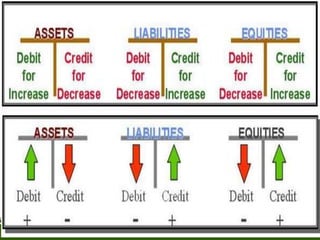
 Debit & Credit
 Rules of Accounts & rules of Debit credit
 Analysis of Transactions
Italian Merchant “ Luca D Bargo Pacioli” in 1949
Double Entry book system
There are two aspects of every business transactions.
 Receiver
 Giver
Recording dual aspects of business transactions in the books of accounts in
terms of Debit & Credit is known as “ Double Entry System of Book –
Keeping”.
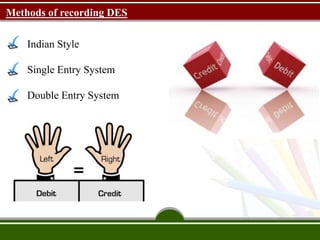
Methods of recording DES
Indian Style
Single Entry System
Double Entry System
Every business transaction has a two fold effect and that it affects two
accounts in opposite directions and if acomplete record is to be made of
each such transaction it would been necessary to debit one account and
credit another account. It is this recording of two fold effect of every
transaction that has given rise to the term double entry” – J.R. Batliboi
Definition of Double Entry System
Principles of DES
 Minimum Two aspects
 Two accounts
 One is receiver and other is giver
 One account is debited the other account must be….
Advantages of DES
1) Accuracy
2) Business Result
3) Complete Record
4) Comparative study
5) Common acceptance
Classifications of Account
Analysis of Transactions
Point of discussion…
Introduction, Meaning & specimen
Voucher – internal & external voucher
Cash & Petty cash voucher
Cash and credit memo
Receipt
Debit and credit note
Pay – in – slip
Withdrawal slip
Cheque
Bank pass book, Bank statement & Bank advice
Introduction
The document required for recording of transactions in the books of accounts are called
as sources of documents.
This document is the legal proof of the transaction which is recorded in the books of
accounts.
The accountant should confirm that every entry made is supported by sources
documents.
The document is the base of passing the entry.
Voucher – Internal & External
Voucher : Voucher is a documentary evidence in support of a business transacting.
like cash Expenses, purchases or sales etc.
It is used as a support for ascertainment of profit in transaction
It helps the auditor to perform his duties
It confirm the date of transaction, the amount and the person details
It describe the nature of transaction
Journal Voucher
Journal Voucher is basic / original Voucher
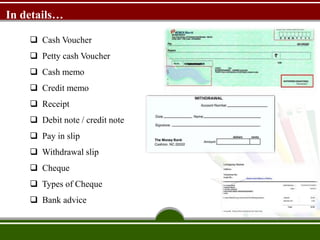
 Cash Voucher
 Petty cash Voucher
 Cash memo
 Credit memo
 Receipt
 Debit note / credit note
 Pay in slip
 Withdrawal slip
 Cheque
 Types of Cheque
 Bank advice
In details…
For more presentation contact….
MO: 09029977770
E-mail : pareshkarande24@gmail.com

Accounting terminology

  • 2.
    Point of discussion… Meaning& Definition of Book - Keeping Features of Book - keeping Objectives of Book - keeping Meaning & Definition of Accountancy Branches of Accounting Basic accounting Terminologies
  • 3.
    Meaning & Definition… Bookkeeping is a process of recording business transitions in the books of accounts in a very systematic manner According to J.R. Batilobi : “ Book – Keeping is an art of recording business dealings in a set of books.” According to Nocth Cott : “ Book – Keeping is an art of recording in the books of accounts the monetary aspects of commercial or financial transactions.”
  • 4.
    Features of Bookkeeping 1、It is the process of recording business transition 2、Monetary transactions are only recorded 3、Recording is made in given set of books of accounts 4、For specific period 5、Art of recording business transactions scientifically
  • 5.
    Objectives of Bookkeeping … Permanent record To know the P&L To know the total amount of Capital To know the total assets and liabilities To know the progress of the business To know Legal requirement and tax liabilites
  • 6.
    Meaning & Definitionof Accountancy Accountancy includes Book keeping & classifying, summarizing and interpreting of the business transactions. According to Kohler : “ Accountancy refers to the entire body of theory and process of accounting.” According to Robert N. Anthony : “ Nearly every business enterprise has an accounting system. It is a means of collecting, summarizing, analyzing and reporting in monetary terms information about the business transactions,”
  • 7.
    Branches of Accounting FinancialAccounting Cost Accounting Management Accounting  Journal  Ledger  Trial balance  Final accounts  Cost Sheet  Job & Contract  Process Costing  Operating Costing  Ratio analysis  Break even point  Standard Costing  Analysis of financial S
  • 9.
    Basic accounting Terminologies Business Transaction  Entry & Narration  Goods  Profit & Loss  Assets, Liabilities & Net worth  Capital & Drawing  Expenditure and types of expenditure  Discount  Good will  Bad debts  Debtors and creditors  Solvent & Insolvent  Accounting Year  Folio, Insurance, Freight Deposit
  • 10.
    Business Transaction Any dealingof business that involves buying and selling of goods and services in exchange of value be called as business transaction.  Cash Transaction  Credit Transactions
  • 11.
    Entry : Recordingof transaction in the proper form or method in the books of accounts is called an entry. It is a first record of any business transaction in the books of accounts Entry, Narration & Goods Narration : A brief explanation of the business transaction for which an entry is passed is called as a narration. It starts with a word ‘Being’ (….) Goods: The commodities or articles in which the trader deals are called as goods for that business
  • 12.
    Profit : Excessof income over the expenses during the accounting year is called a profit Ex:….. Profit & Loss Loss : Excess of expenses over the income is called loss Ex:…..
  • 13.
    Assets, Liabilities &Net worth Assets : Property of any kind owned by a businessman is called an asset, Ex…… Liabilities : Total amount payable by the business to others is known as liability Ex….. Net Worth or owned equity : The amount of fund provided by the proprietor in the business is called as net worth or capital also
  • 14.
    Types of Assets Assets: Property of any kind owned by a businessman is called an asset, Ex…… Fixed Assets : Ex….. Current Assets : Ex….. Fictitious Assets : Ex…..
  • 15.
    Accounting principles arethose rules which are to be adopted by the accountants Accounting concept Accounting is the language of business. This are general guidelines for sound accounting practices 1) Reliable financial statements 2) Generally acceptable basis of measurement 3) Valid and appropriate assumptions 4) Uniformity in presentation 5) Valid and appropriate assumptions 6) Proper information to all
  • 16.
    Accounting concepts 1) Businessentity 2) Money measurement 3) Cost concept 4) Consistency concept 5) Conservatism 6) Going concern 7) Realization 8) Accrual 9) Dual aspect 10) Disclosure 11) Materiality 12) Revenue recognition principle 13) Marching principle 14) Accounting standards
  • 17.
    Double entry booksystem  Study of double entry book – keeping system  Methods of recording accounting information  Definition of double entry system  Principle & Advantages of DES  Conventional Accounting System  Account and it’s Classification  Debit & Credit  Rules of Accounts & rules of Debit credit  Analysis of Transactions
  • 18.
    Italian Merchant “Luca D Bargo Pacioli” in 1949 Double Entry book system There are two aspects of every business transactions.  Receiver  Giver Recording dual aspects of business transactions in the books of accounts in terms of Debit & Credit is known as “ Double Entry System of Book – Keeping”.
  • 19.
    Methods of recordingDES Indian Style Single Entry System Double Entry System
  • 20.
    Every business transactionhas a two fold effect and that it affects two accounts in opposite directions and if acomplete record is to be made of each such transaction it would been necessary to debit one account and credit another account. It is this recording of two fold effect of every transaction that has given rise to the term double entry” – J.R. Batliboi Definition of Double Entry System
  • 21.
    Principles of DES Minimum Two aspects  Two accounts  One is receiver and other is giver  One account is debited the other account must be….
  • 22.
    Advantages of DES 1)Accuracy 2) Business Result 3) Complete Record 4) Comparative study 5) Common acceptance
  • 24.
  • 27.
  • 29.
    Point of discussion… Introduction,Meaning & specimen Voucher – internal & external voucher Cash & Petty cash voucher Cash and credit memo Receipt Debit and credit note Pay – in – slip Withdrawal slip Cheque Bank pass book, Bank statement & Bank advice
  • 30.
    Introduction The document requiredfor recording of transactions in the books of accounts are called as sources of documents. This document is the legal proof of the transaction which is recorded in the books of accounts. The accountant should confirm that every entry made is supported by sources documents. The document is the base of passing the entry.
  • 31.
    Voucher – Internal& External Voucher : Voucher is a documentary evidence in support of a business transacting. like cash Expenses, purchases or sales etc. It is used as a support for ascertainment of profit in transaction It helps the auditor to perform his duties It confirm the date of transaction, the amount and the person details It describe the nature of transaction Journal Voucher Journal Voucher is basic / original Voucher
  • 32.
     Cash Voucher Petty cash Voucher  Cash memo  Credit memo  Receipt  Debit note / credit note  Pay in slip  Withdrawal slip  Cheque  Types of Cheque  Bank advice In details…
  • 34.
    For more presentationcontact…. MO: 09029977770 E-mail : pareshkarande24@gmail.com