DOUBLE ENTRY SYSTEM
&
RULES OF DEBIT AND CREDIT
Mrs. Pooja Kumar
Faculty
IMS, RU
Ranchi
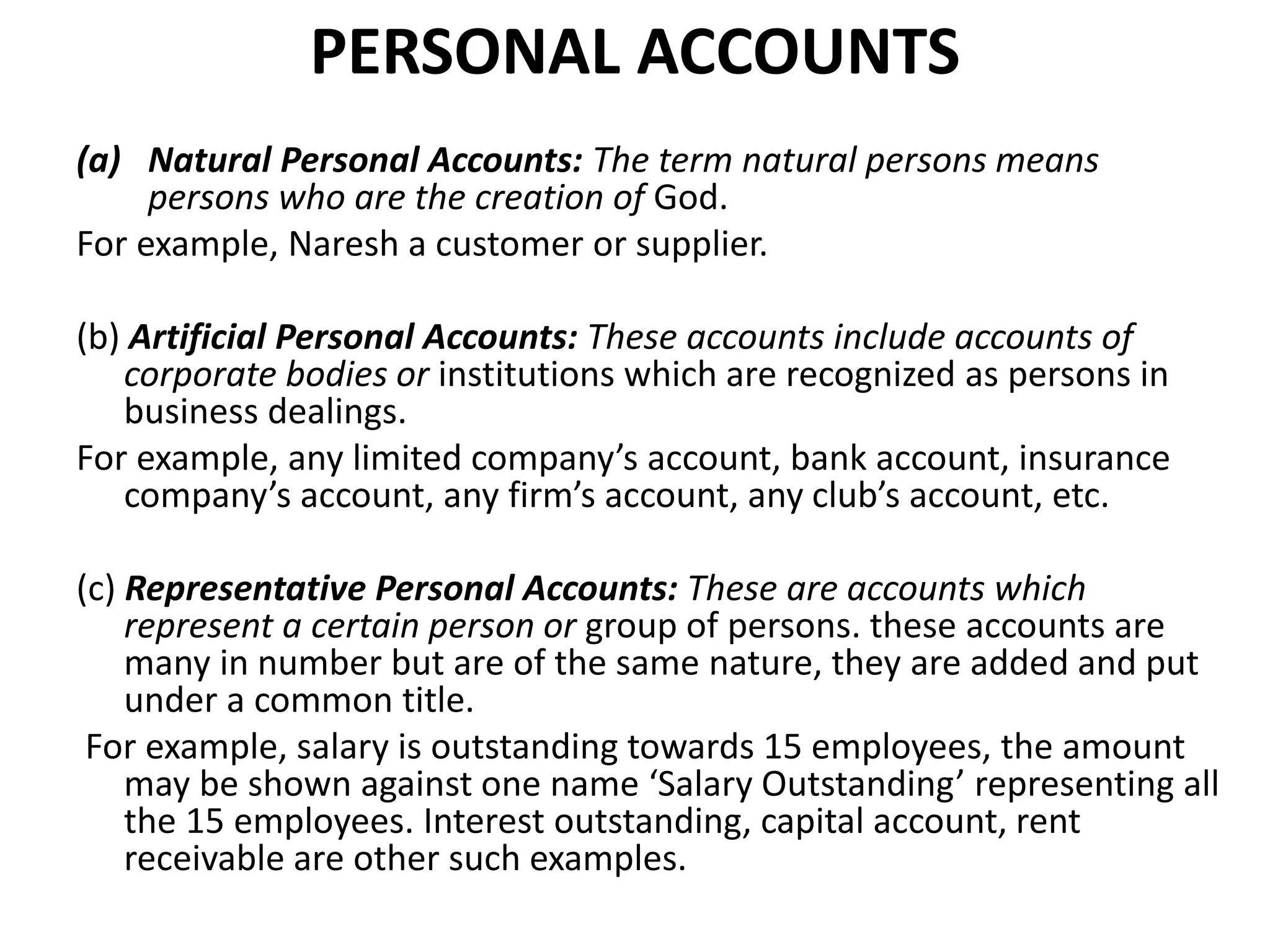
PERSONAL ACCOUNTS
(a) Natural Personal Accounts: The term natural persons means
persons who are the creation of God.
For example, Naresh a customer or supplier.
(b) Artificial Personal Accounts: These accounts include accounts of
corporate bodies or institutions which are recognized as persons in
business dealings.
For example, any limited company’s account, bank account, insurance
company’s account, any firm’s account, any club’s account, etc.
(c) Representative Personal Accounts: These are accounts which
represent a certain person or group of persons. these accounts are
many in number but are of the same nature, they are added and put
under a common title.
For example, salary is outstanding towards 15 employees, the amount
may be shown against one name ‘Salary Outstanding’ representing all
the 15 employees. Interest outstanding, capital account, rent
receivable are other such examples.
REAL ACCOUNTS
(a)Tangible Real Accounts: These are accounts
of such things as are tangible i.e. can be seen,
touched or felt physically.
Examples– land, building, furniture, cash etc.
(b) Intangible Real Accounts: These accounts
represent such things as cannot be touched
but can be measured in terms of money.
Example are, goodwill, trade marks, patent
rights etc.
NOMINAL ACCOUNTS
• Nominal accounts include accounts of all
expenses, losses, income and gains.
• They are known as nominal as at the end of
year these accounts transferred to Trading or
P/L Account.
• Example are salary account, rent account,
commission account etc.
DOUBLE ENTRY SYSTEM
• The double entry system is based on scientific
principles.
• The system recognizes the fact that every
transaction has two aspects and records both
aspects of each and every transaction.
• Under this system, in every transaction an
account is debited and some other account is
credited.
Features of double entry system
• Simplicity.
• Fulfillment of objectives.
• Scientific.
• Elasticity.
• Economical.
• Informative.
• According to government regulations.
• Audit.
Merits of Double Entry System
• It keeps a complete record of business transactions. Both personal
accounts and impersonal accounts are kept.
• It provides a check on the arithmetical accuracy of accounts, since every
debit has corresponding credit to it and vice-versa.
• The detailed profit and loss account can be prepared to show profit
earned or loss suffered during any given period.
• The system makes possible the comparison of purchases as well as sales,
expenditure, income etc. of current year with those of the previous years,
thus enabling a businessman to control its business activities. The balance
sheet can be prepared at any specified point of time or any date showing
the actual amounts of assets, liabilities and capital.
• It significantly reduces the chances of a fraud and if a fraud is committed it
can be easily detected.
• The accurate details with regard to any account can be easily obtained.
RULES OF DEBIT AND CREDIT
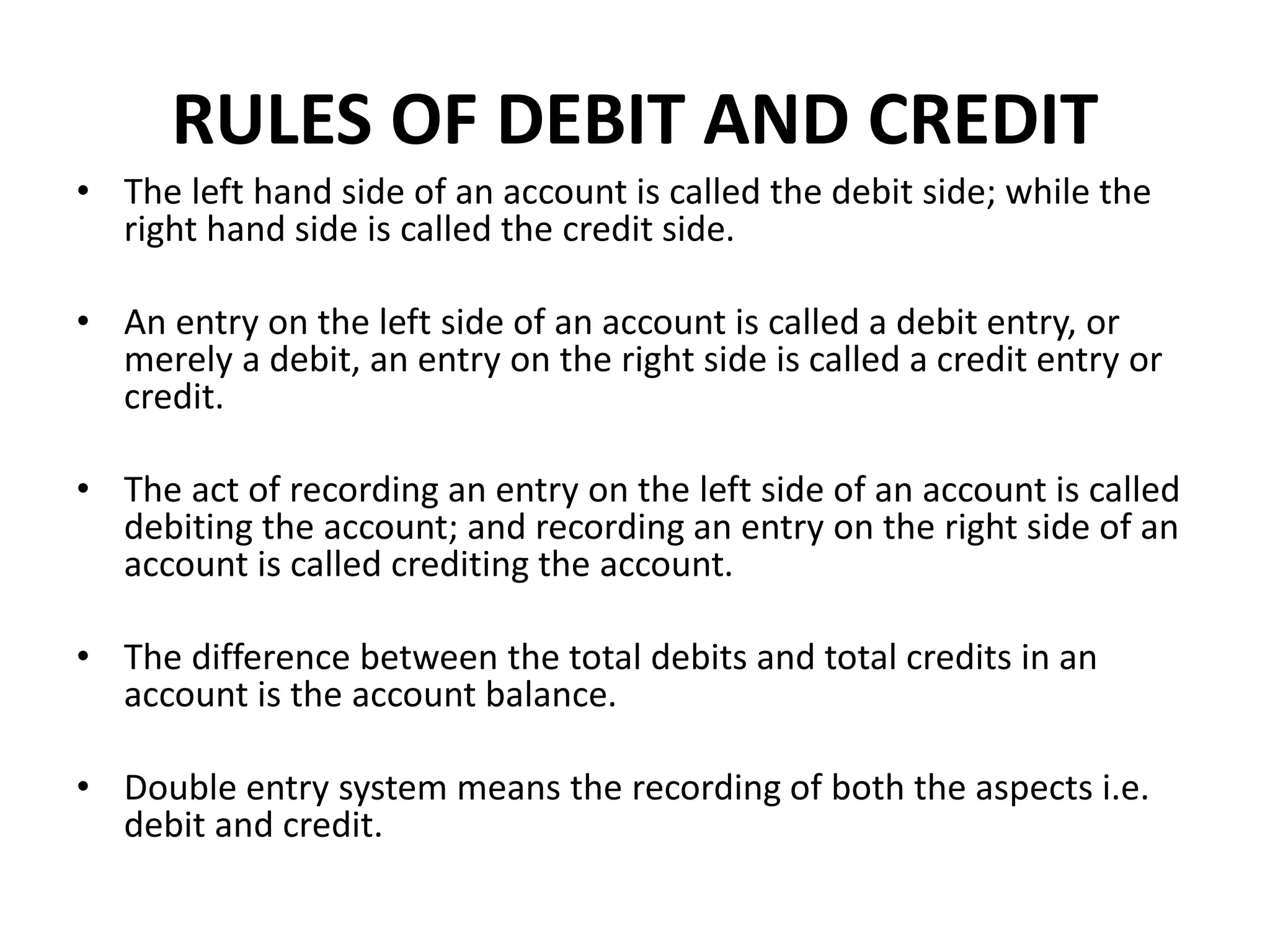
• The left hand side of an account is called the debit side; while the
right hand side is called the credit side.
• An entry on the left side of an account is called a debit entry, or
merely a debit, an entry on the right side is called a credit entry or
credit.
• The act of recording an entry on the left side of an account is called
debiting the account; and recording an entry on the right side of an
account is called crediting the account.
• The difference between the total debits and total credits in an
account is the account balance.
• Double entry system means the recording of both the aspects i.e.
debit and credit.
TRADITIONAL METHOD
GOLDEN RULES
Personal Accounts:
‘Debit the receiver and credit the giver’
Real Accounts:
‘Debit what comes in and credit what goes out’
Nominal Accounts:
‘Debit all expenses and losses and credit all
incomes and gains’
ANALYSING TRANSACTIONS FOR
RECORDING
If the three fundamental rules described above are
kept in mind, it would be possible to record all the
transactions correctly.
Follow these simple steps to record all the
transactions:
– Identify the two accounts involved in the
transaction.
– Find out the type of account for both the accounts
involved in the transaction.
– Apply the rules of debit and credit.
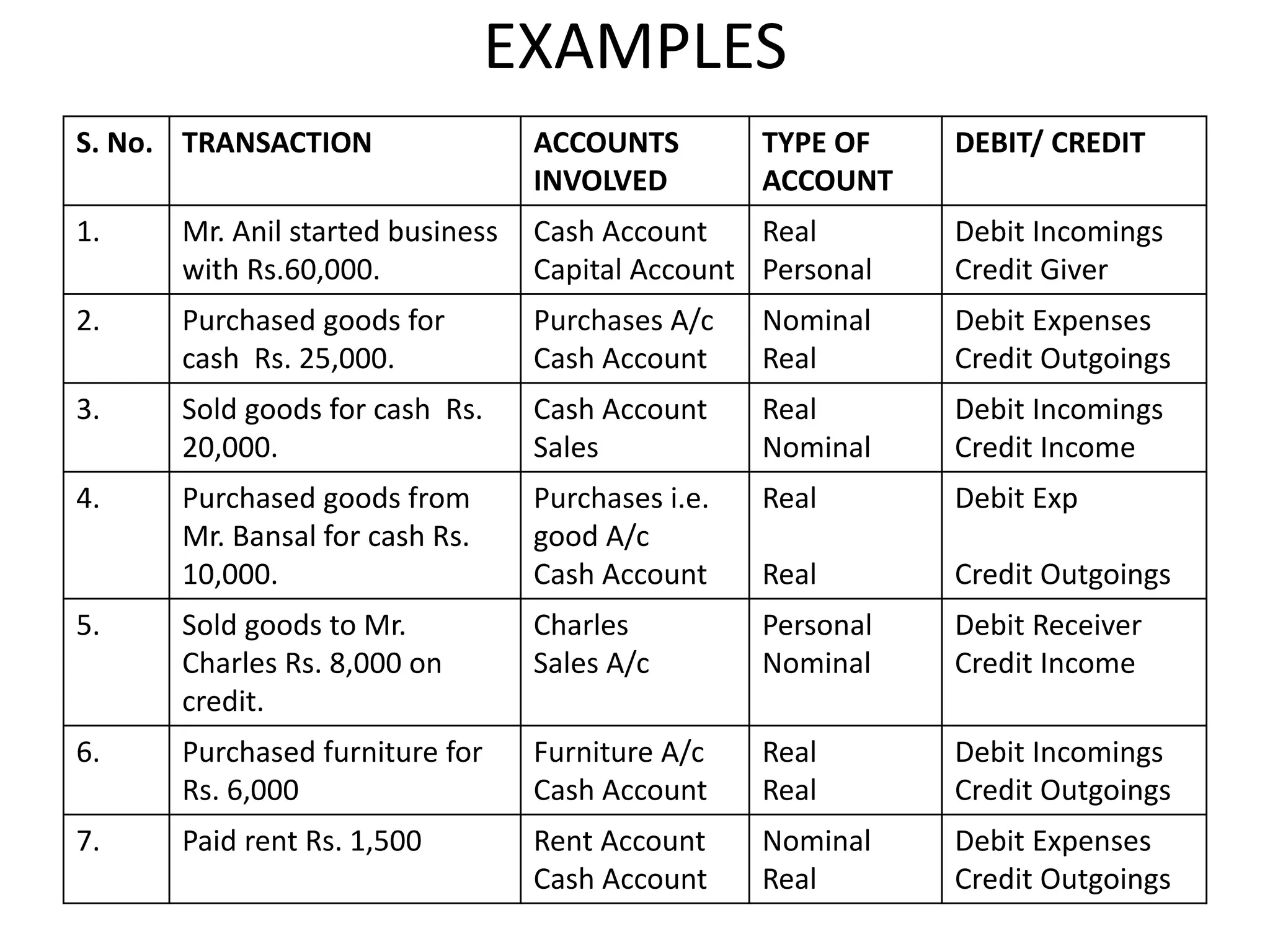
EXAMPLES
S. No. TRANSACTION ACCOUNTS
INVOLVED
TYPE OF
ACCOUNT
DEBIT/ CREDIT
1. Mr. Anil started business
with Rs.60,000.
Cash Account
Capital Account
Real
Personal
Debit Incomings
Credit Giver
2. Purchased goods for
cash Rs. 25,000.
Purchases A/c
Cash Account
Nominal
Real
Debit Expenses
Credit Outgoings
3. Sold goods for cash Rs.
20,000.
Cash Account
Sales
Real
Nominal
Debit Incomings
Credit Income
4. Purchased goods from
Mr. Bansal for cash Rs.
10,000.
Purchases i.e.
good A/c
Cash Account
Real
Real
Debit Exp
Credit Outgoings
5. Sold goods to Mr.
Charles Rs. 8,000 on
credit.
Charles
Sales A/c
Personal
Nominal
Debit Receiver
Credit Income
6. Purchased furniture for
Rs. 6,000
Furniture A/c
Cash Account
Real
Real
Debit Incomings
Credit Outgoings
7. Paid rent Rs. 1,500 Rent Account
Cash Account
Nominal
Real
Debit Expenses
Credit Outgoings
EXAMPLES
S. No. TRANSACTION ACCOUNTS
INVOLVED
TYPE OF
ACCOUNT
DEBIT/ CREDIT
8. Paid wages Wages A/c
Cash Account
Nominal
Real
Debit Expenses
Credit Outgoings
9. Purchased goods from
Ajit on credit
Purchases A/c
Ajit
Nominal
Personal
Debit Expenses
Credit giver
10. Dividend received Cash Account
Dividend A/c
Real
Nominal
Debit incomings
Credit Income
11. Machinery sold Cash Account
Machinery A/c
Real
Real
Debit incomings
Credit Outgoings
12. Outstanding for salaries Salaries A/c
Outstanding
Salaries
A/c
Nominal
Personal
Debit Expenses
Credit given
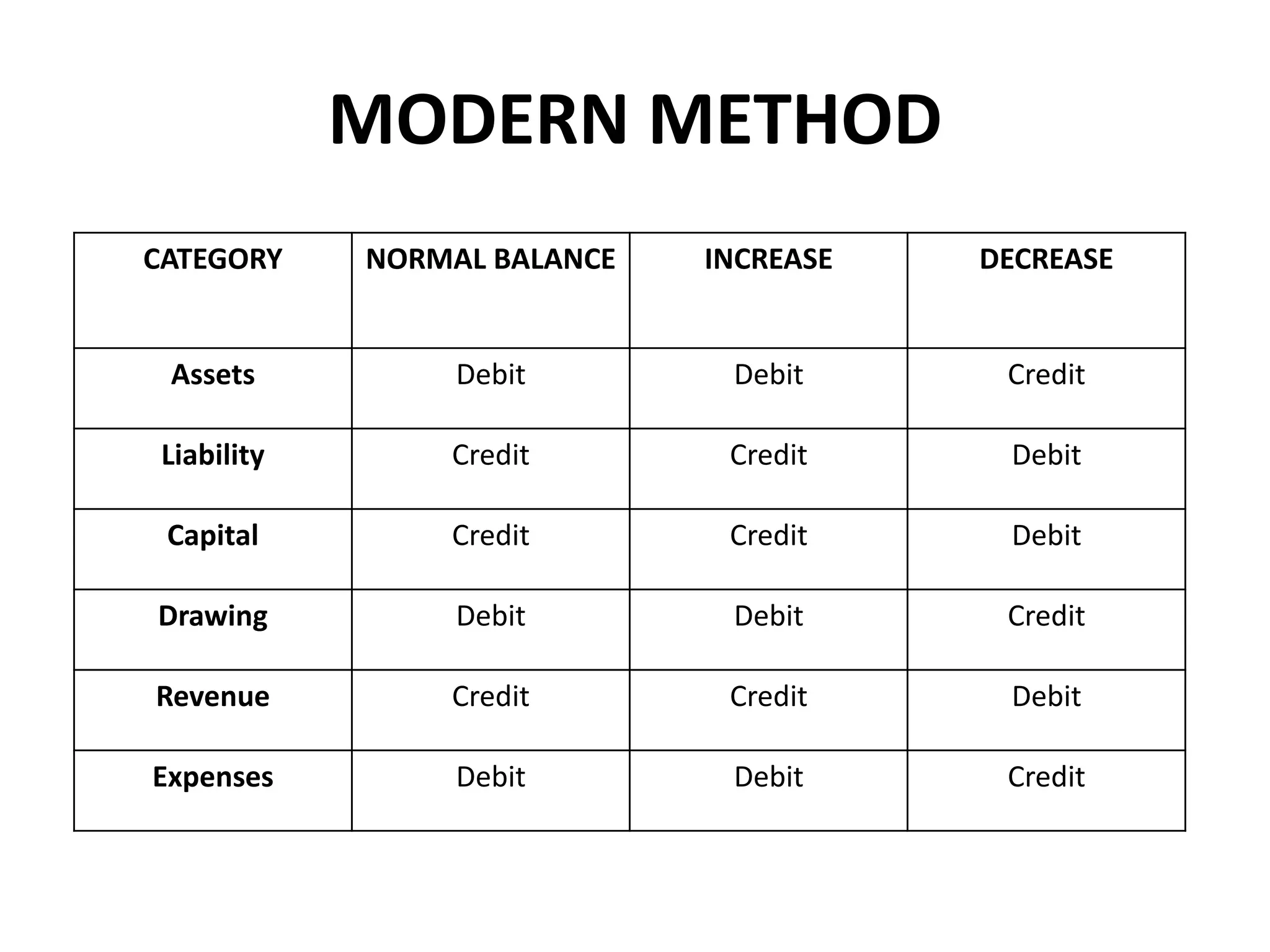
MODERN METHOD
CATEGORY NORMAL BALANCE INCREASE DECREASE
Assets Debit Debit Credit
Liability Credit Credit Debit
Capital Credit Credit Debit
Drawing Debit Debit Credit
Revenue Credit Credit Debit
Expenses Debit Debit Credit
Illustration 1
January 1: Tarun started business with cash 1,00,000
January 2: Goods purchased for cash 20,000
January 4: Machinery Purchased from Vibhu 30,000
January 6: Rent paid in cash 10,000
January 8: Goods purchased on credit from Anil 25,000
January 10: Goods sold for cash 40,000
January 15: Goods sold on credit to Gurmeet 30,000
January 18: Salaries paid. 12,000
January 20: Cash withdrawn for personal use 5,000
Tabular Analysis of Business Transactions
1.3. DOUBLE ENTRY SYSTEM.pptx

1.3. DOUBLE ENTRY SYSTEM.pptx

  • 1.
    DOUBLE ENTRY SYSTEM & RULESOF DEBIT AND CREDIT Mrs. Pooja Kumar Faculty IMS, RU Ranchi
  • 3.
    PERSONAL ACCOUNTS (a) NaturalPersonal Accounts: The term natural persons means persons who are the creation of God. For example, Naresh a customer or supplier. (b) Artificial Personal Accounts: These accounts include accounts of corporate bodies or institutions which are recognized as persons in business dealings. For example, any limited company’s account, bank account, insurance company’s account, any firm’s account, any club’s account, etc. (c) Representative Personal Accounts: These are accounts which represent a certain person or group of persons. these accounts are many in number but are of the same nature, they are added and put under a common title. For example, salary is outstanding towards 15 employees, the amount may be shown against one name ‘Salary Outstanding’ representing all the 15 employees. Interest outstanding, capital account, rent receivable are other such examples.
  • 4.
    REAL ACCOUNTS (a)Tangible RealAccounts: These are accounts of such things as are tangible i.e. can be seen, touched or felt physically. Examples– land, building, furniture, cash etc. (b) Intangible Real Accounts: These accounts represent such things as cannot be touched but can be measured in terms of money. Example are, goodwill, trade marks, patent rights etc.
  • 5.
    NOMINAL ACCOUNTS • Nominalaccounts include accounts of all expenses, losses, income and gains. • They are known as nominal as at the end of year these accounts transferred to Trading or P/L Account. • Example are salary account, rent account, commission account etc.
  • 6.
    DOUBLE ENTRY SYSTEM •The double entry system is based on scientific principles. • The system recognizes the fact that every transaction has two aspects and records both aspects of each and every transaction. • Under this system, in every transaction an account is debited and some other account is credited.
  • 7.
    Features of doubleentry system • Simplicity. • Fulfillment of objectives. • Scientific. • Elasticity. • Economical. • Informative. • According to government regulations. • Audit.
  • 8.
    Merits of DoubleEntry System • It keeps a complete record of business transactions. Both personal accounts and impersonal accounts are kept. • It provides a check on the arithmetical accuracy of accounts, since every debit has corresponding credit to it and vice-versa. • The detailed profit and loss account can be prepared to show profit earned or loss suffered during any given period. • The system makes possible the comparison of purchases as well as sales, expenditure, income etc. of current year with those of the previous years, thus enabling a businessman to control its business activities. The balance sheet can be prepared at any specified point of time or any date showing the actual amounts of assets, liabilities and capital. • It significantly reduces the chances of a fraud and if a fraud is committed it can be easily detected. • The accurate details with regard to any account can be easily obtained.
  • 9.
    RULES OF DEBITAND CREDIT • The left hand side of an account is called the debit side; while the right hand side is called the credit side. • An entry on the left side of an account is called a debit entry, or merely a debit, an entry on the right side is called a credit entry or credit. • The act of recording an entry on the left side of an account is called debiting the account; and recording an entry on the right side of an account is called crediting the account. • The difference between the total debits and total credits in an account is the account balance. • Double entry system means the recording of both the aspects i.e. debit and credit.
  • 10.
    TRADITIONAL METHOD GOLDEN RULES PersonalAccounts: ‘Debit the receiver and credit the giver’ Real Accounts: ‘Debit what comes in and credit what goes out’ Nominal Accounts: ‘Debit all expenses and losses and credit all incomes and gains’
  • 11.
    ANALYSING TRANSACTIONS FOR RECORDING Ifthe three fundamental rules described above are kept in mind, it would be possible to record all the transactions correctly. Follow these simple steps to record all the transactions: – Identify the two accounts involved in the transaction. – Find out the type of account for both the accounts involved in the transaction. – Apply the rules of debit and credit.
  • 12.
    EXAMPLES S. No. TRANSACTIONACCOUNTS INVOLVED TYPE OF ACCOUNT DEBIT/ CREDIT 1. Mr. Anil started business with Rs.60,000. Cash Account Capital Account Real Personal Debit Incomings Credit Giver 2. Purchased goods for cash Rs. 25,000. Purchases A/c Cash Account Nominal Real Debit Expenses Credit Outgoings 3. Sold goods for cash Rs. 20,000. Cash Account Sales Real Nominal Debit Incomings Credit Income 4. Purchased goods from Mr. Bansal for cash Rs. 10,000. Purchases i.e. good A/c Cash Account Real Real Debit Exp Credit Outgoings 5. Sold goods to Mr. Charles Rs. 8,000 on credit. Charles Sales A/c Personal Nominal Debit Receiver Credit Income 6. Purchased furniture for Rs. 6,000 Furniture A/c Cash Account Real Real Debit Incomings Credit Outgoings 7. Paid rent Rs. 1,500 Rent Account Cash Account Nominal Real Debit Expenses Credit Outgoings
  • 13.
    EXAMPLES S. No. TRANSACTIONACCOUNTS INVOLVED TYPE OF ACCOUNT DEBIT/ CREDIT 8. Paid wages Wages A/c Cash Account Nominal Real Debit Expenses Credit Outgoings 9. Purchased goods from Ajit on credit Purchases A/c Ajit Nominal Personal Debit Expenses Credit giver 10. Dividend received Cash Account Dividend A/c Real Nominal Debit incomings Credit Income 11. Machinery sold Cash Account Machinery A/c Real Real Debit incomings Credit Outgoings 12. Outstanding for salaries Salaries A/c Outstanding Salaries A/c Nominal Personal Debit Expenses Credit given
  • 14.
    MODERN METHOD CATEGORY NORMALBALANCE INCREASE DECREASE Assets Debit Debit Credit Liability Credit Credit Debit Capital Credit Credit Debit Drawing Debit Debit Credit Revenue Credit Credit Debit Expenses Debit Debit Credit
  • 15.
    Illustration 1 January 1:Tarun started business with cash 1,00,000 January 2: Goods purchased for cash 20,000 January 4: Machinery Purchased from Vibhu 30,000 January 6: Rent paid in cash 10,000 January 8: Goods purchased on credit from Anil 25,000 January 10: Goods sold for cash 40,000 January 15: Goods sold on credit to Gurmeet 30,000 January 18: Salaries paid. 12,000 January 20: Cash withdrawn for personal use 5,000
  • 16.
    Tabular Analysis ofBusiness Transactions