COMPILED BY: Prof G B Rathod
EC department-BVM College,
Email: ghansyam.rathod@bvmengineering.ac.in
Bio-Potentials
www.gbrathod.co.in
Outline
 Human body and Cell structure
 ElectricalActivity of Excitable Cells
 The action and Resting potentials
 Introduction of Bio-potentials related to the human body
 Outcomes
 Reference
 Questions
www.gbrathod.co.in
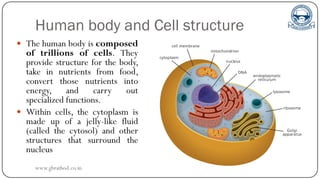
Human body and Cell structure
 The human body is composed
of trillions of cells. They
provide structure for the body,
take in nutrients from food,
convert those nutrients into
energy, and carry out
specialized functions.
 Within cells, the cytoplasm is
made up of a jelly-like fluid
(called the cytosol) and other
structures that surround the
nucleus
www.gbrathod.co.in
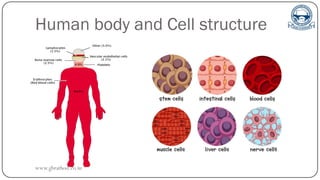
Human body and Cell structure
www.gbrathod.co.in
Electrical Activity of Excitable Cells
 Exist in nervous, muscular and glandular tissue. Exhibit a
resting potential and an action potential.
 Necessary for information transfer (e.g. sensory info in
nervous system or coordination of blood pumping in the
heart)
www.gbrathod.co.in
Electrical Activity of Excitable Cells
www.gbrathod.co.in
Electrical Activity of Excitable Cells
 Bioelectric Potentials: for various functions, body generate their own
monitoring signals which contain some useful information.
 These signals are bioelectric potentials associated with nerve
conduction, brain activity, heartbeat, muscle activity and so on.
 Its an ionic voltages and its produced by certain electrochemical activity
by special types of cells. Transducers can convert this ionic to electrical
voltages.
 First time Italian Professor, Luigi Galvani(1786), claim that he found
electricity in muscle of a frog’s leg. In human 1903 by Dutch physician
willem Einthoven.
 Development of semiconductor electronics, the research made easy.
www.gbrathod.co.in
Resting and Action Potentials
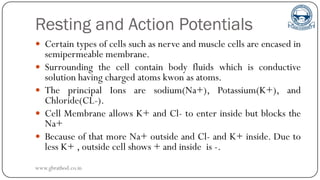
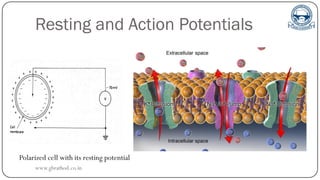
 Certain types of cells such as nerve and muscle cells are encased in
semipermeable membrane.
 Surrounding the cell contain body fluids which is conductive
solution having charged atoms kwon as atoms.
 The principal Ions are sodium(Na+), Potassium(K+), and
Chloride(CL-).
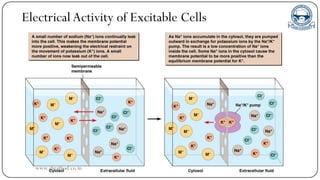
 Cell Membrane allows K+ and Cl- to enter inside but blocks the
Na+
 Because of that more Na+ outside and Cl- and K+ inside. Due to
less K+ , outside cell shows + and inside is -.
www.gbrathod.co.in
Resting and Action Potentials
Polarized cell with its resting potential
www.gbrathod.co.in
Resting and Action Potentials
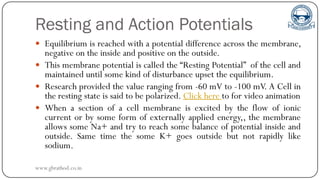
 Equilibrium is reached with a potential difference across the membrane,
negative on the inside and positive on the outside.
 This membrane potential is called the “Resting Potential” of the cell and
maintained until some kind of disturbance upset the equilibrium.
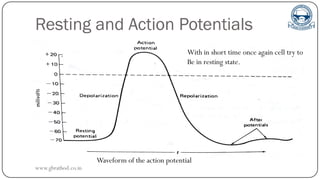
 Research provided the value ranging from -60 mV to -100 mV. A Cell in
the resting state is said to be polarized. Click here to for video animation
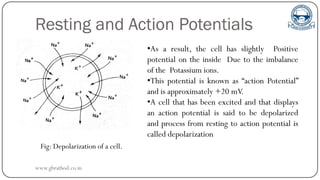
 When a section of a cell membrane is excited by the flow of ionic
current or by some form of externally applied energy,, the membrane
allows some Na+ and try to reach some balance of potential inside and
outside. Same time the some K+ goes outside but not rapidly like
sodium.
www.gbrathod.co.in
Resting and Action Potentials
Fig: Depolarization of a cell.
•As a result, the cell has slightly Positive
potential on the inside Due to the imbalance
of the Potassium ions.
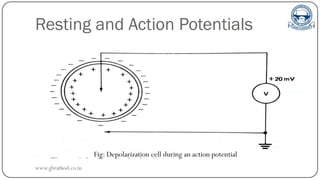
•This potential is known as “action Potential”
and is approximately +20 mV.
•A cell that has been excited and that displays
an action potential is said to be depolarized
and process from resting to action potential is
called depolarization
www.gbrathod.co.in
Resting and Action Potentials
Fig: Depolarization cell during an action potential
www.gbrathod.co.in
Resting and Action Potentials
With in short time once again cell try to
Be in resting state.
Waveform of the action potential
www.gbrathod.co.in
Resting and Action Potentials
 The time scale depends on the cell producing the potential.
 In nerve and muscle cells, repolarization occur as spike around 1 msec total
duration. Heart muscle need 150 to 300 msec.
 Regardless of the method by which cell is excited or the intensity of the
stimulus, the action potential is always the same for any given cell. This is
known as the all-or-nothing law.
 The small period of time where the cell can not respond to any new stimulus is
known as a absolute refractory period, last for 1 msec in nerve cells.
 Following the absolute refractory period, there occurs a relative
refractory period, during which another action potential can be triggered
but much stronger stimulation is required.
www.gbrathod.co.in
Propagation of action potentials
 The rate at which an action potential moves down a fiber or
is propagate from cell to cell is called the propagation rate.
 In nerve fiber the propagation rate is also called the nerve
conduction rate, or conduction velocity.Velocity range in
nerves is from 20 to 140 meters per second.
 In heart muscle, the rate is slower, average 0.2 to 0.4 m/sec
www.gbrathod.co.in
The Bioelectric Potentials
 The Electrocardiogram(ECG)
 The Electroencephalogram(EEG)
 The Electromyogram(EMG)
 The Electroretinogram(ERG)
 The Electro-oculogram(EOG)
 The Electrogastrogram(EGG)
www.gbrathod.co.in
The Bioelectric Potentials
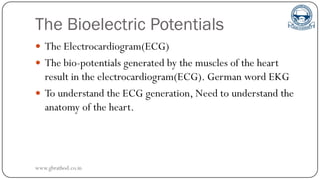
 The Electrocardiogram(ECG)
 The bio-potentials generated by the muscles of the heart
result in the electrocardiogram(ECG). German word EKG
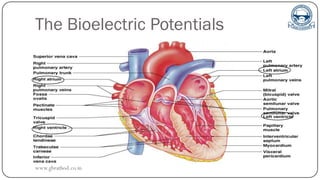
 To understand the ECG generation, Need to understand the
anatomy of the heart.
www.gbrathod.co.in
The Bioelectric Potentials
www.gbrathod.co.in
The Bioelectric Potentials
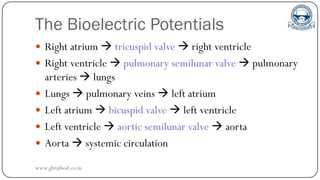
 Right atrium  tricuspid valve  right ventricle
 Right ventricle  pulmonary semilunar valve  pulmonary
arteries  lungs
 Lungs  pulmonary veins  left atrium
 Left atrium  bicuspid valve  left ventricle
 Left ventricle  aortic semilunar valve  aorta
 Aorta  systemic circulation
www.gbrathod.co.in
The Bioelectric Potentials
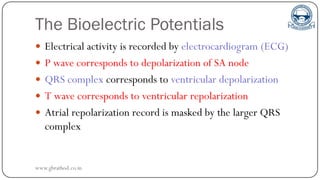
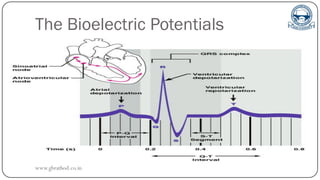
 Electrical activity is recorded by electrocardiogram (ECG)
 P wave corresponds to depolarization of SA node
 QRS complex corresponds to ventricular depolarization
 T wave corresponds to ventricular repolarization
 Atrial repolarization record is masked by the larger QRS
complex
www.gbrathod.co.in
The Bioelectric Potentials
www.gbrathod.co.in
The Bioelectric Potentials
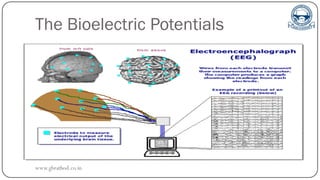
 The Electroencephalogram(EEG)
 The recorded representation of bioelectric potential by the
neuronal activity of the brain is called the
electroencephalogram.
 The waveform varies greatly with the location of the
measuring electrodes on the surface of the scalp.
www.gbrathod.co.in
The Bioelectric Potentials
www.gbrathod.co.in
The Bioelectric Potentials
www.gbrathod.co.in
The Bioelectric Potentials
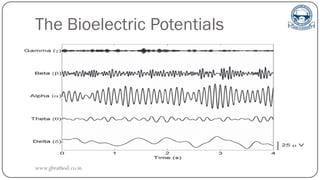
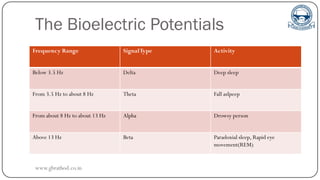
Frequency Range SignalType Activity
Below 3.5 Hz Delta Deep sleep
From 3.5 Hz to about 8 Hz Theta Fall aslpeep
From about 8 Hz to about 13 Hz Alpha Drowsy person
Above 13 Hz Beta Paradoxial sleep, Rapid eye
movement(REM)
www.gbrathod.co.in
The Bioelectric Potentials
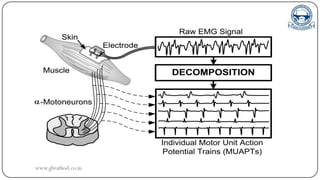
 EMG:The bioelectric potentials associated with muscle
activity constitute the electromyogram.
 Can be measure on the surface of the body or by penetrating
the skin using needle electrodes.
www.gbrathod.co.in
www.gbrathod.co.in
The Bioelectric Potentials
 ERG: Eelctoretinogram:A record of the complex pattern of
the bioelectric potentials obtain from the retina of the eye.
This is usually a response to a visual stimulas.
 EOG: Electro-oculogram:A measure of the variation in the
corneal-retinal potential as affected by the position and
movement of eye.
 EGG:Electrogastrogram:The EMG patterns associated with
the peristaltic movement of the gastrointestinal tract.
www.gbrathod.co.in
Outcomes
 The basic of potential generation from the body
 Understanding of basic concept of various bioelectric signals
from the human body.
www.gbrathod.co.in
References
 Book:“Biomedical instrumentation and measurements “ ,by
L. Cromwell, F .Weibell, and E. Pfeiffer. PHI publication 2nd
Edition
 www.msu.edu/anatomy
 www.humbleisd.net/cms/.../Anatomy
 www.lavc.edu/instructor/...k/.../Lecture
 web.as.uky.edu/Biology/faculty
www.gbrathod.co.in
Thank you
www.gbrathod.co.in
www.gbrathod.co.in

Topic 2 biopotentials

  • 1.
    COMPILED BY: ProfG B Rathod EC department-BVM College, Email: ghansyam.rathod@bvmengineering.ac.in Bio-Potentials www.gbrathod.co.in
  • 2.
    Outline  Human bodyand Cell structure  ElectricalActivity of Excitable Cells  The action and Resting potentials  Introduction of Bio-potentials related to the human body  Outcomes  Reference  Questions www.gbrathod.co.in
  • 3.
    Human body andCell structure  The human body is composed of trillions of cells. They provide structure for the body, take in nutrients from food, convert those nutrients into energy, and carry out specialized functions.  Within cells, the cytoplasm is made up of a jelly-like fluid (called the cytosol) and other structures that surround the nucleus www.gbrathod.co.in
  • 4.
    Human body andCell structure www.gbrathod.co.in
  • 5.
    Electrical Activity ofExcitable Cells  Exist in nervous, muscular and glandular tissue. Exhibit a resting potential and an action potential.  Necessary for information transfer (e.g. sensory info in nervous system or coordination of blood pumping in the heart) www.gbrathod.co.in
  • 6.
    Electrical Activity ofExcitable Cells www.gbrathod.co.in
  • 7.
    Electrical Activity ofExcitable Cells  Bioelectric Potentials: for various functions, body generate their own monitoring signals which contain some useful information.  These signals are bioelectric potentials associated with nerve conduction, brain activity, heartbeat, muscle activity and so on.  Its an ionic voltages and its produced by certain electrochemical activity by special types of cells. Transducers can convert this ionic to electrical voltages.  First time Italian Professor, Luigi Galvani(1786), claim that he found electricity in muscle of a frog’s leg. In human 1903 by Dutch physician willem Einthoven.  Development of semiconductor electronics, the research made easy. www.gbrathod.co.in
  • 8.
    Resting and ActionPotentials  Certain types of cells such as nerve and muscle cells are encased in semipermeable membrane.  Surrounding the cell contain body fluids which is conductive solution having charged atoms kwon as atoms.  The principal Ions are sodium(Na+), Potassium(K+), and Chloride(CL-).  Cell Membrane allows K+ and Cl- to enter inside but blocks the Na+  Because of that more Na+ outside and Cl- and K+ inside. Due to less K+ , outside cell shows + and inside is -. www.gbrathod.co.in
  • 9.
    Resting and ActionPotentials Polarized cell with its resting potential www.gbrathod.co.in
  • 10.
    Resting and ActionPotentials  Equilibrium is reached with a potential difference across the membrane, negative on the inside and positive on the outside.  This membrane potential is called the “Resting Potential” of the cell and maintained until some kind of disturbance upset the equilibrium.  Research provided the value ranging from -60 mV to -100 mV. A Cell in the resting state is said to be polarized. Click here to for video animation  When a section of a cell membrane is excited by the flow of ionic current or by some form of externally applied energy,, the membrane allows some Na+ and try to reach some balance of potential inside and outside. Same time the some K+ goes outside but not rapidly like sodium. www.gbrathod.co.in
  • 11.
    Resting and ActionPotentials Fig: Depolarization of a cell. •As a result, the cell has slightly Positive potential on the inside Due to the imbalance of the Potassium ions. •This potential is known as “action Potential” and is approximately +20 mV. •A cell that has been excited and that displays an action potential is said to be depolarized and process from resting to action potential is called depolarization www.gbrathod.co.in
  • 12.
    Resting and ActionPotentials Fig: Depolarization cell during an action potential www.gbrathod.co.in
  • 13.
    Resting and ActionPotentials With in short time once again cell try to Be in resting state. Waveform of the action potential www.gbrathod.co.in
  • 14.
    Resting and ActionPotentials  The time scale depends on the cell producing the potential.  In nerve and muscle cells, repolarization occur as spike around 1 msec total duration. Heart muscle need 150 to 300 msec.  Regardless of the method by which cell is excited or the intensity of the stimulus, the action potential is always the same for any given cell. This is known as the all-or-nothing law.  The small period of time where the cell can not respond to any new stimulus is known as a absolute refractory period, last for 1 msec in nerve cells.  Following the absolute refractory period, there occurs a relative refractory period, during which another action potential can be triggered but much stronger stimulation is required. www.gbrathod.co.in
  • 15.
    Propagation of actionpotentials  The rate at which an action potential moves down a fiber or is propagate from cell to cell is called the propagation rate.  In nerve fiber the propagation rate is also called the nerve conduction rate, or conduction velocity.Velocity range in nerves is from 20 to 140 meters per second.  In heart muscle, the rate is slower, average 0.2 to 0.4 m/sec www.gbrathod.co.in
  • 16.
    The Bioelectric Potentials The Electrocardiogram(ECG)  The Electroencephalogram(EEG)  The Electromyogram(EMG)  The Electroretinogram(ERG)  The Electro-oculogram(EOG)  The Electrogastrogram(EGG) www.gbrathod.co.in
  • 17.
    The Bioelectric Potentials The Electrocardiogram(ECG)  The bio-potentials generated by the muscles of the heart result in the electrocardiogram(ECG). German word EKG  To understand the ECG generation, Need to understand the anatomy of the heart. www.gbrathod.co.in
  • 18.
  • 19.
    The Bioelectric Potentials Right atrium  tricuspid valve  right ventricle  Right ventricle  pulmonary semilunar valve  pulmonary arteries  lungs  Lungs  pulmonary veins  left atrium  Left atrium  bicuspid valve  left ventricle  Left ventricle  aortic semilunar valve  aorta  Aorta  systemic circulation www.gbrathod.co.in
  • 20.
    The Bioelectric Potentials Electrical activity is recorded by electrocardiogram (ECG)  P wave corresponds to depolarization of SA node  QRS complex corresponds to ventricular depolarization  T wave corresponds to ventricular repolarization  Atrial repolarization record is masked by the larger QRS complex www.gbrathod.co.in
  • 21.
  • 22.
    The Bioelectric Potentials The Electroencephalogram(EEG)  The recorded representation of bioelectric potential by the neuronal activity of the brain is called the electroencephalogram.  The waveform varies greatly with the location of the measuring electrodes on the surface of the scalp. www.gbrathod.co.in
  • 23.
  • 24.
  • 25.
    The Bioelectric Potentials FrequencyRange SignalType Activity Below 3.5 Hz Delta Deep sleep From 3.5 Hz to about 8 Hz Theta Fall aslpeep From about 8 Hz to about 13 Hz Alpha Drowsy person Above 13 Hz Beta Paradoxial sleep, Rapid eye movement(REM) www.gbrathod.co.in
  • 26.
    The Bioelectric Potentials EMG:The bioelectric potentials associated with muscle activity constitute the electromyogram.  Can be measure on the surface of the body or by penetrating the skin using needle electrodes. www.gbrathod.co.in
  • 27.
  • 28.
    The Bioelectric Potentials ERG: Eelctoretinogram:A record of the complex pattern of the bioelectric potentials obtain from the retina of the eye. This is usually a response to a visual stimulas.  EOG: Electro-oculogram:A measure of the variation in the corneal-retinal potential as affected by the position and movement of eye.  EGG:Electrogastrogram:The EMG patterns associated with the peristaltic movement of the gastrointestinal tract. www.gbrathod.co.in
  • 29.
    Outcomes  The basicof potential generation from the body  Understanding of basic concept of various bioelectric signals from the human body. www.gbrathod.co.in
  • 30.
    References  Book:“Biomedical instrumentationand measurements “ ,by L. Cromwell, F .Weibell, and E. Pfeiffer. PHI publication 2nd Edition  www.msu.edu/anatomy  www.humbleisd.net/cms/.../Anatomy  www.lavc.edu/instructor/...k/.../Lecture  web.as.uky.edu/Biology/faculty www.gbrathod.co.in
  • 31.