Compiled by : Prof. G. B. Rathod
Subject: ES102-ElectronicsWorkshop
EC Department, BVM Engineering College
Email:ghansyam.rathod@bvmengineering.ac.in
Practical No-9:FUSE-MCB-ELCB
•Outline
Fuse Definition
Fuse type
MCB Definition
MCB Type
ELCB Definition
ELCB working
2 ES102-EW-EC-BVM-GBR
Fuse Definition
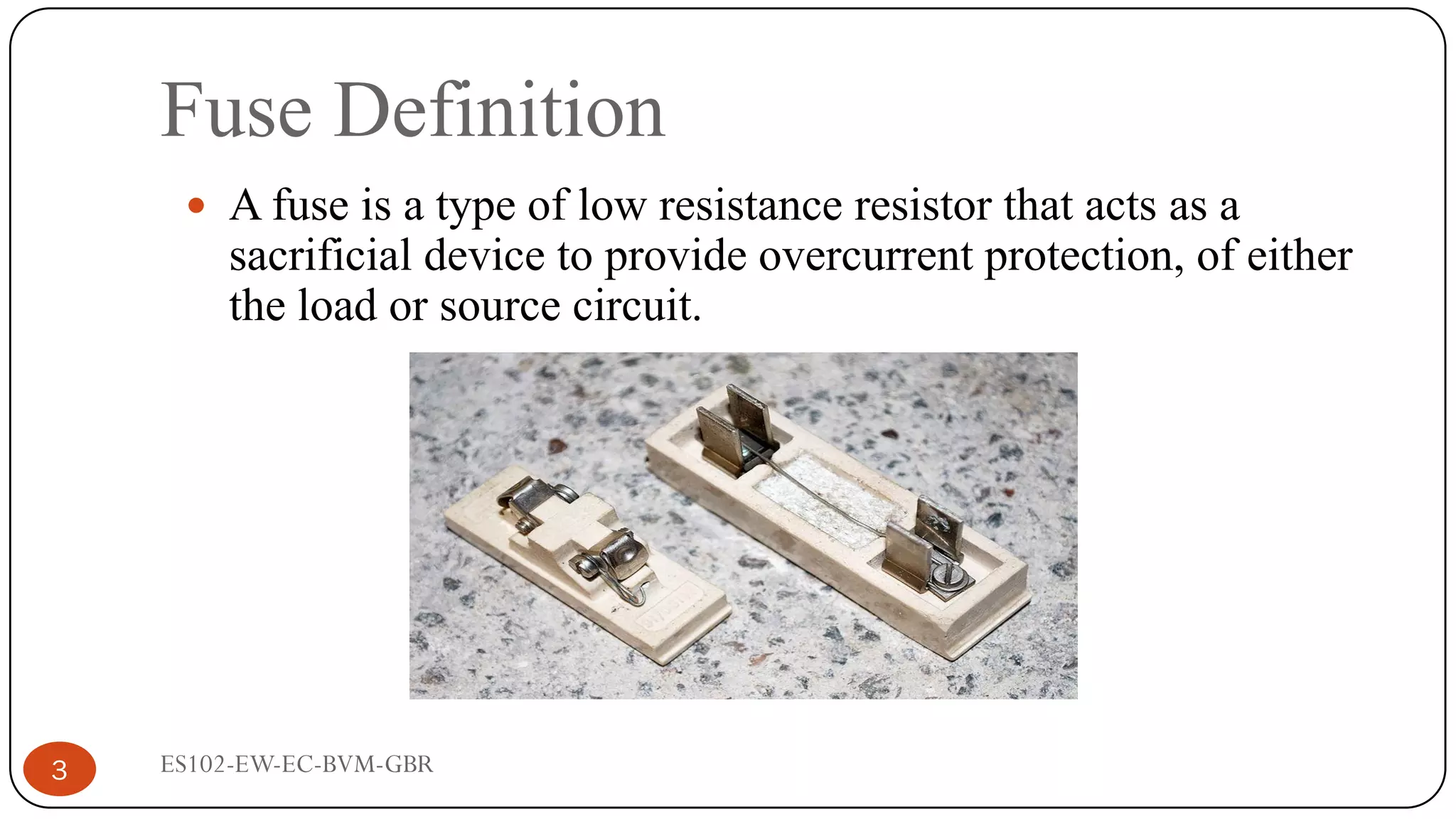
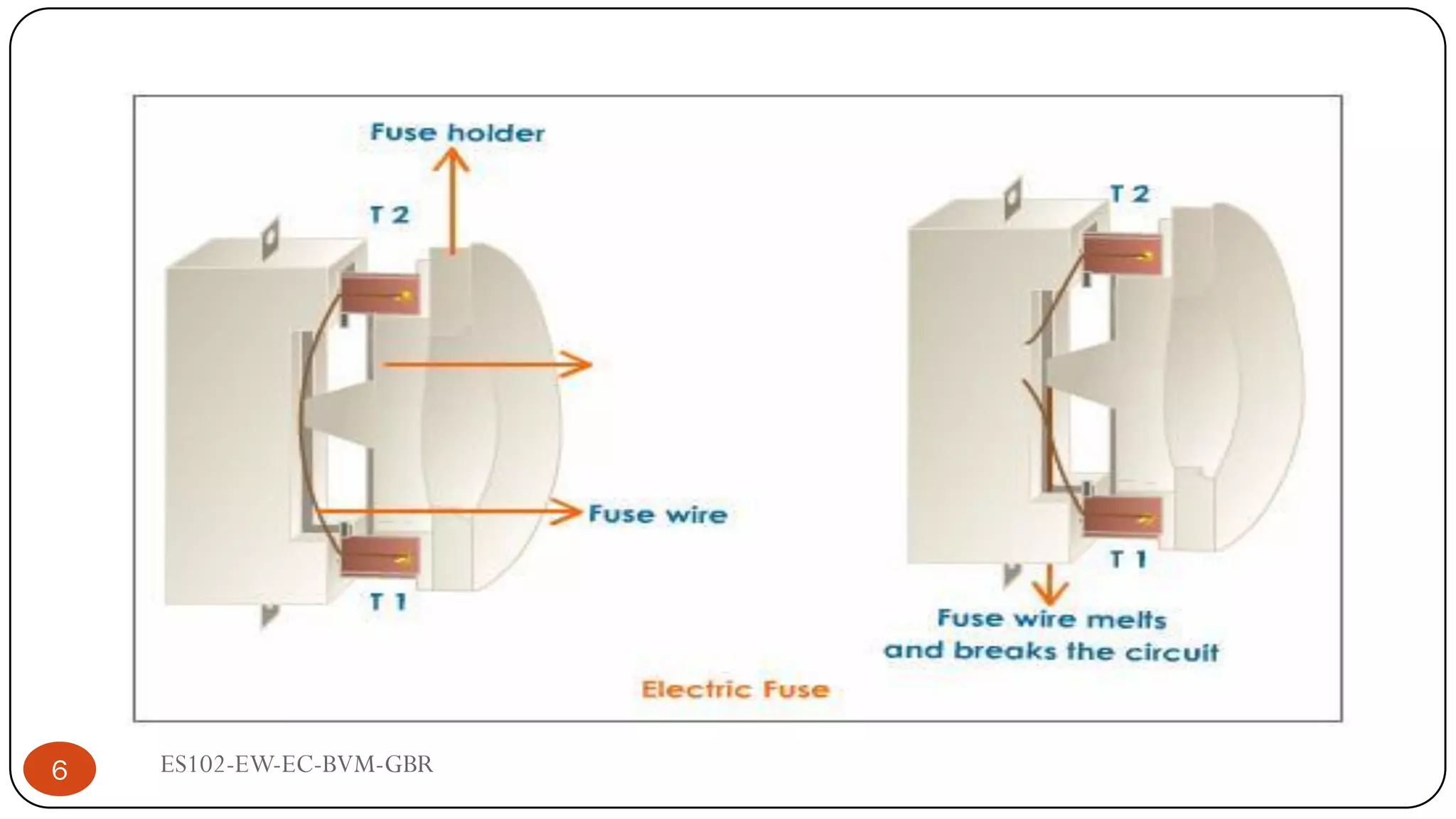
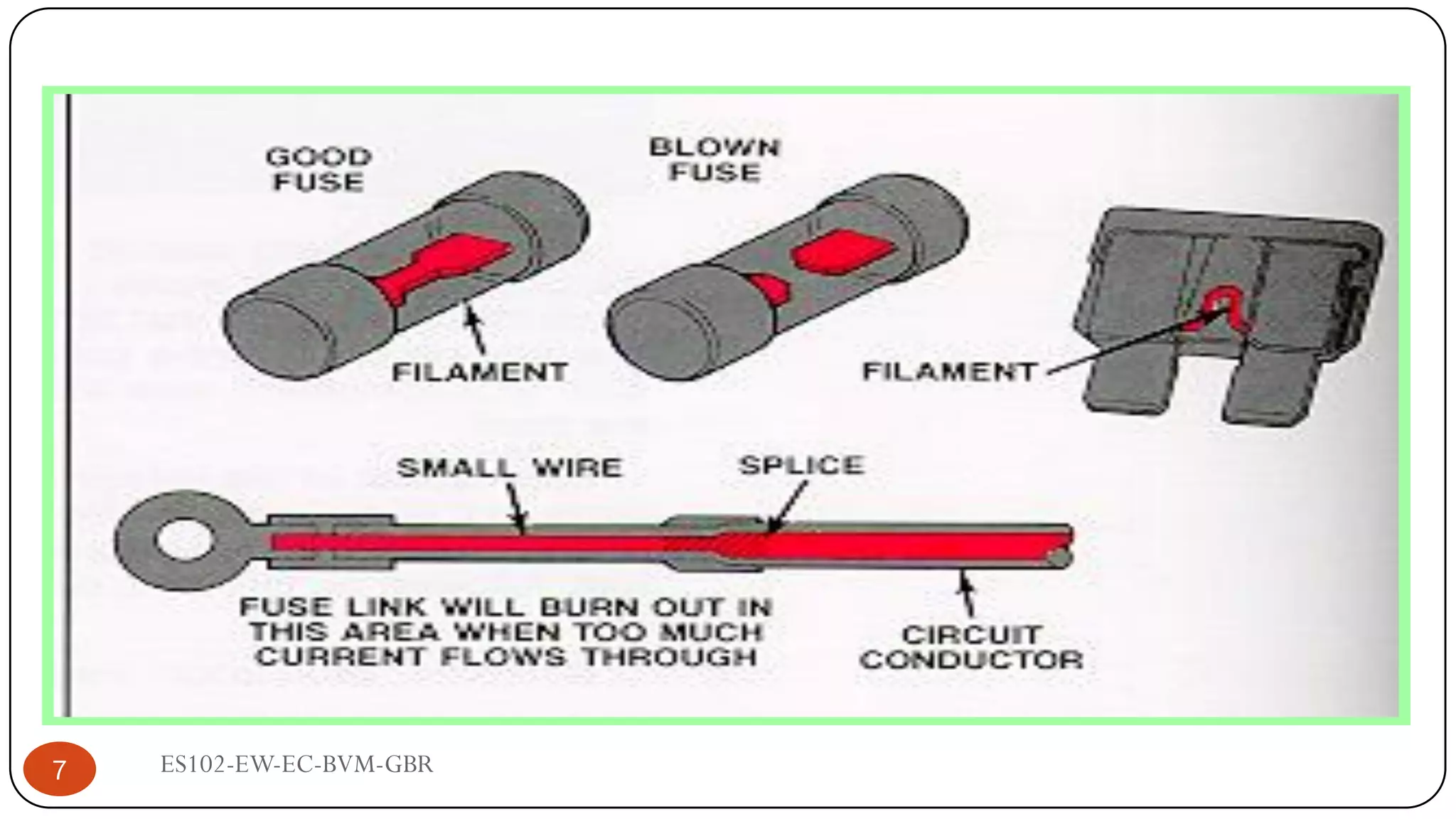
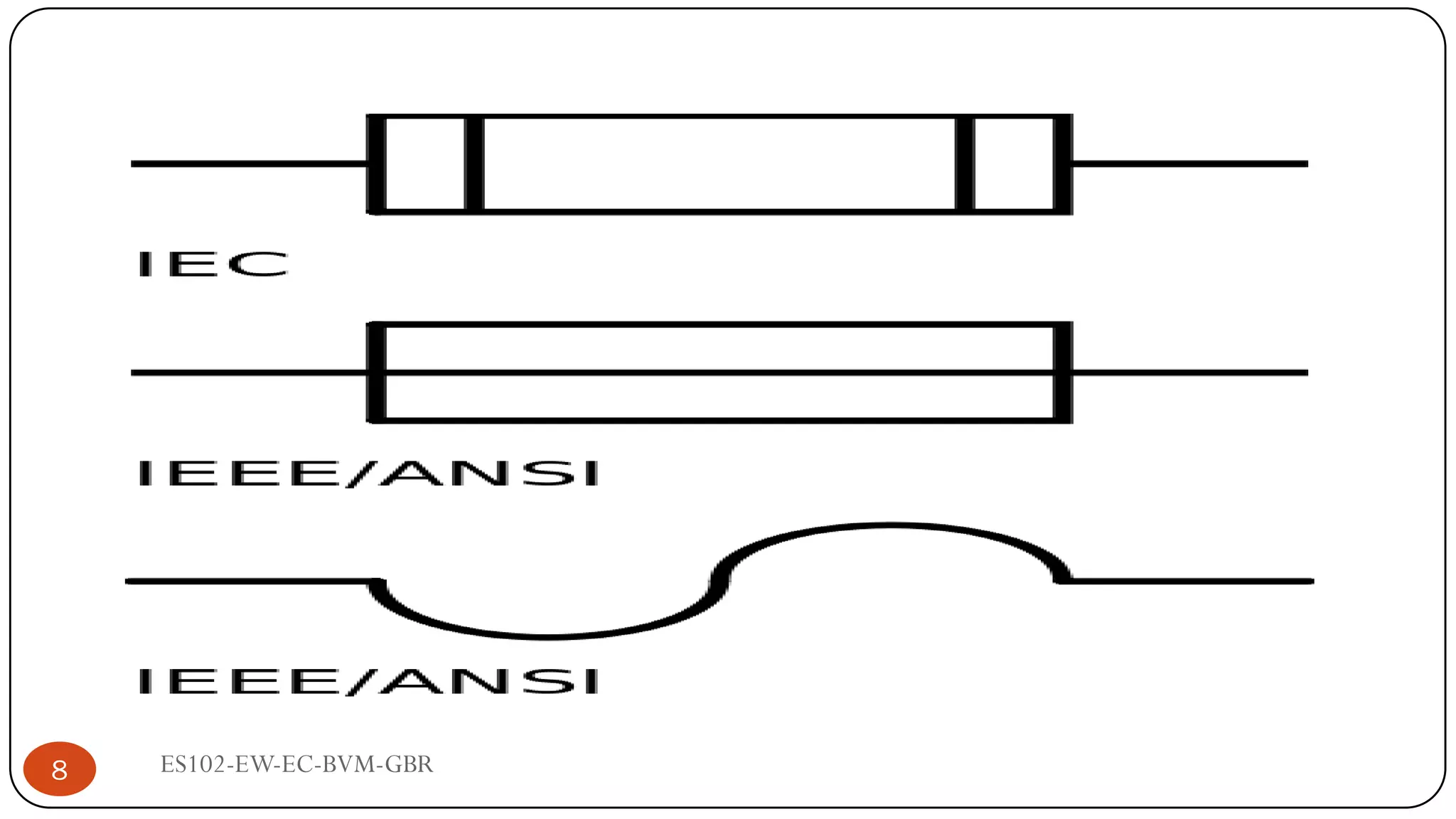
 A fuse is a type of low resistance resistor that acts as a
sacrificial device to provide overcurrent protection, of either
the load or source circuit.
3 ES102-EW-EC-BVM-GBR
•Types of fuse
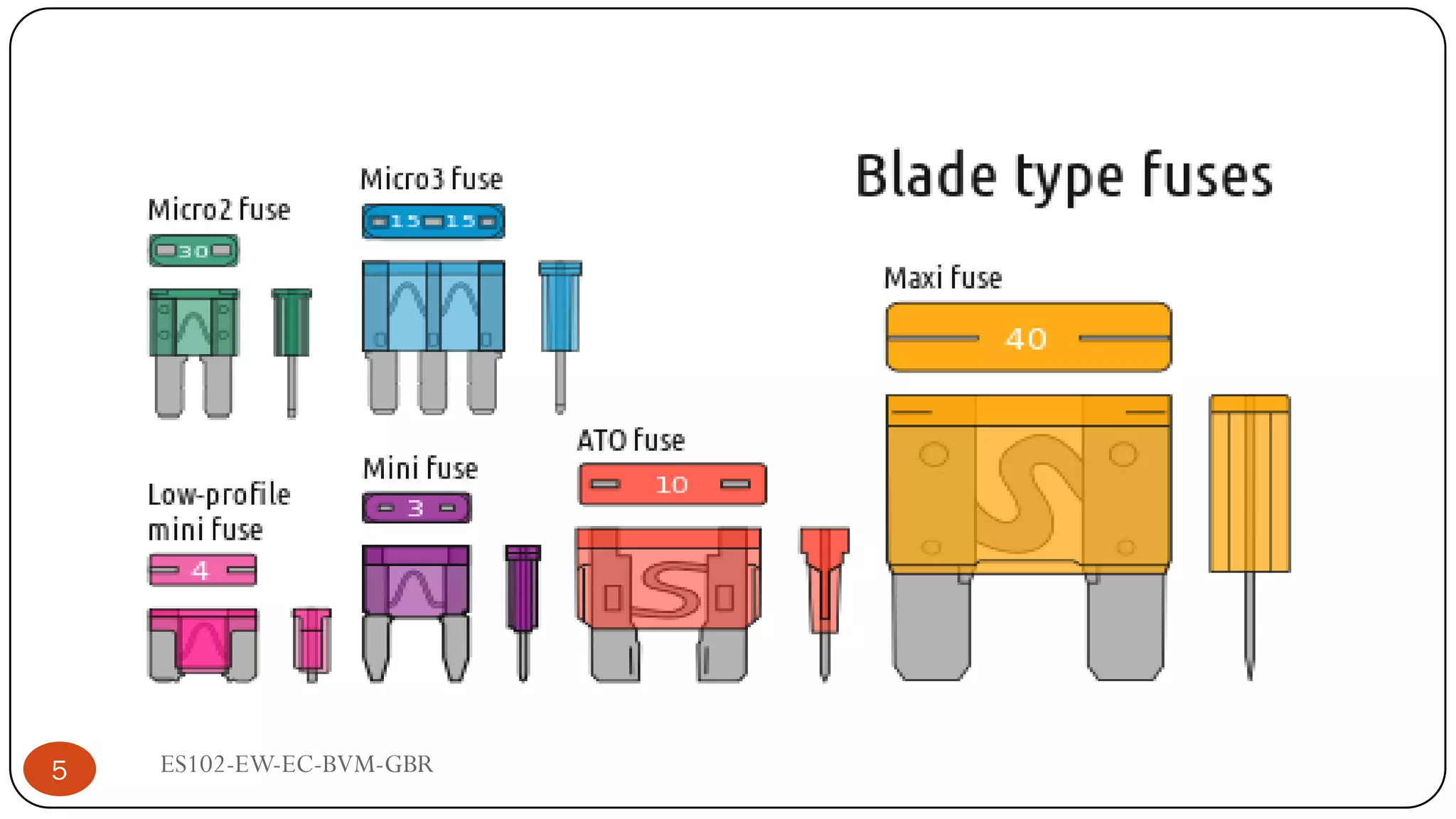
 Automotive fuses
1. Blade type
2. Glass tube or Bosch Type
3. Fusible links
4. Fuse limiters
 High Voltage Fuses
4 ES102-EW-EC-BVM-GBR
5 ES102-EW-EC-BVM-GBR
6 ES102-EW-EC-BVM-GBR
7 ES102-EW-EC-BVM-GBR
8 ES102-EW-EC-BVM-GBR
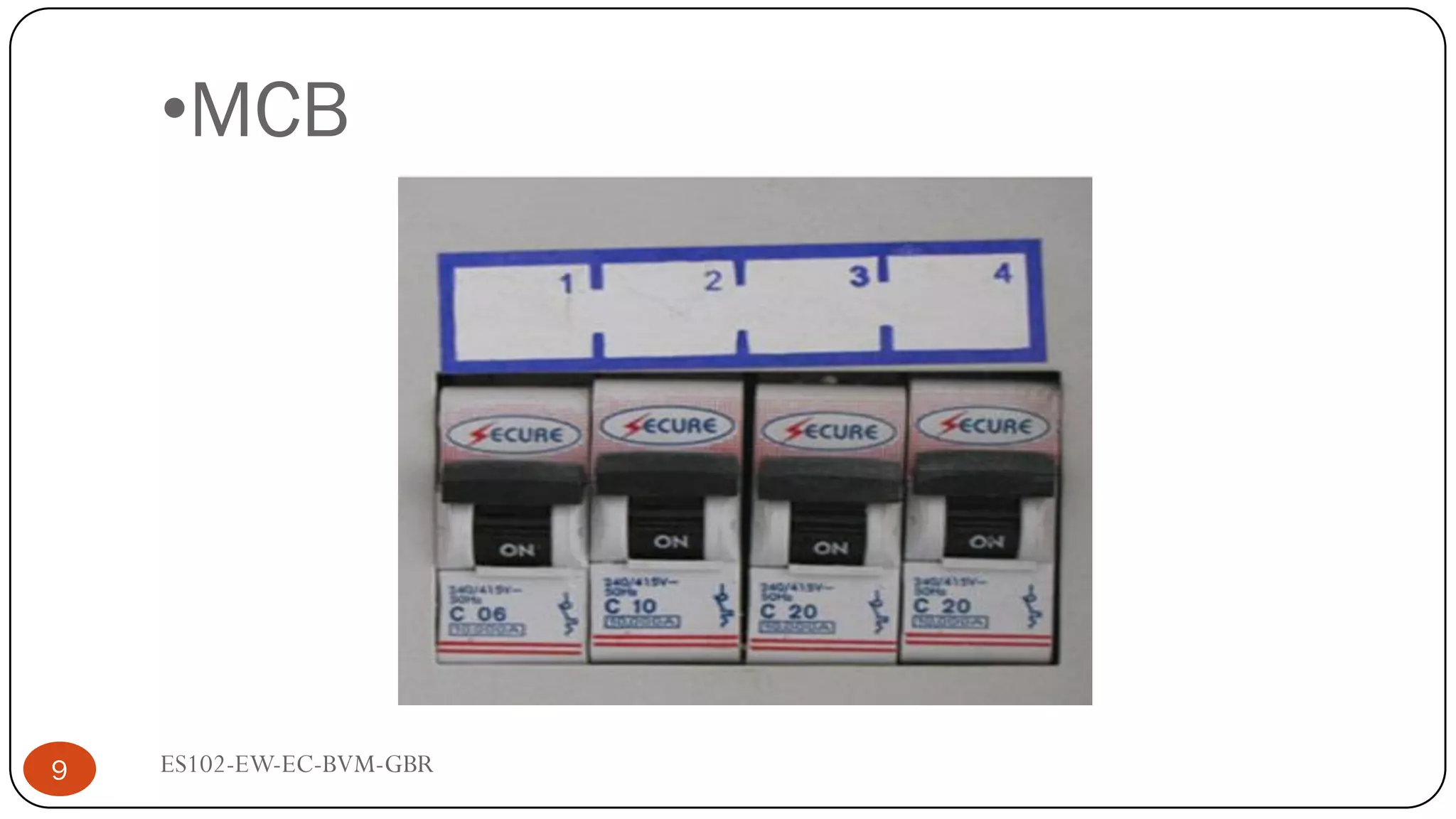
•MCB
9 ES102-EW-EC-BVM-GBR
•MCB Definition
(Electronics) miniature circuit
breaker; a small trip switch
operated by an overload and used
to protect an electric circuit,
especially a domestic circuit as an
alternative to a fuse.
10 ES102-EW-EC-BVM-GBR
•Types of MCB
Low-voltage circuit breakers
MCB (Miniature Circuit Breaker)—
rated current not more than 100 A.
Trip characteristics normally not
adjustable. Thermal or thermal-
magnetic operation.
11 ES102-EW-EC-BVM-GBR
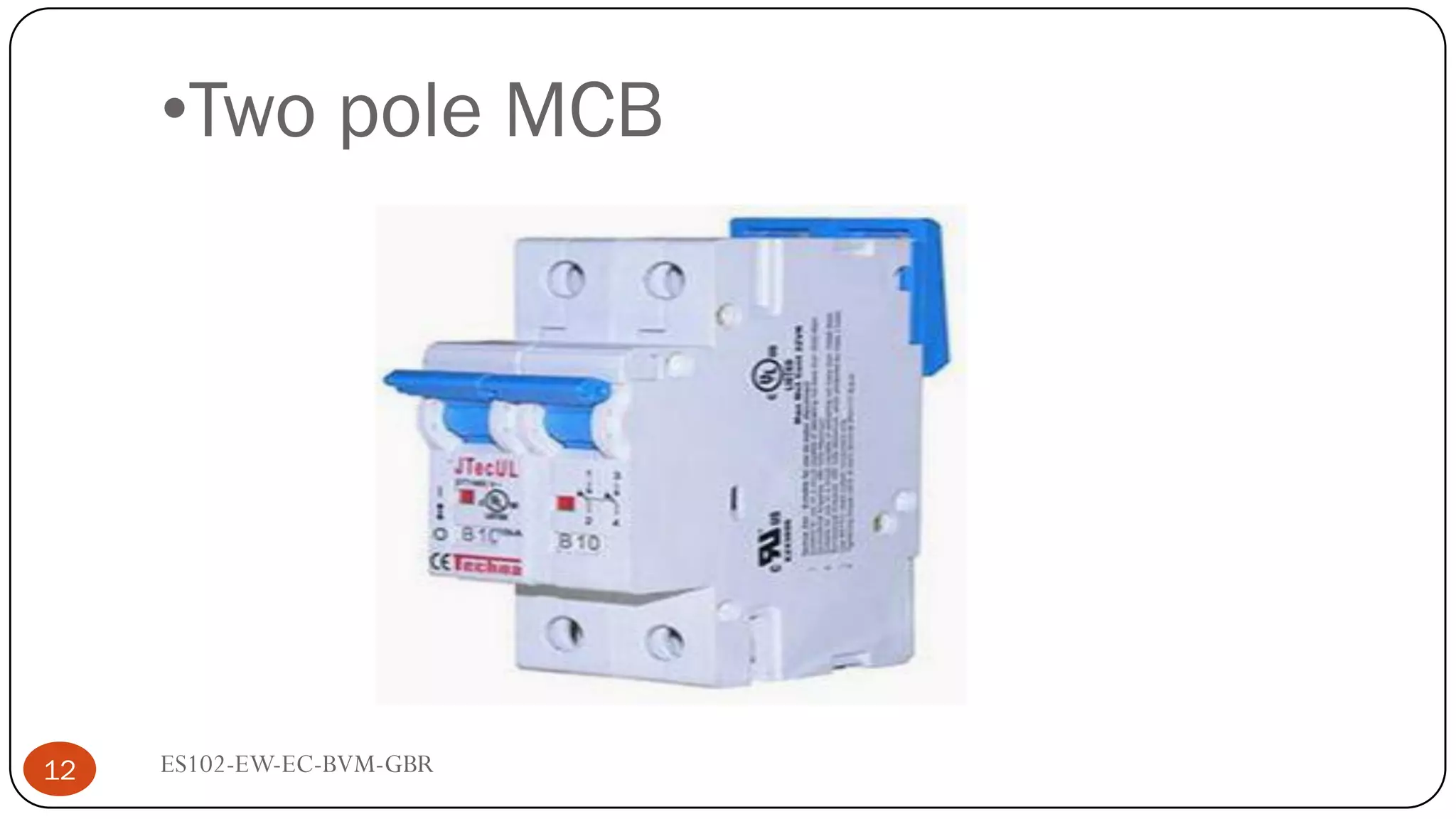
•Two pole MCB
12 ES102-EW-EC-BVM-GBR
13 ES102-EW-EC-BVM-GBR
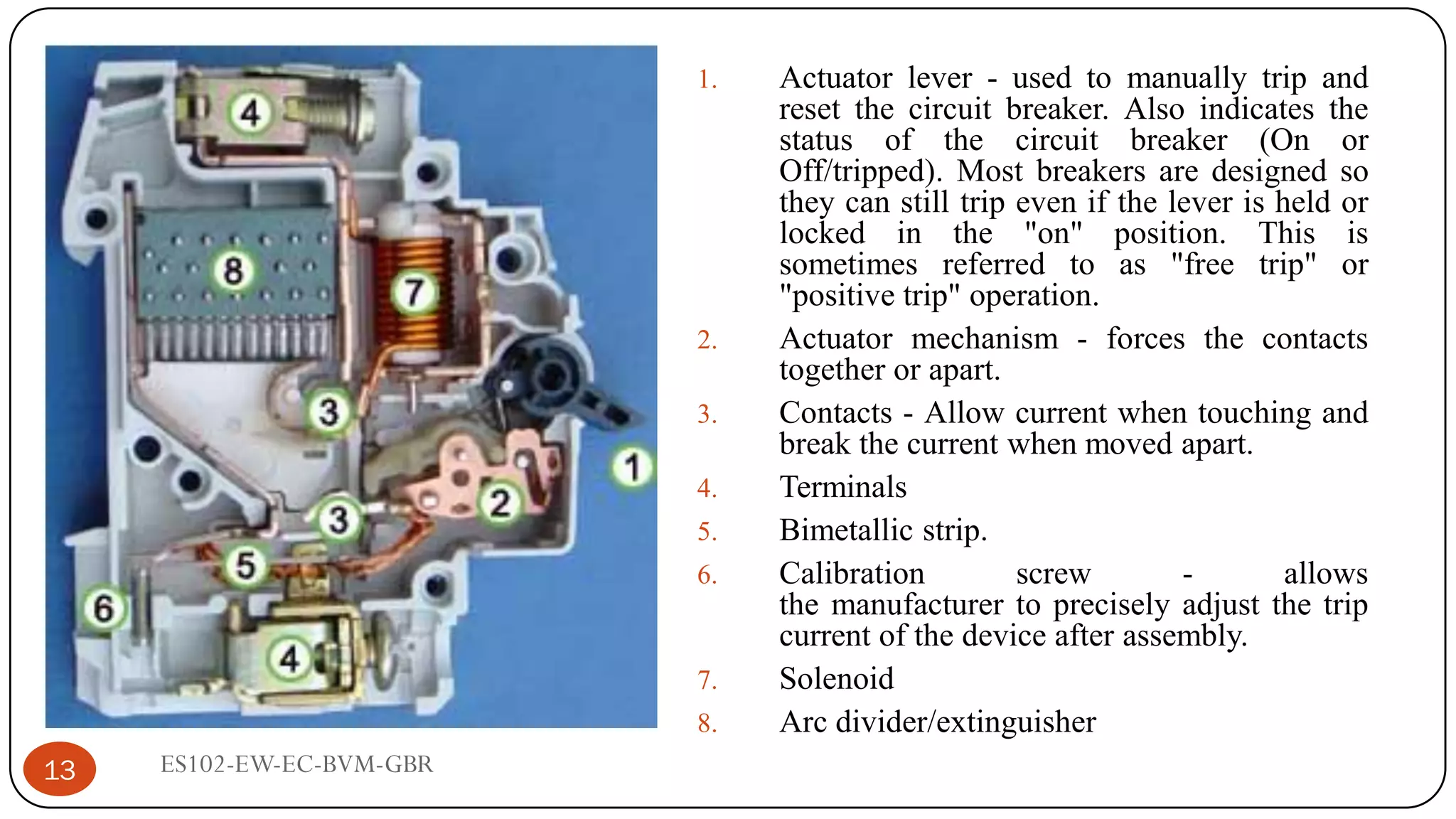
1. Actuator lever - used to manually trip and
reset the circuit breaker. Also indicates the
status of the circuit breaker (On or
Off/tripped). Most breakers are designed so
they can still trip even if the lever is held or
locked in the "on" position. This is
sometimes referred to as "free trip" or
"positive trip" operation.
2. Actuator mechanism - forces the contacts
together or apart.
3. Contacts - Allow current when touching and
break the current when moved apart.
4. Terminals
5. Bimetallic strip.
6. Calibration screw - allows
the manufacturer to precisely adjust the trip
current of the device after assembly.
7. Solenoid
8. Arc divider/extinguisher
•Types Contd..
 Magnetic circuit breakers
Magnetic circuit breakers use a solenoid (electromagnet)
whose pulling force increases with the current. Certain designs
utilize electromagnetic forces in addition to those of the
solenoid.
 Thermal magnetic circuit breakers
Thermal magnetic circuit breakers, which are the type found in
most distribution boards, incorporate both techniques with the
electromagnet responding instantaneously to large surges in
current (short circuits) and the bimetallic strip responding to
less extreme but longer-term over-current conditions.
14 ES102-EW-EC-BVM-GBR
•Types contd..
 Common trip breakers
When supplying a branch circuit with
more than one live conductor, each live
conductor must be protected by a breaker
pole. To ensure that all live conductors are
interrupted when any pole trips, a
"common trip" breaker must be used.
15 ES102-EW-EC-BVM-GBR
•Types Contd..
 Medium-voltage circuit breakers
Medium-voltage circuit breakers rated
between 1 and 72 kV may be assembled
into metal-enclosed switchgear line ups for
indoor use, or may be individual
components installed outdoors in
a substation.
16 ES102-EW-EC-BVM-GBR
•Types contd..
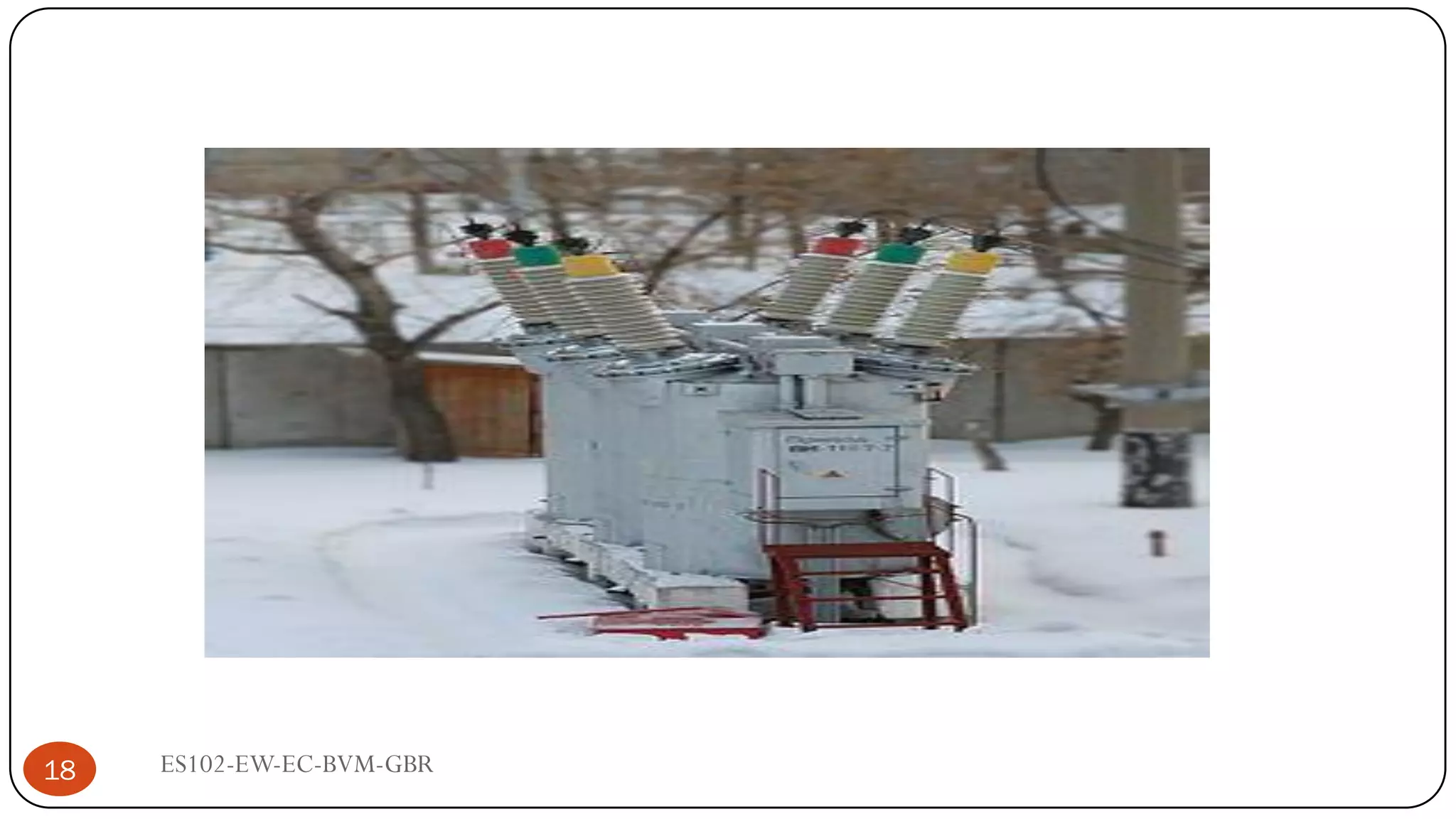
 High-voltage circuit breakers
Electrical power transmission networks are
protected and controlled by high-voltage
breakers. The definition of high voltage varies
but in power transmission work is usually
thought to be 72.5 kV or higher, according to a
recent definition by the International
Electrotechnical Commission (IEC).
17 ES102-EW-EC-BVM-GBR
18 ES102-EW-EC-BVM-GBR
•Types contd..
 Sulfur hexafluoride (SF6) high-voltage
circuit breakers
 Hybrid Switchgear Modules
 Disconnecting circuit breaker (DCB)
 Carbon dioxide (CO2) high-voltage
circuit breakers
19 ES102-EW-EC-BVM-GBR
•ELCB
ES102-EW-EC-BVM-GBR
20
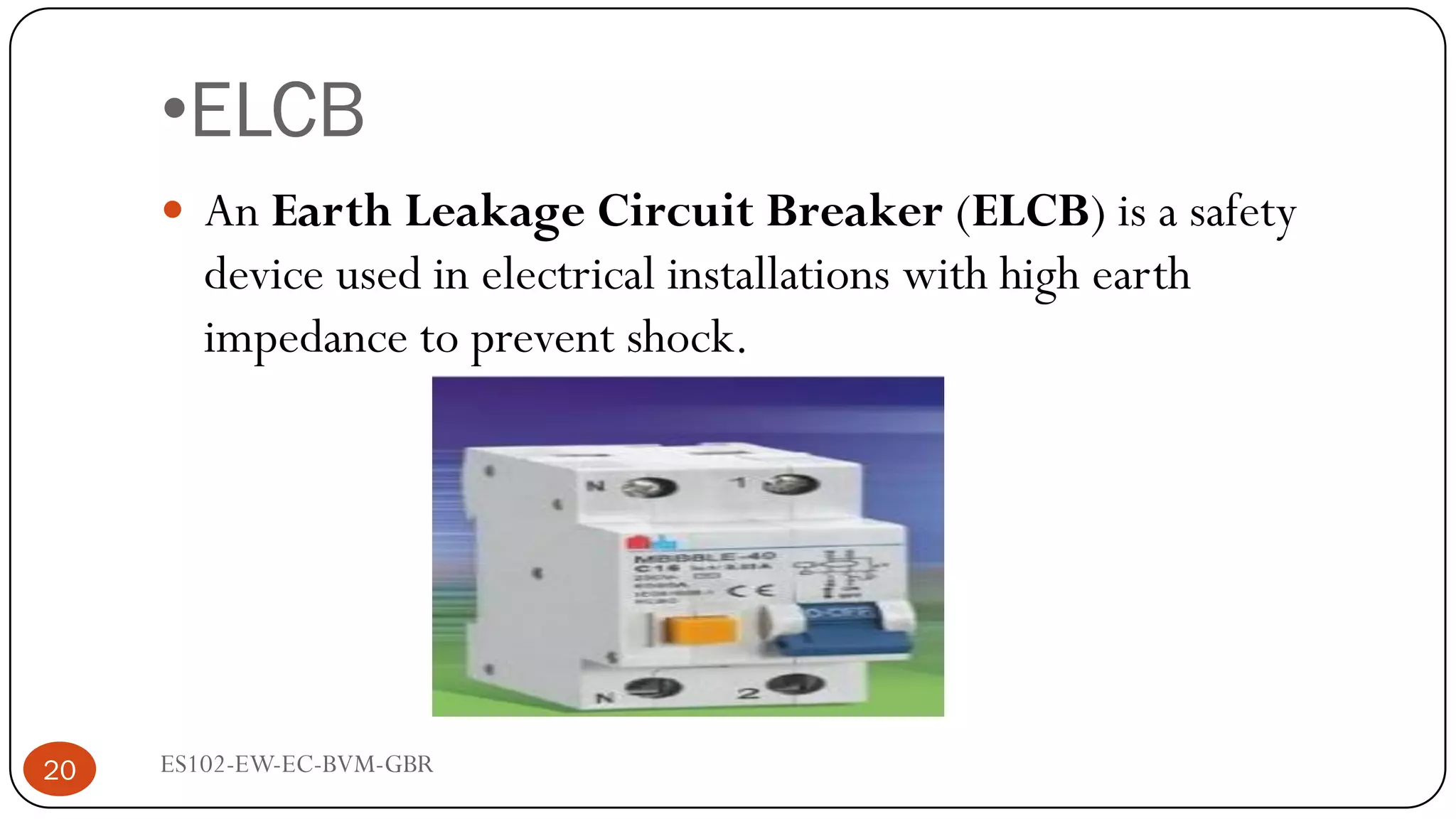
 An Earth Leakage Circuit Breaker (ELCB) is a safety
device used in electrical installations with high earth
impedance to prevent shock.
•Types of ELCB
ES102-EW-EC-BVM-GBR
21
 Voltage-operated
Voltage-operated ELCBs were introduced in the early 20th century, and
provided a major advance in safety for mains electrical supplies with
inadequate earth impedance.
 Current- sensing protection
Residual-current devices (RCD)s protect against earth leakage using a
different method of detection. Both circuit conductors (supply and
return) are run through a sensing coil; any imbalance of the currents
means the magnetic field does not perfectly cancel. The device detects
the imbalance and trips the contact
 Click here to see the working of MCB
Thank You
ES102-EW-EC-BVM-GBR
22
 For more information, Scan the QR Code given below

Practical No-9: Introduction to protecting devices-Fuse-MCB-ELCB

  • 1.
    Compiled by :Prof. G. B. Rathod Subject: ES102-ElectronicsWorkshop EC Department, BVM Engineering College Email:ghansyam.rathod@bvmengineering.ac.in Practical No-9:FUSE-MCB-ELCB
  • 2.
    •Outline Fuse Definition Fuse type MCBDefinition MCB Type ELCB Definition ELCB working 2 ES102-EW-EC-BVM-GBR
  • 3.
    Fuse Definition  Afuse is a type of low resistance resistor that acts as a sacrificial device to provide overcurrent protection, of either the load or source circuit. 3 ES102-EW-EC-BVM-GBR
  • 4.
    •Types of fuse Automotive fuses 1. Blade type 2. Glass tube or Bosch Type 3. Fusible links 4. Fuse limiters  High Voltage Fuses 4 ES102-EW-EC-BVM-GBR
  • 5.
  • 6.
  • 7.
  • 8.
  • 9.
  • 10.
    •MCB Definition (Electronics) miniaturecircuit breaker; a small trip switch operated by an overload and used to protect an electric circuit, especially a domestic circuit as an alternative to a fuse. 10 ES102-EW-EC-BVM-GBR
  • 11.
    •Types of MCB Low-voltagecircuit breakers MCB (Miniature Circuit Breaker)— rated current not more than 100 A. Trip characteristics normally not adjustable. Thermal or thermal- magnetic operation. 11 ES102-EW-EC-BVM-GBR
  • 12.
    •Two pole MCB 12ES102-EW-EC-BVM-GBR
  • 13.
    13 ES102-EW-EC-BVM-GBR 1. Actuatorlever - used to manually trip and reset the circuit breaker. Also indicates the status of the circuit breaker (On or Off/tripped). Most breakers are designed so they can still trip even if the lever is held or locked in the "on" position. This is sometimes referred to as "free trip" or "positive trip" operation. 2. Actuator mechanism - forces the contacts together or apart. 3. Contacts - Allow current when touching and break the current when moved apart. 4. Terminals 5. Bimetallic strip. 6. Calibration screw - allows the manufacturer to precisely adjust the trip current of the device after assembly. 7. Solenoid 8. Arc divider/extinguisher
  • 14.
    •Types Contd..  Magneticcircuit breakers Magnetic circuit breakers use a solenoid (electromagnet) whose pulling force increases with the current. Certain designs utilize electromagnetic forces in addition to those of the solenoid.  Thermal magnetic circuit breakers Thermal magnetic circuit breakers, which are the type found in most distribution boards, incorporate both techniques with the electromagnet responding instantaneously to large surges in current (short circuits) and the bimetallic strip responding to less extreme but longer-term over-current conditions. 14 ES102-EW-EC-BVM-GBR
  • 15.
    •Types contd..  Commontrip breakers When supplying a branch circuit with more than one live conductor, each live conductor must be protected by a breaker pole. To ensure that all live conductors are interrupted when any pole trips, a "common trip" breaker must be used. 15 ES102-EW-EC-BVM-GBR
  • 16.
    •Types Contd..  Medium-voltagecircuit breakers Medium-voltage circuit breakers rated between 1 and 72 kV may be assembled into metal-enclosed switchgear line ups for indoor use, or may be individual components installed outdoors in a substation. 16 ES102-EW-EC-BVM-GBR
  • 17.
    •Types contd..  High-voltagecircuit breakers Electrical power transmission networks are protected and controlled by high-voltage breakers. The definition of high voltage varies but in power transmission work is usually thought to be 72.5 kV or higher, according to a recent definition by the International Electrotechnical Commission (IEC). 17 ES102-EW-EC-BVM-GBR
  • 18.
  • 19.
    •Types contd..  Sulfurhexafluoride (SF6) high-voltage circuit breakers  Hybrid Switchgear Modules  Disconnecting circuit breaker (DCB)  Carbon dioxide (CO2) high-voltage circuit breakers 19 ES102-EW-EC-BVM-GBR
  • 20.
    •ELCB ES102-EW-EC-BVM-GBR 20  An EarthLeakage Circuit Breaker (ELCB) is a safety device used in electrical installations with high earth impedance to prevent shock.
  • 21.
    •Types of ELCB ES102-EW-EC-BVM-GBR 21 Voltage-operated Voltage-operated ELCBs were introduced in the early 20th century, and provided a major advance in safety for mains electrical supplies with inadequate earth impedance.  Current- sensing protection Residual-current devices (RCD)s protect against earth leakage using a different method of detection. Both circuit conductors (supply and return) are run through a sensing coil; any imbalance of the currents means the magnetic field does not perfectly cancel. The device detects the imbalance and trips the contact  Click here to see the working of MCB
  • 22.
    Thank You ES102-EW-EC-BVM-GBR 22  Formore information, Scan the QR Code given below