COMPILED BY: PROF G B RATHOD
EC department-BVM College,
Email: ghansyam.rathod@bvmengineering.ac.in
BASIC TRANSDUCER PRINCIPLES &
ELECTRODES
Prof.G.B.Rathod, EC Dept.BVM-EC453
THE TRANSDUCERS AND TRANDSDUCTION
PRINCIPALES
 A variable is any quantity whose value changes
with time. A variable associated with
physiological process of the body is called a
physiological variable.
 A transducer is required to convert each variable
into an electrical signal which can be amplified
or otherwise processed and converted into some
form of display.
 The device that performs the conversion of one
form of variable into another is called a
transducer.
 Here we discuss the transducer which is having
input some other quantity and output will be
electrical quantity.
Prof.G.B.Rathod, EC Dept.BVM-EC453
THE TRANSDUCERS AND TRANDSDUCTION
PRINCIPALES
 Two different principles are involved in
the process of converting nonelectrical
variables into electrical signals.
 One of these is energy conversion:
Transducers based on this principle is
called active transducers.
 Second of these is control of an
excitation voltage or modulation of a
carrier signal. Transducers based on
this principle is called a passive
transducers.
Prof.G.B.Rathod, EC Dept.BVM-EC453
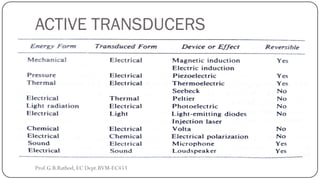
ACTIVE TRANSDUCERS
Prof.G.B.Rathod, EC Dept.BVM-EC453
ACTIVE TRANSDUCERS
 Some conversion principles are describe here
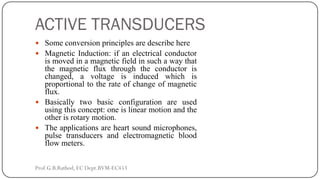
 Magnetic Induction: if an electrical conductor
is moved in a magnetic field in such a way that
the magnetic flux through the conductor is
changed, a voltage is induced which is
proportional to the rate of change of magnetic
flux.
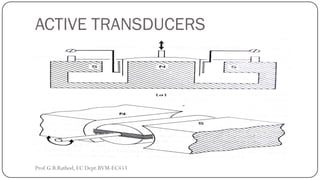
 Basically two basic configuration are used
using this concept: one is linear motion and the
other is rotary motion.
 The applications are heart sound microphones,
pulse transducers and electromagnetic blood
flow meters.
Prof.G.B.Rathod, EC Dept.BVM-EC453
ACTIVE TRANSDUCERS
Prof.G.B.Rathod, EC Dept.BVM-EC453
ACTIVE TRANSDUCERS
Prof.G.B.Rathod, EC Dept.BVM-EC453
ACTIVE TRANSDUCERS
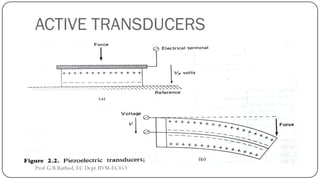
 The natural materials in which this piezoelectric
effect can be observed are primarily slices from
crystals of quartz(SiO2) or Rochelle salt(sodium
potassium tartrate).
 The piezoelectric process is reversible. If an
electric field is applied to a slab of material that has
piezoelectric properties, it changes its dimensions.
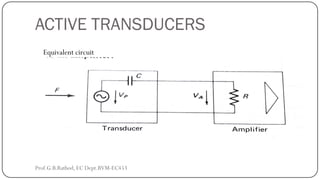
 We will see equivalent circuit of the piezoelectric
transducer connected to an amplifier.
 The piezoelectric principal is also used in
ultrasonic instruments.
Prof.G.B.Rathod, EC Dept.BVM-EC453
ACTIVE TRANSDUCERS
Equivalent circuit
Prof.G.B.Rathod, EC Dept.BVM-EC453
PASSIVE TRANSDUCERS
 Passive transducers utilize the principle of
controlling a dc excitation voltage or an Ac
carrier signal.
 There are only three passive circuit elements
that can be utilized as a passive transducers.
Resistors, capacitors, and Inductors.
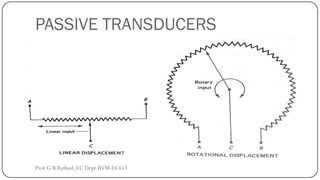
 Passive Transducers Using Resistive Elements:
Special linear potentiometer can be used to
convert displacement into a resistance change.
Prof.G.B.Rathod, EC Dept.BVM-EC453
PASSIVE TRANSDUCERS
Prof.G.B.Rathod, EC Dept.BVM-EC453
PASSIVE TRANSDUCERS
 Passive transducer using Capacitive elements.
 The capacitance of the capacitor can be
changed by varying the physical dimension of
the plate structure or by varying the
dielectric contestant of the medium between
the plates. E.g., the capacitance
plethysmography.
 Passive Transducers Using Active Circuit
Elements. Transistor , Photoelectric
transducers
Prof.G.B.Rathod, EC Dept.BVM-EC453
TRANSDUCERS FOR BIOMEDICAL
APPLICATIONS
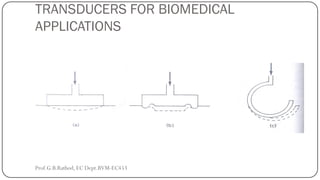
 Pressure Transducers: Pressure transducers are closely
related to force transducers. Force summing members
used in pressure transducers are shown in figure.
 We can use the strain gage also for designing of such
pressure transducers.
 Diaphragm type pressure transducers can be designed for a
wide range of operating pressures, depending on the
diameter and stiffness of the diaphragm, bourdon tube
transducers are usually used for high pressure ranges.
 In differential pressure transducers the two pressure are
applied to opposite side of the diaphragm.
Prof.G.B.Rathod, EC Dept.BVM-EC453
TRANSDUCERS FOR BIOMEDICAL
APPLICATIONS
Prof.G.B.Rathod, EC Dept.BVM-EC453
TRANSDUCERS FOR BIOMEDICAL
APPLICATIONS
 Flow Transducers: For fluids and gases flow rate
measurements, the methods are described in upcoming
topics.
 Transducers with Digital Output: ADC can be used to
convert analog signal to digital output for analog
transducers.
 For digital output, specially design encoding disks are
to be used in the process of the conversion from the
transducers circuit. Usually photo diodes or photo
transistors related circuit are used for the digital out
put data.
Prof.G.B.Rathod, EC Dept.BVM-EC453
Electrode Theory
 Electrodes: Devices that convert ionic potentials
into electronic potentials are called electrodes.
 The interface of metallic ions in solution with
their associated metals results in an electrical
potential that is called the electrode potential.
 At the equilibrium, the double layer charge
produce with opposite sign.
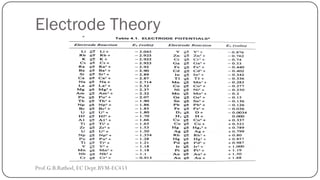
 The hydrogen is taken as a reference electrode in
international agreement. The other potentials are
taken by taking hydrogen as a reference electrode.
The electrodes potentials for variety of other
electrodes are listed in table.
Prof.G.B.Rathod, EC Dept.BVM-EC453
Electrode Theory
Prof.G.B.Rathod, EC Dept.BVM-EC453
Electrode Theory
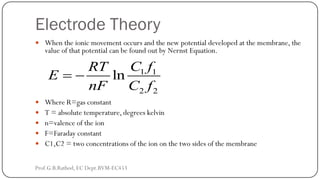
 When the ionic movement occurs and the new potential developed at the membrane, the
value of that potential can be found out by Nernst Equation.
 Where R=gas constant
 T = absolute temperature, degrees kelvin
 n=valence of the ion
 F=Faraday constant
 C1,C2 = two concentrations of the ion on the two sides of the membrane
1 1
2 2
ln
C f
RT
E
nF C f
 
Prof.G.B.Rathod, EC Dept.BVM-EC453
Electrode Theory
 f1,f2=respective activity coefficients of the ion on the two sides of
the membrane
 This above f1 and f2 are depend on such factors as the charges of
all ions in the solution and the distance between ions.
 The product of C1f1 of concentration and its associated activity
coefficient is called the activity of the ion responsible for the
electrode potential.
 The metal-electrolyte interface developed and the potential
generated.
Prof.G.B.Rathod, EC Dept.BVM-EC453
Biopotential electrodes
 Basically three types.
 Microelectrodes: Electrodes used to measure bioelectric
potentials near or within a single cell.
 Skin surface electrodes: Electrodes used to measure ECG,
EEG, and EMG potentials from the surface of the skin.
 Needle electrodes: Electrodes used to penetrate the skin to
record EEG potentials from a local region of the brain or EMG
potentials from a specific group of muscles.
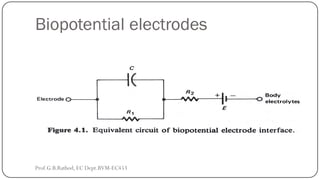
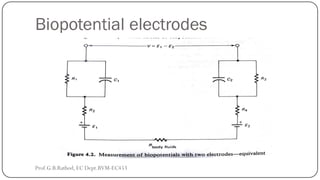
 The equivalent circuit of the electrode in upcoming figure.
Prof.G.B.Rathod, EC Dept.BVM-EC453
Biopotential electrodes
Prof.G.B.Rathod, EC Dept.BVM-EC453
Biopotential electrodes
 Two electrodes are require to do measurements.
 If the same type of electrodes are used, the potential difference is
usually small and depends on the actual difference of ionic
potential between the two points of the body.
 If the electrodes are different, the dc voltage generated which is
nothing but a electrode offset voltage. Which can cause an error in
the measurement.
 Some dc also produce in the same type of electrodes we use.
 To reduce that error by choice of materials, or by special
treatment, such as coating the electrodes by some……contd
Prof.G.B.Rathod, EC Dept.BVM-EC453
Biopotential electrodes
 ….contd….electrolytic method to improve stability.
 E.g : silver silver chloride electrode is very stable prepared by
electrolytically coating a piece of pure silver with silver chloride.
 We can see the equivalent diagram of the use of two electrodes for the
biopotential measurements.
 In that the impedance is varies according to the polarization which is a
result of direct current passing through the metal electrolyte interface.
 Size and type of electrodes also affects the impedance . Higher the size
lower impedance. E.g surface electrodes….have 2 to 10 kohm, where as
small needle electrodes have much larger value.
Prof.G.B.Rathod, EC Dept.BVM-EC453
Biopotential electrodes
Prof.G.B.Rathod, EC Dept.BVM-EC453
Biopotential electrodes
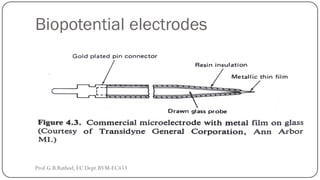
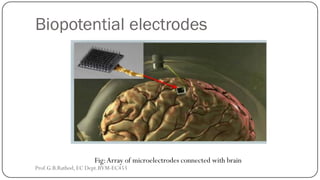
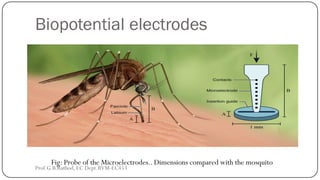
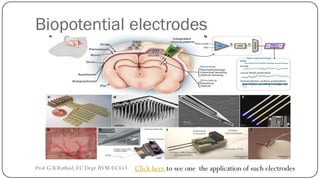
 Microelectrodes: Electrodes with tips sufficiently small to
penetrate a single cell in order to obtain readings from within the
cell.
 Basically two types: 1. Metal , 2. Micropipet.
 Metal type are formed by electrolytically etching the tip of a fine
tungsten or stainless steel wire to the desired size. Then wire is
coated with the an insulating material.
 Micropipet as shown in upcoming diagram.
 The problem with such electrodes is that high impedance and for
that amplifier with very high impedance required.
Prof.G.B.Rathod, EC Dept.BVM-EC453
Biopotential electrodes
Prof.G.B.Rathod, EC Dept.BVM-EC453
Biopotential electrodes
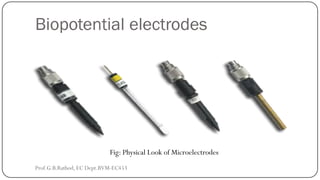
Fig: Physical Look of Microelectrodes
Prof.G.B.Rathod, EC Dept.BVM-EC453
Biopotential electrodes
Fig:Array of microelectrodes connected with brain
Prof.G.B.Rathod, EC Dept.BVM-EC453
Biopotential electrodes
Fig: Probe of the Microelectrodes.. Dimensions compared with the mosquito
Prof.G.B.Rathod, EC Dept.BVM-EC453
Biopotential electrodes
Prof.G.B.Rathod, EC Dept.BVM-EC453 Click here to see one the application of such electrodes
Biopotential electrodes
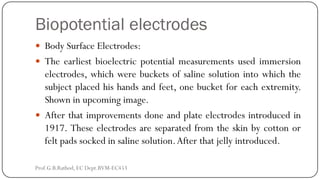
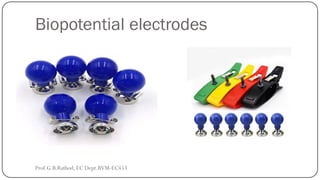
 Body Surface Electrodes:
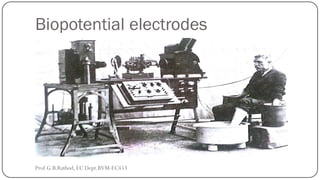
 The earliest bioelectric potential measurements used immersion
electrodes, which were buckets of saline solution into which the
subject placed his hands and feet, one bucket for each extremity.
Shown in upcoming image.
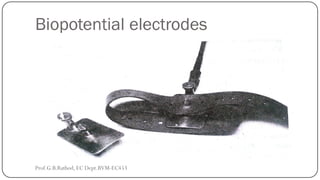
 After that improvements done and plate electrodes introduced in
1917. These electrodes are separated from the skin by cotton or
felt pads socked in saline solution.After that jelly introduced.
Prof.G.B.Rathod, EC Dept.BVM-EC453
Biopotential electrodes
Prof.G.B.Rathod, EC Dept.BVM-EC453
Biopotential electrodes
Prof.G.B.Rathod, EC Dept.BVM-EC453
Biopotential electrodes
Prof.G.B.Rathod, EC Dept.BVM-EC453
Biopotential electrodes
Prof.G.B.Rathod, EC Dept.BVM-EC453
Biopotential electrodes
Prof.G.B.Rathod, EC Dept.BVM-EC453
Biopotential electrodes
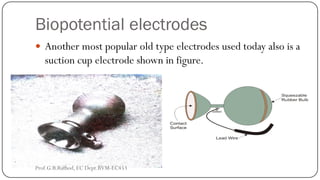
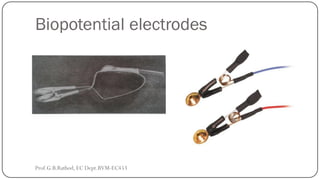
 Another most popular old type electrodes used today also is a
suction cup electrode shown in figure.
Prof.G.B.Rathod, EC Dept.BVM-EC453
Biopotential electrodes
 One difficulty in using plate electrodes is that possibility of electrode
slippage or movement.
 This also occurs with the suction cup electrode after a sufficient length
of time. Number of attempts were made to overcome this problem.
 All the preceding electrodes suffer from a common problem. They are
sensitive to movement, some to a greater degree than others.
 The adhesive tape and “nutmeg grater” electrodes reduce this movement
artifact by limiting electrode movement and reducing the interface
impedance, but neither is satisfactory insensitive to movement.
Prof.G.B.Rathod, EC Dept.BVM-EC453
Biopotential electrodes
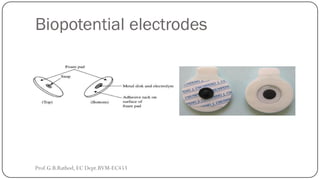
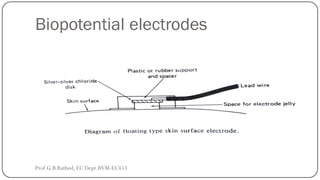
 A new type of electrode, the floating electrode, was introduced in
varying forms by several manufacturers. This principle of this
electrode is to practically eliminate movement artifact by avoiding
any direct contact of the metal with the skin.
 The only conductive path between metal and skin is the electrolyte
paste or jelly.
 Floating electrodes are generally attached to the skin by means of
two sided adhesive rings.
 ECG measurement for long time can make some problem.
Prof.G.B.Rathod, EC Dept.BVM-EC453
Biopotential electrodes
Prof.G.B.Rathod, EC Dept.BVM-EC453
Biopotential electrodes
Prof.G.B.Rathod, EC Dept.BVM-EC453
Biopotential electrodes
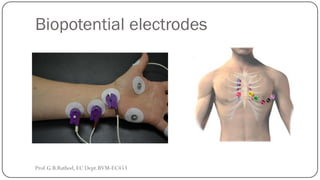
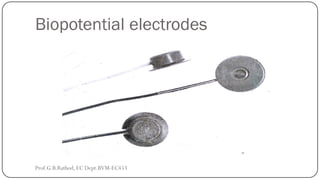
 Various types of disposable electrodes have been introduced in
recent years to eliminate the requirement of cleaning and care
after each use.
 Special types of have been developed for other applications. For
example, a special ear-clip electrode was developed for use as a
reference electrode for EEG measurements.
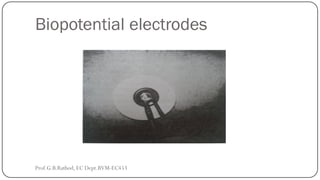
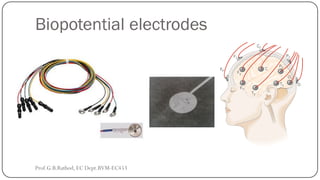
 Scalp surface electrodes for EEG are usually small disks about 7
mm in diameter or small solder pellets that are placed on the
cleaned scalp, using an electrolyte paste.
Prof.G.B.Rathod, EC Dept.BVM-EC453
Biopotential electrodes
Prof.G.B.Rathod, EC Dept.BVM-EC453
Biopotential electrodes
Prof.G.B.Rathod, EC Dept.BVM-EC453
Biopotential electrodes
Prof.G.B.Rathod, EC Dept.BVM-EC453
Biopotential electrodes
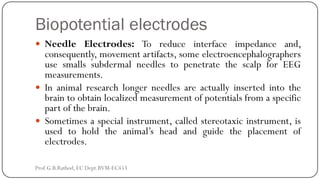
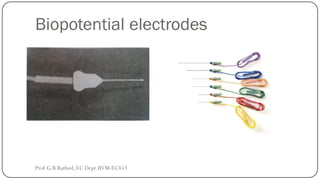
 Needle Electrodes: To reduce interface impedance and,
consequently, movement artifacts, some electroencephalographers
use smalls subdermal needles to penetrate the scalp for EEG
measurements.
 In animal research longer needles are actually inserted into the
brain to obtain localized measurement of potentials from a specific
part of the brain.
 Sometimes a special instrument, called stereotaxic instrument, is
used to hold the animal’s head and guide the placement of
electrodes.
Prof.G.B.Rathod, EC Dept.BVM-EC453
Biopotential electrodes
Prof.G.B.Rathod, EC Dept.BVM-EC453
Biopotential electrodes
 Needle electrodes for EMG consist merely of fine insulated wires,
placed so that their tips are in contact with the nerve muscle. Or
other tissue from which the measurement is made.
 Wire electrodes of copper or platinum are often used for EMG
pickup from specific muscles.
 A single wire inside the needle serves as a unipolar electrode, If a
two wire placed inside the needle, the measurement is called
bipolar and provide a very localized measurement between the
two wire tips.
Prof.G.B.Rathod, EC Dept.BVM-EC453
BIOCHEMICAL TRANSDUCERS
 Reference Electrode
 The pH electrode
 Blood Gas Electrodes
 Specific Ion ELectrodes
Prof.G.B.Rathod, EC Dept.BVM-EC453
BIOCHEMICAL TRANSDUCERS
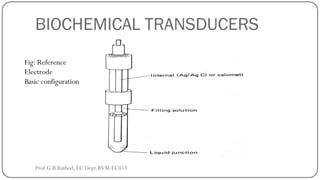
 Reference Electrode: Normally Hydrogen is used as a reference
electrode.
 These electrodes make use of the principle that an inert metal,
such as platinum, readily absorbs hydrogen gas.
 Unfortunately, the hydrogen electrode is not sufficiently stable to
serve as a good reference electrode.
 Measurement of electrochemical concentration simply requires a
change of potential proportional to a change in concentration.
 Two types: silver-silver chloride and the calomel electrode.
Prof.G.B.Rathod, EC Dept.BVM-EC453
BIOCHEMICAL TRANSDUCERS
 The silver-silver chloride electrode used as a reference in
electrochemical measurements utilizes the same type of interface
described before.
 In chemical transducer silver chloride side of the interface is connected
to the solution by an electrolyte bridge which is filling solution KCl.
 The reference electrode with 0.01 mole solution, potential is 0.343 V
and for 1.0 mole solution, potential is 0.236V
 The another is calomel electrode which is also called mercurous
chloride same as a Silver-silver chloride.
 0.01 mole, potential will be 0.388V and 3.5 moles, 0.247V
Prof.G.B.Rathod, EC Dept.BVM-EC453
BIOCHEMICAL TRANSDUCERS
Fig: Reference
Electrode
Basic configuration
Prof.G.B.Rathod, EC Dept.BVM-EC453
BIOCHEMICAL TRANSDUCERS
 The pH Electrode
 To know chemical balance in the body, pH of the blood and other fluids
are very important.
 Equation of pH is
 pH is a measure of the acid base balance of a fluid.
 A natural solution has a pH of 7. Lower pH numbers indicate acidity,
whereas higher pH values define a basic solution. Most human body
fluids are slightly basic. The pH of normal arterial blood ranges between
7.38 and 7.42. The pH of venous blood is 7.35, because of the extra
CO2.
10 10
1
log [ ] log
[ ]
pH H
H


  
Prof.G.B.Rathod, EC Dept.BVM-EC453
BIOCHEMICAL TRANSDUCERS
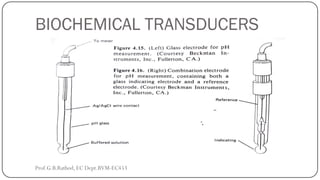
 In the measurement of pH and in any electrochemical
measurement, each of the two electrode required to obtain
the measurement is called half cell and its sometimes called
the half cell potential.
 The glass electrodes quite adequate for pH measurements in
physiological range(around pH 7).
 Special hydroscopic glass that readily absorbs water provides
the best pH response.
Prof.G.B.Rathod, EC Dept.BVM-EC453
BIOCHEMICAL TRANSDUCERS
Prof.G.B.Rathod, EC Dept.BVM-EC453
BIOCHEMICAL TRANSDUCERS
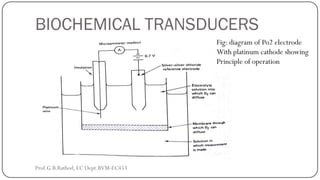
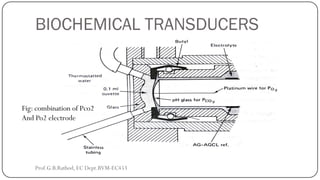
 Blood Gas Electrodes:
 One of the important physiological chemical measurements
is pressure of oxygen and carbon dioxide in the blood.
 The effectiveness of both the respiratory and cardiovascular
systems is reflected in these important parameters.
 The diagram of Po2 electrode with platinum cathode will be
in upcoming slide which shows a principle of operation.
Prof.G.B.Rathod, EC Dept.BVM-EC453
BIOCHEMICAL TRANSDUCERS
Fig: diagram of Po2 electrode
With platinum cathode showing
Principle of operation
Prof.G.B.Rathod, EC Dept.BVM-EC453
BIOCHEMICAL TRANSDUCERS
Fig: combination of Pco2
And Po2 electrode
Prof.G.B.Rathod, EC Dept.BVM-EC453
BIOCHEMICAL TRANSDUCERS
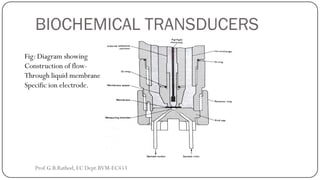
Fig: Diagram showing
Construction of flow-
Through liquid membrane
Specific ion electrode.
Prof.G.B.Rathod, EC Dept.BVM-EC453
BIOCHEMICAL TRANSDUCERS
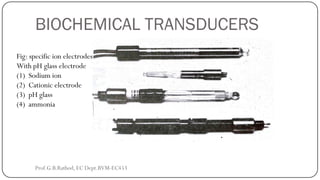
Fig: specific ion electrodes
With pH glass electrode
(1) Sodium ion
(2) Cationic electrode
(3) pH glass
(4) ammonia
Prof.G.B.Rathod, EC Dept.BVM-EC453
Outcomes
 From this unit, we come to know about various types of
transducers used for the physiological potential
measurements. The real time use and the benefit with some
major and minor artifacts also discussed.
 Biochemical transducers and related to pH measurement is
also focused and shows it own stability related advantages in
various measurements.
Prof.G.B.Rathod, EC Dept.BVM-EC453
Reference
 Book:“Biomedical instrumentation and measurements “ ,by
L. Cromwell, F .Weibell, and E. Pfeiffer. PHI publication 2nd
Edition
Prof.G.B.Rathod, EC Dept.BVM-EC453
Thank You
Scan the QR Code for more information
Prof.G.B.Rathod, EC Dept.BVM-EC453

Topic-3 : Basic transducer principles & Electrodes

  • 1.
    COMPILED BY: PROFG B RATHOD EC department-BVM College, Email: ghansyam.rathod@bvmengineering.ac.in BASIC TRANSDUCER PRINCIPLES & ELECTRODES Prof.G.B.Rathod, EC Dept.BVM-EC453
  • 2.
    THE TRANSDUCERS ANDTRANDSDUCTION PRINCIPALES  A variable is any quantity whose value changes with time. A variable associated with physiological process of the body is called a physiological variable.  A transducer is required to convert each variable into an electrical signal which can be amplified or otherwise processed and converted into some form of display.  The device that performs the conversion of one form of variable into another is called a transducer.  Here we discuss the transducer which is having input some other quantity and output will be electrical quantity. Prof.G.B.Rathod, EC Dept.BVM-EC453
  • 3.
    THE TRANSDUCERS ANDTRANDSDUCTION PRINCIPALES  Two different principles are involved in the process of converting nonelectrical variables into electrical signals.  One of these is energy conversion: Transducers based on this principle is called active transducers.  Second of these is control of an excitation voltage or modulation of a carrier signal. Transducers based on this principle is called a passive transducers. Prof.G.B.Rathod, EC Dept.BVM-EC453
  • 4.
  • 5.
    ACTIVE TRANSDUCERS  Someconversion principles are describe here  Magnetic Induction: if an electrical conductor is moved in a magnetic field in such a way that the magnetic flux through the conductor is changed, a voltage is induced which is proportional to the rate of change of magnetic flux.  Basically two basic configuration are used using this concept: one is linear motion and the other is rotary motion.  The applications are heart sound microphones, pulse transducers and electromagnetic blood flow meters. Prof.G.B.Rathod, EC Dept.BVM-EC453
  • 6.
  • 7.
  • 8.
    ACTIVE TRANSDUCERS  Thenatural materials in which this piezoelectric effect can be observed are primarily slices from crystals of quartz(SiO2) or Rochelle salt(sodium potassium tartrate).  The piezoelectric process is reversible. If an electric field is applied to a slab of material that has piezoelectric properties, it changes its dimensions.  We will see equivalent circuit of the piezoelectric transducer connected to an amplifier.  The piezoelectric principal is also used in ultrasonic instruments. Prof.G.B.Rathod, EC Dept.BVM-EC453
  • 9.
  • 10.
    PASSIVE TRANSDUCERS  Passivetransducers utilize the principle of controlling a dc excitation voltage or an Ac carrier signal.  There are only three passive circuit elements that can be utilized as a passive transducers. Resistors, capacitors, and Inductors.  Passive Transducers Using Resistive Elements: Special linear potentiometer can be used to convert displacement into a resistance change. Prof.G.B.Rathod, EC Dept.BVM-EC453
  • 11.
  • 12.
    PASSIVE TRANSDUCERS  Passivetransducer using Capacitive elements.  The capacitance of the capacitor can be changed by varying the physical dimension of the plate structure or by varying the dielectric contestant of the medium between the plates. E.g., the capacitance plethysmography.  Passive Transducers Using Active Circuit Elements. Transistor , Photoelectric transducers Prof.G.B.Rathod, EC Dept.BVM-EC453
  • 13.
    TRANSDUCERS FOR BIOMEDICAL APPLICATIONS Pressure Transducers: Pressure transducers are closely related to force transducers. Force summing members used in pressure transducers are shown in figure.  We can use the strain gage also for designing of such pressure transducers.  Diaphragm type pressure transducers can be designed for a wide range of operating pressures, depending on the diameter and stiffness of the diaphragm, bourdon tube transducers are usually used for high pressure ranges.  In differential pressure transducers the two pressure are applied to opposite side of the diaphragm. Prof.G.B.Rathod, EC Dept.BVM-EC453
  • 14.
  • 15.
    TRANSDUCERS FOR BIOMEDICAL APPLICATIONS Flow Transducers: For fluids and gases flow rate measurements, the methods are described in upcoming topics.  Transducers with Digital Output: ADC can be used to convert analog signal to digital output for analog transducers.  For digital output, specially design encoding disks are to be used in the process of the conversion from the transducers circuit. Usually photo diodes or photo transistors related circuit are used for the digital out put data. Prof.G.B.Rathod, EC Dept.BVM-EC453
  • 16.
    Electrode Theory  Electrodes:Devices that convert ionic potentials into electronic potentials are called electrodes.  The interface of metallic ions in solution with their associated metals results in an electrical potential that is called the electrode potential.  At the equilibrium, the double layer charge produce with opposite sign.  The hydrogen is taken as a reference electrode in international agreement. The other potentials are taken by taking hydrogen as a reference electrode. The electrodes potentials for variety of other electrodes are listed in table. Prof.G.B.Rathod, EC Dept.BVM-EC453
  • 17.
  • 18.
    Electrode Theory  Whenthe ionic movement occurs and the new potential developed at the membrane, the value of that potential can be found out by Nernst Equation.  Where R=gas constant  T = absolute temperature, degrees kelvin  n=valence of the ion  F=Faraday constant  C1,C2 = two concentrations of the ion on the two sides of the membrane 1 1 2 2 ln C f RT E nF C f   Prof.G.B.Rathod, EC Dept.BVM-EC453
  • 19.
    Electrode Theory  f1,f2=respectiveactivity coefficients of the ion on the two sides of the membrane  This above f1 and f2 are depend on such factors as the charges of all ions in the solution and the distance between ions.  The product of C1f1 of concentration and its associated activity coefficient is called the activity of the ion responsible for the electrode potential.  The metal-electrolyte interface developed and the potential generated. Prof.G.B.Rathod, EC Dept.BVM-EC453
  • 20.
    Biopotential electrodes  Basicallythree types.  Microelectrodes: Electrodes used to measure bioelectric potentials near or within a single cell.  Skin surface electrodes: Electrodes used to measure ECG, EEG, and EMG potentials from the surface of the skin.  Needle electrodes: Electrodes used to penetrate the skin to record EEG potentials from a local region of the brain or EMG potentials from a specific group of muscles.  The equivalent circuit of the electrode in upcoming figure. Prof.G.B.Rathod, EC Dept.BVM-EC453
  • 21.
  • 22.
    Biopotential electrodes  Twoelectrodes are require to do measurements.  If the same type of electrodes are used, the potential difference is usually small and depends on the actual difference of ionic potential between the two points of the body.  If the electrodes are different, the dc voltage generated which is nothing but a electrode offset voltage. Which can cause an error in the measurement.  Some dc also produce in the same type of electrodes we use.  To reduce that error by choice of materials, or by special treatment, such as coating the electrodes by some……contd Prof.G.B.Rathod, EC Dept.BVM-EC453
  • 23.
    Biopotential electrodes  ….contd….electrolyticmethod to improve stability.  E.g : silver silver chloride electrode is very stable prepared by electrolytically coating a piece of pure silver with silver chloride.  We can see the equivalent diagram of the use of two electrodes for the biopotential measurements.  In that the impedance is varies according to the polarization which is a result of direct current passing through the metal electrolyte interface.  Size and type of electrodes also affects the impedance . Higher the size lower impedance. E.g surface electrodes….have 2 to 10 kohm, where as small needle electrodes have much larger value. Prof.G.B.Rathod, EC Dept.BVM-EC453
  • 24.
  • 25.
    Biopotential electrodes  Microelectrodes:Electrodes with tips sufficiently small to penetrate a single cell in order to obtain readings from within the cell.  Basically two types: 1. Metal , 2. Micropipet.  Metal type are formed by electrolytically etching the tip of a fine tungsten or stainless steel wire to the desired size. Then wire is coated with the an insulating material.  Micropipet as shown in upcoming diagram.  The problem with such electrodes is that high impedance and for that amplifier with very high impedance required. Prof.G.B.Rathod, EC Dept.BVM-EC453
  • 26.
  • 27.
    Biopotential electrodes Fig: PhysicalLook of Microelectrodes Prof.G.B.Rathod, EC Dept.BVM-EC453
  • 28.
    Biopotential electrodes Fig:Array ofmicroelectrodes connected with brain Prof.G.B.Rathod, EC Dept.BVM-EC453
  • 29.
    Biopotential electrodes Fig: Probeof the Microelectrodes.. Dimensions compared with the mosquito Prof.G.B.Rathod, EC Dept.BVM-EC453
  • 30.
    Biopotential electrodes Prof.G.B.Rathod, ECDept.BVM-EC453 Click here to see one the application of such electrodes
  • 31.
    Biopotential electrodes  BodySurface Electrodes:  The earliest bioelectric potential measurements used immersion electrodes, which were buckets of saline solution into which the subject placed his hands and feet, one bucket for each extremity. Shown in upcoming image.  After that improvements done and plate electrodes introduced in 1917. These electrodes are separated from the skin by cotton or felt pads socked in saline solution.After that jelly introduced. Prof.G.B.Rathod, EC Dept.BVM-EC453
  • 32.
  • 33.
  • 34.
  • 35.
  • 36.
  • 37.
    Biopotential electrodes  Anothermost popular old type electrodes used today also is a suction cup electrode shown in figure. Prof.G.B.Rathod, EC Dept.BVM-EC453
  • 38.
    Biopotential electrodes  Onedifficulty in using plate electrodes is that possibility of electrode slippage or movement.  This also occurs with the suction cup electrode after a sufficient length of time. Number of attempts were made to overcome this problem.  All the preceding electrodes suffer from a common problem. They are sensitive to movement, some to a greater degree than others.  The adhesive tape and “nutmeg grater” electrodes reduce this movement artifact by limiting electrode movement and reducing the interface impedance, but neither is satisfactory insensitive to movement. Prof.G.B.Rathod, EC Dept.BVM-EC453
  • 39.
    Biopotential electrodes  Anew type of electrode, the floating electrode, was introduced in varying forms by several manufacturers. This principle of this electrode is to practically eliminate movement artifact by avoiding any direct contact of the metal with the skin.  The only conductive path between metal and skin is the electrolyte paste or jelly.  Floating electrodes are generally attached to the skin by means of two sided adhesive rings.  ECG measurement for long time can make some problem. Prof.G.B.Rathod, EC Dept.BVM-EC453
  • 40.
  • 41.
  • 42.
    Biopotential electrodes  Varioustypes of disposable electrodes have been introduced in recent years to eliminate the requirement of cleaning and care after each use.  Special types of have been developed for other applications. For example, a special ear-clip electrode was developed for use as a reference electrode for EEG measurements.  Scalp surface electrodes for EEG are usually small disks about 7 mm in diameter or small solder pellets that are placed on the cleaned scalp, using an electrolyte paste. Prof.G.B.Rathod, EC Dept.BVM-EC453
  • 43.
  • 44.
  • 45.
  • 46.
    Biopotential electrodes  NeedleElectrodes: To reduce interface impedance and, consequently, movement artifacts, some electroencephalographers use smalls subdermal needles to penetrate the scalp for EEG measurements.  In animal research longer needles are actually inserted into the brain to obtain localized measurement of potentials from a specific part of the brain.  Sometimes a special instrument, called stereotaxic instrument, is used to hold the animal’s head and guide the placement of electrodes. Prof.G.B.Rathod, EC Dept.BVM-EC453
  • 47.
  • 48.
    Biopotential electrodes  Needleelectrodes for EMG consist merely of fine insulated wires, placed so that their tips are in contact with the nerve muscle. Or other tissue from which the measurement is made.  Wire electrodes of copper or platinum are often used for EMG pickup from specific muscles.  A single wire inside the needle serves as a unipolar electrode, If a two wire placed inside the needle, the measurement is called bipolar and provide a very localized measurement between the two wire tips. Prof.G.B.Rathod, EC Dept.BVM-EC453
  • 49.
    BIOCHEMICAL TRANSDUCERS  ReferenceElectrode  The pH electrode  Blood Gas Electrodes  Specific Ion ELectrodes Prof.G.B.Rathod, EC Dept.BVM-EC453
  • 50.
    BIOCHEMICAL TRANSDUCERS  ReferenceElectrode: Normally Hydrogen is used as a reference electrode.  These electrodes make use of the principle that an inert metal, such as platinum, readily absorbs hydrogen gas.  Unfortunately, the hydrogen electrode is not sufficiently stable to serve as a good reference electrode.  Measurement of electrochemical concentration simply requires a change of potential proportional to a change in concentration.  Two types: silver-silver chloride and the calomel electrode. Prof.G.B.Rathod, EC Dept.BVM-EC453
  • 51.
    BIOCHEMICAL TRANSDUCERS  Thesilver-silver chloride electrode used as a reference in electrochemical measurements utilizes the same type of interface described before.  In chemical transducer silver chloride side of the interface is connected to the solution by an electrolyte bridge which is filling solution KCl.  The reference electrode with 0.01 mole solution, potential is 0.343 V and for 1.0 mole solution, potential is 0.236V  The another is calomel electrode which is also called mercurous chloride same as a Silver-silver chloride.  0.01 mole, potential will be 0.388V and 3.5 moles, 0.247V Prof.G.B.Rathod, EC Dept.BVM-EC453
  • 52.
    BIOCHEMICAL TRANSDUCERS Fig: Reference Electrode Basicconfiguration Prof.G.B.Rathod, EC Dept.BVM-EC453
  • 53.
    BIOCHEMICAL TRANSDUCERS  ThepH Electrode  To know chemical balance in the body, pH of the blood and other fluids are very important.  Equation of pH is  pH is a measure of the acid base balance of a fluid.  A natural solution has a pH of 7. Lower pH numbers indicate acidity, whereas higher pH values define a basic solution. Most human body fluids are slightly basic. The pH of normal arterial blood ranges between 7.38 and 7.42. The pH of venous blood is 7.35, because of the extra CO2. 10 10 1 log [ ] log [ ] pH H H      Prof.G.B.Rathod, EC Dept.BVM-EC453
  • 54.
    BIOCHEMICAL TRANSDUCERS  Inthe measurement of pH and in any electrochemical measurement, each of the two electrode required to obtain the measurement is called half cell and its sometimes called the half cell potential.  The glass electrodes quite adequate for pH measurements in physiological range(around pH 7).  Special hydroscopic glass that readily absorbs water provides the best pH response. Prof.G.B.Rathod, EC Dept.BVM-EC453
  • 55.
  • 56.
    BIOCHEMICAL TRANSDUCERS  BloodGas Electrodes:  One of the important physiological chemical measurements is pressure of oxygen and carbon dioxide in the blood.  The effectiveness of both the respiratory and cardiovascular systems is reflected in these important parameters.  The diagram of Po2 electrode with platinum cathode will be in upcoming slide which shows a principle of operation. Prof.G.B.Rathod, EC Dept.BVM-EC453
  • 57.
    BIOCHEMICAL TRANSDUCERS Fig: diagramof Po2 electrode With platinum cathode showing Principle of operation Prof.G.B.Rathod, EC Dept.BVM-EC453
  • 58.
    BIOCHEMICAL TRANSDUCERS Fig: combinationof Pco2 And Po2 electrode Prof.G.B.Rathod, EC Dept.BVM-EC453
  • 59.
    BIOCHEMICAL TRANSDUCERS Fig: Diagramshowing Construction of flow- Through liquid membrane Specific ion electrode. Prof.G.B.Rathod, EC Dept.BVM-EC453
  • 60.
    BIOCHEMICAL TRANSDUCERS Fig: specificion electrodes With pH glass electrode (1) Sodium ion (2) Cationic electrode (3) pH glass (4) ammonia Prof.G.B.Rathod, EC Dept.BVM-EC453
  • 61.
    Outcomes  From thisunit, we come to know about various types of transducers used for the physiological potential measurements. The real time use and the benefit with some major and minor artifacts also discussed.  Biochemical transducers and related to pH measurement is also focused and shows it own stability related advantages in various measurements. Prof.G.B.Rathod, EC Dept.BVM-EC453
  • 62.
    Reference  Book:“Biomedical instrumentationand measurements “ ,by L. Cromwell, F .Weibell, and E. Pfeiffer. PHI publication 2nd Edition Prof.G.B.Rathod, EC Dept.BVM-EC453
  • 63.
    Thank You Scan theQR Code for more information Prof.G.B.Rathod, EC Dept.BVM-EC453