Method of data collection
LEARNING OBJECTIVES
• At the end of this chapter, the students will be
able to:
• Identify the different methods of data
collection
• understand the criterion for selection a
method to collect data
1
• Identify the different methods of data
collection and
• criterion that we use to selection a method of
data collection.
• Define a questionnaire, identify the different
parts of a questionnaire
• and indicate the procedures to prepare a
questionnaire
2
INTRODUCTION
• Before any statistical work can be done
• data must be collected depending on the type
of variable and
• the objective of the study,
• different data collection methods can be
employed.
3
• Review of Data Collection Methods
• During the planning phase of the
study it necessary to decide upon the
method to be used for collecting
information concerning each of the
variables listed for investigation.
4
• Observation: i.e. the use of techniques varying
from simple visual observation to those
requiring specific skills.
• Interview and self- administered
questionnaire
• The use of documentary sources
• clinical records and
• other personal records such as death
certificates, published statistics, and census
publications.
5
• Data and information collection
• Once it is clearly what information we need
(the key indicators)
• it is then necessary to consider how this might
be obtained.
• The following questions must be asked and
answered
6
• How to collect the information
• What source is most appropriate
• Who should do it
• When and how often the information
should be collected analyzed and
reported.
• What format are required to recorded
the data being collected
7
• When developing answers to these questions,
one of the main issues to keep in mind
• in the resources capacity constraint that well
be faced by those responsible for collecting
the information.
There is no point in designing procedures
which are too complex or
• costly as this will merely lead to frustration
and disappointment in the out comes.
8
• A balance must therefore be struck between
what would be desirable in an ideal world
what is feasible in practice.
• It is also vital to be clear about how the data
will be analyzed and used before embracing
data collection.
9
• DATA COLLECTION METHODS
• Data collection techniques allow us to
systematically collect data about our objects
of study (people, objects, and phenomena)
and about the setting in which they occur.
• In the collection of data we have to be
systematic. If data are collected haphazardly,
it will be difficult to answer our research
questions in a conclusive way.
10
• Using available information
• Focus group discussions (FGD)
• Other data collection techniques-
• Rapide apparisal techniques,
• 3L technique, Nominai group techniques,
Delphi techniques,
• life histories, case studies, etc.
11
• Various data collection techniques can be
used to collect data such as:
• Observation
• Face – to face and self – administered
interviews
• Postal or mail method and telephone
interviews
12
• OBSERVATION- Observation is a
technique that involves
systematically selecting, Watching
and recoding behaviors of people
• or other phenomena and aspects of
the setting in which they occur, for
the purpose of (getting) specified
information.
13
• It includes all methods from simple visual
observations to the use of high level machines
and measurements, sophisticated equipment
or facilities, such as radiographic, biochemical
analysis, x-ray machines, microscope, clinical
examinations and microbiological
examinations.
14
:
• Advantages: Gives relatively more accurate
data on behavior and activities
• Disadvantages: Investigators or observer’s
own biases, prejudice, desires, etc.
• - Needs more resources and skilled human
power during the use of high level machines.
15
INTERVIEWS AND SELF-ADMINISTERED
QUESTIONNAIRE
• Interviews and self- administrated questionnaires
are probably the most commonly used research data
collection techniques.
• Therefore, commonly used research data collection
techniques. Therefore designing good “questioning
tools” forms an important and time consuming
phase in the development of most research
proposals.
16
• Once the decision has been made to use these
techniques, the following questions should be
considered before designing our tools.
1. What exactly do we want to know, according to the
objectives and variables we identified earlier?
2 Is questioning the right technique to obtain all
answer, or do we need additional techniques, such
as observations or analysis of records?
17
Cont……
3. Of whom will we ask questions and what
techniques wile we use?
4. Do we understand the topic sufficiently to design a
questionnaire, or do we need some loosely
structured interviews with key informants or a FGD
first to orient ourselves?
5. Are our informants mainly literate or illiterate? If
illiterate, the use self administrated questionnaires
is not an option.
18
Cont……
• 6. How large is the sample that will be
interviewed? Studies with many respondents
often use shorter, highly structured
questionnaires where as smaller study allow
more flexibility and may use questionnaires
with a number of open-ended questions.
19
Cont……
• Once the decision has been made interviews
may be less or more structured. Unstructured
interview is flexible, the content wording an
order of the questions vary from interview to
interview. The investigator only have idea of
what he/she wants to learn but does not
decide in advance exactly what questions will
be asked, or in what order.
20
Cont……
• -In other situation, a more standardized technique
may be used. The wording and order questions being
decided in advance. This may take the form of a
highly structured interview, in which the questions
are asked orderly, or a self administered
questionnaire. In which case the respondent reads
the questions and fill in the answer by himself
(sometimes in the presence of an interviewer who
stands by’ to give assistance if necessary).
21
Cont……
• -Standardized methods of asking questions are
usually preferred in community medicine research,
since they provide more assurance that the data
will be reproducible.
• Less structured interviews may be useful in a
preliminary survey, where the purpose is to obtain
information to help in the subsequent planning of a
study rather than factors for analysis, and in
intensive studies of perceptions, attitudes,
motivation and affective reaction.
22
Cont……
• -unstructured interviews are characteristic of
qualitative (non-quantitative) research.
• -The uses of self- administered questionnaires is
simpler and cheaper, such questionnaires can be
administered to many persons simultaneously (e.g.
to a class of students). And unlike interviews, can be
sent by post. On the other hand, they demand a
certain level of education and skill on the part of the
respondents; people of a low socio-economic status
are less likely to respond to a mailed questionnaire.
23
Cont……
• -Interviewing using questionnaire, the
investigator appoints agents known as
enumerators, who go to the respondents
personally with the questionnaire, ask them
the questions given there in, and record their
replies. They can be either face – to – face or
telephone interviews.
24
Cont……
• Face-to-face and telephone interviews:
Have many advantages.
• A good interviewer can stimulate and
maintain the respondent’s interest.
• And can create a rapport (understanding,
concord) and atmosphere conductive to the
answering of questions
• If anxiety aroused, the interviewer can allay
it.
25
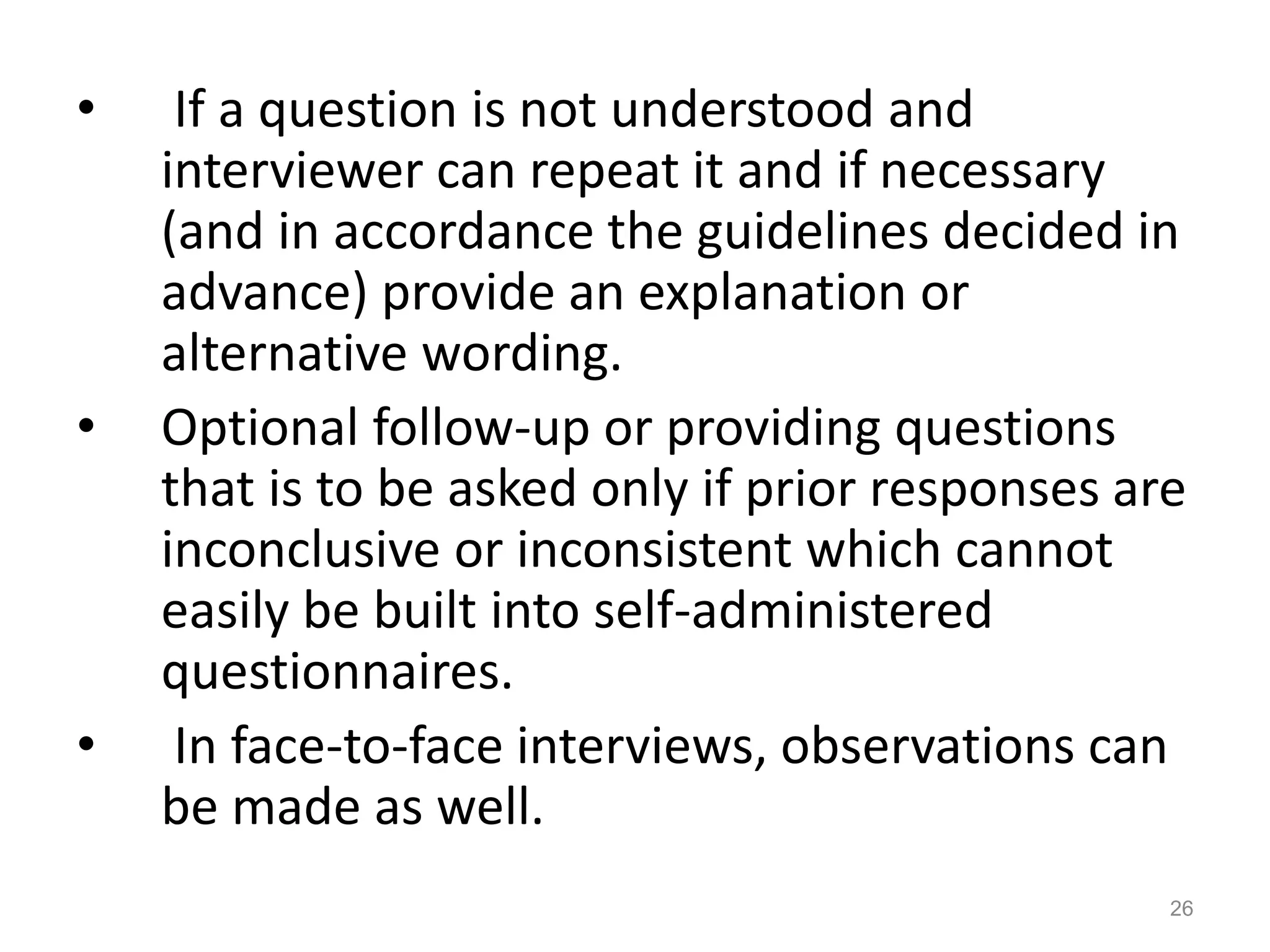
• If a question is not understood and
interviewer can repeat it and if necessary
(and in accordance the guidelines decided in
advance) provide an explanation or
alternative wording.
• Optional follow-up or providing questions
that is to be asked only if prior responses are
inconclusive or inconsistent which cannot
easily be built into self-administered
questionnaires.
• In face-to-face interviews, observations can
be made as well.
26
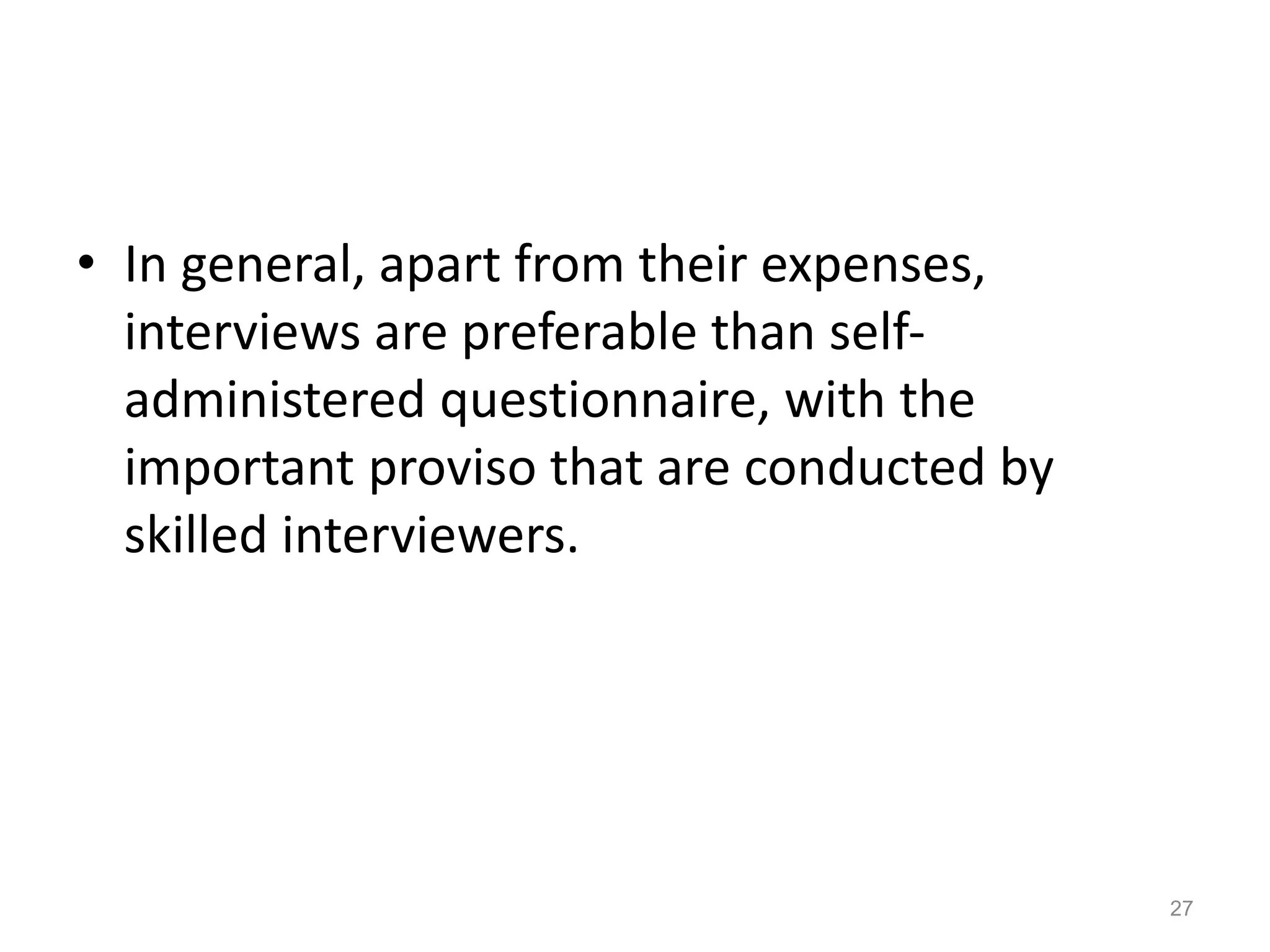
• In general, apart from their expenses,
interviews are preferable than self-
administered questionnaire, with the
important proviso that are conducted by
skilled interviewers.
27
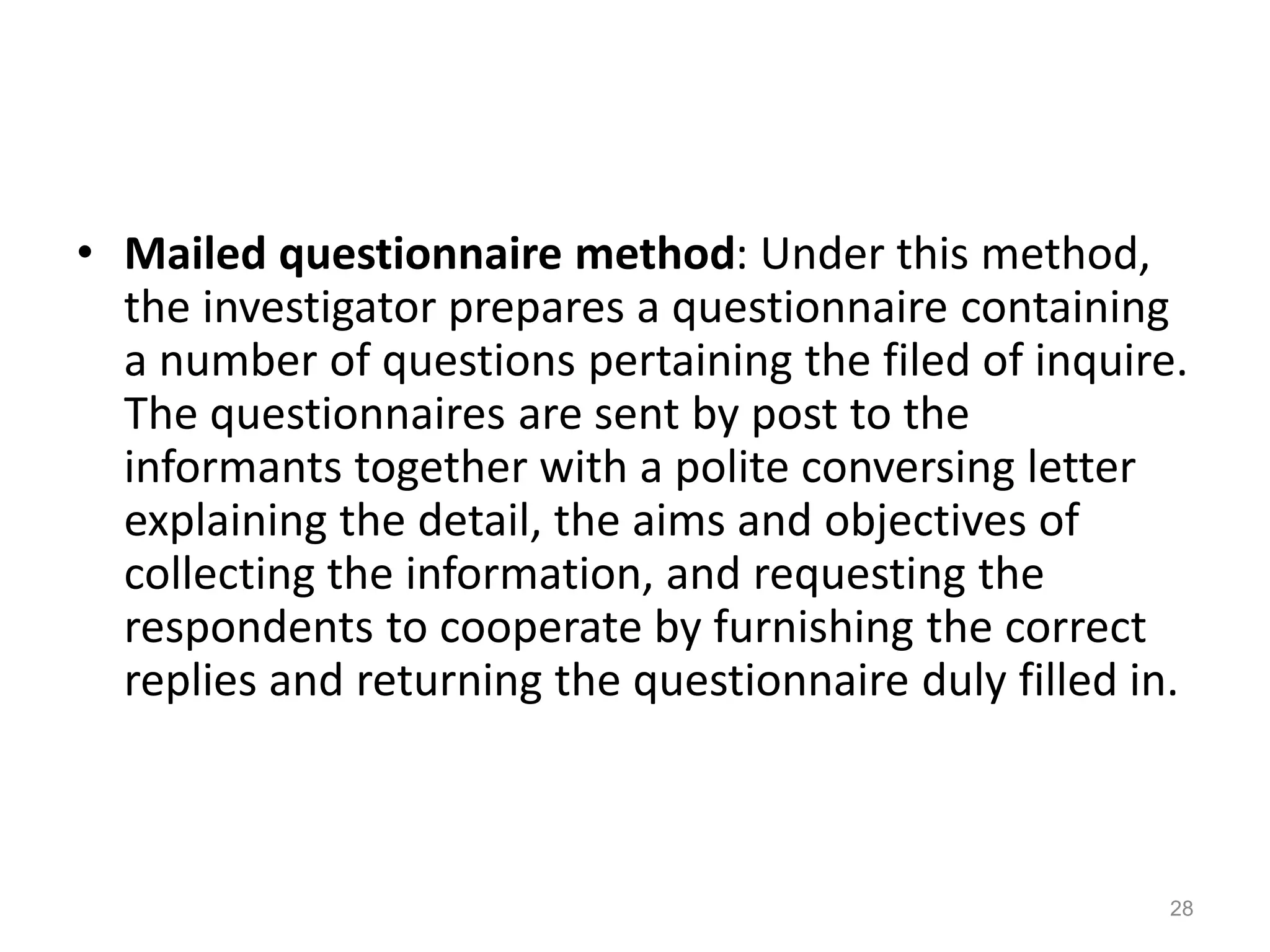
• Mailed questionnaire method: Under this method,
the investigator prepares a questionnaire containing
a number of questions pertaining the filed of inquire.
The questionnaires are sent by post to the
informants together with a polite conversing letter
explaining the detail, the aims and objectives of
collecting the information, and requesting the
respondents to cooperate by furnishing the correct
replies and returning the questionnaire duly filled in.
28
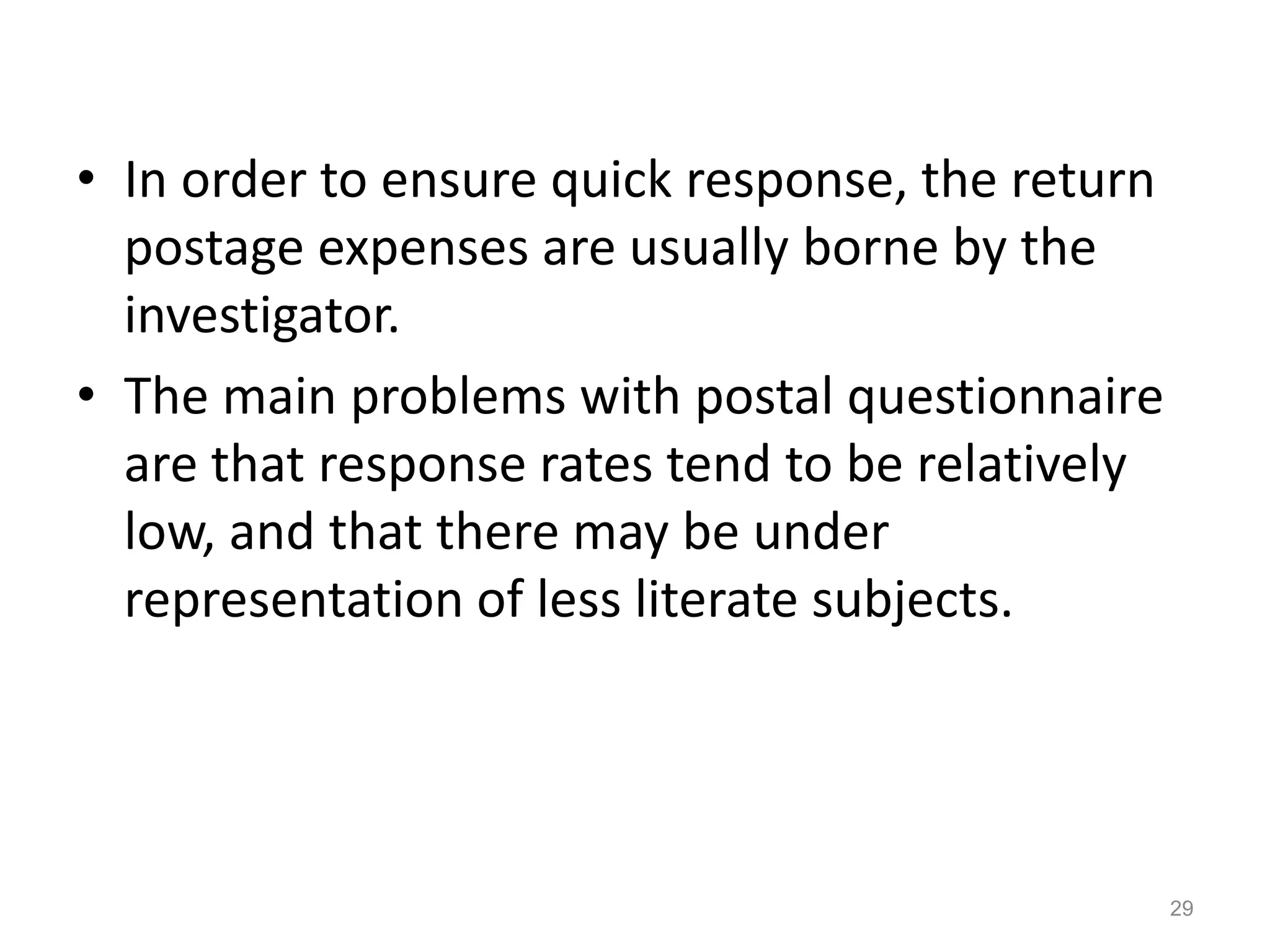
• In order to ensure quick response, the return
postage expenses are usually borne by the
investigator.
• The main problems with postal questionnaire
are that response rates tend to be relatively
low, and that there may be under
representation of less literate subjects.
29
• . USE OF DOCUMENTARY SOURCES: Is the use of
clinical and other personal records, death
certificates, published mortality statistics, census
publications, etc. Examples include:
• Official publications of central statistical Authority
• publication of ministry of Health and other
ministries
• News paper and Journals.
• Internal publications like publication by WHO.
World Bank, UNCEF
• Records of hospitals of or any Health institutions
30
• During the use of data from document’s though
they are less time consuming and relatively has low
cost, care should be taken on the quality and
completeness of the data this may be due to
differences in objectives between the primary
author of the data and the user.
• Usually there is a large body of data already
collected by others, although it may not necessarily
have been analyzed or published.
31
Cont……
• For example, analysis of the information
routinely collected by health facilities can be
very useful for identifying problems in
certain interventions or flow of drug supply,
or for identifying increases in the incidence
of certain deceases. Sometimes the factors
contribute to the problem may also be
identified from the same source.
32
Cont……
• Analysis of health information system data; census
data, unpublished reports and publications in
archives and libraries or in offices at the various
levels of health and health related services might
be a study itself.
• To retrieve data from available sources, the
recording view have to design an instrument such
as a cheekiest or compilation sheet and during
designing such instruments it is important to
inspect the layout (order) of the source documents
from which data are to be extracted. This will save
time and reduce error.
33
• Advantage:- In general inexpensive and permits
examination of post trends.
• Disadvantage
• Sometimes difficult to gain access to records
• Information may not always be complete and
precise enough.
• They sometimes are out of data, census data.
• There may be difference in the definition and
method of recording the data form one health facility
to another.
• Records may have been selectively deposited.
• Ethical issues concerning may arise
34
• PROBLEMS IN GATHERING DATA
• It is important to recognize some of the main
problems that may be faced when data
collected, so that they can be addressed in the
selection of appropriate collection method
and in the training of the staff involved.
• Common problems might include:
• Language barriers
• Lack of adequate time
• Expense
35
• Inadequately trained and experienced staff
• Invasion of privacy
• Suspicion
• Bias (Spatial, project, person, season,
diplomatic, professional)
• Cultural morals/norms (e.g. which may
preclude men interviewing women).
36
Cont……
– CHOOSING A METHOD OF DATA COLLECITON
• Decision- makers need information that is relevant,
timely, accurate and usable. The cost of obtaining,
processing and analyzing these data is high. The
challenges are to find ways, which lead to
information that is cost- effective, relevant, timely
and important for immediate use. Some methods
pay attention to timeliness and reduction in cost.
Others pay attention to accuracy and the strength
of the method in using scientific approaches
37
Cont……
• The statistical data may be classified under
two categories, depending upon the sources.
• 1) Primary data
• 2) Secondary data
38
Cont……
• Primary data:- are those data, which are
collected by the investigator himself for the
purpose of a specific inquiry or study. Such
data are original in character and are mostly
generated by surveys conducted by
individuals or research institutions.
39
• -The first hand information obtained by the
investigator is more reliable and accurate
since the investigator can extract the correct
information by removing doubts, If any in the
minds of the respondents regarding Certain
questions.
• -High response rates might be obtained since
the answers to various questions are obtained
on the spot.
• - It permits explanation of questions
concerning difficult subject matter.
40
• Secondary data:- when an investigator uses
data, which have already been collected by
others, such data are called “ Secondary
data”. Such data are primary data for the
agency that collected them, and become
secondary for someone else who uses these
data fro his own purpose.
• The secondary data can be obtained from
journals, reports, government publications,
publications of professionals and research
organizations.
41
• Secondary data are less expensive to collect
both in money and time.
• These data can also be batter utilized and
sometimes the quality of such data may be
better because these might have been
collected by persons who were special trained
for the purpose.
•
42
• On the other hand, such data must be used
with great care, because such data may also
be full of errors due to the fact that the
purpose of the collection of the data by the
primary agency may have been different
from the purpose of the user of these
secondary data. Secondly, there may have
been bias introduced, the size of the sample
may have been inadequate, or there may
have been arithmetic or definition errors,
hence, it is necessary to critically investigate
the validity of the Secondary data.
43
• In general, the choice of methods of data
collection is largely based on the accuracy of
the information they yield. In this context,
accuracy refers not only to correspondence
between the information and objective reality
– although this certainly enters into the
concept-but also to the information’s
relevance. This issue is the extent to which
the method will provide a precise measure of
the variable the investigator wishes to study.
44
• The selection of the method of data collection
so also based on practical consideration, such
as:
• The need for personnel, skills, equipment, etc.
in relation to what is available and the urgency
which results are needed.
• The acceptability of the procedures to the
subjects- the absence of
45
• The probability that the method will provide a
good coverage i.e. will supply the required
information about all or almost all members of the
population or sample. If many people will not
know the answer to the question, the question is
not an appropriate one.
• 4.The investigator’s familiarity with a study
procedure may be a valid consideration. It comes
as no particular surprise to discover that a scientist
formulates problems in a way which requires for
their solution just those techniques in which he
himself is specially skilled.
46
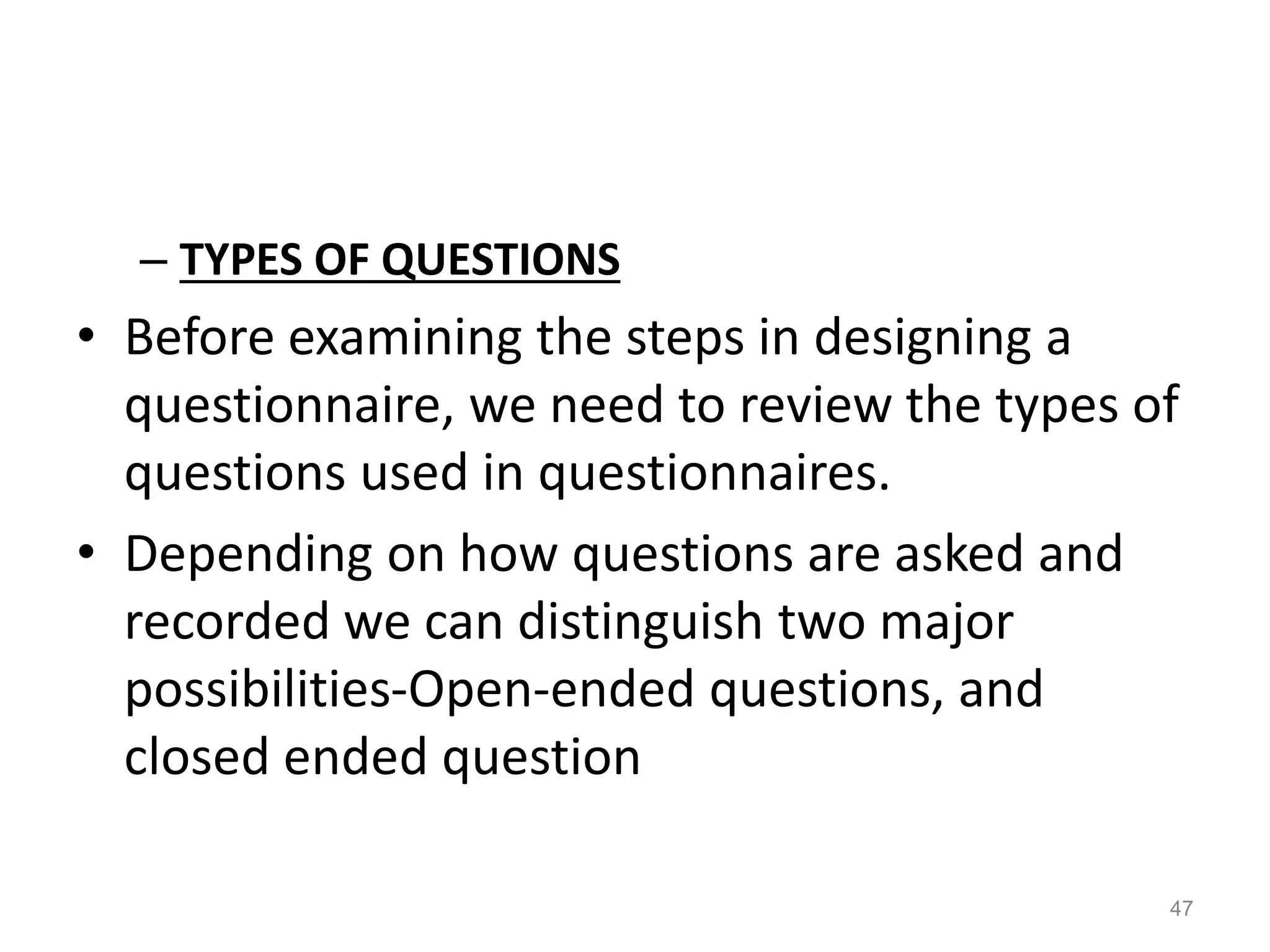
– TYPES OF QUESTIONS
• Before examining the steps in designing a
questionnaire, we need to review the types of
questions used in questionnaires.
• Depending on how questions are asked and
recorded we can distinguish two major
possibilities-Open-ended questions, and
closed ended question
47
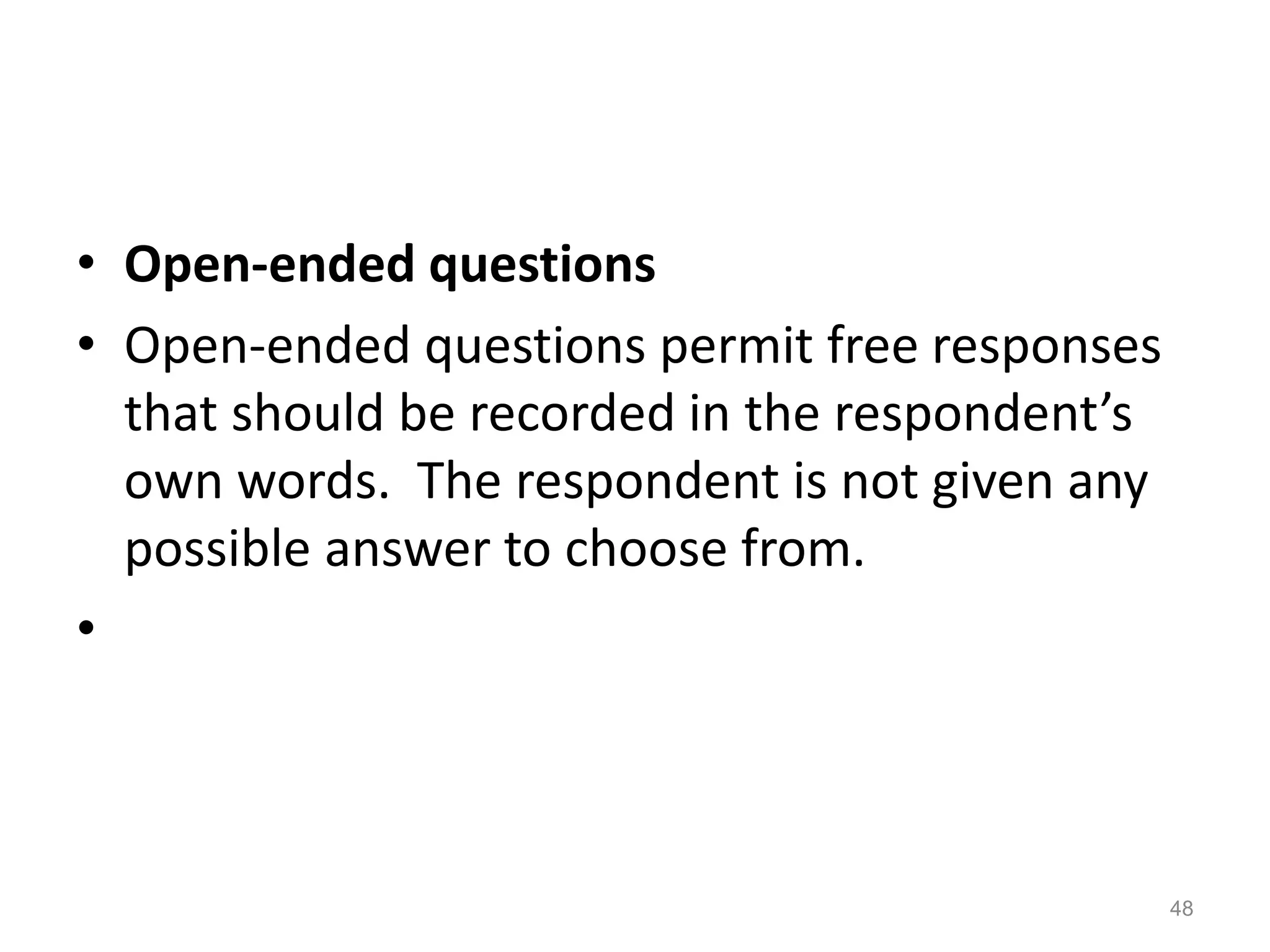
• Open-ended questions
• Open-ended questions permit free responses
that should be recorded in the respondent’s
own words. The respondent is not given any
possible answer to choose from.
•
48
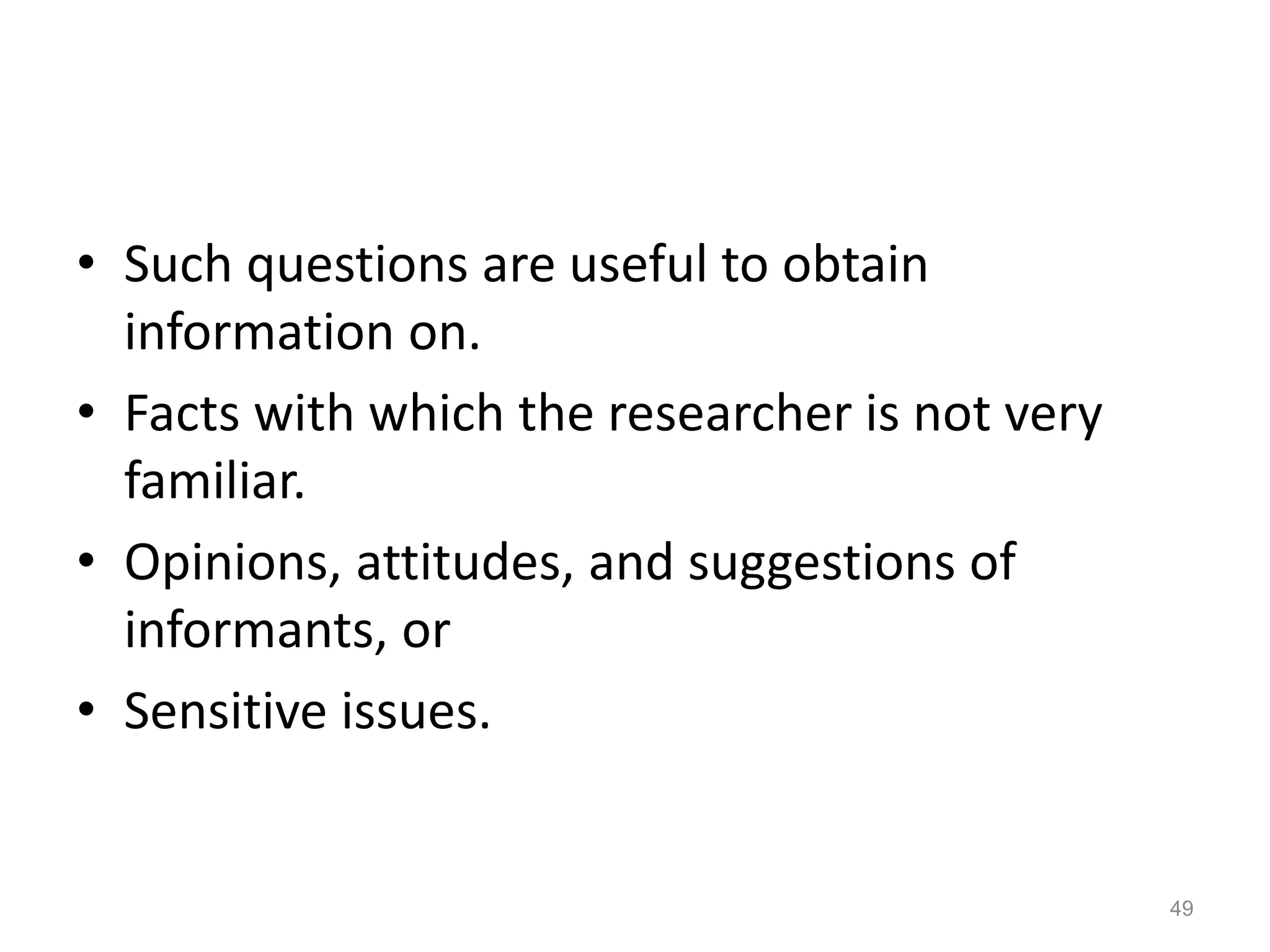
• Such questions are useful to obtain
information on.
• Facts with which the researcher is not very
familiar.
• Opinions, attitudes, and suggestions of
informants, or
• Sensitive issues.
49
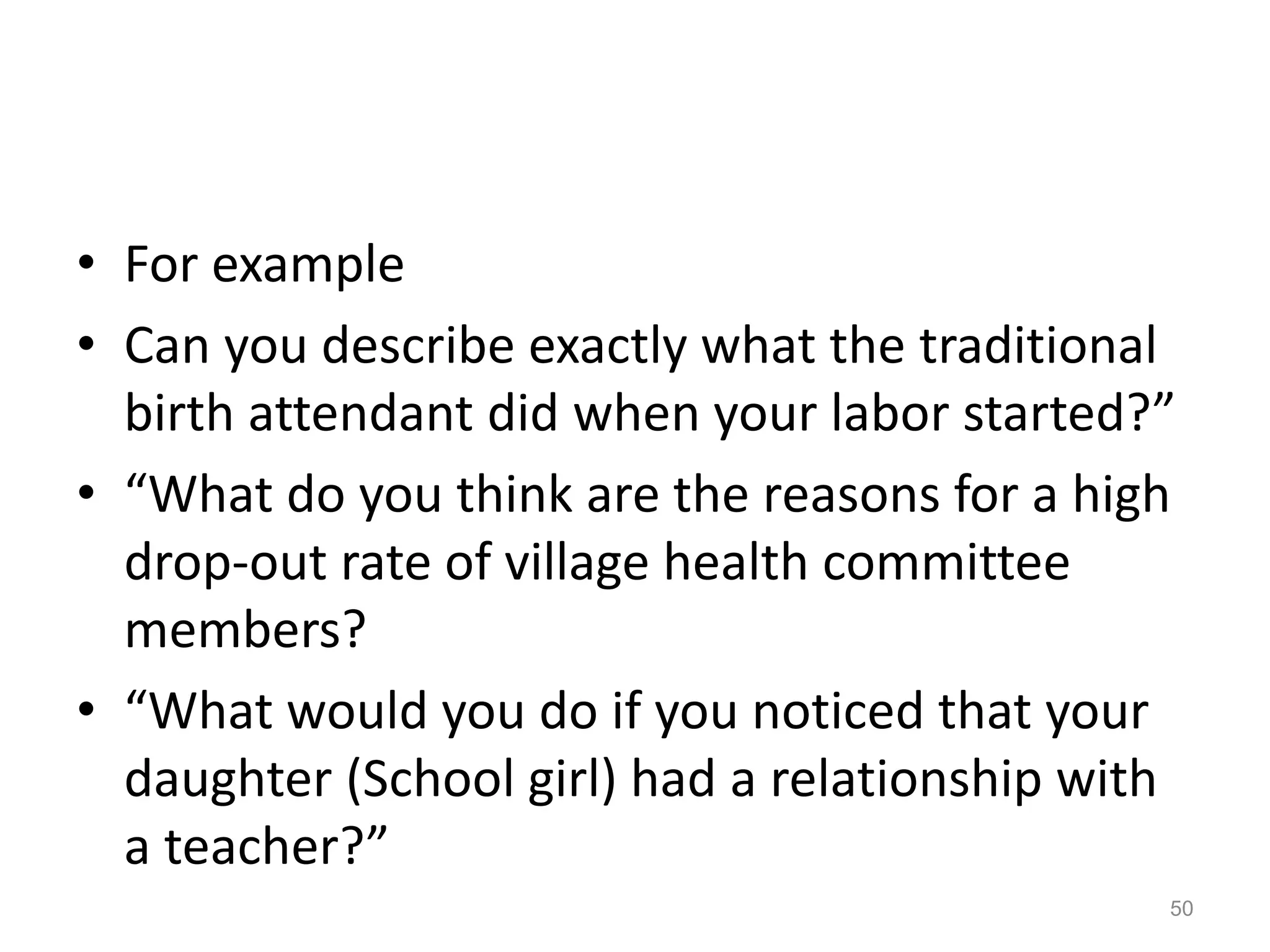
• For example
• Can you describe exactly what the traditional
birth attendant did when your labor started?”
• “What do you think are the reasons for a high
drop-out rate of village health committee
members?
• “What would you do if you noticed that your
daughter (School girl) had a relationship with
a teacher?”
50
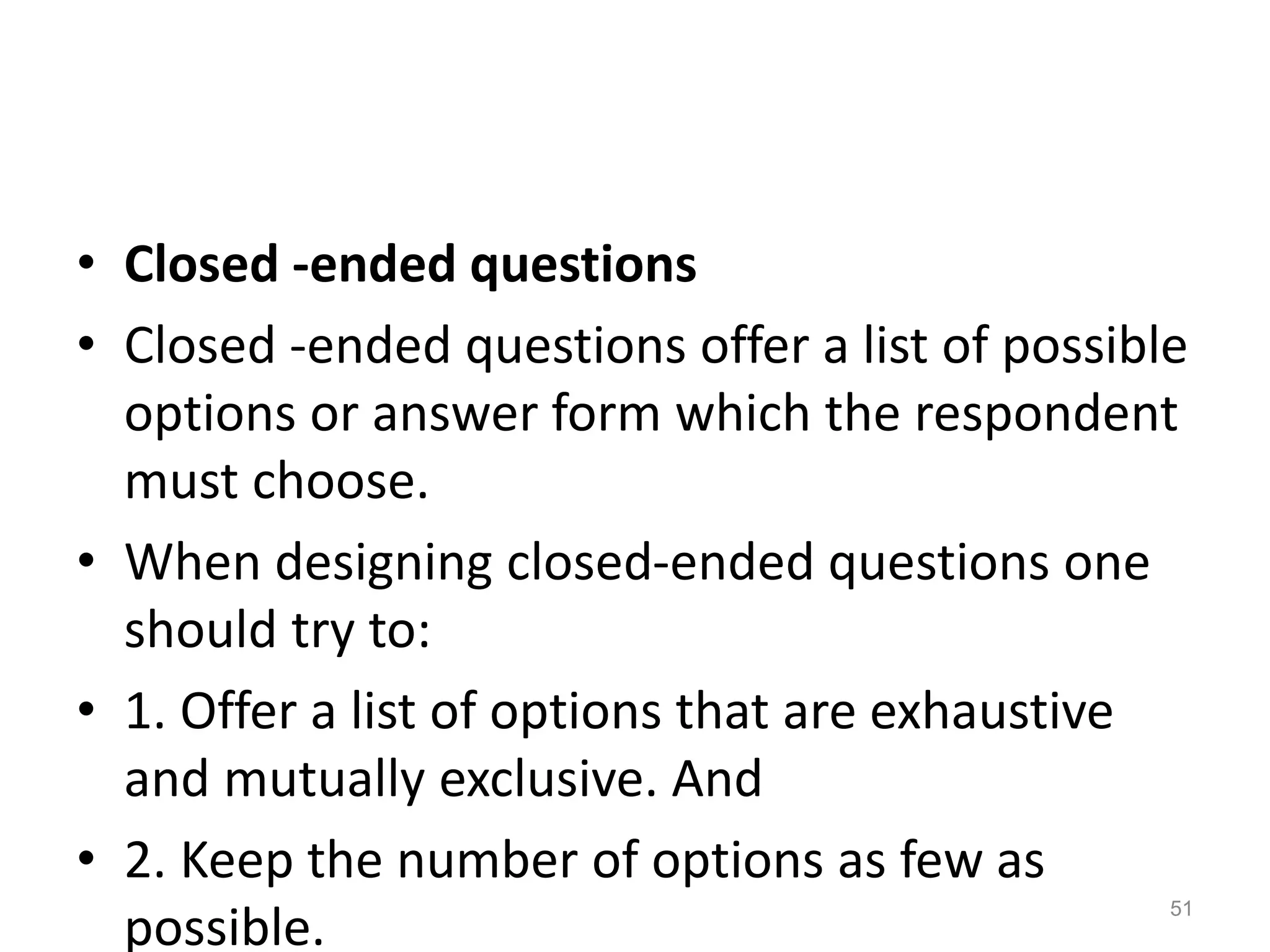
• Closed -ended questions
• Closed -ended questions offer a list of possible
options or answer form which the respondent
must choose.
• When designing closed-ended questions one
should try to:
• 1. Offer a list of options that are exhaustive
and mutually exclusive. And
• 2. Keep the number of options as few as
possible.
51
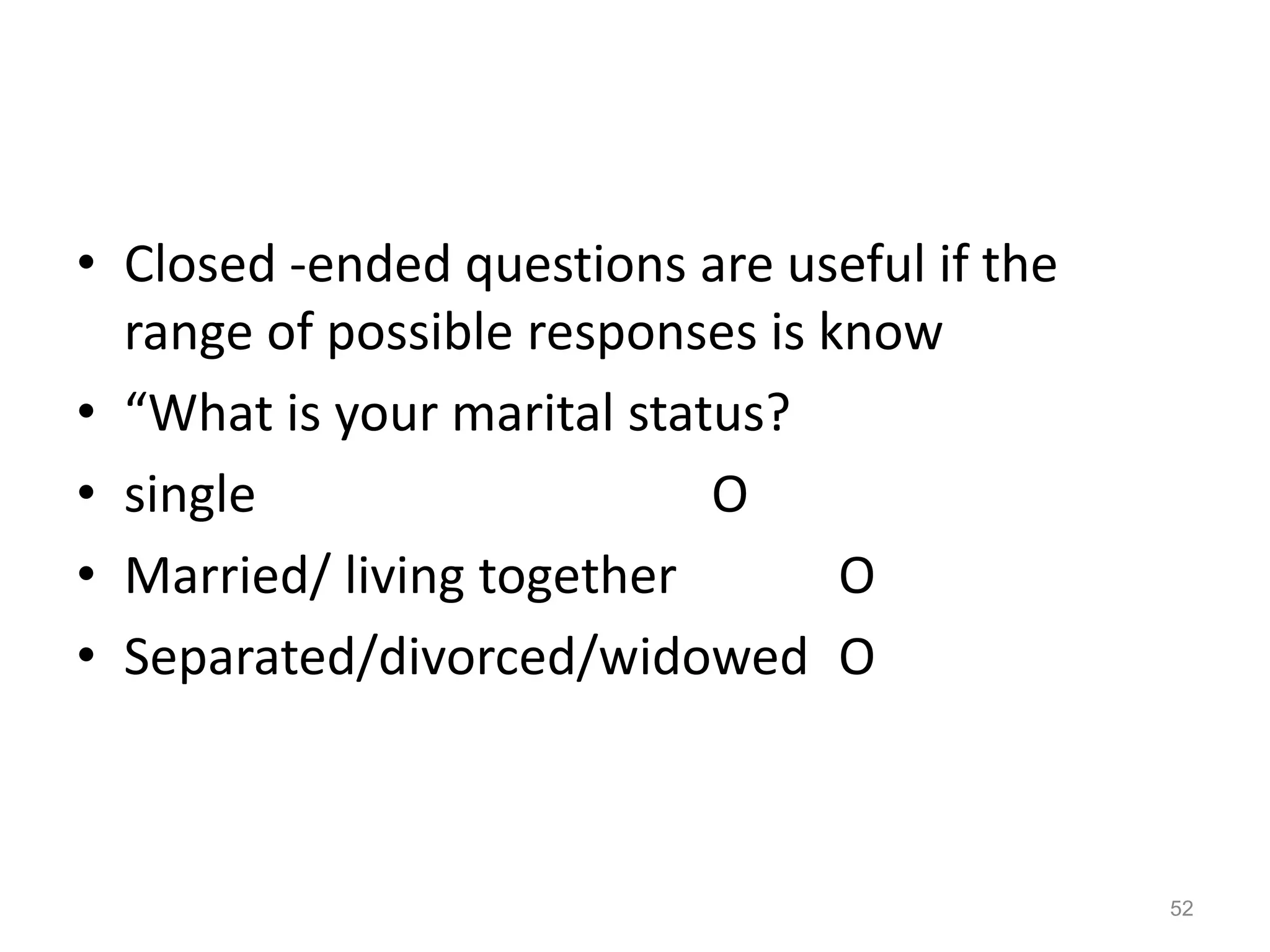
• Closed -ended questions are useful if the
range of possible responses is know
• “What is your marital status?
• single O
• Married/ living together O
• Separated/divorced/widowed O
52
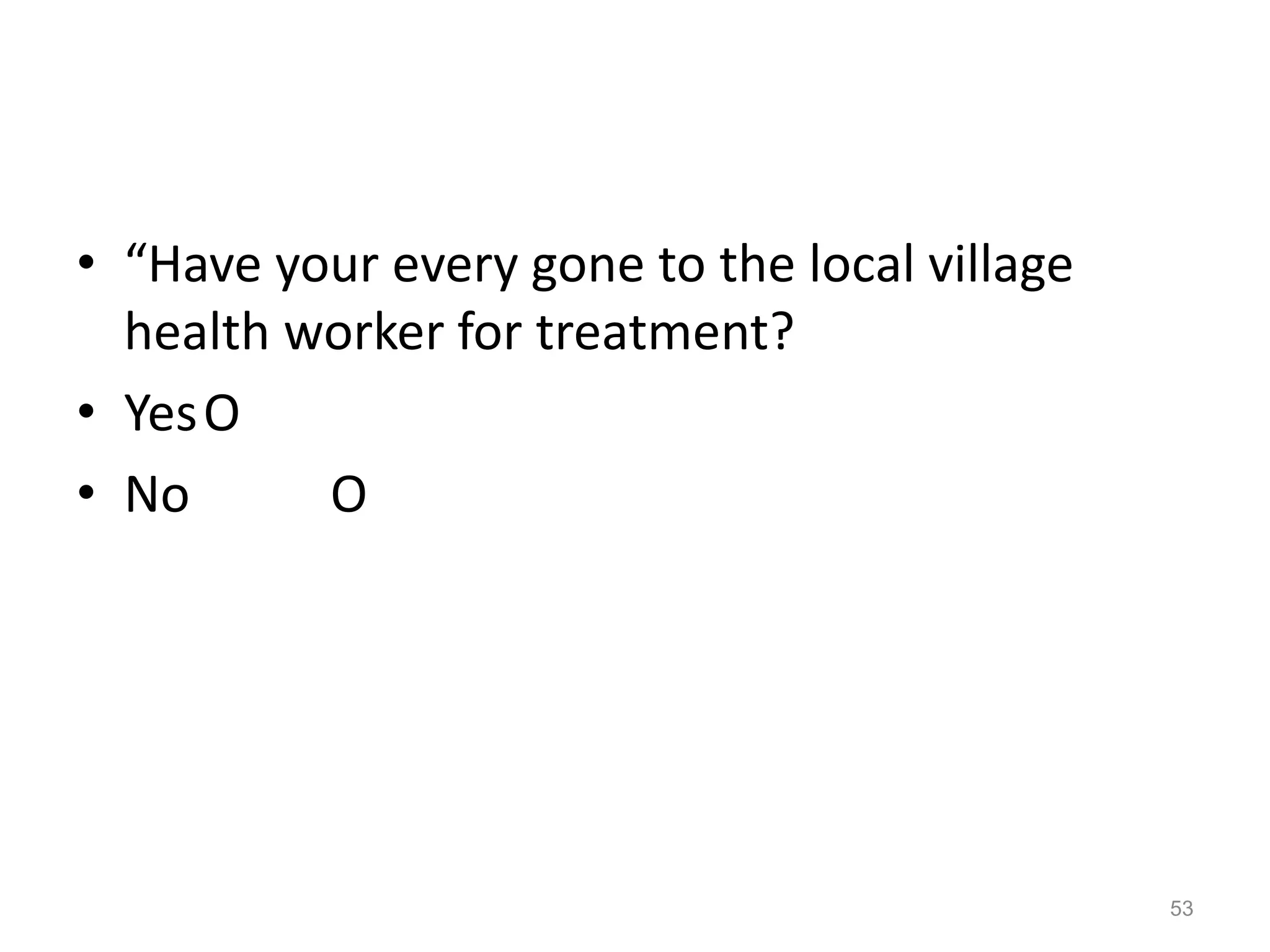
• “Have your every gone to the local village
health worker for treatment?
• YesO
• No O
53
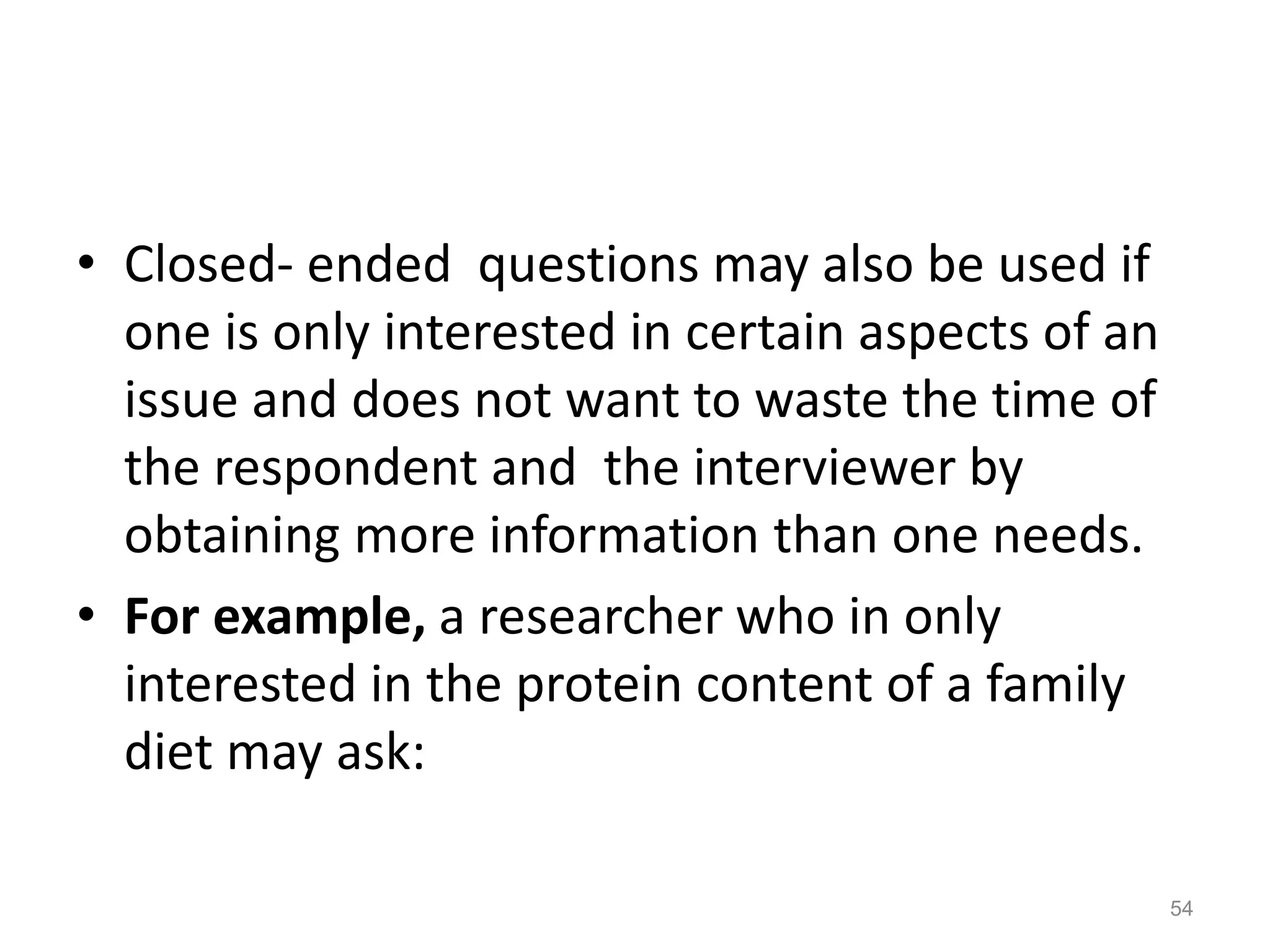
• Closed- ended questions may also be used if
one is only interested in certain aspects of an
issue and does not want to waste the time of
the respondent and the interviewer by
obtaining more information than one needs.
• For example, a researcher who in only
interested in the protein content of a family
diet may ask:
54
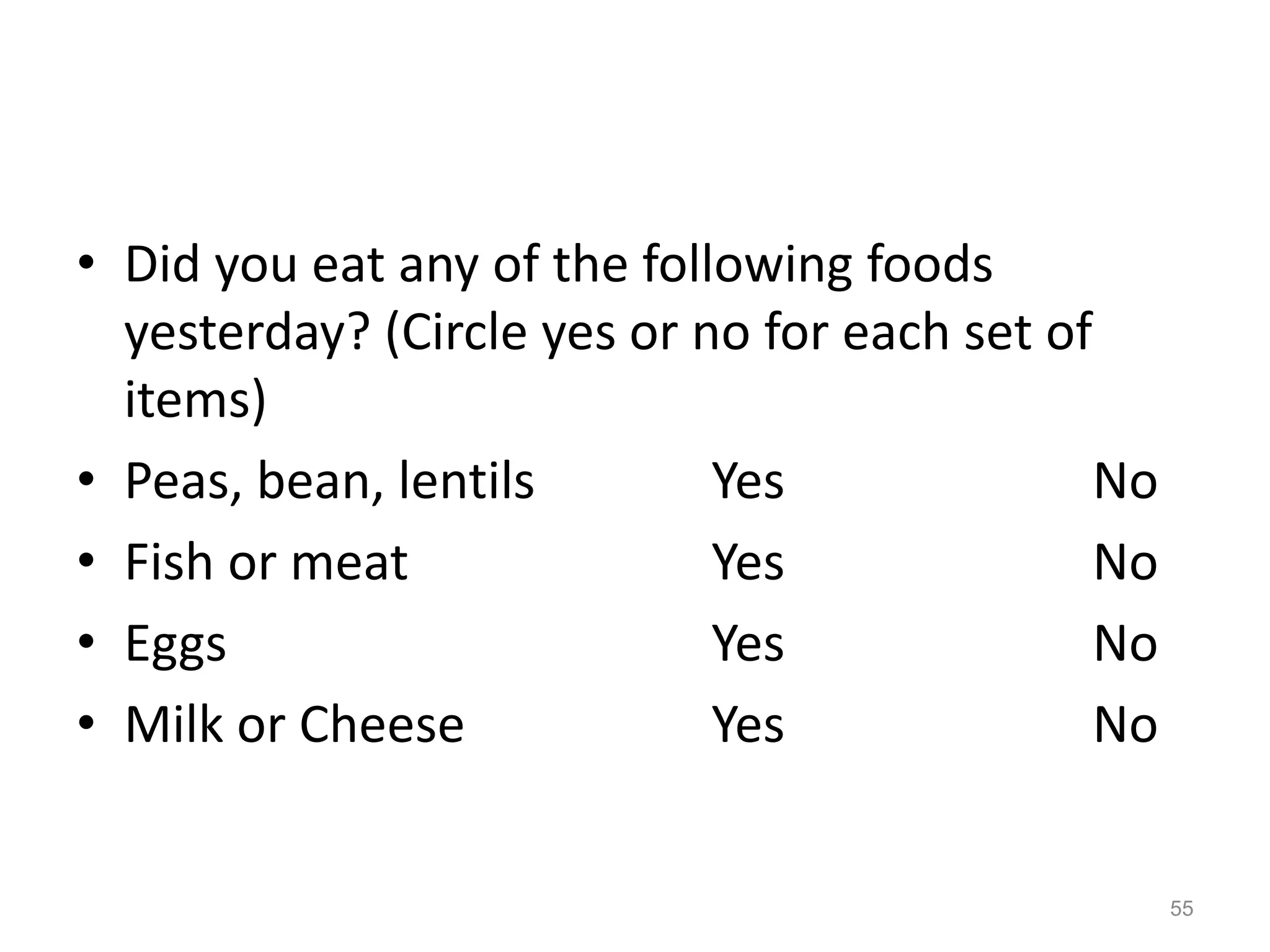
• Did you eat any of the following foods
yesterday? (Circle yes or no for each set of
items)
• Peas, bean, lentils Yes No
• Fish or meat Yes No
• Eggs Yes No
• Milk or Cheese Yes No
55
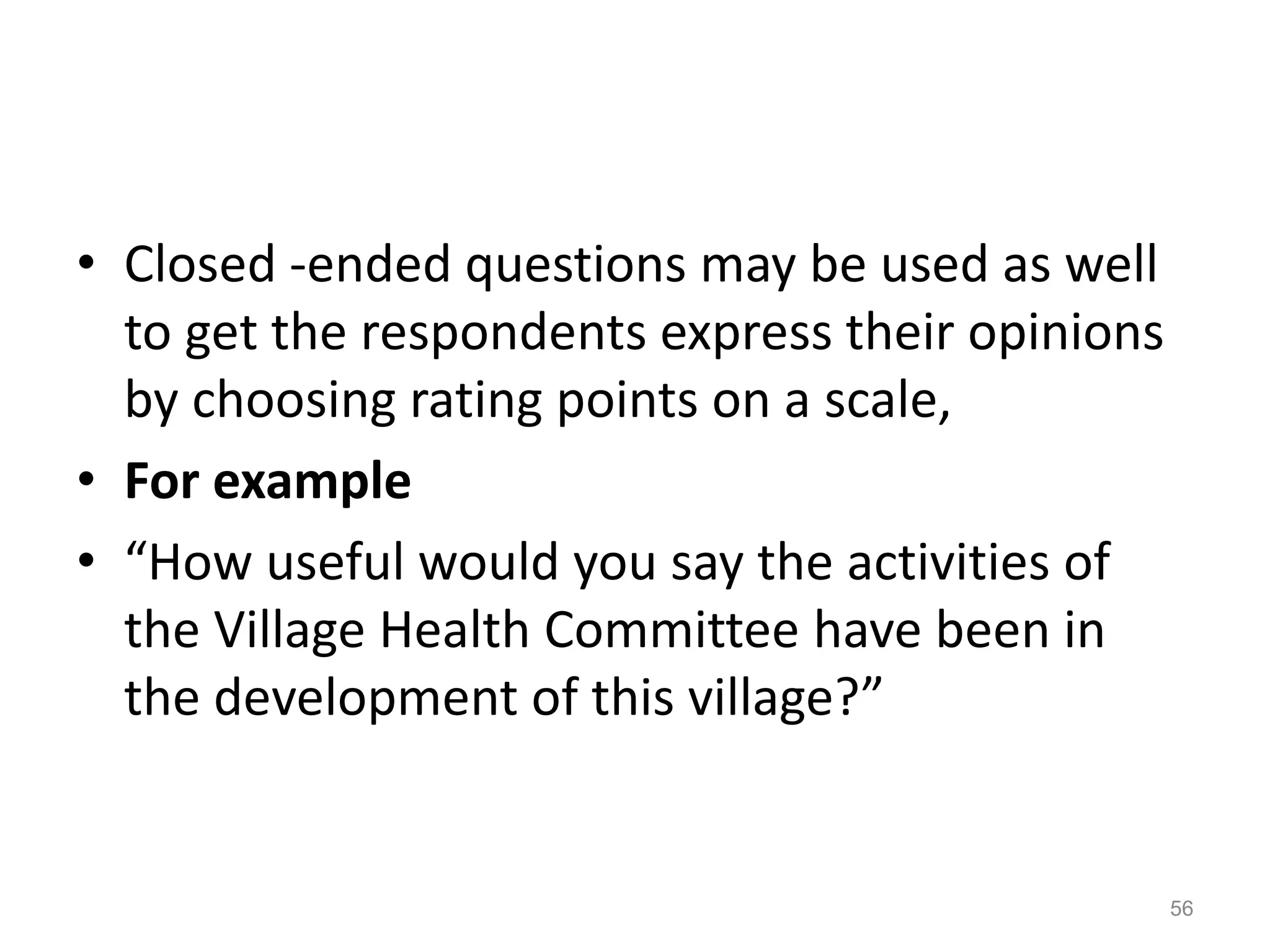
• Closed -ended questions may be used as well
to get the respondents express their opinions
by choosing rating points on a scale,
• For example
• “How useful would you say the activities of
the Village Health Committee have been in
the development of this village?”
56
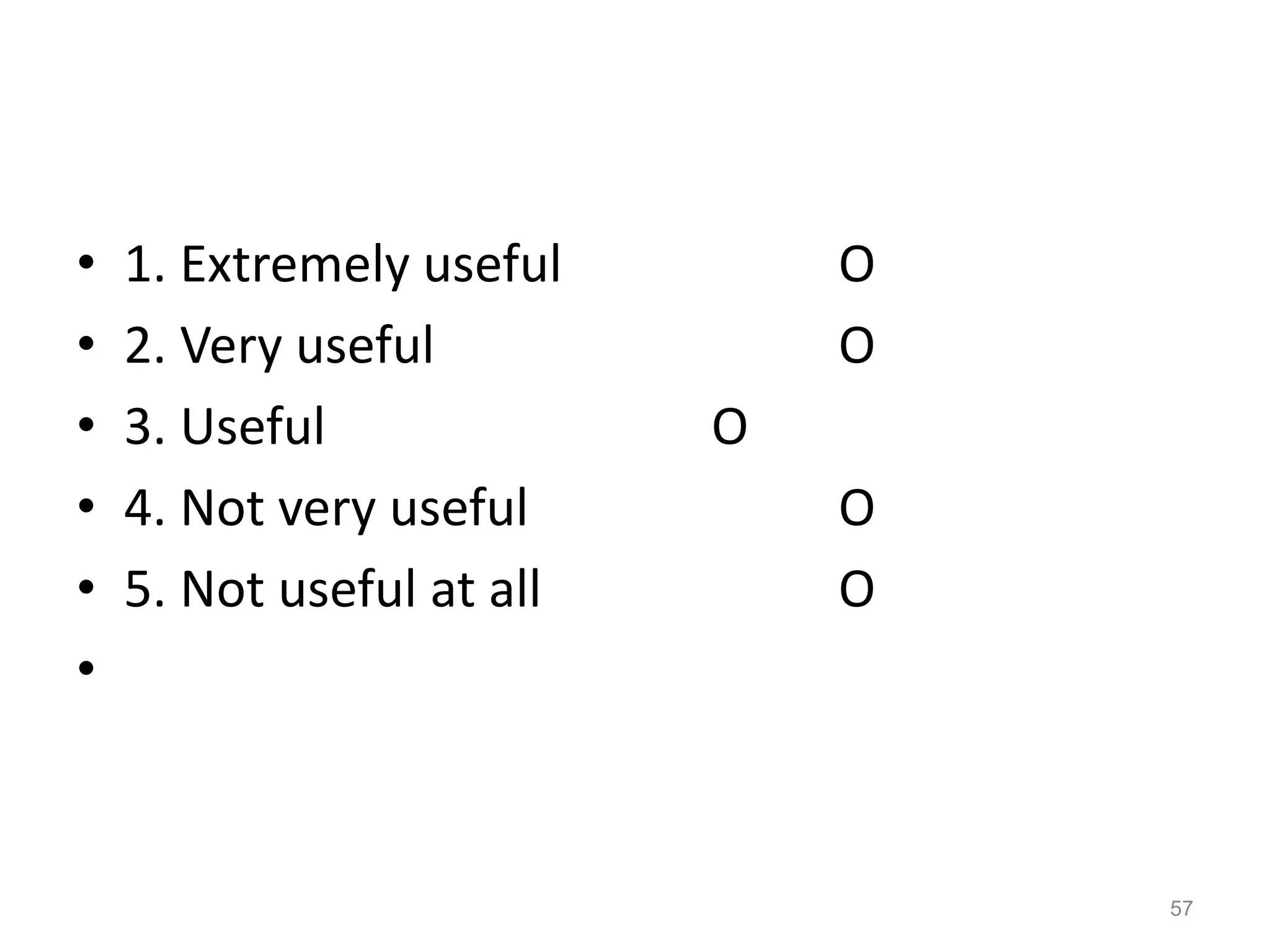
• 1. Extremely useful O
• 2. Very useful O
• 3. Useful O
• 4. Not very useful O
• 5. Not useful at all O
•
57
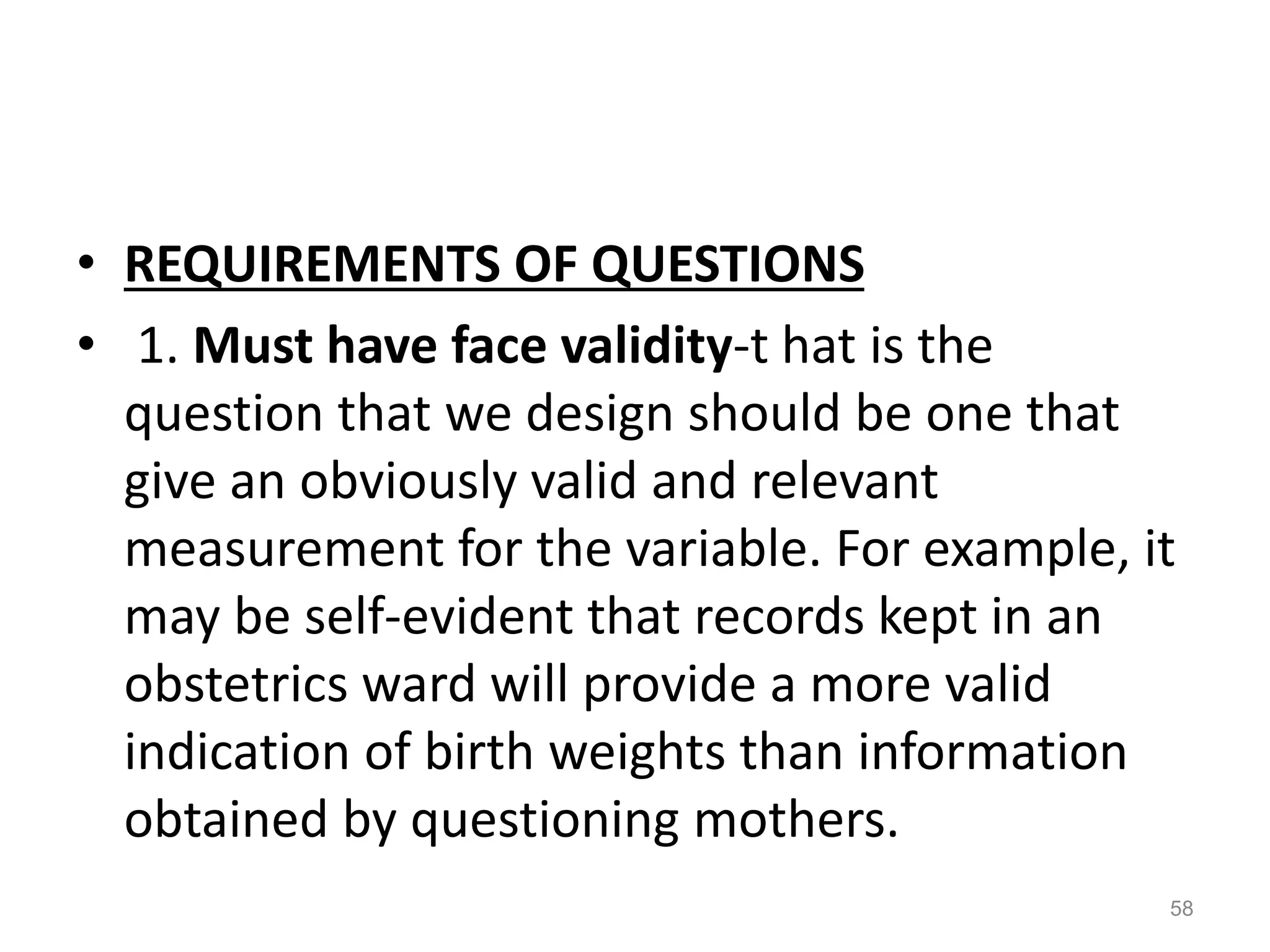
• REQUIREMENTS OF QUESTIONS
• 1. Must have face validity-t hat is the
question that we design should be one that
give an obviously valid and relevant
measurement for the variable. For example, it
may be self-evident that records kept in an
obstetrics ward will provide a more valid
indication of birth weights than information
obtained by questioning mothers.
58
• . Respondents can be expected to know the
answer
• Must be clear and unambiguous-the way in
which questions are worded can ‘make or
break a questionnaire. Questions must be
clear and unambiguous. They must be
phrased in language that it is believed the
respondent will understand, and that all
respondents will understand in the same way.
59
• To ensure clarity, each question should
contain only one idea; ‘double-barreled’
questions like ‘Do you take your child to a
doctor when he has a cold or has diarrhea?
Are difficult to answer, and the answers are
difficult to interpret
60
• Must not be offensive-whenever possible it is
wise to avoid questions that may offend the
respondent, for example those that deal with
intimate matters, those which may seem to
expose the respondent’s ignorance and those
requiring him to give a socially unacceptable
answer.
61
• The questions should be fair. They should not
be phrased in away that suggests a specific
answer, and should not be loaded. Short
questions are generally regarded as preferable
to long ones.
62
• Sensitive questions must be minimized asked
on last- it may not be possible to avoid asking
‘sensitive questions that may offend
respondents, e.g. those that seem to expose
the respondent’s ignorance. In such situations
the interviewer (questioner) should do it very
carefully and wisely and must be asked on the
last
63
• STEPS IN DESIGNING A QUESTIONNAIRE
• Designing a good questionnaire always takes
several drafts, in the first draft we should
concentrate on the content. In the second, we
should look critically at the formulation and
sequencing of the questions. Then we should
scrutinize the format of the questionnaire.
64
• Finally, we should do a test-run to check
whether the questionnaire gives us the
information we require and whether both the
respondents and we feel at ease with it.
Usually the questionnaire will need some
further adaptation before we can use it for
actual data collection.
65
• Step1: Content
• Take your objectives and variables as your
starting point.
• Decide what questions will be needed to
measure or to define your variables and reach
your objectives. When developing the
questionnaire, you should reconsider the
variables you have chosen, and, if necessary,
add, drop or change some. You may even
change some of your objectives at this stage. 66
• Step2: Formulating Questions
• Formulate one or more questions that will
provide the information needed for each
variable.
67
• Take care that questions are specific and
precise enough that different respondents do
not interpret them differently. For example, a
question such as: “Where do community
members usually seek treatment when they
are sick?” cannot be asked in such a general
way because each respondent may have
something different in mind when answering
the question
68
• One informant may think of measles with
complications and say he goes to the hospital,
another of cough and say goes to the private
pharmacy:
• Even if both think of the same disease, they
may have different degrees of seriousness in
mind and thus answer differently:
• In all cases, self-care may be overlooked
69
• The question, therefore, as rule has to be
broken up into different parts and made so
specific that all informants focus on the same
thing. For example, one could.
• Concentrate on illness that has occurred in the
family over the past 14 days and ask what has
been done to treat if from the onset, or
70
• Concentrate on a number of diseases, ask
whether they have occurred in the family over
the past X months (chronic or serious diseases
have a longer recall period than minor
ailments) and what has been done to treat
each of them from the onset.
71
• Check whether each question measures one
thing at a time:
• For example, the question, “How large an
interval would you and your husband prefer
between two successive births? Would better
be divided into two questions because
husband and wife may have different opinions
on the preferred interval
•
72
• Avoid leading questions.
• A question is leading if it suggests a certain
answer. For example, the question, “Do you
agree that the district health team should visit
each health center monthly? Hardly leaves
room for “no” or for other options Better
would be: “Do you thing that district health
teams should visit each health center? If yes,
how often?
73
• Sometimes a question is leading because it
presupposes a certain condition. For example:
“What action did you take when your child
had diarrhea the last time?” presupposes the
child has had diarrhea. A better set of
questions would be: “Has your child had
diarrhea” if yes when was the last time? “Did
you do anything to treat it? If yes, what?
74
• Step3: SEQUENCING OF QUESTIONS
• Design your interview schedule or
questionnaire to be “consumer friendly.”
•
• The sequence of questions must be logical for
the respondent and allow as much as possible
for a “natural” discussion even in more
structured interviews.
75
• At the beginning of the interview, keep
questions concerning “background variables”
(e.g. age, religion, education, marital status, or
occupation) to a minimum. If possible, pose
most or all of these questions later in the
interview. (Respondents may be reluctant to
provide “personal” information early in an
interview and, if they become worried about
confidentiality, be wary about giving their true
opinions.) 76
• Start with an interesting but non-controversial
question (preferably open) that is directly
related to the subject of the study. This type
of beginning should help to raise the
informants’ interest and lessen suspicions
concerning the purpose of the interview (e.g.
that it will be used to provide information to
use in levying taxes).
77
• Pose more sensitive questions as late as
possible in the interview (e.g. questions
pertaining to income, sexual behavior, or
diseases with stigma attached to them. Etc.
• Make the questionnaire as short as possible.
Conduct the interview in two parts if the
nature of the topic requires a long
questionnaire (more than 1 hour).
78
• Step4: Formatting the questionnaire
• When you finalize your questionnaire, be
sure that
•
• Each questionnaire has a heading and space to
insert the number, data and location of the
interview, and, if required the name of the
informant. You may add the name of the
interviewer to facilitate quality control.
79
• Layout is such that questions belonging
together appear together visually. If the
questionnaire is long, you may use
subheadings for groups of questions
• Sufficient space is provided for answers to
open-ended questions.
• Boxes for per-categorized answers are placed
in a consistent manner half of the page
80
• Your questionnaire should not only be
consumer but also user friendly!
• Step5: Translation
• If interview will be conducted in one or more
local languages, the questionnaire has to be
translated to standardize the way questions
will be asked.
81
• After having it translated you should have it
retranslated into the original language. You
can then compare the two versions for
differences and make a decision concerning
the final phrasing of difficult concepts.
82

biostatistics for eving degree N&M recentstudent2.ppt

  • 1.
    Method of datacollection LEARNING OBJECTIVES • At the end of this chapter, the students will be able to: • Identify the different methods of data collection • understand the criterion for selection a method to collect data 1
  • 2.
    • Identify thedifferent methods of data collection and • criterion that we use to selection a method of data collection. • Define a questionnaire, identify the different parts of a questionnaire • and indicate the procedures to prepare a questionnaire 2
  • 3.
    INTRODUCTION • Before anystatistical work can be done • data must be collected depending on the type of variable and • the objective of the study, • different data collection methods can be employed. 3
  • 4.
    • Review ofData Collection Methods • During the planning phase of the study it necessary to decide upon the method to be used for collecting information concerning each of the variables listed for investigation. 4
  • 5.
    • Observation: i.e.the use of techniques varying from simple visual observation to those requiring specific skills. • Interview and self- administered questionnaire • The use of documentary sources • clinical records and • other personal records such as death certificates, published statistics, and census publications. 5
  • 6.
    • Data andinformation collection • Once it is clearly what information we need (the key indicators) • it is then necessary to consider how this might be obtained. • The following questions must be asked and answered 6
  • 7.
    • How tocollect the information • What source is most appropriate • Who should do it • When and how often the information should be collected analyzed and reported. • What format are required to recorded the data being collected 7
  • 8.
    • When developinganswers to these questions, one of the main issues to keep in mind • in the resources capacity constraint that well be faced by those responsible for collecting the information. There is no point in designing procedures which are too complex or • costly as this will merely lead to frustration and disappointment in the out comes. 8
  • 9.
    • A balancemust therefore be struck between what would be desirable in an ideal world what is feasible in practice. • It is also vital to be clear about how the data will be analyzed and used before embracing data collection. 9
  • 10.
    • DATA COLLECTIONMETHODS • Data collection techniques allow us to systematically collect data about our objects of study (people, objects, and phenomena) and about the setting in which they occur. • In the collection of data we have to be systematic. If data are collected haphazardly, it will be difficult to answer our research questions in a conclusive way. 10
  • 11.
    • Using availableinformation • Focus group discussions (FGD) • Other data collection techniques- • Rapide apparisal techniques, • 3L technique, Nominai group techniques, Delphi techniques, • life histories, case studies, etc. 11
  • 12.
    • Various datacollection techniques can be used to collect data such as: • Observation • Face – to face and self – administered interviews • Postal or mail method and telephone interviews 12
  • 13.
    • OBSERVATION- Observationis a technique that involves systematically selecting, Watching and recoding behaviors of people • or other phenomena and aspects of the setting in which they occur, for the purpose of (getting) specified information. 13
  • 14.
    • It includesall methods from simple visual observations to the use of high level machines and measurements, sophisticated equipment or facilities, such as radiographic, biochemical analysis, x-ray machines, microscope, clinical examinations and microbiological examinations. 14
  • 15.
    : • Advantages: Givesrelatively more accurate data on behavior and activities • Disadvantages: Investigators or observer’s own biases, prejudice, desires, etc. • - Needs more resources and skilled human power during the use of high level machines. 15
  • 16.
    INTERVIEWS AND SELF-ADMINISTERED QUESTIONNAIRE •Interviews and self- administrated questionnaires are probably the most commonly used research data collection techniques. • Therefore, commonly used research data collection techniques. Therefore designing good “questioning tools” forms an important and time consuming phase in the development of most research proposals. 16
  • 17.
    • Once thedecision has been made to use these techniques, the following questions should be considered before designing our tools. 1. What exactly do we want to know, according to the objectives and variables we identified earlier? 2 Is questioning the right technique to obtain all answer, or do we need additional techniques, such as observations or analysis of records? 17
  • 18.
    Cont…… 3. Of whomwill we ask questions and what techniques wile we use? 4. Do we understand the topic sufficiently to design a questionnaire, or do we need some loosely structured interviews with key informants or a FGD first to orient ourselves? 5. Are our informants mainly literate or illiterate? If illiterate, the use self administrated questionnaires is not an option. 18
  • 19.
    Cont…… • 6. Howlarge is the sample that will be interviewed? Studies with many respondents often use shorter, highly structured questionnaires where as smaller study allow more flexibility and may use questionnaires with a number of open-ended questions. 19
  • 20.
    Cont…… • Once thedecision has been made interviews may be less or more structured. Unstructured interview is flexible, the content wording an order of the questions vary from interview to interview. The investigator only have idea of what he/she wants to learn but does not decide in advance exactly what questions will be asked, or in what order. 20
  • 21.
    Cont…… • -In othersituation, a more standardized technique may be used. The wording and order questions being decided in advance. This may take the form of a highly structured interview, in which the questions are asked orderly, or a self administered questionnaire. In which case the respondent reads the questions and fill in the answer by himself (sometimes in the presence of an interviewer who stands by’ to give assistance if necessary). 21
  • 22.
    Cont…… • -Standardized methodsof asking questions are usually preferred in community medicine research, since they provide more assurance that the data will be reproducible. • Less structured interviews may be useful in a preliminary survey, where the purpose is to obtain information to help in the subsequent planning of a study rather than factors for analysis, and in intensive studies of perceptions, attitudes, motivation and affective reaction. 22
  • 23.
    Cont…… • -unstructured interviewsare characteristic of qualitative (non-quantitative) research. • -The uses of self- administered questionnaires is simpler and cheaper, such questionnaires can be administered to many persons simultaneously (e.g. to a class of students). And unlike interviews, can be sent by post. On the other hand, they demand a certain level of education and skill on the part of the respondents; people of a low socio-economic status are less likely to respond to a mailed questionnaire. 23
  • 24.
    Cont…… • -Interviewing usingquestionnaire, the investigator appoints agents known as enumerators, who go to the respondents personally with the questionnaire, ask them the questions given there in, and record their replies. They can be either face – to – face or telephone interviews. 24
  • 25.
    Cont…… • Face-to-face andtelephone interviews: Have many advantages. • A good interviewer can stimulate and maintain the respondent’s interest. • And can create a rapport (understanding, concord) and atmosphere conductive to the answering of questions • If anxiety aroused, the interviewer can allay it. 25
  • 26.
    • If aquestion is not understood and interviewer can repeat it and if necessary (and in accordance the guidelines decided in advance) provide an explanation or alternative wording. • Optional follow-up or providing questions that is to be asked only if prior responses are inconclusive or inconsistent which cannot easily be built into self-administered questionnaires. • In face-to-face interviews, observations can be made as well. 26
  • 27.
    • In general,apart from their expenses, interviews are preferable than self- administered questionnaire, with the important proviso that are conducted by skilled interviewers. 27
  • 28.
    • Mailed questionnairemethod: Under this method, the investigator prepares a questionnaire containing a number of questions pertaining the filed of inquire. The questionnaires are sent by post to the informants together with a polite conversing letter explaining the detail, the aims and objectives of collecting the information, and requesting the respondents to cooperate by furnishing the correct replies and returning the questionnaire duly filled in. 28
  • 29.
    • In orderto ensure quick response, the return postage expenses are usually borne by the investigator. • The main problems with postal questionnaire are that response rates tend to be relatively low, and that there may be under representation of less literate subjects. 29
  • 30.
    • . USEOF DOCUMENTARY SOURCES: Is the use of clinical and other personal records, death certificates, published mortality statistics, census publications, etc. Examples include: • Official publications of central statistical Authority • publication of ministry of Health and other ministries • News paper and Journals. • Internal publications like publication by WHO. World Bank, UNCEF • Records of hospitals of or any Health institutions 30
  • 31.
    • During theuse of data from document’s though they are less time consuming and relatively has low cost, care should be taken on the quality and completeness of the data this may be due to differences in objectives between the primary author of the data and the user. • Usually there is a large body of data already collected by others, although it may not necessarily have been analyzed or published. 31
  • 32.
    Cont…… • For example,analysis of the information routinely collected by health facilities can be very useful for identifying problems in certain interventions or flow of drug supply, or for identifying increases in the incidence of certain deceases. Sometimes the factors contribute to the problem may also be identified from the same source. 32
  • 33.
    Cont…… • Analysis ofhealth information system data; census data, unpublished reports and publications in archives and libraries or in offices at the various levels of health and health related services might be a study itself. • To retrieve data from available sources, the recording view have to design an instrument such as a cheekiest or compilation sheet and during designing such instruments it is important to inspect the layout (order) of the source documents from which data are to be extracted. This will save time and reduce error. 33
  • 34.
    • Advantage:- Ingeneral inexpensive and permits examination of post trends. • Disadvantage • Sometimes difficult to gain access to records • Information may not always be complete and precise enough. • They sometimes are out of data, census data. • There may be difference in the definition and method of recording the data form one health facility to another. • Records may have been selectively deposited. • Ethical issues concerning may arise 34
  • 35.
    • PROBLEMS INGATHERING DATA • It is important to recognize some of the main problems that may be faced when data collected, so that they can be addressed in the selection of appropriate collection method and in the training of the staff involved. • Common problems might include: • Language barriers • Lack of adequate time • Expense 35
  • 36.
    • Inadequately trainedand experienced staff • Invasion of privacy • Suspicion • Bias (Spatial, project, person, season, diplomatic, professional) • Cultural morals/norms (e.g. which may preclude men interviewing women). 36
  • 37.
    Cont…… – CHOOSING AMETHOD OF DATA COLLECITON • Decision- makers need information that is relevant, timely, accurate and usable. The cost of obtaining, processing and analyzing these data is high. The challenges are to find ways, which lead to information that is cost- effective, relevant, timely and important for immediate use. Some methods pay attention to timeliness and reduction in cost. Others pay attention to accuracy and the strength of the method in using scientific approaches 37
  • 38.
    Cont…… • The statisticaldata may be classified under two categories, depending upon the sources. • 1) Primary data • 2) Secondary data 38
  • 39.
    Cont…… • Primary data:-are those data, which are collected by the investigator himself for the purpose of a specific inquiry or study. Such data are original in character and are mostly generated by surveys conducted by individuals or research institutions. 39
  • 40.
    • -The firsthand information obtained by the investigator is more reliable and accurate since the investigator can extract the correct information by removing doubts, If any in the minds of the respondents regarding Certain questions. • -High response rates might be obtained since the answers to various questions are obtained on the spot. • - It permits explanation of questions concerning difficult subject matter. 40
  • 41.
    • Secondary data:-when an investigator uses data, which have already been collected by others, such data are called “ Secondary data”. Such data are primary data for the agency that collected them, and become secondary for someone else who uses these data fro his own purpose. • The secondary data can be obtained from journals, reports, government publications, publications of professionals and research organizations. 41
  • 42.
    • Secondary dataare less expensive to collect both in money and time. • These data can also be batter utilized and sometimes the quality of such data may be better because these might have been collected by persons who were special trained for the purpose. • 42
  • 43.
    • On theother hand, such data must be used with great care, because such data may also be full of errors due to the fact that the purpose of the collection of the data by the primary agency may have been different from the purpose of the user of these secondary data. Secondly, there may have been bias introduced, the size of the sample may have been inadequate, or there may have been arithmetic or definition errors, hence, it is necessary to critically investigate the validity of the Secondary data. 43
  • 44.
    • In general,the choice of methods of data collection is largely based on the accuracy of the information they yield. In this context, accuracy refers not only to correspondence between the information and objective reality – although this certainly enters into the concept-but also to the information’s relevance. This issue is the extent to which the method will provide a precise measure of the variable the investigator wishes to study. 44
  • 45.
    • The selectionof the method of data collection so also based on practical consideration, such as: • The need for personnel, skills, equipment, etc. in relation to what is available and the urgency which results are needed. • The acceptability of the procedures to the subjects- the absence of 45
  • 46.
    • The probabilitythat the method will provide a good coverage i.e. will supply the required information about all or almost all members of the population or sample. If many people will not know the answer to the question, the question is not an appropriate one. • 4.The investigator’s familiarity with a study procedure may be a valid consideration. It comes as no particular surprise to discover that a scientist formulates problems in a way which requires for their solution just those techniques in which he himself is specially skilled. 46
  • 47.
    – TYPES OFQUESTIONS • Before examining the steps in designing a questionnaire, we need to review the types of questions used in questionnaires. • Depending on how questions are asked and recorded we can distinguish two major possibilities-Open-ended questions, and closed ended question 47
  • 48.
    • Open-ended questions •Open-ended questions permit free responses that should be recorded in the respondent’s own words. The respondent is not given any possible answer to choose from. • 48
  • 49.
    • Such questionsare useful to obtain information on. • Facts with which the researcher is not very familiar. • Opinions, attitudes, and suggestions of informants, or • Sensitive issues. 49
  • 50.
    • For example •Can you describe exactly what the traditional birth attendant did when your labor started?” • “What do you think are the reasons for a high drop-out rate of village health committee members? • “What would you do if you noticed that your daughter (School girl) had a relationship with a teacher?” 50
  • 51.
    • Closed -endedquestions • Closed -ended questions offer a list of possible options or answer form which the respondent must choose. • When designing closed-ended questions one should try to: • 1. Offer a list of options that are exhaustive and mutually exclusive. And • 2. Keep the number of options as few as possible. 51
  • 52.
    • Closed -endedquestions are useful if the range of possible responses is know • “What is your marital status? • single O • Married/ living together O • Separated/divorced/widowed O 52
  • 53.
    • “Have yourevery gone to the local village health worker for treatment? • YesO • No O 53
  • 54.
    • Closed- endedquestions may also be used if one is only interested in certain aspects of an issue and does not want to waste the time of the respondent and the interviewer by obtaining more information than one needs. • For example, a researcher who in only interested in the protein content of a family diet may ask: 54
  • 55.
    • Did youeat any of the following foods yesterday? (Circle yes or no for each set of items) • Peas, bean, lentils Yes No • Fish or meat Yes No • Eggs Yes No • Milk or Cheese Yes No 55
  • 56.
    • Closed -endedquestions may be used as well to get the respondents express their opinions by choosing rating points on a scale, • For example • “How useful would you say the activities of the Village Health Committee have been in the development of this village?” 56
  • 57.
    • 1. Extremelyuseful O • 2. Very useful O • 3. Useful O • 4. Not very useful O • 5. Not useful at all O • 57
  • 58.
    • REQUIREMENTS OFQUESTIONS • 1. Must have face validity-t hat is the question that we design should be one that give an obviously valid and relevant measurement for the variable. For example, it may be self-evident that records kept in an obstetrics ward will provide a more valid indication of birth weights than information obtained by questioning mothers. 58
  • 59.
    • . Respondentscan be expected to know the answer • Must be clear and unambiguous-the way in which questions are worded can ‘make or break a questionnaire. Questions must be clear and unambiguous. They must be phrased in language that it is believed the respondent will understand, and that all respondents will understand in the same way. 59
  • 60.
    • To ensureclarity, each question should contain only one idea; ‘double-barreled’ questions like ‘Do you take your child to a doctor when he has a cold or has diarrhea? Are difficult to answer, and the answers are difficult to interpret 60
  • 61.
    • Must notbe offensive-whenever possible it is wise to avoid questions that may offend the respondent, for example those that deal with intimate matters, those which may seem to expose the respondent’s ignorance and those requiring him to give a socially unacceptable answer. 61
  • 62.
    • The questionsshould be fair. They should not be phrased in away that suggests a specific answer, and should not be loaded. Short questions are generally regarded as preferable to long ones. 62
  • 63.
    • Sensitive questionsmust be minimized asked on last- it may not be possible to avoid asking ‘sensitive questions that may offend respondents, e.g. those that seem to expose the respondent’s ignorance. In such situations the interviewer (questioner) should do it very carefully and wisely and must be asked on the last 63
  • 64.
    • STEPS INDESIGNING A QUESTIONNAIRE • Designing a good questionnaire always takes several drafts, in the first draft we should concentrate on the content. In the second, we should look critically at the formulation and sequencing of the questions. Then we should scrutinize the format of the questionnaire. 64
  • 65.
    • Finally, weshould do a test-run to check whether the questionnaire gives us the information we require and whether both the respondents and we feel at ease with it. Usually the questionnaire will need some further adaptation before we can use it for actual data collection. 65
  • 66.
    • Step1: Content •Take your objectives and variables as your starting point. • Decide what questions will be needed to measure or to define your variables and reach your objectives. When developing the questionnaire, you should reconsider the variables you have chosen, and, if necessary, add, drop or change some. You may even change some of your objectives at this stage. 66
  • 67.
    • Step2: FormulatingQuestions • Formulate one or more questions that will provide the information needed for each variable. 67
  • 68.
    • Take carethat questions are specific and precise enough that different respondents do not interpret them differently. For example, a question such as: “Where do community members usually seek treatment when they are sick?” cannot be asked in such a general way because each respondent may have something different in mind when answering the question 68
  • 69.
    • One informantmay think of measles with complications and say he goes to the hospital, another of cough and say goes to the private pharmacy: • Even if both think of the same disease, they may have different degrees of seriousness in mind and thus answer differently: • In all cases, self-care may be overlooked 69
  • 70.
    • The question,therefore, as rule has to be broken up into different parts and made so specific that all informants focus on the same thing. For example, one could. • Concentrate on illness that has occurred in the family over the past 14 days and ask what has been done to treat if from the onset, or 70
  • 71.
    • Concentrate ona number of diseases, ask whether they have occurred in the family over the past X months (chronic or serious diseases have a longer recall period than minor ailments) and what has been done to treat each of them from the onset. 71
  • 72.
    • Check whethereach question measures one thing at a time: • For example, the question, “How large an interval would you and your husband prefer between two successive births? Would better be divided into two questions because husband and wife may have different opinions on the preferred interval • 72
  • 73.
    • Avoid leadingquestions. • A question is leading if it suggests a certain answer. For example, the question, “Do you agree that the district health team should visit each health center monthly? Hardly leaves room for “no” or for other options Better would be: “Do you thing that district health teams should visit each health center? If yes, how often? 73
  • 74.
    • Sometimes aquestion is leading because it presupposes a certain condition. For example: “What action did you take when your child had diarrhea the last time?” presupposes the child has had diarrhea. A better set of questions would be: “Has your child had diarrhea” if yes when was the last time? “Did you do anything to treat it? If yes, what? 74
  • 75.
    • Step3: SEQUENCINGOF QUESTIONS • Design your interview schedule or questionnaire to be “consumer friendly.” • • The sequence of questions must be logical for the respondent and allow as much as possible for a “natural” discussion even in more structured interviews. 75
  • 76.
    • At thebeginning of the interview, keep questions concerning “background variables” (e.g. age, religion, education, marital status, or occupation) to a minimum. If possible, pose most or all of these questions later in the interview. (Respondents may be reluctant to provide “personal” information early in an interview and, if they become worried about confidentiality, be wary about giving their true opinions.) 76
  • 77.
    • Start withan interesting but non-controversial question (preferably open) that is directly related to the subject of the study. This type of beginning should help to raise the informants’ interest and lessen suspicions concerning the purpose of the interview (e.g. that it will be used to provide information to use in levying taxes). 77
  • 78.
    • Pose moresensitive questions as late as possible in the interview (e.g. questions pertaining to income, sexual behavior, or diseases with stigma attached to them. Etc. • Make the questionnaire as short as possible. Conduct the interview in two parts if the nature of the topic requires a long questionnaire (more than 1 hour). 78
  • 79.
    • Step4: Formattingthe questionnaire • When you finalize your questionnaire, be sure that • • Each questionnaire has a heading and space to insert the number, data and location of the interview, and, if required the name of the informant. You may add the name of the interviewer to facilitate quality control. 79
  • 80.
    • Layout issuch that questions belonging together appear together visually. If the questionnaire is long, you may use subheadings for groups of questions • Sufficient space is provided for answers to open-ended questions. • Boxes for per-categorized answers are placed in a consistent manner half of the page 80
  • 81.
    • Your questionnaireshould not only be consumer but also user friendly! • Step5: Translation • If interview will be conducted in one or more local languages, the questionnaire has to be translated to standardize the way questions will be asked. 81
  • 82.
    • After havingit translated you should have it retranslated into the original language. You can then compare the two versions for differences and make a decision concerning the final phrasing of difficult concepts. 82