5. DATA COLLECTION
III B.Com Computer Application & Finance
Prepared By:
Ms. Leena K P
Don Bosco College, Mannuthy
 Reliability of managerial decisions  Quality of data [Ex: GIGO]
 Data are facts, figures and other relevant materials, past and present
serving as basis for study and analysis
 Importance:
- Base, Inferences, Findings, Testing hypothesis, Construction – scale, tables
 Classifications:
I. Primary & Secondary
II. Documentary Sources, Personal sources & Library Source
 Choice  factors
- Nature & scope, Money, Time, Accuracy, Status & Availability of
investigator/researcher
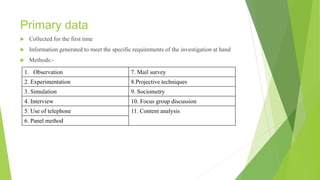
Primary data
 Collected for the first time
 Information generated to meet the specific requirements of the investigation at hand
 Methods:-
1. Observation 7. Mail survey
2. Experimentation 8.Projective techniques
3. Simulation 9. Sociometry
4. Interview 10. Focus group discussion
5. Use of telephone 11. Content analysis
6. Panel method
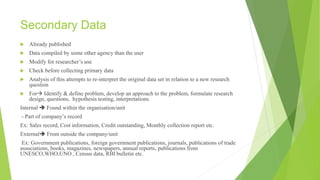
Secondary Data
 Already published
 Data compiled by some other agency than the user
 Modify for researcher’s use
 Check before collecting primary data
 Analysis of this attempts to re-interpret the original data set in relation to a new research
question
 For Identify & define problem, develop an approach to the problem, formulate research
design, questions, hypothesis testing, interpretations
Internal  Found within the organisation/unit
- Part of company’s record
Ex: Sales record, Cost information, Credit outstanding, Monthly collection report etc.
External From outside the company/unit
Ex: Government publications, foreign government publications, journals, publications of trade
associations, books, magazines, newspapers, annual reports, publications from
UNESCO,WHO,UNO , Census data, RBI bulletin etc.
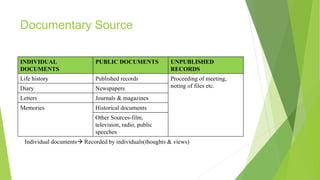
Documentary Source
INDIVIDUAL
DOCUMENTS
PUBLIC DOCUMENTS UNPUBLISHED
RECORDS
Life history Published records Proceeding of meeting,
noting of files etc.
Diary Newspapers
Letters Journals & magazines
Memories Historical documents
Other Sources-film,
television, radio, public
speeches
Individual documents Recorded by individuals(thoughts & views)
Precautions
Minute scrutiny of available data
 Reliability  Who? Where? Methods? Time? Any bias? Accuracy etc.
 Suitability  Terms? Units? Object, scope, nature enquiry
 Adequacy  Level of accuracy
Collection of Primary Data
Quantitative Relatively large no. of responses, Range of possible
answers is known
Qualitative  In-depth information, Range of possible answers is unknown
Factors - Choice of Methods
 Nature  Individual Interview/mailing
Experimentation  Impact study
Behavioural pattern  Observation
 Unit of enquiry  Individual/ Household  Interview
Institutions  mail survey
Communities  Observation
 Size of sample  Small/ solid area  interview
Large/ scattered  Mailing
 Scale of survey  Large scale  mailing or interview through trained investigators
 Respondent’s education  Mail survey / interview
 Type & intensity of information  Factual & non-emotional  Interview / Mailing
In depth survey  Depth interview
Life style, culture, custom  Observation
 Availability of skilled personnel
 Accuracy  Interview
Observation
 “A systematic viewing of a specific phenomenon in its proper setting for the
purpose of gathering data for a particular study”
 Acquiring knowledge in social & physical science
 Features:-
1. Physical & mental activity
2. Selective
3. Purposive(formal?)
4. Grasps significant occurrences
5. Exact
Types of observation
1. Simple & Systematic
2. Subjective & Objective
3. Casual & scientific
4. Intra subjective & inter subjective
5. Factual & inferential
6. Direct & indirect
7. Obtrusive & unobtrusive
8. Disguised & undisguised
9. Participant & Non participant
10. Structured & unstructured
11. Controlled & Non controlled
 Components/Process Of Observation
 Sensation  Sense organs, physical attentiveness, keenness & personality of observer
 Attention  Concentration, Willpower, training, experience
 Perception  Helps mind to recognize facts by grouping & identifying sensations 
interpretation of sensory reports
 Objectives of observation
Collective behavior in complex social situation, Individual units whole & parts 
interrelation, details Indirect
 Success of observation
Problem formulation
Free mind
Vital facts
 Advantages & Disadvantages
Survey
 Method used for collecting primary data based on verbal or written
communication with a representative sample of individuals or
respondents from the target population
 Used for both descriptive and causal research
 Usually conducted by an interviewer  interacts with respondents
 Fact-finding study
 Phenomena cannot be observed directly – Questionnaire  Response
error/bias, Hesitant to reply, Interviewer error etc.
 Features & Objectives
Types of surveys
 Cross – sectional surveys - – No. of characteristics from sample
elements are collected and analysed, relationship found.# single point
of time
 Longitudinal Surveys - Event/occurrence is measured again and again
over a period of time, To observe continuity & change in response in
due course.
Trend Studies : Sample of same population; not same people. Long period
of time.
Cohort studies : Particular population studied more than once .Ex: 2018-21
Batch
Panel studies :
1. True Panel- Same panel, Same variables, Different time
2. Omni Bus – Same panel, Different variables, Different time
 Census Method:
- Whole population is studied
- Time, money & energy
- Universe is small – Good method
 Sample Method
- Small part/sample of universe is studied
 Sample survey, Fax survey, Internet survey, Mail
survey- Industrial & consumer, Media studies,
Multiple surveys & E-mail survey
 Merits & Demerits of survey
Methods of
Survey
Interview
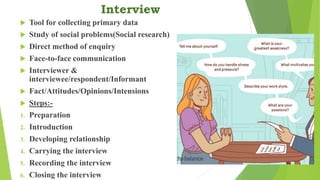
 Tool for collecting primary data
 Study of social problems(Social research)
 Direct method of enquiry
 Face-to-face communication
 Interviewer &
interviewee/respondent/Informant
 Fact/Attitudes/Opinions/Intensions
 Steps:-
1. Preparation
2. Introduction
3. Developing relationship
4. Carrying the interview
5. Recording the interview
6. Closing the interview
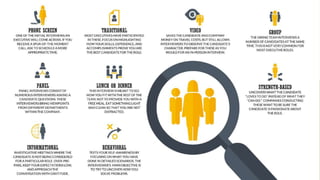
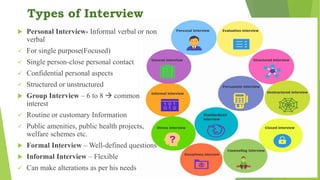
Types of Interview
 Personal Interview- Informal verbal or non
verbal
 For single purpose(Focused)
 Single person-close personal contact
 Confidential personal aspects
 Structured or unstructured
 Group Interview – 6 to 8  common
interest
 Routine or customary Information
 Public amenities, public health projects,
welfare schemes etc.
 Formal Interview – Well-defined questions
 Informal Interview – Flexible
 Can make alterations as per his needs
 Focused Interview = Focus experience & its effects
 Background of emotional & intellectual atmosphere of the
problem
 Freedom Manner & sequence
 Usually unstructured
 Non-directive or Unstructured Interview – No control &
direction
 No predetermined questions
 No standardized technique of recording information
 Catalyst experience & feelings
 Diagnostic Interview- Among patients
 Causes of problems
 Treatment Interview- To make patients aware about their
condition & changes to be made
 Research Interview- Predermined questions
 Specific problem  Information
 Mixed Interview – Specific type of information
 Telephone Interview – Contact through telephone , Less
expensive
 In-Depth Interview – Unstructured
 One –on-one
 Skilled Interviewer
 To discover underlying motives & desires
Questionnaire & Schedule
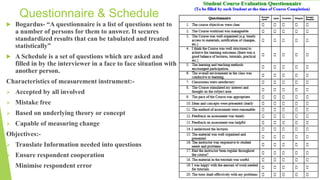
 Bogardus- “A questionnaire is a list of questions sent to
a number of persons for them to answer. It secures
standardized results that can be tabulated and treated
statistically”
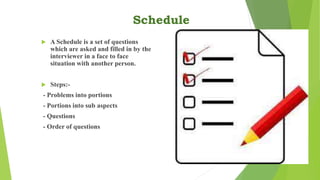
 A Schedule is a set of questions which are asked and
filled in by the interviewer in a face to face situation with
another person.
Characteristics of measurement instrument:-
 Accepted by all involved
 Mistake free
 Based on underlying theory or concept
 Capable of measuring change
Objectives:-
 Translate Information needed into questions
 Ensure respondent cooperation
 Minimise respondent error
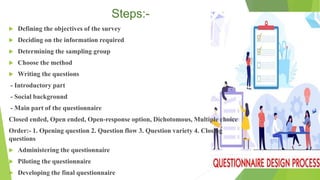
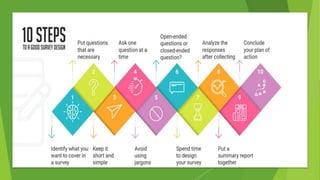
Steps:-
 Defining the objectives of the survey
 Deciding on the information required
 Determining the sampling group
 Choose the method
 Writing the questions
- Introductory part
- Social background
- Main part of the questionnaire
Closed ended, Open ended, Open-response option, Dichotomous, Multiple choice
Order:- 1. Opening question 2. Question flow 3. Question variety 4. Closing
questions
 Administering the questionnaire
 Piloting the questionnaire
 Developing the final questionnaire
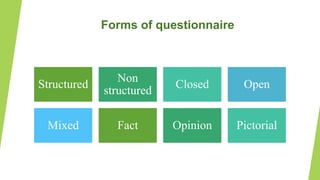
Forms of questionnaire
Structured
Non
structured
Closed Open
Mixed Fact Opinion Pictorial
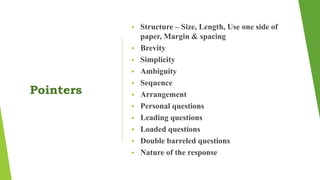
Pointers
 Structure – Size, Length, Use one side of
paper, Margin & spacing
 Brevity
 Simplicity
 Ambiguity
 Sequence
 Arrangement
 Personal questions
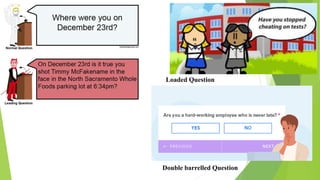
 Leading questions
 Loaded questions
 Double barreled questions
 Nature of the response
Loaded Question
Double barrelled Question
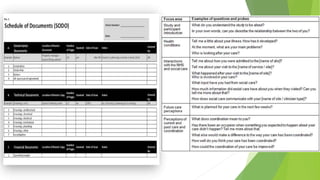
Schedule
 A Schedule is a set of questions
which are asked and filled in by the
interviewer in a face to face
situation with another person.
 Steps:-
- Problems into portions
- Portions into sub aspects
- Questions
- Order of questions
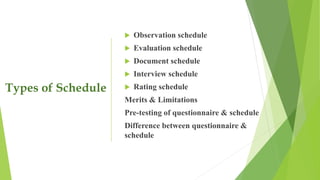
Types of Schedule
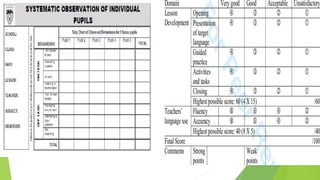
 Observation schedule
 Evaluation schedule
 Document schedule
 Interview schedule
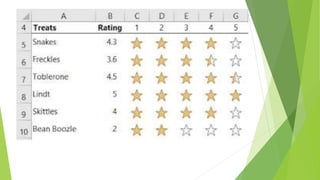
 Rating schedule
Merits & Limitations
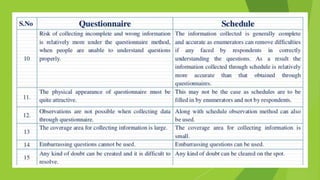
Pre-testing of questionnaire & schedule
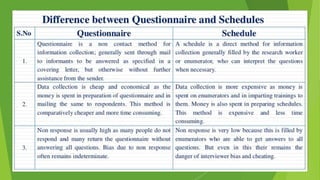
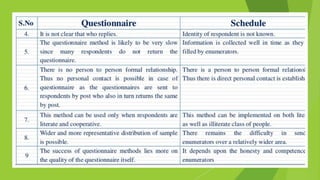
Difference between questionnaire &
schedule
 Reliability:
Internal consistency
Test-retest reliability
Inter-rater reliability
 Validity:
Content validity
Criterion validity
Face validity
Construct validity
1.2 data collection
1.2 data collection
1.2 data collection

1.2 data collection

  • 1.
    5. DATA COLLECTION IIIB.Com Computer Application & Finance Prepared By: Ms. Leena K P Don Bosco College, Mannuthy
  • 2.
     Reliability ofmanagerial decisions  Quality of data [Ex: GIGO]  Data are facts, figures and other relevant materials, past and present serving as basis for study and analysis  Importance: - Base, Inferences, Findings, Testing hypothesis, Construction – scale, tables  Classifications: I. Primary & Secondary II. Documentary Sources, Personal sources & Library Source  Choice  factors - Nature & scope, Money, Time, Accuracy, Status & Availability of investigator/researcher
  • 3.
    Primary data  Collectedfor the first time  Information generated to meet the specific requirements of the investigation at hand  Methods:- 1. Observation 7. Mail survey 2. Experimentation 8.Projective techniques 3. Simulation 9. Sociometry 4. Interview 10. Focus group discussion 5. Use of telephone 11. Content analysis 6. Panel method
  • 4.
    Secondary Data  Alreadypublished  Data compiled by some other agency than the user  Modify for researcher’s use  Check before collecting primary data  Analysis of this attempts to re-interpret the original data set in relation to a new research question  For Identify & define problem, develop an approach to the problem, formulate research design, questions, hypothesis testing, interpretations Internal  Found within the organisation/unit - Part of company’s record Ex: Sales record, Cost information, Credit outstanding, Monthly collection report etc. External From outside the company/unit Ex: Government publications, foreign government publications, journals, publications of trade associations, books, magazines, newspapers, annual reports, publications from UNESCO,WHO,UNO , Census data, RBI bulletin etc.
  • 5.
    Documentary Source INDIVIDUAL DOCUMENTS PUBLIC DOCUMENTSUNPUBLISHED RECORDS Life history Published records Proceeding of meeting, noting of files etc. Diary Newspapers Letters Journals & magazines Memories Historical documents Other Sources-film, television, radio, public speeches Individual documents Recorded by individuals(thoughts & views)
  • 6.
    Precautions Minute scrutiny ofavailable data  Reliability  Who? Where? Methods? Time? Any bias? Accuracy etc.  Suitability  Terms? Units? Object, scope, nature enquiry  Adequacy  Level of accuracy Collection of Primary Data Quantitative Relatively large no. of responses, Range of possible answers is known Qualitative  In-depth information, Range of possible answers is unknown
  • 7.
    Factors - Choiceof Methods  Nature  Individual Interview/mailing Experimentation  Impact study Behavioural pattern  Observation  Unit of enquiry  Individual/ Household  Interview Institutions  mail survey Communities  Observation  Size of sample  Small/ solid area  interview Large/ scattered  Mailing  Scale of survey  Large scale  mailing or interview through trained investigators  Respondent’s education  Mail survey / interview  Type & intensity of information  Factual & non-emotional  Interview / Mailing In depth survey  Depth interview Life style, culture, custom  Observation  Availability of skilled personnel  Accuracy  Interview
  • 8.
    Observation  “A systematicviewing of a specific phenomenon in its proper setting for the purpose of gathering data for a particular study”  Acquiring knowledge in social & physical science  Features:- 1. Physical & mental activity 2. Selective 3. Purposive(formal?) 4. Grasps significant occurrences 5. Exact
  • 9.
    Types of observation 1.Simple & Systematic 2. Subjective & Objective 3. Casual & scientific 4. Intra subjective & inter subjective 5. Factual & inferential 6. Direct & indirect 7. Obtrusive & unobtrusive 8. Disguised & undisguised 9. Participant & Non participant 10. Structured & unstructured 11. Controlled & Non controlled
  • 10.
     Components/Process OfObservation  Sensation  Sense organs, physical attentiveness, keenness & personality of observer  Attention  Concentration, Willpower, training, experience  Perception  Helps mind to recognize facts by grouping & identifying sensations  interpretation of sensory reports  Objectives of observation Collective behavior in complex social situation, Individual units whole & parts  interrelation, details Indirect  Success of observation Problem formulation Free mind Vital facts  Advantages & Disadvantages
  • 11.
    Survey  Method usedfor collecting primary data based on verbal or written communication with a representative sample of individuals or respondents from the target population  Used for both descriptive and causal research  Usually conducted by an interviewer  interacts with respondents  Fact-finding study  Phenomena cannot be observed directly – Questionnaire  Response error/bias, Hesitant to reply, Interviewer error etc.  Features & Objectives
  • 12.
    Types of surveys Cross – sectional surveys - – No. of characteristics from sample elements are collected and analysed, relationship found.# single point of time  Longitudinal Surveys - Event/occurrence is measured again and again over a period of time, To observe continuity & change in response in due course. Trend Studies : Sample of same population; not same people. Long period of time. Cohort studies : Particular population studied more than once .Ex: 2018-21 Batch Panel studies : 1. True Panel- Same panel, Same variables, Different time 2. Omni Bus – Same panel, Different variables, Different time
  • 13.
     Census Method: -Whole population is studied - Time, money & energy - Universe is small – Good method  Sample Method - Small part/sample of universe is studied  Sample survey, Fax survey, Internet survey, Mail survey- Industrial & consumer, Media studies, Multiple surveys & E-mail survey  Merits & Demerits of survey Methods of Survey
  • 14.
    Interview  Tool forcollecting primary data  Study of social problems(Social research)  Direct method of enquiry  Face-to-face communication  Interviewer & interviewee/respondent/Informant  Fact/Attitudes/Opinions/Intensions  Steps:- 1. Preparation 2. Introduction 3. Developing relationship 4. Carrying the interview 5. Recording the interview 6. Closing the interview
  • 17.
    Types of Interview Personal Interview- Informal verbal or non verbal  For single purpose(Focused)  Single person-close personal contact  Confidential personal aspects  Structured or unstructured  Group Interview – 6 to 8  common interest  Routine or customary Information  Public amenities, public health projects, welfare schemes etc.  Formal Interview – Well-defined questions  Informal Interview – Flexible  Can make alterations as per his needs
  • 18.
     Focused Interview= Focus experience & its effects  Background of emotional & intellectual atmosphere of the problem  Freedom Manner & sequence  Usually unstructured  Non-directive or Unstructured Interview – No control & direction  No predetermined questions  No standardized technique of recording information  Catalyst experience & feelings  Diagnostic Interview- Among patients  Causes of problems  Treatment Interview- To make patients aware about their condition & changes to be made
  • 19.
     Research Interview-Predermined questions  Specific problem  Information  Mixed Interview – Specific type of information  Telephone Interview – Contact through telephone , Less expensive  In-Depth Interview – Unstructured  One –on-one  Skilled Interviewer  To discover underlying motives & desires
  • 20.
    Questionnaire & Schedule Bogardus- “A questionnaire is a list of questions sent to a number of persons for them to answer. It secures standardized results that can be tabulated and treated statistically”  A Schedule is a set of questions which are asked and filled in by the interviewer in a face to face situation with another person. Characteristics of measurement instrument:-  Accepted by all involved  Mistake free  Based on underlying theory or concept  Capable of measuring change Objectives:-  Translate Information needed into questions  Ensure respondent cooperation  Minimise respondent error
  • 21.
    Steps:-  Defining theobjectives of the survey  Deciding on the information required  Determining the sampling group  Choose the method  Writing the questions - Introductory part - Social background - Main part of the questionnaire Closed ended, Open ended, Open-response option, Dichotomous, Multiple choice Order:- 1. Opening question 2. Question flow 3. Question variety 4. Closing questions  Administering the questionnaire  Piloting the questionnaire  Developing the final questionnaire
  • 22.
  • 24.
    Pointers  Structure –Size, Length, Use one side of paper, Margin & spacing  Brevity  Simplicity  Ambiguity  Sequence  Arrangement  Personal questions  Leading questions  Loaded questions  Double barreled questions  Nature of the response
  • 25.
  • 26.
    Schedule  A Scheduleis a set of questions which are asked and filled in by the interviewer in a face to face situation with another person.  Steps:- - Problems into portions - Portions into sub aspects - Questions - Order of questions
  • 27.
    Types of Schedule Observation schedule  Evaluation schedule  Document schedule  Interview schedule  Rating schedule Merits & Limitations Pre-testing of questionnaire & schedule Difference between questionnaire & schedule
  • 31.
     Reliability: Internal consistency Test-retestreliability Inter-rater reliability  Validity: Content validity Criterion validity Face validity Construct validity