Mr. PRADEEP ABOTHU
CHILD HEALTH NURSING
ASSOCIATE PROFESSOR
INTRODUCTION
A Research design is the framework or guide used for the planning,
implementation and analysis of a study. It is a systematic plan of what is to be
done, how it will be done and how the data will be analyzed.
DEFINITION
Research design is the master plan or blueprint
specifying the methods and procedures for
collecting and analysing the needed information
in a research study
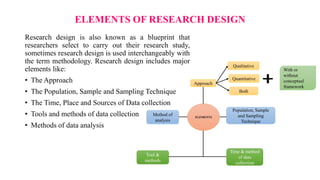
ELEMENTS OF RESEARCH DESIGN
Research design is also known as a blueprint that
researchers select to carry out their research study,
sometimes research design is used interchangeably with
the term methodology. Research design includes major
elements like:
• The Approach
• The Population, Sample and Sampling Technique
• The Time, Place and Sources of Data collection
• Tools and methods of data collection
• Methods of data analysis
ELEMENTS
Approach
Method of
analysis
Population, Sample
and Sampling
Technique
Tool &
methods
Time & method
of data
collection
Qualitative
Quantitative
Both
With or
without
conceptual
framework
THE APPROACH
• It involves the description of the
plan to investigate the phenomenon
under study in a structured,
unstructured or a combination of
two methods. Therefore the
approach helps to decide about the
presence or absence as well as
manipulation and control over
variables.
The Population, Sample and Sampling
Technique
• It also provides the researcher with
directions
about population, sample and sampling
technique which will be used for research
study
The Time, Place and Sources
of Data
collection
• The Time, Place and
Sources of the requisite
data are the other important
constituents
essential to ensure effective
planning to
conduct research study.
Tools and methods of data
collection:
• This element of research
design involves the
description of different tools
and methods of
data collection.
• Ex: questionnaires,
interviews, observation etc..
METHODS OF DATAANALYSIS
A research design must also include the
description of the methods of data analysis
either quantitative or qualitative techniques
that helps the researcher to collect the relevant
data, which later can be analyse as per
research design plan
SELEECTION OF RESEARCH DESIGN
Factors Affecting Selection of Research Design
Nature of Research Problem: Researcher decides whether it should be
investigated through an experimental, Non Experimental or Quasi experimental
approach.
Purpose of study: Study may be conducted for the purpose of the prediction,
description, exploration or correlation of research variable
Researcher Knowledge and Experience: Selection of research design is largely
influenced by researcher knowledge and experience, because they avoid using those
designs wherein they lack confidence, relevant knowledge or experience.
Researcher Interest and Motivation: Motivated researcher always analyse most
aspects of research design before selecting one or a combination of designs
Researcher’s Ethics and Principles: Incorporation of ethics and principles in
research design is essential. This includes moral obligations such as respect for
participants and their rights.
Subjects/ Participants: The number and availability of study subjects may
influence the selection of research design if only few subjects are involved, an in-
depth qualitative research design may be choose, but in case of large samples the
researcher may opt for quantitative research design.
Resources: None of the researcher can be conduct without resources such as money,
equipment, facilities and support from colleagues.
Time: Time is also a major deciding factor for the selection of research design.
Possible Control of Extraneous Variables: An efficient design can maximize
results decrease errors and control pre-existing and impaired conditions that may
affect the outcome of the study.
Users of the Study Finding : A research design also involves various methods data
collection and analysis. Therefore while choosing a research design researcher must
ensure that research design is as appropriate for the users of the study findings.
Validity: Research design validity refers to the degree to which a study accurately measures what it
aims to measure and how well the findings can be trusted. There are several types of validity,
including internal validity, external validity, construct validity, and content validity.
Internal Validity: This refers to the accuracy of conclusions drawn about cause-and-effect
relationships within a study. It is a concern mainly in experimental designs.
Example: examining the effect of a new pain management protocol on post-operative patients,
internal validity would involve ensuring that any observed improvement in pain relief can be
attributed to the protocol itself, rather than other factors.
External Validity: External validity pertains to the extent to which study findings
can be generalized beyond the study sample and setting.
Example: If a study on a specific population of elderly patients shows positive
outcomes from a particular intervention, the external validity would involve
considering whether these findings can be applied to a broader range of patients in
different healthcare settings.
Quantitative Research Design
Quantitative research is a systematic investigation of phenomena by gathering
quantifiable data and performing statistical, mathematical, or computational
techniques. Quantitative research collects information from existing and
potential customers using sampling methods and sending out online
surveys, online polls, and questionnaires
CHARACTERISTICS
• Structured tools: Structured tools such as surveys, polls, or questionnaires are used
to gather quantitative data. Using such structured methods helps in collecting in-
depth and actionable data from the survey respondents.
• Sample size: Quantitative research is conducted on a significant sample size that
represents the target population. Appropriate sampling methods have to be used when
deriving the sample to fortify the research objective
• Close-ended questions: Closed-ended questions are created per the objective of the
research. These questions help collect quantitative data and hence, are extensively
used in quantitative research.
• Prior studies: Various factors related to the research topic are studied before
collecting feedback from respondents.
•Quantitative data: Usually, quantitative data is represented by tables,
charts, graphs, or any other non-numerical form. This makes it easy to
understand the data that has been collected as well as prove the validity of
the market research.
• Generalization of results: Results of this research method can be
generalized to an entire population to take appropriate actions for
improvement.
ADVANTAGES:
 Collect reliable and accurate data
 Quick data collection
 Wider scope of data analysis
 Eliminate bias
Qualitative Research Design
• Qualitative research is defined as a method that focuses on obtaining data
through open-ended and conversational communication.
• This method is not only about “what” people think but also “why” they
think so.
CHARACTERISTICS
• Qualitative research methods usually collect data at the sight, where the
participants are experiencing issues or problems. These are real-time data and
rarely bring the participants out of the geographic locations to collect information.
• Qualitative researchers typically gather multiple forms of data, such as interviews,
observations, and documents, rather than rely on a single data source.
• This type of research method works towards solving complex issues by breaking
down into meaningful inferences, that is easily readable and understood by all.
• Since it’s a more communicative method, people can build their trust on the
researcher and the information thus obtained is raw and unadulterated.
Advantages
• Developing or generating New ideas.
• To strengthen Our strategy.
• To understand strengths and weaknesses.
• To study the behavior of the samples and other communications.
• Exploring demographics and groups.
• Gathering perception data of a Samples
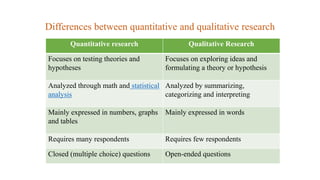
Differences between quantitative and qualitative research
Quantitative research Qualitative Research
Focuses on testing theories and
hypotheses
Focuses on exploring ideas and
formulating a theory or hypothesis
Analyzed through math and statistical
analysis
Analyzed by summarizing,
categorizing and interpreting
Mainly expressed in numbers, graphs
and tables
Mainly expressed in words
Requires many respondents Requires few respondents
Closed (multiple choice) questions Open-ended questions
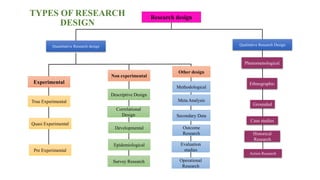
TYPES OF RESEARCH
DESIGN
Qualitative Research Design
Quantitative Research design
Research design
Non experimental
Experimental
True Experimental
Quasi Experimental
Pre Experimental
Descriptive Design
Correlational
Design
Developmental
Epidemiological
Survey Research
Other design
Methodological
Meta Analysis
Secondary Data
Outcome
Research
Evaluation
studies
Operational
Research
Phenomenological
Ethnographic
Grounded
Case studies
Historical
Research
Action Research
QUANTITATIVE RESEARCH DESIGN
True Experimental Design
They are those where researchers have complete control over
the extraneous variables and can predict confidently that the
observed effect on the dependable variable is only due to the
manipulation of the independent variable.
Essential Characteristics :
A True Experimental research design must
essentially consists of following three
characteristics:
• Manipulation,
• Control and
• Randomization.
Manipulation:
• It refers to conscious control of the
independent variable by the researcher
through
treatment or interventions to observe its
effect
on dependent variable.
Control:
It refers to the use of control group
and
controlling the effects of extraneous
variables
on the dependent variable in which
researcher
is interested.
Randomization:
• It means that every subject has an equal
chance of being assigned to experimental or
control group this is also known as random
assignments of subjects which involves the
placement of study subjects on the random
basis. Through random assignments of subjects
under experimental or control group, chances
of systemic bias is eliminated.
Types of True Experimental Design
1. Post-test only Design
2. Pretest-Posttest only Design
3. Solomon Four Group Design
4. Factorial Design
5. Randomized Block Design
6. Cross over Design
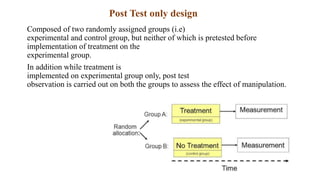
Post Test only design
Composed of two randomly assigned groups (i.e)
experimental and control group, but neither of which is pretested before
implementation of treatment on the
experimental group.
In addition while treatment is
implemented on experimental group only, post test
observation is carried out on both the groups to assess the effect of manipulation.
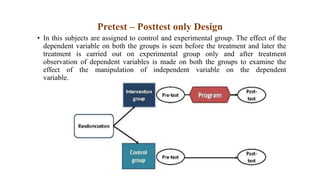
Pretest – Posttest only Design
• In this subjects are assigned to control and experimental group. The effect of the
dependent variable on both the groups is seen before the treatment and later the
treatment is carried out on experimental group only and after treatment
observation of dependent variables is made on both the groups to examine the
effect of the manipulation of independent variable on the dependent
variable.
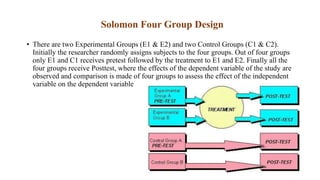
Solomon Four Group Design
• There are two Experimental Groups (E1 & E2) and two Control Groups (C1 & C2).
Initially the researcher randomly assigns subjects to the four groups. Out of four groups
only E1 and C1 receives pretest followed by the treatment to E1 and E2. Finally all the
four groups receive Posttest, where the effects of the dependent variable of the study are
observed and comparison is made of four groups to assess the effect of the independent
variable on the dependent variable
Factorial Design
• In this researcher manipulates two or more independent variables
simultaneously to observe the effects on the dependent variables.
This design is useful when there are more than two independent variables
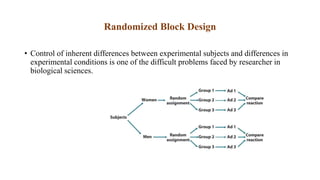
Randomized Block Design
• Control of inherent differences between experimental subjects and differences in
experimental conditions is one of the difficult problems faced by researcher in
biological sciences.
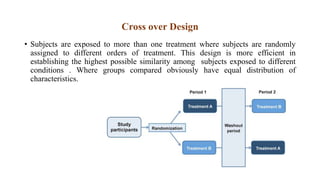
Cross over Design
• Subjects are exposed to more than one treatment where subjects are randomly
assigned to different orders of treatment. This design is more efficient in
establishing the highest possible similarity among subjects exposed to different
conditions . Where groups compared obviously have equal distribution of
characteristics.
Advantages
To establish casual relationship between independent and dependent variables
The controlled environment in which the study is conducted can yield a greater
degree of purity in observation.
Conditions not found in natural settings can be created in an experimental setting
where the independent variable is manipulated by investigator.
In this approach, we can often create conditions in a short period of time that may
take years naturally.
When experiment is conducted in laboratory, the pressure and problems of real life
situations are removed and the researcher can pursue the studies in a more
leisurely careful and concentrated way
Disadvantages
• The results of experimental designs cannot be replicated in studies
conducted on human beings due to ethical problems.
• Many of the human variables neither have valid measurable criteria nor
instruments to measure them.
• If experimental studies conducted in natural settings like hospitals or
community, it is not possible to impose control over extraneous
variables.
• It is difficult to get cooperation from the study participants because it
may involve medical or surgical treatment or intervention which may
make the prospective subjects reluctant to participate in research study
QUASI EXPERIMENTAL RESEARCH DESIGN
• It involves the manipulation of independent variable to observe the effect on dependent
variable, but it lacks at least one of the two characteristics of the true experimental design
randomization or control
Characteristics:
• Manipulation of the independent variables to observe the effects on the dependent
variables.
• Lack at least one of the two other essential characteristics of the true experimental design
• Quasi-independent variable are used instead of true independent variables
TYPES OF QUASI EXPERIMENTAL DESIGN
1.Non Randomized Control Group Design
2.Time Series Design
Non Randomized Control Group Design
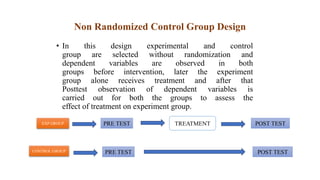
• In this design experimental and control
group are selected without randomization and
dependent variables are observed in both
groups before intervention, later the experiment
group alone receives treatment and after that
Posttest observation of dependent variables is
carried out for both the groups to assess the
effect of treatment on experiment group.
TREATMENT
EXP GROUP
CONTROL GROUP
PRE TEST
PRE TEST
POST TEST
POST TEST
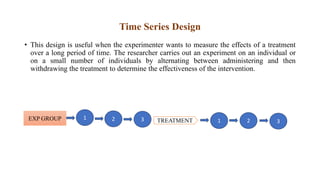
Time Series Design
• This design is useful when the experimenter wants to measure the effects of a treatment
over a long period of time. The researcher carries out an experiment on an individual or
on a small number of individuals by alternating between administering and then
withdrawing the treatment to determine the effectiveness of the intervention.
EXP GROUP 1 2 3 TREATMENT 1 2 3
ADVANTAGES
 They are more frequently used
because they
are more practical and feasible to
conduct research studies in nursing.
 This design is more suitable for real
world natural settings than true
experimental research designs.
 It may be able to establish casual
relationship and where in some of the
hypotheses are practically answered
through this design only
DISADVANTAGES
• There is no control over extraneous
variables influencing the dependent
variables.
• The absence of control group makes
the results of this design less reliable
and weak for the establishment of
casual relationship between dependent
and independent variable.
Pre Experimental Research Design
• This research design considered very weak because the researcher has very little
control over the experiment.
Types of pre experimental research design
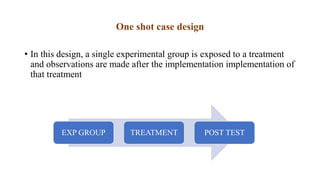
1. One shot case design
2. One group pre-test and post-test design
One shot case design
• In this design, a single experimental group is exposed to a treatment
and observations are made after the implementation implementation of
that treatment
EXP GROUP TREATMENT POST TEST
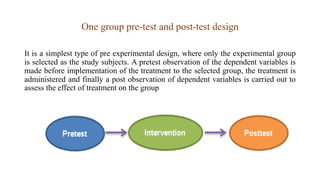
One group pre-test and post-test design
It is a simplest type of pre experimental design, where only the experimental group
is selected as the study subjects. A pretest observation of the dependent variables is
made before implementation of the treatment to the selected group, the treatment is
administered and finally a post observation of dependent variables is carried out to
assess the effect of treatment on the group
Advantages:
Very simple and convenient to conduct
these studies in natural setting especially in
nursing.
Most suitable suitable design for the
beginners beginners in the field of
experimental research.
Disadvantages:
It has very little control over the research.
Considered a very weak experimental
design to establish casual relationship
between independent and dependent
variables, because it controls no threat to
internal validity
NON EXPERIMENTAL RESEARCH DESIGN
It is one of the broad categories of research designs in which the researcher observes
the phenomena as they occur naturally and no external variables are introduced.
In this non experimental research, Researcher collects data without making changes
or introducing treatments. Data obtained are analysed and the results may lead to the
formation of hypothesis that can be tested experimentally
Needs:
• Independent variable cannot be manipulated
• The studies where it is not practically possible to conduct experiment
• Descriptive study that do not require any experimental approaches.
Types of non-experimental research design
• Descriptive Research Design
• Correlational Research
• Developmental Research Design
• Epidemiological Research Design
• Survey Research Design
Descriptive Research Design
• The purpose of descriptive design is to describe and document aspects of
a situation as it naturally occurs and sometimes to serve as a starting point
for hypotheses generation or theory development.
Main features
They are used to observe, document and describe a phenomenon occurring in its
natural setting without any manipulation or control.
They provide an impression of a situation as it occurs in natural settings.
They do not involve the manipulation of variables and they are studied as they
exist in the real world.
They may be used to develop theories, identify problem with current practices,
justify current practices or determine other practices in similar situations.
EXAMPLE : imagine researchers want to understand how nurses interact with
patients during their rounds. A descriptive design would involve directly
observing these interactions without any interference. Researchers would watch
how nurses communicate, provide care, and respond to patients' needs, all within
the real hospital environment.
Correlational Research
• This is Non-Experimental Research design, where researcher examines the
relationship between two or more variables in a natural setting without
manipulation or control.
• In this researchers study the relationship of two or more variables without any
intervention.
Main Features
 The researcher examines the strength of relationship between variables by
determining how change is correlated with changes in the other variables.
 Generally they have independent and dependent variables, but the effect of
independent variable is observed on dependent variable without
manipulating the independent variable
• Magnitude and direction of relationship of independent and dependent
variable is measured by using the correlation coefficient statistical
measure,
where results range between -1 to +1
• -ve results shows negative correlation
• +ve results shows positive correlation
• Zero results shows no correlation
• Theoretically a positive relationship means increase in one variable leads to increase of
the other variable. While negative relationship means increase in one variable leads to
decrease of the other variable or vice versa.
• EXAMPLE: researcher want to investigate if there's a relationship between the
number of hours nurses work per week and their reported stress levels. They collect
data from a group of nurses and measure two variables: the number of hours each nurse
works per week and their self-reported stress levels on a scale of 1 to 10. After
analyzing the data, they find a positive correlation of 0.75 between the two variables.
This means that as the number of hours worked per week increases, the reported stress
levels also tend to increase.
Types of correlational design
1. Prospective Research Design:
A design in which the researcher relates the present to the future is a
prospective research design. In this researcher observes phenomena from
cause to effect
2. Retrospective Research Design:
In this researcher studies current phenomenon by seeking information from
past. In other words researcher has a backward approach, in other words the
researcher has a backward approach where he or she move from effect to
identify cause
Developmental Research Design
They are generally used as adjuvant research designs with other research designs
such as cross sectional, descriptive, longitudinal, correlational research design.
This design examines the phenomenon with reference to time.
EXAMPLE: Imagine researchers are interested in studying how children's pain
management behaviors change as they grow older. They want to understand how
children of different age groups respond to pain and whether there are
developmental patterns in how they cope with discomfort in a medical setting.
Types:
Cross sectional Design:
Is one in which researcher collects data at a particular point of time.
Longitudinal Design:
It is used to collect data over an extended period of time. Its value is in its
ability to demonstrate change over a period of time
Epidemiological Research Design
• It is a study to investigate the distribution and causes of the disease in
population.
• Epidemiological studies are generally conducted to investigate causes of different
diseases in either prospective researches or retrospective researches.
• EXAMPLE: Researchers are interested in studying the prevalence of diabetes in
a specific Community. They want to assess the extent of diabetes in the
community and understand potential factors that contribute to its occurrence.
• Cohort Studies :
a long-term approach to study how a disease happens and what might be causing
it.
Case Control Studies :
In this design, cause of a disease are investigated after the occurrence of disease
TYPES
SURVEY RESEARCH DESIGN
• A survey is a research design which is used to collect information from
different subjects within a given population having same
characteristics of interest
• EXAMPLE: Imagine researchers want to understand public opinions and
awareness regarding vaccination in a community. They create a survey to
gather information about people's attitudes, beliefs, and reasons for either
getting vaccinated or not.
Main features
It is the process of gathering current required data from the subjects so that new
information can be obtained.
In survey research information is collected from a mix of subjects who represent
the total population in the characteristics being studied
It relies heavily upon the validity of verbal reports.
Personal interview are regarded as the most useful method of collecting survey
data, because of the quality
TYPES
1. Depending on the nature of phenomenon
under study
• Descriptive
• Exploratory
• Comparative
• Correlational
2. Based on methods of data collection
• written survey
• Oral survey
• Electronic survey
Depending on the nature of phenomenon under study
• Descriptive:
Describing how often something happens, without looking at the relationship.
• Exploratory:
Looking at something we don't know much about, trying to learn more about it and its
related factors.
• Comparative:
Checking if something happens in different groups and seeing how they're alike or
different.
• Correlational:
It is a study of relationship between two or more variables in a natural settings
without manipulation or control
Based on methods of data collection:
Written survey:
In this data are collected with a help of written, structured tools such as
questionnaire
Oral Survey:
In this data is collected by using face to face or telephonic conversation or oral
interview with respondents
Electronic survey:
When data is collected by using electronic means,such as email messages, web
forms, SMS etc.
Advantages of Non- Experimental Designs
• They mirror real-life situations closely.
• They help us learn more about the actual world around us.
• Many human traits can't be manipulated in an experiment, so non-experimental
designs are valuable for studying their effects on other things.
• Sometimes, it's not feasible to do a proper experiment due to factors like limited
funds, lack of permission, or time constraints etc..
Disadvantages of Non- Experimental Designs
• The results obtained and the relationship between the dependent and independent
variables can never be absolutely clear and error free.
• These kinds of studies are done to compare things, but they often use groups that
weren't chosen randomly.
OTHER DESIGNS
METHODOLOGICAL DESIGN:
This approach involves choosing a specific method or technique to
investigate a research question. It's about how you plan to gather and
analyze data.
Example: Suppose a nurse researcher wants to investigate the impact of
music therapy on reducing anxiety levels in pediatric patients. They
choose to use a mixed-methods approach, combining surveys to gather
quantitative data on anxiety scores and interviews to gather qualitative
insights about the children's experiences during the therapy sessions.
META-ANALYSIS:
Meta-analysis combines results from multiple studies to identify overall patterns or
trends. It's like summarizing a bunch of research to get a bigger picture.
Example: A meta-analysis could combine various studies on the effectiveness of
pain management techniques in post-operative care to determine which methods
consistently yield the best results.
SECONDARY DATA ANALYSIS:
This approach involves analyzing existing data that was collected for
another purpose. It's like recycling data to answer new research questions.
Example: A nurse researcher could analyze hospital records to investigate
the relationship between nurse-patient ratios and patient outcomes, using
data that was initially collected for administrative purposes.
OUTCOME RESEARCH DESIGN:
Outcome research assesses the results of interventions or treatments. It's about
figuring out if a particular action leads to the expected outcomes.
Example: A study might assess the impact of a new training program for nurses
on reducing patient falls in a hospital setting.
EVALUATION STUDIES:
Evaluation studies check if programs or initiatives are doing what they're supposed
to do. It's like giving a report card to a project.
Example : An evaluation study could look at whether a hospital's new infection
control protocol effectively reduces the spread of infections among patients and
staff.
OPERATIONAL RESEARCH:
Operational research uses math and analysis to solve complex decision-
making problems. It's about making things work better.
Example: Operational research might be used to optimize the scheduling of
nursing shifts to ensure adequate coverage while minimizing staff fatigue and
stress.
Phenomenology
• Phenomenology is a way of thinking that cares a lot about how people personally
experience and understand the world.
• People who follow this idea believe that it's really hard to be completely objective,
so they think it's important to consider the feelings and thoughts of the person
doing the research.
• When these thinkers watch and study people, they try to see things from the point
of view of the people they are studying.
Ethnography
• Ethnography emphasizes the observation of details of everyday life as they
naturally unfold in the real world. This is sometimes called naturalistic
research.
• Ethnography is a method of describing a culture or society. This is primarily used
in anthropological research which focuses on community.
Grounded theory
• Grounded theory is an inductive research approach that involves developing
theories from collected data.
• It avoids relying on preconceived notions about the subject. Researchers identify
patterns in their observations and then formulate working hypotheses to guide
further investigation.
• In this method, theories are constructed based on the data itself rather than using
pre-existing assumptions.
Case study
• A case study is a detailed examination of a specific instance or example of
something.
• It could be used to describe, explore, or explain a particular phenomenon. Instead
of looking at a broad picture, a case study focuses deeply on one specific situation.
It's like zooming in and studying a single "case" in great detail to understand its
unique qualities, challenges, and characteristics.
• This approach helps researchers gain insights and draw conclusions about broader
concepts based on the in-depth analysis of that single case.
Historical
Systematic collection and objective evaluation of data related to past occurrences in
order to explain causes, effects, or trends of these events in the present and
anticipate future events.
Action research
• Action research is inquiry or research in the context of focused efforts to
improve the quality of practice
• It is typically designed and conducted by practitioners who analyse the data
to improve their own practice
RESEARCH APPROACHES AND DESIGNS.pptx

RESEARCH APPROACHES AND DESIGNS.pptx

  • 1.
    Mr. PRADEEP ABOTHU CHILDHEALTH NURSING ASSOCIATE PROFESSOR
  • 2.
    INTRODUCTION A Research designis the framework or guide used for the planning, implementation and analysis of a study. It is a systematic plan of what is to be done, how it will be done and how the data will be analyzed.
  • 3.
    DEFINITION Research design isthe master plan or blueprint specifying the methods and procedures for collecting and analysing the needed information in a research study
  • 4.
    ELEMENTS OF RESEARCHDESIGN Research design is also known as a blueprint that researchers select to carry out their research study, sometimes research design is used interchangeably with the term methodology. Research design includes major elements like: • The Approach • The Population, Sample and Sampling Technique • The Time, Place and Sources of Data collection • Tools and methods of data collection • Methods of data analysis ELEMENTS Approach Method of analysis Population, Sample and Sampling Technique Tool & methods Time & method of data collection Qualitative Quantitative Both With or without conceptual framework
  • 5.
    THE APPROACH • Itinvolves the description of the plan to investigate the phenomenon under study in a structured, unstructured or a combination of two methods. Therefore the approach helps to decide about the presence or absence as well as manipulation and control over variables. The Population, Sample and Sampling Technique • It also provides the researcher with directions about population, sample and sampling technique which will be used for research study
  • 6.
    The Time, Placeand Sources of Data collection • The Time, Place and Sources of the requisite data are the other important constituents essential to ensure effective planning to conduct research study. Tools and methods of data collection: • This element of research design involves the description of different tools and methods of data collection. • Ex: questionnaires, interviews, observation etc..
  • 7.
    METHODS OF DATAANALYSIS Aresearch design must also include the description of the methods of data analysis either quantitative or qualitative techniques that helps the researcher to collect the relevant data, which later can be analyse as per research design plan
  • 8.
    SELEECTION OF RESEARCHDESIGN Factors Affecting Selection of Research Design Nature of Research Problem: Researcher decides whether it should be investigated through an experimental, Non Experimental or Quasi experimental approach. Purpose of study: Study may be conducted for the purpose of the prediction, description, exploration or correlation of research variable Researcher Knowledge and Experience: Selection of research design is largely influenced by researcher knowledge and experience, because they avoid using those designs wherein they lack confidence, relevant knowledge or experience.
  • 9.
    Researcher Interest andMotivation: Motivated researcher always analyse most aspects of research design before selecting one or a combination of designs Researcher’s Ethics and Principles: Incorporation of ethics and principles in research design is essential. This includes moral obligations such as respect for participants and their rights. Subjects/ Participants: The number and availability of study subjects may influence the selection of research design if only few subjects are involved, an in- depth qualitative research design may be choose, but in case of large samples the researcher may opt for quantitative research design.
  • 10.
    Resources: None ofthe researcher can be conduct without resources such as money, equipment, facilities and support from colleagues. Time: Time is also a major deciding factor for the selection of research design. Possible Control of Extraneous Variables: An efficient design can maximize results decrease errors and control pre-existing and impaired conditions that may affect the outcome of the study. Users of the Study Finding : A research design also involves various methods data collection and analysis. Therefore while choosing a research design researcher must ensure that research design is as appropriate for the users of the study findings.
  • 11.
    Validity: Research designvalidity refers to the degree to which a study accurately measures what it aims to measure and how well the findings can be trusted. There are several types of validity, including internal validity, external validity, construct validity, and content validity. Internal Validity: This refers to the accuracy of conclusions drawn about cause-and-effect relationships within a study. It is a concern mainly in experimental designs. Example: examining the effect of a new pain management protocol on post-operative patients, internal validity would involve ensuring that any observed improvement in pain relief can be attributed to the protocol itself, rather than other factors.
  • 12.
    External Validity: Externalvalidity pertains to the extent to which study findings can be generalized beyond the study sample and setting. Example: If a study on a specific population of elderly patients shows positive outcomes from a particular intervention, the external validity would involve considering whether these findings can be applied to a broader range of patients in different healthcare settings.
  • 13.
    Quantitative Research Design Quantitativeresearch is a systematic investigation of phenomena by gathering quantifiable data and performing statistical, mathematical, or computational techniques. Quantitative research collects information from existing and potential customers using sampling methods and sending out online surveys, online polls, and questionnaires
  • 14.
    CHARACTERISTICS • Structured tools:Structured tools such as surveys, polls, or questionnaires are used to gather quantitative data. Using such structured methods helps in collecting in- depth and actionable data from the survey respondents. • Sample size: Quantitative research is conducted on a significant sample size that represents the target population. Appropriate sampling methods have to be used when deriving the sample to fortify the research objective • Close-ended questions: Closed-ended questions are created per the objective of the research. These questions help collect quantitative data and hence, are extensively used in quantitative research. • Prior studies: Various factors related to the research topic are studied before collecting feedback from respondents.
  • 15.
    •Quantitative data: Usually,quantitative data is represented by tables, charts, graphs, or any other non-numerical form. This makes it easy to understand the data that has been collected as well as prove the validity of the market research. • Generalization of results: Results of this research method can be generalized to an entire population to take appropriate actions for improvement. ADVANTAGES:  Collect reliable and accurate data  Quick data collection  Wider scope of data analysis  Eliminate bias
  • 16.
    Qualitative Research Design •Qualitative research is defined as a method that focuses on obtaining data through open-ended and conversational communication. • This method is not only about “what” people think but also “why” they think so.
  • 17.
    CHARACTERISTICS • Qualitative researchmethods usually collect data at the sight, where the participants are experiencing issues or problems. These are real-time data and rarely bring the participants out of the geographic locations to collect information. • Qualitative researchers typically gather multiple forms of data, such as interviews, observations, and documents, rather than rely on a single data source. • This type of research method works towards solving complex issues by breaking down into meaningful inferences, that is easily readable and understood by all. • Since it’s a more communicative method, people can build their trust on the researcher and the information thus obtained is raw and unadulterated.
  • 18.
    Advantages • Developing orgenerating New ideas. • To strengthen Our strategy. • To understand strengths and weaknesses. • To study the behavior of the samples and other communications. • Exploring demographics and groups. • Gathering perception data of a Samples
  • 19.
    Differences between quantitativeand qualitative research Quantitative research Qualitative Research Focuses on testing theories and hypotheses Focuses on exploring ideas and formulating a theory or hypothesis Analyzed through math and statistical analysis Analyzed by summarizing, categorizing and interpreting Mainly expressed in numbers, graphs and tables Mainly expressed in words Requires many respondents Requires few respondents Closed (multiple choice) questions Open-ended questions
  • 20.
    TYPES OF RESEARCH DESIGN QualitativeResearch Design Quantitative Research design Research design Non experimental Experimental True Experimental Quasi Experimental Pre Experimental Descriptive Design Correlational Design Developmental Epidemiological Survey Research Other design Methodological Meta Analysis Secondary Data Outcome Research Evaluation studies Operational Research Phenomenological Ethnographic Grounded Case studies Historical Research Action Research
  • 21.
  • 22.
    True Experimental Design Theyare those where researchers have complete control over the extraneous variables and can predict confidently that the observed effect on the dependable variable is only due to the manipulation of the independent variable. Essential Characteristics : A True Experimental research design must essentially consists of following three characteristics: • Manipulation, • Control and • Randomization.
  • 23.
    Manipulation: • It refersto conscious control of the independent variable by the researcher through treatment or interventions to observe its effect on dependent variable. Control: It refers to the use of control group and controlling the effects of extraneous variables on the dependent variable in which researcher is interested. Randomization: • It means that every subject has an equal chance of being assigned to experimental or control group this is also known as random assignments of subjects which involves the placement of study subjects on the random basis. Through random assignments of subjects under experimental or control group, chances of systemic bias is eliminated.
  • 24.
    Types of TrueExperimental Design 1. Post-test only Design 2. Pretest-Posttest only Design 3. Solomon Four Group Design 4. Factorial Design 5. Randomized Block Design 6. Cross over Design
  • 25.
    Post Test onlydesign Composed of two randomly assigned groups (i.e) experimental and control group, but neither of which is pretested before implementation of treatment on the experimental group. In addition while treatment is implemented on experimental group only, post test observation is carried out on both the groups to assess the effect of manipulation.
  • 26.
    Pretest – Posttestonly Design • In this subjects are assigned to control and experimental group. The effect of the dependent variable on both the groups is seen before the treatment and later the treatment is carried out on experimental group only and after treatment observation of dependent variables is made on both the groups to examine the effect of the manipulation of independent variable on the dependent variable.
  • 27.
    Solomon Four GroupDesign • There are two Experimental Groups (E1 & E2) and two Control Groups (C1 & C2). Initially the researcher randomly assigns subjects to the four groups. Out of four groups only E1 and C1 receives pretest followed by the treatment to E1 and E2. Finally all the four groups receive Posttest, where the effects of the dependent variable of the study are observed and comparison is made of four groups to assess the effect of the independent variable on the dependent variable
  • 28.
    Factorial Design • Inthis researcher manipulates two or more independent variables simultaneously to observe the effects on the dependent variables. This design is useful when there are more than two independent variables
  • 29.
    Randomized Block Design •Control of inherent differences between experimental subjects and differences in experimental conditions is one of the difficult problems faced by researcher in biological sciences.
  • 30.
    Cross over Design •Subjects are exposed to more than one treatment where subjects are randomly assigned to different orders of treatment. This design is more efficient in establishing the highest possible similarity among subjects exposed to different conditions . Where groups compared obviously have equal distribution of characteristics.
  • 31.
    Advantages To establish casualrelationship between independent and dependent variables The controlled environment in which the study is conducted can yield a greater degree of purity in observation. Conditions not found in natural settings can be created in an experimental setting where the independent variable is manipulated by investigator. In this approach, we can often create conditions in a short period of time that may take years naturally. When experiment is conducted in laboratory, the pressure and problems of real life situations are removed and the researcher can pursue the studies in a more leisurely careful and concentrated way
  • 32.
    Disadvantages • The resultsof experimental designs cannot be replicated in studies conducted on human beings due to ethical problems. • Many of the human variables neither have valid measurable criteria nor instruments to measure them. • If experimental studies conducted in natural settings like hospitals or community, it is not possible to impose control over extraneous variables. • It is difficult to get cooperation from the study participants because it may involve medical or surgical treatment or intervention which may make the prospective subjects reluctant to participate in research study
  • 33.
    QUASI EXPERIMENTAL RESEARCHDESIGN • It involves the manipulation of independent variable to observe the effect on dependent variable, but it lacks at least one of the two characteristics of the true experimental design randomization or control Characteristics: • Manipulation of the independent variables to observe the effects on the dependent variables. • Lack at least one of the two other essential characteristics of the true experimental design • Quasi-independent variable are used instead of true independent variables
  • 34.
    TYPES OF QUASIEXPERIMENTAL DESIGN 1.Non Randomized Control Group Design 2.Time Series Design
  • 35.
    Non Randomized ControlGroup Design • In this design experimental and control group are selected without randomization and dependent variables are observed in both groups before intervention, later the experiment group alone receives treatment and after that Posttest observation of dependent variables is carried out for both the groups to assess the effect of treatment on experiment group. TREATMENT EXP GROUP CONTROL GROUP PRE TEST PRE TEST POST TEST POST TEST
  • 36.
    Time Series Design •This design is useful when the experimenter wants to measure the effects of a treatment over a long period of time. The researcher carries out an experiment on an individual or on a small number of individuals by alternating between administering and then withdrawing the treatment to determine the effectiveness of the intervention. EXP GROUP 1 2 3 TREATMENT 1 2 3
  • 37.
    ADVANTAGES  They aremore frequently used because they are more practical and feasible to conduct research studies in nursing.  This design is more suitable for real world natural settings than true experimental research designs.  It may be able to establish casual relationship and where in some of the hypotheses are practically answered through this design only DISADVANTAGES • There is no control over extraneous variables influencing the dependent variables. • The absence of control group makes the results of this design less reliable and weak for the establishment of casual relationship between dependent and independent variable.
  • 38.
    Pre Experimental ResearchDesign • This research design considered very weak because the researcher has very little control over the experiment.
  • 39.
    Types of preexperimental research design 1. One shot case design 2. One group pre-test and post-test design
  • 40.
    One shot casedesign • In this design, a single experimental group is exposed to a treatment and observations are made after the implementation implementation of that treatment EXP GROUP TREATMENT POST TEST
  • 41.
    One group pre-testand post-test design It is a simplest type of pre experimental design, where only the experimental group is selected as the study subjects. A pretest observation of the dependent variables is made before implementation of the treatment to the selected group, the treatment is administered and finally a post observation of dependent variables is carried out to assess the effect of treatment on the group
  • 42.
    Advantages: Very simple andconvenient to conduct these studies in natural setting especially in nursing. Most suitable suitable design for the beginners beginners in the field of experimental research. Disadvantages: It has very little control over the research. Considered a very weak experimental design to establish casual relationship between independent and dependent variables, because it controls no threat to internal validity
  • 43.
    NON EXPERIMENTAL RESEARCHDESIGN It is one of the broad categories of research designs in which the researcher observes the phenomena as they occur naturally and no external variables are introduced. In this non experimental research, Researcher collects data without making changes or introducing treatments. Data obtained are analysed and the results may lead to the formation of hypothesis that can be tested experimentally Needs: • Independent variable cannot be manipulated • The studies where it is not practically possible to conduct experiment • Descriptive study that do not require any experimental approaches.
  • 44.
    Types of non-experimentalresearch design • Descriptive Research Design • Correlational Research • Developmental Research Design • Epidemiological Research Design • Survey Research Design
  • 45.
    Descriptive Research Design •The purpose of descriptive design is to describe and document aspects of a situation as it naturally occurs and sometimes to serve as a starting point for hypotheses generation or theory development.
  • 46.
    Main features They areused to observe, document and describe a phenomenon occurring in its natural setting without any manipulation or control. They provide an impression of a situation as it occurs in natural settings. They do not involve the manipulation of variables and they are studied as they exist in the real world. They may be used to develop theories, identify problem with current practices, justify current practices or determine other practices in similar situations. EXAMPLE : imagine researchers want to understand how nurses interact with patients during their rounds. A descriptive design would involve directly observing these interactions without any interference. Researchers would watch how nurses communicate, provide care, and respond to patients' needs, all within the real hospital environment.
  • 47.
    Correlational Research • Thisis Non-Experimental Research design, where researcher examines the relationship between two or more variables in a natural setting without manipulation or control. • In this researchers study the relationship of two or more variables without any intervention.
  • 48.
    Main Features  Theresearcher examines the strength of relationship between variables by determining how change is correlated with changes in the other variables.  Generally they have independent and dependent variables, but the effect of independent variable is observed on dependent variable without manipulating the independent variable • Magnitude and direction of relationship of independent and dependent variable is measured by using the correlation coefficient statistical measure, where results range between -1 to +1 • -ve results shows negative correlation • +ve results shows positive correlation • Zero results shows no correlation
  • 49.
    • Theoretically apositive relationship means increase in one variable leads to increase of the other variable. While negative relationship means increase in one variable leads to decrease of the other variable or vice versa. • EXAMPLE: researcher want to investigate if there's a relationship between the number of hours nurses work per week and their reported stress levels. They collect data from a group of nurses and measure two variables: the number of hours each nurse works per week and their self-reported stress levels on a scale of 1 to 10. After analyzing the data, they find a positive correlation of 0.75 between the two variables. This means that as the number of hours worked per week increases, the reported stress levels also tend to increase.
  • 50.
    Types of correlationaldesign 1. Prospective Research Design: A design in which the researcher relates the present to the future is a prospective research design. In this researcher observes phenomena from cause to effect 2. Retrospective Research Design: In this researcher studies current phenomenon by seeking information from past. In other words researcher has a backward approach, in other words the researcher has a backward approach where he or she move from effect to identify cause
  • 51.
    Developmental Research Design Theyare generally used as adjuvant research designs with other research designs such as cross sectional, descriptive, longitudinal, correlational research design. This design examines the phenomenon with reference to time. EXAMPLE: Imagine researchers are interested in studying how children's pain management behaviors change as they grow older. They want to understand how children of different age groups respond to pain and whether there are developmental patterns in how they cope with discomfort in a medical setting.
  • 52.
    Types: Cross sectional Design: Isone in which researcher collects data at a particular point of time. Longitudinal Design: It is used to collect data over an extended period of time. Its value is in its ability to demonstrate change over a period of time
  • 53.
    Epidemiological Research Design •It is a study to investigate the distribution and causes of the disease in population. • Epidemiological studies are generally conducted to investigate causes of different diseases in either prospective researches or retrospective researches. • EXAMPLE: Researchers are interested in studying the prevalence of diabetes in a specific Community. They want to assess the extent of diabetes in the community and understand potential factors that contribute to its occurrence.
  • 54.
    • Cohort Studies: a long-term approach to study how a disease happens and what might be causing it. Case Control Studies : In this design, cause of a disease are investigated after the occurrence of disease TYPES
  • 55.
    SURVEY RESEARCH DESIGN •A survey is a research design which is used to collect information from different subjects within a given population having same characteristics of interest • EXAMPLE: Imagine researchers want to understand public opinions and awareness regarding vaccination in a community. They create a survey to gather information about people's attitudes, beliefs, and reasons for either getting vaccinated or not.
  • 56.
    Main features It isthe process of gathering current required data from the subjects so that new information can be obtained. In survey research information is collected from a mix of subjects who represent the total population in the characteristics being studied It relies heavily upon the validity of verbal reports. Personal interview are regarded as the most useful method of collecting survey data, because of the quality
  • 57.
    TYPES 1. Depending onthe nature of phenomenon under study • Descriptive • Exploratory • Comparative • Correlational 2. Based on methods of data collection • written survey • Oral survey • Electronic survey
  • 58.
    Depending on thenature of phenomenon under study • Descriptive: Describing how often something happens, without looking at the relationship. • Exploratory: Looking at something we don't know much about, trying to learn more about it and its related factors. • Comparative: Checking if something happens in different groups and seeing how they're alike or different. • Correlational: It is a study of relationship between two or more variables in a natural settings without manipulation or control
  • 59.
    Based on methodsof data collection: Written survey: In this data are collected with a help of written, structured tools such as questionnaire Oral Survey: In this data is collected by using face to face or telephonic conversation or oral interview with respondents Electronic survey: When data is collected by using electronic means,such as email messages, web forms, SMS etc.
  • 60.
    Advantages of Non-Experimental Designs • They mirror real-life situations closely. • They help us learn more about the actual world around us. • Many human traits can't be manipulated in an experiment, so non-experimental designs are valuable for studying their effects on other things. • Sometimes, it's not feasible to do a proper experiment due to factors like limited funds, lack of permission, or time constraints etc..
  • 61.
    Disadvantages of Non-Experimental Designs • The results obtained and the relationship between the dependent and independent variables can never be absolutely clear and error free. • These kinds of studies are done to compare things, but they often use groups that weren't chosen randomly.
  • 62.
    OTHER DESIGNS METHODOLOGICAL DESIGN: Thisapproach involves choosing a specific method or technique to investigate a research question. It's about how you plan to gather and analyze data. Example: Suppose a nurse researcher wants to investigate the impact of music therapy on reducing anxiety levels in pediatric patients. They choose to use a mixed-methods approach, combining surveys to gather quantitative data on anxiety scores and interviews to gather qualitative insights about the children's experiences during the therapy sessions.
  • 63.
    META-ANALYSIS: Meta-analysis combines resultsfrom multiple studies to identify overall patterns or trends. It's like summarizing a bunch of research to get a bigger picture. Example: A meta-analysis could combine various studies on the effectiveness of pain management techniques in post-operative care to determine which methods consistently yield the best results.
  • 64.
    SECONDARY DATA ANALYSIS: Thisapproach involves analyzing existing data that was collected for another purpose. It's like recycling data to answer new research questions. Example: A nurse researcher could analyze hospital records to investigate the relationship between nurse-patient ratios and patient outcomes, using data that was initially collected for administrative purposes.
  • 65.
    OUTCOME RESEARCH DESIGN: Outcomeresearch assesses the results of interventions or treatments. It's about figuring out if a particular action leads to the expected outcomes. Example: A study might assess the impact of a new training program for nurses on reducing patient falls in a hospital setting.
  • 66.
    EVALUATION STUDIES: Evaluation studiescheck if programs or initiatives are doing what they're supposed to do. It's like giving a report card to a project. Example : An evaluation study could look at whether a hospital's new infection control protocol effectively reduces the spread of infections among patients and staff.
  • 67.
    OPERATIONAL RESEARCH: Operational researchuses math and analysis to solve complex decision- making problems. It's about making things work better. Example: Operational research might be used to optimize the scheduling of nursing shifts to ensure adequate coverage while minimizing staff fatigue and stress.
  • 69.
    Phenomenology • Phenomenology isa way of thinking that cares a lot about how people personally experience and understand the world. • People who follow this idea believe that it's really hard to be completely objective, so they think it's important to consider the feelings and thoughts of the person doing the research. • When these thinkers watch and study people, they try to see things from the point of view of the people they are studying.
  • 70.
    Ethnography • Ethnography emphasizesthe observation of details of everyday life as they naturally unfold in the real world. This is sometimes called naturalistic research. • Ethnography is a method of describing a culture or society. This is primarily used in anthropological research which focuses on community.
  • 71.
    Grounded theory • Groundedtheory is an inductive research approach that involves developing theories from collected data. • It avoids relying on preconceived notions about the subject. Researchers identify patterns in their observations and then formulate working hypotheses to guide further investigation. • In this method, theories are constructed based on the data itself rather than using pre-existing assumptions.
  • 72.
    Case study • Acase study is a detailed examination of a specific instance or example of something. • It could be used to describe, explore, or explain a particular phenomenon. Instead of looking at a broad picture, a case study focuses deeply on one specific situation. It's like zooming in and studying a single "case" in great detail to understand its unique qualities, challenges, and characteristics. • This approach helps researchers gain insights and draw conclusions about broader concepts based on the in-depth analysis of that single case.
  • 73.
    Historical Systematic collection andobjective evaluation of data related to past occurrences in order to explain causes, effects, or trends of these events in the present and anticipate future events.
  • 74.
    Action research • Actionresearch is inquiry or research in the context of focused efforts to improve the quality of practice • It is typically designed and conducted by practitioners who analyse the data to improve their own practice