This document provides an overview of nursing research and the research process. It defines research and nursing research. The main points are:
- Nursing research is a systematic, empirical process used to answer questions about nursing practice. It develops the body of professional nursing knowledge.
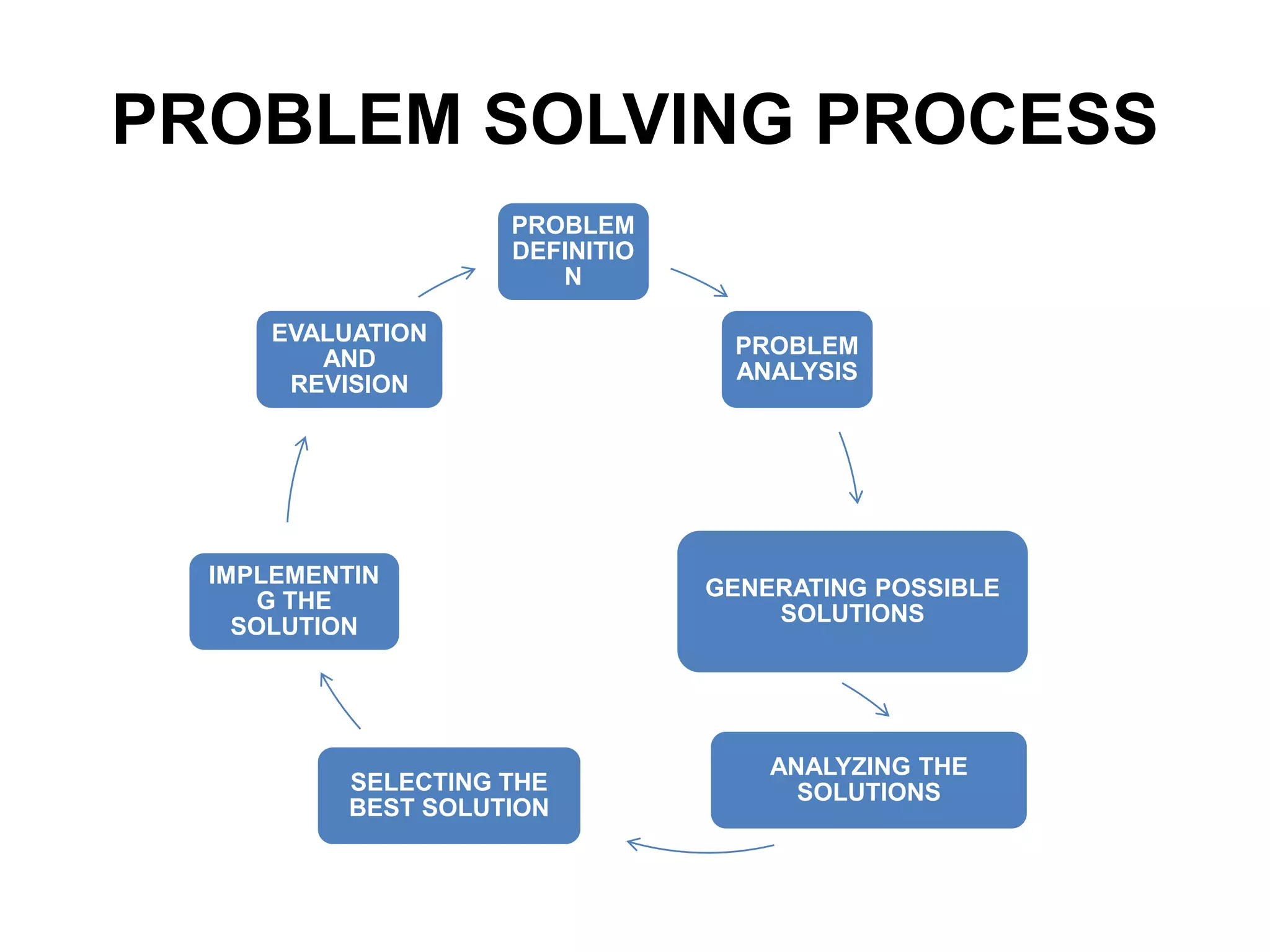
- The research process involves identifying a problem or question, collecting and analyzing data, developing hypotheses, implementing solutions, and evaluating results. It uses scientific methods and aims to describe, explain, predict, and control variables.
- Good research is systematic, objective, generalizable, and helps refine nursing practices through empirical evidence. It addresses important professional issues and improves health outcomes.
NURSING RESEARCH
UNIT I-RESEARCH AND
RESEARCH PROCESS
-Introduction and Need for Nursing Research
- Definition of Research and nursing research
- Steps of Scientific Method
-Characteristics of good research
- Steps of Research Process- Overview
Prepared By:
Mrs.AKILA.A ,M.Sc (N); M.Sc (PSY)
ASSOCIATE PROFESSOR
2.
INTRODUCTION
Nursing is anemerging profession.
Nursing is required to develop, maintain
and improve health of all the individuals.
Nursing Professionals, constituting the
major health care force have an important
role in providing quality care to the
patients. Nurses are responsible for their
practice, so we should have a sound
rationale for actions, based on knowledge
that is gained through scientific research.
3.
MEANING OF RESEARCHAND
NURSING RESEARCH
• The word research is composed of prefix 're' and a
verb 'search' ,re means once gain, anew or fresh, and
search means to look for something or examine
closely and carefully, to look for information, to set and
try, or to prove. Therefore, research means close and
careful examinations of facts and their relationship to
discover new knowledge.
• The ultimate purpose of nursing is to provide high
quality patient care. Clinical nursing practice without
research is based on tradition without empirical
evidences.
4.
RESEARCH
Research = searchagain or to examine carefully
Definition Diligent, systematic inquiry or study
to validate and refine existing knowledge and
develop new knowledge
Goal Development of body of knowledge.
5.
RESEARCH
• Research isdefined as a systematic or scientific process to answer
to questions about facts and relationship between facts. It is an
activity involved in seeking answer to unanswered questions.
• Research is systematic method of exploring, describing, explaining,
relating or establishing the existence of phenomenon , that factors
that cause change in the phenomenon and how the phenomenon
influences other phenomena.
6.
DEFINITION OF NURSING
RESEARCH
•Nursing research refers to the use of
Systematic, controlled, empirical, and critical
investigation in attempting to discover or
confirm facts that relate to specific problem or
question about the practice.
- Walls & Bauzell, 1981.
• It is a way of identify new knowledge,
improve professional education and practices
and use of resources effectively.
- International Council of Nurses, 1986.
7.
NEED AND PURPOSESOF NURSING
RESEARCH
Develop, refine, and extend the scientific
base of knowledge, which is required for
quality nursing care, education and
administration.
Enhance the body of professional knowledge
in nursing.
Provide foundation for evidenced based
nursing practices.
Help in expansion of knowledge.
Enhance the professional identity as research
is an essential component of any profession
8.
CONTD..
Define the parametersof nursing.
Refine and eliminate old knowledge.
Identify nursing care practices that make a
differences in health care status of individuals
and are cost effective.
Enhance accuracy
Develop and refine nursing theories and
principles.
Solve the problems or answer questions.
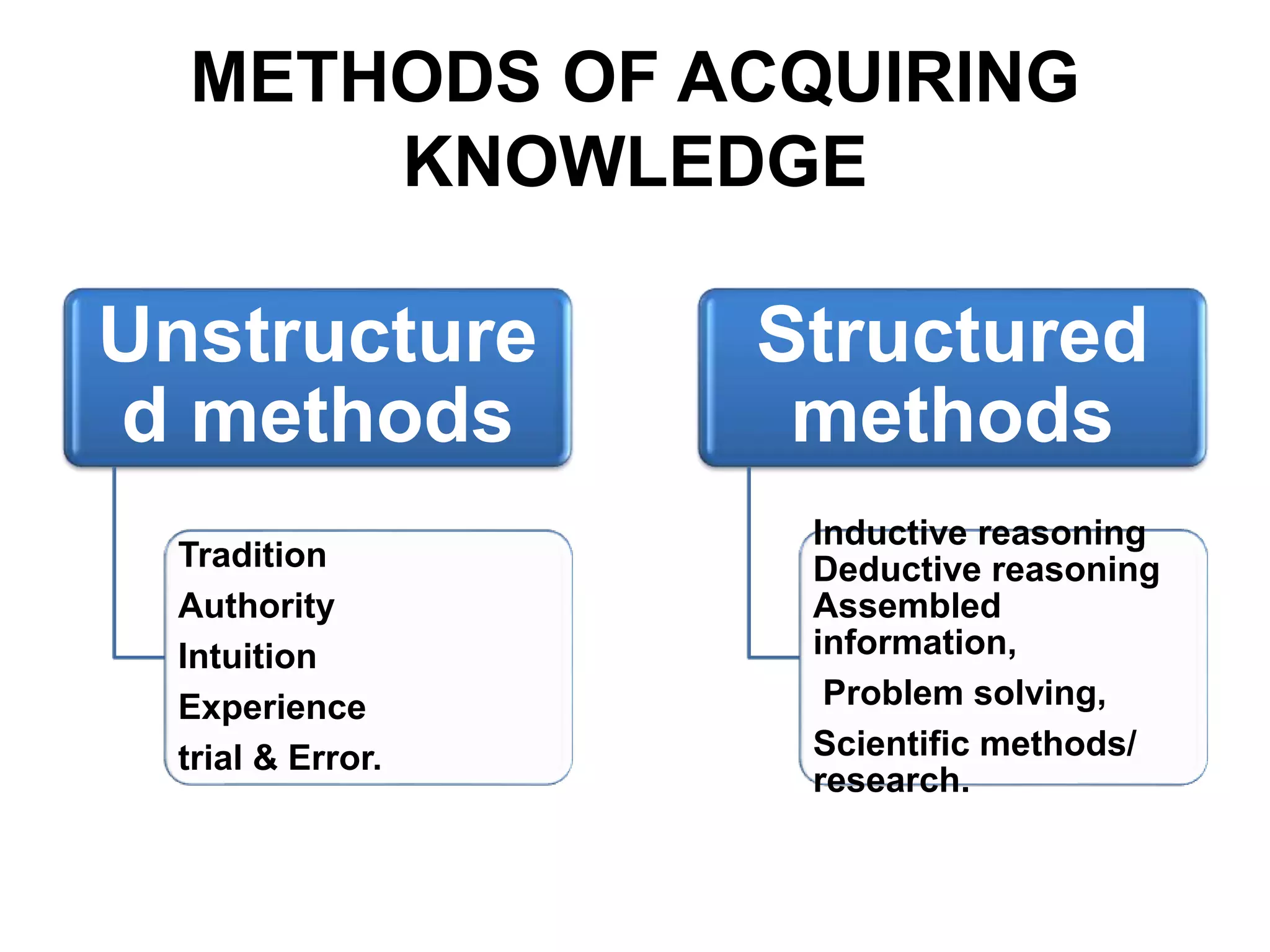
TRADITION
Include ‘truths’ or‘beliefs’ that are based
on customs and past trends.
e.g. Cardiac patients are required to take
sponge bath throughout hospitalization.
13.
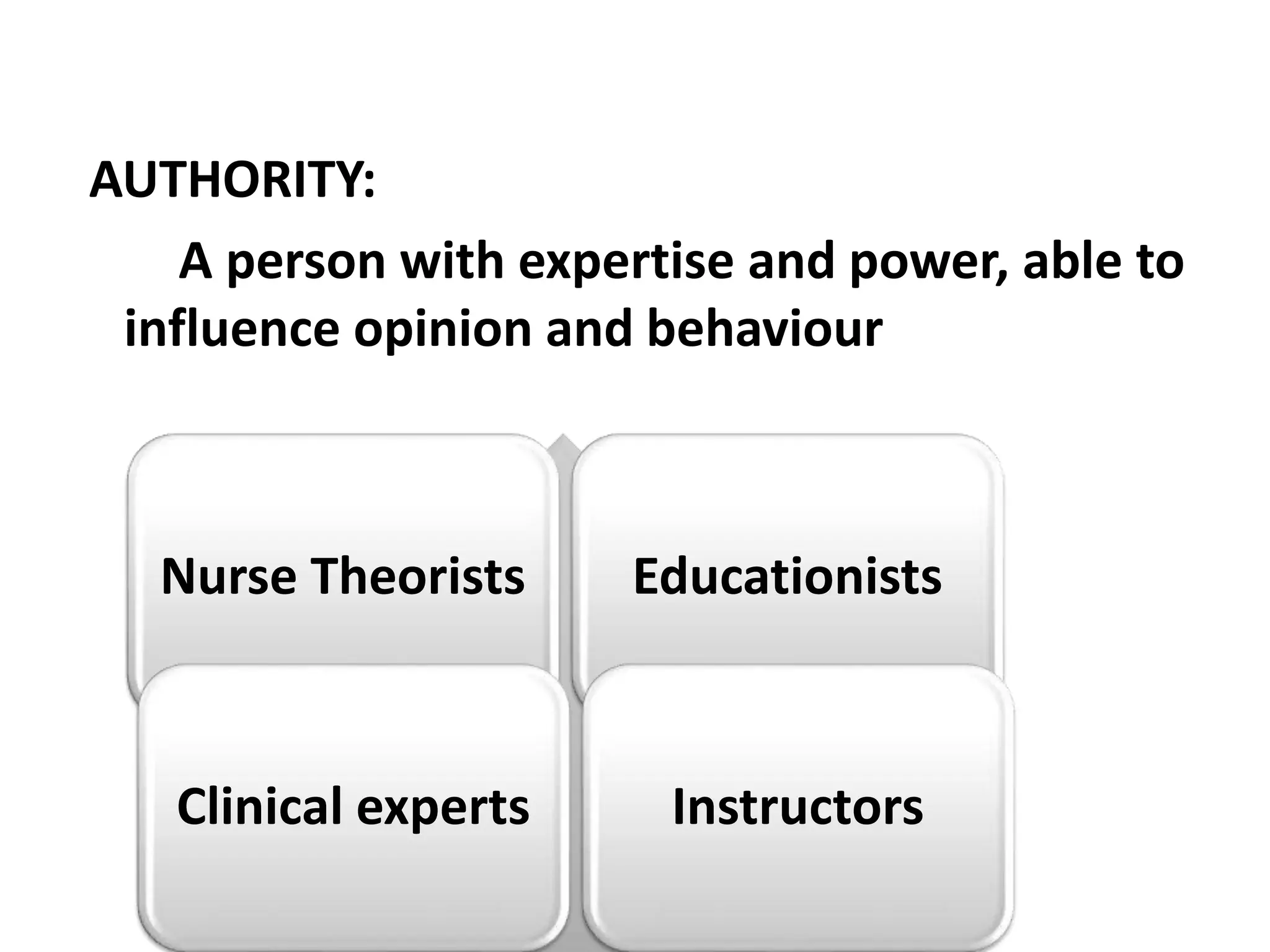
AUTHORITY:
A person withexpertise and power, able to
influence opinion and behaviour
Nurse Theorists Educationists
Clinical experts Instructors
14.
BORROWING
Nursing knowledge isa combination of
information borrowed from disciplines such
as Medicine, Sociology, Psychology,
Physiology, Education, etc.
Direct borrowing
Integrating and applying information
15.
TRIAL AND ERROR
•An approach with unknown outcomes that is
used in situation of uncertainty in which
other sources of knowledge are unavailable
ROLE MODEL
• Learningby initiating the
behaviours of an expert
• Role models include
• Admired Teachers
• Expert Clinicians
• Researchers
• Individuals who inspire
19.
INTUTION
• Learning byinitiating the behaviours of
an expert Role models include admired
teachers, expert clinicians, researchers
or individuals who inspire students
through their example.
20.
REASONING
• The processingand organising of ideas in
order to reach conclusions. Here people
are able to make sense of their thoughts
and experiences.
21.
REASONING
• Inductive reasoningMoves from specific
to general particular instances are
observed and their continued into a larger
whole or general statement.
• Deductive reasoning Moves from general
to specific or from a general premise to a
particular situation or conclusion
22.
METHODS OF ACQUIRING
KNOWLEDGE:
•Scientific method
• Problem solving method
Scientific method:
• It is an objective, logical and a systemic
method aims at discovering facts and is a
process for experimentation that is used to
explore observations and answer new
questions.
• Example: cause and effect relationship.
23.
SCIENTIFIC METHODS
• Itis defined as controlled, systematic investigations,
that are rooted in objective reality and that aim to
develop general knowledge about natural phenomena.
Purposes of scientific Methods
• The basic purposes of scientific methods are
description, exploration, prediction, control,
explanation, prescription and identification of
relationship of the facts
24.
5 basic conceptsof scientific method:
• It relies on empirical evidence
• It utilises relevant concepts
• Committed to only objective consideration
• Results in probabilistic predictions
• Testing the conclusions through replication
25.
CHARACTERISTICS OF
SCIENTIFIC METHOD:
•It is based on empirical evidence (based on
observation or experience )
• It is based on objective observation (bias free,
observation).
• It utilizes relevant concepts
• It follows ethical norms
• It is systematic (planned step by step).
• It results in predictions (anticipating outcome).
• It is based on critical & logical analysis of facts.
• It is replicable (test result or conclusion again & again).
• It formulates base for development of scientific
theories.
26.
STEPS OF SCIENTIFICMETHOD:
IDENTIFICATION
& STATEMENT
OF THE
PROBLEM
COLLECTI
ON OF
FACTS
CLASSIFICATION
&
ORGANIZATION
OF THE FACTS
FORMULATION
OF
HYPOTHESIS
DEDUCING
THE
CONSEQU
ENCES
VERFICATION
OF
HYPOTHESIS
DRAWING
CONCLUSIONS
27.
STEPS OF SCIENTIFICMETHOD:
• Certain phenomena are observed.
• A problem situation which there is in noted and
clarified.
• Crude relationship are tentatively identified and
elaborated.
• A more or less formal hypothesis is derived and design
is developed to test a hypothesis.
• The hypothesis is verified or refused.
• The results are subjected to further tests and
refinements.
• Finally the results are integrated with previous
concepts of science.
CHARACTERISTICS OF GOOD
RESEARCH
Orderlyand systematic process
Based on current professional issues
Begin with clearly defined purposes
Emphasize to develop, refine and expand
professional knowledge.
Directed towards development or testing theories
Finding solution of problem
Dedicated to develop empirical evidence
Strive to collect first- hand information /data
An objective and logical process
31.
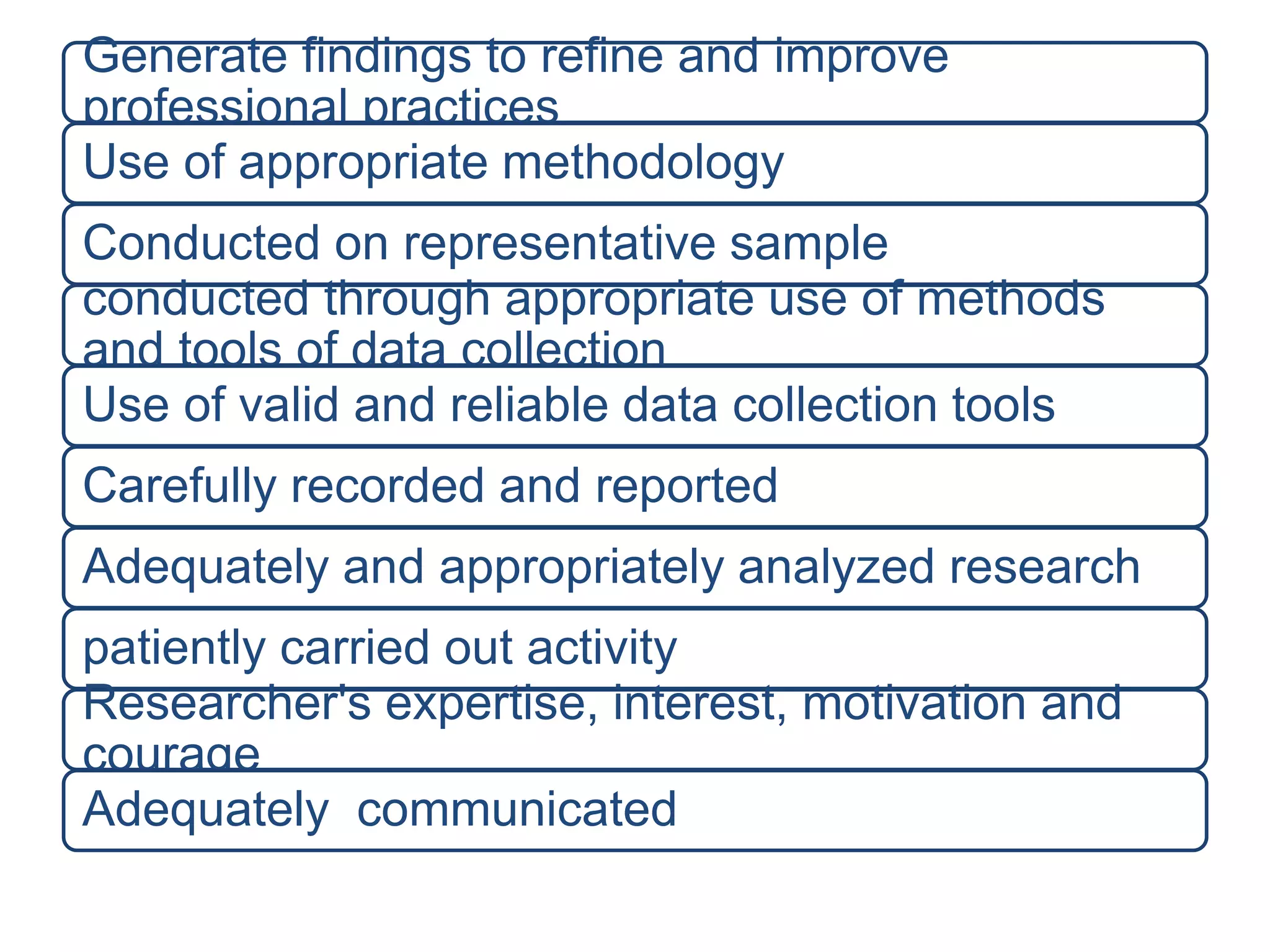
Generate findings torefine and improve
professional practices
Use of appropriate methodology
Conducted on representative sample
conducted through appropriate use of methods
and tools of data collection
Use of valid and reliable data collection tools
Carefully recorded and reported
Adequately and appropriately analyzed research
patiently carried out activity
Researcher's expertise, interest, motivation and
courage
Adequately communicated
32.
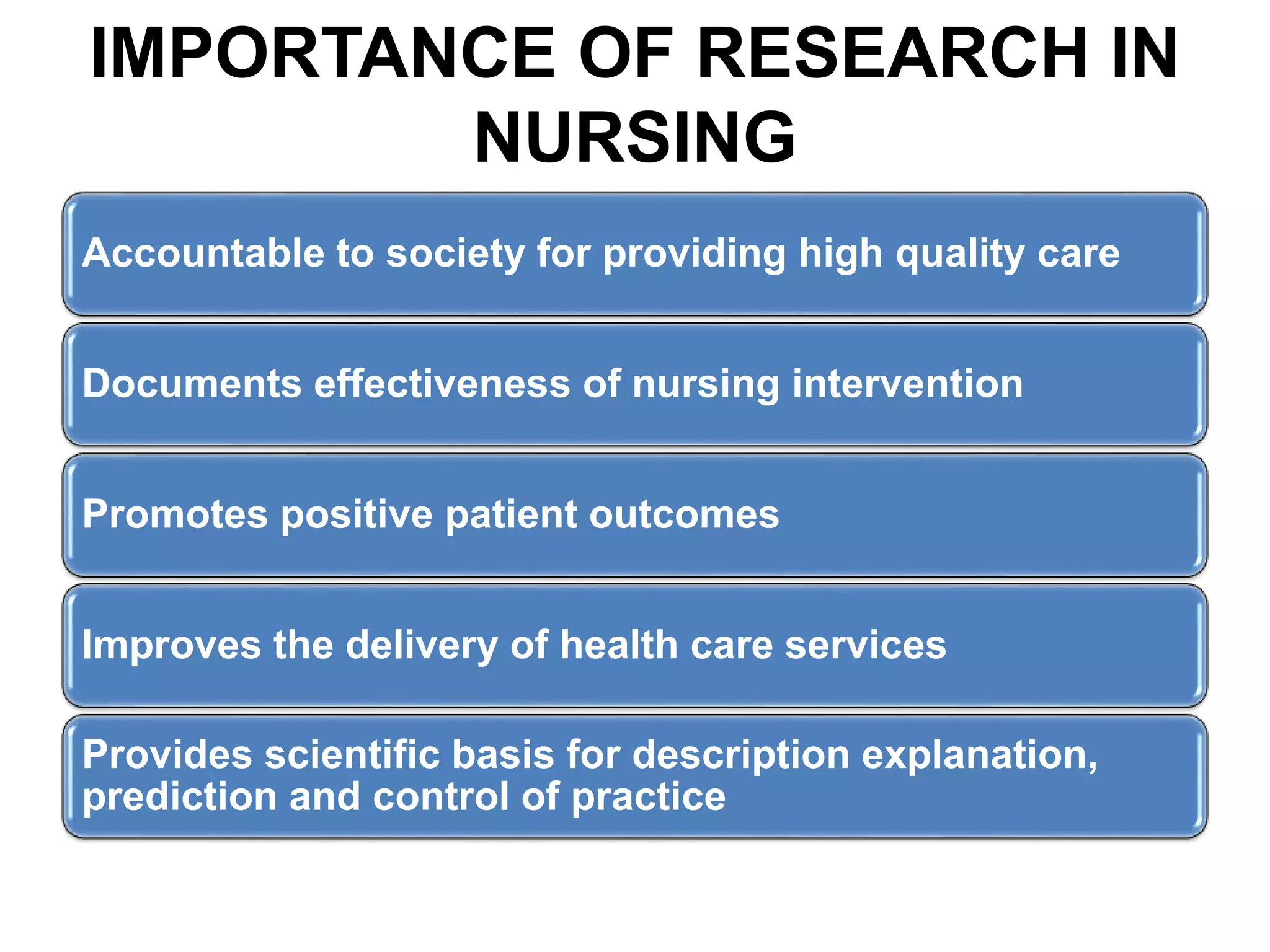
IMPORTANCE OF RESEARCHIN
NURSING
Accountable to society for providing high quality care
Documents effectiveness of nursing intervention
Promotes positive patient outcomes
Improves the delivery of health care services
Provides scientific basis for description explanation,
prediction and control of practice
DESCRIPTION
Identifying the natureand attributes of nursing
phenomena and the relationships among them.
e.g. “Post hospitalization concerns of Medical-Surgical
patients”(Boyle et al, 1992)
Most important concerns identified were
• Understanding the progress patients were making
• Deciding how much activity is good
35.
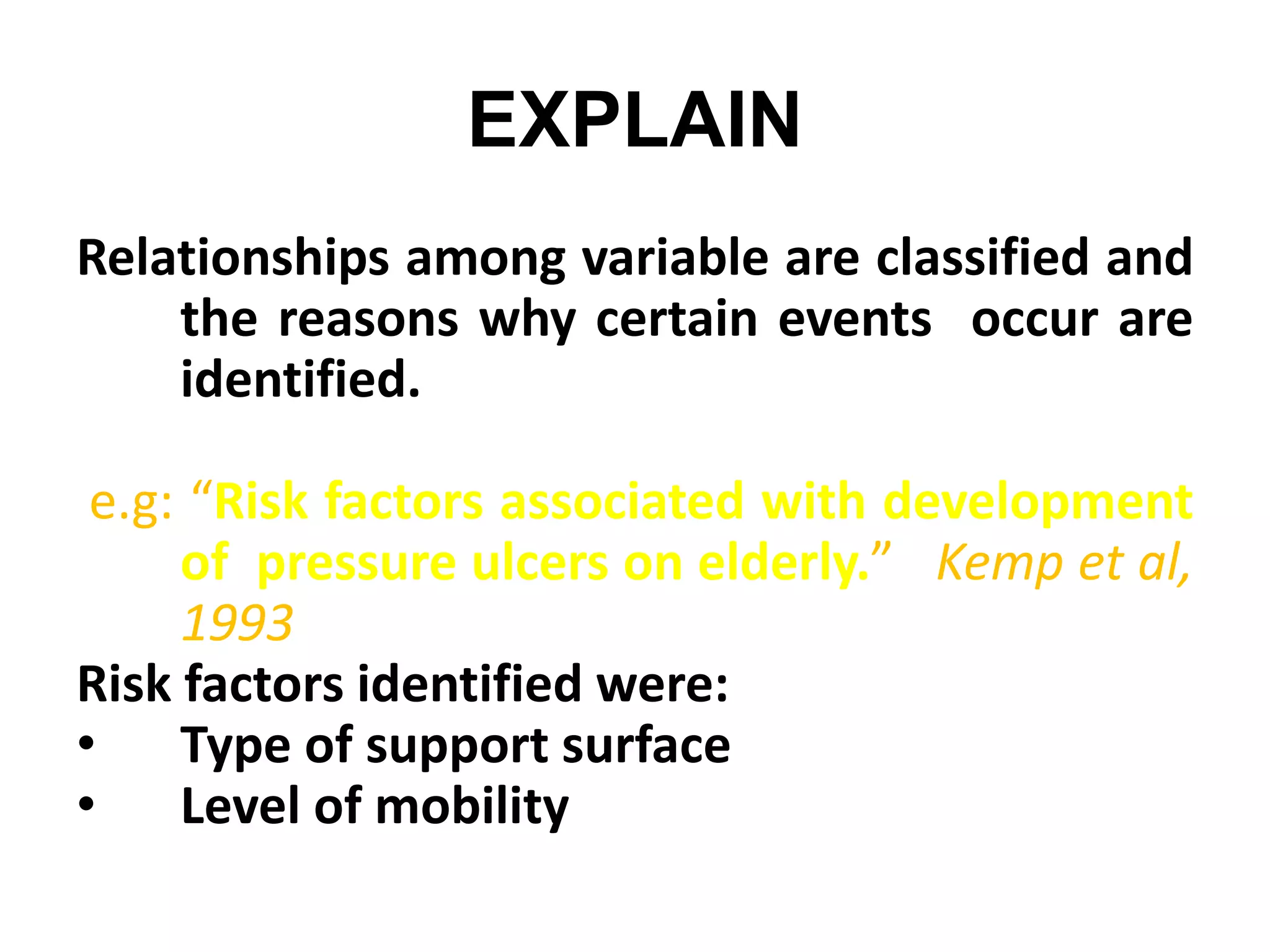
EXPLAIN
Relationships among variableare classified and
the reasons why certain events occur are
identified.
e.g: “Risk factors associated with development
of pressure ulcers on elderly.” Kemp et al,
1993
Risk factors identified were:
• Type of support surface
• Level of mobility
36.
PREDICT
Estimate the probabilityof a specific outcome in a given
situation.
It may not modify or control the outcome.
e.g. “Effects of attendance and effort on the cognition
and physical functioning of older adults involved in a
long term exercise program”
Findings
Patient's attendance and efforts scores were prediction
of their health perception and physical functioning
37.
CONTROL
Ability to producethe desired outcome by
manipulation of the situation.
e.g.: “Back massage to promote comfort and
relaxation in hospice patients”
Findings proved that slow stroke back massage
was helpful for terminally ill patients
38.
RELEVANT TERMS IN
QUANTITATIVERESEARCH
Quantitative Research : Is a formal,
objective systematic process for
generating information about the world.
Basic research : (Pure research) Is a
scientific investigation that involves
pursuit of “Knowledge for knowledge’s
sake” or for the pleasure of learning
and funding truth (Nagel 1961)
39.
Applied Research (Practicalresearch)
Is a scientific investigation conducted
to generate knowledge that will directly
influence or improve clinical practice
(Abdellah & Levine, 1979)
Rigor The striving for excellence in
research and involves discipline,
adherance to detail and strict accuracy.
Rigor ensures reasoning and precision
in conducting the study.
40.
Control :
Involves theimposing of “rules” by the
researcher to decrease the possibility of
error and thus increase the probability that
the study’s findings are an accurate
reflection of reality.
Sampling:
Process of selecting subjects (people,
events, behaviors or other elements) that
are representative of the population being
studied
41.
RESEARCH SETTINGS
The settingis the location where the study is
conducted.
Natural setting (field setting) is an uncontrolled real-life situation.
Here the researcher does not manipulate or change the
environment for the study
Partially controlled setting Is an environment that is manipulated or
modified in some way by the researcher
Highly controlled setting Is an artificially constructed environment
developed for the sole purpose of conducting research, used
extensively for experimental and quasi experimental studies
42.
RESEARCH PROBLEM
Situation inneed of solution,
improvement or alteration (Adebo, 1974)
Or
Discrepancy between the way things are
and the way they ought to be
(Diers, 1979)
The problem is an area of concern for a
particular population that requires study.
STUDY FRAME WORK
•Is the abstract, theoretical basis for a study
that enables the researcher to link the
findings to nursing’s body of knowledge.
Theory consists of an integrated set of
defined concepts and relational statements,
that present a view of a phenomenon and
can be used to describe, explain, predict or
control the phenomenon.
45.
RESEARCH OBJECTIVES
Is aclear, concise, declarative statement that
is expressed in present tense.
For clarity, an objective usually focuses on
one or two variables and indicates whether
they are to be identified or described.
46.
RESEARCH PROBLEM
• Isa concise interrogative statement that is
worded in the present tense and includes
one or more variables (or concepts).
47.
HYPOTHESIS
Formal statement ofthe expected relationship(s) between two
or more variables in specified population.
Translates research problems and purpose into clear
explanations or predictions
Includes variables to be manipulated or measured
Identifies the population to be examined
Indicates the type of research
Directs the conduct of the study
48.
VARIABLES
Variables are conceptsof various levels of
abstraction that are measured, manipulated
or controlled in a study.
Concrete concepts : Temperature, Weight, Blood Pressure etc.,
Abstract concepts : Creativity, empathy, Social support.
Variables are described by the conceptual and operational
definitions.
49.
Conceptual definition providesa variable
with a theoretical meaning of and is
derived from a theorists definition or is
developed through concept analysis.
Operational definition is developed so
the variable can be measured or
manipulated in a study.
50.
Example: Sensation ofdyspnea
Conceptual definition : Subjective
perception of uncomfortable breathing,
which is a stressful situation that
requires appraisal.
Operational definition : Interviews were
conducted with open ended question and
forced-choice terms that focused on the
subjects descriptions (Physical and
emotional sensations) of dyspnea.
51.
ASSUMPTIONS
Statements that aretaken for granted or are considered true even
though they have not been scientifically tested.
Assumptions are embedded (unrecognised) in thinking and behavior,
and uncovering these assumptions requires introspection.
Recognition of assumption by the researches is a strength, not a
weakness.
Eg.: “Increased knowledge about an event lowers anxiety about the
event.
52.
• Limitations arerestrictions in a study that
may decrease credibility and
generalizability of the findings.
• Generalization is the extension of the
implications of the research findings from
the sample to be on larger population
53.
RESEARCH DESIGN
• Blueprintfor the conduct of the study that
maximises control over factors that could
interfere with the outcome.
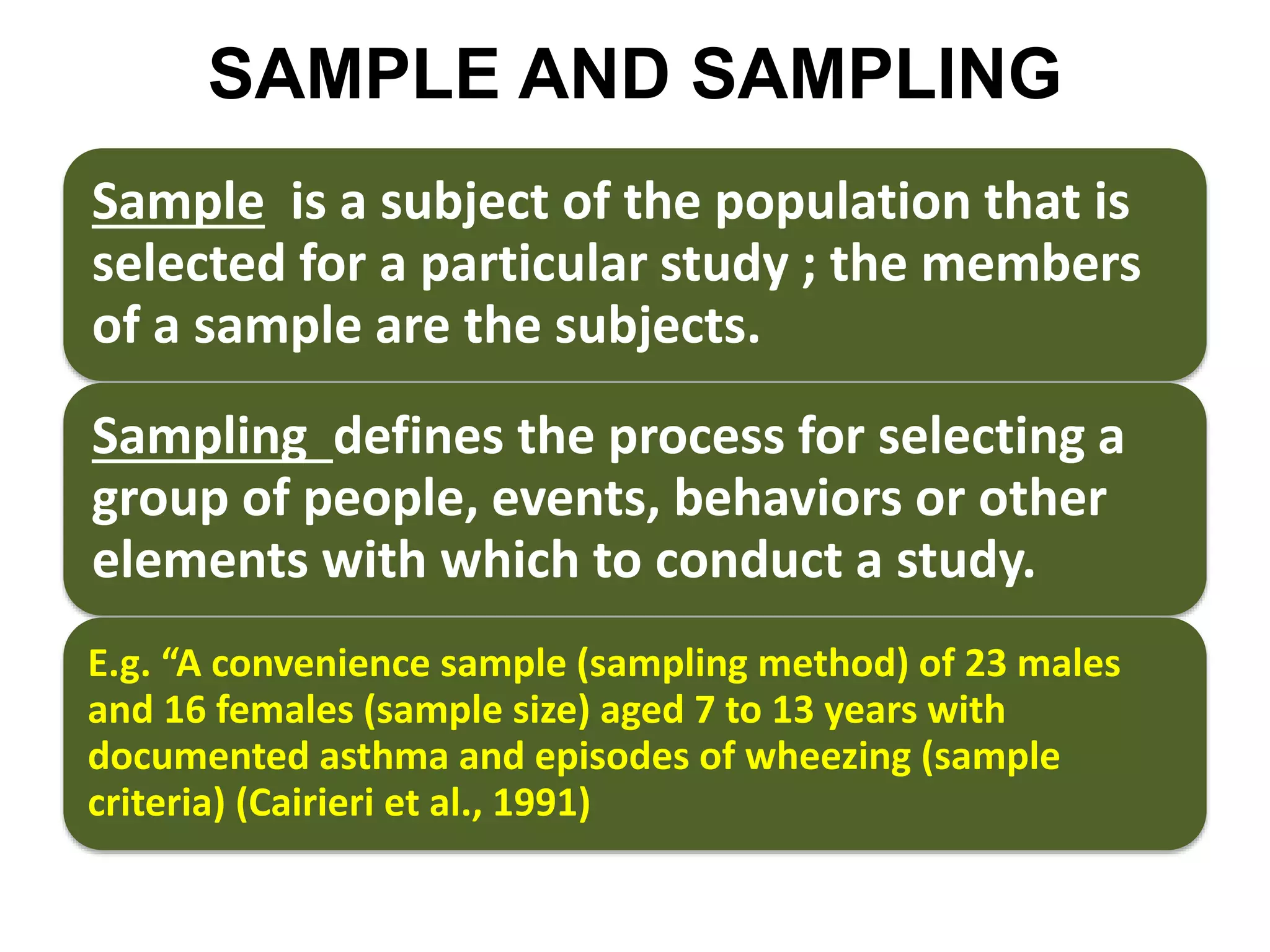
SAMPLE AND SAMPLING
Sampleis a subject of the population that is
selected for a particular study ; the members
of a sample are the subjects.
Sampling defines the process for selecting a
group of people, events, behaviors or other
elements with which to conduct a study.
E.g. “A convenience sample (sampling method) of 23 males
and 16 females (sample size) aged 7 to 13 years with
documented asthma and episodes of wheezing (sample
criteria) (Cairieri et al., 1991)
56.
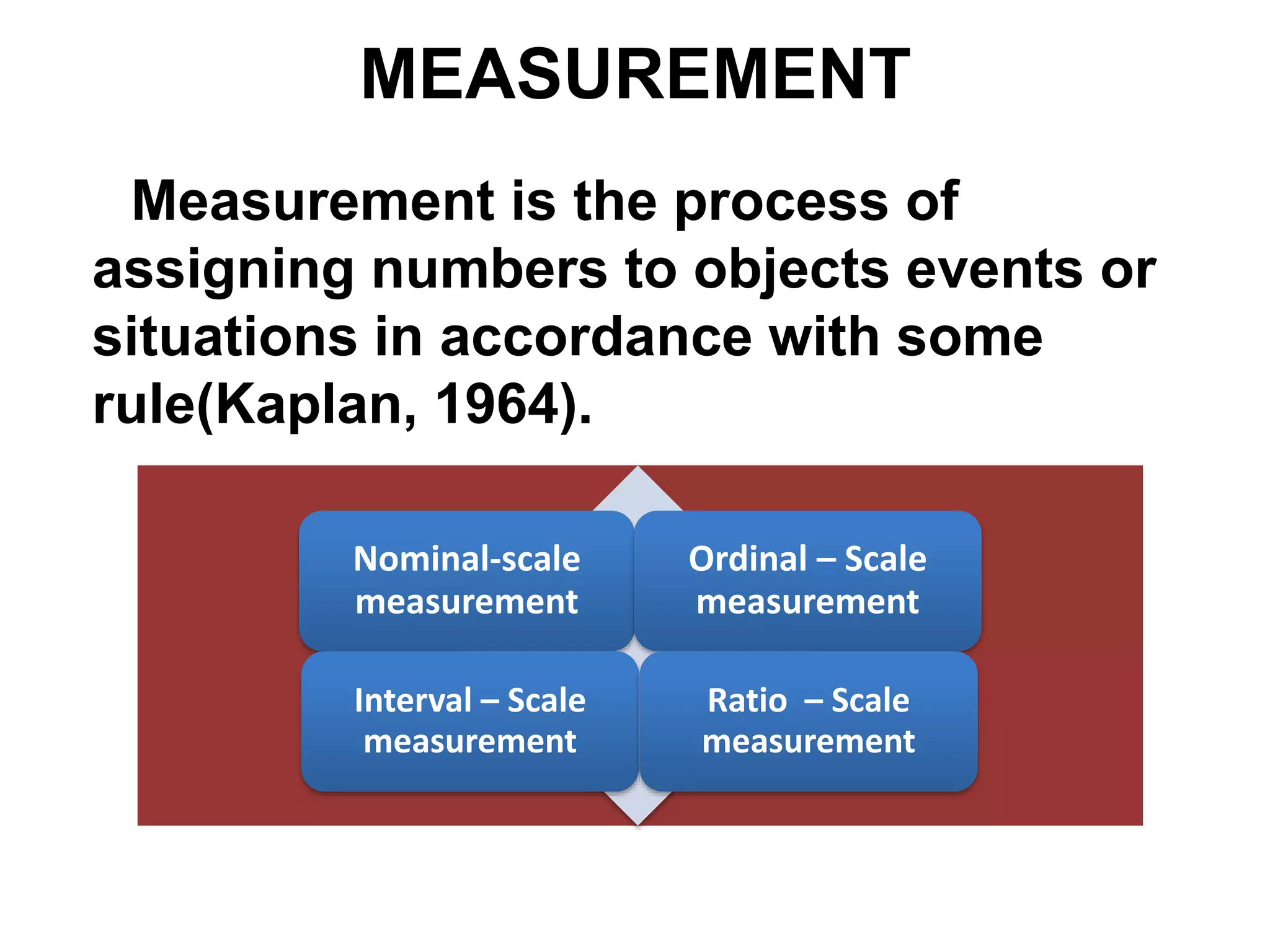
MEASUREMENT
Measurement is theprocess of
assigning numbers to objects events or
situations in accordance with some
rule(Kaplan, 1964).
Nominal-scale
measurement
Ordinal – Scale
measurement
Interval – Scale
measurement
Ratio – Scale
measurement
57.
Reliability: How consistentlythe
measurement technique measures the
concept of interest.
Validity: A determination of the extent to
which the instrument actually reflects
the abstract concept or construct being
examined
58.
Data Collection :Precise, systematic
gathering of information relevant to the
research purpose or the specific objectives,
questions or hypothesis of a study.
Observations, interviews, questionnaires
scales or physiologic instruments.
Consent from the setting, agency where study
is conducted and subjects should always be
obtained.
59.
Data analysis :Conducted to reduce,
organize and give meaning to the dataDescriptive and inferential analyses
Frequency distributions (ungrouped, grouped,
percentages)
Measures of central tendency(mean, median,
mode).
Measures of dispersion(range, variance,
standard deviation etc.,),
Chi-square tests of independence, ‘ t’tests,
Analysis of variance(anova) etc.,
60.
Research Outcomes:
The resultsobtained from data
analysis are interpreted to make them
meaningful.
Interpretation:
Examining the results from data
analysis, forming conclusions,
exploring significance of findings, and
suggesting further studies.
61.
RESEARCH REPORTS
• Researchreports are major resource of
new knowledge and the amount of
research information available
continues to escalate.
62.
RESEARCH PROCESS
• Researchprocess is a vigorous, impersonal
mode of procedure dictated by the demands
of the logic and objective procedure.
• Research process is the examination and
analysis of systematically gathered facts
about the particular problem.
Aim:
• Discovery or validation of the knowledge. It is
the systematic way of problem solving.
63.
STEPS IN RESEARCHPROCESS:
Research Problem and Purpose
Literature review
Study Framework
Objectives, questions or hypotheses
Study variables
Assumptions
65.
STEPS IN RESEARCHPROCESS
QUANTITATIVE RESEARCH:
According to Polit, there are 5 phases in
Research Process.
1.Conceptual Phase
2.Designing and Planning Phase
3.Empirical Phase
4.Analytical Phase
5.Disseminating Phase
66.
STEPS IN CONCEPTUALPHASE
I.CONCEPTUAL PHASE:
1.Formulating and delimiting the problem
2. Review of literature
3. Undertaking clinical field work
4. Defining framework and developing
conceptual definitions
5. Formulating Hypothesis
67.
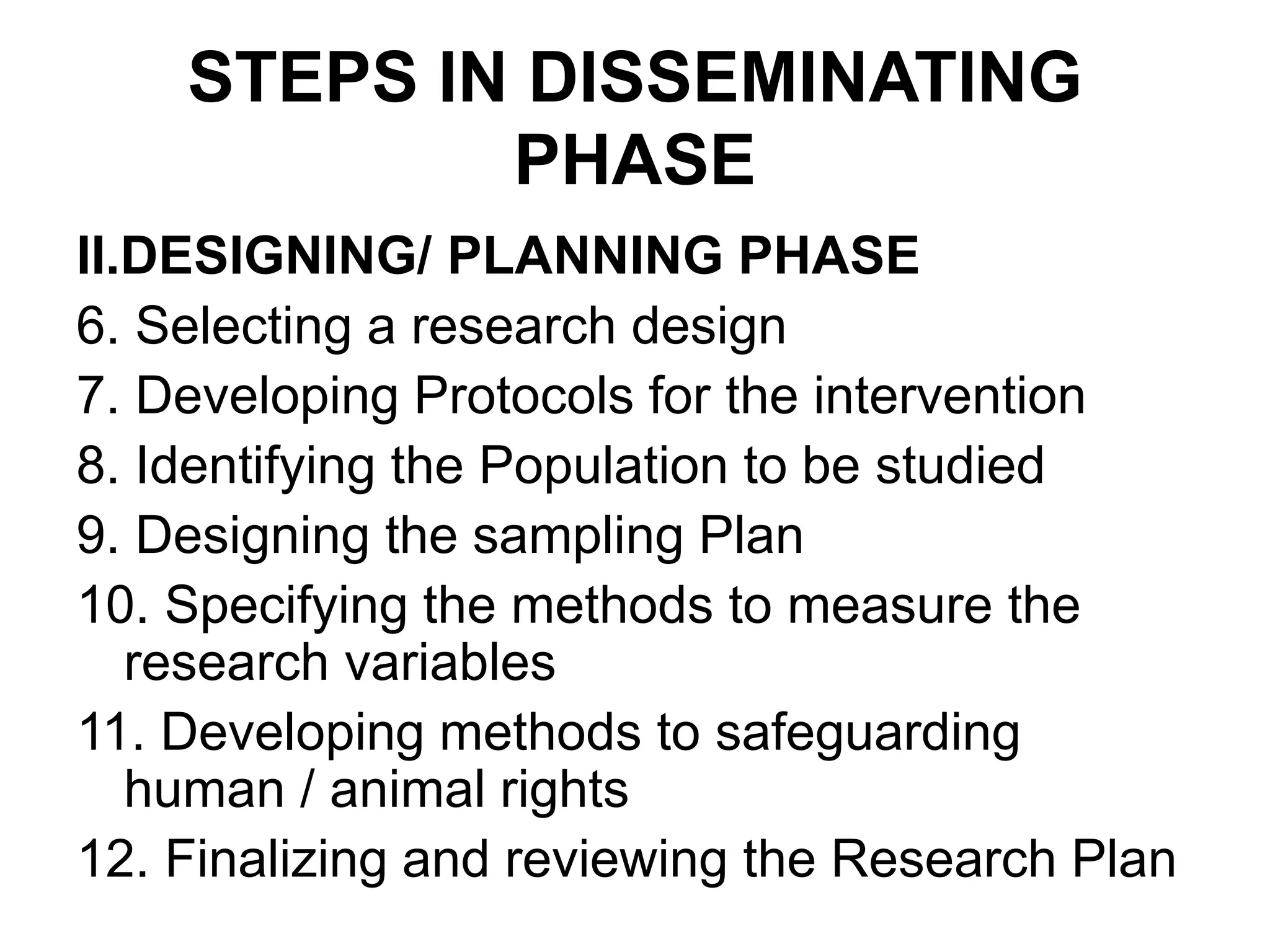
STEPS IN DISSEMINATING
PHASE
II.DESIGNING/PLANNING PHASE
6. Selecting a research design
7. Developing Protocols for the intervention
8. Identifying the Population to be studied
9. Designing the sampling Plan
10. Specifying the methods to measure the
research variables
11. Developing methods to safeguarding
human / animal rights
12. Finalizing and reviewing the Research Plan
68.
STEPS IN EMPIRICALPHASE
III. EMPIRICAL PHASE:
13. Collecting the data
14. Preparing the data for analysis
69.
STEPS IN ANALYTICALPHASE
IV.THE ANALYTICAL PHASE:
15. Analysing the data
16. Interpreting the results
70.
STEPS IN DISSEMINATION
PHASE
V.THE DISSEMINATION PHASE:
17. Communicating the findings
18. Utilizing the findings in Practice
71.
MAJOR STEPS INQUALITATIVE
STUDY:
PHASE 1: CONCEPTUALIZING AND
PLANNING A QUALITATIVE STUDY
• Identifying the research problem
• Doing literature review
• Selecting and gaining entry in to research
sites
• Research design(qualitative)
• Addressing ethical issues
72.
PHASE 2 :CONDUCTING THE
QUALITATIVE STUDY:
• Establishing ethical considerations
• Plan tools for data collection
• Data collection
• Organise the data for analysis
• Analysis and interpretation
73.
PHASE 3: DISSEMINATINGTHE
QUALITATIVE FINDINGS
• Communicating the findings
• Utilising the findings in practice.