Prof X EMERENSIA
HOD CHILD HEALTH NURSING
RVS COLLEGE OF NURSING, SULUR, COIMBATORE
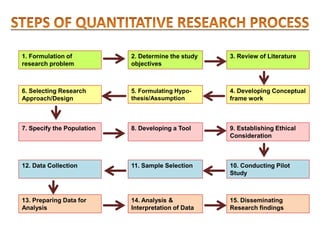
1. Formulation of
research problem
2. Determine the study
objectives
3. Review of Literature
4. Developing Conceptual
frame work
5. Formulating Hypo-
thesis/Assumption
6. Selecting Research
Approach/Design
7. Specify the Population 8. Developing a Tool 9. Establishing Ethical
Consideration
10. Conducting Pilot
Study
11. Sample Selection12. Data Collection
13. Preparing Data for
Analysis
14. Analysis &
Interpretation of Data
15. Disseminating
Research findings
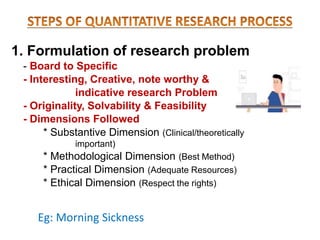
1. Formulation of research problem
- Board to Specific
- Interesting, Creative, note worthy &
indicative research Problem
- Originality, Solvability & Feasibility
- Dimensions Followed
* Substantive Dimension (Clinical/theoretically
important)
* Methodological Dimension (Best Method)
* Practical Dimension (Adequate Resources)
* Ethical Dimension (Respect the rights)
Eg: Morning Sickness
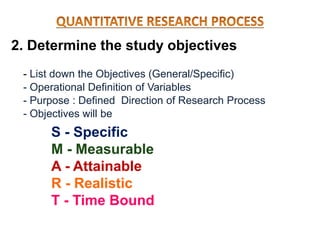
2. Determine the study objectives
- List down the Objectives (General/Specific)
- Operational Definition of Variables
- Purpose : Defined Direction of Research Process
- Objectives will be
S - Specific
M - Measurable
A - Attainable
R - Realistic
T - Time Bound
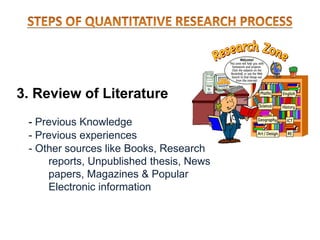
3. Review of Literature
- Previous Knowledge
- Previous experiences
- Other sources like Books, Research
reports, Unpublished thesis, News
papers, Magazines & Popular
Electronic information
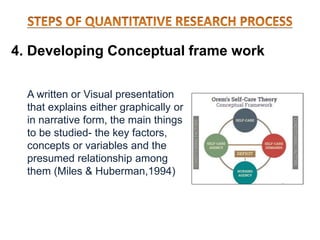
4. Developing Conceptual frame work
A written or Visual presentation
that explains either graphically or
in narrative form, the main things
to be studied- the key factors,
concepts or variables and the
presumed relationship among
them (Miles & Huberman,1994)
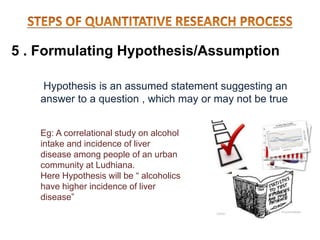
5 . Formulating Hypothesis/Assumption
Hypothesis is an assumed statement suggesting an
answer to a question , which may or may not be true
Eg: A correlational study on alcohol
intake and incidence of liver
disease among people of an urban
community at Ludhiana.
Here Hypothesis will be “ alcoholics
have higher incidence of liver
disease”
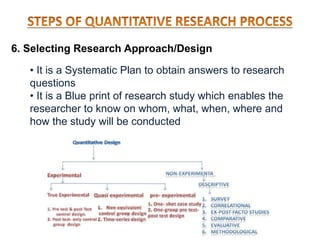
6. Selecting Research Approach/Design
• It is a Systematic Plan to obtain answers to research
questions
• It is a Blue print of research study which enables the
researcher to know on whom, what, when, where and
how the study will be conducted
7. Specify the Population
• Aggregate of all the subject/objects with specific
characteristics
8. Developing a Tool
• Is an instrument to measure the research variables
objectively and accurately as possible
• (Standardized or developed tool can be used)
• Structured or semi structured tool.
Eg: Prevalence of Hospital Acquired Infection among
Patients admitted to ICU
9. Establishing Ethical Consideration
• Taking informed consent from participants
• Avoiding errors in data collection
• Obtaining permission from authority
• Doing justice to participant
• Maintaining confidentiality & anonymity
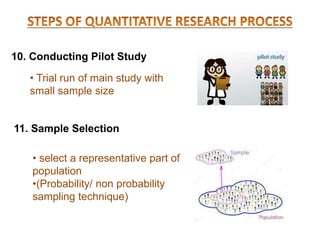
10. Conducting Pilot Study
• Trial run of main study with
small sample size
11. Sample Selection
• select a representative part of
population
•(Probability/ non probability
sampling technique)
12. Data collection
• Gather information to pertaining to the topic under
study
• Data to be collected through questioning,
interviewing or observation methods
13. Preparing data for analysis
• Gather information should be coded manually in a
paper or computer grading sheet or directly in
statistical software
14. Analysis & Interpretation of Data
• Data may be analyzed by descriptive and inferential
statistics
• Data is presented through tables and graphs /
charts to facilitate the interpretation of data
15. Disseminating the research finding
• finding may be communicated through writing of
research thesis, articles or presenting an oral research
report at scientific professional conference
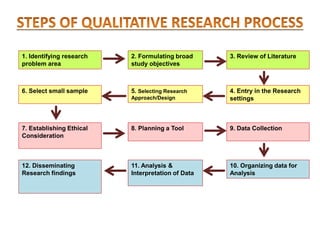
1. Identifying research
problem area
2. Formulating broad
study objectives
3. Review of Literature
4. Entry in the Research
settings
5. Selecting Research
Approach/Design
6. Select small sample
7. Establishing Ethical
Consideration
8. Planning a Tool 9. Data Collection
10. Organizing data for
Analysis
11. Analysis &
Interpretation of Data
12. Disseminating
Research findings
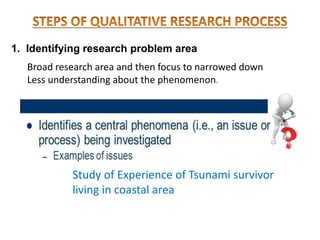
1. Identifying research problem area
Broad research area and then focus to narrowed down
Less understanding about the phenomenon.
Study of Experience of Tsunami survivor
living in coastal area
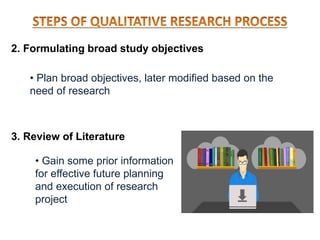
2. Formulating broad study objectives
• Plan broad objectives, later modified based on the
need of research
3. Review of Literature
• Gain some prior information
for effective future planning
and execution of research
project
4. Entry in the Research settings
• Prior permission from authorities
• Contact with key informants, who will share the
information about the phenomenon & subjects
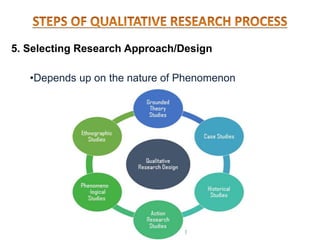
5. Selecting Research Approach/Design
•Depends up on the nature of Phenomenon
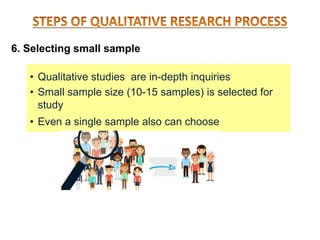
6. Selecting small sample
• Qualitative studies are in-depth inquiries
• Small sample size (10-15 samples) is selected for
study
• Even a single sample also can choose
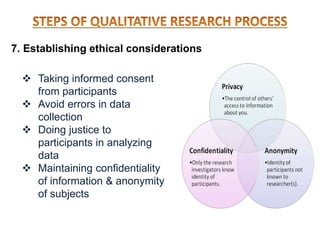
7. Establishing ethical considerations
 Taking informed consent
from participants
 Avoid errors in data
collection
 Doing justice to
participants in analyzing
data
 Maintaining confidentiality
of information & anonymity
of subjects
8. Planning tools for data collection
• Semi-structured or unstructured tool can be used
• Most of the items included in tool are open ended
• Data may be collected through video-taping, tape
recording, focus group interviews, photographs,
reflective journals, field notes, transcripts,
cumulative diaries
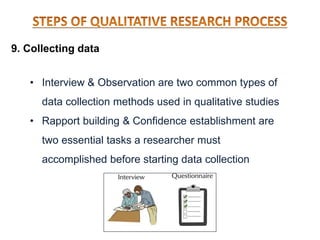
9. Collecting data
• Interview & Observation are two common types of
data collection methods used in qualitative studies
• Rapport building & Confidence establishment are
two essential tasks a researcher must
accomplished before starting data collection
10. Organizing data for analysis
The techniques used in organizing data are
• Listing
• Categorizing
• Comparing
• Laddering
11. Analysis & Interpretation of data
• Here, Analysis is a challenging task
• Analysis begins with data collection.
• Usually involves an examination of words rather than
numbers
• No universally accepted rule for analysis
• Can be also analysed using descriptive coding,
indexing, narrations, integrative diagrams, thematic
analysis.
12. Disseminating the research findings
Research finding communicated
• by writing research thesis, articles or
presenting an oral research report at
scientific professional conferences.
• In a standardized format according to
international, national or institutional
guidelines
Research process  quantitative and qualitative

Research process quantitative and qualitative

  • 1.
    Prof X EMERENSIA HODCHILD HEALTH NURSING RVS COLLEGE OF NURSING, SULUR, COIMBATORE
  • 5.
    1. Formulation of researchproblem 2. Determine the study objectives 3. Review of Literature 4. Developing Conceptual frame work 5. Formulating Hypo- thesis/Assumption 6. Selecting Research Approach/Design 7. Specify the Population 8. Developing a Tool 9. Establishing Ethical Consideration 10. Conducting Pilot Study 11. Sample Selection12. Data Collection 13. Preparing Data for Analysis 14. Analysis & Interpretation of Data 15. Disseminating Research findings
  • 6.
    1. Formulation ofresearch problem - Board to Specific - Interesting, Creative, note worthy & indicative research Problem - Originality, Solvability & Feasibility - Dimensions Followed * Substantive Dimension (Clinical/theoretically important) * Methodological Dimension (Best Method) * Practical Dimension (Adequate Resources) * Ethical Dimension (Respect the rights) Eg: Morning Sickness
  • 7.
    2. Determine thestudy objectives - List down the Objectives (General/Specific) - Operational Definition of Variables - Purpose : Defined Direction of Research Process - Objectives will be S - Specific M - Measurable A - Attainable R - Realistic T - Time Bound
  • 8.
    3. Review ofLiterature - Previous Knowledge - Previous experiences - Other sources like Books, Research reports, Unpublished thesis, News papers, Magazines & Popular Electronic information
  • 9.
    4. Developing Conceptualframe work A written or Visual presentation that explains either graphically or in narrative form, the main things to be studied- the key factors, concepts or variables and the presumed relationship among them (Miles & Huberman,1994)
  • 10.
    5 . FormulatingHypothesis/Assumption Hypothesis is an assumed statement suggesting an answer to a question , which may or may not be true Eg: A correlational study on alcohol intake and incidence of liver disease among people of an urban community at Ludhiana. Here Hypothesis will be “ alcoholics have higher incidence of liver disease”
  • 11.
    6. Selecting ResearchApproach/Design • It is a Systematic Plan to obtain answers to research questions • It is a Blue print of research study which enables the researcher to know on whom, what, when, where and how the study will be conducted
  • 12.
    7. Specify thePopulation • Aggregate of all the subject/objects with specific characteristics 8. Developing a Tool • Is an instrument to measure the research variables objectively and accurately as possible • (Standardized or developed tool can be used) • Structured or semi structured tool. Eg: Prevalence of Hospital Acquired Infection among Patients admitted to ICU
  • 13.
    9. Establishing EthicalConsideration • Taking informed consent from participants • Avoiding errors in data collection • Obtaining permission from authority • Doing justice to participant • Maintaining confidentiality & anonymity
  • 14.
    10. Conducting PilotStudy • Trial run of main study with small sample size 11. Sample Selection • select a representative part of population •(Probability/ non probability sampling technique)
  • 15.
    12. Data collection •Gather information to pertaining to the topic under study • Data to be collected through questioning, interviewing or observation methods 13. Preparing data for analysis • Gather information should be coded manually in a paper or computer grading sheet or directly in statistical software
  • 16.
    14. Analysis &Interpretation of Data • Data may be analyzed by descriptive and inferential statistics • Data is presented through tables and graphs / charts to facilitate the interpretation of data 15. Disseminating the research finding • finding may be communicated through writing of research thesis, articles or presenting an oral research report at scientific professional conference
  • 18.
    1. Identifying research problemarea 2. Formulating broad study objectives 3. Review of Literature 4. Entry in the Research settings 5. Selecting Research Approach/Design 6. Select small sample 7. Establishing Ethical Consideration 8. Planning a Tool 9. Data Collection 10. Organizing data for Analysis 11. Analysis & Interpretation of Data 12. Disseminating Research findings
  • 19.
    1. Identifying researchproblem area Broad research area and then focus to narrowed down Less understanding about the phenomenon. Study of Experience of Tsunami survivor living in coastal area
  • 20.
    2. Formulating broadstudy objectives • Plan broad objectives, later modified based on the need of research 3. Review of Literature • Gain some prior information for effective future planning and execution of research project
  • 21.
    4. Entry inthe Research settings • Prior permission from authorities • Contact with key informants, who will share the information about the phenomenon & subjects
  • 22.
    5. Selecting ResearchApproach/Design •Depends up on the nature of Phenomenon
  • 23.
    6. Selecting smallsample • Qualitative studies are in-depth inquiries • Small sample size (10-15 samples) is selected for study • Even a single sample also can choose
  • 24.
    7. Establishing ethicalconsiderations  Taking informed consent from participants  Avoid errors in data collection  Doing justice to participants in analyzing data  Maintaining confidentiality of information & anonymity of subjects
  • 25.
    8. Planning toolsfor data collection • Semi-structured or unstructured tool can be used • Most of the items included in tool are open ended • Data may be collected through video-taping, tape recording, focus group interviews, photographs, reflective journals, field notes, transcripts, cumulative diaries
  • 26.
    9. Collecting data •Interview & Observation are two common types of data collection methods used in qualitative studies • Rapport building & Confidence establishment are two essential tasks a researcher must accomplished before starting data collection
  • 27.
    10. Organizing datafor analysis The techniques used in organizing data are • Listing • Categorizing • Comparing • Laddering
  • 28.
    11. Analysis &Interpretation of data • Here, Analysis is a challenging task • Analysis begins with data collection. • Usually involves an examination of words rather than numbers • No universally accepted rule for analysis • Can be also analysed using descriptive coding, indexing, narrations, integrative diagrams, thematic analysis.
  • 29.
    12. Disseminating theresearch findings Research finding communicated • by writing research thesis, articles or presenting an oral research report at scientific professional conferences. • In a standardized format according to international, national or institutional guidelines