UNIT-II
RESEARCH PROBLEM-
QUESTION
1. Identification of Problem Area
2.Problem Statement
3.Criteria of a good research Problem
4. Writing Objectives
Prepared By
Mrs.AKILA .A, M.Sc (N), M.Sc (PSY)
ASSOCIATE PROFESSOR
A problem is an interrogative sentence
or statement that asks what relation exists
between two or more variables. The
answer to questions will provide what is
having sought in the research.
DEFINITION:
A research problem is an enigmatic,
perplexing or troubling condition.
Research problem refers to some difficulty
which a researcher experiences in the
context of either a theoretical or practical
situations and requires a solution to that
particular problem.
DEFINING THE PROBLEM
• Involves the task of laying down boundaries within
which a researcher shall study the problem with
the predetermined objectives or objectives in view.
• Three processes:
• Selecting the research topic: Broad, imagination
and abstract
• Narrowing the topic: What, when and why
• Evaluating the research topic: significance,
researchability, feasibility, interest to the topic time,
availability, money and ethical considerations
RESEARCH QUESTION
• Research question is a way of expressing the
researcher’s interest in the problem or
phenomenon being studied.
• PICOT FORMAT:
P-PATIENT/ PROBLEM/ POPULATION
I- INTERVENTIONS
C- COMPARISON
O-OUTCOME
T-TIME
ELEMENTS OF RESEARCH
PROBLEM
• Objectives
• Theme
• Time
• Location
• Population
Six conditions of research
problem
• There should be a individual, group or
organisation which concerns a some difficulty
a problem in a situation or an environment.
• Some objectives
• Course of action
• Some dilemma in selecting the alternatives
• Difficult environment
• Outcomes
SOURCES OF RESEARCH
PROBLEM
• Professional literature
• Professional experience
• Inference from theories and other sources
• External sources
• Social issues
SOURCES OF RESEARCH
PROBLEM
• Personal experiences
• Practical experience
• Critical appraisal of literature
• Previous research
• Existing theories
• Consumer feedback
• Performance improved activities
• Social issues
• Brain storming
• Intuition
• Folklores
• Exposure to field situations
• Consultation with experts
JUSTIFICATION OF RESEARCH
PROBLEM:
• Personal suitability
• General value
CRITERIA FOR SELECTING THE
PROBLEM:
Problem must be:
• Related to professional work
• Problem and solution should improve the psychological
theories and practices
• Relevant, important, new, significant and interesting
• Suited to the attitude, aptitude, interest, competency and
confidences of a researcher
• Practically achievable objectives
• Creativeness, extension of knowledge, novelty, originality and
utility value
• Not too broad or too narrow
• Proper guidance and financial support
• Concerned with international, national, state , district, town,
village...
CRITERIA FOR GOOD
RESEARCH PROBLEM:
A.Must support multiple perspectives
B.Researchable
C.Umbrella topics must be sufficiently
complex
CRITERIA FOR GOOD RESEARCH PROBLEM:
A. Significance to nursing profession
B.Original
C.Feasible
 Time
 Cost
 Equipment and supplies
 Administrative support
 Peer support
 availability of subjects
 Researchers competence
 Ethical considerations
– Solvable/ researchable
– Current
– Interesting
D.Solvable/ researchable
E.Current
F.Interesting
FORMULATION OF RESEARCH
PROBLEM:
• Selecting a research topic
• Reviewing the theories and literature
• Delimiting the research topic
• Evaluating the research problem
• Evaluating the final statement of the
research problem
STATEMENT OF THE PROBLEM:
• A problem statement is an expression of
the dilemma or disturbing situation that
needs investigation for the purposes of
providing understanding and direction.
GOOD CHARECTERSTICS OF
STATEMENT OF THE PROBLEM
• Identifies the key study
variables and possible
interrelationship
• Identifies the population of
interest, dependent and
independent variables
• It indicates the nature of inquiry,
concepts, groups and setting of
the study.
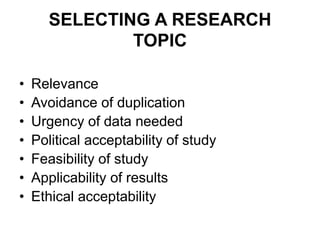
SELECTING A RESEARCH
TOPIC
• Relevance
• Avoidance of duplication
• Urgency of data needed
• Political acceptability of study
• Feasibility of study
• Applicability of results
• Ethical acceptability
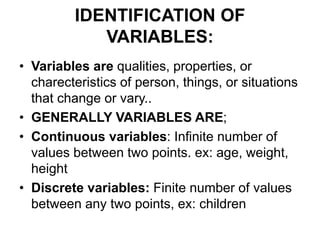
IDENTIFICATION OF
VARIABLES:
• Variables are qualities, properties, or
charecteristics of person, things, or situations
that change or vary..
• GENERALLY VARIABLES ARE;
• Continuous variables: Infinite number of
values between two points. ex: age, weight,
height
• Discrete variables: Finite number of values
between any two points, ex: children
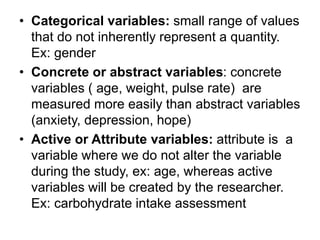
• Categorical variables: small range of values
that do not inherently represent a quantity.
Ex: gender
• Concrete or abstract variables: concrete
variables ( age, weight, pulse rate) are
measured more easily than abstract variables
(anxiety, depression, hope)
• Active or Attribute variables: attribute is a
variable where we do not alter the variable
during the study, ex: age, whereas active
variables will be created by the researcher.
Ex: carbohydrate intake assessment
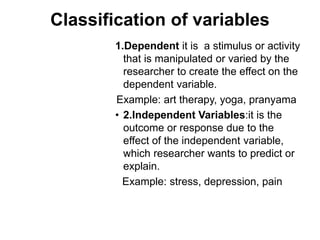
Classification of variables
1.Dependent it is a stimulus or activity
that is manipulated or varied by the
researcher to create the effect on the
dependent variable.
Example: art therapy, yoga, pranyama
• 2.Independent Variables:it is the
outcome or response due to the
effect of the independent variable,
which researcher wants to predict or
explain.
Example: stress, depression, pain
3.Research variables These are qualities,
attributes, properities, or charecteristics
that are observed or measured in a natural
setting without manipulating and
establishing cause and effect relationship.
• Example: prevalence of anemia
(descriptive,exploratory,comparative and
correlational )
4.Demographic variables:
Researchers tries to study
the sample characteristics and
present them in research
findings..some researchers even
try to establish relations of the
demographic variables with the
research variables. These
characteristics and attributes are
demographic variables
5.Control Variables: which effects the
dependent variable .when we control a
variable we wish to balance its effect
across subjects and groups and just study
the relationship between the independent
variable and dependent variable.
• Example: keep humidity the same, and vary
temperature, to study comfort levels.
6.Extraneous variables: These are the
factors that are not the part of a study,
but may affect the study variables. If it
affects in a negative way which are
known as confounding variables.
In some research study, the
researchers may use one, two or many
variables under study based on the
number of variables under study.
• Univariate study : one variable
• Bivariate ( two variables)
• Multivariate study ( more than two
variables)
OPERATIONAL DEFINITIONS:
• In a research study, each variable
or concept must be operationally
defined.
• An operational definition of a
variable provides the theoretical
or conceptual meaning of variable
under study..
• Operational definitions are not same as
conceptual definition, an operational
definition does not only give precise
indications about how to observe or even
measure the characteristics’ under study.
• It is based on the observable characteristics’
of an object or phenomenon and indicates
what to do or what to observe in order to
identify the characteristics’.
•
OBJECTIVES
• The objectives of a research project
summarize what is to be achieved by the
study.Objectives should be closely related to
the statement of the problem.
• RESEARCH OBJECTIVES are a clear,
concise, declarative statement, which
provides direction to investigate the variables.
• Research objectives are the results sought by
the researcher at the end of the research
process; i.e what the researcher will be able
to achieve at the end of the research study..
IMPORTANT CONSIDERATIONS
ABOUT OBJECTIVES
• Objectives are numbered in a way so that
each one stands alone.
• Each objective must have a specific
methodology, so that the researcher is
able to work accordingly for their
accomplishment.
• If the researcher is facing some difficulty in
devising this, they may write up a research
time-line before defining the objectives.
Charecteristics of research
objectives:
• s- specific
• m- measurable
• a-attainable
• r- realistic
• t- time –bound
in other words:
• m- measurable
• f- feasible
• l- logical
• o-observable
• u- unequivocal
• r- relevant
• objectives include obtaining answers to
the research questions
• specific accomplishments and researcher
hopes to achieve y the study.
• Reasonably achieved with the expected
time frame
• Summarises what is to be achieved by the
study.
Purposes/ Importance of
research objectives:
• Focus the study
• Avoid the collection of data which are not
strictly necessary for understanding and
solving the problem you have identified
• Organise the study in clearly defined parts
or phases
Need of research objectives
• Focus
• Avoid
• Organise
• directions
TYPES OF OBJECTIVES:
General objective:
The general objective of a study states what researchers
expect to achieve by the study in general terms.
It is possible to breakdown a general objective into smaller,
logically connected parts. These are normally referred as
specific objectives
Specific objective/ Secondary objectives:
Usually focuses on quantifying or specifying the problem.
Systematically address the various aspects of the problem
as defined understatement of the problem and the key
factors that are assumed to influence or cause the problem.
They should specify what u will do in your study, where,
and for what purpose.
METHODS OF STATING OBJECTIVES:
Guidelines:
•Objectives should be presented briefly and
concisely
•They cover the different aspects of the
problem and their contributing factors in a
coherent way and in a logical sequence.
•They are clearly phrased in operational terms,
specifying exactly what researcher is going to
do, where and for what purpose
•They are realistic considering local conditions
•They use action verbs that are specific enough
to be evaluated.
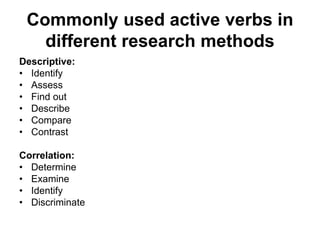
Commonly used active verbs in
different research methods
Descriptive:
• Identify
• Assess
• Find out
• Describe
• Compare
• Contrast
Correlation:
• Determine
• Examine
• Identify
• Discriminate
Experimental:
• Determine
• Examine
• Investigate
• Measure
• Detect
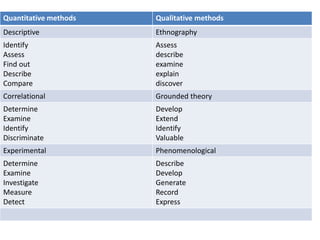
Quantitative methods Qualitative methods
Descriptive Ethnography
Identify
Assess
Find out
Describe
Compare
Assess
describe
examine
explain
discover
Correlational Grounded theory
Determine
Examine
Identify
Discriminate
Develop
Extend
Identify
Valuable
Experimental Phenomenological
Determine
Examine
Investigate
Measure
Detect
Describe
Develop
Generate
Record
Express
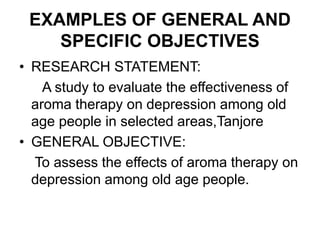
EXAMPLES OF GENERAL AND
SPECIFIC OBJECTIVES
• RESEARCH STATEMENT:
A study to evaluate the effectiveness of
aroma therapy on depression among old
age people in selected areas,Tanjore
• GENERAL OBJECTIVE:
To assess the effects of aroma therapy on
depression among old age people.
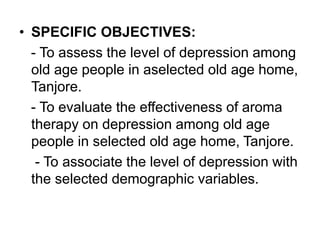
• SPECIFIC OBJECTIVES:
- To assess the level of depression among
old age people in aselected old age home,
Tanjore.
- To evaluate the effectiveness of aroma
therapy on depression among old age
people in selected old age home, Tanjore.
- To associate the level of depression with
the selected demographic variables.
HYPOTHESIS
• Hypothesis: hypo means fixing point
• Hypothesis means a fixing agent for thesis
or report of the research work.
Definition:
• According to Gay, “ a hypothesis is a
tentative explanation for certain behaviour
, phenomena, or events that have
occurred or will occur”.
• According to Lundberg, “ a tentative
generalisation , the validity of which
remains to be tested.
Role of hypothesis in research:
• Tentative solution to the problem
• Tentative generalisations
• Clear framework and guide when analysis
and interpretation
• Specifies the sources of data
• Development of theory
• Definite to the investigation
Characteristics of hypothesis:
• Should provide answers to the enquiry
• Clear and precise
• Conceptual clarity
• Specificity
• Testability
• Availability of techniques
• Theoretical framework
• Consistency
• Objectivity
• Simplicity
• Limited in scope
• Reasonable
• Empirical and reference and evidence
• Self explanatory power
SOURCES OF HYPOTHESIS:
• Theory
• Observation
• Analogies
• Intuition and personal experience
• Findings of studies
• State of knowledge
• Culture
• Continuity of research
• Scientific theory
• Personal experience
PURPOSES OF HYPOTHESIS
• It provides bridge between before theory and
reality and in this sense unifying the two domains.
• It provides powerful tool, for the advancement of
knowledge since they enable the researcher to
objectively enter new areas of discovery.
• It provides direction for any research endeavour
by tentatively identifying the anticipated outcome.
• It is a guide to the thinking process and the
process of discovery
• It serves as a framework for drawing conclusions.
CLASSIFICATION OF
HYPOTHESIS:
ACCORDING TO DIRECTION:
• Directional hypothesis: it is one that
specifies the expected direction of the
relationship between the independent and
dependent variable.
• Example: Positive relationship between trust
and self disclosure in marital relationship
• Non directional hypothesis: it indicates the
existence of relationship between the
variable, it does not specify the direction of
the relationship.
Hypothesis can be categorised as either
research or statistical hypothesis:
• Research hypothesis: scientific or workable
hypothesis consists of a statement about the
expected relationship between the variables.
It indicates what the outcome of the study is
expected to be. It can be stated positively
and can be either directional or non
directional.
Example: ‘There is relationship between
smoking & incidence of lung cancer.
A statistical hypothesis: Null means nil, zero.
When a hypothesis is stated negatively that is
null hypothesis.
• Null hypothesis states that there is no
relationship between two variables. Rejection
of statistical hypothesis is almost equivalent
to acceptance of research hypothesis.
• For example, ‘there is no relationship
between smoking & the incidence of coronary
artery disease’.
• Other types:
– Simple hypothesis: that expresses an
expected relationship between one dependent
and independent variable.
Example: Smoking leads to cancer
– Complex hypothesis: It is a prediction of
relationship between two or more
independent variables and two or more
dependent variables.
Example: Smoking and other drugs leads to cancer,
tension, chest infections etc.
– Casual hypothesis: states that the existence
of or change in, one variable causes or leads
to an effect on another variable. The first
variable is called independent variable and
the latter called an dependent variable.
– Descriptive hypothesis: prepositions that
describe the characteristics’ (such as size,
form of distribution) of a variable. The variable
may be an object, person, organisation,
situation or event.
Ex: The educational system not oriented to the
human resource needs of a country.
– Relational hypothesis: describes the
relationship between variable. The relationship
suggests may be a positive or negative
correlation or casual relationship.
Ex: Families with higher income spends more for
recreation.
– Working hypothesis: while planning the study of
a problem, the hypothesis is formulated. Initially
hypothesis may not be very specific.
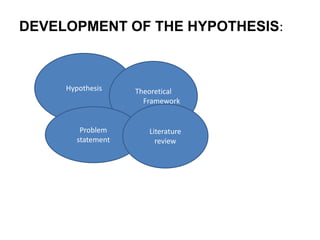
DEVELOPMENT OF THE HYPOTHESIS:
Hypothesis Theoretical
Framework
Problem
statement
Literature
review
FORMULATIONS OF HYPOTHESIS
• Hypothesis are usually formulated in quantitative
research studies, which investigate the interplay of
dependent and independent variables such as
experimental, correlation research studies.
• Points to be considered in formulating hypothesis:
• Hypothesis is always written before starting the study
and should not be changed after the study results are
examined.
• Researchers use null form as well as alternative form
of hypothesis.
• Consider the dependent and independent variables
• Nature of relationship between dependent and
independent variables
• Subjects in which population being studies.
• The level of significance for accepting and
rejecting the hypothesis
• Hypothesis should be stated using declarative
sentence and present tense
• Should be stated in empirical tested form.
• One hypothesis contains only single predication
about relationships of study variables.
• Ideally, the number of hypothesis should be
restricted to six or less because more number of
hypotheses leads to confusion and increased work
in data collection, analysis and interpretations of
data.
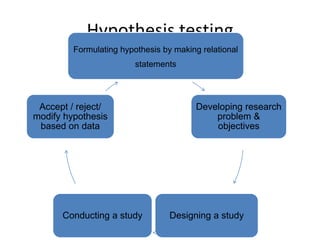
Hypothesis testing
Formulating hypothesis by making relational
statements
Developing research
problem &
objectives
Designing a studyConducting a study
Accept / reject/
modify hypothesis
based on data
ASSUMPTIONS:
• An assumption is a realistic expectation which is
something that we believe to be true. An
assumption provides a basis for theories and also
for research instruments and therefore influence
the development and implementation of research
process.
• Assumptions are statements that are taken for
granted or are considered true, even though they
have not been scientifically tested.
• Assumptions are the declarative statements
about a phenomenon which are largely believed to
be true eve in the absence of significant facts.
Uses of assumption in research
• Research is built upon assumptions as
foundation is needed to move forward. One
must assume something to discover
something.
• Assumption listed in research paper may be
good sources of the research topics
• Assumptions provide basis to the conduct of
the research study.
• Tested assumptions through research studies
expand the professional body of knowledge.
Types of Assumptions:
• Universal assumptions: are beliefs that are
assumed to be true by a large part of society, but
testing such assumptions is not always possible.
Ex: there is a supernatural power that governs this
universe.
• Assumptions based on theories: If a research
study is based on a theory, the assumption of the
particular theory may become assumption of that
particular theory may become assumption of the
particular research study.
Ex: A study based on Roy’s adaptation model will
use assumption of this particular theoretical
model.
• Assumptions needed to conduct a research:
common sense assumptions to conduct a study.
Ex: prevalence of coronary artery disease is
common among urban people.
• Warranted assumptions: these are stated along
with the evidence to support.
Ex: regular prayers bring success because they
boost morale.
• Unwarranted assumptions: These are stated
without any supportive evidence .
• Ex: Almighty God exists everywhere in this
universe.
EXAMPLES OF ASSUMPTION:
• People are aware of the experience that
most affect their life choices.
• People want to assume control of their
own health problems
• People in underserved areas feel
underserved.
DELIMITATIONS
• The delimitations of the study are those
characteristics’ that limit scope of the inquiry as
determined by the conscious exclusionary and
inclusionary decisions that were made throughout
the development of the proposal.
• Narrow down his problem.
• Restrictions / bounds that researchers impose
prior to the inception of the study to narrow the
scope of a study.
• Describe the population from which
generalisations can be carefully under the control
of the researcher.
LIMITATIONS:
• The limitations of the study are those
characteristics of design or methodology that
set parameters on the application and
interpretations of the study.
• Limitations refers to factors which the
experimenter cannot control
• Are conditions that restrict the scope of the
research findings and are outside the control
of the researcher.
NURSING RESEARCH - RESEARCH PROBLEM

NURSING RESEARCH - RESEARCH PROBLEM

  • 1.
    UNIT-II RESEARCH PROBLEM- QUESTION 1. Identificationof Problem Area 2.Problem Statement 3.Criteria of a good research Problem 4. Writing Objectives Prepared By Mrs.AKILA .A, M.Sc (N), M.Sc (PSY) ASSOCIATE PROFESSOR
  • 2.
    A problem isan interrogative sentence or statement that asks what relation exists between two or more variables. The answer to questions will provide what is having sought in the research.
  • 3.
    DEFINITION: A research problemis an enigmatic, perplexing or troubling condition. Research problem refers to some difficulty which a researcher experiences in the context of either a theoretical or practical situations and requires a solution to that particular problem.
  • 4.
    DEFINING THE PROBLEM •Involves the task of laying down boundaries within which a researcher shall study the problem with the predetermined objectives or objectives in view. • Three processes: • Selecting the research topic: Broad, imagination and abstract • Narrowing the topic: What, when and why • Evaluating the research topic: significance, researchability, feasibility, interest to the topic time, availability, money and ethical considerations
  • 5.
    RESEARCH QUESTION • Researchquestion is a way of expressing the researcher’s interest in the problem or phenomenon being studied. • PICOT FORMAT: P-PATIENT/ PROBLEM/ POPULATION I- INTERVENTIONS C- COMPARISON O-OUTCOME T-TIME
  • 6.
    ELEMENTS OF RESEARCH PROBLEM •Objectives • Theme • Time • Location • Population
  • 7.
    Six conditions ofresearch problem • There should be a individual, group or organisation which concerns a some difficulty a problem in a situation or an environment. • Some objectives • Course of action • Some dilemma in selecting the alternatives • Difficult environment • Outcomes
  • 8.
    SOURCES OF RESEARCH PROBLEM •Professional literature • Professional experience • Inference from theories and other sources • External sources • Social issues
  • 9.
    SOURCES OF RESEARCH PROBLEM •Personal experiences • Practical experience • Critical appraisal of literature • Previous research • Existing theories • Consumer feedback • Performance improved activities • Social issues • Brain storming • Intuition • Folklores • Exposure to field situations • Consultation with experts
  • 10.
    JUSTIFICATION OF RESEARCH PROBLEM: •Personal suitability • General value
  • 11.
    CRITERIA FOR SELECTINGTHE PROBLEM: Problem must be: • Related to professional work • Problem and solution should improve the psychological theories and practices • Relevant, important, new, significant and interesting • Suited to the attitude, aptitude, interest, competency and confidences of a researcher • Practically achievable objectives • Creativeness, extension of knowledge, novelty, originality and utility value • Not too broad or too narrow • Proper guidance and financial support • Concerned with international, national, state , district, town, village...
  • 12.
    CRITERIA FOR GOOD RESEARCHPROBLEM: A.Must support multiple perspectives B.Researchable C.Umbrella topics must be sufficiently complex
  • 13.
    CRITERIA FOR GOODRESEARCH PROBLEM: A. Significance to nursing profession B.Original C.Feasible  Time  Cost  Equipment and supplies  Administrative support  Peer support  availability of subjects  Researchers competence  Ethical considerations – Solvable/ researchable – Current – Interesting
  • 14.
  • 15.
    FORMULATION OF RESEARCH PROBLEM: •Selecting a research topic • Reviewing the theories and literature • Delimiting the research topic • Evaluating the research problem • Evaluating the final statement of the research problem
  • 16.
    STATEMENT OF THEPROBLEM: • A problem statement is an expression of the dilemma or disturbing situation that needs investigation for the purposes of providing understanding and direction.
  • 17.
    GOOD CHARECTERSTICS OF STATEMENTOF THE PROBLEM • Identifies the key study variables and possible interrelationship • Identifies the population of interest, dependent and independent variables • It indicates the nature of inquiry, concepts, groups and setting of the study.
  • 18.
    SELECTING A RESEARCH TOPIC •Relevance • Avoidance of duplication • Urgency of data needed • Political acceptability of study • Feasibility of study • Applicability of results • Ethical acceptability
  • 19.
    IDENTIFICATION OF VARIABLES: • Variablesare qualities, properties, or charecteristics of person, things, or situations that change or vary.. • GENERALLY VARIABLES ARE; • Continuous variables: Infinite number of values between two points. ex: age, weight, height • Discrete variables: Finite number of values between any two points, ex: children
  • 20.
    • Categorical variables:small range of values that do not inherently represent a quantity. Ex: gender • Concrete or abstract variables: concrete variables ( age, weight, pulse rate) are measured more easily than abstract variables (anxiety, depression, hope) • Active or Attribute variables: attribute is a variable where we do not alter the variable during the study, ex: age, whereas active variables will be created by the researcher. Ex: carbohydrate intake assessment
  • 21.
    Classification of variables 1.Dependentit is a stimulus or activity that is manipulated or varied by the researcher to create the effect on the dependent variable. Example: art therapy, yoga, pranyama • 2.Independent Variables:it is the outcome or response due to the effect of the independent variable, which researcher wants to predict or explain. Example: stress, depression, pain
  • 22.
    3.Research variables Theseare qualities, attributes, properities, or charecteristics that are observed or measured in a natural setting without manipulating and establishing cause and effect relationship. • Example: prevalence of anemia (descriptive,exploratory,comparative and correlational )
  • 23.
    4.Demographic variables: Researchers triesto study the sample characteristics and present them in research findings..some researchers even try to establish relations of the demographic variables with the research variables. These characteristics and attributes are demographic variables
  • 24.
    5.Control Variables: whicheffects the dependent variable .when we control a variable we wish to balance its effect across subjects and groups and just study the relationship between the independent variable and dependent variable. • Example: keep humidity the same, and vary temperature, to study comfort levels.
  • 25.
    6.Extraneous variables: Theseare the factors that are not the part of a study, but may affect the study variables. If it affects in a negative way which are known as confounding variables.
  • 26.
    In some researchstudy, the researchers may use one, two or many variables under study based on the number of variables under study. • Univariate study : one variable • Bivariate ( two variables) • Multivariate study ( more than two variables)
  • 27.
    OPERATIONAL DEFINITIONS: • Ina research study, each variable or concept must be operationally defined. • An operational definition of a variable provides the theoretical or conceptual meaning of variable under study..
  • 28.
    • Operational definitionsare not same as conceptual definition, an operational definition does not only give precise indications about how to observe or even measure the characteristics’ under study. • It is based on the observable characteristics’ of an object or phenomenon and indicates what to do or what to observe in order to identify the characteristics’. •
  • 29.
    OBJECTIVES • The objectivesof a research project summarize what is to be achieved by the study.Objectives should be closely related to the statement of the problem. • RESEARCH OBJECTIVES are a clear, concise, declarative statement, which provides direction to investigate the variables. • Research objectives are the results sought by the researcher at the end of the research process; i.e what the researcher will be able to achieve at the end of the research study..
  • 30.
    IMPORTANT CONSIDERATIONS ABOUT OBJECTIVES •Objectives are numbered in a way so that each one stands alone. • Each objective must have a specific methodology, so that the researcher is able to work accordingly for their accomplishment. • If the researcher is facing some difficulty in devising this, they may write up a research time-line before defining the objectives.
  • 31.
    Charecteristics of research objectives: •s- specific • m- measurable • a-attainable • r- realistic • t- time –bound in other words: • m- measurable • f- feasible • l- logical • o-observable • u- unequivocal • r- relevant
  • 32.
    • objectives includeobtaining answers to the research questions • specific accomplishments and researcher hopes to achieve y the study. • Reasonably achieved with the expected time frame • Summarises what is to be achieved by the study.
  • 33.
    Purposes/ Importance of researchobjectives: • Focus the study • Avoid the collection of data which are not strictly necessary for understanding and solving the problem you have identified • Organise the study in clearly defined parts or phases
  • 34.
    Need of researchobjectives • Focus • Avoid • Organise • directions
  • 35.
    TYPES OF OBJECTIVES: Generalobjective: The general objective of a study states what researchers expect to achieve by the study in general terms. It is possible to breakdown a general objective into smaller, logically connected parts. These are normally referred as specific objectives Specific objective/ Secondary objectives: Usually focuses on quantifying or specifying the problem. Systematically address the various aspects of the problem as defined understatement of the problem and the key factors that are assumed to influence or cause the problem. They should specify what u will do in your study, where, and for what purpose.
  • 36.
    METHODS OF STATINGOBJECTIVES: Guidelines: •Objectives should be presented briefly and concisely •They cover the different aspects of the problem and their contributing factors in a coherent way and in a logical sequence. •They are clearly phrased in operational terms, specifying exactly what researcher is going to do, where and for what purpose •They are realistic considering local conditions •They use action verbs that are specific enough to be evaluated.
  • 37.
    Commonly used activeverbs in different research methods Descriptive: • Identify • Assess • Find out • Describe • Compare • Contrast Correlation: • Determine • Examine • Identify • Discriminate
  • 38.
    Experimental: • Determine • Examine •Investigate • Measure • Detect
  • 39.
    Quantitative methods Qualitativemethods Descriptive Ethnography Identify Assess Find out Describe Compare Assess describe examine explain discover Correlational Grounded theory Determine Examine Identify Discriminate Develop Extend Identify Valuable Experimental Phenomenological Determine Examine Investigate Measure Detect Describe Develop Generate Record Express
  • 40.
    EXAMPLES OF GENERALAND SPECIFIC OBJECTIVES • RESEARCH STATEMENT: A study to evaluate the effectiveness of aroma therapy on depression among old age people in selected areas,Tanjore • GENERAL OBJECTIVE: To assess the effects of aroma therapy on depression among old age people.
  • 41.
    • SPECIFIC OBJECTIVES: -To assess the level of depression among old age people in aselected old age home, Tanjore. - To evaluate the effectiveness of aroma therapy on depression among old age people in selected old age home, Tanjore. - To associate the level of depression with the selected demographic variables.
  • 42.
    HYPOTHESIS • Hypothesis: hypomeans fixing point • Hypothesis means a fixing agent for thesis or report of the research work.
  • 43.
    Definition: • According toGay, “ a hypothesis is a tentative explanation for certain behaviour , phenomena, or events that have occurred or will occur”. • According to Lundberg, “ a tentative generalisation , the validity of which remains to be tested.
  • 44.
    Role of hypothesisin research: • Tentative solution to the problem • Tentative generalisations • Clear framework and guide when analysis and interpretation • Specifies the sources of data • Development of theory • Definite to the investigation
  • 45.
    Characteristics of hypothesis: •Should provide answers to the enquiry • Clear and precise • Conceptual clarity • Specificity • Testability • Availability of techniques • Theoretical framework • Consistency • Objectivity • Simplicity • Limited in scope • Reasonable • Empirical and reference and evidence • Self explanatory power
  • 46.
    SOURCES OF HYPOTHESIS: •Theory • Observation • Analogies • Intuition and personal experience • Findings of studies • State of knowledge • Culture • Continuity of research • Scientific theory • Personal experience
  • 47.
    PURPOSES OF HYPOTHESIS •It provides bridge between before theory and reality and in this sense unifying the two domains. • It provides powerful tool, for the advancement of knowledge since they enable the researcher to objectively enter new areas of discovery. • It provides direction for any research endeavour by tentatively identifying the anticipated outcome. • It is a guide to the thinking process and the process of discovery • It serves as a framework for drawing conclusions.
  • 48.
    CLASSIFICATION OF HYPOTHESIS: ACCORDING TODIRECTION: • Directional hypothesis: it is one that specifies the expected direction of the relationship between the independent and dependent variable. • Example: Positive relationship between trust and self disclosure in marital relationship • Non directional hypothesis: it indicates the existence of relationship between the variable, it does not specify the direction of the relationship.
  • 49.
    Hypothesis can becategorised as either research or statistical hypothesis: • Research hypothesis: scientific or workable hypothesis consists of a statement about the expected relationship between the variables. It indicates what the outcome of the study is expected to be. It can be stated positively and can be either directional or non directional. Example: ‘There is relationship between smoking & incidence of lung cancer.
  • 50.
    A statistical hypothesis:Null means nil, zero. When a hypothesis is stated negatively that is null hypothesis. • Null hypothesis states that there is no relationship between two variables. Rejection of statistical hypothesis is almost equivalent to acceptance of research hypothesis. • For example, ‘there is no relationship between smoking & the incidence of coronary artery disease’.
  • 51.
    • Other types: –Simple hypothesis: that expresses an expected relationship between one dependent and independent variable. Example: Smoking leads to cancer – Complex hypothesis: It is a prediction of relationship between two or more independent variables and two or more dependent variables. Example: Smoking and other drugs leads to cancer, tension, chest infections etc.
  • 52.
    – Casual hypothesis:states that the existence of or change in, one variable causes or leads to an effect on another variable. The first variable is called independent variable and the latter called an dependent variable. – Descriptive hypothesis: prepositions that describe the characteristics’ (such as size, form of distribution) of a variable. The variable may be an object, person, organisation, situation or event. Ex: The educational system not oriented to the human resource needs of a country.
  • 53.
    – Relational hypothesis:describes the relationship between variable. The relationship suggests may be a positive or negative correlation or casual relationship. Ex: Families with higher income spends more for recreation. – Working hypothesis: while planning the study of a problem, the hypothesis is formulated. Initially hypothesis may not be very specific.
  • 54.
    DEVELOPMENT OF THEHYPOTHESIS: Hypothesis Theoretical Framework Problem statement Literature review
  • 55.
    FORMULATIONS OF HYPOTHESIS •Hypothesis are usually formulated in quantitative research studies, which investigate the interplay of dependent and independent variables such as experimental, correlation research studies. • Points to be considered in formulating hypothesis: • Hypothesis is always written before starting the study and should not be changed after the study results are examined. • Researchers use null form as well as alternative form of hypothesis. • Consider the dependent and independent variables • Nature of relationship between dependent and independent variables
  • 56.
    • Subjects inwhich population being studies. • The level of significance for accepting and rejecting the hypothesis • Hypothesis should be stated using declarative sentence and present tense • Should be stated in empirical tested form. • One hypothesis contains only single predication about relationships of study variables. • Ideally, the number of hypothesis should be restricted to six or less because more number of hypotheses leads to confusion and increased work in data collection, analysis and interpretations of data.
  • 57.
    Hypothesis testing Formulating hypothesisby making relational statements Developing research problem & objectives Designing a studyConducting a study Accept / reject/ modify hypothesis based on data
  • 58.
    ASSUMPTIONS: • An assumptionis a realistic expectation which is something that we believe to be true. An assumption provides a basis for theories and also for research instruments and therefore influence the development and implementation of research process. • Assumptions are statements that are taken for granted or are considered true, even though they have not been scientifically tested. • Assumptions are the declarative statements about a phenomenon which are largely believed to be true eve in the absence of significant facts.
  • 59.
    Uses of assumptionin research • Research is built upon assumptions as foundation is needed to move forward. One must assume something to discover something. • Assumption listed in research paper may be good sources of the research topics • Assumptions provide basis to the conduct of the research study. • Tested assumptions through research studies expand the professional body of knowledge.
  • 60.
    Types of Assumptions: •Universal assumptions: are beliefs that are assumed to be true by a large part of society, but testing such assumptions is not always possible. Ex: there is a supernatural power that governs this universe. • Assumptions based on theories: If a research study is based on a theory, the assumption of the particular theory may become assumption of that particular theory may become assumption of the particular research study. Ex: A study based on Roy’s adaptation model will use assumption of this particular theoretical model.
  • 61.
    • Assumptions neededto conduct a research: common sense assumptions to conduct a study. Ex: prevalence of coronary artery disease is common among urban people. • Warranted assumptions: these are stated along with the evidence to support. Ex: regular prayers bring success because they boost morale. • Unwarranted assumptions: These are stated without any supportive evidence . • Ex: Almighty God exists everywhere in this universe.
  • 62.
    EXAMPLES OF ASSUMPTION: •People are aware of the experience that most affect their life choices. • People want to assume control of their own health problems • People in underserved areas feel underserved.
  • 63.
    DELIMITATIONS • The delimitationsof the study are those characteristics’ that limit scope of the inquiry as determined by the conscious exclusionary and inclusionary decisions that were made throughout the development of the proposal. • Narrow down his problem. • Restrictions / bounds that researchers impose prior to the inception of the study to narrow the scope of a study. • Describe the population from which generalisations can be carefully under the control of the researcher.
  • 64.
    LIMITATIONS: • The limitationsof the study are those characteristics of design or methodology that set parameters on the application and interpretations of the study. • Limitations refers to factors which the experimenter cannot control • Are conditions that restrict the scope of the research findings and are outside the control of the researcher.