Tetralogy of Fallout
JERIN.T.S, 3RD YEAR BSC NURSING, KRSMCON MANGALORE. PH:
+919496743672
 It is the most common cyanotic heart defect, and the
most common cause of blue baby syndrome
 It was described in 1672 by Niels Stensen, in 1773 by
Edward Sandifort, and in 1888 by the French physician
Étienne-Louis Arthur Fallot, after whom it is named.
JERIN.T.S, 3RD YEAR BSC NURSING, KRSMCON MANGALORE. PH:
+919496743672
TOF is the most common type of cyanotic congenital heart
disease. There are several forms of this defect, the
common ones are :
1) Obstruction to right ventricular outflow (pulmonary
stenosis)
2) Ventricular septal defect ( VSD )
3) Dextral position of the aorta with septal override/
overriding of aorta
4) Right ventricular hypertrophy
JERIN.T.S, 3RD YEAR BSC NURSING, KRSMCON MANGALORE. PH:
+919496743672
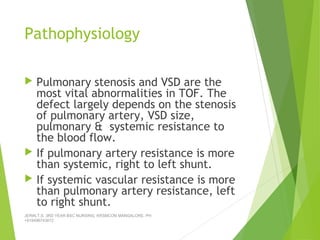
Pathophysiology
 Pulmonary stenosis and VSD are the
most vital abnormalities in TOF. The
defect largely depends on the stenosis
of pulmonary artery, VSD size,
pulmonary & systemic resistance to
the blood flow.
 If pulmonary artery resistance is more
than systemic, right to left shunt.
 If systemic vascular resistance is more
than pulmonary artery resistance, left
to right shunt.
JERIN.T.S, 3RD YEAR BSC NURSING, KRSMCON MANGALORE. PH:
+919496743672
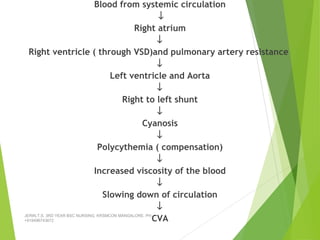
Blood from systemic circulation
↓
Right atrium
↓
Right ventricle ( through VSD)and pulmonary artery resistance
↓
Left ventricle and Aorta
↓
Right to left shunt
↓
Cyanosis
↓
Polycythemia ( compensation)
↓
Increased viscosity of the blood
↓
Slowing down of circulation
↓
CVAJERIN.T.S, 3RD YEAR BSC NURSING, KRSMCON MANGALORE. PH:
+919496743672
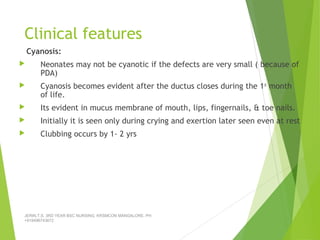
Clinical features
Cyanosis:
 Neonates may not be cyanotic if the defects are very small ( because of
PDA)
 Cyanosis becomes evident after the ductus closes during the 1st
month
of life.
 Its evident in mucus membrane of mouth, lips, fingernails, & toe nails.
 Initially it is seen only during crying and exertion later seen even at rest
 Clubbing occurs by 1- 2 yrs
JERIN.T.S, 3RD YEAR BSC NURSING, KRSMCON MANGALORE. PH:
+919496743672
 Severe dyspnoea on exertion or exercise
 Rest in between the activities ( as compensation to reduce demand for 02)
(they sit or lie down after a brief active play)
 Knee chest position by infants
 Squatting position by older children
JERIN.T.S, 3RD YEAR BSC NURSING, KRSMCON MANGALORE. PH:
+919496743672
JERIN.T.S, 3RD YEAR BSC NURSING, KRSMCON MANGALORE. PH:
+919496743672
Paroxysmal dyspnoic attack
( anoxic “blue” spells) ( TET spells) (hypercyanotic spell)
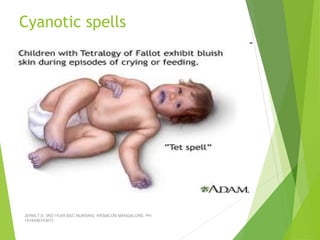
 An episode of intense cyanosis that occurs
predominantly in morning after awakening from
sleep, during or after crying, during or after
defecation, during or following feeding
 Child starts crying becomes Dyspnoic & restless
 Gasps for breath
 Weak cry followed by sleep
Some times may cause convulsions and
unconsciousness
JERIN.T.S, 3RD YEAR BSC NURSING, KRSMCON MANGALORE. PH:
+919496743672
Cyanotic spells
JERIN.T.S, 3RD YEAR BSC NURSING, KRSMCON MANGALORE. PH:
+919496743672
 Prolonged episodes may
lead to
 Unconsciousness
 Convulsions
 Hemiparesis
 Death
JERIN.T.S, 3RD YEAR BSC NURSING, KRSMCON MANGALORE. PH:
+919496743672
 Slow growth and development
 Slow mental development because of tissue hypoxia of brain
 On auscultation murmurs heard
 Radiography shows enlarged ventricles on right side, large aorta &
decrease size of pulmonary artery.
 Cardiac catheterization shows hypertension in right ventricle
JERIN.T.S, 3RD YEAR BSC NURSING, KRSMCON MANGALORE. PH:
+919496743672
Diagnostic measures
1. Hematocrit increased-Polycythemia
2. ECG: shows right axis deviation
3. 2D Echocardiography, color flow mapping & doppler
4. Cardiac catheterization
5. Ventriculography
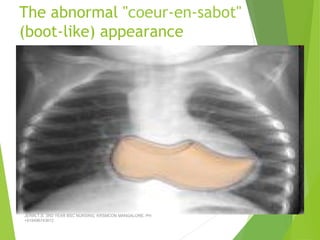
6. Chest X-ray: reveals oligemic lung fields (poorly vascularized lungs) a
small boot shaped heart with the tip of the boot turned up above the
diaphragm.
JERIN.T.S, 3RD YEAR BSC NURSING, KRSMCON MANGALORE. PH:
+919496743672
The abnormal "coeur-en-sabot"
(boot-like) appearance
JERIN.T.S, 3RD YEAR BSC NURSING, KRSMCON MANGALORE. PH:
+919496743672
Medical Management
1. Prostaglandin E (0.05-0.20 µg/kg/min) IV to
maintain the patency of ductus
2. Management of spells, mild sedative like
promethazine reduces the frequency of spells,
provided it is given regularly.
3. Oral propranolol 0.5-1mg/kg oral every 6hrly
4. Treatment of iron deficiency anemia and
dehydration
5. Antibiotic therapy for bacterial infection
JERIN.T.S, 3RD YEAR BSC NURSING, KRSMCON MANGALORE. PH:
+919496743672
Management of TETspells
1)Treated with beta-blocker such as
propranolol, but acute episodes may
require rapid intervention with morphine
to reduce ventilatory drive and a
vasopressor such as epinephrine,
phenylephrine, or norepinephrine to
increase blood pressure.
2)Oxygen (100%) is effective in treating
spells because it is a potent pulmonary
vasodilator and systemic vasoconstrictor.
This allows more blood flow to the lungs.
JERIN.T.S, 3RD YEAR BSC NURSING, KRSMCON MANGALORE. PH:
+919496743672
Conti………
There are also simple procedures such as squatting and the
knee chest position which increases aortic wave
reflection, increasing pressure on the left side of the
heart, decreasing the right to left shunt thus decreasing
the amount of deoxygenated blood entering the
systemic circulation.
JERIN.T.S, 3RD YEAR BSC NURSING, KRSMCON MANGALORE. PH:
+919496743672
Stepwise management of
hypercyanotic spells
1) Put the child in knee chest position
2) Provide humidified O2-6-8L/min
3) Inject Morphine 0.1-0.2mg/kg S/C
4) Obtain arterial pH. If less than 7.3,
administer NaHCO3 1ml/kg diluted 1:1 in
distilled H2O IV
5) Give propranolol 0.1mg/kg IV during spell,
followed by 1mg/kg/day orally
6) Correct anemia by packed cell transfusion.
Start the child on long term oral iron
therapy.
JERIN.T.S, 3RD YEAR BSC NURSING, KRSMCON MANGALORE. PH:
+919496743672
Surgical management
palliative surgeries
To increase the pulmonary blood circulation
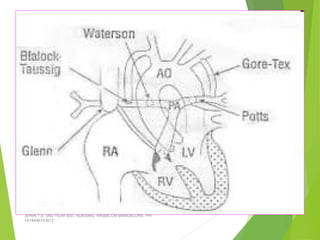
1. Waterson shunt: a side to side anastomosis of the
ascending aorta and right pulmonary artery in
neonates
2. Blalock taussig procedure: for older infants and
children, in which an artificial ductus is created by
anastomosis of a branch of the aorta ( subclavian
artery) to the pulmonary artery.
JERIN.T.S, 3RD YEAR BSC NURSING, KRSMCON MANGALORE. PH:
+919496743672
Modified Blalock-Taussig Shunt:by using Gortex Graft.
Avoid BP measurements and venipunctures in the affected arm after a
Blalock-Taussig shunt. Pulse will not be palpable in that arm because of
use of the subclavian artery for the shunt.
JERIN.T.S, 3RD YEAR BSC NURSING, KRSMCON MANGALORE. PH:
+919496743672
3. Potts procedure: anastomosis of the upper descending aorta and left
pulmonary artery
4. Brock procedure: is a direct operation, pulmonary valvotomy or
infundibular resection, for the pulmonary stenosis. This operation
increases pulmonary blood flow but does not correct the ventricular
septal defect.
JERIN.T.S, 3RD YEAR BSC NURSING, KRSMCON MANGALORE. PH:
+919496743672
JERIN.T.S, 3RD YEAR BSC NURSING, KRSMCON MANGALORE. PH:
+919496743672
Total surgical repair
 Surgery is now often carried out in
infants one year of age or younger with
less than 5% perioperative mortality.
 The open-heart surgery is designed
(1) to relieve the right ventricular outflow
tract stenosis by careful resection of
muscle and
(2) to repair the VSD with a Gore-Tex patch
or a homograft. Additional reparative or
reconstructive surgery may be done on
patients as required by their particular
cardiac anatomy.
JERIN.T.S, 3RD YEAR BSC NURSING, KRSMCON MANGALORE. PH:
+919496743672
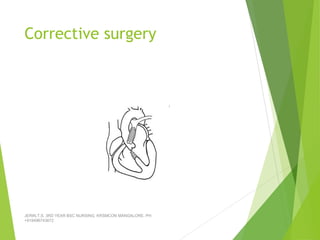
Corrective surgery
Aims:
 To close the VSD
 To correct the pulmonary artery stenosis by
valvotomy
 To close the already created shunts
monitor for ventricular arrhythmias after corrective
repair.
JERIN.T.S, 3RD YEAR BSC NURSING, KRSMCON MANGALORE. PH:
+919496743672
Corrective surgery
JERIN.T.S, 3RD YEAR BSC NURSING, KRSMCON MANGALORE. PH:
+919496743672
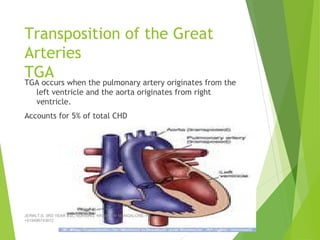
Transposition of the Great
Arteries
TGATGA occurs when the pulmonary artery originates from the
left ventricle and the aorta originates from right
ventricle.
Accounts for 5% of total CHD
JERIN.T.S, 3RD YEAR BSC NURSING, KRSMCON MANGALORE. PH:
+919496743672
Hemodynamics
 The defect results in 2 separate
circulations
 The right side of the heart manages the
systemic circulation
 The left side of the heart manages
pulmonary circulation
 To sustain life there must be
accompanying defects (shunts) where
oxygenated blood mixes with
deoxygenated blood like ASD, VSD, OR
PDA
JERIN.T.S, 3RD YEAR BSC NURSING, KRSMCON MANGALORE. PH:
+919496743672
Pathophysiology
Blood from the systemic circulation
↓
Rt atrium, & Rt ventricle
↓
Aorta
↓
Deoxygenated blood supplied to the body
↓
Cyanosis
↓
Polycythemia
↓
Thrombi
↓
CVA
JERIN.T.S, 3RD YEAR BSC NURSING, KRSMCON MANGALORE. PH:
+919496743672
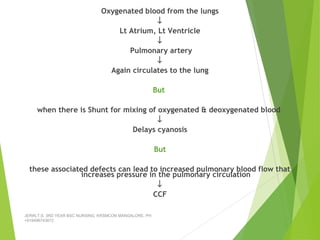
Oxygenated blood from the lungs
↓
Lt Atrium, Lt Ventricle
↓
Pulmonary artery
↓
Again circulates to the lung
But
when there is Shunt for mixing of oxygenated & deoxygenated blood
↓
Delays cyanosis
But
these associated defects can lead to increased pulmonary blood flow that
increases pressure in the pulmonary circulation
↓
CCF
JERIN.T.S, 3RD YEAR BSC NURSING, KRSMCON MANGALORE. PH:
+919496743672
Clinical features
Depends upon the inter circulatory
mixing
 Cyanosis
 Clubbing
 CCF
 Easy fatigability
 Slow weight gain
 Failure to thrive
 Frequent chest infections
 Tachypnea
 Cardiomegaly
JERIN.T.S, 3RD YEAR BSC NURSING, KRSMCON MANGALORE. PH:
+919496743672
Diagnosis
 Auscultation- systolic murmur
 Chest X-ray- cardiomegaly with a typical egg-on-side
shaped heart. Pulmonary vascular markings are
increased
 ECG shows right axis deviation, right or biventricular
hypertrophy
 Cardiac catheterization shows O2 saturation
 2D`echo reveals transpositions
JERIN.T.S, 3RD YEAR BSC NURSING, KRSMCON MANGALORE. PH:
+919496743672
JERIN.T.S, 3RD YEAR BSC NURSING, KRSMCON MANGALORE. PH:
+919496743672
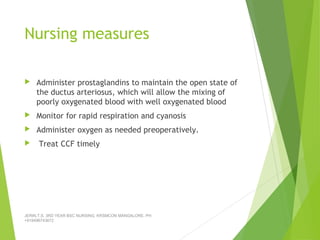
Nursing measures
 Administer prostaglandins to maintain the open state of
the ductus arteriosus, which will allow the mixing of
poorly oxygenated blood with well oxygenated blood
 Monitor for rapid respiration and cyanosis
 Administer oxygen as needed preoperatively.
 Treat CCF timely
JERIN.T.S, 3RD YEAR BSC NURSING, KRSMCON MANGALORE. PH:
+919496743672
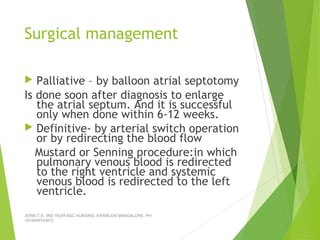
Surgical management
 Palliative – by balloon atrial septotomy
Is done soon after diagnosis to enlarge
the atrial septum. And it is successful
only when done within 6-12 weeks.
 Definitive- by arterial switch operation
or by redirecting the blood flow
Mustard or Senning procedure:in which
pulmonary venous blood is redirected
to the right ventricle and systemic
venous blood is redirected to the left
ventricle.
JERIN.T.S, 3RD YEAR BSC NURSING, KRSMCON MANGALORE. PH:
+919496743672
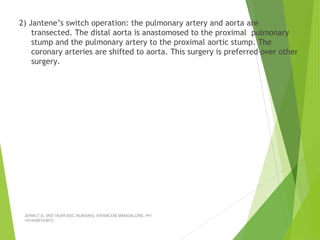
2) Jantene’s switch operation: the pulmonary artery and aorta are
transected. The distal aorta is anastomosed to the proximal pulmonary
stump and the pulmonary artery to the proximal aortic stump. The
coronary arteries are shifted to aorta. This surgery is preferred over other
surgery.
JERIN.T.S, 3RD YEAR BSC NURSING, KRSMCON MANGALORE. PH:
+919496743672
Complications
 Infective endocarditis
 Brain abscess and CVA due to thrombi or severe hypoxia
JERIN.T.S, 3RD YEAR BSC NURSING, KRSMCON MANGALORE. PH:
+919496743672

Tof

  • 1.
    Tetralogy of Fallout JERIN.T.S,3RD YEAR BSC NURSING, KRSMCON MANGALORE. PH: +919496743672
  • 2.
     It isthe most common cyanotic heart defect, and the most common cause of blue baby syndrome  It was described in 1672 by Niels Stensen, in 1773 by Edward Sandifort, and in 1888 by the French physician Étienne-Louis Arthur Fallot, after whom it is named. JERIN.T.S, 3RD YEAR BSC NURSING, KRSMCON MANGALORE. PH: +919496743672
  • 3.
    TOF is themost common type of cyanotic congenital heart disease. There are several forms of this defect, the common ones are : 1) Obstruction to right ventricular outflow (pulmonary stenosis) 2) Ventricular septal defect ( VSD ) 3) Dextral position of the aorta with septal override/ overriding of aorta 4) Right ventricular hypertrophy JERIN.T.S, 3RD YEAR BSC NURSING, KRSMCON MANGALORE. PH: +919496743672
  • 4.
    Pathophysiology  Pulmonary stenosisand VSD are the most vital abnormalities in TOF. The defect largely depends on the stenosis of pulmonary artery, VSD size, pulmonary & systemic resistance to the blood flow.  If pulmonary artery resistance is more than systemic, right to left shunt.  If systemic vascular resistance is more than pulmonary artery resistance, left to right shunt. JERIN.T.S, 3RD YEAR BSC NURSING, KRSMCON MANGALORE. PH: +919496743672
  • 5.
    Blood from systemiccirculation ↓ Right atrium ↓ Right ventricle ( through VSD)and pulmonary artery resistance ↓ Left ventricle and Aorta ↓ Right to left shunt ↓ Cyanosis ↓ Polycythemia ( compensation) ↓ Increased viscosity of the blood ↓ Slowing down of circulation ↓ CVAJERIN.T.S, 3RD YEAR BSC NURSING, KRSMCON MANGALORE. PH: +919496743672
  • 6.
    Clinical features Cyanosis:  Neonatesmay not be cyanotic if the defects are very small ( because of PDA)  Cyanosis becomes evident after the ductus closes during the 1st month of life.  Its evident in mucus membrane of mouth, lips, fingernails, & toe nails.  Initially it is seen only during crying and exertion later seen even at rest  Clubbing occurs by 1- 2 yrs JERIN.T.S, 3RD YEAR BSC NURSING, KRSMCON MANGALORE. PH: +919496743672
  • 7.
     Severe dyspnoeaon exertion or exercise  Rest in between the activities ( as compensation to reduce demand for 02) (they sit or lie down after a brief active play)  Knee chest position by infants  Squatting position by older children JERIN.T.S, 3RD YEAR BSC NURSING, KRSMCON MANGALORE. PH: +919496743672
  • 8.
    JERIN.T.S, 3RD YEARBSC NURSING, KRSMCON MANGALORE. PH: +919496743672
  • 9.
    Paroxysmal dyspnoic attack (anoxic “blue” spells) ( TET spells) (hypercyanotic spell)  An episode of intense cyanosis that occurs predominantly in morning after awakening from sleep, during or after crying, during or after defecation, during or following feeding  Child starts crying becomes Dyspnoic & restless  Gasps for breath  Weak cry followed by sleep Some times may cause convulsions and unconsciousness JERIN.T.S, 3RD YEAR BSC NURSING, KRSMCON MANGALORE. PH: +919496743672
  • 10.
    Cyanotic spells JERIN.T.S, 3RDYEAR BSC NURSING, KRSMCON MANGALORE. PH: +919496743672
  • 11.
     Prolonged episodesmay lead to  Unconsciousness  Convulsions  Hemiparesis  Death JERIN.T.S, 3RD YEAR BSC NURSING, KRSMCON MANGALORE. PH: +919496743672
  • 12.
     Slow growthand development  Slow mental development because of tissue hypoxia of brain  On auscultation murmurs heard  Radiography shows enlarged ventricles on right side, large aorta & decrease size of pulmonary artery.  Cardiac catheterization shows hypertension in right ventricle JERIN.T.S, 3RD YEAR BSC NURSING, KRSMCON MANGALORE. PH: +919496743672
  • 13.
    Diagnostic measures 1. Hematocritincreased-Polycythemia 2. ECG: shows right axis deviation 3. 2D Echocardiography, color flow mapping & doppler 4. Cardiac catheterization 5. Ventriculography 6. Chest X-ray: reveals oligemic lung fields (poorly vascularized lungs) a small boot shaped heart with the tip of the boot turned up above the diaphragm. JERIN.T.S, 3RD YEAR BSC NURSING, KRSMCON MANGALORE. PH: +919496743672
  • 14.
    The abnormal "coeur-en-sabot" (boot-like)appearance JERIN.T.S, 3RD YEAR BSC NURSING, KRSMCON MANGALORE. PH: +919496743672
  • 15.
    Medical Management 1. ProstaglandinE (0.05-0.20 µg/kg/min) IV to maintain the patency of ductus 2. Management of spells, mild sedative like promethazine reduces the frequency of spells, provided it is given regularly. 3. Oral propranolol 0.5-1mg/kg oral every 6hrly 4. Treatment of iron deficiency anemia and dehydration 5. Antibiotic therapy for bacterial infection JERIN.T.S, 3RD YEAR BSC NURSING, KRSMCON MANGALORE. PH: +919496743672
  • 16.
    Management of TETspells 1)Treatedwith beta-blocker such as propranolol, but acute episodes may require rapid intervention with morphine to reduce ventilatory drive and a vasopressor such as epinephrine, phenylephrine, or norepinephrine to increase blood pressure. 2)Oxygen (100%) is effective in treating spells because it is a potent pulmonary vasodilator and systemic vasoconstrictor. This allows more blood flow to the lungs. JERIN.T.S, 3RD YEAR BSC NURSING, KRSMCON MANGALORE. PH: +919496743672
  • 17.
    Conti……… There are alsosimple procedures such as squatting and the knee chest position which increases aortic wave reflection, increasing pressure on the left side of the heart, decreasing the right to left shunt thus decreasing the amount of deoxygenated blood entering the systemic circulation. JERIN.T.S, 3RD YEAR BSC NURSING, KRSMCON MANGALORE. PH: +919496743672
  • 18.
    Stepwise management of hypercyanoticspells 1) Put the child in knee chest position 2) Provide humidified O2-6-8L/min 3) Inject Morphine 0.1-0.2mg/kg S/C 4) Obtain arterial pH. If less than 7.3, administer NaHCO3 1ml/kg diluted 1:1 in distilled H2O IV 5) Give propranolol 0.1mg/kg IV during spell, followed by 1mg/kg/day orally 6) Correct anemia by packed cell transfusion. Start the child on long term oral iron therapy. JERIN.T.S, 3RD YEAR BSC NURSING, KRSMCON MANGALORE. PH: +919496743672
  • 19.
    Surgical management palliative surgeries Toincrease the pulmonary blood circulation 1. Waterson shunt: a side to side anastomosis of the ascending aorta and right pulmonary artery in neonates 2. Blalock taussig procedure: for older infants and children, in which an artificial ductus is created by anastomosis of a branch of the aorta ( subclavian artery) to the pulmonary artery. JERIN.T.S, 3RD YEAR BSC NURSING, KRSMCON MANGALORE. PH: +919496743672
  • 20.
    Modified Blalock-Taussig Shunt:byusing Gortex Graft. Avoid BP measurements and venipunctures in the affected arm after a Blalock-Taussig shunt. Pulse will not be palpable in that arm because of use of the subclavian artery for the shunt. JERIN.T.S, 3RD YEAR BSC NURSING, KRSMCON MANGALORE. PH: +919496743672
  • 21.
    3. Potts procedure:anastomosis of the upper descending aorta and left pulmonary artery 4. Brock procedure: is a direct operation, pulmonary valvotomy or infundibular resection, for the pulmonary stenosis. This operation increases pulmonary blood flow but does not correct the ventricular septal defect. JERIN.T.S, 3RD YEAR BSC NURSING, KRSMCON MANGALORE. PH: +919496743672
  • 22.
    JERIN.T.S, 3RD YEARBSC NURSING, KRSMCON MANGALORE. PH: +919496743672
  • 23.
    Total surgical repair Surgery is now often carried out in infants one year of age or younger with less than 5% perioperative mortality.  The open-heart surgery is designed (1) to relieve the right ventricular outflow tract stenosis by careful resection of muscle and (2) to repair the VSD with a Gore-Tex patch or a homograft. Additional reparative or reconstructive surgery may be done on patients as required by their particular cardiac anatomy. JERIN.T.S, 3RD YEAR BSC NURSING, KRSMCON MANGALORE. PH: +919496743672
  • 24.
    Corrective surgery Aims:  Toclose the VSD  To correct the pulmonary artery stenosis by valvotomy  To close the already created shunts monitor for ventricular arrhythmias after corrective repair. JERIN.T.S, 3RD YEAR BSC NURSING, KRSMCON MANGALORE. PH: +919496743672
  • 25.
    Corrective surgery JERIN.T.S, 3RDYEAR BSC NURSING, KRSMCON MANGALORE. PH: +919496743672
  • 26.
    Transposition of theGreat Arteries TGATGA occurs when the pulmonary artery originates from the left ventricle and the aorta originates from right ventricle. Accounts for 5% of total CHD JERIN.T.S, 3RD YEAR BSC NURSING, KRSMCON MANGALORE. PH: +919496743672
  • 27.
    Hemodynamics  The defectresults in 2 separate circulations  The right side of the heart manages the systemic circulation  The left side of the heart manages pulmonary circulation  To sustain life there must be accompanying defects (shunts) where oxygenated blood mixes with deoxygenated blood like ASD, VSD, OR PDA JERIN.T.S, 3RD YEAR BSC NURSING, KRSMCON MANGALORE. PH: +919496743672
  • 28.
    Pathophysiology Blood from thesystemic circulation ↓ Rt atrium, & Rt ventricle ↓ Aorta ↓ Deoxygenated blood supplied to the body ↓ Cyanosis ↓ Polycythemia ↓ Thrombi ↓ CVA JERIN.T.S, 3RD YEAR BSC NURSING, KRSMCON MANGALORE. PH: +919496743672
  • 29.
    Oxygenated blood fromthe lungs ↓ Lt Atrium, Lt Ventricle ↓ Pulmonary artery ↓ Again circulates to the lung But when there is Shunt for mixing of oxygenated & deoxygenated blood ↓ Delays cyanosis But these associated defects can lead to increased pulmonary blood flow that increases pressure in the pulmonary circulation ↓ CCF JERIN.T.S, 3RD YEAR BSC NURSING, KRSMCON MANGALORE. PH: +919496743672
  • 30.
    Clinical features Depends uponthe inter circulatory mixing  Cyanosis  Clubbing  CCF  Easy fatigability  Slow weight gain  Failure to thrive  Frequent chest infections  Tachypnea  Cardiomegaly JERIN.T.S, 3RD YEAR BSC NURSING, KRSMCON MANGALORE. PH: +919496743672
  • 31.
    Diagnosis  Auscultation- systolicmurmur  Chest X-ray- cardiomegaly with a typical egg-on-side shaped heart. Pulmonary vascular markings are increased  ECG shows right axis deviation, right or biventricular hypertrophy  Cardiac catheterization shows O2 saturation  2D`echo reveals transpositions JERIN.T.S, 3RD YEAR BSC NURSING, KRSMCON MANGALORE. PH: +919496743672
  • 32.
    JERIN.T.S, 3RD YEARBSC NURSING, KRSMCON MANGALORE. PH: +919496743672
  • 33.
    Nursing measures  Administerprostaglandins to maintain the open state of the ductus arteriosus, which will allow the mixing of poorly oxygenated blood with well oxygenated blood  Monitor for rapid respiration and cyanosis  Administer oxygen as needed preoperatively.  Treat CCF timely JERIN.T.S, 3RD YEAR BSC NURSING, KRSMCON MANGALORE. PH: +919496743672
  • 34.
    Surgical management  Palliative– by balloon atrial septotomy Is done soon after diagnosis to enlarge the atrial septum. And it is successful only when done within 6-12 weeks.  Definitive- by arterial switch operation or by redirecting the blood flow Mustard or Senning procedure:in which pulmonary venous blood is redirected to the right ventricle and systemic venous blood is redirected to the left ventricle. JERIN.T.S, 3RD YEAR BSC NURSING, KRSMCON MANGALORE. PH: +919496743672
  • 35.
    2) Jantene’s switchoperation: the pulmonary artery and aorta are transected. The distal aorta is anastomosed to the proximal pulmonary stump and the pulmonary artery to the proximal aortic stump. The coronary arteries are shifted to aorta. This surgery is preferred over other surgery. JERIN.T.S, 3RD YEAR BSC NURSING, KRSMCON MANGALORE. PH: +919496743672
  • 36.
    Complications  Infective endocarditis Brain abscess and CVA due to thrombi or severe hypoxia JERIN.T.S, 3RD YEAR BSC NURSING, KRSMCON MANGALORE. PH: +919496743672