Patent Ductus Arteriosus
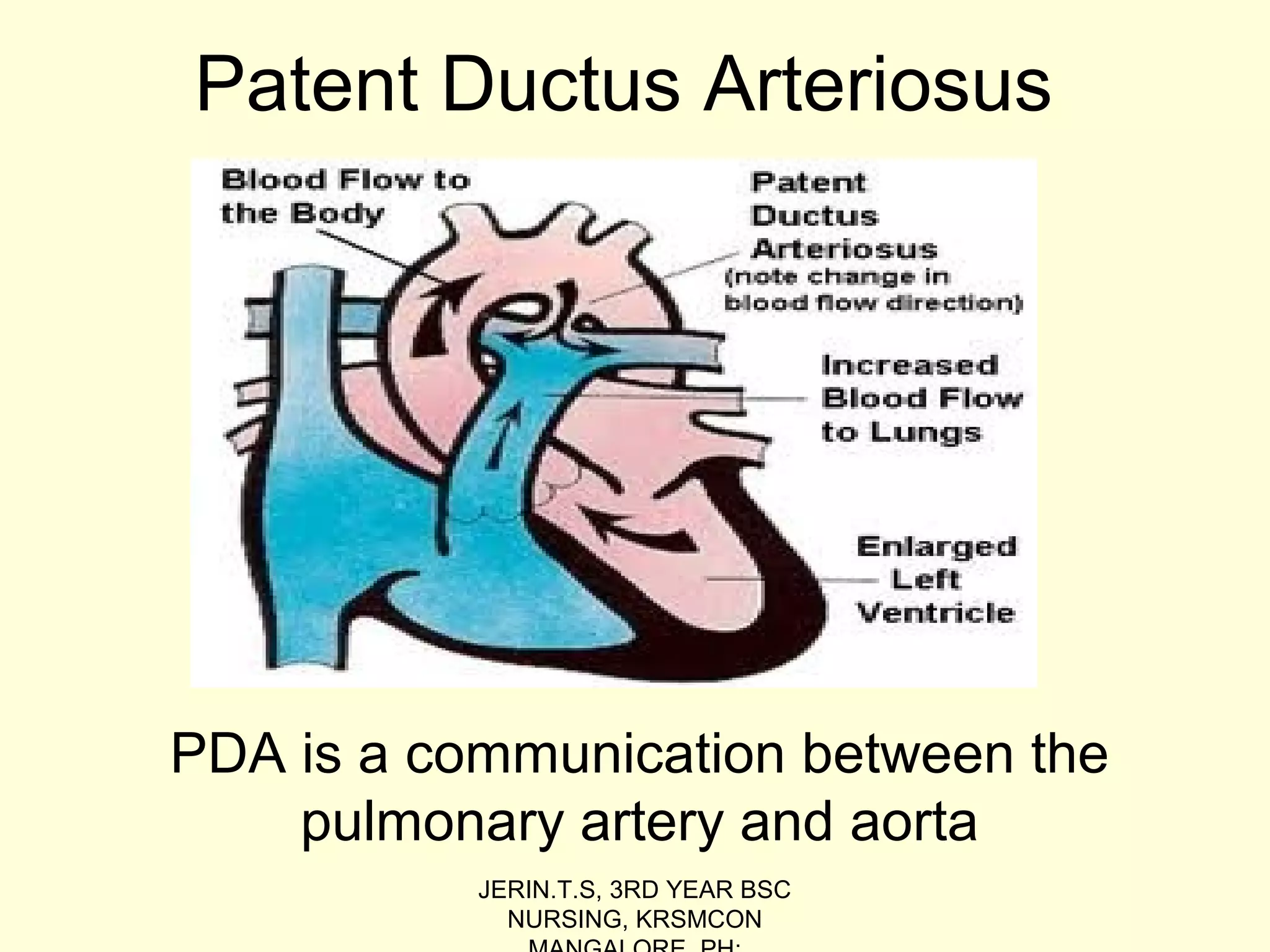
PDA is a communication between the
pulmonary artery and aorta
JERIN.T.S, 3RD YEAR BSC
NURSING, KRSMCON
Epidemiology
PDA is reported in 12-15% of the
infants
Preterm infants PDA is more which is
directly related to their weight and
gestational age
Almost 1/3rd
of infants with gestational
age of 34 weeks or less manifest clinical
evidence of PDA
Female:male :: 2:1
JERIN.T.S, 3RD YEAR BSC
NURSING, KRSMCON
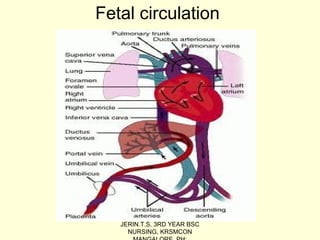
Fetal circulation
JERIN.T.S, 3RD YEAR BSC
NURSING, KRSMCON
Etiology
 Complex interaction between
mechanical, neural, hormonal,
and chemical factors result in
functional and usually complete
closure of PDA
But……….
JERIN.T.S, 3RD YEAR BSC NURSING,
KRSMCON MANGALORE. PH:
+919496743672
When a term infant is found to have PDA,
the wall of the ductus is deficient in both
the mucoid endothelial layer and the
muscular media.
In premature infants patency is due to
hypoxia and immaturity
Maternal rubella infection
Patients who live at high altitude
Systolic and diastolic overloading of the
pulmonary artery
prostaglandins
JERIN.T.S, 3RD YEAR BSC
NURSING, KRSMCON
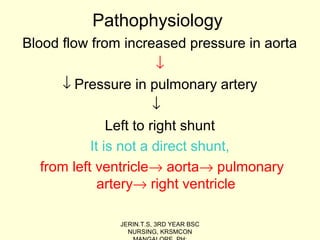
Pathophysiology
Blood flow from increased pressure in aorta
↓
↓ Pressure in pulmonary artery
↓
Left to right shunt
It is not a direct shunt,
from left ventricle→ aorta→ pulmonary
artery→ right ventricle
JERIN.T.S, 3RD YEAR BSC
NURSING, KRSMCON
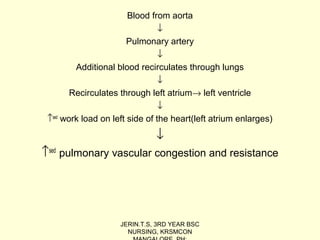
Blood from aorta
↓
Pulmonary artery
↓
Additional blood recirculates through lungs
↓
Recirculates through left atrium→ left ventricle
↓
↑sed
work load on left side of the heart(left atrium enlarges)
↓
↑sed
pulmonary vascular congestion and resistance
JERIN.T.S, 3RD YEAR BSC
NURSING, KRSMCON
Clinical features
1. Small PDA –asymptomatic
2. Large PDA
a) Murmur: machinery/ pan systolic, apical
diastolic murmur
a) Wide pulse pressure: reflected by bounding
peripheral pulses due to systemic leak from
aorta to pulmonary artery
JERIN.T.S, 3RD YEAR BSC
NURSING, KRSMCON
c) Growth retardation
d) Exertional dyspnoea
e) Left ventricular failure and CCF
f) Precordial pain and hoarsness of voice
g) Tachypnoea
h) Tachycardia and palpitations
i) Lower respiratory tract infection
j) Prominent neck vessels
k) left subclavicular thrill (dialatation of
ascending aorta)
JERIN.T.S, 3RD YEAR BSC
NURSING, KRSMCON
Diagnostic measures
Roentgenography: cardiac enlargement,
prominent ascending aorta, plethoric
pulmonary vasculature
Electrocardiograhy: shows deep Q waves
with tall T waves, ST segment changes.
2D Echocardiography done with color
doppler confirms the diagnosis
Cardiac catheterization
JERIN.T.S, 3RD YEAR BSC
NURSING, KRSMCON
Management
Medical:
Fluid restriction
Indomethacin ( PG synthesis inhibitor)
0.2mg/kg IV Q12 hrs for 3 doses
Repeat Indomethacin if treatment fails or
ductus reopens
IV Ibuprofen 10mg/kg bolus then
5mg/kg× 2days
Surgical ligation if still fails
JERIN.T.S, 3RD YEAR BSC
NURSING, KRSMCON
Full term infants, children, and
adolescents
• PDA often asymptomatic, treatment is
electively scheduled after 1 year of age
• Surgical: closure of ligation posterolateral
thoracotomy
VATS: video assisted thoracoscopic surgery
Therapeutic catheterization with an
“umbrella” device or coil procedure in
anatomically favourable small ductus
JERIN.T.S, 3RD YEAR BSC
NURSING, KRSMCON
Different devices used for the
closure
Double umbrella devices
Adjusted buttoned device
Gianturco coils
Risk of operation increases after the age of
15yrs because aortic wall around the
aortic attachment of the PDA becomes
more friable in adult life so risk of tear is
more during operation
JERIN.T.S, 3RD YEAR BSC
NURSING, KRSMCON
Complication
Pulmonary hypertension
Congestive cardiac failure
Infective endarteritis
Aneurismal dilatation of the pulmonary Artery
Calcification of the ductus
Non infective thrombosis
Pulmonary or systemic emboli
Paradoxical emboli
JERIN.T.S, 3RD YEAR BSC
NURSING, KRSMCON
Complications Resulting from
surgery
1) Injury to the
a) Laryngeal nerve (hoarsness)
b) Left phrenic nerve (paralysis of the left
hemidiaphragm)
c) Thoracic duct ( Chylothorax)
2) Recanalization (reopening) is very rare
JERIN.T.S, 3RD YEAR BSC
NURSING, KRSMCON
Prevention
Immunization against rubella
Reduce the preterm births
Prompt treatment of preterm infant with
surfactant
Use of high oscillation ventilators for lung
diseases
Early recognition of PDA
Repeated infusions are used with caution
JERIN.T.S, 3RD YEAR BSC
NURSING, KRSMCON
Nursing care of the child with heart
disease
1. Nursing assessment:
A) Nursing history & to become familiar with
the child & family
B) Childs growth & development
C) Level of exercise tolerance
D) Observe for chest deformities &
precordial bulge
E) Palpate for pulse in all extremities &
neck JERIN.T.S, 3RD YEAR BSC
NURSING, KRSMCON
F) Observe for skin & mucous membrane for
color & temperature changes:
Skin: color vary form pink, dusky, mottled,
blue. Ear lobes are good indicators of O2
saturation
Mucous membrane: Lips & tongue indicate
color change because they are vascular
areas
Extremities: for coolness, any change of
temperaturefrom upper to lower limbs,
varience in pulse of 4 extremities, &
odema
Cyanosis: central or peripheral, duration,
continuous or intermittentJERIN.T.S, 3RD YEAR BSC
NURSING, KRSMCON
G) Observe for clubbing specially after 1 yr
of age
H) Auscultate the child’s heart:
• count apical pulse for 1 full minute
• determine rhythm n its changes
• familiarise with murmur & type
I) Record vital signs,apical pulse, BP,
RESP
J) Look for & record any other congenital
defects.
JERIN.T.S, 3RD YEAR BSC
NURSING, KRSMCON
Nursing interventions
A. Relieving respiratory distress:
1. Determine the degree of resp distress:
a) infants: >60b/min indicates difficulty
b) Young children: >40b/min
c) Observe for regularity of respiration
d) Observe for retractions
e) Observe for any response to change in
positioning
f) Observe for nasal flaring , grunting
g) Observe for color change, irritability, anxiety
JERIN.T.S, 3RD YEAR BSC
NURSING, KRSMCON
,2. Raise the head end, position the child at
45o
angle to decrease pressure of the
viscera on the diaphragm & increase
lung volume:
a) infant: prone or propped on knees
b) children: arm chair fashion fowlers
position
3. Tilt the infants or childs head back slightly
so as to keep the airway straight
4. Suction the nose & throat if the child is
unable to cough up the secretions
JERIN.T.S, 3RD YEAR BSC
NURSING, KRSMCON
5. Feed slowly, allowing frequent rest
periods:
a.Rapid respiration & frequent coughing
predispose the child to aspiration
b. Child requires gavage feeding
c. Observe for abdominal distention, which
may increase respiratory difficulty. If
present insert NG tube
6. Provide O2
if indicated
JERIN.T.S, 3RD YEAR BSC
NURSING, KRSMCON
7. Administer diuretics as ordered
a. Monitor effectiveness
b. I/O chart, Weigh Diapers
c. Specific gravity of urine
d. Weigh daily same time same scale
e. Restrict fluids if indicated
f. Monitor S. Electrolytes n replace as
necessary
JERIN.T.S, 3RD YEAR BSC
NURSING, KRSMCON
B. Improve cardiac output
I. Organize nursing care so that child gets
enough rest
II. Avoid unnecessary activities like frequent
bath, changing cloths
III. Prevent excessive crying:
• Anticipate the need
• Hold the infant
• Feed when hungry
• Keep the infant Comfortable
JERIN.T.S, 3RD YEAR BSC
NURSING, KRSMCON
IV. Explain to child/parents the need for
rest
V. Provide diversional activities
VI. Thermoregulation
VII. Prevent constipation
VIII. Administer medications ordered
JERIN.T.S, 3RD YEAR BSC
NURSING, KRSMCON
C. Improve oxygenation & activity
tolerance
• Provide a safe, effective O2 environment
• Explain the use of O2
• Observe child response to O2
• Observe for child response while weaned
from O2
JERIN.T.S, 3RD YEAR BSC
NURSING, KRSMCON
D. Provide adequate nutrition
1. Feed slowly, frequently in a semierrect position
2. Provide food easy to chew & swallow
3. Don’t prolong feeding time
4. Provide high caloric, high iron & K+ & low Na+
5. Determine child likes & dislikes
6. Strict I/O chart
7. Monitor daily weight
JERIN.T.S, 3RD YEAR BSC
NURSING, KRSMCON
E. Preventing infection
1. Prevent exposure to communicable
diseases
2. Check child immunization status
3. Practice asepsis
4. Report signs of infection
5. Be certain about prophylactice antibiotics
JERIN.T.S, 3RD YEAR BSC
NURSING, KRSMCON
F. Reducing fear
1. Explain the cardiac problem to child &
parents
• Discuss with them & be truthful
2. Prepare the child for diagnostic &
Therapeutic procedures
3. Prepare the child & parents for corrective
surgery
4. Refer them to appropriate resources.S
JERIN.T.S, 3RD YEAR BSC
NURSING, KRSMCON
MANGALORE. PH:

Patent ductus arteriosus

  • 1.
    Patent Ductus Arteriosus PDAis a communication between the pulmonary artery and aorta JERIN.T.S, 3RD YEAR BSC NURSING, KRSMCON
  • 2.
    Epidemiology PDA is reportedin 12-15% of the infants Preterm infants PDA is more which is directly related to their weight and gestational age Almost 1/3rd of infants with gestational age of 34 weeks or less manifest clinical evidence of PDA Female:male :: 2:1 JERIN.T.S, 3RD YEAR BSC NURSING, KRSMCON
  • 3.
    Fetal circulation JERIN.T.S, 3RDYEAR BSC NURSING, KRSMCON
  • 4.
    Etiology  Complex interactionbetween mechanical, neural, hormonal, and chemical factors result in functional and usually complete closure of PDA But………. JERIN.T.S, 3RD YEAR BSC NURSING, KRSMCON MANGALORE. PH: +919496743672
  • 5.
    When a terminfant is found to have PDA, the wall of the ductus is deficient in both the mucoid endothelial layer and the muscular media. In premature infants patency is due to hypoxia and immaturity Maternal rubella infection Patients who live at high altitude Systolic and diastolic overloading of the pulmonary artery prostaglandins JERIN.T.S, 3RD YEAR BSC NURSING, KRSMCON
  • 6.
    Pathophysiology Blood flow fromincreased pressure in aorta ↓ ↓ Pressure in pulmonary artery ↓ Left to right shunt It is not a direct shunt, from left ventricle→ aorta→ pulmonary artery→ right ventricle JERIN.T.S, 3RD YEAR BSC NURSING, KRSMCON
  • 7.
    Blood from aorta ↓ Pulmonaryartery ↓ Additional blood recirculates through lungs ↓ Recirculates through left atrium→ left ventricle ↓ ↑sed work load on left side of the heart(left atrium enlarges) ↓ ↑sed pulmonary vascular congestion and resistance JERIN.T.S, 3RD YEAR BSC NURSING, KRSMCON
  • 8.
    Clinical features 1. SmallPDA –asymptomatic 2. Large PDA a) Murmur: machinery/ pan systolic, apical diastolic murmur a) Wide pulse pressure: reflected by bounding peripheral pulses due to systemic leak from aorta to pulmonary artery JERIN.T.S, 3RD YEAR BSC NURSING, KRSMCON
  • 9.
    c) Growth retardation d)Exertional dyspnoea e) Left ventricular failure and CCF f) Precordial pain and hoarsness of voice g) Tachypnoea h) Tachycardia and palpitations i) Lower respiratory tract infection j) Prominent neck vessels k) left subclavicular thrill (dialatation of ascending aorta) JERIN.T.S, 3RD YEAR BSC NURSING, KRSMCON
  • 10.
    Diagnostic measures Roentgenography: cardiacenlargement, prominent ascending aorta, plethoric pulmonary vasculature Electrocardiograhy: shows deep Q waves with tall T waves, ST segment changes. 2D Echocardiography done with color doppler confirms the diagnosis Cardiac catheterization JERIN.T.S, 3RD YEAR BSC NURSING, KRSMCON
  • 11.
    Management Medical: Fluid restriction Indomethacin (PG synthesis inhibitor) 0.2mg/kg IV Q12 hrs for 3 doses Repeat Indomethacin if treatment fails or ductus reopens IV Ibuprofen 10mg/kg bolus then 5mg/kg× 2days Surgical ligation if still fails JERIN.T.S, 3RD YEAR BSC NURSING, KRSMCON
  • 12.
    Full term infants,children, and adolescents • PDA often asymptomatic, treatment is electively scheduled after 1 year of age • Surgical: closure of ligation posterolateral thoracotomy VATS: video assisted thoracoscopic surgery Therapeutic catheterization with an “umbrella” device or coil procedure in anatomically favourable small ductus JERIN.T.S, 3RD YEAR BSC NURSING, KRSMCON
  • 13.
    Different devices usedfor the closure Double umbrella devices Adjusted buttoned device Gianturco coils Risk of operation increases after the age of 15yrs because aortic wall around the aortic attachment of the PDA becomes more friable in adult life so risk of tear is more during operation JERIN.T.S, 3RD YEAR BSC NURSING, KRSMCON
  • 14.
    Complication Pulmonary hypertension Congestive cardiacfailure Infective endarteritis Aneurismal dilatation of the pulmonary Artery Calcification of the ductus Non infective thrombosis Pulmonary or systemic emboli Paradoxical emboli JERIN.T.S, 3RD YEAR BSC NURSING, KRSMCON
  • 15.
    Complications Resulting from surgery 1)Injury to the a) Laryngeal nerve (hoarsness) b) Left phrenic nerve (paralysis of the left hemidiaphragm) c) Thoracic duct ( Chylothorax) 2) Recanalization (reopening) is very rare JERIN.T.S, 3RD YEAR BSC NURSING, KRSMCON
  • 16.
    Prevention Immunization against rubella Reducethe preterm births Prompt treatment of preterm infant with surfactant Use of high oscillation ventilators for lung diseases Early recognition of PDA Repeated infusions are used with caution JERIN.T.S, 3RD YEAR BSC NURSING, KRSMCON
  • 17.
    Nursing care ofthe child with heart disease 1. Nursing assessment: A) Nursing history & to become familiar with the child & family B) Childs growth & development C) Level of exercise tolerance D) Observe for chest deformities & precordial bulge E) Palpate for pulse in all extremities & neck JERIN.T.S, 3RD YEAR BSC NURSING, KRSMCON
  • 18.
    F) Observe forskin & mucous membrane for color & temperature changes: Skin: color vary form pink, dusky, mottled, blue. Ear lobes are good indicators of O2 saturation Mucous membrane: Lips & tongue indicate color change because they are vascular areas Extremities: for coolness, any change of temperaturefrom upper to lower limbs, varience in pulse of 4 extremities, & odema Cyanosis: central or peripheral, duration, continuous or intermittentJERIN.T.S, 3RD YEAR BSC NURSING, KRSMCON
  • 19.
    G) Observe forclubbing specially after 1 yr of age H) Auscultate the child’s heart: • count apical pulse for 1 full minute • determine rhythm n its changes • familiarise with murmur & type I) Record vital signs,apical pulse, BP, RESP J) Look for & record any other congenital defects. JERIN.T.S, 3RD YEAR BSC NURSING, KRSMCON
  • 20.
    Nursing interventions A. Relievingrespiratory distress: 1. Determine the degree of resp distress: a) infants: >60b/min indicates difficulty b) Young children: >40b/min c) Observe for regularity of respiration d) Observe for retractions e) Observe for any response to change in positioning f) Observe for nasal flaring , grunting g) Observe for color change, irritability, anxiety JERIN.T.S, 3RD YEAR BSC NURSING, KRSMCON
  • 21.
    ,2. Raise thehead end, position the child at 45o angle to decrease pressure of the viscera on the diaphragm & increase lung volume: a) infant: prone or propped on knees b) children: arm chair fashion fowlers position 3. Tilt the infants or childs head back slightly so as to keep the airway straight 4. Suction the nose & throat if the child is unable to cough up the secretions JERIN.T.S, 3RD YEAR BSC NURSING, KRSMCON
  • 22.
    5. Feed slowly,allowing frequent rest periods: a.Rapid respiration & frequent coughing predispose the child to aspiration b. Child requires gavage feeding c. Observe for abdominal distention, which may increase respiratory difficulty. If present insert NG tube 6. Provide O2 if indicated JERIN.T.S, 3RD YEAR BSC NURSING, KRSMCON
  • 23.
    7. Administer diureticsas ordered a. Monitor effectiveness b. I/O chart, Weigh Diapers c. Specific gravity of urine d. Weigh daily same time same scale e. Restrict fluids if indicated f. Monitor S. Electrolytes n replace as necessary JERIN.T.S, 3RD YEAR BSC NURSING, KRSMCON
  • 24.
    B. Improve cardiacoutput I. Organize nursing care so that child gets enough rest II. Avoid unnecessary activities like frequent bath, changing cloths III. Prevent excessive crying: • Anticipate the need • Hold the infant • Feed when hungry • Keep the infant Comfortable JERIN.T.S, 3RD YEAR BSC NURSING, KRSMCON
  • 25.
    IV. Explain tochild/parents the need for rest V. Provide diversional activities VI. Thermoregulation VII. Prevent constipation VIII. Administer medications ordered JERIN.T.S, 3RD YEAR BSC NURSING, KRSMCON
  • 26.
    C. Improve oxygenation& activity tolerance • Provide a safe, effective O2 environment • Explain the use of O2 • Observe child response to O2 • Observe for child response while weaned from O2 JERIN.T.S, 3RD YEAR BSC NURSING, KRSMCON
  • 27.
    D. Provide adequatenutrition 1. Feed slowly, frequently in a semierrect position 2. Provide food easy to chew & swallow 3. Don’t prolong feeding time 4. Provide high caloric, high iron & K+ & low Na+ 5. Determine child likes & dislikes 6. Strict I/O chart 7. Monitor daily weight JERIN.T.S, 3RD YEAR BSC NURSING, KRSMCON
  • 28.
    E. Preventing infection 1.Prevent exposure to communicable diseases 2. Check child immunization status 3. Practice asepsis 4. Report signs of infection 5. Be certain about prophylactice antibiotics JERIN.T.S, 3RD YEAR BSC NURSING, KRSMCON
  • 29.
    F. Reducing fear 1.Explain the cardiac problem to child & parents • Discuss with them & be truthful 2. Prepare the child for diagnostic & Therapeutic procedures 3. Prepare the child & parents for corrective surgery 4. Refer them to appropriate resources.S JERIN.T.S, 3RD YEAR BSC NURSING, KRSMCON MANGALORE. PH: