BRONZE
PRESENTED BY
HARSHVARDHAN KHANTADIA
MANISH KUMAR
PRIY RANJAN
SHAGUFTA ANJUM
SARIKA SHARAN
SONIKA SRI
VINSHI RAJ
BRONZE-INTRODUCTION
 Bronze is an alloy consisting primarily of copper, usually
with tin as the main additive.
 Bronze now refers to alloy of copper having elements of silicon,
manganese etc which may or may not have zinc.
 The discovery of bronze enabled people to create metal objects
which were better than previously possible.(Bronze age – 2nd
cent. B.C)
 Tools, weapons, armor, and various building materials, like
decorative tiles, made of bronze were harder and more durable
than their stone and copper predecessors.
 Initially bronze was made out of copper and arsenic to
form arsenic bronze.
 It was only later that tin was used, becoming the sole type of
bronze in the late 3rd millennium BC.
 Tin bronze was superior to arsenic bronze in that the alloying
process itself could more easily be controlled and the alloy was
stronger and easier to cast.Also, unlike arsenic, tin is not toxic.
Ewer from 7th century Iran. Cast,
chased, and inlaid bronze. New York
Metropolitan Museum of Art
A large bronze cast medallion of the 16th
century.Chinese sword made of bronze
 "True" bronze is a combination of approximately 88% copper (Cu) and 12% tin (Sn),
however there are three major classes or types of "bronzes" used in sculpture and
construction.
 They are:
1. Statuary Bronze - approximately 97% copper (Cu), 2% tin(Sn) and 1% zinc (Zn); this
composition is the closest to "true" bronze.
2. Architectural Bronze - actually more of a "leaded brass“, is commonly composed of
approximately 57% copper (Cu), 40% zinc (Zn) and 3% lead (Pb).
3. Commercial Bronze - composed of approximately 90% copper(Cu) and 10% zinc
(Zn).
 Aluminium bronze - aluminium is the main alloying metal added to copper. Aluminium
bronzes are most commonly used in applications where their resistance to corrosion makes
them preferable to other engineering materials. These applications include plain bearings
and landing gear components on aircraft, engine components (especially for seagoing ships),
underwater fastenings
TYPES OF BRONZE
88%
Cu
12%
Sn
Bronze
CHEMICAL COMPOSITIONS
BRONZE
COMMERCIAL BRONZE
ARCHITECTURAL BRONZE
ALUMINIUM BRONZE
STATUARY BRONZE
PROPERTIES
 The bronzes are generally as strong as they are alloys.
 They are tough and ductile at all temperatures and retain their strength well at elevated
temperatures.
 extremely malleable and durable.
 Melts at 950 centigrade.
 Resists corrosion (especially seawater corrosion-is due to the formation of an intrinsic, thin
but tough adherent film of aluminium oxide.)
 Metal fatigue more than steel.
 Better conductor of heat and electricity.
 Bronze in its "raw" state is a "pinkish", salmon colored metal, however it is rarely seen in its
pure state.
 Bronze usually exhibits some patination or corrosion so that its color normally ranges
from dark brown to lime green.
 Exposed bronze undergoes continuous change and progresses through several predictable
"stages" of oxidation and corrosion.
 It is also non-sparking, so it is often used to make tools for use in combustible
environments.
 Its resonance also makes it ideal for use in casting bells.
 It causes minimal friction, making it highly useful for machine parts and other
applications that involve metal-on-metal contact, such as gears.
USES
 Bronze is commonly used in ship propellers and submerged bearings owing to its
combination of toughness and resistance to salt water corrosion.
 It is also widely used for cast bronze sculpture. Many common bronze alloys have the
unusual and very desirable property of expanding slightly just before they set, thus filling in
the finest details of a mold.
 Phosphor bronze is particularly suited to precision-grade bearings clips, electrical
connectors and springs. It is also used in guitar and piano strings.
 It is used to make hammers, mallets, wrenches and other durable tools to be used in
explosive atmospheres or in the presence of flammable vapors.
 Bronze is used to make bronze wool for woodworking applications where steel
wool would discolor oak.
 Bronze is the preferred metal for top-quality bells
 Bronze has been used in the manufacture of various types of medals
 Architectural bronze is typically used for:
1.door and window frames
2.doorand window hardware
3. rails,
4. furniture hardware.
a small section of the bronze frieze that runs
all the way round the Chanin Building.
The Bronze Tiger of Mysore
Mysore Palace has six of these magnificent scupltures in and around
the grand Mysore Palace
Elias & Co. Department Store Bronze coating glasses in a building
THE CHANIN BUILDING, NEWYORK
ELEVATOR DOORS ELEVATOR DOORS
FRIEZE
PORCH WINDOW FRAMES
Bronze panels used in a Supreme court
in New Zealand.
A bronze beams and sculpture used in an art
gallery
Bronze tiles used in a bathroom
Bronze taps
Bronze handrail in a staircase
BRONZE PLAQUES
propellers Door frames Hinges & nut bolt Window frames
clip
bearings
pumps
sculpture
Decorative elements
handles
Decorative hinges
Door frames
a small section of the bronze frieze that runs
all the way round the Chanin Building.
The Bronze Tiger of Mysore
Mysore Palace has six of these magnificent scupltures in and around
the grand Mysore Palace
Elias & Co. Department Store Bronze coating glasses in a building
THE CHANIN BUILDING, NEWYORK
ELEVATOR DOORS ELEVATOR DOORS
FRIEZE
PORCH WINDOW FRAMES
Bronze panels used in a Supreme court
in New Zealand.
A bronze beams and sculpture used in an art
gallery
Bronze tiles used in a bathroom
Bronze taps
Bronze handrail in a staircase
BRONZE PLAQUES
APPLICATIONS
1. MARINE
The outstanding corrosion resistance of Aluminium Bronze in marine environments coupled
with its high strength and wear resistance, have made it a first choice for ships' propellers for
many years. Modern vessels are fitted with smaller variable pitch propellers and these are
cast in Aluminium Bronze as are the associated gearboxes.Aluminium Bronze is widely used
for pumps, valves and pipes on oil and gas platforms.
Typical component being machined
Impeller in aluminium bronze
Unit under construction –
aluminium bronze components
clearly visible
ALUMINIUMBRONZE
WELDING
•All Aluminium Bronzes can be welded, whether in cast or wrought form.
•it is possible to manufacture components by the most economic production techniques.
•In the event of damage, it is also possible to repair aluminium bronze components by
welding, frequently while still in place.
•INERT GAS SHIELDED ARC WELDING is generally recommended.
•An electric arc forms between a consumable wire (tungsten)electrode and the work piece
metal(s), which heats the work piece metal(s), causing them to melt, and join. Along with the
wire electrode, a shielding gas(argon or helium) feeds through the welding gun, which
shields the process from contaminants in the air.
(1) Direction of travel, (2) Contact
tube,(3) Electrode, (4) Shielding
gas, (5) Molten weld metal, (6)Solidified
weld metal, (7) Workpiece.
2. BUILDING AND CONSTRUCTION
The entire weight of this dome roof at Aberdeen
University,Scotland is supported on Aluminium
Bronze spherical joints set in concrete.
Many modern buildings and large bridges
use Aluminium Bronze expansion joints,
masonry fixings
3. GENERAL ENGINEERING
Aluminium Bronze components are found in many general engineering
applications where high strength coupled with wear and corrosion
resistance is required.
The non-galling property is an added advantage Rolls
Royce appreciate when they specify aluminium
bronze for their wheel nuts
Gear wheels for British Rail braking systems are cast in
aluminium bronze
ARCHITECTURAL BRONZE
•Architectural bronze is a competitive material.
•THE ADVANTAGES:
noble – load-bearing – resistant to weathering – low maintenance – easily formed –
simple to process – recyclable
Colour shades
•The colour scale of alloys ranges from gold yellow,
through yellowy brown to reddish brown.
•Outdoors, bronze develops a natural patina that
varies from pale brown to deep brown and green
shades
•The surface finish can be glossy or matt to intensify
or mute the colour effect to your exact preferences.
•The surface treatment:
polishing – burnishing (something made bright and shiny by rubbing.When an object is
burnished, it reflects a shiny gleam or glow.) – brushing – shot blasting
SOURCE - www.swissmetal.com
STANDARD COLOURS
SOURCE - DML Architectural Systems Ltd. LEEDS
Technical properties
•Architectural bronze has high tensile and compressive strength.
•Low thermal expansion values allow the use of bronze sections in exposed positions and in
the design of high-tech façades.
• Its resistance to corrosion also makes architectural bronze the ideal material in regions with
an aggressive climate.
•Architectural bronze is well suited for nearly all processing technologies.
•The joining techniques:
press-in (mechanical) joining – rolling – screw connection – adhesive joining –
soldering – welding
SOURCE - www.swissmetal.com
A rich variety of shapes
•The ease with which architectural bronze can be formed
opens up enormous design possibilities for window frames,
façades and door sections.
•Architectural bronze can be formed by various techniques.
•The processes:
casting – hot extrusion – cold forming
•All aluminium or stainless steel section shapes can be
produced in bronze
•Wall thicknesses range from 1.0 to 4.0 mm.
SOURCE - www.swissmetal.com
DOORFRAMEPROFILES
SOURCE - DML Architectural Systems Ltd. LEEDS
The range of sections:
solid sections – filigree open sections(metal ware created by shaping fine wire into delicate or intricate
designs) – cellular sections – handrail and railing sections
filigree open sections
SOURCE - www.swissmetal.com
Bronze Door section
Bronze window section
HANDRAILS
BRONZE FINISHES
A lightly grained surface produced by
single - directional abrading.
The most common bronze finish for
architectural products.
Non-Directional Finish
Produced by fine grit orbital sanding
(nondirectional) on mill finish bronze
(Mirror Polished)
Obtained by polishing with successively
finer abrasives, then buffing with a very
fine compound
Angel Hair Finish
Produced by medium-fine grit orbital
sanding, non-directional.
Random Swirl Finish
Grained surface produced by
random multi directional
abrading.
Clear Coat
An optional high-performance factory applied clear coat is available in satin, semi gloss,
and high gloss sheens.
Natural
a bright golden hue.
Medium Bronze
A rich medium brown with
pronounced golden hues.
Oil Rubbed Bronze
A dark brown color
with deep golden tones
of varying intensities.
Dark Statuary Bronze
A dark brown-black statuary
color that varies slightly with
the natural characteristics of
the metal.
PROBLEMS AND DEFECTS
•Bronze usually exhibits some patination or corrosion so that its color normally ranges from lime green to
dark brown. Exposed bronze undergoes continuous change and progresses through several predictable
"stages" of oxidation and corrosion.
•The stages of bronze corrosion vary in duration and time of onset, based on many factors, including:
1. composition of the bronze
2. patination or other protective treatments applied
3. weather
4. location and exposure to rain, sun, and other climatic conditions
5. atmospheric pollutants
6. scheduled maintenance/cleaning, and
7. adjacent materials including residual core materials.
•Problems may be classified into two broad categories:
1) Natural or inherent problems based on the characteristics of the material and the conditions of
the exposure
2) Mechanical deterioration
PATINATION
•Patina is defined as a film or layer caused by oxidisation of old bronze.
•In nature this occurs over a long period of time and can result in a variety of interesting colours usually
green.
•With the use of a variety of chemicals and processes carried out in factory, the outcome can be accelerated
and controlled.
•The process can produce an interesting range of patinas giving a more natural appearance. They are often
selected for historical or artistic work.
•Artificial patinas are applied to bronze using chemical solutions which react with the surface to form a thin
layer of coloured corrosion products.
•Patinas can be transparent or opaque and are sometimes applied in a number of layers to produce widely
varied effects.
•Bronze Oil Rubbed: there is no rubbing to bring out the bronze color. Some bronze
color shows through and more will show over time with wear.
•Bronze with Patina: Heavy application of black patina which gives a bold contrast and
accentuates the carved design.Top surface is buffed to bring out the Bronze color.
•Bronze Raw: Raw bronze is cast and sold without any touching of the surface. There is
major color variation of black to copper which cannot be controlled. Raw Bronze has a
distinct “Old World” look and feel.The surface, in some areas, may be rough.
•Bronze no Patina: Bronze is poured, cleaned and buffed. Depending upon the depth of
the design; you might get some dark areas.
NATURAL PROBLEMS
1. CORROSION :
 the existence of chemicals in the atmosphere, such as chlorine, sulfur, and nitrogen oxides, in the presence of
moisture, is the most significant cause of bronze deterioration.
Corrosion may have many causes and symptoms, including:
1. Uniform oxidation or corrosion or patination: Corrosion attacks the metal surface evenly.
2. Pitting: Attacks the metal surface in localized areas
Sulphide pollution of the sea water may cause pitting in most copper alloys including aluminium bronzes
3. Selective attack: When a metal is not homogenous throughout, certain areas may be attacked in
preference to others.
4. Erosion: When a corrosion-resistant oxide layer is removed and the bare metal beneath corrodes.
Erosion in the bronze layer underneath
chromium playing, which has peeled offPitting of bronzeOxidation of bronze
5. Stress corrosion cracking: Attacks areas in a metal which were stressed during metal working.
6. Humidity, temperature and condensation: Affect the rate of corrosion; in a marine environment,
aerosols can deposit chloride and other salts which will accelerate the rate of atmospheric corrosion.
7. Bronze disease: Bronze disease is the result of exposure to chlorine compounds which can come
from any saline source, such as contact with saline soils, atmospheric pollutants or airborne salt spray
near bodies of salt water. The chlorine reacts with the copper in bronze to form copper chloride. The
copper chloride is relatively unstable and the only way to arrest the continuing corrosion is the complete
removal of the chlorides using electrochemical methods.
Stress corrosion cracking
Bronze disease
1. Abrasion:
• Causes removal of the protective metal surface. Some metals such as zinc are relatively soft and
therefore vulnerable to abrasion damage.
2. Fatigue:
•Failure of metal that has been repeatedly stressed beyond its elastic limit, due to failure to
provide necessary allowances for thermal expansion and contraction caused by temperature
differences.
3.Heat:
•Usually in the form of fire, will cause many metals to become plastic, distort, and fail.
4.Distortion:
•Permanent deformation or failure may occur when a metal is overloaded beyond its yield point
because of increased live or dead loads, thermal stresses, or structural modifications altering a
stress regime.
MECHANICAL DETERIORATION
(PURELY PHYSICAL PROCESSES):
DISADVANTAGES OF BRONZE
 More expensive than steel, brass more likely to crack under load.
 It is a heavy metal
 Like copper, bronze can develop a patina, a green film as a result of long exposure to moist air.
 Bronze will deteriorate rapidly if exposed to moisture and chlorides or sulfides.
 Bronze is susceptible to “Bronze Disease “one of the most serious hazards of bronze.
ADVANTAGES OF BRONZE
 It won't rust but it'll develop a pleasant patina over time
 Corrosion Resistance - By forming a protective surface film, most copper alloys resist many
corrosive environments
 Withstand High Temperatures - Several families of bronze alloys work well in elevated
temperature environments
 Friction and Wear - Copper alloys wear well against steel and are used in numerous bearing and
gear components
 Good Machinability - In general, copper alloys are easy to machine compared to steel
 Weldability - Many grades can be welded
 Brazing and Soldering - All grades of copper alloys can be brazed and soldered
COMPARATIVE ANALYSIS
Brass Bronze Iron
Compositio
n
Copper and zinc. Copper and tin
(sometimes with other elements such as
phosphorus, manganese, aluminum, or
silicon)
Naturally occurring metal
Properties • Higher malleability
• Low melting
point - 900 C
• Corrosion
resistant.
• Susceptible to
stresscracking
when exposed to
ammonia.
• Not as hard as
steel.
• Extremely malleable and durable.
• Less brittle than iron and steel.
• Melts at 950centigrade.
• Resists corrosion (especially seawater
corrosion)
• Metal fatigue more than steel.
• Better conductor of heat and
electricity.
• Melting point of 1600 degrees C.
• When heated, iron retains heat.
• Iron rusts
• Iron has magnetic properties.
• Iron is more brittle than bronze.
Uses • Decorative
• Locks, gears,
doorknobs,
ammunition, valves.
• Plumbing/electroni
cs
• Musical
instruments
• Used where it's
important to
negate
spark(fittings &
tools around
explosive gas).
• Used in boat and ship fittings
• Propellers and submerged bearings.
• Cast bronze sculpture.
• Bearings,clips,electrical connectors
and springs;
• For top-quality bells.
• For railings and grills
• Used for industrial purposes.
• Automobiles,machine tools and
machine parts
• Stainless steel is used in building
parts, cooking pots and pans,
cutlery and surgical equipment
• Iron and steel are used widely in
the construction of roads,
railways, other infrastructure
Color Muted yellow,
somewhat similar to
gold, but duller.
Reddish brown. silver-white color
CASE STUDY
 The use of extruded bronze mullions and
bronze spandrels together with a dark amber-
tinted glass has unified the surface with color.
 Unbroken height of bronze
 Bronze I-beams ready to ship from chicago’s
extruded metals company to new york city,
where they will be part of the construction of
the new seagram’s building tower in midtown,
1956.
CASE STUDY-1
SEAGRAM BUILDING(NEWYORK)
Seagram building
Bronze I- section Seagram building Showing mullions of bronze
Corner detail (horizontal section)
Corner detail (vertical section)
FIXING DETAILS
SECTION DETAIL OF BRONZE USED IN SEAGRAM BUILDING
CASE STUDY-2
WARRINGTON PLACE,DUBLIN,IRELAND
 This composition is contained by the over sailing
bronze canopy roof.
 The entrance forecourt balances the fluid bronze
sculpture by Michael Warren.
 Roof ,cladding elements and a fluid sculpture all
formed from bronze.
 This material –sourced in Germany fabricated in Italy
and treated with bees-wax to maintain its natural
luster adds a distinctive quality to the building
appearance .
Bronze was chosen
 To add a civic quality to the building façade
 Providing visual interest and a unique signature for the
building.
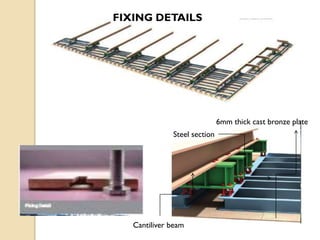
 Elevation treatment. Warrington place
Thick bronze plates were specially cast
and rolled to the required thickness of
6mm.
DETAIL SECTION
Bronze roof
6mm thick cast bronze plate
Cantiliver beam
Steel section
FIXING DETAILS
BIBLIOGRAPHY
 BOOKS REFFERED-
 CONSTRUCTION (MATERIALS, METHODS ANDTECHNIQUES) BY-WILLIAM . P . SPENCE
 LINKS REFFERED-
 http://www.bronzecasements.com/spec-advanced
 http://ibm.nic.in/marketsurvey_copper.pdf.php
 http://ibm.nic.in/marketsurvey_leadandzinc.pdf
 http://www.newagepublishers.com/samplechapter/001382.pdf
 http://www.gsa.gov/portal/content/111994
 http://www.wisegeek.org/what-is-bronze.htm
 http://www.getyourcontent.com/1/78471-0/Properties-and-Uses-of-Br.aspx
 http://en.wikipedia.org/wiki/Aluminium_bronze
 http://en.wikipedia.org/wiki/Gas_tungsten_arc_welding
 http://www.stilesdoors.com/products/bronze/pdf/Bronze%20Clad%20Steel%20Doors%20&%20Frames%20Specs.
pdf
 http://www.vam.ac.uk/content/journals/conservation-journal/issue-31/the-artificial-patination-of-bronze-
sculpture/
 http://www.crstudio4.com/bronze-concepts/

Bronze

  • 1.
    BRONZE PRESENTED BY HARSHVARDHAN KHANTADIA MANISHKUMAR PRIY RANJAN SHAGUFTA ANJUM SARIKA SHARAN SONIKA SRI VINSHI RAJ
  • 2.
    BRONZE-INTRODUCTION  Bronze isan alloy consisting primarily of copper, usually with tin as the main additive.  Bronze now refers to alloy of copper having elements of silicon, manganese etc which may or may not have zinc.  The discovery of bronze enabled people to create metal objects which were better than previously possible.(Bronze age – 2nd cent. B.C)  Tools, weapons, armor, and various building materials, like decorative tiles, made of bronze were harder and more durable than their stone and copper predecessors.  Initially bronze was made out of copper and arsenic to form arsenic bronze.  It was only later that tin was used, becoming the sole type of bronze in the late 3rd millennium BC.  Tin bronze was superior to arsenic bronze in that the alloying process itself could more easily be controlled and the alloy was stronger and easier to cast.Also, unlike arsenic, tin is not toxic. Ewer from 7th century Iran. Cast, chased, and inlaid bronze. New York Metropolitan Museum of Art A large bronze cast medallion of the 16th century.Chinese sword made of bronze
  • 3.
     "True" bronzeis a combination of approximately 88% copper (Cu) and 12% tin (Sn), however there are three major classes or types of "bronzes" used in sculpture and construction.  They are: 1. Statuary Bronze - approximately 97% copper (Cu), 2% tin(Sn) and 1% zinc (Zn); this composition is the closest to "true" bronze. 2. Architectural Bronze - actually more of a "leaded brass“, is commonly composed of approximately 57% copper (Cu), 40% zinc (Zn) and 3% lead (Pb). 3. Commercial Bronze - composed of approximately 90% copper(Cu) and 10% zinc (Zn).  Aluminium bronze - aluminium is the main alloying metal added to copper. Aluminium bronzes are most commonly used in applications where their resistance to corrosion makes them preferable to other engineering materials. These applications include plain bearings and landing gear components on aircraft, engine components (especially for seagoing ships), underwater fastenings TYPES OF BRONZE
  • 4.
  • 5.
    PROPERTIES  The bronzesare generally as strong as they are alloys.  They are tough and ductile at all temperatures and retain their strength well at elevated temperatures.  extremely malleable and durable.  Melts at 950 centigrade.  Resists corrosion (especially seawater corrosion-is due to the formation of an intrinsic, thin but tough adherent film of aluminium oxide.)  Metal fatigue more than steel.  Better conductor of heat and electricity.  Bronze in its "raw" state is a "pinkish", salmon colored metal, however it is rarely seen in its pure state.  Bronze usually exhibits some patination or corrosion so that its color normally ranges from dark brown to lime green.  Exposed bronze undergoes continuous change and progresses through several predictable "stages" of oxidation and corrosion.  It is also non-sparking, so it is often used to make tools for use in combustible environments.  Its resonance also makes it ideal for use in casting bells.  It causes minimal friction, making it highly useful for machine parts and other applications that involve metal-on-metal contact, such as gears.
  • 6.
    USES  Bronze iscommonly used in ship propellers and submerged bearings owing to its combination of toughness and resistance to salt water corrosion.  It is also widely used for cast bronze sculpture. Many common bronze alloys have the unusual and very desirable property of expanding slightly just before they set, thus filling in the finest details of a mold.  Phosphor bronze is particularly suited to precision-grade bearings clips, electrical connectors and springs. It is also used in guitar and piano strings.  It is used to make hammers, mallets, wrenches and other durable tools to be used in explosive atmospheres or in the presence of flammable vapors.  Bronze is used to make bronze wool for woodworking applications where steel wool would discolor oak.  Bronze is the preferred metal for top-quality bells  Bronze has been used in the manufacture of various types of medals  Architectural bronze is typically used for: 1.door and window frames 2.doorand window hardware 3. rails, 4. furniture hardware.
  • 7.
    a small sectionof the bronze frieze that runs all the way round the Chanin Building. The Bronze Tiger of Mysore Mysore Palace has six of these magnificent scupltures in and around the grand Mysore Palace Elias & Co. Department Store Bronze coating glasses in a building
  • 8.
    THE CHANIN BUILDING,NEWYORK ELEVATOR DOORS ELEVATOR DOORS FRIEZE PORCH WINDOW FRAMES
  • 9.
    Bronze panels usedin a Supreme court in New Zealand. A bronze beams and sculpture used in an art gallery Bronze tiles used in a bathroom Bronze taps Bronze handrail in a staircase
  • 10.
  • 11.
    propellers Door framesHinges & nut bolt Window frames clip bearings pumps sculpture Decorative elements handles Decorative hinges Door frames
  • 12.
    a small sectionof the bronze frieze that runs all the way round the Chanin Building. The Bronze Tiger of Mysore Mysore Palace has six of these magnificent scupltures in and around the grand Mysore Palace Elias & Co. Department Store Bronze coating glasses in a building
  • 13.
    THE CHANIN BUILDING,NEWYORK ELEVATOR DOORS ELEVATOR DOORS FRIEZE PORCH WINDOW FRAMES
  • 14.
    Bronze panels usedin a Supreme court in New Zealand. A bronze beams and sculpture used in an art gallery Bronze tiles used in a bathroom Bronze taps Bronze handrail in a staircase
  • 15.
  • 16.
    APPLICATIONS 1. MARINE The outstandingcorrosion resistance of Aluminium Bronze in marine environments coupled with its high strength and wear resistance, have made it a first choice for ships' propellers for many years. Modern vessels are fitted with smaller variable pitch propellers and these are cast in Aluminium Bronze as are the associated gearboxes.Aluminium Bronze is widely used for pumps, valves and pipes on oil and gas platforms. Typical component being machined Impeller in aluminium bronze Unit under construction – aluminium bronze components clearly visible ALUMINIUMBRONZE
  • 17.
    WELDING •All Aluminium Bronzescan be welded, whether in cast or wrought form. •it is possible to manufacture components by the most economic production techniques. •In the event of damage, it is also possible to repair aluminium bronze components by welding, frequently while still in place. •INERT GAS SHIELDED ARC WELDING is generally recommended. •An electric arc forms between a consumable wire (tungsten)electrode and the work piece metal(s), which heats the work piece metal(s), causing them to melt, and join. Along with the wire electrode, a shielding gas(argon or helium) feeds through the welding gun, which shields the process from contaminants in the air. (1) Direction of travel, (2) Contact tube,(3) Electrode, (4) Shielding gas, (5) Molten weld metal, (6)Solidified weld metal, (7) Workpiece.
  • 18.
    2. BUILDING ANDCONSTRUCTION The entire weight of this dome roof at Aberdeen University,Scotland is supported on Aluminium Bronze spherical joints set in concrete. Many modern buildings and large bridges use Aluminium Bronze expansion joints, masonry fixings
  • 19.
    3. GENERAL ENGINEERING AluminiumBronze components are found in many general engineering applications where high strength coupled with wear and corrosion resistance is required. The non-galling property is an added advantage Rolls Royce appreciate when they specify aluminium bronze for their wheel nuts Gear wheels for British Rail braking systems are cast in aluminium bronze
  • 20.
    ARCHITECTURAL BRONZE •Architectural bronzeis a competitive material. •THE ADVANTAGES: noble – load-bearing – resistant to weathering – low maintenance – easily formed – simple to process – recyclable Colour shades •The colour scale of alloys ranges from gold yellow, through yellowy brown to reddish brown. •Outdoors, bronze develops a natural patina that varies from pale brown to deep brown and green shades •The surface finish can be glossy or matt to intensify or mute the colour effect to your exact preferences. •The surface treatment: polishing – burnishing (something made bright and shiny by rubbing.When an object is burnished, it reflects a shiny gleam or glow.) – brushing – shot blasting SOURCE - www.swissmetal.com
  • 21.
    STANDARD COLOURS SOURCE -DML Architectural Systems Ltd. LEEDS
  • 22.
    Technical properties •Architectural bronzehas high tensile and compressive strength. •Low thermal expansion values allow the use of bronze sections in exposed positions and in the design of high-tech façades. • Its resistance to corrosion also makes architectural bronze the ideal material in regions with an aggressive climate. •Architectural bronze is well suited for nearly all processing technologies. •The joining techniques: press-in (mechanical) joining – rolling – screw connection – adhesive joining – soldering – welding SOURCE - www.swissmetal.com
  • 23.
    A rich varietyof shapes •The ease with which architectural bronze can be formed opens up enormous design possibilities for window frames, façades and door sections. •Architectural bronze can be formed by various techniques. •The processes: casting – hot extrusion – cold forming •All aluminium or stainless steel section shapes can be produced in bronze •Wall thicknesses range from 1.0 to 4.0 mm. SOURCE - www.swissmetal.com
  • 24.
    DOORFRAMEPROFILES SOURCE - DMLArchitectural Systems Ltd. LEEDS
  • 25.
    The range ofsections: solid sections – filigree open sections(metal ware created by shaping fine wire into delicate or intricate designs) – cellular sections – handrail and railing sections filigree open sections SOURCE - www.swissmetal.com
  • 26.
  • 27.
  • 29.
    BRONZE FINISHES A lightlygrained surface produced by single - directional abrading. The most common bronze finish for architectural products. Non-Directional Finish Produced by fine grit orbital sanding (nondirectional) on mill finish bronze (Mirror Polished) Obtained by polishing with successively finer abrasives, then buffing with a very fine compound Angel Hair Finish Produced by medium-fine grit orbital sanding, non-directional. Random Swirl Finish Grained surface produced by random multi directional abrading.
  • 30.
    Clear Coat An optionalhigh-performance factory applied clear coat is available in satin, semi gloss, and high gloss sheens. Natural a bright golden hue. Medium Bronze A rich medium brown with pronounced golden hues. Oil Rubbed Bronze A dark brown color with deep golden tones of varying intensities. Dark Statuary Bronze A dark brown-black statuary color that varies slightly with the natural characteristics of the metal.
  • 31.
    PROBLEMS AND DEFECTS •Bronzeusually exhibits some patination or corrosion so that its color normally ranges from lime green to dark brown. Exposed bronze undergoes continuous change and progresses through several predictable "stages" of oxidation and corrosion. •The stages of bronze corrosion vary in duration and time of onset, based on many factors, including: 1. composition of the bronze 2. patination or other protective treatments applied 3. weather 4. location and exposure to rain, sun, and other climatic conditions 5. atmospheric pollutants 6. scheduled maintenance/cleaning, and 7. adjacent materials including residual core materials. •Problems may be classified into two broad categories: 1) Natural or inherent problems based on the characteristics of the material and the conditions of the exposure 2) Mechanical deterioration
  • 32.
    PATINATION •Patina is definedas a film or layer caused by oxidisation of old bronze. •In nature this occurs over a long period of time and can result in a variety of interesting colours usually green. •With the use of a variety of chemicals and processes carried out in factory, the outcome can be accelerated and controlled. •The process can produce an interesting range of patinas giving a more natural appearance. They are often selected for historical or artistic work. •Artificial patinas are applied to bronze using chemical solutions which react with the surface to form a thin layer of coloured corrosion products. •Patinas can be transparent or opaque and are sometimes applied in a number of layers to produce widely varied effects.
  • 33.
    •Bronze Oil Rubbed:there is no rubbing to bring out the bronze color. Some bronze color shows through and more will show over time with wear. •Bronze with Patina: Heavy application of black patina which gives a bold contrast and accentuates the carved design.Top surface is buffed to bring out the Bronze color. •Bronze Raw: Raw bronze is cast and sold without any touching of the surface. There is major color variation of black to copper which cannot be controlled. Raw Bronze has a distinct “Old World” look and feel.The surface, in some areas, may be rough. •Bronze no Patina: Bronze is poured, cleaned and buffed. Depending upon the depth of the design; you might get some dark areas.
  • 34.
    NATURAL PROBLEMS 1. CORROSION:  the existence of chemicals in the atmosphere, such as chlorine, sulfur, and nitrogen oxides, in the presence of moisture, is the most significant cause of bronze deterioration. Corrosion may have many causes and symptoms, including: 1. Uniform oxidation or corrosion or patination: Corrosion attacks the metal surface evenly. 2. Pitting: Attacks the metal surface in localized areas Sulphide pollution of the sea water may cause pitting in most copper alloys including aluminium bronzes 3. Selective attack: When a metal is not homogenous throughout, certain areas may be attacked in preference to others. 4. Erosion: When a corrosion-resistant oxide layer is removed and the bare metal beneath corrodes. Erosion in the bronze layer underneath chromium playing, which has peeled offPitting of bronzeOxidation of bronze
  • 35.
    5. Stress corrosioncracking: Attacks areas in a metal which were stressed during metal working. 6. Humidity, temperature and condensation: Affect the rate of corrosion; in a marine environment, aerosols can deposit chloride and other salts which will accelerate the rate of atmospheric corrosion. 7. Bronze disease: Bronze disease is the result of exposure to chlorine compounds which can come from any saline source, such as contact with saline soils, atmospheric pollutants or airborne salt spray near bodies of salt water. The chlorine reacts with the copper in bronze to form copper chloride. The copper chloride is relatively unstable and the only way to arrest the continuing corrosion is the complete removal of the chlorides using electrochemical methods. Stress corrosion cracking Bronze disease
  • 36.
    1. Abrasion: • Causesremoval of the protective metal surface. Some metals such as zinc are relatively soft and therefore vulnerable to abrasion damage. 2. Fatigue: •Failure of metal that has been repeatedly stressed beyond its elastic limit, due to failure to provide necessary allowances for thermal expansion and contraction caused by temperature differences. 3.Heat: •Usually in the form of fire, will cause many metals to become plastic, distort, and fail. 4.Distortion: •Permanent deformation or failure may occur when a metal is overloaded beyond its yield point because of increased live or dead loads, thermal stresses, or structural modifications altering a stress regime. MECHANICAL DETERIORATION (PURELY PHYSICAL PROCESSES):
  • 37.
    DISADVANTAGES OF BRONZE More expensive than steel, brass more likely to crack under load.  It is a heavy metal  Like copper, bronze can develop a patina, a green film as a result of long exposure to moist air.  Bronze will deteriorate rapidly if exposed to moisture and chlorides or sulfides.  Bronze is susceptible to “Bronze Disease “one of the most serious hazards of bronze. ADVANTAGES OF BRONZE  It won't rust but it'll develop a pleasant patina over time  Corrosion Resistance - By forming a protective surface film, most copper alloys resist many corrosive environments  Withstand High Temperatures - Several families of bronze alloys work well in elevated temperature environments  Friction and Wear - Copper alloys wear well against steel and are used in numerous bearing and gear components  Good Machinability - In general, copper alloys are easy to machine compared to steel  Weldability - Many grades can be welded  Brazing and Soldering - All grades of copper alloys can be brazed and soldered
  • 38.
  • 39.
    Brass Bronze Iron Compositio n Copperand zinc. Copper and tin (sometimes with other elements such as phosphorus, manganese, aluminum, or silicon) Naturally occurring metal Properties • Higher malleability • Low melting point - 900 C • Corrosion resistant. • Susceptible to stresscracking when exposed to ammonia. • Not as hard as steel. • Extremely malleable and durable. • Less brittle than iron and steel. • Melts at 950centigrade. • Resists corrosion (especially seawater corrosion) • Metal fatigue more than steel. • Better conductor of heat and electricity. • Melting point of 1600 degrees C. • When heated, iron retains heat. • Iron rusts • Iron has magnetic properties. • Iron is more brittle than bronze. Uses • Decorative • Locks, gears, doorknobs, ammunition, valves. • Plumbing/electroni cs • Musical instruments • Used where it's important to negate spark(fittings & tools around explosive gas). • Used in boat and ship fittings • Propellers and submerged bearings. • Cast bronze sculpture. • Bearings,clips,electrical connectors and springs; • For top-quality bells. • For railings and grills • Used for industrial purposes. • Automobiles,machine tools and machine parts • Stainless steel is used in building parts, cooking pots and pans, cutlery and surgical equipment • Iron and steel are used widely in the construction of roads, railways, other infrastructure Color Muted yellow, somewhat similar to gold, but duller. Reddish brown. silver-white color
  • 40.
  • 41.
     The useof extruded bronze mullions and bronze spandrels together with a dark amber- tinted glass has unified the surface with color.  Unbroken height of bronze  Bronze I-beams ready to ship from chicago’s extruded metals company to new york city, where they will be part of the construction of the new seagram’s building tower in midtown, 1956. CASE STUDY-1 SEAGRAM BUILDING(NEWYORK) Seagram building
  • 42.
    Bronze I- sectionSeagram building Showing mullions of bronze Corner detail (horizontal section) Corner detail (vertical section) FIXING DETAILS
  • 43.
    SECTION DETAIL OFBRONZE USED IN SEAGRAM BUILDING
  • 44.
    CASE STUDY-2 WARRINGTON PLACE,DUBLIN,IRELAND This composition is contained by the over sailing bronze canopy roof.  The entrance forecourt balances the fluid bronze sculpture by Michael Warren.  Roof ,cladding elements and a fluid sculpture all formed from bronze.  This material –sourced in Germany fabricated in Italy and treated with bees-wax to maintain its natural luster adds a distinctive quality to the building appearance . Bronze was chosen  To add a civic quality to the building façade  Providing visual interest and a unique signature for the building.  Elevation treatment. Warrington place
  • 45.
    Thick bronze plateswere specially cast and rolled to the required thickness of 6mm. DETAIL SECTION Bronze roof
  • 46.
    6mm thick castbronze plate Cantiliver beam Steel section FIXING DETAILS
  • 48.
    BIBLIOGRAPHY  BOOKS REFFERED- CONSTRUCTION (MATERIALS, METHODS ANDTECHNIQUES) BY-WILLIAM . P . SPENCE  LINKS REFFERED-  http://www.bronzecasements.com/spec-advanced  http://ibm.nic.in/marketsurvey_copper.pdf.php  http://ibm.nic.in/marketsurvey_leadandzinc.pdf  http://www.newagepublishers.com/samplechapter/001382.pdf  http://www.gsa.gov/portal/content/111994  http://www.wisegeek.org/what-is-bronze.htm  http://www.getyourcontent.com/1/78471-0/Properties-and-Uses-of-Br.aspx  http://en.wikipedia.org/wiki/Aluminium_bronze  http://en.wikipedia.org/wiki/Gas_tungsten_arc_welding  http://www.stilesdoors.com/products/bronze/pdf/Bronze%20Clad%20Steel%20Doors%20&%20Frames%20Specs. pdf  http://www.vam.ac.uk/content/journals/conservation-journal/issue-31/the-artificial-patination-of-bronze- sculpture/  http://www.crstudio4.com/bronze-concepts/