FIBER REINFORCED
PLASTICS (FRP)
Submitted by,
Menon Lakshmi Suresh
Divya C S
Amrutha K S
Lini cleetus C
DEFINITION
Fiber Reinforced Polymer (FRP)
Composites are defined as:
“A matrix of polymeric material that is
reinforced by fibers or other
reinforcing material”
Processes
• Matched die molding
• RTM
• Spray-up
• Hand lay-up
• Filament winding
• Pultrusion
• RIM
Benefits Of FRP
• HIGH STRENGTH/WEIGHT RATIO
• ORIENTATED STRENGTH
• DESIGN FLEXIBILITY
• LIGHTWEIGHT
• CORROSION RESISTANCE
• LOW MAINTENANCE/LONG-TERM DURABILITY
• LARGE PART SIZE POSSIBLE
• TAILORED AESTHETIC APPEARANCE
• DIMENSIONAL STABILITY
• LOW THERMAL CONDUCTIVITY
• LOW INSTALLED COSTS
FRP COMPOSITE
CONSTITUENTS
• RESINS (POLYMERS)
• REINFORCEMENTS
• FILLERS
• ADDITIVES
MATERIALS: RESINS
• PRIMARY FUNCTION:
“TO TRANSFER STRESS BETWEEN
REINFORCING FIBERS AND TO PROTECT
THEM FROM MECHANICAL AND
ENVIRONMENTAL DAMAGE”
• TYPES:
– THERMOSET
– THERMOPLASTIC
RESINS
THERMOSET THERMOPLASTIC
POLYESTER ACETAL
VINYL ESTER ACRYRONITRILE BUTADIENE
STYRENE (ABS)
EPOXY NYLON
PHENOLIC POLYETHYLENE (PE)
POLYURETHANE POLYPROPYLENE (PP)
POLYETHYLENE
TEREPHTHALATE (PET)
Matrix Materials – FRP
• Intermediate length fiber reinforcement
– The longer the fibers, the more difficult it is to coat the fibers
enough to reap strength benefits
– Low viscosity thermosets “wet-out” the materials better than high
viscosity thermoplastics
– Generally use unsaturated polyester and vinylester resins for
FRP
• Very long fibers or continuous fibers
– Typically used with thermosets, also for “wet-out” reasons
– Used generally in advanced composite parts and have greater
material property requirements
– Generally use epoxy resins
Reinforcements
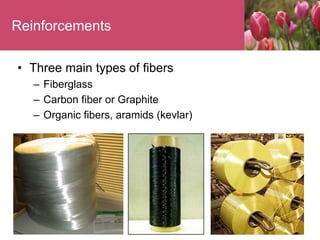
• Three main types of fibers
– Fiberglass
– Carbon fiber or Graphite
– Organic fibers, aramids (kevlar)
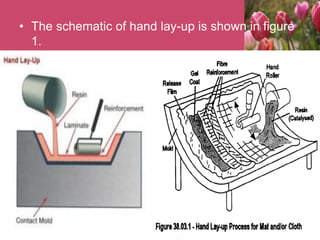
• Hand lay-up technique is the simplest method of
composite processing.
• The processing steps are quite simple
 First of all, mould is treated with a release agent-
to prevent sticking
 Gel coat layers are placed on the mold- to give
decorative and protective surface
 Put the reinforcement (woven rovings or
chopped strand mat)
 The thermosetting resin is mixed with a curing
agent, and applied with brush or roller on the
reinforcement
 Curing at room temperature. After curing either
at room temperature or at some specific
temperature, mold is opened and the developed
composite part is taken out and further
processed.
 Hand lay-up method finds application in many
areas like aircraft components, automotive parts,
boat hulls, diase board, deck etc.
• The schematic of hand lay-up is shown in figure
1.
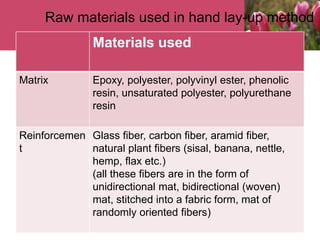
Materials used
Matrix Epoxy, polyester, polyvinyl ester, phenolic
resin, unsaturated polyester, polyurethane
resin
Reinforcemen
t
Glass fiber, carbon fiber, aramid fiber,
natural plant fibers (sisal, banana, nettle,
hemp, flax etc.)
(all these fibers are in the form of
unidirectional mat, bidirectional (woven)
mat, stitched into a fabric form, mat of
randomly oriented fibers)
Raw materials used in hand lay-up method
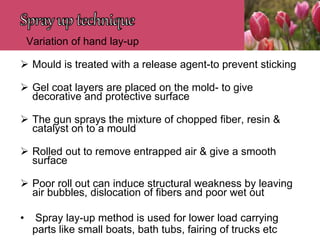
Variation of hand lay-up
 Mould is treated with a release agent-to prevent sticking
 Gel coat layers are placed on the mold- to give
decorative and protective surface
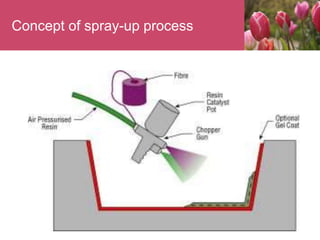
 The gun sprays the mixture of chopped fiber, resin &
catalyst on to a mould
 Rolled out to remove entrapped air & give a smooth
surface
 Poor roll out can induce structural weakness by leaving
air bubbles, dislocation of fibers and poor wet out
• Spray lay-up method is used for lower load carrying
parts like small boats, bath tubs, fairing of trucks etc
Concept of spray-up process
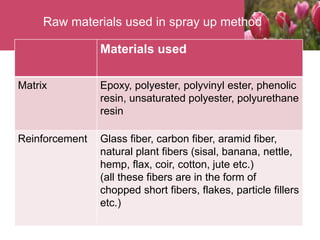
Materials used
Matrix Epoxy, polyester, polyvinyl ester, phenolic
resin, unsaturated polyester, polyurethane
resin
Reinforcement Glass fiber, carbon fiber, aramid fiber,
natural plant fibers (sisal, banana, nettle,
hemp, flax, coir, cotton, jute etc.)
(all these fibers are in the form of
chopped short fibers, flakes, particle fillers
etc.)
Raw materials used in spray up method
[image courtesy:-www.engr.ku.edu]
RESIN TRANSFER MOLDING (RTM
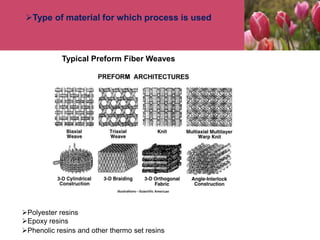
Typical Preform Fiber Weaves
Polyester resins
Epoxy resins
Phenolic resins and other thermo set resins
Type of material for which process is used
RTM PROCESS
• impregnating preformed dry reinforcement in a
closed mold with wet thermosetting resin under
pressure
• production rate comparison
– 2 - 8 pph (parts per hour)
– spray-up @ 0.5 pph
– SMC, injection molding @ 30 pph (chopped fibers,
high pressures requires >>$ tooling)
REINFORCEMENTS RESINS
type
E-glass, S-glass
carbon/graphite
aramid
form
mat
fabric
textile preform architecture
(knitted, braided, 3-D stitched)
preforms - preshaping of
reinforcement
Polyester
vinyl ester
epoxy
RTM EQUIPMENT
• resin/curing agent (catalyst) mixing equipment
– positive displacement piston pumping cycle
– maintain accurate ratio control between resin and curing
agent
– RTM process requires low injection pressures (30 psi - 100
psi)
– piston type positive displacement pumps are critical due to
changing back pressure conditions - as resin is pushed
through reinforcement an increasing back pressure builds
against metering pumps - if slippage occurs at pump,
resin/curing agent ratio will be affected
• with resin system components accurately metered,
sent through flexible hoses to a mix head
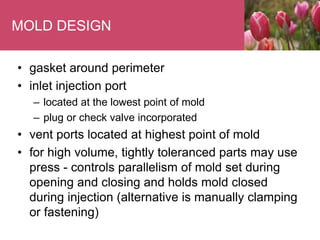
MOLD DESIGN
• gasket around perimeter
• inlet injection port
– located at the lowest point of mold
– plug or check valve incorporated
• vent ports located at highest point of mold
• for high volume, tightly toleranced parts may use
press - controls parallelism of mold set during
opening and closing and holds mold closed
during injection (alternative is manually clamping
or fastening)
RTM PROCESS
• may or may not take place under vacuum (assists in
minimizing air entrapment)
• mixer/injection head is inserted into mold
• injection pressure pushes check valve off its seat and
allows resin to begin filling
• air is pushed ahead of resin
• resin will begin flowing from vent ports
– if part design is simple may be full
– if part design complex, may require slight overfill to vent all
air
• vent ports are pinched off and internal pressure
causes inlet check valve to close
RTM PROCESS ISSUES
• critical to control infusion rate and flow front of
resin so that it infiltrates fiber preform evenly and
completely, but quickly before gelling
• resin is injected in center of part to guard against
formation of air pockets and minimize distance
resin must travel
• care must be exercised to insure reinforcement
does not move during injection (fiber wash)
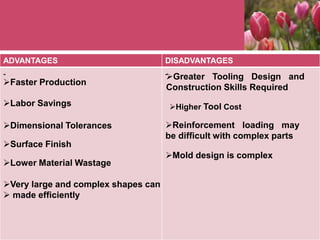
ADVANTAGES DISADVANTAGES
- -
Faster Production
Labor Savings
Dimensional Tolerances
Surface Finish
Lower Material Wastage
Very large and complex shapes can
 made efficiently
Greater Tooling Design and
Construction Skills Required
Higher Tool Cost
Reinforcement loading may
be difficult with complex parts
Mold design is complex
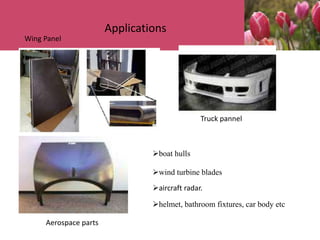
Applications
Wing Panel
Truck pannel
Aerospace parts
boat hulls
wind turbine blades
aircraft radar.
helmet, bathroom fixtures, car body etc
27
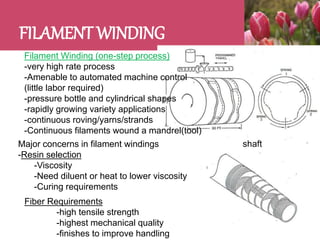
FILAMENT WINDING
shaft
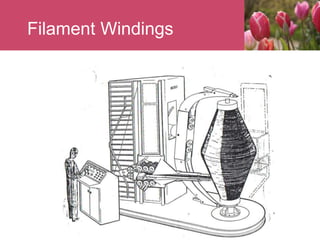
Filament Winding (one-step process)
-very high rate process
-Amenable to automated machine control
(little labor required)
-pressure bottle and cylindrical shapes
-rapidly growing variety applications
-continuous roving/yarns/strands
-Continuous filaments wound a mandrel(tool)
Major concerns in filament windings
-Resin selection
-Viscosity
-Need diluent or heat to lower viscosity
-Curing requirements
Fiber Requirements
-high tensile strength
-highest mechanical quality
-finishes to improve handling
REINFORCEMENTS RESINS
fiber in roving form
E-glass, S-glass
carbon/graphite
aramid
hybrids (within layer and
layer to layer)
wet or prepreg
epoxy
vinyl ester
polyester
Epoxy resins
Polyester resins
Phenolic resins
Silicone resins
29
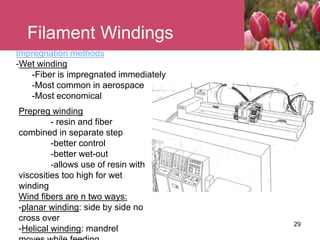
Filament Windings
Impregnation methods
-Wet winding
-Fiber is impregnated immediately
-Most common in aerospace
-Most economical
Prepreg winding
- resin and fiber
combined in separate step
-better control
-better wet-out
-allows use of resin with
viscosities too high for wet
winding
Wind fibers are n two ways:
-planar winding: side by side no
cross over
-Helical winding: mandrel
Filament Windings
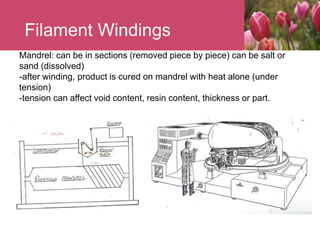
Mandrel: can be in sections (removed piece by piece) can be salt or
sand (dissolved)
-after winding, product is cured on mandrel with heat alone (under
tension)
-tension can affect void content, resin content, thickness or part.
Filament Windings
32
Filament Windings
Characteristics of filament winding
-automation
-no prepreg step
-low labor cost
-high machine cost
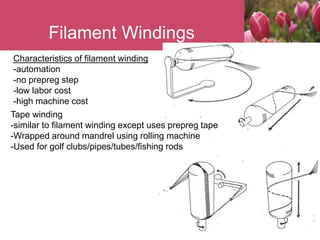
Tape winding
-similar to filament winding except uses prepreg tape
-Wrapped around mandrel using rolling machine
-Used for golf clubs/pipes/tubes/fishing rods
ADVANTAGES DISADVANTAGES
-highly reproducible nature of the process
(layer to layer, part to part)
-continuous fiber over the entire part
high fiber volume is obtainable
-ability to orient fibers in the load direction
-fiber and resin used in lowest cost form
-autoclave not necessary
-a very fast and economic method
-Lack of ductility
-Low modulus of elasticity
-part configuration must facilitate mandrel
extraction (no trapped tooling)
-mandrel could be complex and expensive
-inability to wind reverse curvature
-inability to easily change fiber path within
one layer
-as wound external surface may not be
satisfactory for some applications
FILAMENT WINDING
APPLICATIONS
• surfaces of revolution
– cylinders, pipe or tubing
– spherical or conical
– pressure
• Storage tank
• Railway tank car
• Pipe
• Aerospace
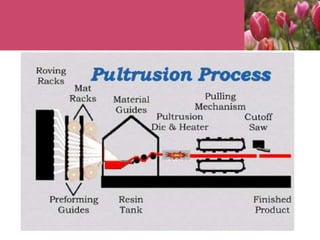
Pultrusion
Pultrusion: a process for producing continuous length of shapes with a
constant cross section by pulling resin-impregnated fibers through a
heated die where curing occurs.
Characteristics
-Pultrusion produces parts with
-high fiber volume, high percentage of unidirectional
reinforcement.
-primarily a method for thermosetting resins
-one of few continuous FRP process
-Accounts for 3% of total FRP
-based on continuous fibers
36
Pultrusion
Process Steps:
-String-up of desired fiber pattern
-Resin impregnation
-Preforming shape around mandrel (if necessary)
-Pre-heat (augmented cure)
-Cut finished part to length
-Speed: 0.5 to 10 ft/min
-Throughput: up to 4 lb/min
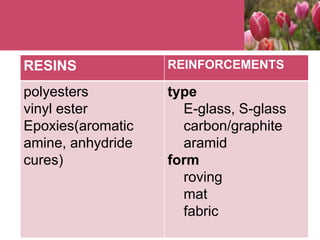
RESINS REINFORCEMENTS
polyesters
vinyl ester
Epoxies(aromatic
amine, anhydride
cures)
type
E-glass, S-glass
carbon/graphite
aramid
form
roving
mat
fabric
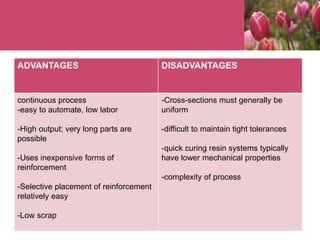
ADVANTAGES DISADVANTAGES
continuous process
-easy to automate, low labor
-High output; very long parts are
possible
-Uses inexpensive forms of
reinforcement
-Selective placement of reinforcement
relatively easy
-Low scrap
-Cross-sections must generally be
uniform
-difficult to maintain tight tolerances
-quick curing resin systems typically
have lower mechanical properties
-complexity of process
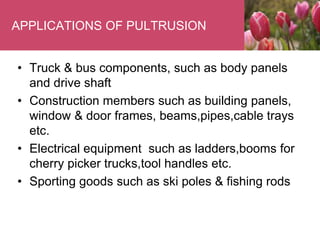
APPLICATIONS OF PULTRUSION
• Truck & bus components, such as body panels
and drive shaft
• Construction members such as building panels,
window & door frames, beams,pipes,cable trays
etc.
• Electrical equipment such as ladders,booms for
cherry picker trucks,tool handles etc.
• Sporting goods such as ski poles & fishing rods
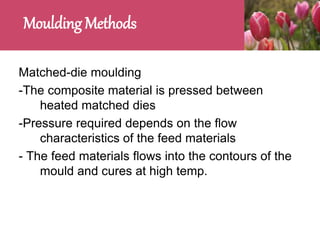
Moulding Methods
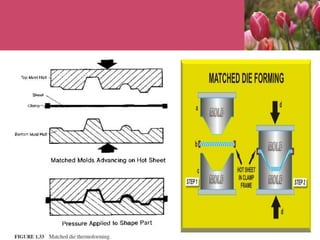
Matched-die moulding
-The composite material is pressed between
heated matched dies
-Pressure required depends on the flow
characteristics of the feed materials
- The feed materials flows into the contours of the
mould and cures at high temp.
• Matched die or Compression molding
– Reduced flow path over injection or extrusion
– SMC compression molding allows for continuous
fibers, mats or weaves
– These processes offer parts that are finished on both
sides where most other composite processes do not
REACTION INJECTION MOULDING
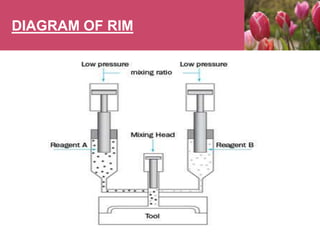
 RIM utilizes highly reactive two-component resins that are low-viscosity
liquids at room temperature
 To initiate mixing and injection,the piston in the mixhead moves up and the
two resin components collide in the mixing chamber under high speed and
high pressure
 The resin streams collide at 100-200m/s resulting in pressures of 10-40MPa
 Following mold filling, the piston purges the mixhead of remaining resin
 Since crosslinking is initiated by mixing and is very rapid,the resin gels
within seconds after the mold has been filled,paertially aided by heating of
the mould
 To ensure complete crosslinking,it is important that exactly correct
proportions of resin components are mixed
DIAGRAM OF RIM
REINFORCED REACTION
INJECTION MOLDING
• Reinforced Reaction Injection Molding (RRIM) is
a process used to produce polyurethane and
polyurea thermoset polymers
• In RRIM short fibers are added to one of the
resin components prior to final resin mixing
• It has proved difficult to include fibers longer
than 0.5mm, since this leads to a too high
viscosity
• Although even such short fibers provide
significantly increased stiffness, damage
tolerance, dimensional tolerance and lower CTE
over what RIM components may offer, articles
produced through RRIM nevertheless have poor
structural properties from a composite view point
• This process is mainly used in automative
industry, where short cycle times and low labour
cost is important
STRUCTURAL REACTION
INJECTION MOLDING
• A subset of RIM is structural reaction injection molding (SRIM), which
uses fiber meshes for the reinforcing agent. The fiber mesh is arranged
in the mold and the polymer mixture is injection molded over it
• SRIM is the result of conceptually combining RTM and RIM
• In SRIM the reinforcement is first placed in the mold and following
mold closure the highly impingement-mixed resin is injected into the
mold to impregnate the reinforcement
• SRIM is used for long series where the significantly higher initial cost
for injection equipment may be written off
ADVANTAGES/DISADVANTAGE
S OF RIM PROCESS
– RIM resin builds viscosity rapidly (higher average viscosity during
mold filling)
• applications must be simple geometries
• SRIM preform must be less complex and lower in reinforcement
content
• parts do not normally flash out of mold parting line sufficiently to
require sealing beyond metal land area or a pinch off around
perimeter of part (low viscosity of RTM resin requires gasket or o-
ring)
– highly reactive nature of RIM resin systems leads to cycle times
currently faster than achieved with RTM process
– mix ratios of RIM resin systems nearly 1:1 in volume
• ideally suited to impingement mixing process
• self-cleaning mix element
• RTM ratios (as high as 100:1 by volume) require mixing in a static
mixer and subsequent solvent flush
Applications
Roofs
Interior Panels
Energy Absorbing Bumpers
External Body Panels / Hoods / Air Deflectors
 Fenders
Tractor Fender Deck
Or any other component that requires strength
and less weight
FIBER REINFORCED PLASTICS (FRP)

FIBER REINFORCED PLASTICS (FRP)

  • 1.
    FIBER REINFORCED PLASTICS (FRP) Submittedby, Menon Lakshmi Suresh Divya C S Amrutha K S Lini cleetus C
  • 2.
    DEFINITION Fiber Reinforced Polymer(FRP) Composites are defined as: “A matrix of polymeric material that is reinforced by fibers or other reinforcing material”
  • 3.
    Processes • Matched diemolding • RTM • Spray-up • Hand lay-up • Filament winding • Pultrusion • RIM
  • 4.
    Benefits Of FRP •HIGH STRENGTH/WEIGHT RATIO • ORIENTATED STRENGTH • DESIGN FLEXIBILITY • LIGHTWEIGHT • CORROSION RESISTANCE • LOW MAINTENANCE/LONG-TERM DURABILITY • LARGE PART SIZE POSSIBLE • TAILORED AESTHETIC APPEARANCE • DIMENSIONAL STABILITY • LOW THERMAL CONDUCTIVITY • LOW INSTALLED COSTS
  • 5.
    FRP COMPOSITE CONSTITUENTS • RESINS(POLYMERS) • REINFORCEMENTS • FILLERS • ADDITIVES
  • 6.
    MATERIALS: RESINS • PRIMARYFUNCTION: “TO TRANSFER STRESS BETWEEN REINFORCING FIBERS AND TO PROTECT THEM FROM MECHANICAL AND ENVIRONMENTAL DAMAGE” • TYPES: – THERMOSET – THERMOPLASTIC
  • 7.
    RESINS THERMOSET THERMOPLASTIC POLYESTER ACETAL VINYLESTER ACRYRONITRILE BUTADIENE STYRENE (ABS) EPOXY NYLON PHENOLIC POLYETHYLENE (PE) POLYURETHANE POLYPROPYLENE (PP) POLYETHYLENE TEREPHTHALATE (PET)
  • 8.
    Matrix Materials –FRP • Intermediate length fiber reinforcement – The longer the fibers, the more difficult it is to coat the fibers enough to reap strength benefits – Low viscosity thermosets “wet-out” the materials better than high viscosity thermoplastics – Generally use unsaturated polyester and vinylester resins for FRP • Very long fibers or continuous fibers – Typically used with thermosets, also for “wet-out” reasons – Used generally in advanced composite parts and have greater material property requirements – Generally use epoxy resins
  • 9.
    Reinforcements • Three maintypes of fibers – Fiberglass – Carbon fiber or Graphite – Organic fibers, aramids (kevlar)
  • 10.
    • Hand lay-uptechnique is the simplest method of composite processing. • The processing steps are quite simple  First of all, mould is treated with a release agent- to prevent sticking  Gel coat layers are placed on the mold- to give decorative and protective surface  Put the reinforcement (woven rovings or chopped strand mat)
  • 11.
     The thermosettingresin is mixed with a curing agent, and applied with brush or roller on the reinforcement  Curing at room temperature. After curing either at room temperature or at some specific temperature, mold is opened and the developed composite part is taken out and further processed.  Hand lay-up method finds application in many areas like aircraft components, automotive parts, boat hulls, diase board, deck etc.
  • 12.
    • The schematicof hand lay-up is shown in figure 1.
  • 13.
    Materials used Matrix Epoxy,polyester, polyvinyl ester, phenolic resin, unsaturated polyester, polyurethane resin Reinforcemen t Glass fiber, carbon fiber, aramid fiber, natural plant fibers (sisal, banana, nettle, hemp, flax etc.) (all these fibers are in the form of unidirectional mat, bidirectional (woven) mat, stitched into a fabric form, mat of randomly oriented fibers) Raw materials used in hand lay-up method
  • 14.
    Variation of handlay-up  Mould is treated with a release agent-to prevent sticking  Gel coat layers are placed on the mold- to give decorative and protective surface  The gun sprays the mixture of chopped fiber, resin & catalyst on to a mould  Rolled out to remove entrapped air & give a smooth surface  Poor roll out can induce structural weakness by leaving air bubbles, dislocation of fibers and poor wet out • Spray lay-up method is used for lower load carrying parts like small boats, bath tubs, fairing of trucks etc
  • 15.
  • 16.
    Materials used Matrix Epoxy,polyester, polyvinyl ester, phenolic resin, unsaturated polyester, polyurethane resin Reinforcement Glass fiber, carbon fiber, aramid fiber, natural plant fibers (sisal, banana, nettle, hemp, flax, coir, cotton, jute etc.) (all these fibers are in the form of chopped short fibers, flakes, particle fillers etc.) Raw materials used in spray up method
  • 17.
  • 18.
    Typical Preform FiberWeaves Polyester resins Epoxy resins Phenolic resins and other thermo set resins Type of material for which process is used
  • 19.
    RTM PROCESS • impregnatingpreformed dry reinforcement in a closed mold with wet thermosetting resin under pressure • production rate comparison – 2 - 8 pph (parts per hour) – spray-up @ 0.5 pph – SMC, injection molding @ 30 pph (chopped fibers, high pressures requires >>$ tooling)
  • 20.
    REINFORCEMENTS RESINS type E-glass, S-glass carbon/graphite aramid form mat fabric textilepreform architecture (knitted, braided, 3-D stitched) preforms - preshaping of reinforcement Polyester vinyl ester epoxy
  • 21.
    RTM EQUIPMENT • resin/curingagent (catalyst) mixing equipment – positive displacement piston pumping cycle – maintain accurate ratio control between resin and curing agent – RTM process requires low injection pressures (30 psi - 100 psi) – piston type positive displacement pumps are critical due to changing back pressure conditions - as resin is pushed through reinforcement an increasing back pressure builds against metering pumps - if slippage occurs at pump, resin/curing agent ratio will be affected • with resin system components accurately metered, sent through flexible hoses to a mix head
  • 22.
    MOLD DESIGN • gasketaround perimeter • inlet injection port – located at the lowest point of mold – plug or check valve incorporated • vent ports located at highest point of mold • for high volume, tightly toleranced parts may use press - controls parallelism of mold set during opening and closing and holds mold closed during injection (alternative is manually clamping or fastening)
  • 23.
    RTM PROCESS • mayor may not take place under vacuum (assists in minimizing air entrapment) • mixer/injection head is inserted into mold • injection pressure pushes check valve off its seat and allows resin to begin filling • air is pushed ahead of resin • resin will begin flowing from vent ports – if part design is simple may be full – if part design complex, may require slight overfill to vent all air • vent ports are pinched off and internal pressure causes inlet check valve to close
  • 24.
    RTM PROCESS ISSUES •critical to control infusion rate and flow front of resin so that it infiltrates fiber preform evenly and completely, but quickly before gelling • resin is injected in center of part to guard against formation of air pockets and minimize distance resin must travel • care must be exercised to insure reinforcement does not move during injection (fiber wash)
  • 25.
    ADVANTAGES DISADVANTAGES - - FasterProduction Labor Savings Dimensional Tolerances Surface Finish Lower Material Wastage Very large and complex shapes can  made efficiently Greater Tooling Design and Construction Skills Required Higher Tool Cost Reinforcement loading may be difficult with complex parts Mold design is complex
  • 26.
    Applications Wing Panel Truck pannel Aerospaceparts boat hulls wind turbine blades aircraft radar. helmet, bathroom fixtures, car body etc
  • 27.
    27 FILAMENT WINDING shaft Filament Winding(one-step process) -very high rate process -Amenable to automated machine control (little labor required) -pressure bottle and cylindrical shapes -rapidly growing variety applications -continuous roving/yarns/strands -Continuous filaments wound a mandrel(tool) Major concerns in filament windings -Resin selection -Viscosity -Need diluent or heat to lower viscosity -Curing requirements Fiber Requirements -high tensile strength -highest mechanical quality -finishes to improve handling
  • 28.
    REINFORCEMENTS RESINS fiber inroving form E-glass, S-glass carbon/graphite aramid hybrids (within layer and layer to layer) wet or prepreg epoxy vinyl ester polyester Epoxy resins Polyester resins Phenolic resins Silicone resins
  • 29.
    29 Filament Windings Impregnation methods -Wetwinding -Fiber is impregnated immediately -Most common in aerospace -Most economical Prepreg winding - resin and fiber combined in separate step -better control -better wet-out -allows use of resin with viscosities too high for wet winding Wind fibers are n two ways: -planar winding: side by side no cross over -Helical winding: mandrel
  • 30.
    Filament Windings Mandrel: canbe in sections (removed piece by piece) can be salt or sand (dissolved) -after winding, product is cured on mandrel with heat alone (under tension) -tension can affect void content, resin content, thickness or part.
  • 31.
  • 32.
    32 Filament Windings Characteristics offilament winding -automation -no prepreg step -low labor cost -high machine cost Tape winding -similar to filament winding except uses prepreg tape -Wrapped around mandrel using rolling machine -Used for golf clubs/pipes/tubes/fishing rods
  • 33.
    ADVANTAGES DISADVANTAGES -highly reproduciblenature of the process (layer to layer, part to part) -continuous fiber over the entire part high fiber volume is obtainable -ability to orient fibers in the load direction -fiber and resin used in lowest cost form -autoclave not necessary -a very fast and economic method -Lack of ductility -Low modulus of elasticity -part configuration must facilitate mandrel extraction (no trapped tooling) -mandrel could be complex and expensive -inability to wind reverse curvature -inability to easily change fiber path within one layer -as wound external surface may not be satisfactory for some applications
  • 34.
    FILAMENT WINDING APPLICATIONS • surfacesof revolution – cylinders, pipe or tubing – spherical or conical – pressure • Storage tank • Railway tank car • Pipe • Aerospace
  • 35.
    Pultrusion Pultrusion: a processfor producing continuous length of shapes with a constant cross section by pulling resin-impregnated fibers through a heated die where curing occurs. Characteristics -Pultrusion produces parts with -high fiber volume, high percentage of unidirectional reinforcement. -primarily a method for thermosetting resins -one of few continuous FRP process -Accounts for 3% of total FRP -based on continuous fibers
  • 36.
    36 Pultrusion Process Steps: -String-up ofdesired fiber pattern -Resin impregnation -Preforming shape around mandrel (if necessary) -Pre-heat (augmented cure) -Cut finished part to length -Speed: 0.5 to 10 ft/min -Throughput: up to 4 lb/min
  • 38.
    RESINS REINFORCEMENTS polyesters vinyl ester Epoxies(aromatic amine,anhydride cures) type E-glass, S-glass carbon/graphite aramid form roving mat fabric
  • 39.
    ADVANTAGES DISADVANTAGES continuous process -easyto automate, low labor -High output; very long parts are possible -Uses inexpensive forms of reinforcement -Selective placement of reinforcement relatively easy -Low scrap -Cross-sections must generally be uniform -difficult to maintain tight tolerances -quick curing resin systems typically have lower mechanical properties -complexity of process
  • 40.
    APPLICATIONS OF PULTRUSION •Truck & bus components, such as body panels and drive shaft • Construction members such as building panels, window & door frames, beams,pipes,cable trays etc. • Electrical equipment such as ladders,booms for cherry picker trucks,tool handles etc. • Sporting goods such as ski poles & fishing rods
  • 41.
    Moulding Methods Matched-die moulding -Thecomposite material is pressed between heated matched dies -Pressure required depends on the flow characteristics of the feed materials - The feed materials flows into the contours of the mould and cures at high temp.
  • 42.
    • Matched dieor Compression molding – Reduced flow path over injection or extrusion – SMC compression molding allows for continuous fibers, mats or weaves – These processes offer parts that are finished on both sides where most other composite processes do not
  • 44.
    REACTION INJECTION MOULDING RIM utilizes highly reactive two-component resins that are low-viscosity liquids at room temperature  To initiate mixing and injection,the piston in the mixhead moves up and the two resin components collide in the mixing chamber under high speed and high pressure  The resin streams collide at 100-200m/s resulting in pressures of 10-40MPa  Following mold filling, the piston purges the mixhead of remaining resin  Since crosslinking is initiated by mixing and is very rapid,the resin gels within seconds after the mold has been filled,paertially aided by heating of the mould  To ensure complete crosslinking,it is important that exactly correct proportions of resin components are mixed
  • 45.
  • 46.
    REINFORCED REACTION INJECTION MOLDING •Reinforced Reaction Injection Molding (RRIM) is a process used to produce polyurethane and polyurea thermoset polymers • In RRIM short fibers are added to one of the resin components prior to final resin mixing • It has proved difficult to include fibers longer than 0.5mm, since this leads to a too high viscosity
  • 47.
    • Although evensuch short fibers provide significantly increased stiffness, damage tolerance, dimensional tolerance and lower CTE over what RIM components may offer, articles produced through RRIM nevertheless have poor structural properties from a composite view point • This process is mainly used in automative industry, where short cycle times and low labour cost is important
  • 48.
    STRUCTURAL REACTION INJECTION MOLDING •A subset of RIM is structural reaction injection molding (SRIM), which uses fiber meshes for the reinforcing agent. The fiber mesh is arranged in the mold and the polymer mixture is injection molded over it • SRIM is the result of conceptually combining RTM and RIM • In SRIM the reinforcement is first placed in the mold and following mold closure the highly impingement-mixed resin is injected into the mold to impregnate the reinforcement • SRIM is used for long series where the significantly higher initial cost for injection equipment may be written off
  • 49.
    ADVANTAGES/DISADVANTAGE S OF RIMPROCESS – RIM resin builds viscosity rapidly (higher average viscosity during mold filling) • applications must be simple geometries • SRIM preform must be less complex and lower in reinforcement content • parts do not normally flash out of mold parting line sufficiently to require sealing beyond metal land area or a pinch off around perimeter of part (low viscosity of RTM resin requires gasket or o- ring) – highly reactive nature of RIM resin systems leads to cycle times currently faster than achieved with RTM process – mix ratios of RIM resin systems nearly 1:1 in volume • ideally suited to impingement mixing process • self-cleaning mix element • RTM ratios (as high as 100:1 by volume) require mixing in a static mixer and subsequent solvent flush
  • 50.
    Applications Roofs Interior Panels Energy AbsorbingBumpers External Body Panels / Hoods / Air Deflectors  Fenders Tractor Fender Deck Or any other component that requires strength and less weight

Editor's Notes

  • #5 Composites can provide infrastructure applications with many benefits as listed here. Infrastructure can have all these benefits an more when the proper materials and manufacturing process is selected. But I believe that in order to achieve these goals, the engineer must specifically know the performance of his product. This includes the physical, mechanical, installation, cost, and quality that identifies the minimum performance specifications.
  • #6 Composites are composed of polymers, reinforcing fibers, fillers, and other additives. Each of these ingredients play an important role in the processing and final performance of the end product. In general terms, you could say that: The polymer is the “glue” that holds the composite and influence the physical properties of the composite end product. The reinforcement provides the mechanical strength properties to the end product. The fillers and additives are processing aids and also impart “special” properties to the end product. Other materials that we will cover include core materials. Depending on you application, core materials provide stiffness while being lightweight.
  • #7 Polymers are generally petrochemical or natural gas derivatives and can be either thermoplastic or thermosetting. Both types of polymers are used in composites and can benefit when combined with reinforcing fibers. However, the major volume of thermoplastic polymers are not used in composite form. In contrast to thermoplastics, thermosetting polymers generally require reinforcing fibers of high filler loading in order to be used. Properties required are usually dominated by strength, stiffness, toughness, and durability. The end-user must take into account the type of application, service temperature, environment, method of fabrication, and the mechanical propeties needed. Proper curing of the resin is essential for obtaining optimum mechanical properties, preventing heat softening, limiting creep, and reducing moisture impact.