PRESENTED BY:
SHUBHANGI AGRAWAL
Ist YEAR MDS
CONTENT
 INTRODUCTION
 HISTORY
 OCCURENCE
 CLASSIFICTION
 PHYSICAL PROPERTIES OF TITANIUM
 CHEMICAL PROPERTIES OF TITANIUM
 MECHANICAL PROPERTIES OF TITANIUM
 DENTAL USES OF TITANIUM
 IMPLANTS
 PRODUCTION OF TITANIUM
 CASTING AND MACHINING OF TITANIUM
 TITANIUM ALLOYS
 TOXICOLOGYAND OCCUPATIONAL HAZARDS
 CONCLUSION
 REVIEW OF LITERATURE
 REFERENCES
INTRODUCTION
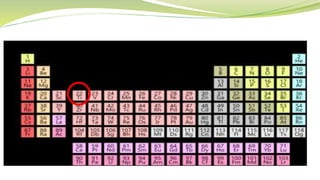
 Titanium (Ti) exists as a pure element listed in the periodic table with an atomic
number of 22 and an atomic weight of 47.9.
 A member of group 4 of the periodic table. It has two 4s and two 3d valence
electrons and is a transition element. The electronic configuration is 1s2 2s2p6
3s2p6d24s2.
 It is the ninth most abundant element.
 The fourth most abundant metallic element in the earth’s crust, following aluminum,
iron, and magnesium.
Sibum H, Güther V, Roidl O, Habashi F, Uwe Wolf H, Siemers C. Titanium, titanium alloys, and titanium compounds. Ullmann's Encyclopedia of Industrial Chemistry. 2000 Jun 15:1-35.
 Large reserves of this metal are found in Canada, Australia, and the United States.
Most titanium used today comes from mines located in Australia, with a small
amount from the United States.
USES OF TITANIUM IN GENERAL
 Of the total amount of titanium mined, most is converted to titanium dioxide
pigment for use in paint. Only 5% to 10% is used in its metal form.
 Important applications include petrochemicals and the production and handling
of, e.g., acetic acid, propionic acid, nitric acid, and chlorine gas.
 In the food industry, cooking equipment, stirring devices, and containers are
constructed of titanium because of its resistance to a wide range of organic acids.
 In the cellulose, paper, and textile industries, titanium is important because of its
resistance to hypochlorite, chlorite, and chlorine dioxide.
 In deep-sea research, seawater desalination, and closed-loop cooling water
systems in power stations.
 In electrolysis technology and surface finishing, commercially pure grades of
titanium, especially the softer grades (Grade 1 And Grade 2), are used.
Sibum H, Güther V, Roidl O, Habashi F, Uwe Wolf H, Siemers C. Titanium, titanium alloys, and titanium compounds. Ullmann's Encyclopedia of Industrial Chemistry. 2000 Jun 15:1-35
 Offshore and onshore drilling represent a growing demand for titanium.
 Aerospace
• In aircraft engines,
• In airframes,
• In civilian wide-body jets,
• in military super sonic aircraft
 In automotive industry
 X-ray amplifiers
 Television cameras
 Transmitter tubes
 In sonar detectors
 Gyrocompasses
 In medicine
 pins for fixing broken bones, plates,
 heart pacemaker capsules, and
 surgical instruments are manufactured from titanium and the alloy Ti 6 Al 4 V because
of their compatibility with human tissue.
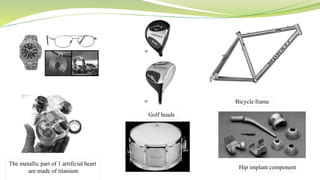
Golf heads
Bicycle frame
The metallic part of 1 artificial heart
are made of titanium
Hip implant component
HISTORY
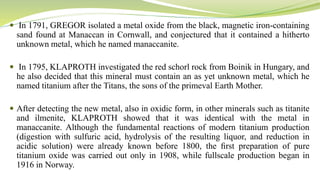
 In 1791, GREGOR isolated a metal oxide from the black, magnetic iron-containing
sand found at Manaccan in Cornwall, and conjectured that it contained a hitherto
unknown metal, which he named manaccanite.
 In 1795, KLAPROTH investigated the red schorl rock from Boinik in Hungary, and
he also decided that this mineral must contain an as yet unknown metal, which he
named titanium after the Titans, the sons of the primeval Earth Mother.
 After detecting the new metal, also in oxidic form, in other minerals such as titanite
and ilmenite, KLAPROTH showed that it was identical with the metal in
manaccanite. Although the fundamental reactions of modern titanium production
(digestion with sulfuric acid, hydrolysis of the resulting liquor, and reduction in
acidic solution) were already known before 1800, the first preparation of pure
titanium oxide was carried out only in 1908, while fullscale production began in
1916 in Norway.
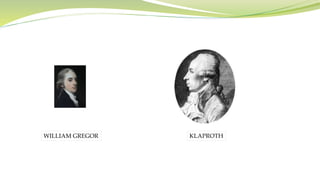
WILLIAM GREGOR KLAPROTH
OCCURENCE
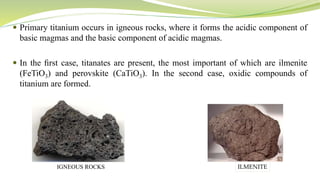
 Primary titanium occurs in igneous rocks, where it forms the acidic component of
basic magmas and the basic component of acidic magmas.
 In the first case, titanates are present, the most important of which are ilmenite
(FeTiO3) and perovskite (CaTiO3). In the second case, oxidic compounds of
titanium are formed.
IGNEOUS ROCKS ILMENITE
 Intermediate forms also exist, e.g., in silicates, in which titanium is present mainly
as a basic element (e.g., in zircon minerals and aluminosilicates), but also as a
replacement for silicon.
 These transitional forms include titanite (sphene), CaTi(SiO4)O, a common
component of magmatic rocks. All these forms also occur in metamorphic titanium-
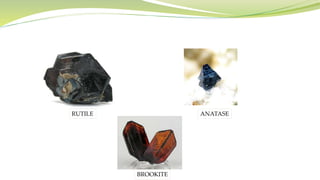
containing rocks. The two TiO2 modifications anatase and brookite occur
exclusively in metamorphic deposits.
 The most useful mineral for the extraction of titanium and titanium compounds is
rutile (TiO2). Although it is rarer than ilmenite, its TiO2 content is higher. Naturally
occurring enriched rutile is brown to black, and contains 90 – 97% TiO2 together
with impurities including up to 10% silica, iron oxides, vanadium, niobium, and
tantalum, and traces of tin, chromium, and molybdenum compounds.
ANATASE
BROOKITE
RUTILE
CLASSIFICATION
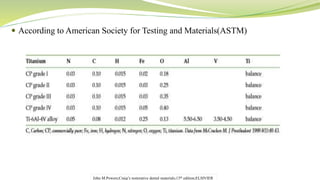
 According to American Society for Testing and Materials(ASTM)
John M.Powers;Craig’s restorative dental materials;13th edition;ELSIVIER
 Titanium grade 1 has the highest purity, lowest strength, and best room
temperature ductility.
 Grade 2 titanium is the most widely used commercially pure titanium. It has
good cold working properties, and may also be used for load bearing
components at temperature upto 250⁰C.
 Grade 3 is used almost exclusively for pressure vessels. This material has
adequate cold working properties and can be used at lower thickness than softer
grades of titanium.
 Grade 4 has the highest strength of the unalloyed ASTM grades.
 Grade 5, an ASTM titanium alloy (Ti-6Al-4V), is the most widely used titanium
alloy in medical implants but not common in dental implants. The alloy is most
commonly used in the annealed state.
PROPERTIES OF TITANIUM
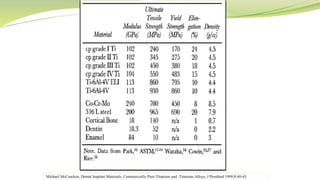
Michael McCracken, Dental Implant Materials: Commercially Pure Titanium and Titanium Alloys, J Prosthod 1999;8:40-43
 The modulus of elasticity of titanium is five times greater than that of compact
bone, and this property places emphasis on the importance of design in the
proper distribution of mechanical stress transfer.
Carl E. Misch;contemporary implant dentistry;3rd edition;ELSEVIER
2.CORROSION
 The disintegration of the metal may occur through the action of moisture,
atmospheric acid and alkaline other chemical agents. Further it has been
reported that water, oxygen, chloride, sulphur corrodes various metal present in
the dental alloys.
 Corrosion can severely limit the fatigue life and ultimate strength of the material
leading to mechanical failure of the dental materials.
 Titanium has excellent corrosion resistance and biocompatibility in biological
fluids. The influence of contaminants and surface treatments of titanium
implants (like alumina-blasting, acid etching, anodization, hydroxyapatite
coating,) on osseous integration has been extensively studied.
 Titanium is a thermodynamically reactive metal as suggested by its relatively
negative reversible potential in the electrochemical series. It gets readily
oxidized during exposure to air and electrolytes to form oxides, hydrated
complexes, and aqueous cationic species.
 The oxides and hydrated complexes act as barrier layers between the titanium
surface and the surrounding environment and suppress the subsequent oxidation
of titanium across the metal/barrier layer/solution interface.
 Even if the barrier layer gets disrupted, it can get reformed very easily, leading
to spontaneous re-passivation.
3.SHAPE MEMORY
 Nitinol possess a unique combination of properties, including superelasticity or
pseudoelasticity and shape memory, which are very attractive for biomedical
applications.
 NiTi has been used in orthopedic and orthodontic implants. Their ability to
recover large strains and dissipate mechanical work without macroscopic
permanent deformation has generated significant interest in various fieldology.
Among all SMA, titanium nickel (TiNi) is the most important alloy.
 The wire sample of NiTi can be bent at room temperature, but will return to its
linear shape when heated by hot air or water as its atoms move in a kind of
“atomic ballet.”
 Moreover, the wire can be heated to the much higher temperature
(approximately 500°C), where it can be trained to “remember” a new shape.
Subsequently, when the wire is distorted at room temperature and heated by hot
air or water, it will return to this new shape.
4.FLEXIBILITY
 While strength characteristics of implants are important, they must also be
somewhat flexible to avoid shielding of bones from stress (“stress shielding”).
 When stress is applied to a stiff dental/orthopaedic implant, the implant will
carry most of the stress and the bone may start to resorb and may become less
dense and weak.
 On the other hand if stress is applied to a less stiff or more flexible implant,
some of the stress can be shared with the surrounding bone.
 This will help to keep the bone active and strong. Flexibility and elasticity
rivals that of human bone. Titanium’s modulus of elasticity and coefficient of
thermal expansion matches those of human bone, reducing the potential for
implant failure.
5.NON-MAGNETIC
 Commercially pure titanium and all the titanium alloys are non magnetic. The
physical difference between ferromagnetic and nonferromagnetic materials lies
in the degree of magnetization.
 Titanium is not susceptible to outside interference and won’t trigger metal
detector.
 Another benefit to titanium for use in medicine is its non-ferromagnetic
property, patients with titanium implants can be safely examined with magnetic
resonance imaging (convenient for long-term implants).
6.BIOCOMPATIBILITY
 Among all the other properties of titanium, the excellent biocompatibility is the
most practical aspect for the application in dentistry.
 This useful biological property of titanium is based on the existence of titanium
oxide (TiO2) layers, which are naturally formed in oxygen containing environments.
 Titanium is relatively inert, corrosion resistance metal because of its thin
(approximately 4nm) surface oxide layer. Studies have shown that Titanium readily
adsorbs protein like albumin, laminin, glycosaminoglycans, collagenase,
fibronectins, complement proteins, fibrinogens etc from the biological fluids.
7.OSSEOINTEGRATION
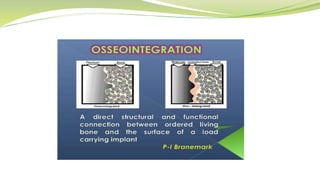
 “Osseointegration” is defined as the apparent direct attachment or connection of
osseous tissue to an inert, alloplastic material without intervening connective
tissue.
 Branemark observed the fusion of bone with titanium chambers when he had
placed them into the femurs of rabbits.
 Surface composition, hydrophilicity and roughness are parameters that may play
a role in implant–tissue interaction and osseointegration.
 Osseointegration firmly anchors the titanium dental or medical implant into
place. Titanium is one of the best metals that allows for this integration.
 Because it is absolutely inert in the human body, immune to attack from body
fluids, compatible with the bone growth and strong and flexible, titanium is the
most biocompatible of all metals the osseointegration rate of titanium dental
implants is related to their composition and surface roughness or application of
osteoconductive coatings.
 Rough-surfaced implants favor both bone anchoring and biomechanical
stability.
 Surface treatments, such as titanium plasma-spraying, grit-blasting, acid-
etching, anodization or calcium phosphate coatings can be used.
DENTAL USES
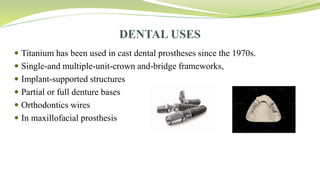
 Titanium has been used in cast dental prostheses since the 1970s.
 Single-and multiple-unit-crown and-bridge frameworks,
 Implant-supported structures
 Partial or full denture bases
 Orthodontics wires
 In maxillofacial prosthesis
TITANIUM AND IMPLANT
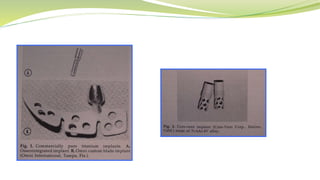
 The use of metals for implants dates back to ancient times. It was not until the
1930s, however, that improvements in metal technology led to an era of
expanded surgical use of metallic implants.
 A successful long-term implant requires biocompatibility, toughness, strength,
corrosion resistance, wear resistance, and fracture resistance.
 Pure titanium, theoretically, may form several oxides. Among these TiO, Ti02
and Ti203. Of these, TiO2 is the most stable and therefore the most commonly
used under physiologic conditions. These oxides form spontaneously on
exposure of Ti to air.
Parr GR, Gardner LK, Toth RW. Titanium: the mystery metal of implant dentistry. Dental materials aspects. Journal of Prosthetic Dentistry. 1985 Sep 1;54(3):410-4.
 When an implant is introduced into the body, complex reactions begin to take
place at the oxide/bio environment interface. The oxide film grows as ions
diffuse outward from the metal and inward from the environment. The oxide
that forms in the body may therefore, be somewhat different than that which
forms in air.
 The rate of formation and composition of this film is important. Titanium, both
as a pure metal and as an alloy, is easily passivated, forming a stable Ti02
surface oxide that makes the metal corrosion resistant. This oxide will repair
itself instantaneously on damage such as might occur during insertion of an
implant.
 The normal level of Ti in human tissue is 50 ppm. Values of 100 to 300 ppm
are frequently observed in soft tissues surrounding Ti implants. At these levels,
tissue discoloration with Ti pigments can be seen.
 This rate of dissolution is one of the lowest of all passivated implant metals
and seems to be well tolerated by the body. The clinical significance of this
data is substantiated by more than 20 years of clinical experience with pure Ti
and Ti 6A1 4V alloys.
PRODUCTION OF TITANIUM
1.HUNTER PROCESS
 In 1910,HUNTER succeeded in producing larger quantities of pure titanium by
reacting titanium tetrachloride with sodium in an evacuated steel bomb.
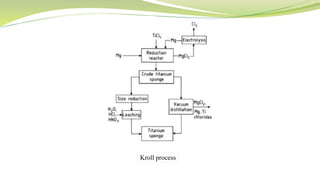
2.KROLL PROCESS
 The reduction of titanium tetrachloride with magnesium was discovered by
KROLL process.
Sibum H, Güther V, Roidl O, Habashi F, Uwe Wolf H, Siemers C. Titanium, titanium alloys, and titanium compounds. Ullmann's Encyclopedia of Industrial Chemistry. 2000 Jun
15:1-35.
Kroll process
CASTING OF TITANIUM
 The two most important factors in casting titanium based materials are its high
melting point and chemical reactivity.
 Because of its high melting point the special melting procedures, cooling
cycles, mold material and casting equipments to prevent metal contaminant is
required.
 Titanium readily reacts with gaseous contaminants such as hydrogen, oxygen
and nitrogen particularly at higher temperature.
 As a result manipulation of titanium at elevated temperature must be controlled
in well performed vaccum or inert atmosphere.
 Because of the low density of titanium, it is difficult to cast in conventional,
centrifugal force casting machines.
 Pure titanium has been cast with a pressure vacuum casting machines. Other
manufacturers developed centrifugal casting machines that use an electric arc
to melt titanium in an argon or helium atmosphere.
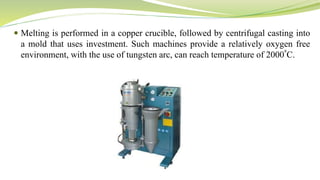
 Melting is performed in a copper crucible, followed by centrifugal casting into
a mold that uses investment. Such machines provide a relatively oxygen free
environment, with the use of tungsten arc, can reach temperature of 2000⁰C.
MACHINING OF TITANIUM
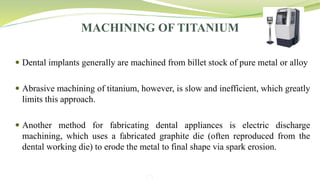
 Dental implants generally are machined from billet stock of pure metal or alloy
 Abrasive machining of titanium, however, is slow and inefficient, which greatly
limits this approach.
 Another method for fabricating dental appliances is electric discharge
machining, which uses a fabricated graphite die (often reproduced from the
dental working die) to erode the metal to final shape via spark erosion.
 Multiple dental prostheses also can be connected using laser welding or electric
spot welding.
 Other techniques of frameworks fabrication through titanium machining are also
available. Such techniques utilize the CAD-CAM system and comprise a
computed system of restoration/reconstruction that uses a scanning technique
primarily in combination with machining techniques of titanium and/or
porcelain in the prosthetic laboratory.
 The different systems can use either CAD-CAM or a wax pattern combined with
CAM.
Jorge JR, Barão VA, Delben JA, Faverani LP, Queiroz TP, Assunçao WG. Titanium in dentistry: historical development, state of the art and future perspectives. The Journal of Indian Prosthodontic Society.
2013 Jun 1;13(2):71-7.
 These techniques are based on a model scanning, which is digitalized for the
production of a design by the software.
 This design would represent the final shape of the desired structure. Therefore,
through the data obtained from the representation of the final structure shape,
the framework is fabricated by industrial machining equipments using a single
block of titanium.
 From this moment, also through the same system described previously, the
crowns on the framework are obtained by machining a ceramic block.
TITANIUM ALLOYS
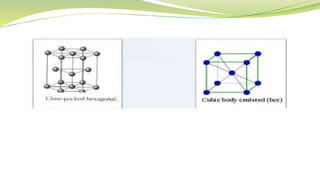
 CP Ti undergoes an allotropic transformation from a hexagonal close-packed
crystal structure (α phase) at 882 °C to a stronger and more ductile body-
centered crystal structure (β phase).
 By incorporating α and/or β microstructural stabilizers, four possible types of
titanium alloys can be produced: α, near-α, α-β, and β.
 Alpha-phase stabilizers, such as aluminum, carbon, nitrogen, and gallium,
cause the transformation from α to β phase to occur at a higher temperature on
heating.
Anusavice;Phillip’s Science Of Dental Materials;12th Edition Elsevier; 2013
 Beta-phase stabilizers, such as molybdenum, cobalt, nickel, niobium, copper,
palladium, tantalum, and vanadium, cause the transformation from β to α phase
to occur at lower temperatures on cooling.
 Alpha alloys will form no beta phase on cooling and may contain α stabilizers.
 Near-alpha alloys will form a limited amount of beta phase on cooling by
alloying with a small percentage of β stabilizers.
 Alpha-beta alloys are metastable and contain some combination of α and β
stabilizers.
 This group of alloys is heat treatable and will contain α phase at room
temperature; they may contain retained β phase and/or transformed β phase.
 Thermal treatment dictates the relative amount of α and β phases and their
contributions to mechanical properties.
 Beta alloys contain sufficient beta stabilizers to retain the beta phase on
cooling; they can be solution-treated and aged to improve strength.
Ti-6Al-4V
 The most widely used titanium alloy in dentistry and for general commercial
applications is Ti-6Al-4V , which is an α-β alloy.
 Although this alloy has greater strength than that of CP Ti, it is not as attractive
because of some concerns about health hazards from the slow release of
aluminum and vanadium.
 Vanadium is highly toxic both in the elemental state and in oxide forms, and
aluminum has been reported to cause potential neurological disorders.
 Niobium has not been associated with any known toxic or adverse reactions in
the body.
 Both vanadium and niobium belong to group VA in the periodic table, and they
show similar common characteristics, especially as β stabilizers.
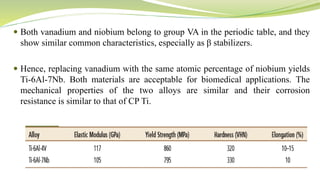
 Hence, replacing vanadium with the same atomic percentage of niobium yields
Ti-6Al-7Nb. Both materials are acceptable for biomedical applications. The
mechanical properties of the two alloys are similar and their corrosion
resistance is similar to that of CP Ti.
TOXICOLOGY AND OCCUPATIONAL HAZARDS
 The average intake of TiO2 in humans is 0.3 – 0.5 mg/d.
 Approximately the same amount is excreted daily:at least 0.29 mg/d via the feces
and 0.01 mg/d via the urine.
 The rate of gastrointestinal absorption is about 3% of the ingested material, i.e.,
most of the ingested Ti is excreted unabsorbed.
 The mean Ti concentration in blood is 0.07 mg/L. The lungs and the lymph
nodes are the predominant target organs for the accumulation of TiO2. About 0.4
mg Ti is stored in the lungs per day. The biological half-life of Ti is between 320
and 640 d. Excretion by other routes than via urine is unknown.
 Contact with the skin, the mucous membranes, and the conjunctiva leads to
severe irritation and necrosis due to the hydrochloric acid formed by immediate
hydrolysis. Contact with the eyes can cause blindness.
TREATMENT
 After contact of the skin with TiCl4 immediate dry removal (without use of water)
is necessary.
 Thereafter, remaining traces of TiCl4 should be removed with soap and plenty of
water.
 After contact of the eyes with TiCl4 , adequate measures are rinsing with plenty
of water, use of Isogutt eye drops, and contacting an ophthalmologist as soon as
possible.
 In cases of TiCl4 vapor inhalation, cortisone preparations should be applied
immediately (e.g., inhalation of Auxiloson) to avoid the development of lung
edema. In severe cases clinical observation for at least 24 h is necessary.
CONCLUSION
A number of important points concerning titanium and its alloys have been
discussed. They are summarized as follows.
1. Ti and its alloys, particularly the alpha-beta alloys, possess mechanical
properties that make them ideal implant materials.
2. Ti and its alloys oxidize readily in air. This surface oxide is extremely stable
in the physiologic environment of the body.
3. The stability and inertness of this surface oxide layer acts to protect Ti from
corrosive breakdown when used in the body.
4. The elimination of surface irregularities and contaminants is important when
preparing a metal for implantation.
5. Titanium can be coupled with equally passive metals in the body without
causing galvanic corrosion.
REVIEW OF LITERATURE
Schiff N, Grosgogeat B, Lissac M, Dalard F. Influence of fluoride content
and pH on the corrosion resistance of titanium and its alloys.
 The aim of this study was to compare the NiTi, NiTiCo and TiAl6V4 alloys
with the titanium, regarding the corrosion resistance in Fusayama Meyer
artificial saliva with different pH and fluoride contents. In the experimental
methods, the corrosion potential was measured over time, then a linear sweep
voltametric analysis measured the polarization resistances and corrosion
currents.
 Results have shown that TiAl6V4 alloys have a good corrosion resistance as
good as that of titanium in Fusayama Meyer saliva and acid salivary solution,
except NiTi and NiTiCo alloys.
Biomaterials. 2002 May 1;23(9):1995-2002.
Revathi A, Borras AD, Munoz AI, Richard C, Manivasagam G. Degradation
mechanisms and future challenges of titanium and its alloys for dental
implant applications in oral environment.
 For many decades the failure of titanium implants due to corrosion and wear
were approached individually and their synergic effect was not considered. In
recent past, developments and understanding of the tribocorrosion aspects have
thrown deeper understanding on the failure of implants and this has been
reviewed in this article extensively.
 Medline, google scholar and Embase search was conducted to identify studies
published between 1993 and 2016 which were related to the analysis of
degradation mechanism which the dental implants undergo after implantation.
Materials Science and Engineering: C. 2017 Jul 1;76:1354-68.
 Tribocorrosion has been identified as the major degradation mechanisms that
result in the failure of dental implants. Hence, it is of utmost importance to
improve the service period of dental implants by reducing the tribocorrosion
effects through developing new dental implant materials using nobler alloying
elements or through modifying the surface of the implants. In order to have a
thorough understanding of tribocorrosion behavior and failure mechanisms,
round robin test are to be conducted and new protocols/standards are to be
developed for the testing of implants.
Hindy A, Farahmand F, sadat Tabatabaei F. In vitro biological outcome of
laser application for modification or processing of titanium dental implants.
 There are numerous functions for laser in modern implant dentistry including
surface treatment, surface coating, and implant manufacturing. As laser
application may potentially improve osseointegration of dental implants.
 After screening the 136 references obtained, 28 articles met the inclusion
criteria. They found that Nd:YAG laser was the most commonly used lasers in
the treatment or processing of titanium dental implants.
Lasers in medical science. 2017 Jul 1;32(5):1197-206.
 Most of the experiments used cell attachment and cell proliferation to
investigate bioresponses of the implants. The most commonly used cells in
these assays were osteoblast-like cells.
 Only one study was conducted in stem cells. These in vitro studies reported
higher biocompatibility in laser-modified titanium implants. It seems that laser
radiation plays a vital role in cell response to dental implants; however, it is
necessary to accomplish more studies using different laser types and parameters
on various cells to offer a more conclusive result.
Cordeiro JM, Beline T, Ribeiro AL, Rangel EC, da Cruz NC, Landers R,
Faverani LP, Vaz LG, Fais LM, Vicente FB, Grandini CR. Development of
binary and ternary titanium alloys for dental implants.
 The aim of this study was to develop binary and ternary titanium (Ti) alloys
containing zirconium (Zr) and niobium (Nb) and to characterize them in terms
of microstructural, mechanical, chemical, electrochemical, and biological
properties.
Dental Materials. 2017 Nov 1;33(11):1244-57.
 The alloying elements proved to modify the alloy microstructure and to
enhance the mechanical properties, improving the hardness and decreasing
the elastic modulus of the binary and ternary alloys, respectively. Ti–Zr alloys
displayed greater electrochemical stability relative to that of controls,
presenting higher polarization resistance and lower capacitance. The
experimental alloys were not detrimental to albumin adsorption.
REFERENCES
 Sibum H, Guther V, Roidl O, Habashi F, Uwe Wolf H, Siemers C. Titanium,
titanium alloys, and titanium compounds. Ullmann's Encyclopedia of Industrial
Chemistry. 2000 Jun 15:1-35
 John M.Powers;Craig’s restorative dental materials;13th edition;ELSIVIER
 Michael McCracken, Dental Implant Materials: Commercially Pure Titanium and
Titanium Alloys, J Prosthod 1999;8:40-43
 Carl E. Misch;contemporary implant dentistry;3rd edition;ELSEVIER
 Parr GR, Gardner LK, Toth RW. Titanium: the mystery metal of implant dentistry.
Dental materials aspects. Journal of Prosthetic Dentistry. 1985 Sep 1;54(3):410-4.
 Anusavice;Phillip’s Science Of Dental Materials;12th Edition Elsevier; 2013
 Schiff N, Grosgogeat B, Lissac M, Dalard F. Influence of fluoride content and
pH on the corrosion resistance of titanium and its alloys. Biomaterials. 2002
May 1;23(9):1995-2002.
 Revathi A, Borrás AD, Muñoz AI, Richard C, Manivasagam G. Degradation
mechanisms and future challenges of titanium and its alloys for dental implant
applications in oral environment. Materials Science and Engineering: C. 2017
Jul 1;76:1354-68.
 Cordeiro JM, Beline T, Ribeiro AL, Rangel EC, da Cruz NC, Landers R,
Faverani LP, Vaz LG, Fais LM, Vicente FB, Grandini CR. Development of
binary and ternary titanium alloys for dental implants. Dental Materials. 2017
Nov 1;33(11):1244-57.
 Hindy A, Farahmand F, sadat Tabatabaei F. In vitro biological outcome of laser
application for modification or processing of titanium dental implants. Lasers in

medical science. 2017 Jul 1;32(5):1197-206.
THANK YOU
Titanium
Titanium
Titanium
Titanium
Titanium
Titanium
Titanium
Titanium
Titanium
Titanium
Titanium
Titanium
Titanium
Titanium
Titanium
Titanium
Titanium
Titanium
Titanium
Titanium
Titanium
Titanium
Titanium