Topic:Tissue Engineering
& Regeneration
Tissue Engineering
• Def: Involves the implantation of cells and tissues or cellularized or cell free
scaffolds that have been expanded in vitro and implanted into areas of
tissue injury with the aim of promoting in vivo regeneration and repair of
tissues.
• Some tissues have ability of undergoing spontaneous repair and
regeneration like bone but some have very limited ability like cartilage.
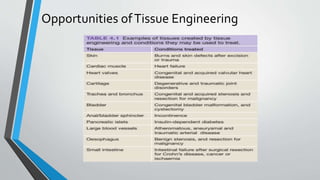
Opportunities ofTissue Engineering
Sources of cells forTissue Eng.
• There are two main sources:
1. Fully differentiated cell (Somatic cell): a) Autologus cell eg. Skin, Chondrocyte
b) Allogenic cell
2. Undifferentiated cell (Stem Cell):
A) Adult tissue resident/somatic stem cell:
- Hemopoietic stem cell
- Mesenchymal/Stromal stem cell
- Endothelial progenitor cell
- Neural stem cell
B) Embryonic Stem Cell
C) Fetal Stem Cell
D) Induced Pluripotent stem cell
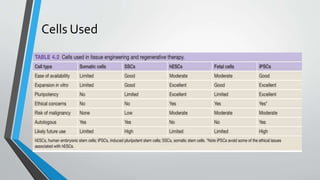
Cells Used
Advantage ofTissue Eng.
• Treatment for a wide range of disease
• Clinical application in surgical assessment &Treatment
• Models to test therapeutic efficacy and toxicity
• Medical benefits in the fields of therapeutic cloning and regenerative
medicine.
• Cures to a plethora of diseases including Parkinson’s Disease,
Schizophrenia, Alzheimer’s disease, Cancer, Spinal Cord injuries & Diabetes.
• Limbs & organs could be grown in a lab from stem cells
• Easy to learn about lumen growth and cell development
Disadvantage ofTissue Eng.
• The use of embryonic stem cells involves the destruction of blastocyst formed
from laboratory fertilized human eggs hurts people religious sentiment.
• Long term effects are unknown that may have influence on nature.
• These are pre-specialized like blood stem cell only make blood.
• Chance of graft rejection
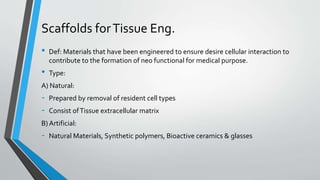
Scaffolds forTissue Eng.
• Def: Materials that have been engineered to ensure desire cellular interaction to
contribute to the formation of neo functional for medical purpose.
• Type:
A) Natural:
- Prepared by removal of resident cell types
- Consist ofTissue extracellular matrix
B) Artificial:
- Natural Materials, Synthetic polymers, Bioactive ceramics & glasses
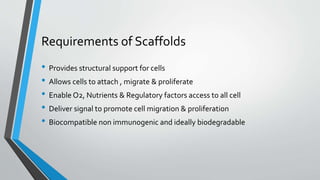
Requirements of Scaffolds
• Provides structural support for cells
• Allows cells to attach , migrate & proliferate
• Enable O2, Nutrients & Regulatory factors access to all cell
• Deliver signal to promote cell migration & proliferation
• Biocompatible non immunogenic and ideally biodegradable
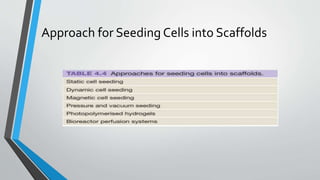
Approach for Seeding Cells into Scaffolds
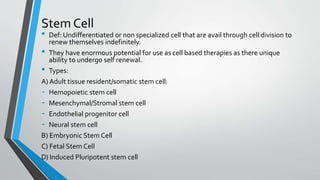
Stem Cell
• Def: Undifferentiated or non specialized cell that are avail through cell division to
renew themselves indefinitely.
• They have enormous potential for use as cell based therapies as there unique
ability to undergo self renewal.
• Types:
A) Adult tissue resident/somatic stem cell:
- Hemopoietic stem cell
- Mesenchymal/Stromal stem cell
- Endothelial progenitor cell
- Neural stem cell
B) Embryonic Stem Cell
C) Fetal Stem Cell
D) Induced Pluripotent stem cell
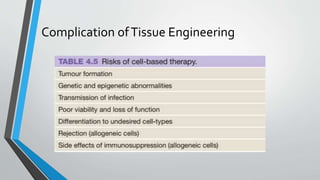
Complication ofTissue Engineering
Thank You

Tissue Engineering

  • 1.
  • 2.
    Tissue Engineering • Def:Involves the implantation of cells and tissues or cellularized or cell free scaffolds that have been expanded in vitro and implanted into areas of tissue injury with the aim of promoting in vivo regeneration and repair of tissues. • Some tissues have ability of undergoing spontaneous repair and regeneration like bone but some have very limited ability like cartilage.
  • 3.
  • 4.
    Sources of cellsforTissue Eng. • There are two main sources: 1. Fully differentiated cell (Somatic cell): a) Autologus cell eg. Skin, Chondrocyte b) Allogenic cell 2. Undifferentiated cell (Stem Cell): A) Adult tissue resident/somatic stem cell: - Hemopoietic stem cell - Mesenchymal/Stromal stem cell - Endothelial progenitor cell - Neural stem cell B) Embryonic Stem Cell C) Fetal Stem Cell D) Induced Pluripotent stem cell
  • 5.
  • 6.
    Advantage ofTissue Eng. •Treatment for a wide range of disease • Clinical application in surgical assessment &Treatment • Models to test therapeutic efficacy and toxicity • Medical benefits in the fields of therapeutic cloning and regenerative medicine. • Cures to a plethora of diseases including Parkinson’s Disease, Schizophrenia, Alzheimer’s disease, Cancer, Spinal Cord injuries & Diabetes. • Limbs & organs could be grown in a lab from stem cells • Easy to learn about lumen growth and cell development
  • 7.
    Disadvantage ofTissue Eng. •The use of embryonic stem cells involves the destruction of blastocyst formed from laboratory fertilized human eggs hurts people religious sentiment. • Long term effects are unknown that may have influence on nature. • These are pre-specialized like blood stem cell only make blood. • Chance of graft rejection
  • 8.
    Scaffolds forTissue Eng. •Def: Materials that have been engineered to ensure desire cellular interaction to contribute to the formation of neo functional for medical purpose. • Type: A) Natural: - Prepared by removal of resident cell types - Consist ofTissue extracellular matrix B) Artificial: - Natural Materials, Synthetic polymers, Bioactive ceramics & glasses
  • 9.
    Requirements of Scaffolds •Provides structural support for cells • Allows cells to attach , migrate & proliferate • Enable O2, Nutrients & Regulatory factors access to all cell • Deliver signal to promote cell migration & proliferation • Biocompatible non immunogenic and ideally biodegradable
  • 10.
    Approach for SeedingCells into Scaffolds
  • 11.
    Stem Cell • Def:Undifferentiated or non specialized cell that are avail through cell division to renew themselves indefinitely. • They have enormous potential for use as cell based therapies as there unique ability to undergo self renewal. • Types: A) Adult tissue resident/somatic stem cell: - Hemopoietic stem cell - Mesenchymal/Stromal stem cell - Endothelial progenitor cell - Neural stem cell B) Embryonic Stem Cell C) Fetal Stem Cell D) Induced Pluripotent stem cell
  • 12.
  • 13.