Centre Universitaire              De Souk-Ahras

                Institut : Sciences & Techniques
                     Département : Sciences
                   Diagramme de Temps


Réalisé par :                                  dérigé:
 Heragmi kamel eddine                  Dr .Abdelkrim Amirat
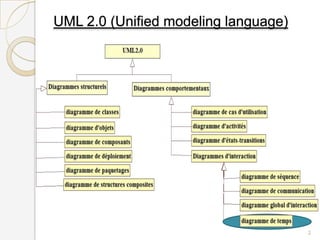
UML 2.0 (Unified modeling language)


                                      2
Timing Diagram
   The timing diagram is another view on the
    interaction model.

   Focus on conditions changing within and among
    Lifelines along a linear time axis.

   Used to show interactions when a primary purpose
    of the diagram is to reason about time.

   Describe comportment of both individual
    classifiers and interactions of classifiers,


                                                    3
Graphic Nodes
The following nodes and edges are typically drawn in a
UML timing diagram .

   1.   Lifeline ( Ligne de Vie ),
   2.   State or Condition Timeline (Etat ou Condition),
   3.   Duration Constraint (Contrainte de Durée ),
   4.   Time Constraint (Contrainte de Temps),
   5.   Destruction Event (Destruction de l'événement),
   6.   Message
   7.   General value lifeline

                                                       4
Lifeline
   Is a named element which represents an individual
    participant in the interaction.

   Represent only one interacting entity.

   See lifeLine from sequence diagrams for more details.

   Is represented by the name of classifier or the instance
    it represents. It could be placed inside diagram frame .


EX : Lifelines representing instances of
System and Virus

               Lifeline
                                                          5
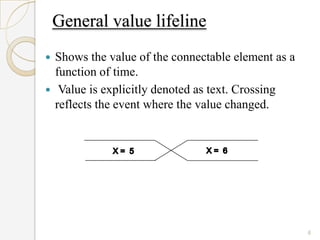
General value lifeline
 Shows the value of the connectable element as a
  function of time.
 Value is explicitly denoted as text. Crossing
  reflects the event where the value changed.


                                                    6
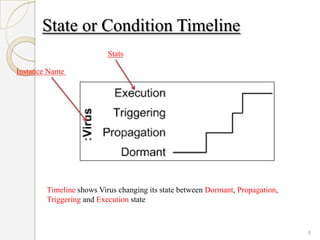
State or Condition Timeline
   This is the state of the classifier or attribute, or
    some testable condition, such as an discrete or
    enumerable value for attribute.

   It is also permissible to let the state-dimension be
    continuous as well as discrete. This is illustrative
    for scenarios where certain entities undergo
    continuous state changes, such as temperature or
    density.


                                                           7
State or Condition Timeline
                          Stats

Instance Name


        Timeline shows Virus changing its state between Dormant, Propagation,
        Triggering and Execution state


                                                                                8
Duration Constraint
   Is an interval constraint that refers to a duration
    interval.

   The duration interval is duration used to determine
    whether the constraint is satisfied.

   The semantics of a Duration constraint is inherited
    from constraints. If constraints are violated, traces
    become negative which means that system is
    considered as failed.


                                                          9
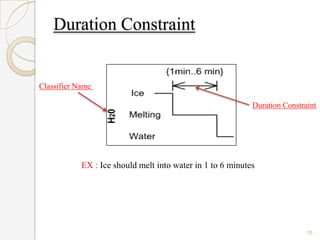
Duration Constraint


Classifier Name

                                                            Duration Constraint


            EX : Ice should melt into water in 1 to 6 minutes


                                                                            10
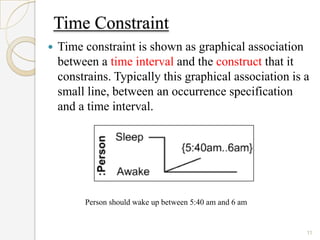
Time Constraint
   Time constraint is shown as graphical association
    between a time interval and the construct that it
    constrains. Typically this graphical association is a
    small line, between an occurrence specification
    and a time interval.


         Person should wake up between 5:40 am and 6 am


                                                          11
Destruction Event

   Is event which represents the destruction of the
    instance described by the lifeline. containing the
    Occurrence Specification that references the
    destruction event.

   It may result in the subsequent destruction of
    other objects that this object owns by
    composition.


                                                         12
Destruction Event
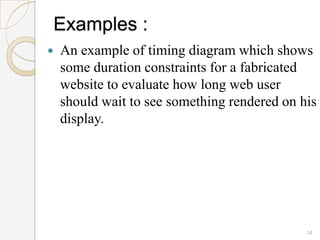
   The destruction event is depicted by a cross in the
    form of an X at the end of a timeline.


                 Virus lifeline is terminated


                                                          13
Examples :
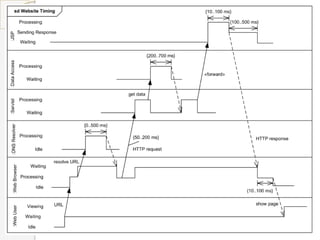
   An example of timing diagram which shows
    some duration constraints for a fabricated
    website to evaluate how long web user
    should wait to see something rendered on his
    display.


                                              14
15
16

Timing diagram

  • 1.
    Centre Universitaire De Souk-Ahras Institut : Sciences & Techniques Département : Sciences Diagramme de Temps Réalisé par : dérigé:  Heragmi kamel eddine Dr .Abdelkrim Amirat
  • 2.
    UML 2.0 (Unifiedmodeling language) 2
  • 3.
    Timing Diagram  The timing diagram is another view on the interaction model.  Focus on conditions changing within and among Lifelines along a linear time axis.  Used to show interactions when a primary purpose of the diagram is to reason about time.  Describe comportment of both individual classifiers and interactions of classifiers, 3
  • 4.
    Graphic Nodes The followingnodes and edges are typically drawn in a UML timing diagram . 1. Lifeline ( Ligne de Vie ), 2. State or Condition Timeline (Etat ou Condition), 3. Duration Constraint (Contrainte de Durée ), 4. Time Constraint (Contrainte de Temps), 5. Destruction Event (Destruction de l'événement), 6. Message 7. General value lifeline 4
  • 5.
    Lifeline  Is a named element which represents an individual participant in the interaction.  Represent only one interacting entity.  See lifeLine from sequence diagrams for more details.  Is represented by the name of classifier or the instance it represents. It could be placed inside diagram frame . EX : Lifelines representing instances of System and Virus Lifeline 5
  • 6.
    General value lifeline Shows the value of the connectable element as a function of time.  Value is explicitly denoted as text. Crossing reflects the event where the value changed. 6
  • 7.
    State or ConditionTimeline  This is the state of the classifier or attribute, or some testable condition, such as an discrete or enumerable value for attribute.  It is also permissible to let the state-dimension be continuous as well as discrete. This is illustrative for scenarios where certain entities undergo continuous state changes, such as temperature or density. 7
  • 8.
    State or ConditionTimeline Stats Instance Name Timeline shows Virus changing its state between Dormant, Propagation, Triggering and Execution state 8
  • 9.
    Duration Constraint  Is an interval constraint that refers to a duration interval.  The duration interval is duration used to determine whether the constraint is satisfied.  The semantics of a Duration constraint is inherited from constraints. If constraints are violated, traces become negative which means that system is considered as failed. 9
  • 10.
    Duration Constraint Classifier Name Duration Constraint EX : Ice should melt into water in 1 to 6 minutes 10
  • 11.
    Time Constraint  Time constraint is shown as graphical association between a time interval and the construct that it constrains. Typically this graphical association is a small line, between an occurrence specification and a time interval. Person should wake up between 5:40 am and 6 am 11
  • 12.
    Destruction Event  Is event which represents the destruction of the instance described by the lifeline. containing the Occurrence Specification that references the destruction event.  It may result in the subsequent destruction of other objects that this object owns by composition. 12
  • 13.
    Destruction Event  The destruction event is depicted by a cross in the form of an X at the end of a timeline. Virus lifeline is terminated 13
  • 14.
    Examples :  An example of timing diagram which shows some duration constraints for a fabricated website to evaluate how long web user should wait to see something rendered on his display. 14
  • 15.
  • 16.