UML Diagrams


       Jung Woo
What is UML?
• Standard  language for specifying, visualizing,
  constructing, and documenting the artifacts of software
  systems, business modeling and other non-software
  systems.
• The UML represents a collection of best engineering
  practices that have proven successful in the modeling of
  large and complex systems.
• The UML is a very important part of developing object
  oriented software and the software development
  process. 
• The UML uses mostly graphical notations to express the
  design of software projects. 
• Using the UML helps project teams communicate,
  explore potential designs, and validate the architectural
  design of the software.
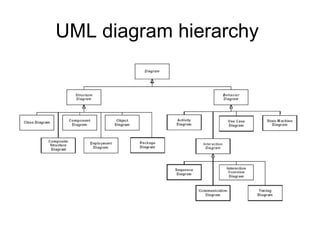
Overview of UML Diagrams
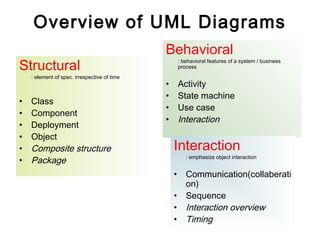
                                              Behavioral
Structural
                                                      : behavioral features of a system / business
                                                      process
    : element of spec. irrespective of time
                                              •       Activity
                                              •       State machine
•   Class
                                              •       Use case
•   Component
                                              •       Interaction
•   Deployment
•   Object
•   Composite structure                           Interaction
                                                         : emphasize object interaction
•   Package
                                                  •      Communication(collaberati
                                                         on)
                                                  •      Sequence
                                                  •      Interaction overview
                                                  •      Timing
Class diagram
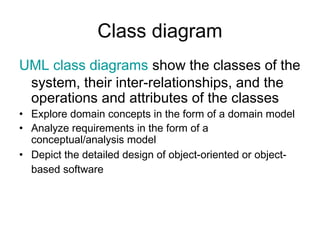
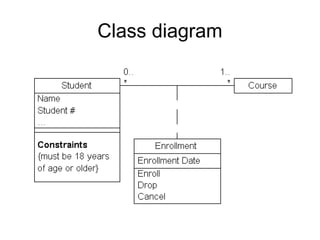
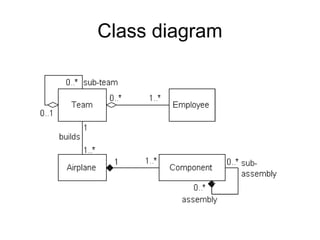
UML class diagrams show the classes of the
 system, their inter-relationships, and the
 operations and attributes of the classes
• Explore domain concepts in the form of a domain model
• Analyze requirements in the form of a
  conceptual/analysis model
• Depict the detailed design of object-oriented or object-
  based software
Class diagram
Class diagram
Component diagram
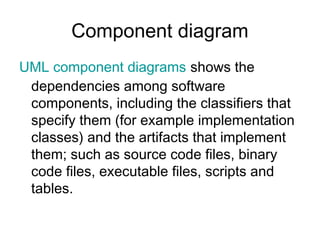
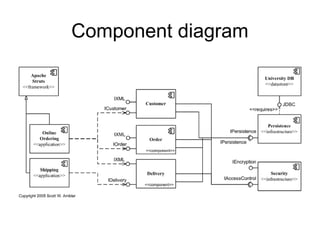
UML component diagrams shows the
 dependencies among software
 components, including the classifiers that
 specify them (for example implementation
 classes) and the artifacts that implement
 them; such as source code files, binary
 code files, executable files, scripts and
 tables.
Component diagram
Deployment diagram
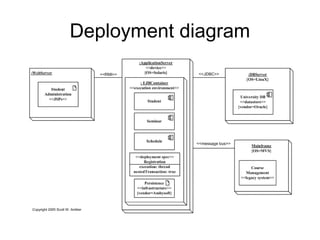
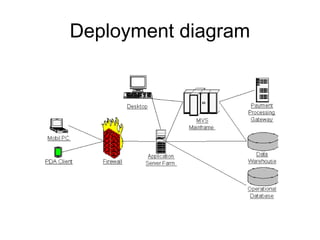
UML deployment diagram depicts a static
 view of the run-time configuration of
 hardware nodes and the software
 components that run on those nodes.
 Deployment diagrams show the hardware
 for your system, the software that is
 installed on that hardware, and the
 middleware used to connect the disparate
 machines to one another.
Deployment diagram
Deployment diagram
Object diagram
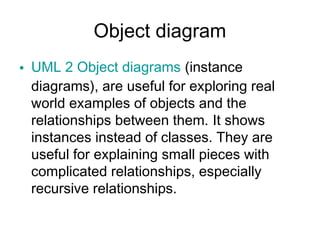
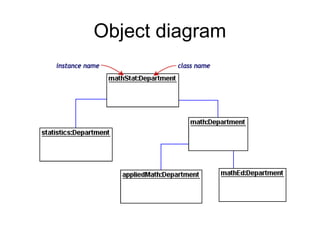
• UML 2 Object diagrams (instance
  diagrams), are useful for exploring real
  world examples of objects and the
  relationships between them. It shows
  instances instead of classes. They are
  useful for explaining small pieces with
  complicated relationships, especially
  recursive relationships.
Object diagram
Package diagram
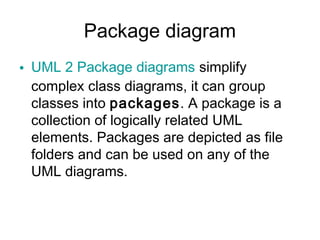
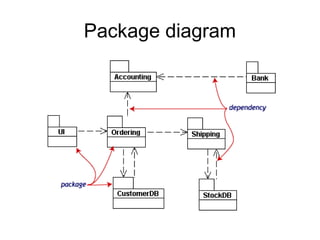
• UML 2 Package diagrams simplify
  complex class diagrams, it can group
  classes into packages. A package is a
  collection of logically related UML
  elements. Packages are depicted as file
  folders and can be used on any of the
  UML diagrams.
Package diagram
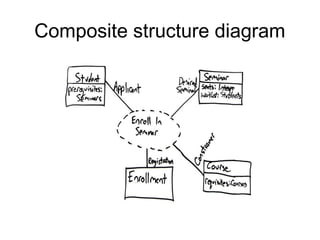
Composite structure diagram
• UML 2 Composite structure diagrams
  used to explore run-time instances of
  interconnected instances collaborating
  over communications links. It shows the
  internal structure (including parts and
  connectors) of a structured classifier or
  collaboration.
Composite structure diagram
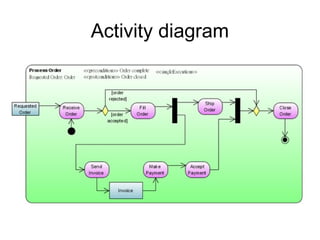
Activity diagram
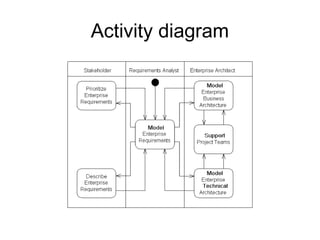
• UML 2 Activity diagrams helps to describe
  the flow of control of the target system,
  such as the exploring complex business
  rules and operations, describing the use
  case also the business process. It is
  object-oriented equivalent of flow charts
  and data-flow diagrams (DFDs).
Activity diagram
Activity diagram
State machine diagram
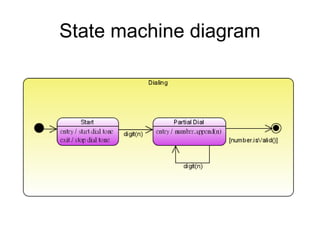
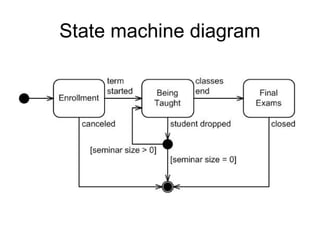
• UML 2 State machine diagrams can show
  the different states of an entity also how
  an entity responds to various events by
  changing from one state to another. The
  history of an entity can best be modeled
  by a finite state diagram.
State machine diagram
Use cases diagram
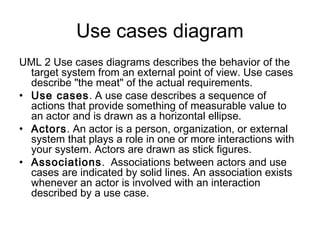
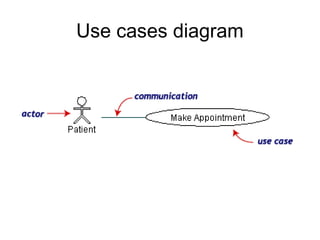
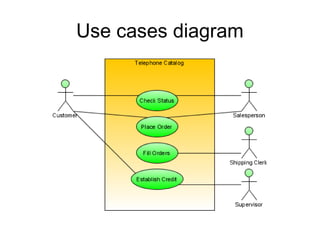
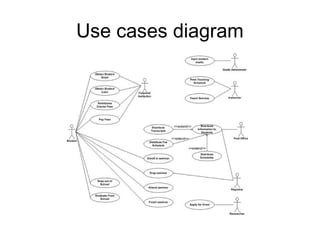
UML 2 Use cases diagrams describes the behavior of the
  target system from an external point of view. Use cases
  describe "the meat" of the actual requirements.
• Use cases. A use case describes a sequence of
  actions that provide something of measurable value to
  an actor and is drawn as a horizontal ellipse.
• Actors. An actor is a person, organization, or external
  system that plays a role in one or more interactions with
  your system. Actors are drawn as stick figures.
• Associations.  Associations between actors and use
  cases are indicated by solid lines. An association exists
  whenever an actor is involved with an interaction
  described by a use case.
Use cases diagram
Use cases diagram
Use cases diagram
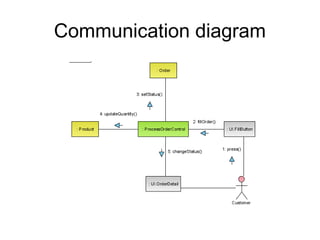
Communication diagram
• UML 2 Communication diagrams used to
  model the dynamic behavior of the use
  case. When compare to Sequence
  Diagram, the Communication Diagram is
  more focused on showing the
  collaboration of objects rather than the
  time sequence.
Communication diagram
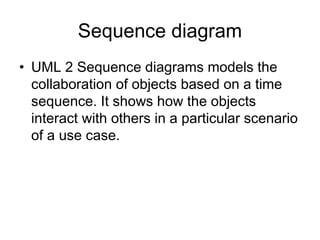
Sequence diagram
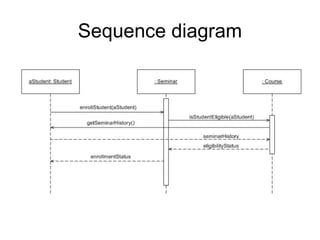
• UML 2 Sequence diagrams models the
  collaboration of objects based on a time
  sequence. It shows how the objects
  interact with others in a particular scenario
  of a use case.
Sequence diagram
Timing diagram
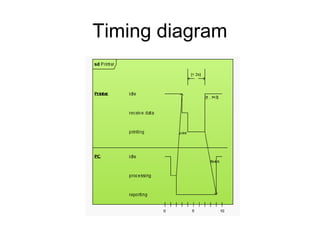
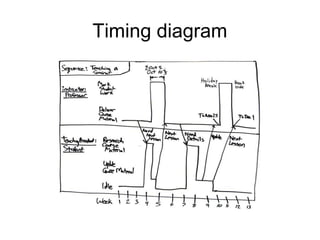
• UML 2 Timing diagrams shows the
  behavior of the objects in a given period of
  time. Timing diagram is a special form of a
  sequence diagram. The differences
  between timing diagram and sequence
  diagram are the axes are reversed so that
  the time are increase from left to right and
  the lifelines are shown in separate
  compartments arranged vertically.
Timing diagram
Timing diagram
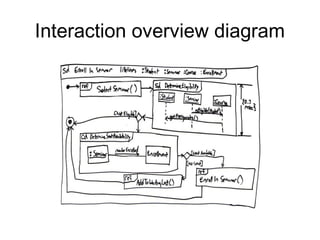
Interaction overview diagram
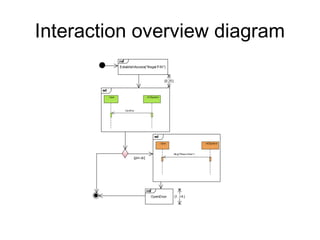
• UML 2 Interaction overview diagrams
  focuses on the overview of the flow of
  control of the interactions. It is a variant of
  the Activity Diagram where the nodes are
  the interactions or interaction occurrences.
  It describes the interactions where
  messages and lifelines are hidden.
Interaction overview diagram
UML diagram hierarchy
References

• http://www.agilemodeling.com/
• http://www.visual-
  paradigm.com/VPGallery/diagrams/index.html
• http://bdn.borland.com/article/0,1410,31863,00.h
  tml
• http://en.wikipedia.org/wiki/Unified_Modeling_La
  nguage
• http://pigseye.kennesaw.edu/~dbraun/csis4650/
  A&D/UML_tutorial/index.htm

Uml diagrams

  • 1.
    UML Diagrams Jung Woo
  • 2.
    What is UML? •Standard  language for specifying, visualizing, constructing, and documenting the artifacts of software systems, business modeling and other non-software systems. • The UML represents a collection of best engineering practices that have proven successful in the modeling of large and complex systems. • The UML is a very important part of developing object oriented software and the software development process.  • The UML uses mostly graphical notations to express the design of software projects.  • Using the UML helps project teams communicate, explore potential designs, and validate the architectural design of the software.
  • 3.
    Overview of UMLDiagrams Behavioral Structural : behavioral features of a system / business process : element of spec. irrespective of time • Activity • State machine • Class • Use case • Component • Interaction • Deployment • Object • Composite structure Interaction : emphasize object interaction • Package • Communication(collaberati on) • Sequence • Interaction overview • Timing
  • 4.
    Class diagram UML classdiagrams show the classes of the system, their inter-relationships, and the operations and attributes of the classes • Explore domain concepts in the form of a domain model • Analyze requirements in the form of a conceptual/analysis model • Depict the detailed design of object-oriented or object- based software
  • 5.
  • 6.
  • 7.
    Component diagram UML componentdiagrams shows the dependencies among software components, including the classifiers that specify them (for example implementation classes) and the artifacts that implement them; such as source code files, binary code files, executable files, scripts and tables.
  • 8.
  • 9.
    Deployment diagram UML deploymentdiagram depicts a static view of the run-time configuration of hardware nodes and the software components that run on those nodes. Deployment diagrams show the hardware for your system, the software that is installed on that hardware, and the middleware used to connect the disparate machines to one another.
  • 10.
  • 11.
  • 12.
    Object diagram • UML2 Object diagrams (instance diagrams), are useful for exploring real world examples of objects and the relationships between them. It shows instances instead of classes. They are useful for explaining small pieces with complicated relationships, especially recursive relationships.
  • 13.
  • 14.
    Package diagram • UML2 Package diagrams simplify complex class diagrams, it can group classes into packages. A package is a collection of logically related UML elements. Packages are depicted as file folders and can be used on any of the UML diagrams.
  • 15.
  • 16.
    Composite structure diagram •UML 2 Composite structure diagrams used to explore run-time instances of interconnected instances collaborating over communications links. It shows the internal structure (including parts and connectors) of a structured classifier or collaboration.
  • 17.
  • 18.
    Activity diagram • UML2 Activity diagrams helps to describe the flow of control of the target system, such as the exploring complex business rules and operations, describing the use case also the business process. It is object-oriented equivalent of flow charts and data-flow diagrams (DFDs).
  • 19.
  • 20.
  • 21.
    State machine diagram •UML 2 State machine diagrams can show the different states of an entity also how an entity responds to various events by changing from one state to another. The history of an entity can best be modeled by a finite state diagram.
  • 22.
  • 23.
  • 24.
    Use cases diagram UML2 Use cases diagrams describes the behavior of the target system from an external point of view. Use cases describe "the meat" of the actual requirements. • Use cases. A use case describes a sequence of actions that provide something of measurable value to an actor and is drawn as a horizontal ellipse. • Actors. An actor is a person, organization, or external system that plays a role in one or more interactions with your system. Actors are drawn as stick figures. • Associations.  Associations between actors and use cases are indicated by solid lines. An association exists whenever an actor is involved with an interaction described by a use case.
  • 25.
  • 26.
  • 27.
  • 28.
    Communication diagram • UML2 Communication diagrams used to model the dynamic behavior of the use case. When compare to Sequence Diagram, the Communication Diagram is more focused on showing the collaboration of objects rather than the time sequence.
  • 29.
  • 30.
    Sequence diagram • UML2 Sequence diagrams models the collaboration of objects based on a time sequence. It shows how the objects interact with others in a particular scenario of a use case.
  • 31.
  • 32.
    Timing diagram • UML2 Timing diagrams shows the behavior of the objects in a given period of time. Timing diagram is a special form of a sequence diagram. The differences between timing diagram and sequence diagram are the axes are reversed so that the time are increase from left to right and the lifelines are shown in separate compartments arranged vertically.
  • 33.
  • 34.
  • 35.
    Interaction overview diagram •UML 2 Interaction overview diagrams focuses on the overview of the flow of control of the interactions. It is a variant of the Activity Diagram where the nodes are the interactions or interaction occurrences. It describes the interactions where messages and lifelines are hidden.
  • 36.
  • 37.
  • 38.
  • 39.
    References • http://www.agilemodeling.com/ • http://www.visual- paradigm.com/VPGallery/diagrams/index.html • http://bdn.borland.com/article/0,1410,31863,00.h tml • http://en.wikipedia.org/wiki/Unified_Modeling_La nguage • http://pigseye.kennesaw.edu/~dbraun/csis4650/ A&D/UML_tutorial/index.htm

Editor's Notes

  • #18 Dashed oval : collaboration , rectangular : instances of any type of classifier, including classes, objects, or interfaces
  • #20 Dashed oval : collaboration , rectangular : instances of any type of classifier, including classes, objects, or interfaces
  • #21 A swimlane is a way to group activities performed by the same actor on an activity diagram or to group activities in a single thread.
  • #23 Dashed oval : collaboration , rectangular : instances of any type of classifier, including classes, objects, or interfaces
  • #27 Dashed oval : collaboration , rectangular : instances of any type of classifier, including classes, objects, or interfaces
  • #30 Dashed oval : collaboration , rectangular : instances of any type of classifier, including classes, objects, or interfaces
  • #32 Dashed oval : collaboration , rectangular : instances of any type of classifier, including classes, objects, or interfaces
  • #34 Dashed oval : collaboration , rectangular : instances of any type of classifier, including classes, objects, or interfaces
  • #37 Dashed oval : collaboration , rectangular : instances of any type of classifier, including classes, objects, or interfaces