Introduction
 It provides a visual evaluation of use case narration.
It identifies-
Normal flow
Alternate flow
It describes-
Sequential tasks
Conditional tasks
concurrency
Notations
Activity
 A step represent in the process where some tasks/work
is being done.
 That work can be-
 Calculation
 Finding some data
 Manipulating information
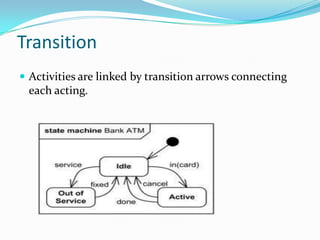
Transition
 Activities are linked by transition arrows connecting
each acting.
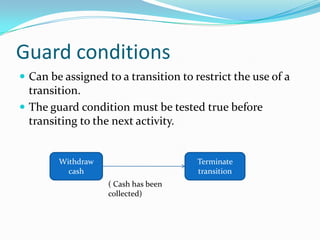
Guard conditions
 Can be assigned to a transition to restrict the use of a
transition.
 The guard condition must be tested true before
transiting to the next activity.
Withdraw
cash
Terminate
transition
( Cash has been
collected)
Decisions
 Diamond in the decision item can be simple true false
test.
 Decision may involve a choice between a set of
options.
Sufficient
conditions
Insufficient
conditions
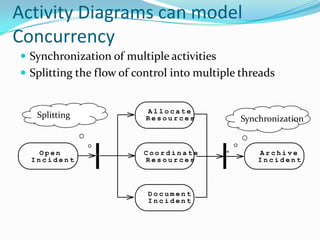
Activity Diagrams can model
Concurrency
 Synchronization of multiple activities
 Splitting the flow of control into multiple threads
O p e n
I n c i d e n t
A l l o c a t e
R e s o u r c e s
C o o r d i n a t e
R e s o u r c e s
D o c u m e n t
I n c i d e n t
A r c h i v e
I n c i d e n t
SynchronizationSplitting
Link For Activity Diagram

Activity diagram

  • 2.
    Introduction  It providesa visual evaluation of use case narration. It identifies- Normal flow Alternate flow It describes- Sequential tasks Conditional tasks concurrency
  • 3.
    Notations Activity  A steprepresent in the process where some tasks/work is being done.  That work can be-  Calculation  Finding some data  Manipulating information
  • 4.
    Transition  Activities arelinked by transition arrows connecting each acting.
  • 5.
    Guard conditions  Canbe assigned to a transition to restrict the use of a transition.  The guard condition must be tested true before transiting to the next activity. Withdraw cash Terminate transition ( Cash has been collected)
  • 6.
    Decisions  Diamond inthe decision item can be simple true false test.  Decision may involve a choice between a set of options. Sufficient conditions Insufficient conditions
  • 7.
    Activity Diagrams canmodel Concurrency  Synchronization of multiple activities  Splitting the flow of control into multiple threads O p e n I n c i d e n t A l l o c a t e R e s o u r c e s C o o r d i n a t e R e s o u r c e s D o c u m e n t I n c i d e n t A r c h i v e I n c i d e n t SynchronizationSplitting
  • 8.