V.REVATHIAMBIKA
SAMS College of Engg & Tech.,
         Chennai.
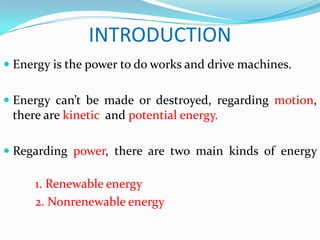
INTRODUCTION
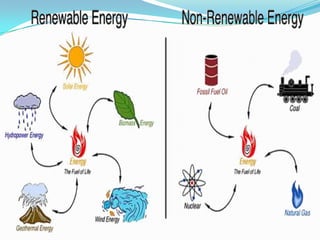
 Energy is the power to do works and drive machines.


 Energy can’t be made or destroyed, regarding motion,
  there are kinetic and potential energy.

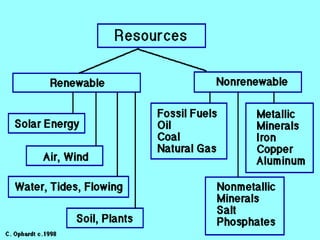
 Regarding power, there are two main kinds of energy

     1. Renewable energy
     2. Nonrenewable energy
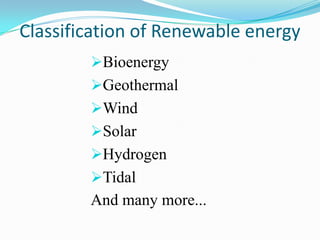
Classification of Renewable energy
        Bioenergy
        Geothermal
        Wind
        Solar
        Hydrogen
        Tidal
        And many more...
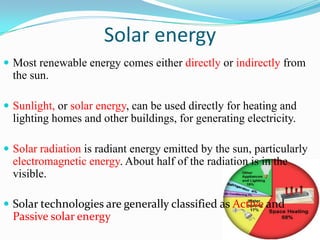
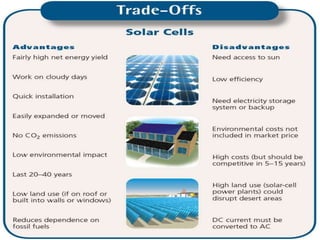
Solar energy
 Most renewable energy comes either directly or indirectly from
  the sun.

 Sunlight, or solar energy, can be used directly for heating and
  lighting homes and other buildings, for generating electricity.

 Solar radiation is radiant energy emitted by the sun, particularly
  electromagnetic energy. About half of the radiation is in the
  visible.

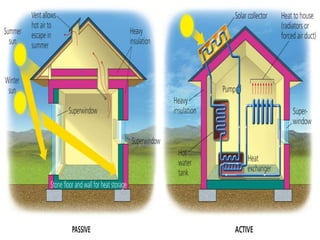
 Solar technologies are generally classified as Active and
  Passive solar energy
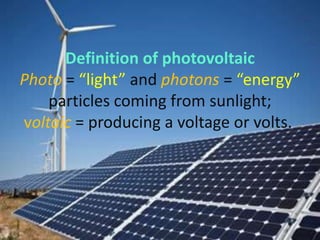
Definition of photovoltaic
Photo = “light” and photons = “energy”
    particles coming from sunlight;
voltaic = producing a voltage or volts.
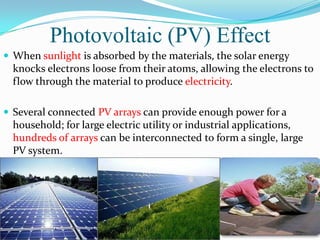
Photovoltaic (PV) Effect
 When sunlight is absorbed by the materials, the solar energy
  knocks electrons loose from their atoms, allowing the electrons to
  flow through the material to produce electricity.

 Several connected PV arrays can provide enough power for a
  household; for large electric utility or industrial applications,
  hundreds of arrays can be interconnected to form a single, large
  PV system.
PHOTOVOLTAIC SOLAR PANALS

 It convert sunlight directly into electricity.


 It consists of several connected 0.6-V dc PV cells, which are made out of a
  semiconducting material sandwiched between two metallic electrodes.

 The photovoltaic effect refers to the separation of minority carriers [electrons and
  holes] by a built-in electric field, such as a PN-junction or Schottky barrier.

 Thin-film crystalline-silicon solar cells consist of layers about 10 µm thick compared
  with 200- to 300-µm layers for crystalline-silicon cells.
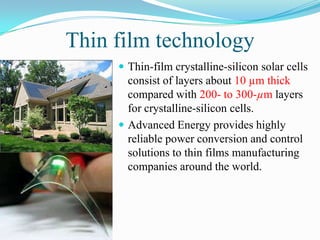
Thin film technology
      Thin-film crystalline-silicon solar cells
       consist of layers about 10 µm thick
       compared with 200- to 300-µm layers
       for crystalline-silicon cells.
      Advanced Energy provides highly
       reliable power conversion and control
       solutions to thin films manufacturing
       companies around the world.
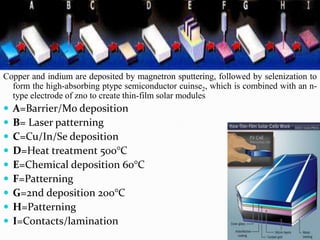
Copper and indium are deposited by magnetron sputtering, followed by selenization to
  form the high-absorbing ptype semiconductor cuinse2, which is combined with an n-
  type electrode of zno to create thin-film solar modules
   A=Barrier/Mo deposition
   B= Laser patterning
   C=Cu/In/Se deposition
   D=Heat treatment 500°C
   E=Chemical deposition 60°C
   F=Patterning
   G=2nd deposition 200°C
   H=Patterning
   I=Contacts/lamination
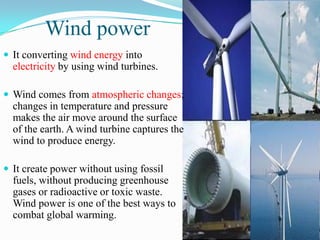
Wind power
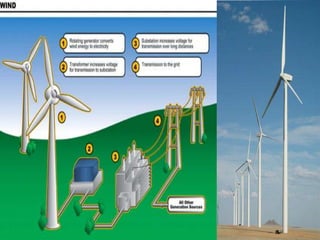
 It converting wind energy into
  electricity by using wind turbines.

 Wind comes from atmospheric changes;
  changes in temperature and pressure
  makes the air move around the surface
  of the earth. A wind turbine captures the
  wind to produce energy.

 It create power without using fossil
  fuels, without producing greenhouse
  gases or radioactive or toxic waste.
  Wind power is one of the best ways to
  combat global warming.
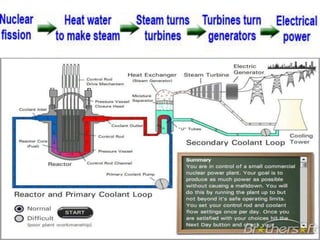
Nuclear Energy
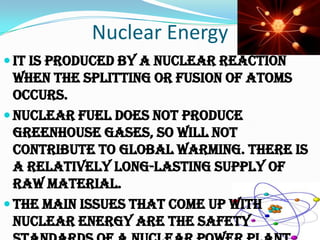
 It is produced by a nuclear reaction
  when the splitting or fusion of atoms
  occurs.
 Nuclear fuel does not produce
  greenhouse gases, so will not
  contribute to global warming. There is
  a relatively long-lasting supply of
  raw material.
 The main issues that come up with
  nuclear energy are the safety
Free Energy/Radiant Energy
 It is the energy of electromagnetic waves.
 The oceans and other waters of the world cover
  over 70% of the Earth’s surface.
 Free Energy device/method would draw
  additional power from the sea of Universal
  Energy in which all matter is carried, and it is
  thought that such a device would produce more
  energy than is used to run it, also known as
  Over unity.
 Constantly moving, which allows many waters
SQUIDS/OCEAN RADIENT ENERGY
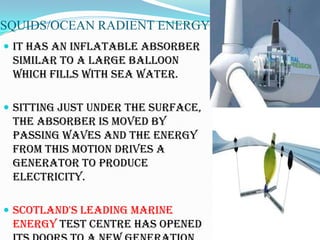
 It has an inflatable absorber
 similar to a large balloon
 which fills with sea water.

 Sitting just under the surface,
 the absorber is moved by
 passing waves and the energy
 from this motion drives a
 generator to produce
 electricity.

 Scotland's leading marine
 energy test centre has opened
MEMS & Nanotechnology
 Ultra low power electronics – MCUs, RTCs, DSPs
 Smart devices in everything,
 Sensors everywhere for data capture and analysis,
 Wireless is pervasive,
 Miniaturization,
 Integration,
 High Reliability,
 Eco-friendly solutions,
 Renewable energy sources,
 Reduced life cycle costs.
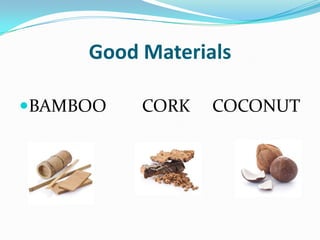
Good Materials

BAMBOO   CORK   COCONUT
Renewable energy from natural resources
 Synthetic solar cells created on tobacco plants
 Generating energy from evaporation on a leaf
 Electricity from bacteria and grass clippings
 Generating energy from trees to power sensors
 Virus Battery
 Energy from Cactus
 Living Batteries
 Frog-inspired technology to generate biofuel using artificial
  photosynthesis
 Harvesting energy from Spinach
 Energy to run LEDs harvested from trees
Advantages & disadvantages of nuclear energy
  Advantages                 Disadvantages

 Nuclear power costs        It is very, very dangerous.
  about the same as coal,  It must be sealed up and
  so it's not expensive to   buried for many
  make.                      thousands of years to
 Does not produce smoke     allow the radioactivity to
  or carbon dioxide, so it   die away.
  does not contribute to    For all that time it must
  the greenhouse effect.     be kept safe from
 Produces huge amounts      earthquakes, flooding,
  of energy from small       terrorists and everything
                             else.
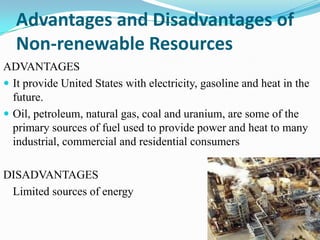
Advantages and Disadvantages of
  Non-renewable Resources
ADVANTAGES
 It provide United States with electricity, gasoline and heat in the
  future.
 Oil, petroleum, natural gas, coal and uranium, are some of the
  primary sources of fuel used to provide power and heat to many
  industrial, commercial and residential consumers

DISADVANTAGES
 Limited sources of energy
Saving Energy    Quality
                  Excellence
                  Reliability
Saving Money     Range
                  Support and Service
Saving the       Cost-effective

 Environment      Efficient
                  Clean and sustainable
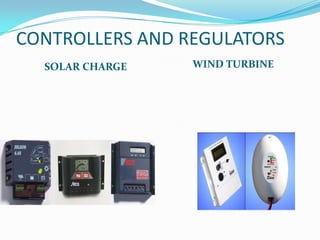
CONTROLLERS AND REGULATORS
  SOLAR CHARGE   WIND TURBINE
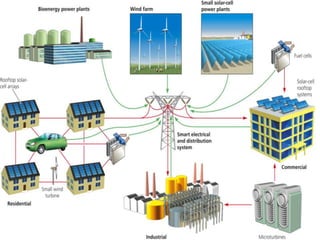
Renewable energy technologies can help contribute
 to a clean and secure energy future for our nation
 and the world


As an electricity provider
As a farmer or rancher
As a homeowner
As a small business owner
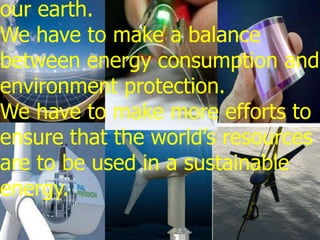
our earth.
We have to make a balance
between energy consumption and
environment protection.
We have to make more efforts to
ensure that the world’s resources
are to be used in a sustainable
energy.
THANK YOU

Renewable energy and resources

  • 1.
    V.REVATHIAMBIKA SAMS College ofEngg & Tech., Chennai.
  • 2.
    INTRODUCTION  Energy isthe power to do works and drive machines.  Energy can’t be made or destroyed, regarding motion, there are kinetic and potential energy.  Regarding power, there are two main kinds of energy 1. Renewable energy 2. Nonrenewable energy
  • 4.
    Classification of Renewableenergy Bioenergy Geothermal Wind Solar Hydrogen Tidal And many more...
  • 7.
    Solar energy  Mostrenewable energy comes either directly or indirectly from the sun.  Sunlight, or solar energy, can be used directly for heating and lighting homes and other buildings, for generating electricity.  Solar radiation is radiant energy emitted by the sun, particularly electromagnetic energy. About half of the radiation is in the visible.  Solar technologies are generally classified as Active and Passive solar energy
  • 9.
    Definition of photovoltaic Photo= “light” and photons = “energy” particles coming from sunlight; voltaic = producing a voltage or volts.
  • 10.
    Photovoltaic (PV) Effect When sunlight is absorbed by the materials, the solar energy knocks electrons loose from their atoms, allowing the electrons to flow through the material to produce electricity.  Several connected PV arrays can provide enough power for a household; for large electric utility or industrial applications, hundreds of arrays can be interconnected to form a single, large PV system.
  • 11.
    PHOTOVOLTAIC SOLAR PANALS It convert sunlight directly into electricity.  It consists of several connected 0.6-V dc PV cells, which are made out of a semiconducting material sandwiched between two metallic electrodes.  The photovoltaic effect refers to the separation of minority carriers [electrons and holes] by a built-in electric field, such as a PN-junction or Schottky barrier.  Thin-film crystalline-silicon solar cells consist of layers about 10 µm thick compared with 200- to 300-µm layers for crystalline-silicon cells.
  • 12.
    Thin film technology  Thin-film crystalline-silicon solar cells consist of layers about 10 µm thick compared with 200- to 300-µm layers for crystalline-silicon cells.  Advanced Energy provides highly reliable power conversion and control solutions to thin films manufacturing companies around the world.
  • 13.
    Copper and indiumare deposited by magnetron sputtering, followed by selenization to form the high-absorbing ptype semiconductor cuinse2, which is combined with an n- type electrode of zno to create thin-film solar modules  A=Barrier/Mo deposition  B= Laser patterning  C=Cu/In/Se deposition  D=Heat treatment 500°C  E=Chemical deposition 60°C  F=Patterning  G=2nd deposition 200°C  H=Patterning  I=Contacts/lamination
  • 14.
    Wind power  Itconverting wind energy into electricity by using wind turbines.  Wind comes from atmospheric changes; changes in temperature and pressure makes the air move around the surface of the earth. A wind turbine captures the wind to produce energy.  It create power without using fossil fuels, without producing greenhouse gases or radioactive or toxic waste. Wind power is one of the best ways to combat global warming.
  • 16.
    Nuclear Energy  Itis produced by a nuclear reaction when the splitting or fusion of atoms occurs.  Nuclear fuel does not produce greenhouse gases, so will not contribute to global warming. There is a relatively long-lasting supply of raw material.  The main issues that come up with nuclear energy are the safety
  • 18.
    Free Energy/Radiant Energy It is the energy of electromagnetic waves.  The oceans and other waters of the world cover over 70% of the Earth’s surface.  Free Energy device/method would draw additional power from the sea of Universal Energy in which all matter is carried, and it is thought that such a device would produce more energy than is used to run it, also known as Over unity.  Constantly moving, which allows many waters
  • 19.
    SQUIDS/OCEAN RADIENT ENERGY It has an inflatable absorber similar to a large balloon which fills with sea water.  Sitting just under the surface, the absorber is moved by passing waves and the energy from this motion drives a generator to produce electricity.  Scotland's leading marine energy test centre has opened
  • 20.
    MEMS & Nanotechnology Ultra low power electronics – MCUs, RTCs, DSPs  Smart devices in everything,  Sensors everywhere for data capture and analysis,  Wireless is pervasive,  Miniaturization,  Integration,  High Reliability,  Eco-friendly solutions,  Renewable energy sources,  Reduced life cycle costs.
  • 22.
  • 23.
    Renewable energy fromnatural resources  Synthetic solar cells created on tobacco plants  Generating energy from evaporation on a leaf  Electricity from bacteria and grass clippings  Generating energy from trees to power sensors  Virus Battery  Energy from Cactus  Living Batteries  Frog-inspired technology to generate biofuel using artificial photosynthesis  Harvesting energy from Spinach  Energy to run LEDs harvested from trees
  • 25.
    Advantages & disadvantagesof nuclear energy Advantages Disadvantages  Nuclear power costs  It is very, very dangerous. about the same as coal,  It must be sealed up and so it's not expensive to buried for many make. thousands of years to  Does not produce smoke allow the radioactivity to or carbon dioxide, so it die away. does not contribute to  For all that time it must the greenhouse effect. be kept safe from  Produces huge amounts earthquakes, flooding, of energy from small terrorists and everything else.
  • 26.
    Advantages and Disadvantagesof Non-renewable Resources ADVANTAGES  It provide United States with electricity, gasoline and heat in the future.  Oil, petroleum, natural gas, coal and uranium, are some of the primary sources of fuel used to provide power and heat to many industrial, commercial and residential consumers DISADVANTAGES Limited sources of energy
  • 28.
    Saving Energy  Quality  Excellence  Reliability Saving Money  Range  Support and Service Saving the  Cost-effective Environment  Efficient  Clean and sustainable
  • 29.
    CONTROLLERS AND REGULATORS SOLAR CHARGE WIND TURBINE
  • 30.
    Renewable energy technologiescan help contribute to a clean and secure energy future for our nation and the world As an electricity provider As a farmer or rancher As a homeowner As a small business owner
  • 32.
    our earth. We haveto make a balance between energy consumption and environment protection. We have to make more efforts to ensure that the world’s resources are to be used in a sustainable energy.
  • 34.