WAVE ENERGY
SENA KOYUNCU
MEF UNIVERSITY
RENEWABLE ENERGY
World’s energy demand is increasing.
Some ways to produce energy:
◦ Solar energy
◦ Energy generated by fossil fuels(coal, oil, natural gas)
◦ Wind energy
◦ Wave energy
◦ Biomass energy
In order to avoid pollution whilst generating energy, renewable energy resourses should be
used.
WHAT IS WAVE ENERGY?
Wind energy transfers its energy to the surface water of the ocean, and with that the waves are being
generated.
WHAT IS WAVE ENERGY?
Machines like turbines, special buoys capture the power of waves and tides convert them it into
pollution-free electricity.
Wave energy is:
◦ Renewable
◦ Environment friendly
◦ A continuous resource
◦ Does not cause any harm to the atmosphere
It is estimated that if the potential of the wave energy is fully exploited, then it can satisfy around 40% of
the world’s total energy needs.
ANY DISADVANTAGES?
Due to our current technology, we cannot utilize the wave energy efficiently just yet.
The equipment required for utilizing wave energy is really expensive as they have to withstand
severe weather conditions such as storms.
But with further experience in the field, adequate R&D funding, and proactive public support; the
costs of wave and tidal technologies are expected to decrease
CAPTURING WAVES
Three main ways to capture the power of waves:
◦ Surface devices: These devices gain power from the waves moving them up and down on the surface of
the ocean.
◦ Underwater devices: These devices range from balloon type objects attached to the ocean floor to long
tubes that stretch over a long distance. When the waves cause them to oscillate, they move a turbine
and create electricity.
◦ Reservoirs: These devices take advantage of the waves moving water into a reservoir on the coastline.
As water moves back out into the ocean it is forced down a tube and turns the blades of turbine. The
turbine then converts the energy into electricity.
WAVE ENERGY CONVERTERS
A machine that exploits wave power is a wave energy converter (WEC).
TYPES OF
WEC
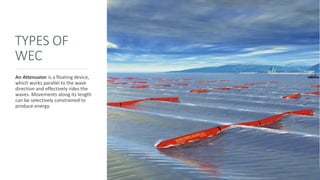
An Attenuator is a floating device,
which works parallel to the wave
direction and effectively rides the
waves. Movements along its length
can be selectively constrained to
produce energy.
TYPES OF
WEC
A Point Absorber is a floating
structure which absorbs energy in
all directions through its
movements at or near the water
surface. The power take-off system
may take a number of forms,
depending on the configuration of
displacers/reactors.
TYPES OF
WEC
Submerged Pressure Differential
Devices are typically located near
shore and are attached to the
seabed. The motion of the waves
causes the sea level to rise and fall
above the device, inducing a
pressure differential inside the
device. The alternating pressure can
then pump fl uid through a system
to generate electricity.
TYPES OF
WEC
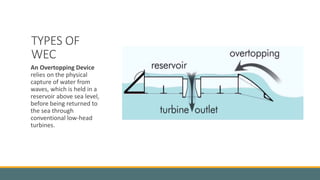
An Overtopping Device
relies on the physical
capture of water from
waves, which is held in a
reservoir above sea level,
before being returned to
the sea through
conventional low-head
turbines.
TYPES OF
WEC
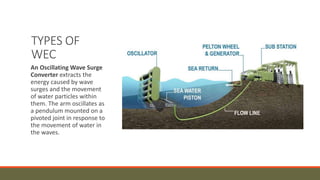
An Oscillating Wave Surge
Converter extracts the
energy caused by wave
surges and the movement
of water particles within
them. The arm oscillates as
a pendulum mounted on a
pivoted joint in response to
the movement of water in
the waves.
REFERENCES
[1]: https://renewablenw.org/node/wave-tidal-energy-technology
[2]: https://www.conserve-energy-future.com/different-energy-sources.
[3]: https://www.youtube.com/watch?v=JOP33yCKmNw
[4]: https://www.ducksters.com/science/environment/wave_and_tidal_energy.php
[5]: https://en.wikipedia.org/wiki/Wave_power
[6]: https://www.schiffundhafen.de/fileadmin/user_upload/Publikationen/ShipOffshore/2010-
04/Offshore_Principles_of_wave_energy.pdf
[7]:https://energiatalgud.ee/img_auth.php/2/23/Drew,_B.,_Plummer,_A.R.,_Sahinkaya,_M.N._A
_review_of_wave_energy_converter_technology._2009.pdf

Wave Energy

  • 1.
  • 2.
    RENEWABLE ENERGY World’s energydemand is increasing. Some ways to produce energy: ◦ Solar energy ◦ Energy generated by fossil fuels(coal, oil, natural gas) ◦ Wind energy ◦ Wave energy ◦ Biomass energy In order to avoid pollution whilst generating energy, renewable energy resourses should be used.
  • 3.
    WHAT IS WAVEENERGY? Wind energy transfers its energy to the surface water of the ocean, and with that the waves are being generated.
  • 4.
    WHAT IS WAVEENERGY? Machines like turbines, special buoys capture the power of waves and tides convert them it into pollution-free electricity. Wave energy is: ◦ Renewable ◦ Environment friendly ◦ A continuous resource ◦ Does not cause any harm to the atmosphere It is estimated that if the potential of the wave energy is fully exploited, then it can satisfy around 40% of the world’s total energy needs.
  • 5.
    ANY DISADVANTAGES? Due toour current technology, we cannot utilize the wave energy efficiently just yet. The equipment required for utilizing wave energy is really expensive as they have to withstand severe weather conditions such as storms. But with further experience in the field, adequate R&D funding, and proactive public support; the costs of wave and tidal technologies are expected to decrease
  • 6.
    CAPTURING WAVES Three mainways to capture the power of waves: ◦ Surface devices: These devices gain power from the waves moving them up and down on the surface of the ocean. ◦ Underwater devices: These devices range from balloon type objects attached to the ocean floor to long tubes that stretch over a long distance. When the waves cause them to oscillate, they move a turbine and create electricity. ◦ Reservoirs: These devices take advantage of the waves moving water into a reservoir on the coastline. As water moves back out into the ocean it is forced down a tube and turns the blades of turbine. The turbine then converts the energy into electricity.
  • 7.
    WAVE ENERGY CONVERTERS Amachine that exploits wave power is a wave energy converter (WEC).
  • 8.
    TYPES OF WEC An Attenuatoris a floating device, which works parallel to the wave direction and effectively rides the waves. Movements along its length can be selectively constrained to produce energy.
  • 9.
    TYPES OF WEC A PointAbsorber is a floating structure which absorbs energy in all directions through its movements at or near the water surface. The power take-off system may take a number of forms, depending on the configuration of displacers/reactors.
  • 10.
    TYPES OF WEC Submerged PressureDifferential Devices are typically located near shore and are attached to the seabed. The motion of the waves causes the sea level to rise and fall above the device, inducing a pressure differential inside the device. The alternating pressure can then pump fl uid through a system to generate electricity.
  • 11.
    TYPES OF WEC An OvertoppingDevice relies on the physical capture of water from waves, which is held in a reservoir above sea level, before being returned to the sea through conventional low-head turbines.
  • 12.
    TYPES OF WEC An OscillatingWave Surge Converter extracts the energy caused by wave surges and the movement of water particles within them. The arm oscillates as a pendulum mounted on a pivoted joint in response to the movement of water in the waves.
  • 13.
    REFERENCES [1]: https://renewablenw.org/node/wave-tidal-energy-technology [2]: https://www.conserve-energy-future.com/different-energy-sources. [3]:https://www.youtube.com/watch?v=JOP33yCKmNw [4]: https://www.ducksters.com/science/environment/wave_and_tidal_energy.php [5]: https://en.wikipedia.org/wiki/Wave_power [6]: https://www.schiffundhafen.de/fileadmin/user_upload/Publikationen/ShipOffshore/2010- 04/Offshore_Principles_of_wave_energy.pdf [7]:https://energiatalgud.ee/img_auth.php/2/23/Drew,_B.,_Plummer,_A.R.,_Sahinkaya,_M.N._A _review_of_wave_energy_converter_technology._2009.pdf