THYROTOXICOSIS 
IN 
PREGNANCY 
Hamad Emad H. Dhuhayr
PHYSIOLOGIC CHANGES IN THYROID FUNCTION 
DURING PREGNANCY 
• Thyroid binding globulin (TBG) increases due to reduced 
hepatic clearance and estrogenic stimulation of TBG synthesis. 
• The test results that change in pregnancy are influenced by 
changes in TBG concentration. 
• Plasma iodide levels decrease due to fetal iodide use and 
increased maternal clearance -> leads to notable increase in 
gland size in 15% of women (without abnormal TFTs)
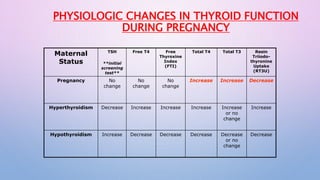
PHYSIOLOGIC CHANGES IN THYROID FUNCTION 
DURING PREGNANCY 
Maternal 
Status 
TSH 
**initial 
screening 
test** 
Free T4 Free 
Thyroxine 
Index 
(FTI) 
Total T4 Total T3 Resin 
Triiodo-thyronine 
Uptake 
(RT3U) 
Pregnancy No 
change 
No 
change 
No 
change 
Increase Increase Decrease 
Hyperthyroidism Decrease Increase Increase Increase Increase 
or no 
change 
Increase 
Hypothyroidism Increase Decrease Decrease Decrease Decrease 
or no 
change 
Decrease
FETAL THYROID 
7-9 weeks formation of thyroid gland 
10 weeks TSH and thyroxine deteable 
17 weeks maturation of the gland 
>18weeks response to TSH stimulation
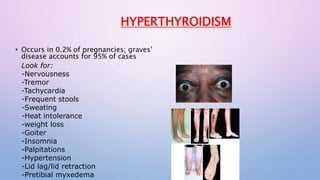
HYPERTHYROIDISM 
• Occurs in 0.2% of pregnancies; graves’ 
disease accounts for 95% of cases 
Look for: 
-Nervousness 
-Tremor 
-Tachycardia 
-Frequent stools 
-Sweating 
-Heat intolerance 
-weight loss 
-Goiter 
-Insomnia 
-Palpitations 
-Hypertension 
-Lid lag/lid retraction 
-Pretibial myxedema
CAUSES & DIAGNOSIS OF HYPERTHYROIDISM 
• Most common cause of hyperthyroidism is graves’ 
disease 
• Document elevated FT4 or elevated FTI with suppressed TSH, 
in absence of goiter/mass 
• Most patients have antibodies to TSH receptor, 
antimicrosomal, or antithyroid peroxidase antibodies, but 
measurement of these is not required (though some 
endocrinologists recommend measuring TSI, which are 
stimulatory antibodies to TSH receptor) 
• Other causes: 
• Excess TSH production, gestational trophoplastic disease, 
hyperfunctioning thyroid adenoma, toxic goiter, subacute 
thyroiditis, extrathyroid source of “TH”
GUIDELINES FOR CLINICAL MANAGEMENT OF MATERNAL 
HYPERTHYROIDISM DURING PREGNANCY 
• 1. Use the lowest dosage of thionamide (preferably PTU) to maintain 
maternal total T4 concentrations in the upper one third of normal to 
slightly elevated range for pregnancy. 
• Normal range of total t4 during pregnancy is estimated to be 1.5 
times the nonpregnant state 
• 2. Monitor maternal total T4 serum concentration every 2–4 weeks, 
and titrate thionamide as necessary. 
• Monitoring serum tsh may become useful later.
GUIDELINES FOR CLINICAL MANAGEMENT OF MATERNAL 
HYPERTHYROIDISM DURING PREGNANCY 
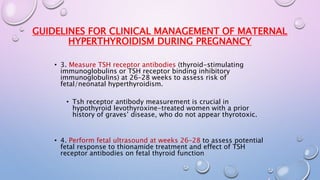
• 3. Measure TSH receptor antibodies (thyroid-stimulating 
immunoglobulins or TSH receptor binding inhibitory 
immunoglobulins) at 26–28 weeks to assess risk of 
fetal/neonatal hyperthyroidism. 
• Tsh receptor antibody measurement is crucial in 
hypothyroid levothyroxine-treated women with a prior 
history of graves’ disease, who do not appear thyrotoxic. 
• 4. Perform fetal ultrasound at weeks 26–28 to assess potential 
fetal response to thionamide treatment and effect of TSH 
receptor antibodies on fetal thyroid function
GUIDELINES FOR CLINICAL MANAGEMENT OF MATERNAL 
HYPERTHYROIDISM DURING PREGNANCY 
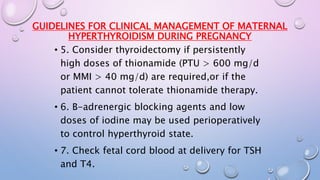
• 5. Consider thyroidectomy if persistently 
high doses of thionamide (PTU > 600 mg/d 
or MMI > 40 mg/d) are required,or if the 
patient cannot tolerate thionamide therapy. 
• 6. Β-adrenergic blocking agents and low 
doses of iodine may be used perioperatively 
to control hyperthyroid state. 
• 7. Check fetal cord blood at delivery for TSH 
and T4.
TREATMENT 
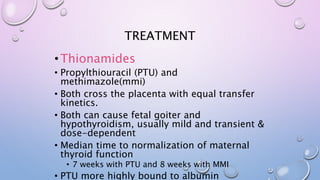
• Thionamides 
• Propylthiouracil (PTU) and 
methimazole(mmi) 
• Both cross the placenta with equal transfer 
kinetics. 
• Both can cause fetal goiter and 
hypothyroidism, usually mild and transient & 
dose-dependent 
• Median time to normalization of maternal 
thyroid function 
• 7 weeks with PTU and 8 weeks with MMI 
• PTU more highly bound to albumin
TREATMENT 
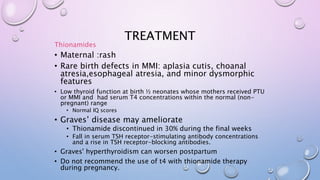
Thionamides 
• Maternal :rash 
• Rare birth defects in MMI: aplasia cutis, choanal 
atresia,esophageal atresia, and minor dysmorphic 
features 
• Low thyroid function at birth ½ neonates whose mothers received PTU 
or MMI and had serum T4 concentrations within the normal (non-pregnant) 
range 
• Normal IQ scores 
• Graves’ disease may ameliorate 
• Thionamide discontinued in 30% during the final weeks 
• Fall in serum TSH receptor-stimulating antibody concentrations 
and a rise in TSH receptor-blocking antibodies. 
• Graves' hyperthyroidism can worsen postpartum 
• Do not recommend the use of t4 with thionamide therapy 
during pregnancy.
TREATMENT 
• Β-adrenergic blockers 
• Weaned as soon as the hyperthyroidism is 
controlled 
• Occasional cases of neonatal growth restriction, 
hypoglycemia, respiratory depression, and 
bradycardia 
• Increased frequency of first-trimester miscarriages 
• Avoiding in the first trimester 
• Iodides 
• Past reports of neonatal hypothyroidism after 
exposure to iodine 
• Low-dose potassium iodide may be considered 
• Preparation for thyroidectomy 
• Thionamide-intolerant patients refusing surgery.
TREATMENT 
• Surgery 
• Subtotal thyroidectomy : 
• Persistently high dosages of thionamides (PTU > 600 
mg/d, MMI > 40 mg/d) are required to control maternal 
disease 
• Allergic or intolerant of both thionamides 
• Noncompliant with medical therapy 
• Compressive symptoms 
• Second trimester, before gestational week 24 
• Prepared with a β-adrenergic blocking agent and a 10- to 14- 
day course of potassium iodide
TREATMENT 
• Radioactive iodine therapy 
• Contraindicated 
• Fetal thyroid gland begins to concentrate iodine 
after gestational week 10, fetal thyroid tissue is 
present by 10 to 12 weeks 
• Predisposing to congenital hypothyroidism 
• Nursing 
• Breast feeding in mothers taking PTU or MMI is safe 
• Thyroid function in newborn infants is unaffected 
• PTU is preferred because it is less concentrated in 
breast milk
REFFRENCES 
• KUMAR 
• CECIEL 
• WEBSITE UP TO DATE

Thyrotoxicosis in pregnancy - hamad

  • 1.
    THYROTOXICOSIS IN PREGNANCY Hamad Emad H. Dhuhayr
  • 2.
    PHYSIOLOGIC CHANGES INTHYROID FUNCTION DURING PREGNANCY • Thyroid binding globulin (TBG) increases due to reduced hepatic clearance and estrogenic stimulation of TBG synthesis. • The test results that change in pregnancy are influenced by changes in TBG concentration. • Plasma iodide levels decrease due to fetal iodide use and increased maternal clearance -> leads to notable increase in gland size in 15% of women (without abnormal TFTs)
  • 3.
    PHYSIOLOGIC CHANGES INTHYROID FUNCTION DURING PREGNANCY Maternal Status TSH **initial screening test** Free T4 Free Thyroxine Index (FTI) Total T4 Total T3 Resin Triiodo-thyronine Uptake (RT3U) Pregnancy No change No change No change Increase Increase Decrease Hyperthyroidism Decrease Increase Increase Increase Increase or no change Increase Hypothyroidism Increase Decrease Decrease Decrease Decrease or no change Decrease
  • 4.
    FETAL THYROID 7-9weeks formation of thyroid gland 10 weeks TSH and thyroxine deteable 17 weeks maturation of the gland >18weeks response to TSH stimulation
  • 5.
    HYPERTHYROIDISM • Occursin 0.2% of pregnancies; graves’ disease accounts for 95% of cases Look for: -Nervousness -Tremor -Tachycardia -Frequent stools -Sweating -Heat intolerance -weight loss -Goiter -Insomnia -Palpitations -Hypertension -Lid lag/lid retraction -Pretibial myxedema
  • 6.
    CAUSES & DIAGNOSISOF HYPERTHYROIDISM • Most common cause of hyperthyroidism is graves’ disease • Document elevated FT4 or elevated FTI with suppressed TSH, in absence of goiter/mass • Most patients have antibodies to TSH receptor, antimicrosomal, or antithyroid peroxidase antibodies, but measurement of these is not required (though some endocrinologists recommend measuring TSI, which are stimulatory antibodies to TSH receptor) • Other causes: • Excess TSH production, gestational trophoplastic disease, hyperfunctioning thyroid adenoma, toxic goiter, subacute thyroiditis, extrathyroid source of “TH”
  • 7.
    GUIDELINES FOR CLINICALMANAGEMENT OF MATERNAL HYPERTHYROIDISM DURING PREGNANCY • 1. Use the lowest dosage of thionamide (preferably PTU) to maintain maternal total T4 concentrations in the upper one third of normal to slightly elevated range for pregnancy. • Normal range of total t4 during pregnancy is estimated to be 1.5 times the nonpregnant state • 2. Monitor maternal total T4 serum concentration every 2–4 weeks, and titrate thionamide as necessary. • Monitoring serum tsh may become useful later.
  • 8.
    GUIDELINES FOR CLINICALMANAGEMENT OF MATERNAL HYPERTHYROIDISM DURING PREGNANCY • 3. Measure TSH receptor antibodies (thyroid-stimulating immunoglobulins or TSH receptor binding inhibitory immunoglobulins) at 26–28 weeks to assess risk of fetal/neonatal hyperthyroidism. • Tsh receptor antibody measurement is crucial in hypothyroid levothyroxine-treated women with a prior history of graves’ disease, who do not appear thyrotoxic. • 4. Perform fetal ultrasound at weeks 26–28 to assess potential fetal response to thionamide treatment and effect of TSH receptor antibodies on fetal thyroid function
  • 9.
    GUIDELINES FOR CLINICALMANAGEMENT OF MATERNAL HYPERTHYROIDISM DURING PREGNANCY • 5. Consider thyroidectomy if persistently high doses of thionamide (PTU > 600 mg/d or MMI > 40 mg/d) are required,or if the patient cannot tolerate thionamide therapy. • 6. Β-adrenergic blocking agents and low doses of iodine may be used perioperatively to control hyperthyroid state. • 7. Check fetal cord blood at delivery for TSH and T4.
  • 10.
    TREATMENT • Thionamides • Propylthiouracil (PTU) and methimazole(mmi) • Both cross the placenta with equal transfer kinetics. • Both can cause fetal goiter and hypothyroidism, usually mild and transient & dose-dependent • Median time to normalization of maternal thyroid function • 7 weeks with PTU and 8 weeks with MMI • PTU more highly bound to albumin
  • 11.
    TREATMENT Thionamides •Maternal :rash • Rare birth defects in MMI: aplasia cutis, choanal atresia,esophageal atresia, and minor dysmorphic features • Low thyroid function at birth ½ neonates whose mothers received PTU or MMI and had serum T4 concentrations within the normal (non-pregnant) range • Normal IQ scores • Graves’ disease may ameliorate • Thionamide discontinued in 30% during the final weeks • Fall in serum TSH receptor-stimulating antibody concentrations and a rise in TSH receptor-blocking antibodies. • Graves' hyperthyroidism can worsen postpartum • Do not recommend the use of t4 with thionamide therapy during pregnancy.
  • 12.
    TREATMENT • Β-adrenergicblockers • Weaned as soon as the hyperthyroidism is controlled • Occasional cases of neonatal growth restriction, hypoglycemia, respiratory depression, and bradycardia • Increased frequency of first-trimester miscarriages • Avoiding in the first trimester • Iodides • Past reports of neonatal hypothyroidism after exposure to iodine • Low-dose potassium iodide may be considered • Preparation for thyroidectomy • Thionamide-intolerant patients refusing surgery.
  • 13.
    TREATMENT • Surgery • Subtotal thyroidectomy : • Persistently high dosages of thionamides (PTU > 600 mg/d, MMI > 40 mg/d) are required to control maternal disease • Allergic or intolerant of both thionamides • Noncompliant with medical therapy • Compressive symptoms • Second trimester, before gestational week 24 • Prepared with a β-adrenergic blocking agent and a 10- to 14- day course of potassium iodide
  • 14.
    TREATMENT • Radioactiveiodine therapy • Contraindicated • Fetal thyroid gland begins to concentrate iodine after gestational week 10, fetal thyroid tissue is present by 10 to 12 weeks • Predisposing to congenital hypothyroidism • Nursing • Breast feeding in mothers taking PTU or MMI is safe • Thyroid function in newborn infants is unaffected • PTU is preferred because it is less concentrated in breast milk
  • 15.
    REFFRENCES • KUMAR • CECIEL • WEBSITE UP TO DATE