Hyperthyroidism
During pregnancy
Prof. Aboubakr Elnashar
Benha University Hospital
ABOUBAKR ELNASHAR
1. INCIDENCE AND TYPES
2. CAUSES
3. CLINICAL FEATURES
4. LABORATORY DIAGNOSIS
5. EFFECT OF PREGNANCY ON
THYROTOXICOSIS
6. EFFECT OF THYROTOXICOSIS ON
PREGNANCY
7. MANAGEMENT
ABOUBAKR ELNASHAR
1. INCIDENCE AND TYPES
•Women>men (10:1).
•1 in 500 pregnancies.
•50%: family history of autoimmune thyroid disease.
•Most cases encountered in pregnancy have already
been diagnosed and will already be on tt.
•If thyrotoxicosis occurs for the 1st time in pregnancy, it
usually presents late in 1st or early in 2nd trimester.
ABOUBAKR ELNASHAR
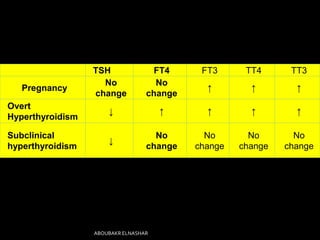
TSH FT4 FT3 TT4 TT3
Pregnancy
No
change
No
change
↑ ↑ ↑
Overt
Hyperthyroidism
↓ ↑ ↑ ↑ ↑
Subclinical
hyperthyroidism
↓
No
change
No
change
No
change
No
change
ABOUBAKR ELNASHAR
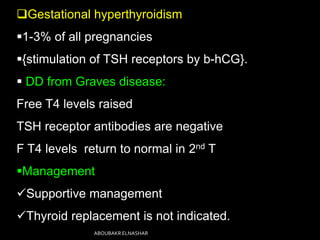
Gestational hyperthyroidism
1-3% of all pregnancies
{stimulation of TSH receptors by b-hCG}.
 DD from Graves disease:
Free T4 levels raised
TSH receptor antibodies are negative
F T4 levels return to normal in 2nd T
Management
Supportive management
Thyroid replacement is not indicated.
ABOUBAKR ELNASHAR
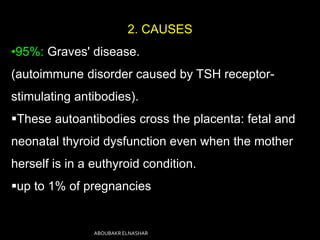
2. CAUSES
•95%: Graves' disease.
(autoimmune disorder caused by TSH receptor-
stimulating antibodies).
These autoantibodies cross the placenta: fetal and
neonatal thyroid dysfunction even when the mother
herself is in a euthyroid condition.
up to 1% of pregnancies
ABOUBAKR ELNASHAR
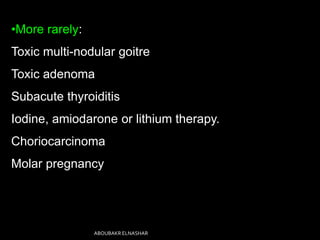
•More rarely:
Toxic multi-nodular goitre
Toxic adenoma
Subacute thyroiditis
Iodine, amiodarone or lithium therapy.
Choriocarcinoma
Molar pregnancy
ABOUBAKR ELNASHAR
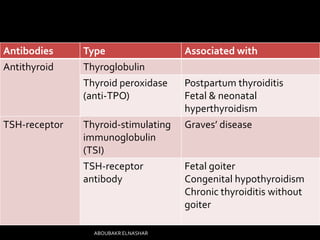
Antibodies Type Associated with
Antithyroid Thyroglobulin
Thyroid peroxidase
(anti-TPO)
Postpartum thyroiditis
Fetal & neonatal
hyperthyroidism
TSH-receptor Thyroid-stimulating
immunoglobulin
(TSI)
Graves’ disease
TSH-receptor
antibody
Fetal goiter
Congenital hypothyroidism
Chronic thyroiditis without
goiter
ABOUBAKR ELNASHAR
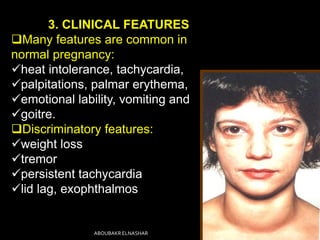
3. CLINICAL FEATURES
Many features are common in
normal pregnancy:
heat intolerance, tachycardia,
palpitations, palmar erythema,
emotional lability, vomiting and
goitre.
Discriminatory features:
weight loss
tremor
persistent tachycardia
lid lag, exophthalmos
ABOUBAKR ELNASHAR
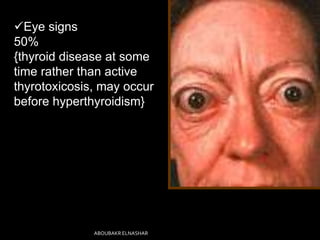
Eye signs
50%
{thyroid disease at some
time rather than active
thyrotoxicosis, may occur
before hyperthyroidism}
ABOUBAKR ELNASHAR
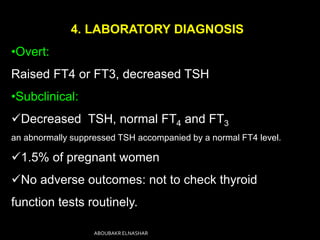
4. LABORATORY DIAGNOSIS
•Overt:
Raised FT4 or FT3, decreased TSH
•Subclinical:
Decreased TSH, normal FT4 and FT3
an abnormally suppressed TSH accompanied by a normal FT4 level.
1.5% of pregnant women
No adverse outcomes: not to check thyroid
function tests routinely.
ABOUBAKR ELNASHAR
American Thyroid Association (2014):
1. Subclinical hyperthyroidism
TSH: 0.1-0.2 mIU/L with normal FT4.
2. Overt hyperthyroidism
TSH: < 0.2 mIU/L accompanied by high FT4 OR
TSH < 0.1 mIU/L irrespective of FT4 level.
ABOUBAKR ELNASHAR
Screening for Maternal thyroid antibodies:
1. Graves’ disease
with fetal or neonatal hyperthyroidism in a previous
pregnancy
Active Graves’ disease being treated with antithyroid
drugs
2. Euthyroid or have undergone ablative therapy and
have fetal tachycardia or IUGR
3. Chronic thyroiditis without goiter
4. Fetal goiter on ultrasound.
Screening for Neonatal thyroid antibodies:
congenital hypothyroidism
ABOUBAKR ELNASHAR
5. EFFECT OF PREGNANCY ON
THYROTOXICOSIS
1. Exacerbations may occur in:
1st trimester {hCG production}
Puerperium {reversal of the fall in antibody levels seen
during pregnancy}.
2. Improvement: lower requirement for antithyroid tt
during 2nd and 3rd trimesters.
{As with other autoimmune conditions, there is a state of
relative immunosuppression in pregnancy and levels of TSH
receptor-stimulating antibodies may fall}
3. Pregnancy has no effect on Graves'
ophthalmapathy.
ABOUBAKR ELNASHAR
6. EFFECT OF THYROTOXICOSIS ON
PREGNANCY
Severe untreated: inhibition of ovulatian and
infertility.
Well controlled or
previously treated Graves' disease in remission:
No effect on maternal and fetal outcome
ABOUBAKR ELNASHAR
 Untreated:
1. increased rate of
Miscarriage
IUGR, PTL
perinatal mortality,
congestive heart failure,
PET.
2. Thyroid crisis ('storm') and heart failure, particularly at
the time of delivery.
3. Retrosternal extension of a goitre:
tracheal obstruction.
This is a particular problem if the patient needs to be
intubated.
rare
ABOUBAKR ELNASHAR
4. Fetal or neonatal thyrotoxicosis
{Thyroid stimulating antibodies }
Neonates of women with definitively treated Graves’
disease (status post thyroidectomy or tt with I131 before
pregnancy) have a higher risk of neonatal Graves disease
compared with women with Graves disease currently on
thioamide tt during pregnancy.
{1. definitively treated women still have thyroid stimulating
antibodies that cross the placenta and could affect the fetus
but they have no concurrent thioamide treatment, a drug that
also crosses the placenta
2. we tend to forget these women had Graves disease
because they are on thyroid replacement and, in our minds,
they are labeled as having hypothyroidism}
ABOUBAKR ELNASHAR
THYROID STORM
Rare:
1% to 2% of patients receiving thioamide therapy.
In most instances:
a complication of uncontrolled hyperthyroidism,
Precipitated by:
infection
surgery
Thromboembolism
PET
labor, and delivery.
ABOUBAKR ELNASHAR
Potentially lethal
C.P:
Fever
nausea, vomiting, diarrhea
Tachycardia, cardiac arrhythmias.
altered mental status, restlessness,
nervousness, seizures, coma,
ABOUBAKR ELNASHAR
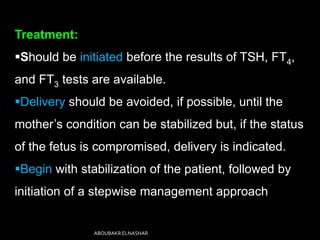
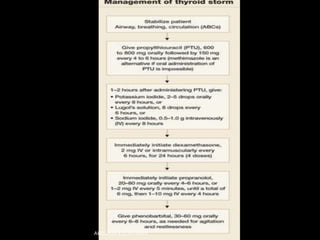
Treatment:
Should be initiated before the results of TSH, FT4,
and FT3 tests are available.
Delivery should be avoided, if possible, until the
mother’s condition can be stabilized but, if the status
of the fetus is compromised, delivery is indicated.
Begin with stabilization of the patient, followed by
initiation of a stepwise management approach
ABOUBAKR ELNASHAR
ABOUBAKR ELNASHAR
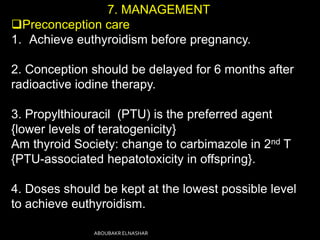
7. MANAGEMENT
Preconception care
1. Achieve euthyroidism before pregnancy.
2. Conception should be delayed for 6 months after
radioactive iodine therapy.
3. Propylthiouracil (PTU) is the preferred agent
{lower levels of teratogenicity}
Am thyroid Society: change to carbimazole in 2nd T
{PTU-associated hepatotoxicity in offspring}.
4. Doses should be kept at the lowest possible level
to achieve euthyroidism.
ABOUBAKR ELNASHAR
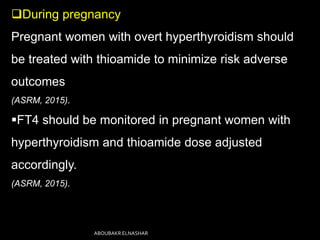
During pregnancy
Pregnant women with overt hyperthyroidism should
be treated with thioamide to minimize risk adverse
outcomes
(ASRM, 2015).
FT4 should be monitored in pregnant women with
hyperthyroidism and thioamide dose adjusted
accordingly.
(ASRM, 2015).
ABOUBAKR ELNASHAR
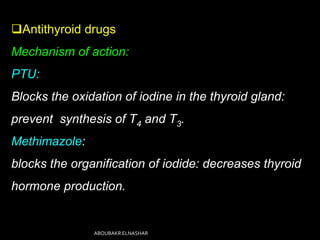
Antithyroid drugs
Mechanism of action:
PTU:
Blocks the oxidation of iodine in the thyroid gland:
prevent synthesis of T4 and T3.
Methimazole:
blocks the organification of iodide: decreases thyroid
hormone production.
ABOUBAKR ELNASHAR
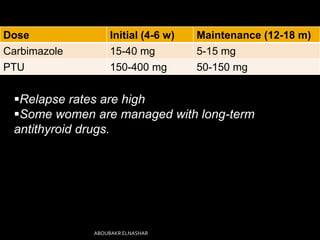
Relapse rates are high
Some women are managed with long-term
antithyroid drugs.
Maintenance (12-18 m)Initial (4-6 w)Dose
5-15 mg15-40 mgCarbimazole
50-150 mg150-400 mgPTU
ABOUBAKR ELNASHAR
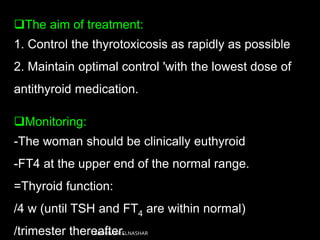
The aim of treatment:
1. Control the thyrotoxicosis as rapidly as possible
2. Maintain optimal control 'with the lowest dose of
antithyroid medication.
Monitoring:
-The woman should be clinically euthyroid
-FT4 at the upper end of the normal range.
=Thyroid function:
/4 w (until TSH and FT4 are within normal)
/trimester thereafter.ABOUBAKR ELNASHAR
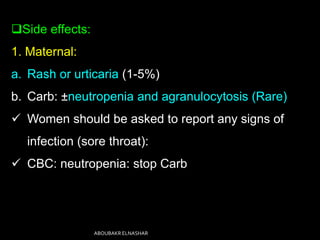
Side effects:
1. Maternal:
a. Rash or urticaria (1-5%)
b. Carb: ±neutropenia and agranulocytosis (Rare)
 Women should be asked to report any signs of
infection (sore throat):
 CBC: neutropenia: stop Carb
ABOUBAKR ELNASHAR
2. Foetal:
a. High doses: fetal hypothyroidism and goitre
{Both drugs cross the placenta, PTU< Carb}
 No place for 'block-and-replace' regimens.
Thyroxine 'replacement' does not cross the
placenta in doses to protect the fetus.
b. Neither is grossly teratogenic, although Carbim
occasionally: scalp defect (aplasia cutis).
•Doses of
PTU 150 mg/d
Carb 15 mg/d: unlikely to cause F problems
ABOUBAKR ELNASHAR
3. During lactation:
•Very little PTU (0.07%) and carb (0.5%) is excreted
in breast milk: safe PTU 150 mg/d and Carb 15 mg/d
•High doses of antithyroid drugs: Thyroid function
should be checked in umbilical cord blood and at
regular intervals in the neonate
•PTU is preferable for newly diagnosed cases in
pregnancy
{less transfer across the placenta and to breast milk}
but women already on maintenance Carb prior to
pregnancy need not be switched to PTU in
pregnancy.
ABOUBAKR ELNASHAR
βBlockers
•Indications:
1. Early management of thyrotoxicosis
2. Relapse {prove sympathetic symptoms of
tachycardia, sweating and tremor}.
•Stop once there is Cl improvement, usually evident
within 3 ws.
•Doses:
40 mg tds for such short periods of time: not harmful
to the fetus.
ABOUBAKR ELNASHAR
Surgery (Thyroidectomy)
Indications: Rare
1. Dysphagia or stridor related to a large goitre.
2. Confirmed or suspected carcinoma.
3. Allergies to both antithyroid drugs.
Best performed in: 2nd trimester.
Complications:
1. Hypothyroidism (25-50%)
close follow-up to ensure rapid diagnosis and tt with
replacement therapy.
2. Hypocalcaemia
{removal of the parathyroid glands}
ABOUBAKR ELNASHAR
Radioactive iodine
Contraindicated:
1. Pregnancy
•Pregnancy should be avoided for at least 4 months
after tt
{risk of chromosomal damage and genetic
abnormalities}.
2. Breast-feeding
{it is taken up by the fetal thyroid (after 10-12w):
thyroid ablation and hypothyroidism}.
ABOUBAKR ELNASHAR
 Diagnostic radioiodine scans (as opposed to tt)
contraindicated in pregnancy
±performed in breast-feeding:
stop breast-feeding for 24 h after the procedure.
ABOUBAKR ELNASHAR
Benha University Hospital, Egypt
E-mail:elnashar53@hotmail.comABOUBAKR ELNASHAR

Hyperthyroidism During pregnancy

  • 1.
    Hyperthyroidism During pregnancy Prof. AboubakrElnashar Benha University Hospital ABOUBAKR ELNASHAR
  • 2.
    1. INCIDENCE ANDTYPES 2. CAUSES 3. CLINICAL FEATURES 4. LABORATORY DIAGNOSIS 5. EFFECT OF PREGNANCY ON THYROTOXICOSIS 6. EFFECT OF THYROTOXICOSIS ON PREGNANCY 7. MANAGEMENT ABOUBAKR ELNASHAR
  • 3.
    1. INCIDENCE ANDTYPES •Women>men (10:1). •1 in 500 pregnancies. •50%: family history of autoimmune thyroid disease. •Most cases encountered in pregnancy have already been diagnosed and will already be on tt. •If thyrotoxicosis occurs for the 1st time in pregnancy, it usually presents late in 1st or early in 2nd trimester. ABOUBAKR ELNASHAR
  • 4.
    TSH FT4 FT3TT4 TT3 Pregnancy No change No change ↑ ↑ ↑ Overt Hyperthyroidism ↓ ↑ ↑ ↑ ↑ Subclinical hyperthyroidism ↓ No change No change No change No change ABOUBAKR ELNASHAR
  • 5.
    Gestational hyperthyroidism 1-3% ofall pregnancies {stimulation of TSH receptors by b-hCG}.  DD from Graves disease: Free T4 levels raised TSH receptor antibodies are negative F T4 levels return to normal in 2nd T Management Supportive management Thyroid replacement is not indicated. ABOUBAKR ELNASHAR
  • 6.
    2. CAUSES •95%: Graves'disease. (autoimmune disorder caused by TSH receptor- stimulating antibodies). These autoantibodies cross the placenta: fetal and neonatal thyroid dysfunction even when the mother herself is in a euthyroid condition. up to 1% of pregnancies ABOUBAKR ELNASHAR
  • 7.
    •More rarely: Toxic multi-nodulargoitre Toxic adenoma Subacute thyroiditis Iodine, amiodarone or lithium therapy. Choriocarcinoma Molar pregnancy ABOUBAKR ELNASHAR
  • 8.
    Antibodies Type Associatedwith Antithyroid Thyroglobulin Thyroid peroxidase (anti-TPO) Postpartum thyroiditis Fetal & neonatal hyperthyroidism TSH-receptor Thyroid-stimulating immunoglobulin (TSI) Graves’ disease TSH-receptor antibody Fetal goiter Congenital hypothyroidism Chronic thyroiditis without goiter ABOUBAKR ELNASHAR
  • 9.
    3. CLINICAL FEATURES Manyfeatures are common in normal pregnancy: heat intolerance, tachycardia, palpitations, palmar erythema, emotional lability, vomiting and goitre. Discriminatory features: weight loss tremor persistent tachycardia lid lag, exophthalmos ABOUBAKR ELNASHAR
  • 10.
    Eye signs 50% {thyroid diseaseat some time rather than active thyrotoxicosis, may occur before hyperthyroidism} ABOUBAKR ELNASHAR
  • 11.
    4. LABORATORY DIAGNOSIS •Overt: RaisedFT4 or FT3, decreased TSH •Subclinical: Decreased TSH, normal FT4 and FT3 an abnormally suppressed TSH accompanied by a normal FT4 level. 1.5% of pregnant women No adverse outcomes: not to check thyroid function tests routinely. ABOUBAKR ELNASHAR
  • 12.
    American Thyroid Association(2014): 1. Subclinical hyperthyroidism TSH: 0.1-0.2 mIU/L with normal FT4. 2. Overt hyperthyroidism TSH: < 0.2 mIU/L accompanied by high FT4 OR TSH < 0.1 mIU/L irrespective of FT4 level. ABOUBAKR ELNASHAR
  • 13.
    Screening for Maternalthyroid antibodies: 1. Graves’ disease with fetal or neonatal hyperthyroidism in a previous pregnancy Active Graves’ disease being treated with antithyroid drugs 2. Euthyroid or have undergone ablative therapy and have fetal tachycardia or IUGR 3. Chronic thyroiditis without goiter 4. Fetal goiter on ultrasound. Screening for Neonatal thyroid antibodies: congenital hypothyroidism ABOUBAKR ELNASHAR
  • 14.
    5. EFFECT OFPREGNANCY ON THYROTOXICOSIS 1. Exacerbations may occur in: 1st trimester {hCG production} Puerperium {reversal of the fall in antibody levels seen during pregnancy}. 2. Improvement: lower requirement for antithyroid tt during 2nd and 3rd trimesters. {As with other autoimmune conditions, there is a state of relative immunosuppression in pregnancy and levels of TSH receptor-stimulating antibodies may fall} 3. Pregnancy has no effect on Graves' ophthalmapathy. ABOUBAKR ELNASHAR
  • 15.
    6. EFFECT OFTHYROTOXICOSIS ON PREGNANCY Severe untreated: inhibition of ovulatian and infertility. Well controlled or previously treated Graves' disease in remission: No effect on maternal and fetal outcome ABOUBAKR ELNASHAR
  • 16.
     Untreated: 1. increasedrate of Miscarriage IUGR, PTL perinatal mortality, congestive heart failure, PET. 2. Thyroid crisis ('storm') and heart failure, particularly at the time of delivery. 3. Retrosternal extension of a goitre: tracheal obstruction. This is a particular problem if the patient needs to be intubated. rare ABOUBAKR ELNASHAR
  • 17.
    4. Fetal orneonatal thyrotoxicosis {Thyroid stimulating antibodies } Neonates of women with definitively treated Graves’ disease (status post thyroidectomy or tt with I131 before pregnancy) have a higher risk of neonatal Graves disease compared with women with Graves disease currently on thioamide tt during pregnancy. {1. definitively treated women still have thyroid stimulating antibodies that cross the placenta and could affect the fetus but they have no concurrent thioamide treatment, a drug that also crosses the placenta 2. we tend to forget these women had Graves disease because they are on thyroid replacement and, in our minds, they are labeled as having hypothyroidism} ABOUBAKR ELNASHAR
  • 18.
    THYROID STORM Rare: 1% to2% of patients receiving thioamide therapy. In most instances: a complication of uncontrolled hyperthyroidism, Precipitated by: infection surgery Thromboembolism PET labor, and delivery. ABOUBAKR ELNASHAR
  • 19.
    Potentially lethal C.P: Fever nausea, vomiting,diarrhea Tachycardia, cardiac arrhythmias. altered mental status, restlessness, nervousness, seizures, coma, ABOUBAKR ELNASHAR
  • 20.
    Treatment: Should be initiatedbefore the results of TSH, FT4, and FT3 tests are available. Delivery should be avoided, if possible, until the mother’s condition can be stabilized but, if the status of the fetus is compromised, delivery is indicated. Begin with stabilization of the patient, followed by initiation of a stepwise management approach ABOUBAKR ELNASHAR
  • 21.
  • 22.
    7. MANAGEMENT Preconception care 1.Achieve euthyroidism before pregnancy. 2. Conception should be delayed for 6 months after radioactive iodine therapy. 3. Propylthiouracil (PTU) is the preferred agent {lower levels of teratogenicity} Am thyroid Society: change to carbimazole in 2nd T {PTU-associated hepatotoxicity in offspring}. 4. Doses should be kept at the lowest possible level to achieve euthyroidism. ABOUBAKR ELNASHAR
  • 23.
    During pregnancy Pregnant womenwith overt hyperthyroidism should be treated with thioamide to minimize risk adverse outcomes (ASRM, 2015). FT4 should be monitored in pregnant women with hyperthyroidism and thioamide dose adjusted accordingly. (ASRM, 2015). ABOUBAKR ELNASHAR
  • 24.
    Antithyroid drugs Mechanism ofaction: PTU: Blocks the oxidation of iodine in the thyroid gland: prevent synthesis of T4 and T3. Methimazole: blocks the organification of iodide: decreases thyroid hormone production. ABOUBAKR ELNASHAR
  • 25.
    Relapse rates arehigh Some women are managed with long-term antithyroid drugs. Maintenance (12-18 m)Initial (4-6 w)Dose 5-15 mg15-40 mgCarbimazole 50-150 mg150-400 mgPTU ABOUBAKR ELNASHAR
  • 26.
    The aim oftreatment: 1. Control the thyrotoxicosis as rapidly as possible 2. Maintain optimal control 'with the lowest dose of antithyroid medication. Monitoring: -The woman should be clinically euthyroid -FT4 at the upper end of the normal range. =Thyroid function: /4 w (until TSH and FT4 are within normal) /trimester thereafter.ABOUBAKR ELNASHAR
  • 27.
    Side effects: 1. Maternal: a.Rash or urticaria (1-5%) b. Carb: ±neutropenia and agranulocytosis (Rare)  Women should be asked to report any signs of infection (sore throat):  CBC: neutropenia: stop Carb ABOUBAKR ELNASHAR
  • 28.
    2. Foetal: a. Highdoses: fetal hypothyroidism and goitre {Both drugs cross the placenta, PTU< Carb}  No place for 'block-and-replace' regimens. Thyroxine 'replacement' does not cross the placenta in doses to protect the fetus. b. Neither is grossly teratogenic, although Carbim occasionally: scalp defect (aplasia cutis). •Doses of PTU 150 mg/d Carb 15 mg/d: unlikely to cause F problems ABOUBAKR ELNASHAR
  • 29.
    3. During lactation: •Verylittle PTU (0.07%) and carb (0.5%) is excreted in breast milk: safe PTU 150 mg/d and Carb 15 mg/d •High doses of antithyroid drugs: Thyroid function should be checked in umbilical cord blood and at regular intervals in the neonate •PTU is preferable for newly diagnosed cases in pregnancy {less transfer across the placenta and to breast milk} but women already on maintenance Carb prior to pregnancy need not be switched to PTU in pregnancy. ABOUBAKR ELNASHAR
  • 30.
    βBlockers •Indications: 1. Early managementof thyrotoxicosis 2. Relapse {prove sympathetic symptoms of tachycardia, sweating and tremor}. •Stop once there is Cl improvement, usually evident within 3 ws. •Doses: 40 mg tds for such short periods of time: not harmful to the fetus. ABOUBAKR ELNASHAR
  • 31.
    Surgery (Thyroidectomy) Indications: Rare 1.Dysphagia or stridor related to a large goitre. 2. Confirmed or suspected carcinoma. 3. Allergies to both antithyroid drugs. Best performed in: 2nd trimester. Complications: 1. Hypothyroidism (25-50%) close follow-up to ensure rapid diagnosis and tt with replacement therapy. 2. Hypocalcaemia {removal of the parathyroid glands} ABOUBAKR ELNASHAR
  • 32.
    Radioactive iodine Contraindicated: 1. Pregnancy •Pregnancyshould be avoided for at least 4 months after tt {risk of chromosomal damage and genetic abnormalities}. 2. Breast-feeding {it is taken up by the fetal thyroid (after 10-12w): thyroid ablation and hypothyroidism}. ABOUBAKR ELNASHAR
  • 33.
     Diagnostic radioiodinescans (as opposed to tt) contraindicated in pregnancy ±performed in breast-feeding: stop breast-feeding for 24 h after the procedure. ABOUBAKR ELNASHAR
  • 34.
    Benha University Hospital,Egypt E-mail:elnashar53@hotmail.comABOUBAKR ELNASHAR