Nerve injury
Hamad emad dhuhayr
Dr Saleh WaslAllah Alharby
www.ksu.edu.sa/DrSalehAlharby
OUTLINE
 DEFINITION.
 TYPES OF NERVE INJURIES.
 FATE (pathophysiology) AND
REHABILITATION.
 ETIOLOGY.
 PRESENTATION.
 DIAGNOSIS.
 CLINICAL EXAMPLES:
(ERB’S,CARPAL TUNNEL,RADIAL,ULNAR,SCIATIC AND
PERONEAL N.)
Dr Saleh WaslAllah Alharby
www.ksu.edu.sa/DrSalehAlharby
DEFINITION
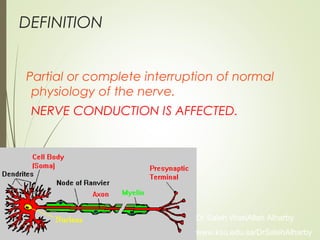
Partial or complete interruption of normal
physiology of the nerve.
NERVE CONDUCTION IS AFFECTED.
Dr Saleh WaslAllah Alharby
www.ksu.edu.sa/DrSalehAlharby
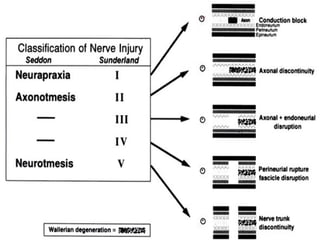
Classification Of Nerve
Injuries
 Seddon, Sunderland and lately by Mackinnon
 6 degrees
Degrees Of Nerve Injury
 1st
degree of injury(neuraparaxia)
 Segmental demylination
 Axons intact
 Recovery in 12 to 16 wks
 2nd
degree injury(axonotmesis)
 Axonal injury/ distal wallerian degeneration
 Regeneration at rate of 1 inch per month
 Complete slow recovery
Degrees Of Nerve Injury
 3rd
degree injury
 Axonal injury & fibrosis of endoneurium
 Incomplete recovery
 4th
degree injury
 Axonal injury
 Damage to endo and perineurium with
dense scarring
 Needs surgical intervention
Degrees Of Nerve Injury
 5th
degree injury(neurotmesis)
 Complete nerve division
 6th
degree injury
 Variable combination of previous
five degrees of nerve injury
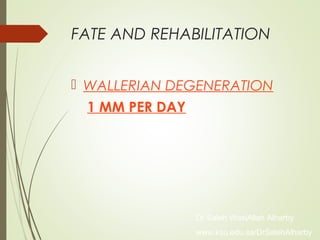
FATE AND REHABILITATION
 WALLERIAN DEGENERATION
1 MM PER DAY
Dr Saleh WaslAllah Alharby
www.ksu.edu.sa/DrSalehAlharby
REHABILITATION
 PAIN CONTROL.
 SPLINT. (AVOID PRESSURE SORES)
 NERVE AND MUSCLE STIMULATION.
 NEARBY JOINTS RANGE OF MOTION.
 MONTHS ----- YEARS .
Dr Saleh WaslAllah Alharby
www.ksu.edu.sa/DrSalehAlharby
Nerve Injury
 Focal contusion (gunshot wounds)
 Stretch/traction injury
 Drug injection injury
 Compression
 Crush injuries
 Avulsion
 Laceration
 Electrical burns
 Idiopathic
 Others(Viral infections, metabolic and neural disorders)
PERSENTATION
 PAIN
 LOSS OF SENSATION
 LOSS OF MOTION
 LOSS OF POWER
 LOSS OF REFLEXES
 WASTING
 TROPHIC CHANGES
(skin,sc,neurovascular,bones,muscles)
 CONTRACTURES
Dr Saleh WaslAllah Alharby
www.ksu.edu.sa/DrSalehAlharby
DiagnosisDiagnosis
 Motor functionMotor function
 Movements, muscle atrophyMovements, muscle atrophy
 sensory functionsensory function
 Tinel sign, Ten testTinel sign, Ten test
 Two point discriminationTwo point discrimination
 Touch, vibrationTouch, vibration
•HistoryHistory
•ExaminationExamination
Tinel Sign
 Tinel sign: -
 peripheral tingling or
dysaesthesia' provoked by
percussion of the nerve
 Positive in axonal injuries
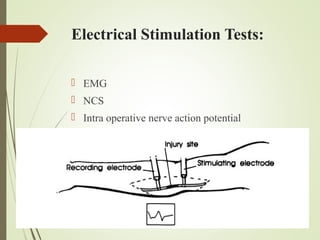
Electrical Stimulation Tests:
 EMG
 NCS
 Intra operative nerve action potential
CLINICAL EXAMPLES
 ERB’ PALSY
 CARPAL TUNNEL SYNDROME(MEDIAN NV)
 RADIAL NERVE INJURY
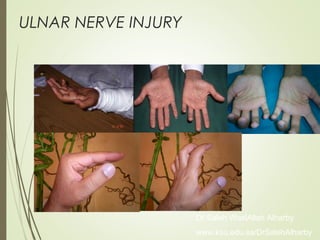
 ULNAR NERVE INJURY
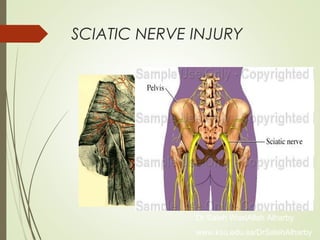
 SCIATIC NERVE INJURY
 LATERAL POPLITEAL NERVE INJURY
Dr Saleh WaslAllah Alharby
www.ksu.edu.sa/DrSalehAlharby
ERB’S PALSY
 BIRTH INJURY (DIFFICULT LABOUR)
 TRACTION ON NERVE ROOTS C5-6
 STRETCH-RUPTURE-AVULSION
 UPPER LIMB IN EXTENSION
 MOTHER NOTICE NO MOTION
 90% GOOD RECOVERY
 ROLE OF SURGERY AFTER 3 MONTHS
 REMEMBER PROPER REHABILITATION
Dr Saleh WaslAllah Alharby
www.ksu.edu.sa/DrSalehAlharby
CARPAL TUNNEL SYNDROME
 MEDIAN NERVE ENTRAPMENT BY FLEXOR RETINACULUM
PAIN,NUMBNESS,NIGHT
 MANUAL WORKERS
 DIAGNOSIS
 SURGERY
Dr Saleh WaslAllah Alharby
www.ksu.edu.sa/DrSalehAlharby
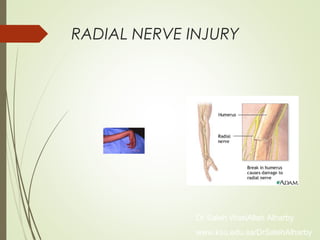
RADIAL NERVE INJURY
Dr Saleh WaslAllah Alharby
www.ksu.edu.sa/DrSalehAlharby
ULNAR NERVE INJURY
Dr Saleh WaslAllah Alharby
www.ksu.edu.sa/DrSalehAlharby
SCIATIC NERVE INJURY
Dr Saleh WaslAllah Alharby
www.ksu.edu.sa/DrSalehAlharby
PERONEAL NERVE INJURY
(LPN)
 FOOT DROP
 TIGHT POP
 SKELETAL TRACTION
 DIRECT INJURY (RARE)
 DYNAMIC SPLINT
Dr Saleh WaslAllah Alharby
www.ksu.edu.sa/DrSalehAlharby
Principals Of Nerve Repair
 Microsurgical techniques
 Adequate magnification
 Microsurgical instruments & sutures
 Different techniques:
 Primary nerve repair
 Nerve grafting
 Nerve transfer
 Nerve conduits
 Nerve allografts
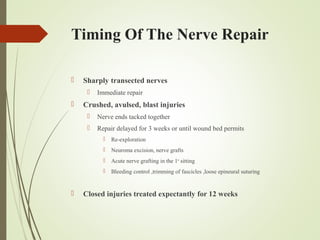
Timing Of The Nerve Repair
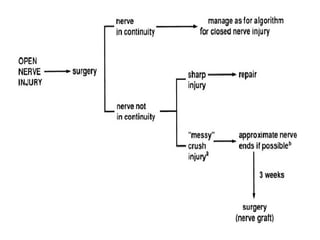
 Sharply transected nerves
 Immediate repair
 Crushed, avulsed, blast injuries
 Nerve ends tacked together
 Repair delayed for 3 weeks or until wound bed permits
 Re-exploration
 Neuroma excision, nerve grafts
 Acute nerve grafting in the 1st
sitting
 Bleeding control ,trimming of fascicles ,loose epineural suturing
 Closed injuries treated expectantly for 12 weeks
Primary Nerve Repair
 Primary nerve repair
 Epineural repair
 Grouped fascicular repair
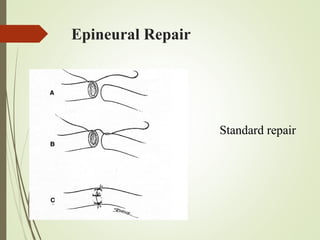
Epineural Repair
Standard repair
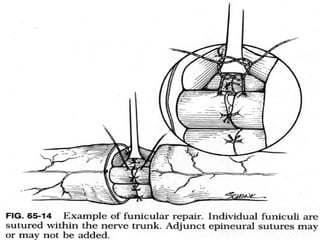
Fascicular Repair
 Restore the continuity of fascicles
 Internal topography
 Intra-operative nerve stimulation
 Neurolysis with the eyes
 Priority to the motor recovery(radial
and peroneal nerve)
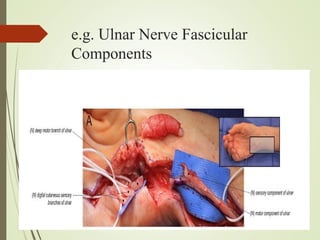
e.g. Ulnar Nerve Fascicular
Components
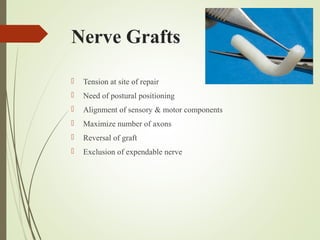
Nerve Grafts
 Tension at site of repair
 Need of postural positioning
 Alignment of sensory & motor components
 Maximize number of axons
 Reversal of graft
 Exclusion of expendable nerve
Options For Nerve Grafts
 Sural nerve
 30-40cm
 Lateral peroneal communicating br : 10-20cm
 Lateral antebrachial cutaneous nerve(LABC)
 8cm
 Medial antebrachial cutaneous nerve (MABC)
 Anterior & posterior division
 20 cm
 Expendable nerves(peroneal and radial)
 Sensory branches of ulnar and median nerves
 Distal anterior interosseous nerve and so on…
Disadvantages
 Donor site scarring
 Donor site sensory loss
 Patient education
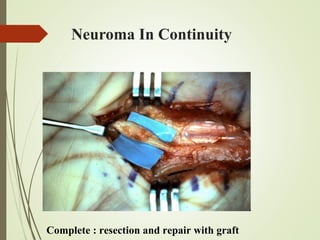
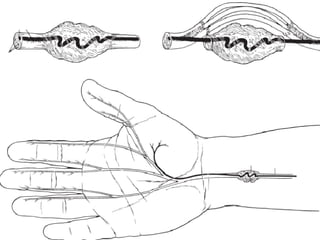
Neuroma In Continuity
Complete : resection and repair with graft
Neuroma In Continuity
 Incomplete neuroma
 Intra-operative nerve stimulation
 Black boxing around neuroma
Nerve Transfer
 Indications:
 Very proximal peripheral nerve injuries
 Root avulsions
 Excessive scarring
 Level of injury unclear
 Idiopathic neuritides
 Radiation induced nerve injury
Nerve Transfer
 Motor nerve transfer
 Pure motor axons
 Close proximity
 expendable
 Synergistic supply
 Sensory nerve transfer
 pure sensory axons
 Innervates non critical area
 Expendable and lying in close proximity
Most Common Uses Of Nerve
Transfer
 elbow flexion
 Shoulder abduction
 Ulnar-innervated intrinsic hand function
 Forearm pronation
 Radial nerve function
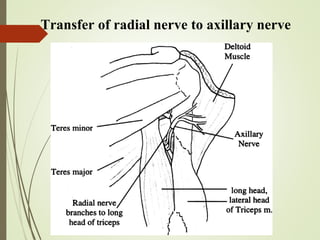
Transfer of radial nerve to axillary nerve
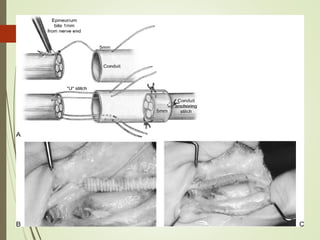
Nerve Conduits
 Veins, pseudo-sheaths,
bioabsorbable tubes
 short nerve gaps ≤ 3cm
 Low antigenicity , biodegradability
 Trials to add a nerve graft inside the
conduit
 neurotrophic factors
Nerve Allografts
 Extensive injuries
 Limited donor material
 Immunosuppressive agents
 FK506( tacrolimus )
 Prednisone , azathioprine
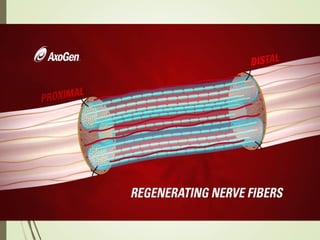
 Processed acellular cadaveric nerve allografts
 AxoGen, Inc. ,Alachua, FL.
Summary
 Axon degeneration occurs from mild
compression injury
 The prognosis for Neuropraxia is poor
 Axonotmesis is generally caused from
separation of the cell body from the neuron
 Wallerian Degeneration typically does not occur
in Neuropraxic injury
 Surgical reconstruction is necessary in
Neurotmesis
 Wallerian Degeneration does not occur in
Neurotmesis
 A ligamentous structure can cause Neuropraxia
Dr Saleh WaslAllah Alharby
www.ksu.edu.sa/DrSalehAlharby
Refferences
 Special surgery matary
Dr Saleh WaslAllah Alharby
www.ksu.edu.sa/DrSalehAlharby

nerve injury

  • 1.
    Nerve injury Hamad emaddhuhayr Dr Saleh WaslAllah Alharby www.ksu.edu.sa/DrSalehAlharby
  • 2.
    OUTLINE  DEFINITION.  TYPESOF NERVE INJURIES.  FATE (pathophysiology) AND REHABILITATION.  ETIOLOGY.  PRESENTATION.  DIAGNOSIS.  CLINICAL EXAMPLES: (ERB’S,CARPAL TUNNEL,RADIAL,ULNAR,SCIATIC AND PERONEAL N.) Dr Saleh WaslAllah Alharby www.ksu.edu.sa/DrSalehAlharby
  • 3.
    DEFINITION Partial or completeinterruption of normal physiology of the nerve. NERVE CONDUCTION IS AFFECTED. Dr Saleh WaslAllah Alharby www.ksu.edu.sa/DrSalehAlharby
  • 4.
    Classification Of Nerve Injuries Seddon, Sunderland and lately by Mackinnon  6 degrees
  • 5.
    Degrees Of NerveInjury  1st degree of injury(neuraparaxia)  Segmental demylination  Axons intact  Recovery in 12 to 16 wks  2nd degree injury(axonotmesis)  Axonal injury/ distal wallerian degeneration  Regeneration at rate of 1 inch per month  Complete slow recovery
  • 6.
    Degrees Of NerveInjury  3rd degree injury  Axonal injury & fibrosis of endoneurium  Incomplete recovery  4th degree injury  Axonal injury  Damage to endo and perineurium with dense scarring  Needs surgical intervention
  • 7.
    Degrees Of NerveInjury  5th degree injury(neurotmesis)  Complete nerve division  6th degree injury  Variable combination of previous five degrees of nerve injury
  • 9.
    FATE AND REHABILITATION WALLERIAN DEGENERATION 1 MM PER DAY Dr Saleh WaslAllah Alharby www.ksu.edu.sa/DrSalehAlharby
  • 10.
    REHABILITATION  PAIN CONTROL. SPLINT. (AVOID PRESSURE SORES)  NERVE AND MUSCLE STIMULATION.  NEARBY JOINTS RANGE OF MOTION.  MONTHS ----- YEARS . Dr Saleh WaslAllah Alharby www.ksu.edu.sa/DrSalehAlharby
  • 11.
    Nerve Injury  Focalcontusion (gunshot wounds)  Stretch/traction injury  Drug injection injury  Compression  Crush injuries  Avulsion  Laceration  Electrical burns  Idiopathic  Others(Viral infections, metabolic and neural disorders)
  • 12.
    PERSENTATION  PAIN  LOSSOF SENSATION  LOSS OF MOTION  LOSS OF POWER  LOSS OF REFLEXES  WASTING  TROPHIC CHANGES (skin,sc,neurovascular,bones,muscles)  CONTRACTURES Dr Saleh WaslAllah Alharby www.ksu.edu.sa/DrSalehAlharby
  • 13.
    DiagnosisDiagnosis  Motor functionMotorfunction  Movements, muscle atrophyMovements, muscle atrophy  sensory functionsensory function  Tinel sign, Ten testTinel sign, Ten test  Two point discriminationTwo point discrimination  Touch, vibrationTouch, vibration •HistoryHistory •ExaminationExamination
  • 14.
    Tinel Sign  Tinelsign: -  peripheral tingling or dysaesthesia' provoked by percussion of the nerve  Positive in axonal injuries
  • 15.
    Electrical Stimulation Tests: EMG  NCS  Intra operative nerve action potential
  • 16.
    CLINICAL EXAMPLES  ERB’PALSY  CARPAL TUNNEL SYNDROME(MEDIAN NV)  RADIAL NERVE INJURY  ULNAR NERVE INJURY  SCIATIC NERVE INJURY  LATERAL POPLITEAL NERVE INJURY Dr Saleh WaslAllah Alharby www.ksu.edu.sa/DrSalehAlharby
  • 17.
    ERB’S PALSY  BIRTHINJURY (DIFFICULT LABOUR)  TRACTION ON NERVE ROOTS C5-6  STRETCH-RUPTURE-AVULSION  UPPER LIMB IN EXTENSION  MOTHER NOTICE NO MOTION  90% GOOD RECOVERY  ROLE OF SURGERY AFTER 3 MONTHS  REMEMBER PROPER REHABILITATION Dr Saleh WaslAllah Alharby www.ksu.edu.sa/DrSalehAlharby
  • 18.
    CARPAL TUNNEL SYNDROME MEDIAN NERVE ENTRAPMENT BY FLEXOR RETINACULUM PAIN,NUMBNESS,NIGHT  MANUAL WORKERS  DIAGNOSIS  SURGERY Dr Saleh WaslAllah Alharby www.ksu.edu.sa/DrSalehAlharby
  • 19.
    RADIAL NERVE INJURY DrSaleh WaslAllah Alharby www.ksu.edu.sa/DrSalehAlharby
  • 20.
    ULNAR NERVE INJURY DrSaleh WaslAllah Alharby www.ksu.edu.sa/DrSalehAlharby
  • 21.
    SCIATIC NERVE INJURY DrSaleh WaslAllah Alharby www.ksu.edu.sa/DrSalehAlharby
  • 22.
    PERONEAL NERVE INJURY (LPN) FOOT DROP  TIGHT POP  SKELETAL TRACTION  DIRECT INJURY (RARE)  DYNAMIC SPLINT Dr Saleh WaslAllah Alharby www.ksu.edu.sa/DrSalehAlharby
  • 23.
    Principals Of NerveRepair  Microsurgical techniques  Adequate magnification  Microsurgical instruments & sutures  Different techniques:  Primary nerve repair  Nerve grafting  Nerve transfer  Nerve conduits  Nerve allografts
  • 24.
    Timing Of TheNerve Repair  Sharply transected nerves  Immediate repair  Crushed, avulsed, blast injuries  Nerve ends tacked together  Repair delayed for 3 weeks or until wound bed permits  Re-exploration  Neuroma excision, nerve grafts  Acute nerve grafting in the 1st sitting  Bleeding control ,trimming of fascicles ,loose epineural suturing  Closed injuries treated expectantly for 12 weeks
  • 26.
    Primary Nerve Repair Primary nerve repair  Epineural repair  Grouped fascicular repair
  • 27.
  • 28.
    Fascicular Repair  Restorethe continuity of fascicles  Internal topography  Intra-operative nerve stimulation  Neurolysis with the eyes  Priority to the motor recovery(radial and peroneal nerve)
  • 30.
    e.g. Ulnar NerveFascicular Components
  • 31.
    Nerve Grafts  Tensionat site of repair  Need of postural positioning  Alignment of sensory & motor components  Maximize number of axons  Reversal of graft  Exclusion of expendable nerve
  • 32.
    Options For NerveGrafts  Sural nerve  30-40cm  Lateral peroneal communicating br : 10-20cm  Lateral antebrachial cutaneous nerve(LABC)  8cm  Medial antebrachial cutaneous nerve (MABC)  Anterior & posterior division  20 cm  Expendable nerves(peroneal and radial)  Sensory branches of ulnar and median nerves  Distal anterior interosseous nerve and so on…
  • 33.
    Disadvantages  Donor sitescarring  Donor site sensory loss  Patient education
  • 34.
    Neuroma In Continuity Complete: resection and repair with graft
  • 36.
    Neuroma In Continuity Incomplete neuroma  Intra-operative nerve stimulation  Black boxing around neuroma
  • 38.
    Nerve Transfer  Indications: Very proximal peripheral nerve injuries  Root avulsions  Excessive scarring  Level of injury unclear  Idiopathic neuritides  Radiation induced nerve injury
  • 39.
    Nerve Transfer  Motornerve transfer  Pure motor axons  Close proximity  expendable  Synergistic supply  Sensory nerve transfer  pure sensory axons  Innervates non critical area  Expendable and lying in close proximity
  • 40.
    Most Common UsesOf Nerve Transfer  elbow flexion  Shoulder abduction  Ulnar-innervated intrinsic hand function  Forearm pronation  Radial nerve function
  • 41.
    Transfer of radialnerve to axillary nerve
  • 42.
    Nerve Conduits  Veins,pseudo-sheaths, bioabsorbable tubes  short nerve gaps ≤ 3cm  Low antigenicity , biodegradability  Trials to add a nerve graft inside the conduit  neurotrophic factors
  • 44.
    Nerve Allografts  Extensiveinjuries  Limited donor material  Immunosuppressive agents  FK506( tacrolimus )  Prednisone , azathioprine  Processed acellular cadaveric nerve allografts  AxoGen, Inc. ,Alachua, FL.
  • 46.
    Summary  Axon degenerationoccurs from mild compression injury  The prognosis for Neuropraxia is poor  Axonotmesis is generally caused from separation of the cell body from the neuron  Wallerian Degeneration typically does not occur in Neuropraxic injury  Surgical reconstruction is necessary in Neurotmesis  Wallerian Degeneration does not occur in Neurotmesis  A ligamentous structure can cause Neuropraxia Dr Saleh WaslAllah Alharby www.ksu.edu.sa/DrSalehAlharby
  • 47.
    Refferences  Special surgerymatary Dr Saleh WaslAllah Alharby www.ksu.edu.sa/DrSalehAlharby

Editor's Notes

  • #15 Ten test for quality of sensation Static and moving two point descrimination that measures no of fibres innervating it yet
  • #25 Nerves have an intrinsic elastic property which makes the nerve to have horizontal or spiral bands along its length known as bands of fontana by which they can be moved to certain extent..these bands disappear when the nerve is compressed
  • #30 In order to restore the sensory and motor modalities of a nerve..stitch the sensory & motor fascicles of proximal segment to those of distal segment if the internal topography of a nerve is clear..every nerve has a specific internal organization and u must know all of them before going into that micro repair..usually nerves r more monofascicular proximally and are polyfascicular distally and there is plexus formation in between these fascicles that diminish distally
  • #33 Alignment is a challenge Then no of max axons…u can even reverse a long graft to have maximum axons at the distal site Exclusion of non essential nerve components..n their distal sensory ends joined to nearby sensory nerves by end to side anastomosis
  • #34 LABN accompanying cephalic vein MABN accompanying basilic vein
  • #38 Due to partial injury or a previous repair Proper assessment of functioning fascicles by nerve stimulation tests If neuroma is circumferential and normally functioning components are difficult to be separated then
  • #41 Criteria for motor n sensory donor nerves
  • #44 Limited use
  • #46 Challenging as they can evoke immune system leading to graft rejection