TOCOLYSIS & FDA RISK
   CATEGORIES
     DR RAJEEV SOOD
      ASTT.PROF.OBG
       IGMC SHIMLA
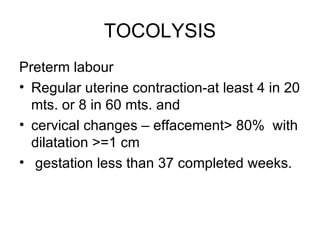
TOCOLYSIS
Preterm labour
• Regular uterine contraction-at least 4 in 20
  mts. or 8 in 60 mts. and
• cervical changes – effacement> 80% with
  dilatation >=1 cm
• gestation less than 37 completed weeks.
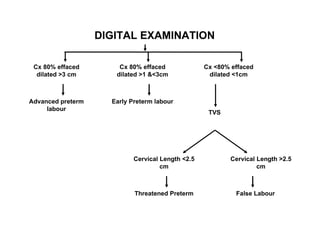
DIGITAL EXAMINATION

 Cx 80% effaced        Cx 80% effaced              Cx <80% effaced
  dilated >3 cm       dilated >1 &<3cm              dilated <1cm


Advanced preterm     Early Preterm labour
     labour
                                                    TVS


                            Cervical Length <2.5           Cervical Length >2.5
                                     cm                             cm


                            Threatened Preterm              False Labour
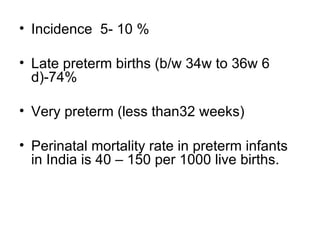
• Incidence 5- 10 %

• Late preterm births (b/w 34w to 36w 6
  d)-74%

• Very preterm (less than32 weeks)

• Perinatal mortality rate in preterm infants
  in India is 40 – 150 per 1000 live births.
• Preterm birth is associated with a number of
  complication in baby
   – Asphyxia
   – Hypothermia
   – Pulmonary syndrome.
   – Cerebral haemorage.
   – Fetal shock.
   – Heart failure.
   – Oliguria, anuria
   – Infection
   – Jaundice
   – Anemia
   – Retinopathy of prematurity.
TOCOLYTIC AGENTS

• Drugs which are used to inhibit uterine
  contractions.

• Can be used as
  – Short term therapy (1-3days)
  – Long term therapy
Objectives of short term therapy

• To delay delivery for atleast 24-48 hrs for glucocorticoid
  therapy to enhance lung maturation
• In utero transfer of patient to an advanced neonatal
  intensive care unit.

Contraindications

Maternal
• Uncontrolled diabetes
• Thyrotoxicosis
• Severe HTN
• Cardiac ds
• Placenta Previa
• Abruption
fetal
• fetal distress
• IUD
• Congenital malformations
• Pregnancy beyond 34 weeks
Others
• Rupture of membrane
• Chorioamnionitis
• Cervical dilatation >4 cm
TOCOLYTIC AGENTS
•   Mgso4
•   Beta agonist
•   Calcium channel blockers
•   Prostaglandin synthethase inhibtors
•   Nitroglycerine
•   Diazoxide
•   Oxytocin receptor antagonist
•   Ethyl alcohol.
MAGNESIUM SULPHATE
• Acts by competitive inhibition to calcium
  ion either at motor end plate or at cell
  membrane.
• Decreases acetylcholine release and its
  sensitivity at motor end plate.
• Direct depressant action on uterine ms.
In addition, MgSO4 has been proposed to
act as neuroprotectant
Following Mechanisms are postulated.
A). Haemodynamic stability
  – By stabilizing BP.
  – Reducing constriction in cerebral arts.
  – Restoring cerebral perfusion.
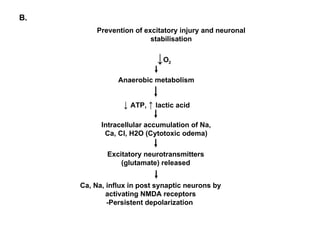
B.
          Prevention of excitatory injury and neuronal
                          stabilisation

                           ↓O  2


                Anaerobic metabolism


                 ↓ ATP, ↑ lactic acid

           Intracellular accumulation of Na,
            Ca, Cl, H2O (Cytotoxic odema)

             Excitatory neurotransmitters
                 (glutamate) released


     Ca, Na, influx in post synaptic neurons by
             activating NMDA receptors
             -Persistent depolarization
MgSO4 inhibits this influx and acts as a membrane
stabilizer.
C). Antioxidant Properties
  – Increased intracellular Ca inhibits activation of lipases
    proteases, endonucleases, phospholipases
  – Leads to neuronal cell injury & irreversible brain
    damage.
  – MgSO4 by blocking Ca Influx reduces the brain
    damage.
D). Anti inflammatory properties-
  – MgSO4 reduces the synthesis of cytokines and
    bacterial endotoxins, minimising the inflammatory
    effects of infection.
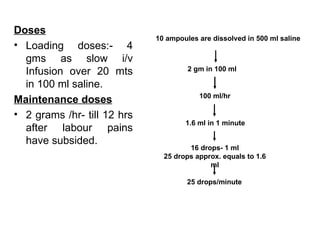
Doses
                             10 ampoules are dissolved in 500 ml saline
• Loading doses:- 4
  gms as slow i/v
  Infusion over 20 mts                2 gm in 100 ml

  in 100 ml saline.
                                         100 ml/hr
Maintenance doses
• 2 grams /hr- till 12 hrs
                                     1.6 ml in 1 minute
  after labour pains
  have subsided.
                                      16 drops- 1 ml
                               25 drops approx. equals to 1.6
                                            ml

                                      25 drops/minute
Monitoring
• By measuring urine output/hr
• DTR’s
• Respiratory rate, presence of basilar crepts.

Side effects

Maternal
• Nausea
• Blurred vision
• Generalised weakness
• Altered sensorium
• Muscular weakness
• Headache
• Pulmonary odema
• Respiratory depression
• Neurotoxicity
Fetal
• Letharggy
• Hypotonia
• Respiratory depression
• Hypocalcaemia
• Increased frequency of IVH.
Contraindication
• Patients with myasthenia Gravis.
• Impaired renal function
β- ADRENERGIC AGONISTS
• Activate intracellular enzymes adenylate
  cyclase, cAMP, Protein kinase.
• Reduces intracellular Ca.
• Inhibits activation of MLCK.
• Reduced interaction of actin & myosin- smooth
  ms. Relaxation.
• Commonly used drugs are
  – Terbutaline
  – Ritodrine
  – Isoxsuprine
Doses
Terbutaline
• 5 mg is dissolved in 500 ml RL (10ug/ml)
• Started at 5 ug/mt (0.5 ml)
• Increased gradually by 5 ug/mt every
  10-20 mts until contraction stop or
  intolerable side –effects appear.
• Max. dose is 30 ug/mt.
• 0.25 mg every 3-4 hrs sub- cutaneously
  can also be given.
Ritodrine
• Started by i/v infusion in 5%D.
• 50 ug/mt.
• Increased by 50 ug/mt until cont. stop or toxicity
  develops
• Max. dose 350 ug/mt.
• After 12hrs oral therapy with 10-20 mg tab every 4-6 hrs.
Isoxsuprine
• Orally effective long acting selective β stimulant.
• Direct smooth ms. Relaxant property.
Dose
• Initial IV drip 100mg in 5%D .
• Rate o.2ug/min gradually increased to0.8ug /min.
• To continue at least 2hrs after contraction
  ceases.
• Maintaince-10mg 6hrly /im for 24hrs.
• Oral 10mg 6-8hrly.
• SALBUTAMOL-
• IV infusion 5mg in 5%D @10ug/min intially
  gradually increased upto50 ug/min .
• Maintainance-4mg tab 6hrly.
• S/E-
  tremors,tachycardia,hypertension,palpitati
  on.
Side effects

Maternal
• Headache
• Palpitation
• Tachycardia
• Pulmonary odema
• Hypotension
• Cardiac failure
• Hyperglycemia
• ARDS
• Hyperinsulinemia
• Hypokalemia
• Lactic acidemia
fetal
• Tachycardia
• Heart failure
• IUD
Neonatal
• IVH
• Hypoglycemia

Contraindications
• Ventricular outflow obstruction
• Conduction disturbances
• Hyperthyroidism
• Sickle cell ds
• Uncontrolled insulin dependent diabetes
• Chorioamnionitis
• Eclampsia or severe pre Eclampsia
• Pts receiving MAO Inhibitions.
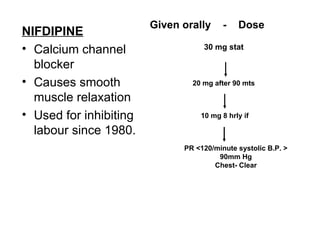
Given orally     -   Dose
NIFDIPINE
• Calcium channel                  30 mg stat

  blocker
• Causes smooth                 20 mg after 90 mts

  muscle relaxation
• Used for inhibiting             10 mg 8 hrly if

  labour since 1980.
                              PR <120/minute systolic B.P. >
                                       90mm Hg
                                      Chest- Clear
Side effects
Maternal
• Headache
• Hypotension
• Flushing
• Nausea
fetal
• Apparently nil
INDO METHACIN
• A cyclo-oxygenase inhibitor
• Reduces synthesis of prostaglandins
  leading to decreased intracellular free
  calcium
• This reduces activation of myosin light
  chain kinase leading to decreased uterine
  contractions.
• Loading dose-50 mg orally
• Followed by – 25 mg every 6 hrs for 48
  hrs.
Side effects
Maternal
• Asthma
• GI Bleeding
• Thrombocytopenia
• Renal Injury
Fetal
• Constriction of ductus arteriosus.
• Decreased fetal urinary output, oligohydroamnios.
• IUGR
• Neomatal Pulmonary HTN.
• Necrotising enterocolitis
• Grade III/IV intraventricular hemorrhage
Contra Indications
• Hepatic ds.
• Active peptic ulcer
• Coagulation disorders
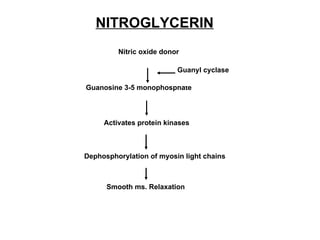
NITROGLYCERIN
         Nitric oxide donor

                          Guanyl cyclase

Guanosine 3-5 monophosphate


     Activates protein kinases


Dephosphorylation of myosin light chains


      Smooth ms. Relaxation
•   Given as Transdermal patches
•   A specific amount of medication is released proportional to the size
    of patch.
•   Varies B/W 0.1-0.8 mg/hr.
•   A low dose patch is started (0.2 mg/hr)
•   Add 0.1 mg/hr every hr, if no response.

Intra venous dose
•   100 ug Bolus followed by continuous 1/v infusion at a rate of 1 ug
    /Kg/ minute.

Side effects
•   Hypotension
•   Tachycardia
•   Severe headaches
•   Methaemoglobinemia
•   May causes cervical ripening
DIAZOXIDE
•   Structurally related to thiazide diuretics
•   Inhibits contractility of arterial and venous smooth muscles.
•   Also inhibits respiratory, GIT, genitourinary smooth muscle.
Dose
•   5 mg/kg
•   1 ampoule of diazoxide is dissolved in 250 ml of normal saline
•   Given slowly i/v over 30 minutes
•   Can also be given in boluses of 50-100 mg every 5 minutes
•   Patient should be in left recumbent position.
•   Continuous monitoring of maternal heart rate, B.P. , Uterine activity
    and fetal heart rate is recommended.
    To avoid side-effect it is desirable to expand the maternal intra
    vascular volume before diazoxide is given.
•   500-1000 ml RL or NS is given.
•   Uterine contraction stop within 15 minutes.
•   If labour recurs, a second doses can be given.
Side-effects
Maternal
• Hypotension
• Tachycardia
• Hyperglycemia
• Decreased uteroplacental flow.
Fetal
• Hyperglycemia
• fetal distress.
ATOSIBAN
• Oxytocin antagonist
• Blocks myometrial oxytocin receptors.
• Inhibits intracellular calcium release, PG’s release,
  inhibiting myometrial contraction.
• Half life is 12 mts
• Crosses placenta but fetal levels are only 10% of
  maternal levels.
Doses
• 6.75 mg bolus i/v Injection followed by 300 ug for 3 hrs.
• Maintenance dose of 100 ug/minutes for 48 hrs.
Side-effects
• Nausea
• Vomiting
• Chest Pain
ETHYL ALCOHOL

• Inhibitory action on hypothalamus,
  preventing release of oxytocin.
• 50ml 95% ethyl alcohol in 450 ml 5% D as
  i/v infusion
• Initially7.5ml/kg for first 2 hours followed
  by 1.5ml/kg/hr for 10-12hrs .
• Marked maternal CNS depression.
• Risk of foetal hypoxia.
• No longer recommended.
ACUTE TOCOLYSIS
• Rapid uterine relaxation is required in following
  clinical situations-
• Uterine hypertonus
• Breech delivery
• Intrapartum version of fetal malpresentation
• Shoulder dystocia
• Retained placetna
• Acute uterine inversion
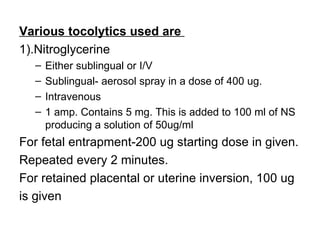
Various tocolytics used are
1).Nitroglycerine
  –   Either sublingual or I/V
  –   Sublingual- aerosol spray in a dose of 400 ug.
  –   Intravenous
  –   1 amp. Contains 5 mg. This is added to 100 ml of NS
      producing a solution of 50ug/ml
For fetal entrapment-200 ug starting dose in given.
Repeated every 2 minutes.
For retained placental or uterine inversion, 100 ug
is given
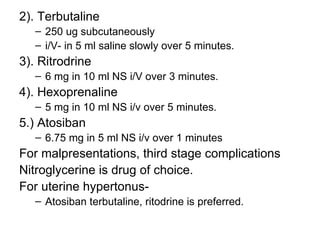
2). Terbutaline
   – 250 ug subcutaneously
   – i/V- in 5 ml saline slowly over 5 minutes.
3). Ritrodrine
   – 6 mg in 10 ml NS i/V over 3 minutes.
4). Hexoprenaline
   – 5 mg in 10 ml NS i/v over 5 minutes.
5.) Atosiban
   – 6.75 mg in 5 ml NS i/v over 1 minutes
For malpresentations, third stage complications
Nitroglycerine is drug of choice.
For uterine hypertonus-
   – Atosiban terbutaline, ritodrine is preferred.
FDA Risk CAtegoRies
• Risk of major congenital abnormalities in
  each pregnancy 2-3%

• 7-10% if minor malformations included.
      25% - genetic
      2-3%- drug exposure
      65% - unknown or combination of genetic &
       environmental factors
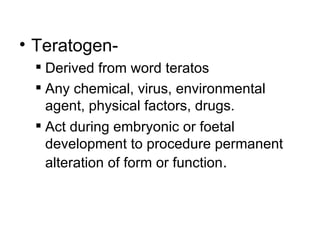
• Teratogen-
  Derived from word teratos
  Any chemical, virus, environmental
   agent, physical factors, drugs.
  Act during embryonic or foetal
   development to procedure permanent
   alteration of form or function.
Crieteria for proof of human teratogenecity
are :-

   Defect must be completely characterized,
   Agent must cross the placenta
   Exposure must occur during a critical developmental
    period
   Biologically plausible association should be there.
   Epidemiological findings must be consistent.
   Suspected teratogen causes defect in animal
Mechanism of teratogenecity

 A. Disruption of folic acid metabolism
    Responsible for production of
 methionine, reqd for methylation
 reactions, production of proteins, lipid,
    myelin.
B. Foetal genetic composition anomalies

  can be caused by interaction of
  environment & altered genes.
• MTHFR
• Epoxide hydrolase deficiency- leads to
  accumulation of oxidative intermediates like
  epoxides or arena oxides having carcinogenic &
  teratogenic properties.
• Associated with use of phentoin,
  carbamazepine, phenobarbitone.
• Transforming growth factor-1 alteration in this
  gene causes increased incidence of cleft palate
  with smoking.
C. Homeobox Genes:- Essential for
  establishing positional identity of various
  structures along body axis from Brachial
  axis to coccyx.
• Retonic acid activates these genes
  prematurely resulting in chaoitic
  expression.
• Valproic acid alters the expression of Hox
  genes.
D. Paternal Exposure
Several theories
• Induction of gene mutation or chromosomal
  abnormality in sperm
• During intercourse a drug in seminal fluid could
  directly contact foetus.
• Paternal germ cell exposure to drugs or
  environmental agents may alter gene
  expression. eg. mercury, lead solvents,
  pesticides hydrocarbons.
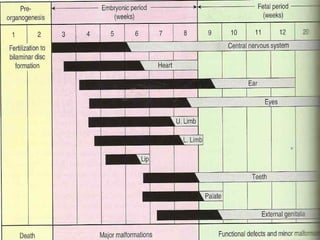
• Before Day 31- Peri-implantation period all or
  none effect conceptus either does not survive or
  survives without anomalies.
• Day 31 to 71- embryonic period most cruicial
  period.
   Period of organogensis.
   Effects of teratogen depends on
      Amount of drug reaching foetus.
      Gestational age at time of exposure.
      Duration of exposure.

• After Day71- (Foetal period)
  Certain organs remain vulnerable brain
  Foetal alcohol syndrome occurs late in pregnancy
• Depends on
  a)Molecular weight
     >1000 Da not cross placenta (Insulin,
     Heparin)
  c)Concentration of free drug
  d)Lipid solubility
  e)Uteroplacental Blood flow
  f) Placental surface area
  g)Placental metabolism
DESCRIPTION OF FDA RISK
  CATEGORIES OF DRUGS
• A - adequate,well tolerated studies in
  pregnant women have no increased risk of
  foteal abnormalities
• B – animal studies show no harm to foetus
  however there is no adequate and well
  controled studies in women or animal
  studies have shown adverse effects,but
  adequate and well controled studies in
  pregnant women have failed to
  demonstrate risk to foetus.
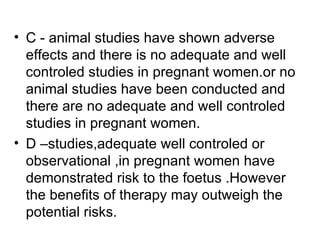
• C - animal studies have shown adverse
  effects and there is no adequate and well
  controled studies in pregnant women.or no
  animal studies have been conducted and
  there are no adequate and well controled
  studies in pregnant women.
• D –studies,adequate well controled or
  observational ,in pregnant women have
  demonstrated risk to the foetus .However
  the benefits of therapy may outweigh the
  potential risks.
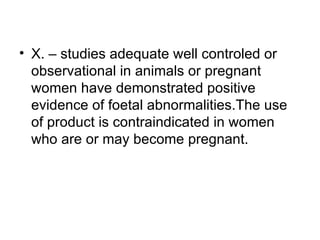
• X. – studies adequate well controled or
  observational in animals or pregnant
  women have demonstrated positive
  evidence of foetal abnormalities.The use
  of product is contraindicated in women
  who are or may become pregnant.
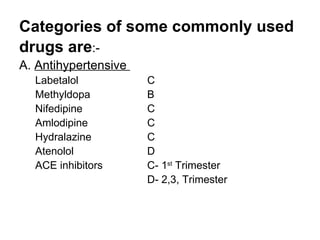
Categories of some commonly used
drugs are:-
A. Antihypertensive
  Labetalol           C
  Methyldopa          B
  Nifedipine          C
  Amlodipine          C
  Hydralazine         C
  Atenolol            D
  ACE inhibitors      C- 1st Trimester
                      D- 2,3, Trimester
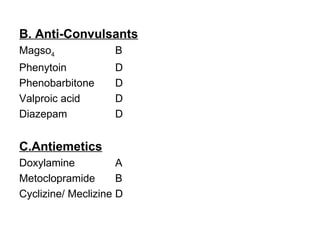
B. Anti-Convulsants
Magso4              B
Phenytoin           D
Phenobarbitone      D
Valproic acid       D
Diazepam            D


C.Antiemetics
Doxylamine           A
Metoclopramide       B
Cyclizine/ Meclizine D
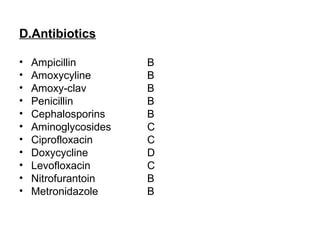
D.Antibiotics

•   Ampicillin        B
•   Amoxycyline       B
•   Amoxy-clav        B
•   Penicillin        B
•   Cephalosporins    B
•   Aminoglycosides   C
•   Ciprofloxacin     C
•   Doxycycline       D
•   Levofloxacin      C
•   Nitrofurantoin    B
•   Metronidazole     B
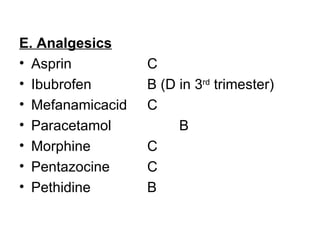
E. Analgesics
• Asprin          C
• Ibubrofen       B (D in 3rd trimester)
• Mefanamicacid   C
• Paracetamol          B
• Morphine        C
• Pentazocine     C
• Pethidine       B
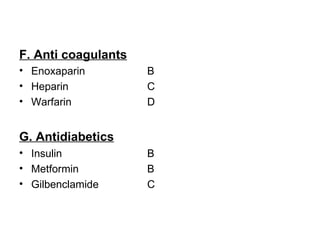
F. Anti coagulants
• Enoxaparin         B
• Heparin            C
• Warfarin           D


G. Antidiabetics
• Insulin            B
• Metformin          B
• Gilbenclamide      C
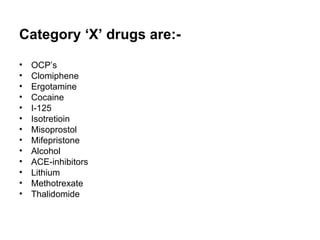
Category ‘X’ drugs are:-

•   OCP’s
•   Clomiphene
•   Ergotamine
•   Cocaine
•   I-125
•   Isotretioin
•   Misoprostol
•   Mifepristone
•   Alcohol
•   ACE-inhibitors
•   Lithium
•   Methotrexate
•   Thalidomide
Teratogenic Drugs With Their Effects

•    Alcohol-Foetal alocohol syndrome
          Dysmorphic facial features

              a) Small palpebral fissures
              b) Thin vermillion Borders
              c) Smooth philtrum

          Prenatal/Postnatal growth Impairment
          CNS abnormalities.
• Phenytoin - Foetal Hydantoin Syndrome
• Valproate - Neural Tube defects, clefts, skeletal
               abnormalities, developmental delay
• Mefipristone-Sirenomelia
• Misoprostol - Mobuis Syndrome
• Lithium     - Ebstein’s anomaly, foetal DI,
                Polyhydraminos, neonatal goitre.
• DES        - Vaginal adenosis, cervical hoods, uterine
               hypoplasia.
• Steroids- Foetal adrenal suppression, IUGR
• Chloramphenicol- Grey Baby Syndrome
• Tetracycline- Yellow discolouration of teeth, inhibition of
  bone growth.
• Quinolones-arthopathy
• Nitrofuratoin-Haemolysis in Infants with G-6- PD
  deficiency if used at term.
• Narcotics- Depression of CNS- apnoea, Bradycardia,
  Hypothermia.
• Warfarin- nasal midface hypoplasia, stippled vertebral &
  femoral epiphysis, Dandy walker syndrome, optic
  atrophy, blindness, mental retardation.
• Isotretenoin- Micro or anotia hydrocephalus, outflow tract
  abnormalities, thymic abnormalities.
• ACE- Inhibitors- Oligohydraminos, IUGR, Craniofacial
  and limb abnormalities.
»THANK YOU

Tocolysis & fda risk categories

  • 1.
    TOCOLYSIS & FDARISK CATEGORIES DR RAJEEV SOOD ASTT.PROF.OBG IGMC SHIMLA
  • 2.
    TOCOLYSIS Preterm labour • Regularuterine contraction-at least 4 in 20 mts. or 8 in 60 mts. and • cervical changes – effacement> 80% with dilatation >=1 cm • gestation less than 37 completed weeks.
  • 3.
    DIGITAL EXAMINATION Cx80% effaced Cx 80% effaced Cx <80% effaced dilated >3 cm dilated >1 &<3cm dilated <1cm Advanced preterm Early Preterm labour labour TVS Cervical Length <2.5 Cervical Length >2.5 cm cm Threatened Preterm False Labour
  • 4.
    • Incidence 5-10 % • Late preterm births (b/w 34w to 36w 6 d)-74% • Very preterm (less than32 weeks) • Perinatal mortality rate in preterm infants in India is 40 – 150 per 1000 live births.
  • 5.
    • Preterm birthis associated with a number of complication in baby – Asphyxia – Hypothermia – Pulmonary syndrome. – Cerebral haemorage. – Fetal shock. – Heart failure. – Oliguria, anuria – Infection – Jaundice – Anemia – Retinopathy of prematurity.
  • 6.
    TOCOLYTIC AGENTS • Drugswhich are used to inhibit uterine contractions. • Can be used as – Short term therapy (1-3days) – Long term therapy
  • 7.
    Objectives of shortterm therapy • To delay delivery for atleast 24-48 hrs for glucocorticoid therapy to enhance lung maturation • In utero transfer of patient to an advanced neonatal intensive care unit. Contraindications Maternal • Uncontrolled diabetes • Thyrotoxicosis • Severe HTN • Cardiac ds • Placenta Previa • Abruption
  • 8.
    fetal • fetal distress •IUD • Congenital malformations • Pregnancy beyond 34 weeks Others • Rupture of membrane • Chorioamnionitis • Cervical dilatation >4 cm
  • 9.
    TOCOLYTIC AGENTS • Mgso4 • Beta agonist • Calcium channel blockers • Prostaglandin synthethase inhibtors • Nitroglycerine • Diazoxide • Oxytocin receptor antagonist • Ethyl alcohol.
  • 10.
    MAGNESIUM SULPHATE • Actsby competitive inhibition to calcium ion either at motor end plate or at cell membrane. • Decreases acetylcholine release and its sensitivity at motor end plate. • Direct depressant action on uterine ms.
  • 11.
    In addition, MgSO4has been proposed to act as neuroprotectant Following Mechanisms are postulated. A). Haemodynamic stability – By stabilizing BP. – Reducing constriction in cerebral arts. – Restoring cerebral perfusion.
  • 12.
    B. Prevention of excitatory injury and neuronal stabilisation ↓O 2 Anaerobic metabolism ↓ ATP, ↑ lactic acid Intracellular accumulation of Na, Ca, Cl, H2O (Cytotoxic odema) Excitatory neurotransmitters (glutamate) released Ca, Na, influx in post synaptic neurons by activating NMDA receptors -Persistent depolarization
  • 13.
    MgSO4 inhibits thisinflux and acts as a membrane stabilizer. C). Antioxidant Properties – Increased intracellular Ca inhibits activation of lipases proteases, endonucleases, phospholipases – Leads to neuronal cell injury & irreversible brain damage. – MgSO4 by blocking Ca Influx reduces the brain damage. D). Anti inflammatory properties- – MgSO4 reduces the synthesis of cytokines and bacterial endotoxins, minimising the inflammatory effects of infection.
  • 14.
    Doses 10 ampoules are dissolved in 500 ml saline • Loading doses:- 4 gms as slow i/v Infusion over 20 mts 2 gm in 100 ml in 100 ml saline. 100 ml/hr Maintenance doses • 2 grams /hr- till 12 hrs 1.6 ml in 1 minute after labour pains have subsided. 16 drops- 1 ml 25 drops approx. equals to 1.6 ml 25 drops/minute
  • 15.
    Monitoring • By measuringurine output/hr • DTR’s • Respiratory rate, presence of basilar crepts. Side effects Maternal • Nausea • Blurred vision • Generalised weakness • Altered sensorium • Muscular weakness • Headache • Pulmonary odema • Respiratory depression • Neurotoxicity
  • 16.
    Fetal • Letharggy • Hypotonia •Respiratory depression • Hypocalcaemia • Increased frequency of IVH. Contraindication • Patients with myasthenia Gravis. • Impaired renal function
  • 17.
    β- ADRENERGIC AGONISTS •Activate intracellular enzymes adenylate cyclase, cAMP, Protein kinase. • Reduces intracellular Ca. • Inhibits activation of MLCK. • Reduced interaction of actin & myosin- smooth ms. Relaxation. • Commonly used drugs are – Terbutaline – Ritodrine – Isoxsuprine
  • 18.
    Doses Terbutaline • 5 mgis dissolved in 500 ml RL (10ug/ml) • Started at 5 ug/mt (0.5 ml) • Increased gradually by 5 ug/mt every 10-20 mts until contraction stop or intolerable side –effects appear. • Max. dose is 30 ug/mt. • 0.25 mg every 3-4 hrs sub- cutaneously can also be given.
  • 19.
    Ritodrine • Started byi/v infusion in 5%D. • 50 ug/mt. • Increased by 50 ug/mt until cont. stop or toxicity develops • Max. dose 350 ug/mt. • After 12hrs oral therapy with 10-20 mg tab every 4-6 hrs. Isoxsuprine • Orally effective long acting selective β stimulant. • Direct smooth ms. Relaxant property. Dose • Initial IV drip 100mg in 5%D . • Rate o.2ug/min gradually increased to0.8ug /min.
  • 20.
    • To continueat least 2hrs after contraction ceases. • Maintaince-10mg 6hrly /im for 24hrs. • Oral 10mg 6-8hrly.
  • 21.
    • SALBUTAMOL- • IVinfusion 5mg in 5%D @10ug/min intially gradually increased upto50 ug/min . • Maintainance-4mg tab 6hrly. • S/E- tremors,tachycardia,hypertension,palpitati on.
  • 22.
    Side effects Maternal • Headache •Palpitation • Tachycardia • Pulmonary odema • Hypotension • Cardiac failure • Hyperglycemia • ARDS • Hyperinsulinemia • Hypokalemia • Lactic acidemia fetal • Tachycardia • Heart failure • IUD
  • 23.
    Neonatal • IVH • Hypoglycemia Contraindications •Ventricular outflow obstruction • Conduction disturbances • Hyperthyroidism • Sickle cell ds • Uncontrolled insulin dependent diabetes • Chorioamnionitis • Eclampsia or severe pre Eclampsia • Pts receiving MAO Inhibitions.
  • 24.
    Given orally - Dose NIFDIPINE • Calcium channel 30 mg stat blocker • Causes smooth 20 mg after 90 mts muscle relaxation • Used for inhibiting 10 mg 8 hrly if labour since 1980. PR <120/minute systolic B.P. > 90mm Hg Chest- Clear
  • 25.
    Side effects Maternal • Headache •Hypotension • Flushing • Nausea fetal • Apparently nil
  • 26.
    INDO METHACIN • Acyclo-oxygenase inhibitor • Reduces synthesis of prostaglandins leading to decreased intracellular free calcium • This reduces activation of myosin light chain kinase leading to decreased uterine contractions. • Loading dose-50 mg orally • Followed by – 25 mg every 6 hrs for 48 hrs.
  • 27.
    Side effects Maternal • Asthma •GI Bleeding • Thrombocytopenia • Renal Injury Fetal • Constriction of ductus arteriosus. • Decreased fetal urinary output, oligohydroamnios. • IUGR • Neomatal Pulmonary HTN. • Necrotising enterocolitis • Grade III/IV intraventricular hemorrhage Contra Indications • Hepatic ds. • Active peptic ulcer • Coagulation disorders
  • 28.
    NITROGLYCERIN Nitric oxide donor Guanyl cyclase Guanosine 3-5 monophosphate Activates protein kinases Dephosphorylation of myosin light chains Smooth ms. Relaxation
  • 29.
    Given as Transdermal patches • A specific amount of medication is released proportional to the size of patch. • Varies B/W 0.1-0.8 mg/hr. • A low dose patch is started (0.2 mg/hr) • Add 0.1 mg/hr every hr, if no response. Intra venous dose • 100 ug Bolus followed by continuous 1/v infusion at a rate of 1 ug /Kg/ minute. Side effects • Hypotension • Tachycardia • Severe headaches • Methaemoglobinemia • May causes cervical ripening
  • 30.
    DIAZOXIDE • Structurally related to thiazide diuretics • Inhibits contractility of arterial and venous smooth muscles. • Also inhibits respiratory, GIT, genitourinary smooth muscle. Dose • 5 mg/kg • 1 ampoule of diazoxide is dissolved in 250 ml of normal saline • Given slowly i/v over 30 minutes • Can also be given in boluses of 50-100 mg every 5 minutes • Patient should be in left recumbent position. • Continuous monitoring of maternal heart rate, B.P. , Uterine activity and fetal heart rate is recommended. To avoid side-effect it is desirable to expand the maternal intra vascular volume before diazoxide is given. • 500-1000 ml RL or NS is given. • Uterine contraction stop within 15 minutes. • If labour recurs, a second doses can be given.
  • 31.
    Side-effects Maternal • Hypotension • Tachycardia •Hyperglycemia • Decreased uteroplacental flow. Fetal • Hyperglycemia • fetal distress.
  • 32.
    ATOSIBAN • Oxytocin antagonist •Blocks myometrial oxytocin receptors. • Inhibits intracellular calcium release, PG’s release, inhibiting myometrial contraction. • Half life is 12 mts • Crosses placenta but fetal levels are only 10% of maternal levels. Doses • 6.75 mg bolus i/v Injection followed by 300 ug for 3 hrs. • Maintenance dose of 100 ug/minutes for 48 hrs. Side-effects • Nausea • Vomiting • Chest Pain
  • 33.
    ETHYL ALCOHOL • Inhibitoryaction on hypothalamus, preventing release of oxytocin. • 50ml 95% ethyl alcohol in 450 ml 5% D as i/v infusion • Initially7.5ml/kg for first 2 hours followed by 1.5ml/kg/hr for 10-12hrs . • Marked maternal CNS depression. • Risk of foetal hypoxia. • No longer recommended.
  • 34.
    ACUTE TOCOLYSIS • Rapiduterine relaxation is required in following clinical situations- • Uterine hypertonus • Breech delivery • Intrapartum version of fetal malpresentation • Shoulder dystocia • Retained placetna • Acute uterine inversion
  • 35.
    Various tocolytics usedare 1).Nitroglycerine – Either sublingual or I/V – Sublingual- aerosol spray in a dose of 400 ug. – Intravenous – 1 amp. Contains 5 mg. This is added to 100 ml of NS producing a solution of 50ug/ml For fetal entrapment-200 ug starting dose in given. Repeated every 2 minutes. For retained placental or uterine inversion, 100 ug is given
  • 36.
    2). Terbutaline – 250 ug subcutaneously – i/V- in 5 ml saline slowly over 5 minutes. 3). Ritrodrine – 6 mg in 10 ml NS i/V over 3 minutes. 4). Hexoprenaline – 5 mg in 10 ml NS i/v over 5 minutes. 5.) Atosiban – 6.75 mg in 5 ml NS i/v over 1 minutes For malpresentations, third stage complications Nitroglycerine is drug of choice. For uterine hypertonus- – Atosiban terbutaline, ritodrine is preferred.
  • 37.
  • 38.
    • Risk ofmajor congenital abnormalities in each pregnancy 2-3% • 7-10% if minor malformations included.  25% - genetic  2-3%- drug exposure  65% - unknown or combination of genetic & environmental factors
  • 39.
    • Teratogen- Derived from word teratos  Any chemical, virus, environmental agent, physical factors, drugs.  Act during embryonic or foetal development to procedure permanent alteration of form or function.
  • 40.
    Crieteria for proofof human teratogenecity are :-  Defect must be completely characterized,  Agent must cross the placenta  Exposure must occur during a critical developmental period  Biologically plausible association should be there.  Epidemiological findings must be consistent.  Suspected teratogen causes defect in animal
  • 41.
    Mechanism of teratogenecity A. Disruption of folic acid metabolism Responsible for production of methionine, reqd for methylation reactions, production of proteins, lipid, myelin.
  • 42.
    B. Foetal geneticcomposition anomalies can be caused by interaction of environment & altered genes. • MTHFR • Epoxide hydrolase deficiency- leads to accumulation of oxidative intermediates like epoxides or arena oxides having carcinogenic & teratogenic properties. • Associated with use of phentoin, carbamazepine, phenobarbitone. • Transforming growth factor-1 alteration in this gene causes increased incidence of cleft palate with smoking.
  • 43.
    C. Homeobox Genes:-Essential for establishing positional identity of various structures along body axis from Brachial axis to coccyx. • Retonic acid activates these genes prematurely resulting in chaoitic expression. • Valproic acid alters the expression of Hox genes.
  • 44.
    D. Paternal Exposure Severaltheories • Induction of gene mutation or chromosomal abnormality in sperm • During intercourse a drug in seminal fluid could directly contact foetus. • Paternal germ cell exposure to drugs or environmental agents may alter gene expression. eg. mercury, lead solvents, pesticides hydrocarbons.
  • 45.
    • Before Day31- Peri-implantation period all or none effect conceptus either does not survive or survives without anomalies. • Day 31 to 71- embryonic period most cruicial period.  Period of organogensis.  Effects of teratogen depends on  Amount of drug reaching foetus.  Gestational age at time of exposure.  Duration of exposure. • After Day71- (Foetal period) Certain organs remain vulnerable brain Foetal alcohol syndrome occurs late in pregnancy
  • 47.
    • Depends on a)Molecular weight >1000 Da not cross placenta (Insulin, Heparin) c)Concentration of free drug d)Lipid solubility e)Uteroplacental Blood flow f) Placental surface area g)Placental metabolism
  • 48.
    DESCRIPTION OF FDARISK CATEGORIES OF DRUGS • A - adequate,well tolerated studies in pregnant women have no increased risk of foteal abnormalities • B – animal studies show no harm to foetus however there is no adequate and well controled studies in women or animal studies have shown adverse effects,but adequate and well controled studies in pregnant women have failed to demonstrate risk to foetus.
  • 49.
    • C -animal studies have shown adverse effects and there is no adequate and well controled studies in pregnant women.or no animal studies have been conducted and there are no adequate and well controled studies in pregnant women. • D –studies,adequate well controled or observational ,in pregnant women have demonstrated risk to the foetus .However the benefits of therapy may outweigh the potential risks.
  • 50.
    • X. –studies adequate well controled or observational in animals or pregnant women have demonstrated positive evidence of foetal abnormalities.The use of product is contraindicated in women who are or may become pregnant.
  • 51.
    Categories of somecommonly used drugs are:- A. Antihypertensive Labetalol C Methyldopa B Nifedipine C Amlodipine C Hydralazine C Atenolol D ACE inhibitors C- 1st Trimester D- 2,3, Trimester
  • 52.
    B. Anti-Convulsants Magso4 B Phenytoin D Phenobarbitone D Valproic acid D Diazepam D C.Antiemetics Doxylamine A Metoclopramide B Cyclizine/ Meclizine D
  • 53.
    D.Antibiotics • Ampicillin B • Amoxycyline B • Amoxy-clav B • Penicillin B • Cephalosporins B • Aminoglycosides C • Ciprofloxacin C • Doxycycline D • Levofloxacin C • Nitrofurantoin B • Metronidazole B
  • 54.
    E. Analgesics • Asprin C • Ibubrofen B (D in 3rd trimester) • Mefanamicacid C • Paracetamol B • Morphine C • Pentazocine C • Pethidine B
  • 55.
    F. Anti coagulants •Enoxaparin B • Heparin C • Warfarin D G. Antidiabetics • Insulin B • Metformin B • Gilbenclamide C
  • 56.
    Category ‘X’ drugsare:- • OCP’s • Clomiphene • Ergotamine • Cocaine • I-125 • Isotretioin • Misoprostol • Mifepristone • Alcohol • ACE-inhibitors • Lithium • Methotrexate • Thalidomide
  • 57.
    Teratogenic Drugs WithTheir Effects • Alcohol-Foetal alocohol syndrome  Dysmorphic facial features a) Small palpebral fissures b) Thin vermillion Borders c) Smooth philtrum  Prenatal/Postnatal growth Impairment  CNS abnormalities.
  • 58.
    • Phenytoin -Foetal Hydantoin Syndrome • Valproate - Neural Tube defects, clefts, skeletal abnormalities, developmental delay • Mefipristone-Sirenomelia • Misoprostol - Mobuis Syndrome • Lithium - Ebstein’s anomaly, foetal DI, Polyhydraminos, neonatal goitre. • DES - Vaginal adenosis, cervical hoods, uterine hypoplasia.
  • 59.
    • Steroids- Foetaladrenal suppression, IUGR • Chloramphenicol- Grey Baby Syndrome • Tetracycline- Yellow discolouration of teeth, inhibition of bone growth. • Quinolones-arthopathy • Nitrofuratoin-Haemolysis in Infants with G-6- PD deficiency if used at term. • Narcotics- Depression of CNS- apnoea, Bradycardia, Hypothermia. • Warfarin- nasal midface hypoplasia, stippled vertebral & femoral epiphysis, Dandy walker syndrome, optic atrophy, blindness, mental retardation. • Isotretenoin- Micro or anotia hydrocephalus, outflow tract abnormalities, thymic abnormalities. • ACE- Inhibitors- Oligohydraminos, IUGR, Craniofacial and limb abnormalities.
  • 60.